Loading summary
Transcript87 lines
- [00:00]
Nicole Lapin
You know what I'm really over? Fees.
- [00:03]
Jason Pfeiffer
Concert ticket fees, cleaning fees on weekend rentals, a processing fee for existing. It is endless. And the worst part, These fees hit hardest when you're already trying to get ahead. Fees are everywhere and they hurt you most when you're down. That's why Chime offers fee free banking, which means no monthly fees, no overdraft fees and no minimum balance fees. I once got hit with a $15 maintenance fee just because my account dipped below the minimum bal for a single day. I wasn't overspending. I was just timing my rent payments around payday. That fee felt like a big penalty just for budgeting. But with Chime, I wouldn't have gotten charged for not being rich yet. No minimum balances, no hidden fees, just.
- [00:49]
Nicole Lapin
Breathing room when I actually would have needed it.
- [00:52]
Jason Pfeiffer
It is so simple. Banking should not cost you money. And with Chime, it doesn't open your account in two minutes. @chime.com help wanted. Chime feels like progress.
- [01:01]
Chime
Chime is a financial technology company, not a bank. Banking services and debit card provided by the Bancorp Bank NA or Stride Bank NA members, FDIC spot and eligibility requirements and overdraft limits apply. Timing depends on submission of payment file. Fees apply at out of network ATMs. Bank ranking and number of ATMs, according to U.S. news and World Report, 2023 Chime checking account required.
- [01:20]
Jason Pfeiffer
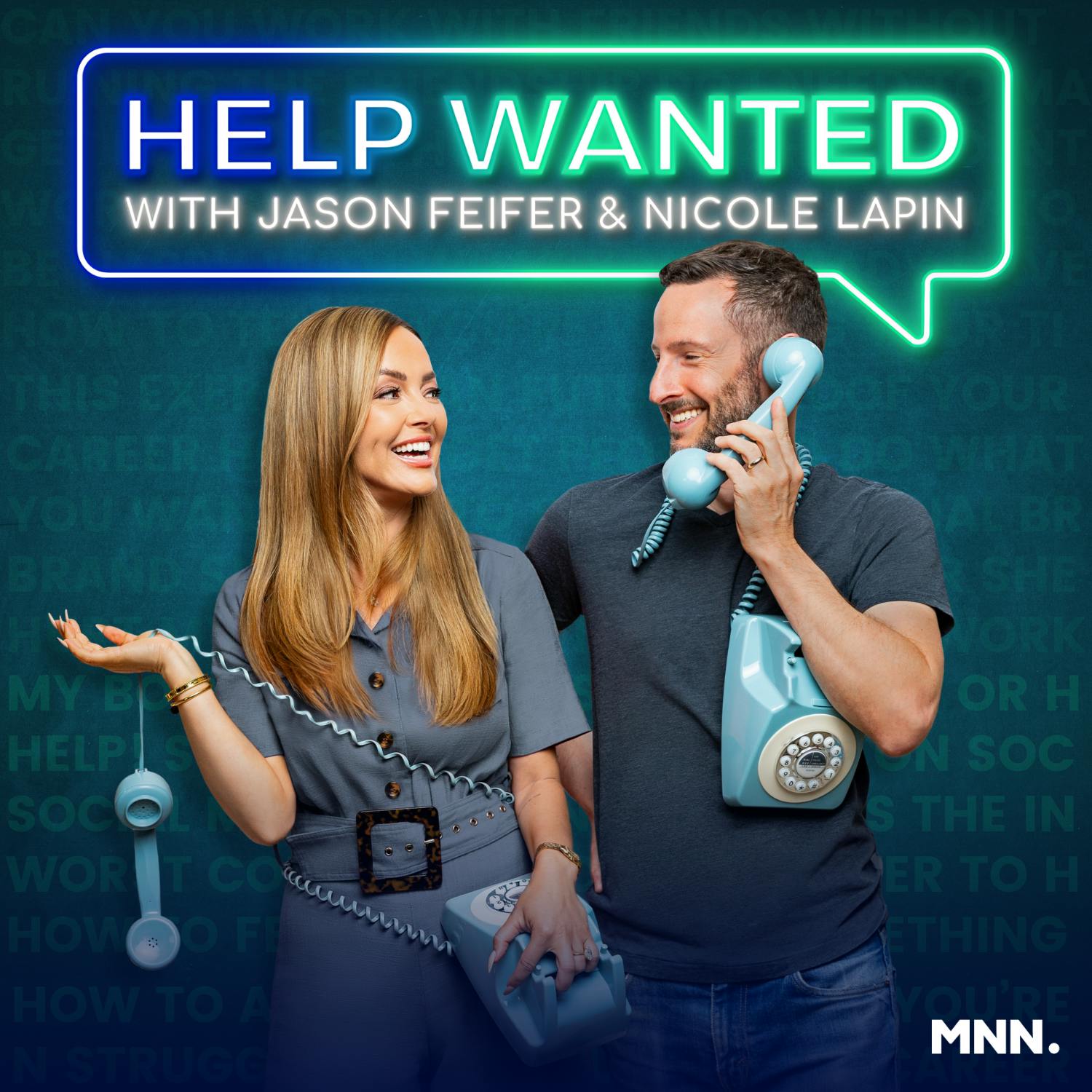
This is Help Wanted, the show that makes your work work for you. I'm Jason Pfeiffer, editor in chief of.
- [01:26]
Nicole Lapin
Entrepreneur magazine and I'm money expert Nicole Lapin. On Tuesdays, Jason and I answer the helpline and solve their work problems.
- [01:34]
Jason Pfeiffer
And on Thursdays, I give you one way to improve your work and build a career or company you love.
- [01:39]
Nicole Lapin
And it starts now.
- [01:45]
Jason Pfeiffer
So, Nicole, I have someone awesome who's calling our Help Wanted helpline today. Do you know who it is?
- [01:52]
Nicole Lapin
I love awesome people. Yeah, I have a hunch of who it is.
- [01:57]
Jason Pfeiffer
It's you making you call the helpline.
- [02:01]
Nicole Lapin
Oh no, that's not the hunch that I had.
- [02:06]
Jason Pfeiffer
Yeah, and here's why. Because you like me. Don't often say I could use talking to someone. I happen to be talking to this interesting business owner. His name is Andrew Cates. He's got this company called Raisin but R A Y Z Y N. Like he takes these quality Ryan grapes and turns them into raisins and better raisins. The point is not the raisins, although the raisins actually look really good. The point is that at the end of our conversation, he said that his house burned down in 2017.
- [02:39]
Nicole Lapin
Wow.
- [02:39]
Jason Pfeiffer
It's sort of like the origin story of the business. And when he said that, I said, oh, my God, My good friend and podcast co host just lost her house in a fire. I would love to talk with her if she wants to talk to someone who's been there. And so I thought that I could use some help. That would be a nice thing. Yeah. And that because we make a podcast together, we should just do it while the mic is running because I think it'll be helpful to others, too, because what this really is hearing from someone far enough along that there's evidence that there's something on the other side of it. Like, I remember when, as you well know, But I was reminding listeners that I was sued for five years and it was awful. And I kept thinking, the only thing that is valuable here is the idea that one day this will be over. And I just didn't know what that looked like. What does that future look like and sound like? And I thought it would be nice to bring someone who is living. And I don't want to make you cry. Can we do this without making you cry, do you think? Probably not. All right, well, are you up to talking to her anyway?
- [03:48]
Nicole Lapin
Yeah. Thank you.
- [03:50]
Jason Pfeiffer
All right, Andrew, welcome to Help Wanted.
- [03:54]
Andrew Cates
First off, Nicole, I'm so sorry about your house. Oh, my gosh, I can feel your pain. And hopefully today you can come away with something that's helpful, something that's going to make you feel differently or more optimistic about the situation, because I know it's a fresh cut.
- [04:11]
Nicole Lapin
Thanks, Andrew.
- [04:12]
Jason Pfeiffer
Andrew, you would know. I think you've just kicked off the episode here. Let me explain why you are here, and then you can explain who you are. As we know, we just have been talking about this on the show. Nicole lost her house in the California fires very recently. And when something terrible happens, the only solace that I could ever find is to think, at some point, it won't be like this. It can't be like this forever. Like, for the lawsuit, at some point, this lawsuit will end. It's not going to be like this for the rest of my life. At some point, there will be another house. At some point, there will be something. But how to get there, and what that looks like is unknown. And it's. And sucks, and getting there sucks. And it's useful. I think it was useful for me when I was going through my lawsuit to talk to people who had gone through a lawsuit and who could tell me what it was like to get out of it. And then what happened afterwards? You fill it in from here. What did you tell me about your own house?
- [05:17]
Andrew Cates
I've been there. I know what this feels like, Nicole. What you're feeling, you're feeling grief, you're feeling anger, you're feeling a bunch of different emotions. And these are natural feelings. But it's a matter of what can you proactively do to get your life, quote unquote, back on track. And this is because my house burnt down in 2017.
- [05:40]
Jason Pfeiffer
And so you are years ahead of this same exact situation. So you said fire.
- [05:47]
Andrew Cates
Was that the Napa fires up in Napa in 2017. Yeah.
- [05:54]
Jason Pfeiffer
So before we get into it, your name is Andrew Cates and just orient us quickly before we get into fire, which will be an all consuming conversation. Tell us who you are outside of having lost your house in a fire. You have this awesome raisin company. Give me the basics.
- [06:08]
Andrew Cates
Sure. So I'm the raisin guy and a raisin is a wine raisin. What we do is we take Cabernet, Chardonnay and merlot wine grapes and instead of crushing to make wine, we. We put them through a special drying process to turn them into gourmet raisins that are full of antioxidants, full of functional benefits, taste delicious, and it's a new superfruit that we're trying to.
- [06:35]
Nicole Lapin
Yeah, it's like why you drink wine, but mine is the wine for all of those benefits.
- [06:39]
Andrew Cates
Right, Exactly. Wine without the alcohol, but more concentrated and invented by my cardiologist father who's been prescribing wine for decades about the heart, healthy benefits of this. And so we're trying to make it into a super fruit. And we're upcycling grapes from all over the region that can't be used for wine for whatever reason while it be wildfire smoke or excess supply and trying to repurpose that into something useful and helpful.
- [07:12]
Nicole Lapin
Well, it's so cool that you're doing that. Obviously not impacted by tariffs, which is also exciting because it comes locally. Funny enough, yesterday as Jason was texting me, I was also talking to a cardiologist for the very first time because now I'm an old lady and have some like high cholesterol and all sorts of fun, fun heart things. So really stoked. The best. So really stoked to try the raisins and also to hear your story.
- [07:40]
Jason Pfeiffer
Yeah. And the brand is called Raisin R A y z y at right.
- [07:45]
Andrew Cates
That's right. The wine raisin company.
- [07:47]
Jason Pfeiffer
Okay. Andrew lost his house in 2017. It has been many years. He is many years ahead of where you are right now on this terrible journey that nobody asks for. What is the first thing that springs to mind for you?
- [07:58]
Andrew Cates
The first thing that jumps into my mind is not to allow yourself to go down into a spiral of despair.
- [08:07]
Jason Pfeiffer
Is that what happened to you.
- [08:10]
Andrew Cates
That'S happening now?
- [08:11]
Nicole Lapin
You tell me, Andrew.
- [08:12]
Andrew Cates
I know, I know, but it's a self fulfilling prophecy and at the end of the day you didn't choose this, but you've got to deal with it.
- [08:21]
Jason Pfeiffer
What did you do? What happened right after for you?
- [08:24]
Andrew Cates
What happened to me is I immediately started crying, right. I broke down and screamed out, then I went numb and I was out of town. Right. I found out my house burnt down from my neighbor's security camera that he had looking down at my house. And you saw nothing? Nothing, nothing. And then a burst of flames and he sent it to me and I was just like devastated. I didn't know what to think. I didn't know who to turn to. I was in such a shock. A numb sort of emotional inability to make decisions. Right. Paralysis. And so the first thing that I did was got back on a plane and I went back to see what was left or see what was there and assess the damage. I can't talk too poorly about insurance companies because I'm still in an ongoing situation with one seven years later, if you can believe it.
- [09:18]
Nicole Lapin
Seriously?
- [09:19]
Andrew Cates
Yep. It's terrible, the insurance process. The first thing that I would do is get in touch with somebody that has experience and understands insurance policies because your policy is what you've been paying into for the last X amount of years and you hope and you desire to get made whole out of that. Right. But at the end of the day, there's a lot of information that you have to make decisions on relatively quickly. It's a lot for a lot of people to handle. Understanding what a bucket is a policy bucket. If you have a household possessions bucket and everything is lost in your house, the maximum amount that the insurance will pay is that bucket amount. Right. It doesn't matter if you have a bunch of possessions over that limit amount. So you know, from an insurance coverage perspective, how are you covered? Is there a way to look at your insurance policy differently? All right. Thinking of it as, okay, what's a household possession versus what's I guess, part of the infrastructure of the house. Right. Necessary to run the house.
- [10:39]
Jason Pfeiffer
Did you find someone to help you with this?
- [10:42]
Andrew Cates
I tried. It took a lot of self learning and having to roll up my sleeves and do it myself. Which is why I would advise finding someone that knows insurance and knows policies. But that being said, in the insurance companies, no matter how nice they are and how much they tell you that they want to be there for you and stuff, there's a misalignment of interest there and it's very clear they want to pay you as little as possible and you want to have your life back to the way it was. And that's a conflict of interest and it's just terrible. I have such a jaded impression of insurance companies. It starts with day one, right? Day one, they send out the insurance agent and they say to me and they look me in the eyes, I'm going to be your point of contact going forward. We're going to have this relationship. We're going to get you back on your feet. I'm going to be here for you. No less than three weeks later, new contact. No more than three months later, another new contact. And so anything that you tell these people, I would communicate in writing, always over email.
- [11:57]
Jason Pfeiffer
Nicole, you're nodding. You've already witnessed this.
- [12:00]
Nicole Lapin
Yeah, well, I mean, it makes me want to vomit that you are still dealing with this seven years later. Because three months of this is more months than I wish on anybody. But our insurance was canceled the year before the fire and then just got like the most bare bones situation to just have that because we needed to check the box. So severely underinsured. But even in trying to salvage anything, already had four adjusters. I've just been grasping at anything I could possibly do to. To navigate this system. I've talked to public adjusters. I didn't even know public adjusters were a thing. Different experts around how to interpret personal property versus Ali. So right now I'm fighting about what the meaning of additional living expenses is, which is like a whole thing that I never thought about. And then this word incurred, which now is like such a big issue because they pay you for what has been incurred, which means they reimburse you for stuff so that you have to pay out of pocket first and then fight to get reimbursed, which is like my biggest nightmare. The only thing I haven't tried yet is giving up. But I am, I'm close.
- [13:25]
Jason Pfeiffer
Stick around. Help wanted. We'll be right back. Welcome back to Help Wanted. Let's get to it. I'm just going to want to build off of what Nicole just said there at the very, very end. Not necessarily about insurance because I think that this is Just good God. But a terrible hold. But looking back on it, what would you say you did or what did you find that just helped you start putting pieces together to start marching through this and getting to some place that feels more normal?
- [14:01]
Andrew Cates
Yeah, that's a great question. To be very blunt, the only thing that got me through it was my faith. I'm a Christian and that was monumental to have that relationship. The other thing I really focused on was what I had control over and winning. And I mean it like this. Win. It's an acronym. What is important now? Focusing on what is important now. What does the insurance company need now? Not getting bogged down in the whole master plan here. Understanding that this is going to be a long process and being able to compartmentalize the pain. Have the pain in a closet door or an office door, walk in, assess the pain, deal with what you need to do for the insurance company, then come back out, close the back of the door. That's the only way that I've been able to really deal with it. Especially with at the end of the day when you were talking about your possessions and whatnot, everyone says what is something worth? I've got an answer to that. People say, oh, it's what somebody's willing to give you for it right now. Better response is it's what the insurance company is willing to give it to you when it burns down because it's a depreciated non replaceable cost. That again to your point about ale or living expenses is you have to go out and replace whatever burnt to smithereens with cash that you don't have right now to then send a receipt in to then get reimbursed for the full amount versus accepting what the insurance gives you, which is their arbitrary amount of a depreciation, shaded value of X. So let's say you have a mink coat. It's a beautiful mink coat that you've kept in mint condition and mink condition, I suppose, and you wear it maybe once a year and then you put it back in plastic. How much has that coat depreciated? Insurance would say they've got some answer to that. It's worth something around a fraction. However, if you want to get reimbursed for it, you have to go out and buy it, show a receipt and prove that it is worth X. It's a backwards system.
- [16:33]
Nicole Lapin
It's the worst system. The inventory list was one of the most gut wrenching things I've had to do and we didn't even do a comprehensive list. We got to like many, many, many X above this bare bones, nothing that we recovered for and needed to submit that. And now trying to figure out beyond that, is there any hope for this huge uninsured component that we had through FEMA or SBA or all these organizations, or the city and the county and every step of the way is like a huge dead end. I've been rejected everything that I've applied to, and I'm not the smartest human on the planet, but I'm really not the dumbest. And I've put lots of applications out into the world and they've been accepted and I've achieved a lot of success through writing and other things. And I have never had this much rejection. And each step I'm like, how can I appeal for the 50th time to these organizations that are supposed to help people in times of need? So I'm curious if you've had any luck or any pro tips on trying to navigate the insane bureaucracy on red tape of all of it?
- [17:55]
Andrew Cates
Short answer, not heartening. There were some federal resistance programs directed towards agricultural grants because of the loss of farming etc that were offered. But again, it was so challenging to even fill out the paperwork and the time frame with all the details.
- [18:16]
Nicole Lapin
It's really messed up because they ask you for all these documents. I left with the clothes on my back without any document, without my driver's license, passport, anything. And so trying to find all these documents. They'll reject you because you don't have the documents but the documents burned. And it's the most maddening cycle. I'm just. If it wasn't happening to me, I wouldn't believe it. And I like your acronym, the. The WIN acronym. My husband says something similar like keep the main thing. The main thing. What is the most important thing? But I somehow get bogged down in like trying to get any little thing I can. Like I'm not differentiating between what's the greatest possible outcome because maybe I'm not getting success. So I'm like, okay, there could be some thousands of dollars at fema. We haven't gotten any. Or there could be like a couple hundred bucks in my AMEX purchase protection, which I'm also rejected for the fifth time. I can't differentiate between a few thousand dollars or a few hundred dollars because, well, I'm getting any dollars. So how I want all of the dollars. So I'm curious if you've had any experience there in some of the like, beyond insurance fights and why are you fighting with Them for seven years.
- [19:26]
Andrew Cates
I'll give you a perfect example. My little winery in Napa has a wine cellar, right? And the wine cellar housed wine. Is that an app of parent structure to the main dwelling? It is because it's not attached to the main dwelling. However, the contents contain wine. Where was the wine consumed? The wine from the vineyard was consumed in the main house. So it's not an app apparent structure. It's household property that was held in an outside non adjacent storage. So I think it's important to again, just stay focused on what your end goal is. And your end goal is, if it be rebuilding, right, is getting your insurance to pay for your house to be rebuilt.
- [20:26]
Jason Pfeiffer
I think we could clearly spend hours talking about the terribleness of the insurance experience. But I want to get to a more personal inquiry, which is this to just think, okay, one day this is over. What can I imagine my life when this is over? Can you tell us what it is like to get past the worst of this? What are the things that happened? Or what do you think made the most difference? Or what did you do that made it feel like there was a turn?
- [20:57]
Andrew Cates
Very good question. I think it was difficult getting to this point, but mentally shifting my mind to how can I turn this terrible thing into something positive? And personally, as a grape farmer, for instance, I lost my entire crop to smoke. The grapes didn't burn, but the smoke negatively affects the aromatics of the wine. Three, four, five years down the road, I knew that people in the valley were hurting. And it was weird because being hurt so much made me want to help others. And I think that I wanted to do something that was proactive, that would, I don't want to say, get my mind off of it, but make me take some of the paralysis away, cut something that I could move forward and be successful at doing. Since I wasn't being successful at successful with the insurance company. I wanted success and to do something good. What we did is we created this rescue raisin project where we harvested 100 tons of Napa Valley cabernet from farmers that had their fruit in the same situation. The smoke tainted fruit. And what we did is instead of crushing it to make wine, we turned them into raisins and chocolate, then gave the proceeds back to two nonprofits. And that was our way of kind of staying busy and being in the moment and trying to do something good. So I bring this all to say, like helping other people helped me get through this. Talking to other people, communities, community forums, friends, family, that's what it takes. Time it just takes time.
- [22:50]
Jason Pfeiffer
When you just said that, it brought me back to this thing I think I've talked about on the show before. But I want to put it to you both because first of all, it's interesting, Andrew, to hear you say that, because, Nicole, that is where your mind has gone. It's almost the very beginning, which is like, how can you use this experience to be useful to others? And now hearing both of you say some version of that, it made me think of this thing. So let me just tell you, which is I've mentioned on the show, I've become obsessed with this psychological theory was popularized in the 1980s. It revolutionized our understanding of human motivation. It is called self determination theory. Theory. Self determination theory holds that all humans have the same three basic psychological needs, and those are autonomy, relatedness, and competency. Arc. Arc. That's how I remember them. Autonomy, you need to feel ownership over the decisions that you make. Relatedness, you need to feel good relationships with those around you. Competency, you need to feel good at what you do. And, you know, when something like changes in our lives or when something terrible happens in our lives, it fundamentally disrupts our access to these three things. Right. To hear you both talk about the insurance companies is to have an absence of all of these things. You don't feel like you have any autonomy. You are at the whim of this insurance company that you can't understand and can't communicate with. You feel alone. So there's no relativeness and competency. You certainly feel, like, bad at what you do, right? Like, in the way that Nicole articulated that, she's like, I'm not the smartest person in the world, but I'm not the dumbest. And yet I can't seem to do this. You don't feel competent, you don't feel good at what you're doing. But very interestingly, like, when pathways for your own growth and control are cut off, which is what happens in a moment like this, you can find those things by turning to others. So that is what I'm hearing you describe, Andrew, for example, which is that when you said, all right, you know what, we're going to round up these, like smoke tainted grapes. We're going to do something with them. Now you have autonomy. Like, you've lost your house. There's like, a lot of things that just are completely outside of your control. So what can you control? I could drive around, I could pick up all these grapes and do something with them. So that's autonomy, relatedness. Doing this now builds Bonds with other people who are impacted. So that's relatedness. And then competency is like you are building off of something that you know how to do. You don't know how to deal with the insurance company, certainly not at the very beginning. And now even seven years later, still not fully sure how the hell to deal with them. But like wine grapes, you know about that. So you can be in your kind of area of competency. And. And I have never. I spent a lot of time thinking about self determination theory because it like to me explains all these moments, big and small. I had never really thought about applying it in this way. And also seeing it as a potential solution. Like it's not to can't solve the reason that there's a problem, but it can create a pathway to feeling better. Because that's the whole point of this, is that these are your psychological needs and you can find them in ways that are unexpected. So there's a theory to put to both of you. What do you make of it?
- [26:09]
Nicole Lapin
I think it's really interesting to hear Andrew talk about the business now because before this episode I went on the website and I watched the video to get an understanding of what the business was and I didn't actually hear that as part of the story. And I think that might be really compelling. And I'm curious if that's. Maybe I just didn't see it like as part of the marketing. Have you incorporated that into any of the marketing and has that resonated?
- [26:40]
Andrew Cates
Yeah, people, there's a growing trend for ingredients and snacks with a story. Right. People want to know where their food comes from and more importantly, they're willing to make decisions based upon what a company is doing. And so yes, we have incorporated that into our marketing. It is part of our story and our ethos. The wine market is hurting right now and so our goal for this coming up, harvest as kind of alcohol demand wanes a little bit and the oversupply of grapes is still there is to be a solution provider to the wine grape industry. Right. Being able to take their wine grapes excess and be able to dehydrate them and deliver them back into products that they can go out to their own channels in private and white label forms.
- [27:34]
Jason Pfeiffer
And none of this would have happened if that fire didn't exists, right?
- [27:38]
Andrew Cates
That's right.
- [27:40]
Nicole Lapin
I struggle with the idea of how to incorporate this story into our business. I don't know how much I want this to be part of my identity. I'm 41 and I've had a lot of crazy things happen. And I've incorporated as much as I could or felt comfortable into origin stories and into the work I do. But for some reason, I've just had a. Also because it's way lower on the to do list at this point, I'm just trying to keep up, but trying to think, like, how does it incorporate into my business story? In the beginning, we were thinking about, do we try to create an offering to brands to help us rebuild the studio with naming rights or special advertising packages, or how much do I go and talk about this, or do I relate this to finances and things that I wish I knew but didn't? Some of it makes me feel a little bit of shame. Like, I talk about making sure you have your own back in so many ways, and I didn't in a lot of ways. So that feels like I should have taken more of my own advice. And so from our position, I really struggle with, like, how much to make that part of this story. Sounds like you've created a whole new business out of it. So have you or the community there in napa. Do you find that they've incorporated the fire into some of their business messaging?
- [29:14]
Andrew Cates
I think everybody wants to forget the fire, to be perfectly honest. It's just. It's such a hard time. It just shut everything down for so long. And I think everybody just. At this point, you go to napa, people really don't talk about it. It's been, like I said, seven years. But I think everything happens for a reason, as painful as some things are. And I know that this fire displaced me. And I met my wife, and we have three beautiful children together. Three little boys, Two identical twin boys that are about to be one, and one boy that's going to be three in about a month. So we've been blessed.
- [29:56]
Jason Pfeiffer
That's a busy house.
- [29:57]
Andrew Cates
It's a such a busy house. It is a loud, busy house. And that wouldn't have happened if this fire didn't happen. And so being able to look five years back, seven years back, My life has changed so dramatically. And I've grown, like, the amount of patience that I was incapable of pretty fire. I've grown exponentially in that. And that's helped me be a better father. That's helped me in business. That's helped me in a lot of things, because you can only control what you have control over. And you can't make insurance people get back to you. You can't force the pipeline. It's just a process. And there's a lot of Opportunity that comes out of this. That's what I see.
- [30:41]
Jason Pfeiffer
I had this realization couple years after the lawsuit, and the realization was this. So first of all, to Nicole's kind of thinking about, like, how do you tell this story? For many years, I thought, I never want anyone to know about this lawsuit. It's embarrassing, it's traumatic. It is a distraction for everything that I want to do. And then I found the moment to talk about it, and the moment to talk about it was to articulate a single insight, which I don't always do, but occasionally it comes up in conversation. It comes up on. Sometimes I share it on stages. When I'm talking. I'm sharing it right now, which was this. I came up to this realization, which is that life is not linear. Life is reactive. That was the way that I came to make sense of the lawsuit, which is that, like, the thing we always think is a thing will happen, and then the next logical thing will happen, and then the next logical thing will happen, which is the reason why bad things are so scary, because they just feel like they're the start of a downward slide into just more bad things. But of course, that's not actually how life works. Life is reactive. Something happens, and then you take an action that you might not have taken otherwise in response to that thing that happened, and then that sends you in a completely different direction. And with me, I realized some point, I said, oh, my God, the lawsuit. When I got sued, I had just left a magazine, and I had this idea of what I wanted to do with my career, which was I was going to become a celebrity ghostwriter. I had signed my first book deal to be a celebrity ghostwriter, and I was going to consult on men's magazines because I had a friend who was in the developing men's media. This was now a while ago. And I was like, that's what I'll do. I'll be a celebrity ghostwriter, and I'll develop men's media. And then I got sued, and I thought, I need some financial cover here. I can't be just freelancing when I've got now legal bills to pay. And one of the freelance gigs that I had at the time that I just thought of as a freelance gig was that I was a freelance editor at Entrepreneur magazine. And the editor in chief at the time had floated that there could be a staff position if I ever wanted it. And I was like, I don't want that. But now I wanted it. And so I went to her and I was like, look, I Got sued, and it's awful, and I'm freaking out, but also, I need a job. And so she hired me. And then nine months later, she left. And then I became editor in chief and of Entrepreneur magazine, which is the reason that I then met Nicole, which is the reason that we're all having this conversation right now. Among many other things that were very positive that happened in my life, it was all because of that. And there's no way to know any of that at the start of it, and there's not really even a way to recognize it as it's happening. But at some point, you're able to step back and look behind you and say, oh, my God. The first domino in this ultimately positive thing. Not that I would have asked for the domino to fall this way, but it was that awful thing. And that takes a long time to find. Right. And, like, the moral of the story in some way for Nicole. So I'm going to pass the mic to you in a second when I'm done with this Shakespearean monologue, is it will happen. It just takes time. Which is like the thing that I was hoping we could almost fast track in this conversation by bringing in someone who had their house burned out in 2017. Just be like, here, this is what it's like. But, of course, the answer is, like, this is still a thing that has to be lived, and the time has to pass. And it's not just about time passing. It's about all the things that will happen during that time. And all the things that will happen during that time can be positive, which is a crazy thing that I would not have believed at the beginning of this goddamn lawsuit, but it happened. And here I am on a show that only exists because it happened to tell you.
- [34:23]
Nicole Lapin
Yeah.
- [34:26]
Jason Pfeiffer
Not bad.
- [34:28]
Nicole Lapin
Yeah. And Andrew took some smoky grapes and figured out how to eat them and make them good for your heart. And I will figure out my equivalent at some point soon. And, yeah, time is always the answer. Problem is, you can't rush that.
- [34:41]
Jason Pfeiffer
Nope.
- [34:42]
Nicole Lapin
Even if we tried. So thank you for trying to find the shortcut for me, Jason. The only thing that I'm trying to work through right now, and it sounds like both of you might not be natural like worriers. I may natural worry about everything, Every scenario. And being an almost new mom last year, creating a nursery that burned down and a studio and all these things, I worried about everything. And this thing that I was like 5 million on the worry list. If you asked me for the 5 million things that I thought could go wrong. In that time period, it was not that, like, my whole community burned down. And I realized that this thing that sometimes cripples me with worry and anxiety, like, it actually doesn't prevent bad things from happening. It hasn't helped me. It hasn't helped prevent my whole life from burning down. And that's what I'm trying to workshop right now and trying to figure out.
- [35:52]
Andrew Cates
Something'S good's gonna happen out of this. You just don't know it yet. And this is gonna make you that much more adaptable. This is a stressor in your life. This is not what you chose. But it's gonna be with you, and it's an opportunity to see what you're gonna do with it.
- [36:11]
Jason Pfeiffer
You know what? If there's anything to take away from this conversation, it's that there's always more to build and create and love. Andrew's built this business that he is passionate about, which wouldn't have started without something terrible. And I built a career that I love, which wouldn't have happened without something terrible. And the only thing left to do now for you is to get to that point, too.
- [36:35]
Andrew Cates
Can't wait.
- [36:36]
Nicole Lapin
I can't wait to eat those raisins for real.
- [36:38]
Andrew Cates
I cannot wait to send you something.
- [36:40]
Nicole Lapin
I'll give you our Airbnb address.
- [36:44]
Jason Pfeiffer
Sorry, Nicole. I said we weren't going to make you cry, and then it happened.
- [36:47]
It's fine.
- [36:48]
Nicole Lapin
I cry every day about it.
- [36:49]
Jason Pfeiffer
It's okay.
- [36:50]
Nicole Lapin
It's changed the hour.
- [36:55]
Jason Pfeiffer
Help Wanted is a production of Money News Network. Help Wanted is hosted by me, Jason.
- [36:59]
Pfeiffer, and me, Nicole Lapin.
- [37:02]
Nicole Lapin
Our executive producer is Morgan Lavoy. Do you want some help? Email our helpline@help wantedoneynewsnetwork.com for the chance to have some of your questions answered on the show. And follow us on Instagramoneynews and TikTokoneyNewsNetwork.
- [37:16]
Jason Pfeiffer
For exclusive content and to see our beautiful faces.
- [37:19]
Nicole Lapin
Maybe a little dance.
- [37:20]
Jason Pfeiffer
Oh, I didn't sign up for that.
- [37:21]
Nicole Lapin
All right, well, talk to you soon.
- [37:30]
Jason Pfeiffer
It.