← Here's the Scoop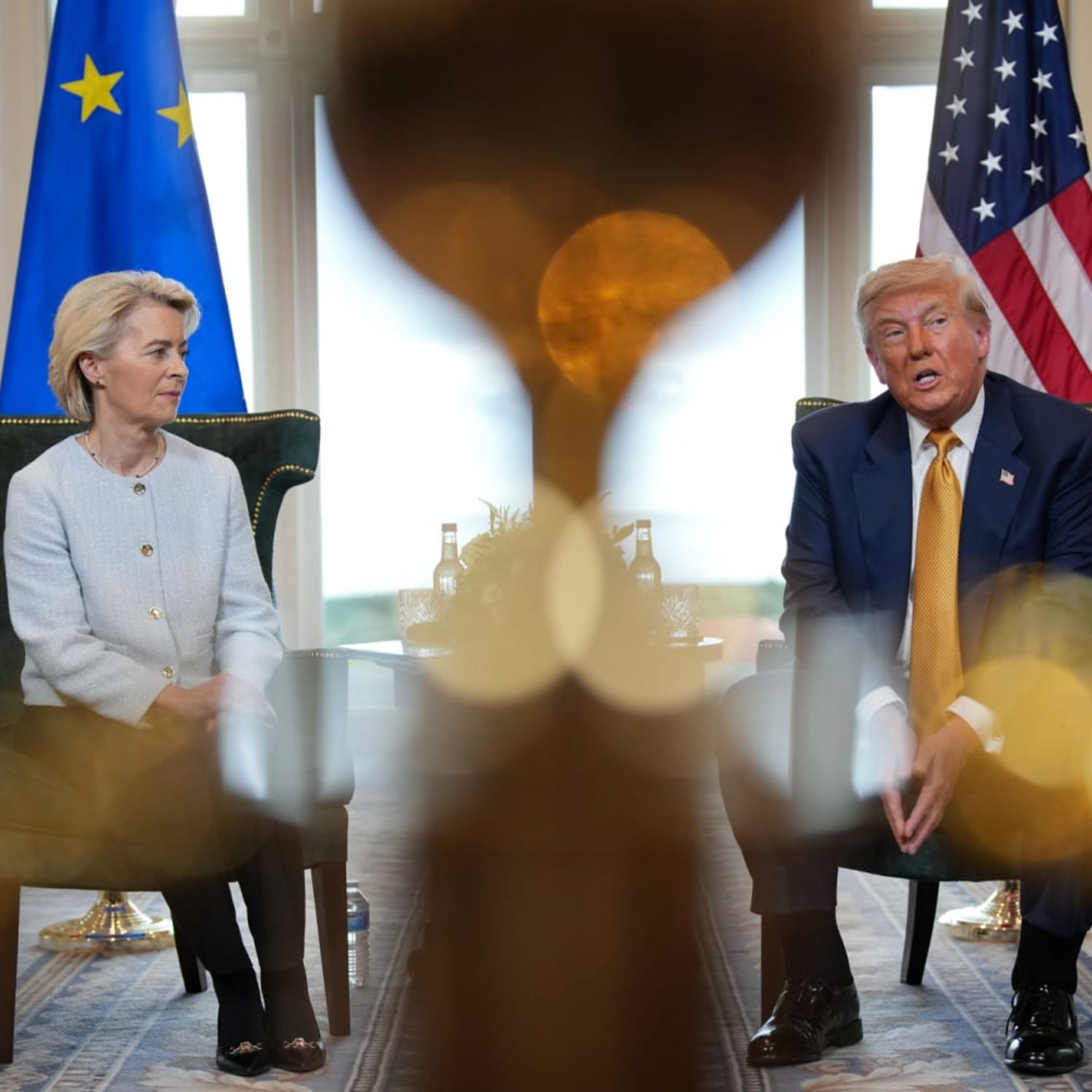
Here's the Scoop
U.S., E.U. reach trade deal; new research on potential ways to delay Alzheimer’s
00:14:04
Loading summary
Transcript42 lines
- [00:01]
Kristen Welker
This week on MEET THE press. With tensions rising over the Epstein files and the House starting recess early, Kristen Welker sits down with Speaker Mike Johnson. Plus Senator Lindsey Graham, Congressman Ro Khanna and Congressman Thomas Massie this week on MEET THE press. Listen to the full episode now, wherever you get your podcasts.
- [00:26]
Morgan Chesky
Hey, friends, welcome to here's the scoop from NBC News. I'm Morgan. I'm Morgan Chesky. There's a lot to talk about today. Israel allows a trickle of aid into Gaza. We have some new research on how to delay Alzheimer's. And a missing wallet is finally reunited with its owner after more than a decade. That's all coming up, but first we gotta talk about our top story. A preliminary trade deal with the European Union. President Trump announced the agreement in Scotland over the weekend, ending months of uncertainty with the US's largest trading partner. The deal tentatively sets tariffs at 15%. That's lower than the president had been threatening in recent months, but also much higher than before his trade war began. And it all comes just in time for the administration's Aug. 1 deadline. Here's European Commission President Ursula von Der Land.
- [01:14]
Dr. Kavita Patel
And it's a big deal. It's a huge deal. It will bring stability. It will bring predictability. That's very important for our businesses on both sides of the Atlantic.
- [01:25]
Morgan Chesky
For so, for more on this deal and maybe more importantly, what it's going to mean for us back home, I got to bring in Mike Calia. He's NBC News managing editor for both business and econ. Hey, Mike.
- [01:37]
Mike Calia
Hey, Morgan. Thanks for having me.
- [01:39]
Morgan Chesky
Okay, let's get straight to the tariffs. What do you know?
- [01:43]
Mike Calia
This deal is a framework. It's 15% on most imports we get from the European Union. There will be exceptions for certain industries, certain pharmaceuticals, certain airplane parts, things like that. But overwhelmingly, goods from the European Union will be more expensive for American companies and consumers.
- [02:05]
Morgan Chesky
Why do you think they finally came to a deal now? And who exactly gave up what?
- [02:11]
Mike Calia
Right. Well, Europe gave up probably the most here. And that's the criticism you're hearing within Europe, that it's unbalanced. The European Union imports a lot of stuff into our country, pharmaceuticals, cars, but also, you know, cheese, wine.
- [02:27]
Morgan Chesky
I mean, come on, olive oil.
- [02:29]
Mike Calia
I mean, Sunday dinner isn't going to be what it once was. So Trump might have gotten some extra billions for the treasury by collecting tariffs, but in the longer run, this is going to mean more costs for the American consumer. We've already started seeing some of that from the modified tariff regime that he put in the 10% global tariffs he put on everyone as he negotiates all these deals. Prices still went up and you're starting to see it in inflation data. It's not a lot, but it takes a while for these things to trickle through. So Trump got a lot what he wanted. Europe got somewhat what they wanted. In that it's clarity and they have Trump off their back for the time being. But consumers did not get what they were wanting.
- [03:18]
Morgan Chesky
And I feel like consumers throughout the all of this kind of roller coaster of tariff talk have been waiting to see how hard they're actually going to be hit. You mentioned the Sunday dinners. I'm absolutely going to feel that. Where else do you think the US Consumer is going to feel this sooner than later?
- [03:36]
Mike Calia
Well, you're going to start feeling it more in car purchases, auto parts. And a lot of that is because American car companies are still subject to this 25% tariff on auto parts and autos that aren't built here. Whereas Trump cut a deal with Japan and a deal with the EU that will bring their tariff down to 15% on autos. So there's a lot of conveching going on in Detroit. But for a while, car companies in the US Were giving away to consumers what's known as employee pricing, favorable pricing to keep them loyal, to get them to buy the cars that were already in inventory before the tariffs started to hit. You're probably going to see that start to bite a little bit more. Has a knock on effect. It's auto parts, it's maintenance, it's car insurance, which is already astronomical. And if the cost of repairing cars is going to go up because the cost of parts are going up, that means car insurance is going to go up.
- [04:33]
Morgan Chesky
Oh, man.
- [04:34]
Mike Calia
Yeah, exactly. So all those people who ran out to buy cars in March and April were probably right on. I want to pat myself on the back for that. We bought a new Kia in April, so we are good to go at.
- [04:47]
Morgan Chesky
Least ahead of the curve on that one. Mike, I'm searching if you can buy olive oil in a 50 gallon drum. I will let you know. Really appreciate your time.
- [04:56]
Mike Calia
Thank you.
- [04:59]
Morgan Chesky
All right, gang, we're going to take a quick break now, but when we're back, we have new research on how to potentially delay Alzheimer's. Stick around.
- [05:12]
Jessica St. Clair
Hi, I'm Jessica St. Clair. And I'm June Diane Rayfield. And we are two friends trying to survive the chaos and celebrate the joy that life throws our way. And we do it every week on our podcast, the Deep Dive. Sometimes we dig into the Deep stuff like how I communicate with my dead best friend. And sometimes we give bad advice based off a TikTok I saw. And we're not going to apologize for that. Absolutely not. You'll laugh, you'll cry, you'll hire a psychic medium. Join us, won't you? Listen to the Deep Dive wherever you get your podcasts from Lemonada Media.
- [05:51]
Morgan Chesky
Have you ever wondered what it's like to be buried in an avalanche? Weird foreign feeling of despair? Or how it feels to crash a skydive?
- [06:00]
Dr. Kavita Patel
I remember feeling my body hit the ground.
- [06:02]
Morgan Chesky
These are the stories you'll hear on the podcast called what Was that Like True stories told by the actual person.
- [06:09]
Mike Calia
Who went through it.
- [06:10]
Morgan Chesky
And you'll hear actual 911 calls.
- [06:13]
Jessica St. Clair
911 there's a man at my back.
- [06:15]
Morgan Chesky
Door trying to get in search for what was that like on any podcast app or@whatwosthatlike.com welcome back to here's the Scoop, and I want to share with you a statistic that really struck me. The Alzheimer's association estimates that roughly 7 million Americans are living with the disease. Some new research is offering a glimmer of hope for those genetically predisposed. Two new studies in particular are being presented at the Alzheimer's Association International Conference that's meeting today in Toronto. And while the findings aren't exactly groundbreaking, they do reinforce something that we've heard before. Lifestyle changes can make a real difference. One major factor how much you move. Here to walk us through these studies is our own NBC News medical contributor, Dr. Kavita Patel.
- [07:07]
Dr. Kavita Patel
Hey, Doc, thanks for having me.
- [07:08]
Morgan Chesky
Morgan, when you got eyes on this new research, what struck you?
- [07:13]
Dr. Kavita Patel
Yeah, so for a long time, Morgan, we've known that there is a genetic risk that you can test for a gene called the APOE4 gene. I'll just refer to it as the APO gene. It gives you a higher risk of Alzheimer's, and more and more people are getting that checked out. What we always have tried to figure out, though, is does a genetic risk automatically translate to a clinical risk? Can you have the gene and can you overcome the clinical possibility of dementia? And these two new studies that were presented, as you mentioned, really tell us that your genetics don't necessarily lead you to a fate. And I think that's really important. And on top of that, even if you don't have the gene, you still benefit.
- [07:52]
Morgan Chesky
So what lifestyle changes do you want people to be most aware of?
- [07:56]
Dr. Kavita Patel
One of the studies really just looked at something pretty straight up. Morgan Walking. So they just looked at people who they had to self report it. They looked at thousands of adults over 10 years, and they broke out the people into different risk groups. People that had that APOE4 gene mutation that I mentioned that gives you a high, higher risk, and people who didn't. And it was. Here's what's really interesting. For people that had the gene, it really dramatically lowered the risk. In men, we don't understand why, but women tend to get Alzheimer's diagnoses at a higher degree than men do. We don't understand that either. But the walking affected men and women, but for some reason, men even more when they carry that genetic risk.
- [08:36]
Morgan Chesky
My grandparents used to do a lot of crossword puzzles. Does that kind of cognitive training, does that help as much as the walking does?
- [08:45]
Dr. Kavita Patel
It does. So there was a second study that was done in Finland, and these were also researchers who looked at a number of lifestyle interventions, including, to your point, cognitive training. They looked at people who did cognitive exercises, physical exercises, and then they also looked at nutrition, diet. We've talked about all these three things as kind of things that are important. But now we've seen that if you have any of these or all of these lifestyle interventions, you too can lower your genetic risk.
- [09:13]
Morgan Chesky
If someone out there, and inevitably they do, has a family member with Alzheimer's, does that mean automatically they have the gene?
- [09:21]
Dr. Kavita Patel
No, it does not. And I think that's what's tricky, is that you can have people who have the gene and they can have several copies of the gene, and they have risk, but do not ever develop the clinical symptoms of Alzheimer's. But you can also have people who have Alzheimer's and do not carry the gene whatsoever. So this is why I think Alzheimer's has been so troubling for scientists, because there's not this one precise thing that we can point to. Although, again, today's research that they talk about is great, combined with some newer treatments that are also out. It adds up, Morgan, to something that we didn't even have even five years ago.
- [09:56]
Morgan Chesky
Alzheimer's is such a scary disease. It affects so many people. And yet, to your point, there is still so much unknown about it, these findings, what do they tell you about kind of the future of the research here when it comes to this disease?
- [10:12]
Dr. Kavita Patel
Yeah, the future of research is incredible. I think you're seeing the conference that we're mentioning that this research is being presented at. You're seeing an incredible amount of what I'll call basic science research. So things that are still early haven't necessarily gotten to human testing. All the way to clinical interventions for treatments for early to later stages of Alzheimer's. We never had this when I was training, even several decades ago, this was not part of the medical textbooks to have options. But I think what's exciting is that so many people have worried that there's nothing that they could do even before they get a diagnosis. These interventions point to a very promising hope. And imagine being able to do this earlier and avoid even having any symptoms. That's incredible.
- [10:57]
Morgan Chesky
Doc, thanks so much.
- [10:58]
Dr. Kavita Patel
Thank you.
- [11:02]
Morgan Chesky
All right, time now for some headlines. And we do want to start in the Middle east where Israel has announced a, quote, tactical pause in fighting for parts of the Gaza Strip. Now, Israeli officials say this is to allow more humanitarian aid inside the enclave. The pause follows growing global media attention on the conditions there, including starvation and deaths due to malnutrition. Gaza's health ministry says that more than 130 people have died due to malnutrition since the war began. And remember, that does include dozens of children. Aid groups say the help won't be enough to avoid ongoing famine. Meanwhile, in a break with Israel, President Trump said today that there's real starvation inside Gaza and that the US Would pledge to set up food centers there. Thailand and Cambodia have agreed to an unconditional ceasefire after the deadliest outbreak of violence there along that 500 mile long stretch of border in years. Essentially, each country blames the other for starting last week's fighting, which left more than a dozen people dead over the weekend. President Trump did warn that the US Might not go forward with trade deals with both countries if they didn't resolve their dispute. Brace yourself, everyone. Mother Nature is warming up in the most literal sense here. Right now, 171 million Americans are under heat alerts from Texas all the way up to our friends in New York. Florida and Georgia are leading this unofficial heat parade with feels like temps nearing 1:15. And while there is some cooler air coming for the Midwest and the Northeast later this week, the south is staying locked in broiler mode. And by the way, hurricane season, it's about to throw some hands here. We've only seen three named storms so far, but experts say that the real drama will be hitting in August and September. The Gulf is the hottest it's been since 1981 and that means perfect fuel for fast building dangerous storms, especially along the Texas and Louisiana coasts. Bottom line, between the heat and the hurricanes, summer ain't over yet. Alright, heads up to lovers of a good deal. Starting today, Target's saying goodbye to its price matching policy with competitors like Amazon and Walmart. Target says it will only honor prices from its own website or those in store deals. The change is all part of a push to simplify pricing as the company faces some financial headwinds. And as you can imagine, not everyone's thrilled here. Shoppers, in fact, are already sounding off, and employees are definitely bracing for some awkward conversations at checkout. Finally, before we let you go, if you've ever lost or forgotten something inside your car, this one's for you. Our Minnesota affiliate, Care, brought us the story of Chad Volk. Chad's a mechanic in Lake Crystal, Minnesota, who stumbled on an unexpected a wallet missing for 11 years. Yeah, it was buried deep inside a 2015 Ford Edge. Volk was trying to reinstall the cooling fan, as one does when something didn't quite line up. So we took a closer look and boom, there it was. Turns out the wallet belonged to a guy named Richard Guilford, a retired auto worker from Michigan who lost it while, you guessed it, building that exact model inside a Ford plant. I never wore sweatpants for work, but I did that day and I had my wallet in my shirt pocket, guilford says. He leaned over the car, the wallet slipped out and it was gone. Since then, though, get this, the wallets racked up 150,000 miles, cruised from Arizona to Minnesota, still held 15 bucks, a few crusty scratch offs and $250 in Cabela's gift cards that still worked. Volk tracked Guilford down on Facebook, mailed it back with zero fuss, and just like that, the brotherhood of the traveling wallet was born. Wonder what he's going to spend those gift cards on? All right, that's going to do it for us at here's the scoop. We'll be right back tomorrow with a brand new episode. Until then, for NBC News, I'm Morgan Chesky.
- [15:39]
Kristen Welker
Hey everybody, I'm Al Roker from the Today show, here to tell you about our Jumpstart July event. The Start Today app has everything you need to get and stay motivated on your wellness journey all in one place. Like walking challenges for all levels to get you moving. Healthy recipes that are easy and delicious and so much more. And now when you subscribe for an annual plan, you'll get your first month completely free with promo code jumpstart. Just download the Start Today app now to get started.
- [16:10]
Morgan Chesky
Offer in 73125 must enter code at checkout, must be 18 or up after first month, you will be automatically charged $65.99 a year plus tax for an annual subscription until you cancel. Cancel anytime through your device Settings under Apple Account C website for full terms.