Podcast
Hertie Highlights
Hosted by Hertie School · EN
Keynotes, discussions, interventions, and presentations extracted from events hosted by the Hertie School.
thehertieschool.substack.com
thehertieschool.substack.com
18episodes
Episodes
Newest firstAll episodes
Wolfgang Schmidt's Commencement Speech to Hertie Graduates 2026
Jul 100:22:00Tap to summarize22 June 2026, Berlin PhilharmonieWolfgang Schmidt, former Federal Minister for Special Affairs, delivers an inspirational speach to Hertie Graduates. He talks about leadership, cooperation, and respecting other opinions and valuing comprimise.https://www.hertie-school.org/en/news/detail/content/hertie-school-celebrates-class-of-2026https://www.hertie-school.org/en/ This is a public episode. If you would like to discuss this with other subscribers or get access to bonus episodes, visit thehertieschool.substack.com
Transcribe →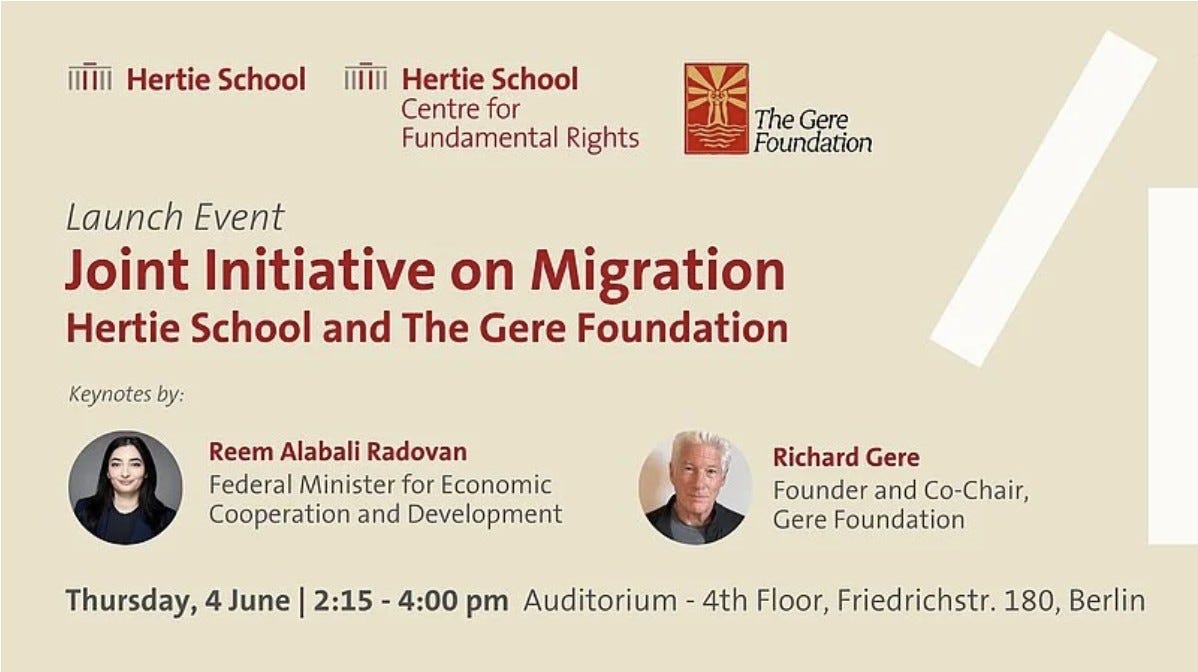
Reem Alabali Radovan on migration and todays challenges
Jun 1000:11:54Tap to summarizeReem Alabali Radovan, German Ministor for Economic Cooperation and Development, speaks at the launch of the joint initiative on migration by the Hertie School and the Gere Foundation. She talks about the migration, displacement, and refugees around the world and specifically about Europe.“We have to make sure, as Europeans, together with our partners in Africa, that no more people die in the mediterranean sea.”“What is required is clear, people need to be able to see a future in the place they live, opportunities that make it worth staying for them and their children.”https://www.hertie-school.org/en/fundamental-rightshttps://gerefoundation.org/The new Joint Initiative will examine the deep causes of migration, that is, push, pull, and repeal factors that structure migration flows, addressing the drivers of transnational movements holistically. It will consider state policies, their consequences, and the interplay between them, exploring alternatives and proposing better ways forward to prompt a fundamental change of approach.Full event recording on YouTube: This is a public episode. If you would like to discuss this with other subscribers or get access to bonus episodes, visit thehertieschool.substack.com
Transcribe →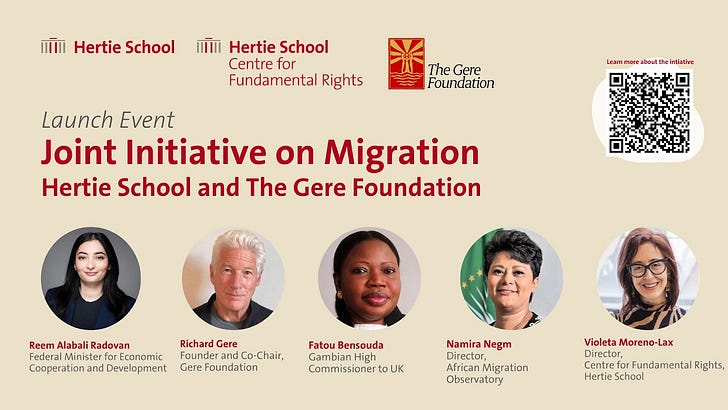
Richard Gere on being a migrant, on being human
Jun 500:29:14Tap to summarizeRichard Gere speaking on the occasion of the public launch of the joint initiative on migration between the Hertie School Centre for Fundamental Rights and The Gere Foundation.https://www.hertie-school.org/en/fundamental-rights https://gerefoundation.org/Mr Gere speaks of his personal experience and hopes for the future.The new Joint Initiative will examine the deep causes of migration, that is, push, pull, and repeal factors that structure migration flows, addressing the drivers of transnational movements holistically. It will consider state policies, their consequences, and the interplay between them, exploring alternatives and proposing better ways forward to prompt a fundamental change of approach.Full event recording on YouTube: This is a public episode. If you would like to discuss this with other subscribers or get access to bonus episodes, visit thehertieschool.substack.com
Transcribe →
José Manuel Albares Bueno on Spain’s Vision for the Future of Europe
May 2100:18:31Tap to summarizeThe Jacques Delors Centre at the Hertie School is pleased to have hosted a keynote speech by José Manuel Albares, Minister of Foreign Affairs, European Union and Cooperation of Spain, on the future of Europe in an increasingly fragmented and competitive world.At a moment of profound geopolitical change, Europe faces growing pressure to strengthen its capacity to act collectively - economically, socially, and in matters of security and defence. From Russia’s war against Ukraine to global industrial competition and the climate crisis, the European Union is being tested on multiple fronts at once. Against this backdrop, Minister Albares shared his reflections on the future of Europe. This is a public episode. If you would like to discuss this with other subscribers or get access to bonus episodes, visit thehertieschool.substack.com
Transcribe →
Clément Beaune on a competitive Europe
Apr 2800:24:49Tap to summarizeA timely discussion on Europe’s geoeconomic future with Clément Beaune, drawing on his experience at the highest levels of French and European policymaking.Geopolitical tensions have laid bare the depth of Europe’s strategic dependencies, spanning security, energy, and critical raw materials. In an increasingly adversarial geoeconomic landscape, how can the EU reduce its most acute vulnerabilities, while leveraging its strengths to enhance resilience and increase its capacity to act? A spotlight on Clément Beaune, who shares his insights at the intersection of European policy, economic strategy, and global challenges, drawing on his experience and the work of the French High Commissioner for Strategy and Planning, with particular attention to the role of Franco-German cooperation in shaping a coherent European approach.The discussion addresses key questions:On what strengths can the EU draw to improve its geoeconomic position?Can Europe remain an open trade partner and reduce vulnerabilities at the same time?How far should “Buy European” approaches go without undermining competitiveness?Where do France and Germany differ in their vision for Europe’s geoeconomic power and where is convergence possible to build a coherent European strategy? The keynote is followed by a moderated discussion with Thu Nguyen, Acting Co-Director of the Jacques Delors Centre, including a Q&A with the audience. This is a public episode. If you would like to discuss this with other subscribers or get access to bonus episodes, visit thehertieschool.substack.com
Transcribe →
Symposium in memoriam Claus Offe
Mar 3001:25:47Tap to summarizeSymposium in memoriam Claus Offe, part 3/527 March 2026, Henrik Enderlein Forum, Hertie SchoolPublic lecture: Social science and social progressModerator: Melinda CraneSetting the stage with Claus Offe’s reflections: Ulrich Preuss and Helmut K AnheierPanellists: Sven Giegold, Gesine Schwan, and Lea YpiView the full five panel event on YouTube:https://youtube.com/playlist?list=PLVyW-1uzF8DZtYw2xxUm0tQF7Iuovj56n&si=KevPhl1896lARqShClaus Offe dedicated his intellectual life to uncovering the conditions for social progress in the modern world, probing notions of social justice and how to defend individual freedoms. While keenly aware of the tensions liberal and open-market societies harbour, the profound challenges democracies face, and the complex contradictions of political transitions, neither optimism nor hope left him in any doubt that the social sciences can improve the world.In his unpublished “A Short Account of my Professional Life, Including Facets of lts Context”, which he shared only with close friends, he wrote: “I have also been convinced that social science research is virtually worthless unless its findings provoke, throw light on, or can serve as arguments in normative discourses on the nature of a ‘well-ordered society’ and its defining features of the reasonable use of freedom and distributive justice. A key goal must be to propose, in the mode of thoughtful wishing rather than that of wishful thinking, ways to achieve that end.”This symposium will honour Claus Offe’s intellectual achievements by taking his compelling argument as a point of departure, highlighting his insights and contributions to a better future for our societies, and embracing the spirit of “thoughtful wishing” that he championed.The symposium includes a public session with representatives from politics and academia, as well as a series of panels to debate the intellectual legacy of Claus Offe.Speakers and panellists will focus on key elements of Claus Offe’s work and apply them to current political challenges and debates. Brief opening statements or keynote speeches will set the stage, bridging academic discussions and current political debates. They will address one key question: “How can Claus Offe’s contributions and insights help shape the future?” Throughout the conference, we will revisit excerpts from Claus Offe’s writing and reflections, applying his perspective to current challenges.━━━━━━━━Understand today. Shape tomorrow.▶ Website: https://www.hertie-school.org▶ Facebook: https://facebook.com/hertieschool▶ Instagram: https://instagram.com/thehertieschool▶ Bluesky: https://bsky.app/profile/hertieschool.bsky.social▶ LinkedIn: https://linkedin.com/school/hertie-schoolThe Hertie School is a private university based in Berlin, Germany, accredited by the state and the German Science Council. It prepares exceptional students for leadership positions in government, business, and civil society. Interdisciplinary and practice-oriented teaching, first-class research and an extensive international network set the Hertie School apart and position it as an ambassador of good governance, characterised by public debate and engagement. This is a public episode. If you would like to discuss this with other subscribers or get access to bonus episodes, visit thehertieschool.substack.com
Transcribe →
Roberta Metsola on the Future of Europe
Mar 1800:43:29Tap to summarizeWe are honoured to welcome Roberta Metsola, President of the European Parliament, at the Jacques Delors Centre at the Hertie School for an open conversation on the future of Europe. The event is organised in cooperation with the European Parliament Liaison Office in Germany.President Metsola answers questions from Hertie School students and audience members.From geopolitics and security to competitiveness, democracy, and social cohesion, this event offers a unique opportunity to engage directly with one of the EU’s key decision-makers on the most pressing issues shaping Europe’s future.e are honoured to welcome Roberta Metsola, President of the European Parliament, at the Jacques Delors Centre at the Hertie School for an open conversation on the future of Europe. The event is organised in cooperation with the European Parliament Liaison Office in Germany.President Metsola answers questions from Hertie School students and audience members.From geopolitics and security to competitiveness, democracy, and social cohesion, this event offers a unique opportunity to engage directly with one of the EU’s key decision-makers on the most pressing issues shaping Europe’s future.Understand today. Shape tomorrow. ▶ Website: https://www.hertie-school.org ▶ Facebook: https://facebook.com/hertieschool ▶ Instagram: https://instagram.com/thehertieschool ▶ Bluesky: https://bsky.app/profile/hertieschool.bsky.social ▶ LinkedIn: https://linkedin.com/school/hertie-school This is a public episode. If you would like to discuss this with other subscribers or get access to bonus episodes, visit thehertieschool.substack.com
Transcribe →
Ali Fathollah-Nejad on Iran
Mar 1100:31:38Tap to summarizeMarch 2026, Hertie SchoolIran is facing its most profound crisis since the 1979 revolution.Nationwide protests that began in late 2025 have reportedly been met with severe repression, mass arrests, and a near-total communications blackout. US and Israeli missile strikes on Iran have led to growing escalation in the region, with the involvement of regional allies leading to a wider conflict in the Middle East.After the death of the Ayatollah and other leaders of Iran's oppressive regime, can it still reform from within to serve its citizens' social and economic needs, or does it edge closer to rupture, both domestically and regionally?To make sense of current developments and Iran’s possible futures, we will host Ali Fathollah-Nejad, PhD, for a conversation with Cornelia Woll, president of the Hertie School.Full recording on YouTube:https://www.youtube.com/@TheHertieSchool━━━━━━━━Understand today. Shape tomorrow.▶ Website: https://www.hertie-school.org▶ Facebook: https://facebook.com/hertieschool▶ Instagram: https://instagram.com/thehertieschool▶ Bluesky: https://bsky.app/profile/hertieschool.bsky.social▶ LinkedIn: https://linkedin.com/school/hertie-school▶ Substack: https://substack.com/@thehertieschool This is a public episode. If you would like to discuss this with other subscribers or get access to bonus episodes, visit thehertieschool.substack.com
Transcribe →
Tamara Ćapeta on the EU as a constitutional democracy
Mar 200:34:10Tap to summarizeThe European Union is often characterised as a constitutional democracy - a legal order structured around common values, fundamental rights, and judicial review. But what does it mean to describe the European Union as a constitutional democracy? And who ultimately safeguards its values?The Jacques Delors Centre and Centre for Fundamental Rights at the Hertie School invite you to view a keynote with Tamara Ćapeta, Advocate General at the Court of Justice of the European Union.The keynote is followed by a panel discussion on the constitutional foundations of the European Union and the role of the Court of Justice in current controversies, such as restrictions on LGBTQ content in Hungary, social housing policies in Denmark, Frontex and pushback operations, and trade agreements in the context of Western Sahara.Tamara Ćapeta, Advocate General, Court of Justice of the European UnionVioleta Moreno-Lax, Professor of International Law, Director, Centre for Fundamental RightsAna Bobić, Senior Researcher, Jacques Delors CentreModerated by Mark Dawson, Professor of European Law and Governance, Co-Director, Jacques Delors CentreAt a time of political contestation and growing tensions between integration and national sovereignty, the discussion addresses core questions of EU constitutional democracy: How coherent is the EU’s constitutional system if fundamental rights and constitutional values are differently understood across the Member States? Is the Court of Justice the right institution to actively define and defend the EU’s constitutional values? What role should the Court of Justice play in ensuring constitutional values and fundamental rights vis-à-vis the EU’s own institutions?━━━━━━━━Understand today. Shape tomorrow.▶ https://www.delorscentre.eu/en/▶ Website: https://www.hertie-school.org▶ Facebook: https://facebook.com/hertieschool▶ Instagram: https://instagram.com/thehertieschool▶ Bluesky: https://bsky.app/profile/hertieschool.bsky.social▶ LinkedIn: https://linkedin.com/school/hertie-school▶ Substack video podcasts: https://thehertieschool.substack.com/ The Hertie SchoolThe Hertie School is a private university based in Berlin, Germany, accredited by the state and the German Science Council. It prepares exceptional students for leadership positions in government, business, and civil society. Interdisciplinary and practice-oriented teaching, first-class research and an extensive international network set the Hertie School apart and position it as an ambassador of good governance, characterised by public debate and engagement. This is a public episode. If you would like to discuss this with other subscribers or get access to bonus episodes, visit thehertieschool.substack.com
Transcribe →
Dr Kao Kim Hourn on ASEAN's role in a multipolar world
Feb 1700:20:02Tap to summarizeThe Hertie School, in collaboration with Deutsche Gesellschaft für Internationale Zusammenarbeit (GIZ) GmbH, is pleased to present a lecture to the students of Hertie School from H.E. Dr Kao Kim Hourn, Secretary-General of the Association of Southeast Asian Nations (ASEAN), on the topic “Geopolitics and ASEAN’s role in a multipolar world”.ASEAN now comprises 11 Southeast Asian member states. Southeast Asia is widely regarded as a dynamic region of the future, whose political and economic importance continues to grow, and which is becoming increasingly relevant for Germany, both politically and economically.In his lecture, Dr Kao Kim Hourn outlines the key challenges and opportunities facing the region. This is a public episode. If you would like to discuss this with other subscribers or get access to bonus episodes, visit thehertieschool.substack.com
Transcribe →