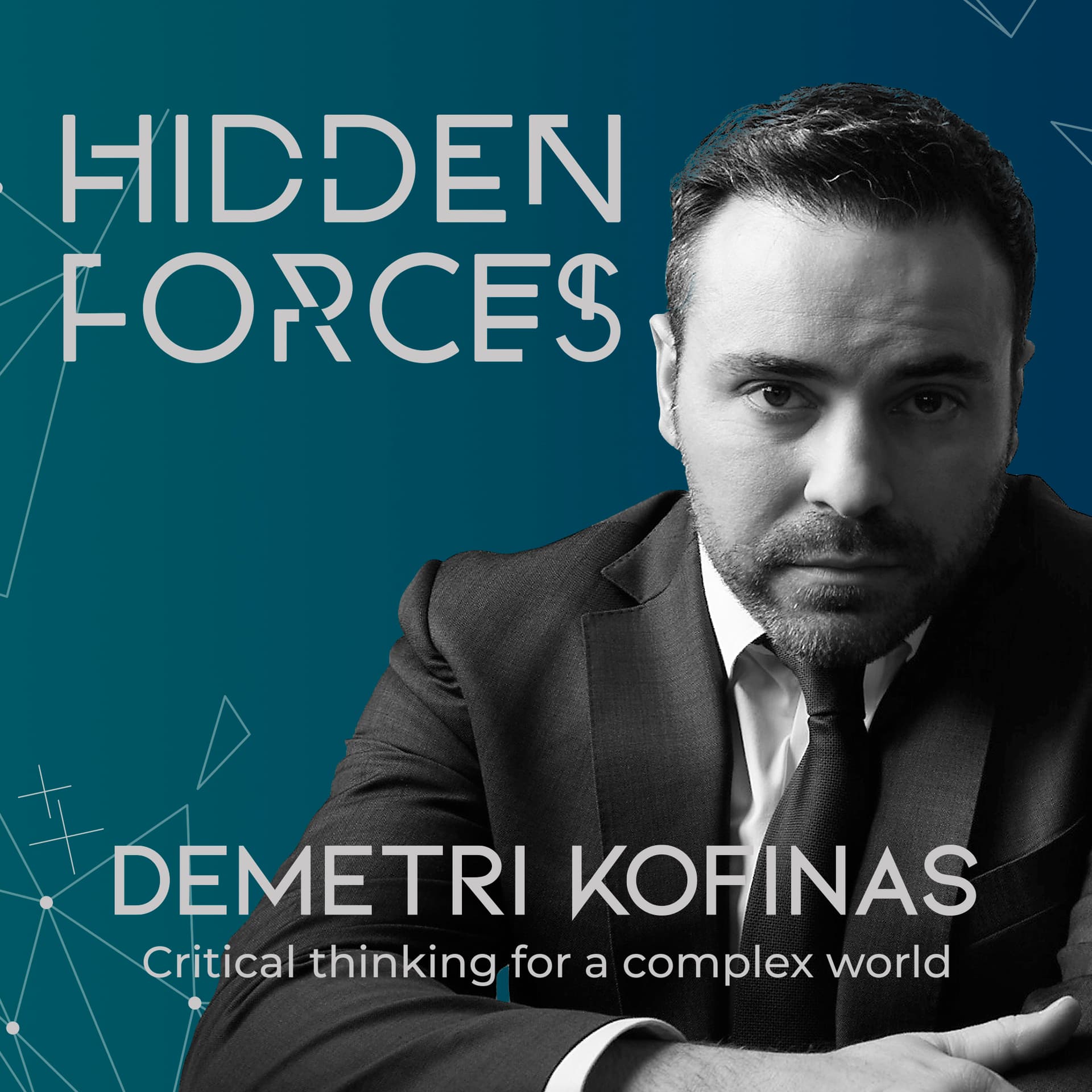
Hidden Forces Podcast Summary
Episode: Investing on the Front Lines of the AI Arms Race
Host: Demetri Kofinas
Guest: Nathan Benaich, Founder of Air Street Capital & Creator of the State of AI Report
Date: November 10, 2025
Episode Overview
This episode dives deep into the current state and future trajectory of artificial intelligence (AI), focusing on breakthroughs, challenges, and the broader social, economic, and geopolitical implications. Demetri Kofinas hosts Nathan Benaich, a leading AI venture capitalist and the mind behind the influential State of AI Report, for a rigorous discussion spanning technological advancements, the evolution of AI reasoning, the rise of open-source and global competition (especially China), and the shifting investment landscape at the heart of the AI "arms race."
Key Discussion Points and Insights
Origins & Impact of the State of AI Report
- Report Genesis & Purpose
- Nathan began his career in bioinformatics and realized the value of computers understanding complex data.
- Established the State of AI Report in 2017, influenced by Mary Meeker’s Internet Trends Report, aiming to provide an open access, rigorous, and non-marketing overview of research, policy, and industry trends in AI (03:21).
- "It's become kind of like the most trusted, I think, source in AI and got lots of interesting contributors to the report from major researchers, major companies, a lot of reviewers from the same organizations to make sure that the opinions are valid and correct." — Nathan (05:47)
Defining AI, AGI, and Superintelligence
What is AI?
- At its core, AI is a machine program (not biological) exhibiting capabilities typically associated with intelligent biological systems.
- The essence is learning from prior data to predict future outcomes.
- "We've been basically on a journey of bringing in more and more sophisticated data, more and more sophisticated predictions... to climb up the human capabilities intelligence curve..." — Nathan (06:53)
AGI vs. Superintelligence
- AGI: Can perform many tasks previously restricted to humans, as opposed to narrow AI focused on single tasks.
- Superintelligence: Surpasses human capabilities in certain tasks; models may already be superintelligent in select areas (07:48).
- "A general system can do many tasks, and a narrow system can do one task... The superintelligence piece... is driven by researchers recognizing... there are already certain tasks that models can outperform humans on." — Nathan (07:48)
Architecture: Transforming AI’s Capability
- Pre-transformers: Relied on hand-engineered priors, e.g., convolutional neural nets for images (10:18).
- Transformers: General-purpose sequence-based models that learn patterns without relying on fixed priors; powerful because they're adaptable to many domains (11:34).
- Tokens: The atomic unit of contextual information for these models, akin to bytes (12:43).
Qualitative Leaps: 2018-2025
From "Magic" to Mainstream
- The capacity of AI systems to produce lifelike images/videos, clone voices, digest PDFs, and reason, is seen as "magic" compared to ten years ago (13:38).
- "If you showed them what we have today, go back 10 years, they'd say it's magic." — Nathan (13:38)
- The public and market were slow to recognize how scaling laws would allow for such rapid progress due to difficulty grasping exponential change and lack of large-scale investment prior to the last few years (14:57).
Breakthroughs and Benchmark Events
- DeepSeek’s Milestone:
- Achieved near parity with leading US LLMs at a fraction of the perceived cost. Yet, reported $5M training cost is misleading, as it neglects substantial R&D, infrastructure, and data costs (16:46).
- "It’s the equivalent of saying...the $4 million or $5 million that Deepseek R1 cost was basically the cost of the fastest qualifying lap. And it ignores everything else..." — Nathan (16:46)
- Chain-of-Thought Reasoning:
- Asking models to “think step by step” (chain-of-thought) led to marked performance improvements in complex domains like math and coding (33:28).
- "The system can debug a bit better because it can figure out where it might have made a mistake in its thinking process..." — Nathan (33:51)
- Voice synthesis/cloning:
- The field has "pretty much solved" this with stunning fidelity (21:31).
- "With services like ElevenLabs...for people who don't know you extremely well...it’s hard to tell the difference." — Nathan (21:31)
Limitations and Critiques
- Variability & Brittleness:
- The quality of AI responses varies and is linked to both user prompting and system architecture; over-long or contextually overloaded chats result in “memory” confusion, reducing output quality (29:11).
- Users who structure prompts with context and constraints get markedly better results (29:40).
- “The field in general is going towards a direction of…It should be able to figure it out, but we’re still nudging our way there.” — Nathan (29:40)
AI as a Force Multiplier
Information Integration & Beyond
- AI’s ability to consume, synthesize, and operationalize the entirety of online information transcends any previous technology, including the Internet.
- "Having access to all that information in one place is pretty magical...now with AIs, we have the opportunity to explore probably global maxima...you can synthesize all the best experts into a single system." — Nathan (23:46)
- Even the best human experts are “local maxima” relative to the potential capacity of AI systems to combine all available expertise.
Reality vs. Representation and the Role of Sensors
- Some skepticism remains about AI's ability to perfectly model the analog world due to imperfect data and human perception biases (26:32).
- In practice, AI is skilled at following rules and adopting personas based on provided Internet data, which acts as a kind of epistemological shortcut (27:25).
The Prompting Game: How to Get Better AI Answers
- AI systems store information in a complex, high-dimensional space. Quality of output depends on how well a user can guide the system to the desired “answer space" (28:43).
- The more targeted and contextualized the prompt, the smaller the answer space, and the more likely a relevant answer is returned (29:11).
- Over time, as a chat’s memory fills, the system’s effectiveness can degrade; it’s best practice to start new threads for distinct topics (31:15).
The State of Progress: Scaling, Reasoning, and Plateau Myths
Reasoning Models and Trade-offs
- OpenAI’s O Preview and the chain-of-thought approach represent a new era, with rolling “stepwise” reasoning and explicit output of the model’s thinking process now baked into training (33:28).
- Not all progress is linear: New models sometimes regress on capabilities valued by some users, due to the complexity of optimizing myriad usage scenarios at once (39:11).
- “There is not really a free lunch with being good at everything while not regressing in one direction or another.” — Nathan (39:11)
- Notion of plateau in deep learning progress often stems from raised expectations and imperfect benchmarks rather than real stagnation (45:38).
Inference Time Compute & Monitoring
- Allocating more compute during inference (problem-solving) as opposed to training is emerging as a new axis for improving model accuracy and transparency (42:25).
- "Inference time scaling" — spending more time and resources on thinking at inference — is making models stronger without simply increasing pre-training resources.
- Exposing reasoning traces in user interfaces both increases transparency and offers tools to monitor and detect tampering or failure modes (44:26).
Investment and Technology Implications
- Industry consensus holds that further advances will come from a combination of scaling and smarter architectures; new axes such as synthetic self-improvement and multi-modality (image, video, audio) are just beginning to be tapped (48:30).
- Post-ChatGPT, immense engineering talent is flooding into AI, promising further leaps in robustness, cost-efficiency, and speed (48:59).
Notable Quotes & Memorable Moments
- “If you showed them what we have today, go back 10 years, they’d say it’s magic.” — Nathan, on the paradigm shift in AI capability (13:38)
- “The consensus in the community is there’s definitely more to squeeze...this recipe will yield some form of superintelligence, whether it’ll be across every single task is another question.” — Nathan (48:30)
- “It’s just like this human thing of we sort of ignore the 99% that works and we focus on the 1% that’s really crappy.” — Nathan, on user expectations and normalization of progress (41:28)
- “There is not really a free lunch with being good at everything while not regressing in one direction or another.” — Nathan, on trade-offs in model design (39:11)
- “The more support, scaffolding, guidance...you give it...the more you give it support to figure out where in this high-dimensional space it should live to answer your question.” — Nathan, on effective prompting (27:59)
- “After [ChatGPT], AI became the new new thing...all the energy of every other industry [has been] subsumed into it.” — Nathan, on the post-ChatGPT brain drain into AI (48:59)
Timestamps for Key Segments
- [03:21] - Nathan's background and the origins of the State of AI Report
- [06:53] - Definitions of AI, AGI, and superintelligence
- [09:26] - Discussion of transformers and model architecture
- [13:38] - What feels “qualitatively new” in AI today ("magic" moment)
- [14:57] - The surprise and scalability narrative in AI’s progress
- [16:46] - DeepSeek event impact and misconceptions
- [20:02] - Summary of most significant breakthroughs in the previous year
- [21:31] - Rapid progress in voice synthesis/cloning technologies
- [23:46] - Why AI is the most transformative technology (Bill Gates comparison)
- [26:32] - Philosophical challenge: Can AI ever perceive reality perfectly?
- [29:11] - The importance of context and prompting in effective use of AI models
- [33:28] - Reasoning models, chain-of-thought, and inference time scaling
- [38:01] - Observed regressions and the trade-offs in different model generations
- [41:13] - Human adaptation to technology; Louis CK airplane analogy
- [42:25] - Transparency and monitoring through visible reasoning traces
- [45:38] - On the myth of hitting a plateau in deep learning progress
- [48:30] - Where future improvements and scaling might come from
- [48:59] - Post-ChatGPT, broader engineering talent and optimism for progress
Tone and Takeaways
The episode is deeply analytical, pragmatic, and optimistic about AI’s future—tempered by nuanced recognition of its current limitations and the complexity of progressing without trade-offs. Nathan describes the AI landscape in language that’s direct yet metaphor-rich, making advanced concepts accessible without losing their technical edge. Demetri’s probing questions surface not just the technology, but the human, geopolitical, and philosophical implications, resulting in a conversation that is as much about thinking through the future as reporting on the present.
For the Second Hour
Demetri signals a deep dive in the premium feed on:
- The geopolitical and commercial ramifications of China’s open-source AI strategy
- Shifting profit opportunities along the AI stack
- The debate over regulatory moats and AI safety
- Prospects for scientific acceleration via AI
This summary captures the core themes, technical advances, memorable discussions, and the tone of a landmark episode for anyone tracking AI’s explosive development and its broader societal impact.