Loading summary
Transcript43 lines
- [00:00]
Ismaila Dien
So we used to sell a really expensive car with all the features. Now, like they have to focus on the value. So maybe right now what you need is just like a four wheel that takes you to point A to a point B.
- [00:12]
Amy Vaccaro
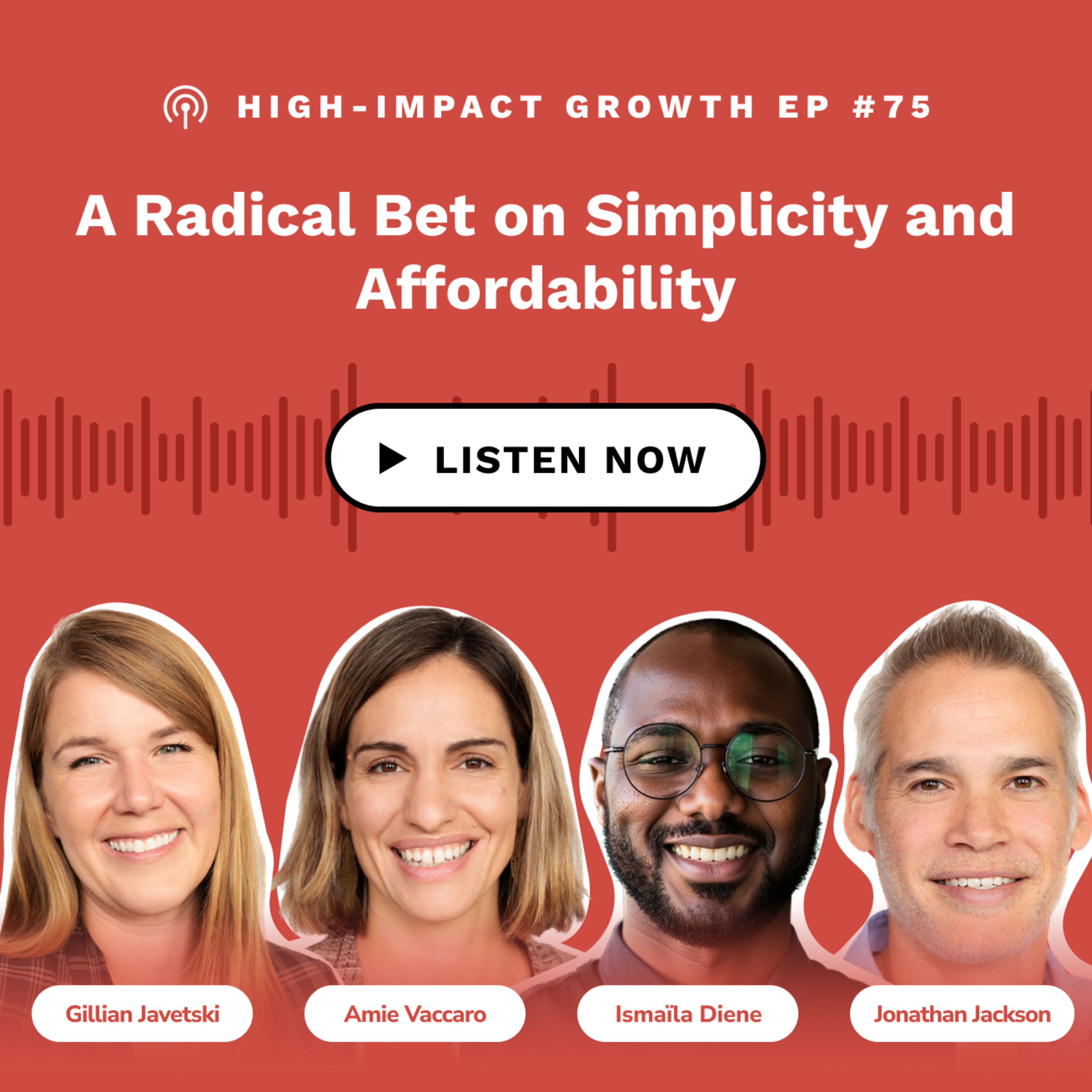
Welcome to High Impact Growth, a podcast from Dimaghi. For people committed to creating a world where everyone has access to the services they need to thrive, we bring you candid conversations with leaders across global health and development about raising the bar on what's possible with technology and human creativity. Amy I'm Amy Vaccaro, Senior Director of Marketing at Dimaghi and your co host along with Jonathan Jackson, DiMaghi's CEO and co founder. Today we ask what happens when the funding dries up, but the problems don't go away. Before we dive in, I want to acknowledge the devastating real world impact that recent funding cuts have had on health outcomes. The conversation we're having today is focused on our small part in closing the massive gap in access to services in this new reality and the innovations born from necessity. Nine months after massive sector wide funding cuts sent shockwaves through global development, we're checking in on the aftermath. Today we're rejoined by two of our managing directors at d', Monaghi, Gillian Javetsky, who leads our Comcare division, and Ismaila Dien, who runs our Global Solutions division. Last time they were on the podcast back in March, the mood was somber. We were reeling from the aid cuts. Now we're digging for the diamonds created from the pressure. Specifically, we're digging into a new offering, Dimagi, just launched as a direct response to this crisis. A national scale electronic community health information system. For just $5,000 a month, we explore the radical bet that the future lies not in adding more features, but in becoming simple enough and cheap enough to achieve scale. If you're a leader in global health, a funder or technologist grappling with this new reality, today's conversation will give you a candid take on how Dimagi is adapting, innovating under pressure, and redefining value when resources are scarce. Welcome to the High Impact Growth podcast. So I'm really looking forward to our conversation. Today. I'm joined by Jonathan Jackson, as always. Hey John, good to see you. And we are rejoined today by two of our more popular past guests. So we have Ismaila Dien and Jillian Javetsky, both managing directors at Dimagi, and we are bringing you guys both back on the podcast after a pretty intense year. You were both on back in March, which was really shortly after the the beginning of the unraveling of usaid and the entire sector was really reeling from those cuts. The mood was quite somber, but excited to have you both back on to check in on how things have gone since then. So welcome back. So I want to start with you, Gillian. When we spoke back in March, you really hoped that eventually we could talk about the diamonds that were created from all the pressure of funding cuts. So several months later, what does the new normal actually look like and feel like for you and for our partners?
- [03:14]
Jillian Javetsky
So many people in our industry and maybe even outside of it, definitely outside of it, feel as if it feels six months ago was 10 years ago. There's just been so much that's happened and so many different things. Yeah, I think just like looking back from where we were into where we are now and just trying to focus a little bit on the good things, I know for us personally on our team, we tried to take a lot of frustration with a lot of cuts and, and the impact on global development and really channeled that into our product. It reminds me a little bit of we did a similar thing when Covid happened, where it was like a rallying cry for the team to come together and say, we know exactly what we have to build. We're going to go for it. And this was similar. Like, we knew just from seeing the impact to our partners, it was very clear the things that we had to do. And so we knew we had to lower pricing. That was the first thing and something we talked about. I know on the last podcast, it's been great to see the impact with that. Like, we didn't quite know what would happen when we did it, but we have seen a number of locally led organizations be able to import ComCare for the first time, which is incredibly inspiring, especially in this year. And then beyond that, we just knew we had to make the product be able to work for teams that were much smaller, that had new folks who were being thrown into comcare to take over a system that their previous colleagues ran. So we had to focus on really making the platform a lot more usable. That has been a big one, making it easier and faster for teams to use and make sure that for data managers, for example, they're spending less time doing, like, manual data editing. We did a lot of things around that. We added a AI chatbot just to provide better support to folks, and then also an EU cloud option, too. Just for a lot of our European organizations that we're working with. It's been. I wouldn't have expected that a year like this with all these cuts that we were able to take something like this and really I think use that pressure to turn into like just as much of diamonds with our most prolific year on the product. And I know we just had the webinar, which is great, that goes through this and I think it really showed our team all the things we've been able to do.
- [05:09]
Amy Vaccaro
Yeah, I appreciate that. And we'll include a link in the show notes to the webinar that kind of gets into just all of the incredible work that the CommCare product team did this year to really make the most of a rough year. I want to turn to you, Ismaila, and one of the quotes you had from our last session that just really stuck with me was basically saying the problems are still here. The money's gone, but the problems are still here. How have conversations with our partners, especially governments, changed since then and what are they asking for now?
- [05:41]
Ismaila Dien
I always come up with quotes that I'm not sure I can back on all the time. But yeah, I think obviously the problems are still here today. And in terms of the conversation we have with governments, I feel like we went through different cycles the past nine months. I think when we had the last podcast in March, we had a few governments scrambling to find alternative funding, making sure that the work that was running was not stopped, that we would continue the implementation or different activities that were running, especially on the digital side, could continue to be supported. So I think that was like the first two, three months. And then I think that there was actually the realization that there was no funding out there. Especially because I feel like in terms of post USA cuts, even other funders like went quiet for a while. So it created this kind of like big gap. And governments, while they had hope at the beginning to come up with new funding, I quickly realized that it would be like a tough year anyway. So I think there was like another six months where things were really quiet from that end. A lot of the discussion we had in March are the session we're continuing to have now and I think more recently with as well some of the funding cuts coming to an end. Like there was also another run of scrambling. We literally had today a government sending us an email and saying, hey, we have a campaign next week. We know the subscription is over, but we were able to find some, some last minute funding. Can you just reactivate Comcare so we can run it, et cetera, et cetera. So I think that that was the phasing and I think from our point of view, our discussion, because we were not just passive and waiting for governments to bring these discussions to us. It was about our role, was to think about what are we offering, what are we putting out there for the governments to be able to sustain some of these programs? And I think with the new offer we're putting on the table, especially for community health workers and our EEHE system. Yeah. So just that new ECHS offering I think is our response. And right now we are, we're seeing there are at least some positive response from governments understanding that this can be a game changer for them to be able to sustain this program. So, yeah, I think it's been a roller coaster. I think we're in ascending phase now with a lot of positive discussions and we hope that continues into 2026, into more positive news.
- [08:04]
Amy Vaccaro
I definitely want to get into the ECHIS offering, which stands for Electronic Community Health Information Systems. But even before we get there, I do want to ask a little bit around creative partnership models. Are you seeing new or more creative partnership models emerging to fill some of these funding gaps or what are you seeing from government partners?
- [08:29]
Ismaila Dien
I am hearing a lot, I am not seeing a lot. To be truly transparent, I think obviously, like people, this has been like a devastating event in our sector. So nine months in the lifetime of a government or in the cycles of a government is not enough time to see the changes and the new partnerships and the new angles that we want to see with something like this happen. If you just think about it like a government budget is annual. Like, we're not even into the new budgets for most of these governments. So it's natural that like some of these partnerships are not formed and I'm not sure they're going to be formed in the, in the short term. So I think at least now we were not seeing that. But I think people are trying to think about simplification and that's a term that, that is coming back a lot generally on the market. How it's transcribing reality, that's something else. But simplification is something that's coming more and more. Local ownership has been a discussion we've been having for forever now, but it's also coming often. So more than new partnerships and new way of funding, it's about, okay, how do we make the total cost of ownership of these things cheaper so, so that the governments or the local actors can own them and can run with them. So that ties a lot with what Gillian was mentioning just before, like, really trying to make sure that smaller teams can run the systems. And I Think that's where as well some of the discussion in the market have been. But in terms of like purely new partnerships, having new ways of partnering, a new innovative way of partnering, I haven't seen at least something like that. That was like amazing next year.
- [10:08]
Jonathan Jackson
And to build on that, we just had the UN General assembly in New York a couple weeks before this recording. And there's a significant amount of talk, Amy, about new partnership models, new kind of global development, Global health architecture was a used a lot. So I do expect to see those coming out in 2026, as Milo mentioned. But these are going to take time. This is a massive undertaking. The amount of disruption that happened is just unparalleled and devastating. But the silver lining to your quote billing earlier of what's going to emerge under all this pressure, there's going to be have to be new ways of working because it'll be out of necessity that we will see these things. But as Smilo said, it's going to happen when you, you know, literally have to write your budget down and figure out who your partners are going to be and what subcontracts you're doing. And we'll start to see that towards the end of this year, heading into 2026, because it just literally must happen in some way.
- [11:02]
Amy Vaccaro
Gillian, one thing I wanted to ask you about is Digital Public Goods, which for folks in the audience, I think most of you are probably familiar with that term, but these are open source data tech products that are used across many countries and have long been seen as a really key element of digital health programming and advancement. Gillian, since the start of the year, what has been the impact to Digital Public goods? Commcare being one of them.
- [11:32]
Jillian Javetsky
Yeah, I think similar to what John and Smiler are saying, like there are still things that we are waiting for to see. There's been lots of discussion from I know the Digital Public alliance done really great job of convening different tech together to look at different like hybrid business models and exploring different ways. And I know that a lot of that conversation is still happening from other organizations too that are helping facilitate it. I think that's going on and at the same time there's a little bit of, I think a silent shift that I'm seeing at least, which is that there are just immediate decisions that these organizations need to make. And I think this goes back to John as well and what you were saying about like when you have a budget in front of you, that's when you're going to make a decision. And so for some of these, like they're looking at how they're going to maintain their teams over the next year. I think what we are seeing is before maybe a lot of lumping together as digital public goods in one bucket. And there's a bit of a divergence between organizations like ours where we have a software as a service model and are leaning more heavily into that and focusing on simplicity just like you said as Violet, like I think similar thing like we're doubling down on that. I'm very excited to see a few more are doing that as well. Like Open FN has really they're one of our really close partners or another digital public good. And they've also embraced their staff model too. So we're seeing a little bit of that. Then the other side. I think there's also an unfortunate thing too with other digital public goods that are struggling to maintain profitability really as an organization to run leads.
- [13:01]
Jonathan Jackson
I think we've had a lot of discussions on DBG providers, the consortium globally. We've been saying for a while like it's quite hard to support the number of digital public goods that are out there with viable business models. And I think what we're seeing now is a lot of products having to switch to more of a community led development model, which I think it's unclear whether that community has the resources to really drive continued future R and D. One of the criticisms DiMaggi's had rightfully is that a number of contributors to CommCare over the years have almost exclusively been inside of Tamagi. That was a purposeful choice in that we wanted to build the ecosystem at the implementer level on top of the software layer and we wanted to build a viable business model to fund the development of CommCare. And that's the business you're running, which is our SaaS business that brings in that money. And we're incredibly fortunate that you, Asmaila and DiMaggi have built that SaaS business that can now fund the R and D engine for CommCare indefinitely. We are seeing the content with us now of the models that were heavily grant funded, heavily donor funded, not necessarily having a clear path to ongoing sustainability, even though the code they've written to date is great. Now there's this big uncertainty what's going to happen to that code base going forward?
- [14:19]
Jillian Javetsky
I will say I think before all this happened there's a little bit of a together role in digital public goods. So we're all the same. And I think there's something that this has shown which is Just that we're just not contributing to an open source code base for features is one thing. Making sure those tools continue to run is a totally different thing. And that has nothing to do with open source development. And that is the biggest challenge that I'm anticipating we're going to see in 2026 with a lot of these tools and we're already seeing it at the national level. Some of these tools are going down for several weeks at a time. And what does that mean? Especially when we don't have this global development?
- [14:51]
Jonathan Jackson
I think it's there and as Milo mentioned, our new Commcare ECHIS offering and we're incredibly excited. It's already been publicized, but we're now offering CommCare for national scale CHW programs at $60,000 a year or $5,000 a month. And we think this has an unbelievably good value on 10 years of CHW programs. We've been doing 15 years of developing Comcare and something that we've got a really positive response as Myla mentioned. Now whether we can ultimately convince governments that the trade off of running in a SaaS environment hosted in the EU or elsewhere that's secure, SOC2 compliant and all these things is worth it to time is ultimately going to be up as a country. But we if they want to go forward with digitizing their CHW workforce, there's simply not going to be a better option than buying commcare for 60k a year. That's our hope and that's what we're pushing to. But as you mentioned when we first brought this up, you were like, you want me to run a national scale program for 60k a year? And I'm like, think about what an amazing problem that would be to have. Right? It was like the problem we had is government wants, it believes in the value. There's too many active users because everybody loves it. That's a great problem to give an end to. Nothing better than to go solve that problem as opposed to the problem we've been solving historically in many other DPG providers of selling the next feature set to do the next shiny thing product instead of just making what already works today work even better tomorrow, be even cheaper tomorrow, be even simpler tomorrow. And that's the big shift that we've had with this moment that we hope is one of these diamonds that comes out of all this pressure is this incredibly high value offering that Amy, we can link to the conversation we just had with Kevin at Malago is good enough, is cheap enough, and is simple Enough for governments to really get the value in these national scale programs. But the only reason we're in this position to do it is the significant amount of DPG funding we've gotten over the years that built all the platform, the business model innovation that you led Gillian, making SaaS runnable and maintainable and scalable at this price point. And the amazing work our services team has done over at Smila, bringing together 10 years of learning into what we think is a relatively common offering. Now that can get 80% of the way there right out of the box and get that last 20% configured really quickly. But we do have to make trade offs this moment in time, this new environment that we find ourselves in. I think asking governments, asking ourselves to be more honest about the trade offs is hopefully viable in a way that I think last year or the year before, like we frankly couldn't really force people to make trade offs. We would have to promise everything, charge a lot for it, and then we cope with that collectively with a lot of effort and a lot of new feature development would get to where we needed to be. And now I think we're saying, look, we'll be 90% cheaper than we were, but we're offering the value that already exists today and we're not offering, promising, committing to more value tomorrow, although we absolutely think we'll deliver on that. But you either think it's worth what we're doing today for 60k or you don't. And that's what we want to be able to offer to government in a very clear way and have them either say, yep, I agree that sounds great for 60k or no, we either don't want commcare or we just don't want to do this project as a priority. And we're really excited to see what the market response is going to be to this.
- [18:09]
Jillian Javetsky
John, I couldn't agree more. And I think there's something I'm hearing which is like maybe going back to your original question, like what are those diamonds? The things I'm hearing are like simplicity and trade offs, which I think need focus. Right. And that is the thing I think we're trying to get more clear on is like there are a lot of issues before with our industry, like anyone who works at global development knows that. Right. But if there's something that we can do from this and emerge from this where we are more focused and clear, that's something we want to move into. And even with this ECHS offering, it's something we need to do quickly, right? That's the other thing here, right? Which is we do not have a lot of time to do this. Which is partly why when this first came up, I was like, oh man, 60k, right? Like these programs, like used to run a million dollars of work. You had like custom builds and everything. But we just have to go for it because otherwise we're going to miss a moment.
- [18:52]
Amy Vaccaro
I want to dig in further on the strategy, but even before that, I think it's helpful for the audience to just give a little bit more just context on what is this ECHIS offering, What we're saying, $5,000 a month for national scale community health worker programs. What does this product do?
- [19:09]
Jillian Javetsky
I'm happy to start with, like how we're envisioning it from a SaaS offering. And that's why I'd love just to hear from you too on how conversations have been and what like beating transition would look like. But just to say so. There are several countries who use CommCare as their national tool for their electronic community health information system. A lot of those systems have like custom development on them. They've been the product of years and years of work and hours, thousands, millions of hours. I don't even know from our teams.
- [19:36]
Amy Vaccaro
That have built these.
- [19:37]
Jillian Javetsky
Our goal with this offering is to take those and adapt them to be a productized realssas offering. And so what that means is that we are moving a lot of that custom development into our core platform so that not only those programs can benefit, but all users can benefit. That's a big component of it. And then the other component is that we are offering this at $5,000 a month for all governments, up to 15,000 users, which is, I don't even want to do enough of how much money that is like less than our normal projects. But I think just like John was saying, this is something that we just know we have to do in this.
- [20:11]
Jonathan Jackson
Moment to build on that. Julian, like historically, the big challenge we have on these national scale projects is building new features fast enough to keep up with the government's expectations. And a lot of those features may not have been necessary, may not even get used that much. But again, we were in an environment where you just couldn't say no. Now the problem we want to have is can we make this cheap enough? We have just loads of evidence, randomized control trials, demand from governments that show the value of Commcare is. Maila and his team put together what we call a content solution internally, but like a best practices toolkit to accelerate application building, deployed with Senegal in less than 90 days for what could be scaled nationally. And we've worked with other countries because we've been doing this for 10 years, seen it so many times. We now know what the best practices application looks like for kind of a standard community health worker. There is no standard we community health worker, but all of them were doing household based maternal, child health, infectious disease and a lot of other components that now we've made it turnkey to turn on. And the reason I'm so excited about where we're headed is we're taking that 10 years of learning and all this work we've done, scaling Comcare and making it super performant and available and secure and really combining these two things which frankly in the past had felt different internally. At the magi we had this wireless team that worked on project based funding cycles, working with USAID with the multilaterals, doing big huge seven figure builds. And we had Gillian's team selling four figure deals to enterprises who were doing all the app development themselves. And now we think we have this beautiful solution that's in the middle of those two things, bringing together all of this expertise that we gained from years in the field and everything we know about how to run products and trying to then combine that to offer government this amazing deal. But we have a lot of uncertainty ahead as to whether government's going to say yes. And so it's a very different relationship. We're now trying to support governments and saying, look, you shouldn't be spending 7 figures on your ECIHS anyway. You should be spending 60k a year and you should be compromising on what you're going to get out of it so that you have a much higher value price point. Because yes, you could invest and get more of what you want, but it's not the best use of our limited resources anymore. The best use is getting what you can for 60k and then spending that money elsewhere, whether that's on other software, on commodities, on healthcare workers salaries or many of these other areas. And so it really, it's a totally different problem space and totally different relationship we're trying to form with our government partners now. And we used to sell our ECHIS systems and Smile the Fly all, all around the world. Talking about our partners, we used to sell this to funders. We're now only interested in selling this directly to governments who think it's worth 60k a year.
- [23:02]
Ismaila Dien
Yeah, and the analogy I've been using with this is like the core analogy. So we used to sell a really expensive car with all the features. So you had the automatic gears, you, you had the ac, you had the like a tactical screen, massages, et cetera, et cetera. And because the money was there, we could afford do that. And government like they would ask because hey, we can get money from this funder, this funder, we could add that now like they have to focus on the value. And I think for me that's going to be the biggest shift that has been the biggest shift for our team internally to say, okay, what are we selling? It is the key, the core value. So maybe right now what you need is just like a four wheel that takes you to point A, to a point B. If I'm in Senegal, I might add the ac, but that's the only thing I'm going to add because it's really hot here. So does the government want the AC and the car that can take them to point Endeavor because that's what we can offer at 60k or do they want to add all these other things? And if it's the case, unfortunately DiMaggi is not able to offer that with the condition of the market. So I think for me that's going to be the biggest shift as well. It's not just about cheaper or whatever is like settling on what is the core value that they want. And we believe Commcare offers that today way more than that. Actually we offer more than the ACN and a few other things. So I think that's why we believe this offer is so competing. And I think one point will come up as well from all this point. And that has been one of the point government has been anchoring on which local hosting, hey, we want the data to be stored in contra et cetera. We also offering a future where you can basically duplicate that data on a local database to be able to that box and say hey, we are able to get the a solution with as well our data stored in a local database. So I think for us it's really end to end. We believe we have the best solution at the really cheapest price on the market. And I am excited to really talk to this with government and seeing their response about this. Now there are many challenges ahead because we know we talked about it earlier, right? So the cycles of funding of government, like their annual contracting with a government takes a lot of time. All of that is still challenging in front of us. But I think we're at the point where we are excited about this and we believe government are also excited about it.
- [25:18]
Jonathan Jackson
I'll add on to that Perspective beyond just the scope of Dumaghi. And Joe and I have talked about this a ton in the context of those DPG discussions. Like, I really think this is where every digital public good provider needs to be thinking is there's not going to be a lot of money for new feature development anywhere in our industry foreseeable future. It's all about can we run the cost down. You know, so many public goods, Commcare included and I'd argue among the best, provide a lot of value already. The goal I don't think is add even more features to be able to claim to provide even more capabilities. It's take what you have and can you get price so compelling that it can be used as is. And that's inverse of the game everybody's been playing for the last decade with public code. It was always about selling the next big thing you could do if you got the next big check. And now it's gotta be can you get the price point low enough with what you can already deliver right now? And I think this right now piece has also been top of mind. I've talked with our leadership team at DiMaggi and the whole company a lot about this. Unless you can really deliver it tomorrow, you can't get a real answer today. Because if we're talking about delivery three, six, 12 months from now, it's wild. Be open to interpretation. Anybody competing whatever they want in those expectations, it's gotta be, this is what I can offer you at this price point and if you say yes, you have it tomorrow. And I think our industry will benefit a lot from that. Being more of the discussion that's happening with all of our digital public goods.
- [26:47]
Amy Vaccaro
It feels like two of the most important pieces of all of this is the simple enough and cheap enough. And I'm curious, I'd love to hear actually both from Ismaila and Jillian a bit on this with you. Ismaila, from the perspective of our government partners, I guess can you share a little bit of what how are they seeing simple enough in practice? Is that something there's an openness to? How have those like early conversations gone sharing this?
- [27:17]
Ismaila Dien
Yeah, that's a really good question. And I think you can try to break that down in several pieces. So if you go back in the old world, you hire DiMaggy for, let's call it a million dollar, and we come in from day one, we actually put together your requirements, we build the application, we help you deploy it. So we train your trainers, we go on the field, we support you, and then we Offer you a period of like support where like any issues that comes in, we take it on, we can fix it and deploy new version.
- [27:49]
Jonathan Jackson
Et cetera, et cetera.
- [27:50]
Ismaila Dien
So that's a really heavy effort. And the, even the second phase after building that, which is obviously the biggest effort, the run and maintain is still like a heavy effort. Like it's three, four people in my team that can go train people, but as well answer to questions, et cetera, et cetera. And we never got to a point where governments like either developed the internal capacity or had the means to really take over that. So when we're talking about simplification and cheaper, those two things are linked. It's not just about obviously the feature set being simpler to build or whatever, because that we believe where we got to that point. But it's as well like the maintenance. And once the government takes it, can you run commcare with 1 to 2 people instead of 10? Like a simple oversimplification. But that's the idea of this. So it's about as well like making sure that we, we find a way to not just say hey, you paying it cheaper, but if you're paying it cheaper but you still have to pay 10 people to maintain it, that doesn't make any sense. It's not cheaper for you at the end of the day. So the simplification is as well about those processes and how we transfer the capacity and what they have to do to make sure that the system is still running and being maintained. And one, by using SaaS at this cheaper price, we think we lowers that down. But the second thing is our team of solutions is not going to operate in the same way we will operate like maybe at your onboarding or maybe if you need some capacity building of your team. But we won't be a team that will hold your hand to push you. So part of the simplification of the tool and the features, integrating them in the core tech is about that and not having engineers always needing to be present to support the government. So yeah, so I think that's those two things are length simplification and lower price. And that's the only way we'll able to get like a government to, to run, to run these, these programs. We believe there are other things we'll be able to do in the future. Especially if you look at, of the total, if you look at the total cost of ownership of these programs, a lot of the effort goes into the training, into the deployment and into the support at the end. And I think now today with tools that are not within commcare but you can use in concordance with Commcare chatbots and other things like you can find way to as well reduce the complexity of how to run a system like CommCare. I'll give a simple example just to finish. If you scale in average, average number of CHWs, let's say in the countries we're supporting is 25,000. If you go at full scale, if you just do the math, 25,000 users using every data system, if even like 1% of them have an issue on a monthly basis, you can see how many issues you have to fix. So if a government is not able to have a system and a process and a framework to support those, let's call them 250 or 2,500 or whatever it is issues that's creating more challenges down the line. So the simplification is not just about the tech, but it's as well the whole process of running these systems.
- [30:59]
Jillian Javetsky
I think that's a great point is that's exactly it. Which is like when we say simplification, sure, the features may be different, right? But when we think about the foundation that it's built on, like that's really where the value is, right? It's like you are not going to find another global good out there. And feel free to quote me everyone listening to this. Where there's an SLA for uptime, right? We can guarantee like the system's going to be on and running, that you have a support SLA where you can reach out to an organization that will answer your questions and go through this. Right? That's something that governments will get. Now there's just, I think those are like the foundations of running a platform that we want to make sure are also part of that and that's existed for CommCare. But we want to make sure that something that continues to run for these governments too.
- [31:45]
Amy Vaccaro
Yeah, this is really helpful and I think what I'm hearing is just like how big of a shift in how we work this is requiring to be able to meet this moment and deliver this ech I s that's simple enough and cheap enough, but really it's changing how our team shows up as well.
- [32:05]
Ismaila Dien
I can give you a concrete example of how that could work. It's not on the ECHS context, but on what we call public health campaign context. On our side, we're working with governments to deploy these heavy campaigns like a mass drug administration or polio campaign or whatever. And these campaigns, they happen over a Course of two weeks, three weeks, sometimes one week. And they are like heavy operations. So you have sometimes 10,000 users, if you go to Nigeria, 25,000 users or whatever, like trained, deployed, like using the system for two weeks. And in simplifying really the operations, what we've done before was like, hey, you had these WhatsApp groups, like you created these systems that was like, hey, every time like there was like an issue, it came directly to someone at Z Mighty or someone at the government is super complex. So one of our team members were like, hey, there are chatbots out there. 90% of these issues, they can be answered really quickly. So let me set up a chatbot that all queries of the users will go through and the chatbot will triage what it can answer and what has to be escalated. And just by doing that and by setting up like a support framework with the government and some people in the field at level one, some government people at level two and level three were able to like get like these thousand issues to like just a dozen. That comes to dmaggi during a campaign. And that shows you like what like process and as well like simplifying but like technology the right way can help something like this. So I think like that there is the core part that GNN is running with the tech and making sure that it's cheaper and simpler. And there is as well everything that we're doing externally with the government that needs as well to be simplified and optimized.
- [33:57]
Amy Vaccaro
Yeah, the quote of necessity is the mother of invention is coming to me right here where it's like we're being forced to innovate in these ways and to rethink some of these things to make, to really streamline efforts. I do want to also hear from you Gillian, a little bit. You mentioned really continuing to invest in this platform, being able to really see standby, our uptime service level agreements, our support service level agreement. I'm curious to hear a little bit more of what is it like actually embedding all of this incredible functionality that's been available for these massive government scale country national scale programs into the core CommCare product, which really hasn't been done before, but that's required for this to happen. Right. To make CommCare simpler and more accessible. So I'd love to just, yeah, dig in a little bit from your side of like how is that going and what's required there.
- [34:52]
Jillian Javetsky
I think a lot of people have a lot to look forward to next year if you're using CommCare and if not, you should sign up. You're about to get some fancy things in the system. So, yeah, it's interesting for, like, our government partners, right, they may see that, like, the system is simplified a little bit for CommCare users that are in these governments. Right. They're going to be getting some really cool features. I think that's going to be the main focus of next year for us. And again, this is something that we just. We have to do at this moment. Like, we have to take the years and years of custom development that we've done in comcare for these national scale programs that the Smiling team has expertly led for a decade like this. Valentine, really just thinking of Burkina Bossa, like you personally were on that project and started the system more than 10 years ago. Right. We have to take all that from all these systems and bring it into our core platform. So it's a massive undertaking. But it's also something that our team, when we made this decision, is really excited about because it really does represent, for the first time, one platform that we have for CommCare that we're excited by. We're standing behind. We'll be, I think, in a lot of ways more focused on service delivery, which is great. That's something we also want to ensure Commcare is continued to be prioritized around. And yeah, I think there's a lot of good things to come.
- [36:04]
Jonathan Jackson
And just to give a concrete example of what we mean, Jolene, because that's a great articulation in that project you mentioned in Burkina that we started over five years ago, amazing partnership with the government. One of the things we wanted to do was display a growth chart for a child over time as they came back to the clinic multiple times in a row. That required building the ability to view a mobile graph on commcare. No big deal. So we implemented that. Making a feature like robust so that you can't break it and anybody can use it and it can display not just four data points, but 100. Requires all this additional work that sometimes our team couldn't get to because we built it, it worked for Burkina, and then we needed to go on to the next feature for the next government. So it's taking all of those things that we've built over the years. They're incredibly powerful. Were great feature requests, but maybe were only available to Burkina because it was built specifically before them, or only available to Ethiopia. And now this will be available for everyone. But it's a significant amount of work to switch our mindset and to say, look, what we have with CommCare is more than enough value. It's more than enough for the users. It satisfies 80 to 90% of what you need. We need to focus on making this robust, bulletproof and scalable instead of continuing to hang feature. So it is a huge shift for us, you know, from a mindset just all across. Tamagi from the Smiler's team, Jillian's team, Amy on product marketing, how I'm thinking about talking to our partners. And it's exciting because it's fun to be able to stand behind our products and services and be like, we know this is amazing value. If you don't want this value. We feel really good about just saying we're not the right partner anymore, as opposed to kind of like always getting into this, oh yeah, we gotta build these two features for you type of discussion. So it's exciting to be embarking on this.
- [37:48]
Jillian Javetsky
One group that I think is also going to really love. This is in addition to all of our users. Right? We'll have access to all these things. I'm really excited when we get to announce for the first time that like, we have, I think, about 26 organizations in countries that are certified Commcare providers. So they've gone through lots of tests and have to prove to us that they've deployed CommCare projects in a great way that meets our standards. And for the first time, those organizations will have access to all the features that like our team has too. And so it's not just for users, but it's also an amazing opportunity for organizations in countries that still want more in person. Support from organizations that are in their community can help them with too.
- [38:26]
Jonathan Jackson
That's such a great point, Julian. And it's not unique to CommCare or Dimagi, but lots of people buy very robust, very mature enterprise software like CommCare, whether that's a Salesforce or HubSpot or some of these big products. And you're like, cool, how do I unlock that vision that you sold me on? And you're like, oh, cool, Just have a center of excellence with 15 people who go talk to every leader and have a harmonized data model and a shared enterprise backlog. And you're like, I'm sorry, what are we talking about with 15 people here? So it's back to what you said, Jolene, of we are so excited to unlock all this power as Milestone's point is half an FTE for three months, not five FTEs for three years in terms of what it takes to deliver, scale and maintain these things. And again, we gotta deliver. This is still a non trivial execution effort on our part. We've gotta be right that we can deliver this as affordably as we think we can. But it's, you know, I think a ton of software, not just us, has to grapple with in today's environment. How do you bring that total cost of ownership not just down, but like comically down from where it used to be last year?
- [39:27]
Amy Vaccaro
Yeah, this is, it's definitely a really major undertaking and something we've talked about a lot on this podcast is like the product model. Right. And that this is one way that we're really as dimaghi further embracing what does the product model look like in global health and development, which is really, really hard. But I will say, yeah, I'm very encouraged by just the incredible progress. And I think one thing just reflecting on what I'm seeing from the teams, like there's a huge team right now working on this effort, right. To bring all of this incredible customization that's been built in CommCare over the years for specific projects and bringing that into the mainline code base. It's a huge effort. Yeah. I just want to give a shout out to the team involved in that and also to the three of you on this call as well because I think it takes a lot to get a team rallied around a goal and I think you've done a really beautiful job of rallying the troops on this goal right amidst this chaos, like creating this rallying cry of this is our chance to. The project internally is called GA or bus. So general available or bust for all the features and yeah, so very exciting. And I'm sure that I'd love to do a follow up conversation in six months to hear how this is playing out. Because I also feel like there's a little bit of an energy here where we're saying take it or leave it. We're going to see, we're going to see what happens. We're going to learn a lot, I think in the next six months and we're very hopeful that there's the appetite that we think is there. Yeah, we're at this place where we've got this team mobilized working on this effort. But I am curious to hear, starting with you, John, a bit about what was the journey to get to this place where we had this clarity, like it. I feel the clarity in the room of yes, we've got this offering, it's 5k a month, like take it or leave it. We feel really proud of this. But what did it look like to get to that decision?
- [41:11]
Jonathan Jackson
It's a great question, Amy, and it's. I'd love to hear a smile and Jillian's version of their journey for us when this happened. We first recorded the episode together back in March. Like, we all knew this was going to be devastating for the global development industry and that CHWs were probably going to really struggle this year next to be prioritized. We also felt like we're about to learn. I think I quoted this on a different podcast, but we're about to learn if anybody really wanted CommCare because they're just going to turn it on if they didn't. Still, to date, no government has turned it off that was using CommCare at that point. And so we thought, okay, we know we got to simplify this. We know we got to get it cheaper. And so as Myla's team, Jolene's team went back and said, okay, we need a couple million dollars of R and D, a couple million dollars to really get over the hump and then we can offer it for $200,000 a year. And we really positive response from funders. Although everybody right now seems to be just supporting their current portfolio, it's really hard to engage funders in new investments right now. Though I do expect that'll change going forward. But we said, even if we got that Several million dollars, $200,000 just still feels like too much money. Mil and I would be thinking one on one would be like, even if we pull off the core funding, is this really viable? And it was the day before we got together as a management team a couple months ago that I was sitting in my office. I'm just like, it's about price. We just know, like those conversations were all telling us, we just know this is still too expensive. We knew the value was there. Deeply believe the value of Comare is there. And again, it's proven through evidence. But I was just like, 200k is a lot. That's a lot of money to be paying every year for anything right now. And so that's where we said, select Joey. So what do you think about 5k? Like the day before we're heading into management planning. And she was like, I love it. Let's do it again. If we fail to deliver on that price point, let's fail at that if we're going to fail at something. And so that got me really excited. And then I shot an email off to a good friend of mine who runs a Foundation. I was like, hey, are you interested in potentially supporting this? And she loved the idea. And so we now have one funder on board to help support this journey. So it's really exciting. But for us, I think at that 200k price point, we knew we were only half it. You know, we're like, this is still a little bit too expensive. Like you can see somebody really being passionate about digitizing their CHWs and being like, you know what, 200k is too much. Where we just can again, we have to prove it out, we have to feedback. But 60k, we're just like, this is a no brainer. Like this is, this is something that hopefully comes in below your existing training costs on an annual basis. You know, that's how we're thinking about it. So yeah, it was, but it was hard. It was a multi month period. Jason Morris, who's been on previous podcasts with us, Amy, we were reaching out to him, being like really feeling the struggle of are we in this moment doing everything we can to support community health workers, to support our government partners? And until we kind of landed on this, it didn't feel like it. And now we are extremely proud that we do think we're just creating amazing value and taking this awesome shot at something that can really be transformative in the next couple of years.
- [44:20]
Ismaila Dien
One of my other legendary quotes inspired him. I think I said something like if chws are doing this for free, we should do better. So some, something around that way. But I think that was the, for me personally, that was the motivation of trying anything and failing potentially we might still fail at succeeding in this, but at least like trying to, to, to. To really offer something that, that we believe is the right price and, and, and the right values. Because CHW really deserve this. They, they are amazing people doing amazing work and critical for a lot of these countries.
- [44:53]
Jonathan Jackson
Yeah.
- [44:54]
Ismaila Dien
Yeah.
- [44:55]
Amy Vaccaro
Thank you so much. Lightning round on my final question, which is for folks listening to this episode, what's the single most important takeaway in terms of how we as an industry should be adapting to this new market?
- [45:07]
Jonathan Jackson
Our experience and I think what other people should be doing like the next couple years, it's going to be about price. It's about price, it's about simplicity. And so I think that's the big takeaway that we believe is going to happen in the marketplace and that I think other digital providers and governments should be thinking and talking about. When Amy, your opening question about are we seeing those new partnerships? I think a lot of those got to be based on a more simple structure and a more valuable structure going forward.
- [45:32]
Ismaila Dien
I was about to say the other part, the other side of it is like focus on the real value, not just the value because I think value is sometimes like a word that is overused and misused, but really focus on the real value that these systems can bring. We, I don't want to say we played that game. I think we were focusing on the value but we were focusing on other things. So we probably didn't bring all our energy on the right thing during this time even if we had a amazing product. But I think the context before force you to look at other things rather than focus on the core value that these systems are bringing. And then I think just by flipping that it obviously like bringing the price down and other stuff like will really go a long way from the industry.
- [46:20]
Jillian Javetsky
In the next few years. I expect that we're going to see a lot more clarity in terms of what these systems are and not all these systems are the same. I think it's been a model we've been operating in a lot for the last few years, maybe since really the inception of global development and technology at the community health level especially. And these are just not the same system. And I, I'm excited about that. I'm excited about Ismail being honest and saying these are different things.
- [46:45]
Amy Vaccaro
Awesome. Thank you so much to our guests Jillian Javetsky and Ismaila Dien for such a transparent look into navigating this challenging year. And as always, thanks to each of you for listening. This conversation held incredible insights around adapting under pressure. Here are a couple of my takeaways. First, in a resource scarce environment, the game is no longer about adding features, but about radically lowering the price. The challenge for digital public goods has shifted from selling the next big thing to making the existing proven value so affordable that it's a no brainer. It's about focusing on the core real value a system can bring. Second, this new reality demands an embrace of simplicity and honest trade offs. To make solutions sustainable, we must move away from the million dollar custom build and towards a standardized model that allows partners to get 80% of the way there for a fraction of the cost, even if it means compromising on some features. Third, true productization requires internal transformation to deliver a simple enough and cheap enough solution. Dimagi is embracing radical changes across our organization from engineering by moving years of custom code into the core platform to services by redesigning support models with tools like chatbots to be leaner and more scalable for small our teams and budgets finally, the crisis is creating a critical inflection point for digital public goods, sharpening the focus on long term sustainability. It's making the distinction between different business models like SaaS versus community led clearer than ever, pushing every organization to prove it has a viable path to lasting impact. That's our show. Please like rate, review, subscribe and share this episode if you found it useful. It really helps us grow our impact and write to us@podcastamagi.com with any ideas, comments or feedback. This show is executive produced by myself. Parthana Balachandar and Sudhan Sukanth are our editors, Natalia Glowacki is our producer and cover art is by Sudhan Sukanth.