Loading summary
Transcript74 lines
- [00:01]
Grainger Representative
If you're the purchasing manager at a manufacturing plant, you know having a trusted partner makes all the difference. That's why, hands down, you count on Grainger for auto reordering. With on time restocks, your team will have the cut resistant gloves they need at the start of their shift and you can end your day knowing they've got safety well in hand. Call 1-800-GRAINGER Click grainger.com or just stop by Granger for the ones who get it done.
- [00:36]
Podcast Host
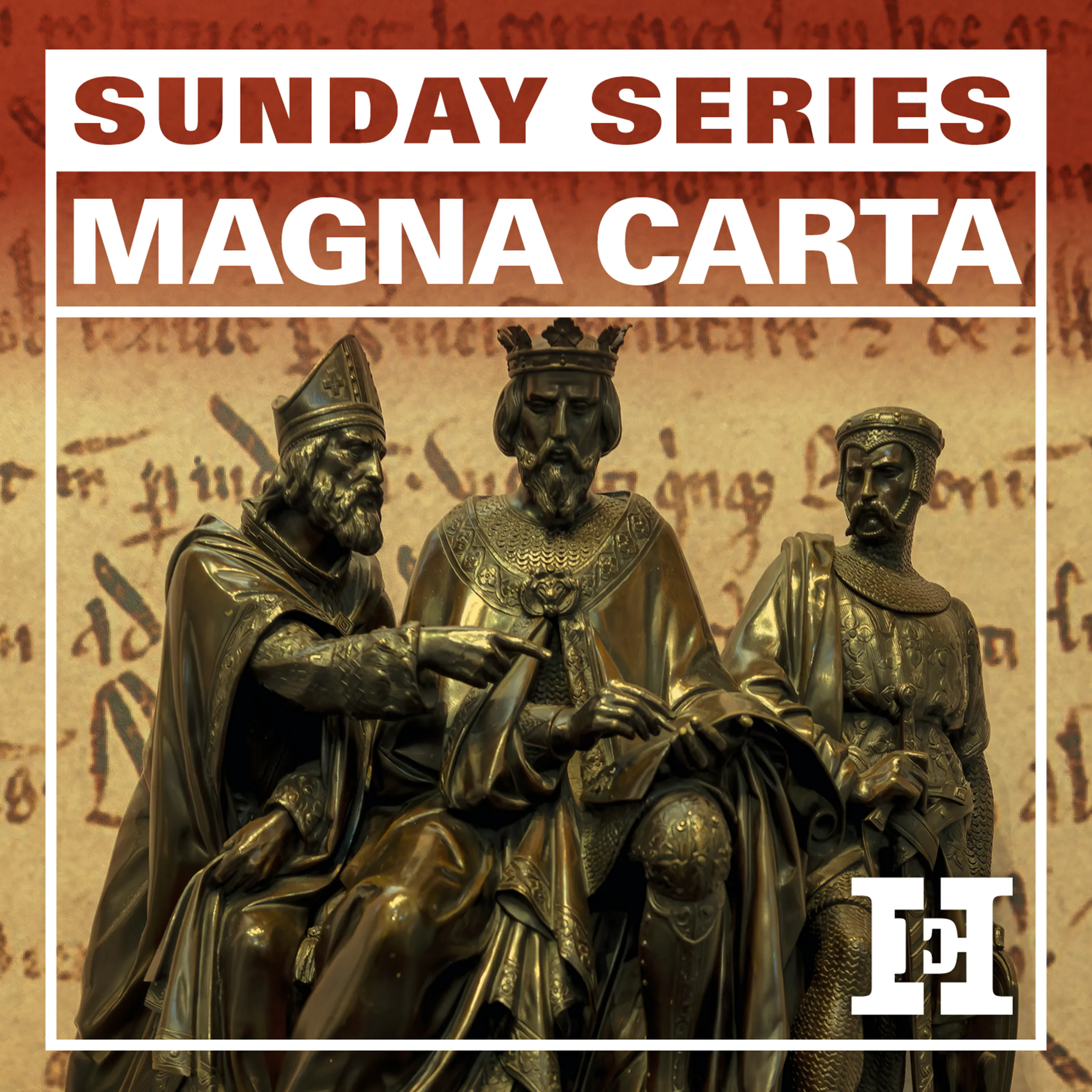
Welcome to the History Extra Podcast. Today we've got the final episode of our Sunday series on Magna Carta, exploring its legacy across subsequent centuries. And if you've enjoyed this series, join us next Sunday when we'll be examining the life, legend and legacy of one of British history's most famous monarchs and Elizabeth. I don't miss that. But for now, it's back to Emily Briffet and Nicholas Vincent for the last word on Magna Carta.
- [01:03]
Emily Briffett
Politicians invoke it, activists wield it, and legal thinkers debate what it can still offer our modern world. But what does Magna Carta actually mean today?
- [01:14]
I'm Emily Briffet and I'm joined by historian Professor Nicholas Vincent.
- [01:19]
In this fourth and final episode of our series on the charter, we're going to be considering its long afterlife, tracing how a narrow medieval settlement morphed into a legendary document that still speaks to our ongoing struggle over power, justice and freedom.
- [01:36]
Welcome back to this, our fourth episode. Nicholas, hello. It's a pleasure to have you back. We are going to be talking all about the legacy of Magna Carta. This is something we've been building to over the course of the series and it's something that keeps coming up again and again. But if we go back to the 13th century, what was the immediate impact of Magna Carta on the the 13th century mindset?
- [01:59]
Professor Nicholas Vincent
It's there constantly when people object to a king or what a king is up to. They are aware that there is a precedent set by Magna Carta and that this in a sense, is an ongoing process. And you begin to get the emergence of these books of statutes, books of law. Before this, we don't really have books of law. We've got guides how you do the law, but we haven't actually got the laws themselves in book form in quite this way. But from the 13th century onwards, we get books in which the latest laws laid down by the kings of England are set down in writing and they always begin with Magna Carta. It is the great, great, great grandfather of all law. Ever since in English terms So it'd
- [02:50]
Emily Briffett
be fair to say that it became very much a part of English political life, even if the clauses themselves didn't very much.
- [02:57]
Professor Nicholas Vincent
So for that reasons we've discussed earlier that it's now hardwired into the English sense of identity that there is this thing called Magna Carta, that kings are placed under the rule of law, that we are a people who are entitled to certain rights and liberties, and that Magna Carta in some way that probably people don't actually understand the details here, but in some way Magna Carta's got something to do with that.
- [03:24]
Emily Briffett
Do you think that those present at Runnymede in 1215 would expect us to still be talking about Magna Carta today?
- [03:30]
Professor Nicholas Vincent
No, I don't think they would have had a clue that that was where things were going, because they were negotiating a peace and in some ways they were negotiating a peace that might have been very temporary. But then we go back to something we said earlier on. They were aware that something important was happening because they did keep lots of the bits and pieces, the sort of relics that were knocking around on the table at Runnymede. And all the chroniclers at that time realized that this meeting between king and realm is of significance. So they knew that something had happened, but they wouldn't have had a clue. The longer term echoes of all of this.
- [04:09]
Emily Briffett
At what point did it lose its practical significance? What could we give a rough time frame for that?
- [04:16]
Professor Nicholas Vincent
Well, it's an interesting question whether it's ever entirely lost its practical significance. Cause it still comes up in political debate today, and maybe it's been mythologized, but really into the 1960s, that debate over right of navigation, the common property that is not to be exploited for anyone's particular gain, that was still being litigated in English courts. Judges on the whole will tell you that any defendant who uses Magna Carta in court almost certainly doesn't know what they're talking about. It's always those who represent themselves who cite Magna Carta. And today in law, it doesn't really have much day to day relevance in the way that court's function, but Certainly through the 13th century, by the end of the 13th century, in specific terms, it's all a bit archaic and it doesn't really necessarily talk to the specific points that are for particular topical concern in dealing between the crown and the realm. So you could say by the late 13th century it was already in many ways out of date. But as I say, even into the present day, it remains part of debate. Even Though it doesn't necessarily answer some of the questions people want answered.
- [05:34]
Emily Briffett
The last three episodes we've been focusing majorly on the Middle Ages. If we step away from those for
- [05:40]
a brief while and head more towards
- [05:42]
the early modern period, where does Magna Carta go there?
- [05:46]
Professor Nicholas Vincent
Well, there are a number of things that really. It becomes a very, very hot potato if we jump forward a bit. So when the Stuarts come in after 1603, Scots kings who believe in the absolute right of kingship, James I would quite happily be an absolutist monarch. English lawyers, English constitutionalists, if you like to call them that, people like Abu Cook cite Magna Carta as an indication of an ancient constitution, largely a figment of their imagination, but as an ancient constitution that no king has the right to challenge. So Magna Carta enters the whole debate that leads on to the Civil War and is brandished by Parliament during the course of that Civil War as a totem of liberty. It's brandished again in the 18th century. I'm sure we're going to talk about the American colonists in due course. But even in England in the 18th century, John Wilkes and the right to, as it were, speak against the Crown, the right of the citizen to express freedom of opinion. Wilkes cites Magna Carta. Charles James Fox. The great statue in Bed Square shows Charles James Fox holding Magna Carta. So the Whigs at the end of the 18th century, who are, as it were, on the side of liberty, even perhaps on the side of the French revolutionaries. The French revolutionaries adopt certain ideas from Magna Carta. So in the Declaration of the Rights of Man, that idea that the sovereign power is, is not to go against the people saved by the law, well, that's written into, even into French law. And after the defeat of Napoleon, the restoration of the Bourbons, the French kings issue la Grand Charte. They issue their Chartres constitutionnel both in 1815 and again in 1830, trying to place French law under something a bit like English law, you know, like growing something in a greenhouse and transplanting it from England to France. The Chartists who want universal suffrage, who want people, everybody to have the right to vote. 1840s, 1830s, 40s, 50s. They are Chartists because they believe in the charter. And their charter, in a sense goes back to the great charter of the 13th century. After the First World War. Winston Churchill says that England and America are united by their documents of liberty, by their love of liberty, with Magna Carta as one of the foundational documents of this English speaking union. And then Even in the mid-1940s, when the United nations was being set up, and the Declaration of the Rights of the Citizen, the United Nations Declaration of Human Rights, they again go back to Magna Carta clauses 39 and 40 on the right to justice and the right to place the sovereign power under the rule of law. So in all of those instances, it's continued to resonate down the centuries.
- [09:04]
Emily Briffett
Now, you're totally right. We do need to talk about the us what led American colonists to claim Magna Carta as their inheritance?
- [09:13]
Professor Nicholas Vincent
I think the key point there is that the American colonists are not actually American to start with. They are English and they believe that they are freeborn Englishmen and they have all the rights that go with being freeborn Englishmen. And therefore Parliament's attempts to tax them are contrary to their rights as freeborn Englishmen. And they have a right to representation, which of course, they're denied because they have no parliamentary representation themselves. So we get the irony of the American Revolution where they see themselves as loyal subjects of the Crown. It's not the King who's the object of their disaffection, it's Parliament that they see acting against their rights, that they would regard as going back to Magna Carta.
- [10:01]
Emily Briffett
And it would be fair to say that this has become quite a big part of their constitution.
- [10:06]
Professor Nicholas Vincent
Magna Carta is enormously significant in America, I think, even more so than is the case in this country. It's venerated in America to an extraordinary extent. The number of buildings in America, the number of state legislatures or state courthouses that have illustrations of Magna carta from the 19th century through to really very recent times, images of John holding the charter, images of John sealing the charter, and of course, in terms of their constitutional documents, the use of that idea of due process, and then the incorporation of the entire text of Magna Carta into the state legislation, the state constitutions of 17 of the United States. Now in this country, in the United kingdom, from the 19th century, gradually, various clauses of the charter were slowly done away with. They are silently disposed of and removed from the statute book. So we're now down to four clauses that are law in England today. Whereas in America, because of its incorporation into those state constitutions, you could say that the whole thing is still up and running there in America. In practical terms, quite. What that means is another matter. But there's a lot more of it, actually, that's still on the statute books in America than is the case in this country.
- [11:38]
Emily Briffett
And when it comes to this, we need to talk about this idea that we've Spoken about in previous episodes that this is a constitutional document that deals with these ancient personal liberties. Why has the myth that that is what Magna Carta is about, been so pervasive?
- [11:57]
Professor Nicholas Vincent
I suppose simply through the number of times that the power of the sovereign has been challenged both in this country and in America. And that idea that we got, it's not necessarily true, but the idea that we got there first, that one of the rights of freeborn English people, the Anglo Saxon world, if you want to term it like that, and here I'm using it in a very general sense. I realize that it has a lot of pejorative meanings, that term, but that's not the sense I'm using it. The English speaking version of history says that liberty is hardwired into our rights. Now, there are all sorts of ironies to that. So for example, America remained a slave owning nation after the Declaration of Independence. The Jamaican slave owners of the British Empire used Magna Carta to justify slavery because Magna Carta does set aside certain groups within society and say that merchants are entitled to this and knights are entitled to this. Essentially, peasants are entitled to this. So it seems to recognize social divisions. And therefore those who wanted to argue in favor of slavery were able to say that slavery itself is part of Magna Carta. So you get the use of Magna Carta as a very divisive weapon. You find the same thing that within the British Empire, if you're Irish or Indian or not, as it were English, you don't have the right to appeal to Magna Carta in the same way that you would do if you were free born English citizen. So if you're an Irish person or an Indian person living under English rule, under English law, there's a degree of discrimination against you that goes back to that idea that English liberties are in some ways special and they're not extended to everybody. So the great point there is that Magna Carta can be used both by the radical, what we might call the left today, and in many ways by the conservative right. So it's a symbol both of radical rebellion against the state or the Crown or whatever we want to call it, and at the same time of tradition and the good old days and a return to the proper old laws of past.
- [14:20]
Emily Briffett
How have modern historians critiqued popular perceptions such as this surrounding the Charter? You know, the idea that it gave freedom for all instantly in 1215?
- [14:30]
Professor Nicholas Vincent
I think the key point there is that whatever the professional historians say, it is almost impossible to get out of the public mind certain ideas. So as far as most People are concerned, ha, corpus, parliament, right to trial by jury, all these things are somehow in Magna Carta, they're not really. You can sort of make an argument that some of them are almost half there, but they're not really there. To actually remove that from popular consciousness I think is virtually impossible. What's changed, if we look over the last hundred years or so, is a far greater understanding of the context of Magna Carta, of the reign of King John, of the personalities involved, of the formation of this baronial coalition. There's wonderful work being done on the detailed politics of the 13th century. I think there's also, as in all these things, fashions change. So if you went back to the 1920s, 30s, there grew up this idea that Magna Carta was a purely baronial, selfish, oligarchic sort of thing and it had no relevance. Well, that went away in the 1950s, after the Second World War. The idea that in some way England, England is best, or the Anglo Saxon, English speaking world have something that others don't have and Magna Carta might be part of it. And then again, you could go on to more recent times when there's a tendency to knock the charter and to say, actually most of it's mythologized and lots of things that people think ought to be there aren't really there. So these things always, they come and they go. But the charter itself has remained a topic of debate really since the 13th century. It's. It's difficult to think of. I don't think there is a century since 1215 where Magna Carta hasn't been at the center of English political debate.
- [16:34]
Podcast Host
This History Extra podcast is sponsored by the Expedition Unknown podcast from Discovery. As a fan of history, you're looking for the truth among the fiction, the insight of experts and even a dash of mystery. All three are on offer in abundance on the Expedition Unknown podcast from Discovery, which sees Josh Gates explore some of the past's most compelling unsolved tales. From the mythical city of El Dorado and the hidden loot of a notorious Wild west gang. And from a missing Second World War pilot to a secret tunnel system dug by the Nazis, the series is packed with historical adventure. Featuring direct audio from the hit TV show. Each episode helps separate the myth from the history. Listen to Expedition Unknown now, wherever you get your podcasts.
- [17:24]
Professor Nicholas Vincent
Lifelock. How can I help? The IRS said I filed my return, but I haven't.
- [17:28]
Lifelock Representative
One in four tax paying Americans has paid the price of identity fraud.
- [17:32]
Professor Nicholas Vincent
What do I do?
- [17:32]
Stitch Fix Representative
My refund, though I'm freaking out.
- [17:34]
Emily Briffett
Don't worry.
- [17:35]
Professor Nicholas Vincent
I can fix this.
- [17:36]
Lifelock Representative
Lifelock fixes identity theft guaranteed and gets your money back with up to $3 million in coverage.
- [17:41]
Emily Briffett
I'm so relieved. No problem.
- [17:42]
Professor Nicholas Vincent
I'll be with you every step of the way.
- [17:44]
Lifelock Representative
One in four was a fraud paying American. Not anymore. Save up to 40% your first year. Visit lifelock.com podcast Terms apply. I have created the most advanced AI soldier.
- [17:57]
Tron Aries Advertiser
The wait is over. Tron Aries now streaming on Disney plus.
- [18:01]
Professor Nicholas Vincent
We are looking for something, something you've discovered. Give me something to believe and some of us will stop at nothing to get it ready.
- [18:12]
Tron Aries Advertiser
The countdown is complete.
- [18:14]
Professor Nicholas Vincent
There's no going back.
- [18:16]
Tron Aries Advertiser
Our directive is clear.
- [18:18]
Professor Nicholas Vincent
Hang on.
- [18:19]
Tron Aries Advertiser
Tron Ares now streaming on Disney. Rated PG 13.
- [18:24]
Emily Briffett
Are there any other big myths that have grown up around Magna Carta that you think we should point to? Bust, critique, challenge?
- [18:32]
Professor Nicholas Vincent
Oh, I suppose the idea that in some way it's all been done and that we don't need to continue to protect some of those rights and liberties that the charter in some eyes guarantees. So, you know, the price of freedom is eternal vigilance. If we just assume it's all there, then I think problems arise. Or if we believe that we've somehow reached a situation of constitutional perfection where these things, they were all done a long time ago because that's not how the law works. I'm afraid that a lot of people today don't actually understand the basis of their constitutional history, right, whatever it might be. And we live in a very dangerous world where there are all sorts of groups that want to use totems of the past like Magna Carta to argue particular points of view. I'll give you a recent instance. The right to trial by jury. There are some who say that the right to trial by jury is hardwired into Magna Carta. There are some who say that Magna Carta is all about speeding up justice so that you shouldn't have justice delayed. Well, they're both right and they're both wrong, but they're both using Magna Carta to score party political points. And I think that really that's the key point. That unless we actually continue to debate these things and actually think about them with a degree of depth of understanding, there is a risk that the all those things we take for granted will somehow just vanish before us. I would urge anyone who doesn't know what's in the charter to read the text. It's not exactly a laugh a minute. It's got its high points and its low points, and it's Got an awful lot of language there, technical, legal terminology of the 13th century that won't mean very much to people. People on the whole aren't really worri worried about Praetipe today, for instance. But I would urge anyone who's interested to read the text, because it must be about the most famous document in the history of the world that no one's ever read.
- [20:46]
Emily Briffett
Are there any particularly good editions that people could go and read?
- [20:50]
Professor Nicholas Vincent
Oh, well, you know, there are great books on Magna Carta, if you want to understand about the reign of King John. J.C. holt's the Northerners is a great book. David Carpenter's Penguin book on Magna Carta. Some of us in this room have themselves written short introductions to Magna Carta, so there's no shortage of literature on it. The reign of King John is of enduring fascination and there are all sorts of good books that you could go away and read about it.
- [21:18]
Emily Briffett
And is it possible to get up close with a version of Magna Carta at all?
- [21:22]
Professor Nicholas Vincent
You can see Magna Carta in the British Library, as long as you don't go armed with a pickaxe, which has happened recently. You can go and see it in Salisbury Cathedral, as long as you don't go armed with a pickaxe, which has happened recently. And you can go and see it at Lincoln. So they all display their Magna Cartas. The Bodleian Library in Oxford has got more original Magna Cartas than any other collection. You can see it in Durham in America. You can see it in the National Archives in the Rotunda in Washington. You can go to Canberra in Australia, where in the 1950s a small school in Somerset found that it had a Magna Carta in rather strange circumstances and sold that on to the Australian. Well, it's actually not quite clear who they sold it to, the National Library or the Senate. But in the Senate in Canberra, you can see Magna Carta on display and you can go to Rune, or you could go to any of those other great sites that play a role, like Rochester Castle. You see Rochester Castle with those three towers that are identical, and then the tower that John knocked down when he besieged the castle, you have it in front of you as a living memorial of what happened in 1215.
- [22:41]
Emily Briffett
To go back to your point about the legacy of this and how it's been used in the modern world, can a medieval document ever remain relevant without being misrepresented?
- [22:52]
Professor Nicholas Vincent
I think probably not. But then, you know, think of world religions. They're all based on books that were written long, long before the Middle Ages. In some cases books that are really very much read by those who think they know what's in them. So all things, as it were, change their meaning over time. And we, we've talked about that, haven't we, when we've talked about liberty. So the meaning of liberty in Magna Carta as a sort of franchise that belongs to particular individuals, well, by the 17th century that's coming to mean a very different sort of liberty, the sort of freedom to which we feel that we're entitled, liberty under the law. So the, that very word has changed its meaning, but it doesn't in any way reduce its relevance. So in a sense its swanky word would be the polyvalence, the, the multi faceted meaning of something. Over time these things actually acquire a richness of interpretation that when they were crudely put down on parchment in 1215, they, they didn't actually possess. So in a sense, you could argue that it's even more important now than it was in 1215.
- [24:05]
Emily Briffett
Is there, say, a modern equivalent of it?
- [24:08]
Professor Nicholas Vincent
Very hard to think of anything. The only thing that. I don't even know if it's any longer taught as such, but the 1832 Great Reform act that extended the franchise and as it were, began to bring a larger part of the population within the right to vote. The 1832 Reform act is in many ways seen as a totem of liberty. In a slightly similar way, I think, to an older generation, a much older generation. 1688, the Glorious Revolution, the way in which the, the Stuart absolutism was kicked out and Protestant liberty was declared, that too might be seen as equivalent to Magna Carta. But I think in terms of the way that Magna Carta resonates around the world, it's very difficult to think of anything quite like that. It's only three and a half thousand words. It's not some great book of scripture. But it is generally recognized throughout the world as being important, often by people who've never actually read it.
- [25:14]
Emily Briffett
What lessons would you say that more than just Magna Carta itself, but the Magna Carta story offers for contemporary debate. You know, if you were to say, design a modern charter, what do you think Magna Carta can teach us?
- [25:30]
Professor Nicholas Vincent
I suppose, I mean, that's a very personal assessment that you're asking for. There's a great debate at the moment about whether we need a written constitution. And there are those who say that we do need a written constitution. And you can see in recent years there has been a certain amount of constitutional crisis. The obvious instance of that is Brexit and the fallout from Brexit and the degree to which Parliament was, as it were, wandering in the D over how to actually organize its own affairs. So there are some who would say that a written constitution is the answer. Isn't it at the same time interesting that the two key clauses of Magna Carta, we will not delay or sell or deny justice, and that you have certain rights that the Crown cannot simply prosecute you or destroy you, save by the judgment of your peers or the law of the land. Those are very, very woolly clauses and the envelope is pushed very, very wide there. So in a sense, the most significant parts of Magna Carta are the least specific and the most specific, like the business about expelling the Sheriff of Nottingham and getting rid of kittles fish wheels on the Medway, they're the ones of least relevance. So what I suppose it suggests is that if you have a constitution, don't expect the constitution to answer all your problems. And bear in mind also that that idea that we live under the rule of law, North Korea has a constitution. The Soviet Union had a constitution. 1936 Constitution of the Soviet Union. And basically those constitutions say you will live under the rule of law. And law is what we say it is. So even the idea of the rule of law can mean various things to various people. So is there a lesson there? Yes. That if we believe that we are a freedom loving people living under the rule of law, and that we've done so for the last 800 years quite successfully, and although there have been a few hitches along the way, on the whole, things have worked out in the end. We may behave in future in ways that are subtly different from countries where what you've had for the last 800 years is the rule of the mighty and the sense that might is right and that the only way that a country can work effectively is under the rule of a rather more repressive regime, I think that that's not a bad lesson to learn from Magna Carta, going
- [28:11]
Emily Briffett
back to our charter, the one we've been looking at throughout this series, the Magna Carta. How has this document been commemorated in centuries gone by, or perhaps reinterpreted.
- [28:24]
Professor Nicholas Vincent
So people collected it, as we've said, from a very early date, and that went on really into very modern times. Horace Walpole, son of the great Prime Minister Robert Walpole, he couldn't get hold of Magna Carta, but he had a forest charter, the little charter, in his holy of holies at Strawberry Hill. So he collected it as a token of what at that stage was his own political ideas of liberty and the resistance to the tyranny of the Crown. So both as an object and as an idea, Magna Carta has been of great significance.
- [29:00]
Emily Briffett
And we've obviously seen the 800th anniversary in the last decade.
- [29:05]
Professor Nicholas Vincent
So for the 800th anniversary in 2015, there was enormous worldwide celebration of this thing, you know, pretty much on every continent, including even the People's Republic of China. On the anniversary date itself, 15th of June 2015, the Queen, the Prime Minister, the Archbishop of Canterbury all came to Runnymede, to the site where the Charter was signed. And there were speeches and there was a great deal of celebration, and there was a significant American involvement in that. The Queen came to Runnymede from Windsor Castle, which is where King John had come to runnymede from in 1215. The Prime Minister came from Whitehall, from London, which is where the barons came from in 1215. The Archbishop of Canterbury came from his house at Lambeth palace, which is where the then Archbishop of Canterbury, Stephen Langton, came from in 1215. In other words, there's an incredible continuity there to English history, despite all the constitutional upheavals of the last 800 years. So in a sense, what you got there was a celebration of the past, but also a looking forward. Who could have predicted in 2015 some of the constitutional crises on both sides of the Atlantic since then? So watch this space. I suspect Magna Carta is going to carry on having a relevance for some considerable time to come. I won't be around for the 1600th anniversary of Magna Carta, whenever that hits, but I wouldn't be surprised if it's still being celebrated even then.
- [30:40]
Emily Briffett
I've got to ask you this as a little bit of a little curiosity. What have been some of the perhaps most interesting representations or uses of Magna Carta that you have seen? Perhaps something a little bit bizarre or not what you'd expect.
- [30:58]
Professor Nicholas Vincent
I was told of a guide to one of the Magna Cartas in a cathedral library who explained to the audience that Magna Carta is written in this very small handwriting because it is the only charter written with a robin's feather and those sorts of things. I love where people, as it were, invent things that go with the Charter. I found a great sense of irony in the invitation by the Chinese government to display Magna Carta in 2015, up to the point where they realized what was actually in the document, at which stage it only became visible in the British, whatever it was, consulate, because it Wasn't, as it were, for popular release. I love some of the ongoing mystery over where some of these charters have ended up. So we know, for instance, that there was an original of the 1225 charter that was displayed in the 18th century. It's probably still somewhere to be found, but we still don't quite know where it was. In recent years, a couple of the charters that are, as it were, in the wild have been tracked down, but I'm sure that there are more yet to discover. And pretty much year by year, somebody somewhere turns up something interesting from an archive that, as it were, alters and in some cases transforms our understanding of the individual details of what happened in John's reign. And long may that continue.
- [32:35]
Emily Briffett
As a final question to you then, Nicholas, what do you think will be the lasting significance of the Magna Carta over the next century? Will it still matter and in what form?
- [32:46]
Professor Nicholas Vincent
Only way I can see it mattering in the future, and let's hope that that is the way things go, is that we continue to see ourselves as a freedom loving land of liberty, that we continue to see ourselves as bound to the past, in some ways obliged to the past, and yet not afraid of radical solutions to future problems. So power is there to be challenged always. Power is not simply to be accepted for what it is, it's always there to be questioned. And we need, as it were, to continue that vigilance towards a state authority that otherwise threatens the very things that we believe Magna Carta stands for. What was done there was really quite extraordinary that they were challenging the sovereign authority of the Crown, even the sovereign authority of the Pope, later on. As to the relevance? Well, part of it is that you just can't predict these things. Who would know that what happened at Runnymede? Who would have ever heard of Runnymede before or after? But somehow some events stick. It's a bit like memory, isn't it? You know, weird things stick in your mind, not necessarily the most important things, but when we think of our own individual paths, we remember certain moments or certain incidents which probably aren't the most important, but they're the ones that somehow registered. So there's that, there's the, as it were, the accidental, the serendipitous aspects of Magna Carta. And then as to the relevance of the Middle Ages more generally, well, there's this point about continuity, but there's also this point about the way that we ourselves reinterpret the past. So the Middle Ages as we understand them now are very different from the way that the Middle Ages were understood, say in the 1930s or in the 1830s or in the 1730s. And I'm sure they will continue to be very different into centuries to come. As to their relevance, well, just think, you know, how do we create our sense of identity? It is precisely by gathering up those individual points of memory. And as a node of memory, Magna Carta really is one of those. And not only is it one of those points of significance, but it's a particularly happy one because it celebrates something that we all seem to think is really rather significant. Constitutional liberty does seem to matter to a large number of people. I remember a few years ago, no names, but a Home Secretary under a previous government saying about the last thing on earth anyone wanted within this country was more medieval historians. And I was able actually to confront that person in a lift once when he said, and what do you do? I said, well, I'm a medieval historian. It is remarkable how many people remain fascinated by events of the distant past. Not just the Middle Ages, but antiquity and the Greeks and the Rens and everything else. These things do matter. They really do matter. They are part of our sense of our own being. And although our interpretation of them changes over time, they'll continue to matter, I hope, for a very long time to come.
- [36:09]
Emily Briffett
Thank you for joining me on this series, Nicholas. It's been an absolute pleasure having you on.
- [36:13]
Professor Nicholas Vincent
Thank you very much.
- [36:15]
Emily Briffett
That was Professor Nicholas Vincent, professor of
- [36:18]
Medieval History at the University of East Anglia. He was speaking to me. Emily Briffett. Fancy going beyond the podcast. If you're curious to learn more about Magna Carta and the world in which it originated, I've put together some essential reading, listening and viewing from the History Extra Archive to help deepen your understanding. You can find a link to that in the description of this episode.
- [36:50]
Blinds.com Representative
Atblinds.com it's not just about window treatments. It's about you. Your style, your space, your way. Whether you DIY or want the pros to handle it all, you'll have the confidence of knowing it's done right. From free expert design help to our 100% satisfaction guarantee, everything we do is made to fit your life and your windows. Because@blinds.com the only thing we treat better than than windows is you. Visit blinds.com now for up to 45% off select styles plus a free professional measure. Rules and restrictions apply.
- [37:19]
Stitch Fix Representative
Stitch fix. Shopping is hard. Let's talk about it.
- [37:23]
Blinds.com Representative
I don't have time to shop, so I buy all my clothes, where I buy my seafood. I just want someone to tell me what shirt goes with what pants. I just want jeans that fit.
- [37:31]
Stitch Fix Representative
Stitch Fix makes shopping easy. Just show your size, style, and budget, and your stylist sends personalized looks right to your door. No subscription required, plus free shipping and returns.
- [37:41]
Lifelock Representative
Man, that was easy. That looked good.
- [37:44]
Stitch Fix Representative
Stitch Fix Online personal styling for everyone. Take your style quiz today@stitch fix.com.
- [37:49]
Tron Aries Advertiser
they put hot honey sauce on the snack wrap. McDonald's outdid themselves again. The classic snack wrap we all know and love, paired with the sweet heat of hot honey sauce. Just what we needed to make it even more perfect. You know the drill, so go to McDonald's and try it today.