Loading summary
Transcript149 lines
- [00:01]
Podcast Advertiser
This episode is brought to you by Progressive Insurance. Most of you listening right now are probably multitasking. Yep, while you're listening to me talk, you're probably also driving, cleaning, exercising, maybe even grocery shopping. But if you're not currently operating some kind of moving vehicle, there's something else you could be doing right now that's easy and could save you money right from your phone. Getting an auto quote from Progressive Insurance. Drivers who save by switching to Progressive save nearly $750 on average. Plus auto customers qualify for an average of 7 discounts. There are discounts for having multiple vehicles on your policy, being a homeowner and more. And just like your favorite podcast, Progressive will be with you 24 7, 365 days a year. So you're protected no matter what. So multitask right now. Quote your car insurance@progressive.com to to join over 28 million drivers who trust Progressive, Progressive Casualty Insurance Company and affiliates. National average 12 month savings of $744 by new customers surveyed who saved with Progressive between June 2022 and May 2023. Potential savings will vary. Discounts not available in all states and situations.
- [01:16]
Podcast Host
Disney wants to know, are you ready?
- [01:19]
Kev Lotchin
Yes.
- [01:20]
Podcast Host
For Marvel Studios the New Avengers. Now streaming on.
- [01:25]
Kev Lotchin
Let's do this.
- [01:26]
Podcast Host
One of the best Marvel movies of all time is now streaming on Disney.
- [01:30]
Kev Lotchin
Hey, you weren't listening to me.
- [01:32]
Podcast Host
I said Thunderbolts. The New Avengers is now streaming on Disney.
- [01:36]
Chandler Garcia
Meet the New Avengers.
- [01:39]
Kev Lotchin
That's cool.
- [01:40]
Podcast Host
Then Marvel Studios Thunderbolts the New Avengers, rated PG 13, now streaming on. You guessed it, Disney. Oh, such a clutch off season pickup, Dave. I was worried we'd bring back the same team.
- [01:51]
Kev Lotchin
I meant those Blackout motorized shades.
- [01:53]
Podcast Host
Blinds.com made it crazy affordable to replace our old blinds.
- [01:56]
Kev Lotchin
Hard to install?
- [01:57]
Podcast Host
No, it's easy. I installed these and then got some for my mom. She talked to a design consultant for free and scheduled a professional measure and install hall of Fame Sun. They're the number one online retailer of custom window coverings in the world.
- [02:08]
Kev Lotchin
Blinds.com is the goat shop. Up to 40% off site wide, plus.
- [02:12]
Dr. Jess Venner
An extra 10% off every order.
- [02:13]
Kev Lotchin
And a free professional measure happening right.
- [02:15]
Dr. Jess Venner
Now@Blinds.Com New year, same extra value meals at McDonald's now get a savory sausage McMuffin with egg plus hash browns and a small coffee for just $5 for a limited time only. Prices and participation may vary. Prices may be higher. Hawaii, Alaska and California. And for delivery.
- [02:37]
History Extra Podcast Narrator
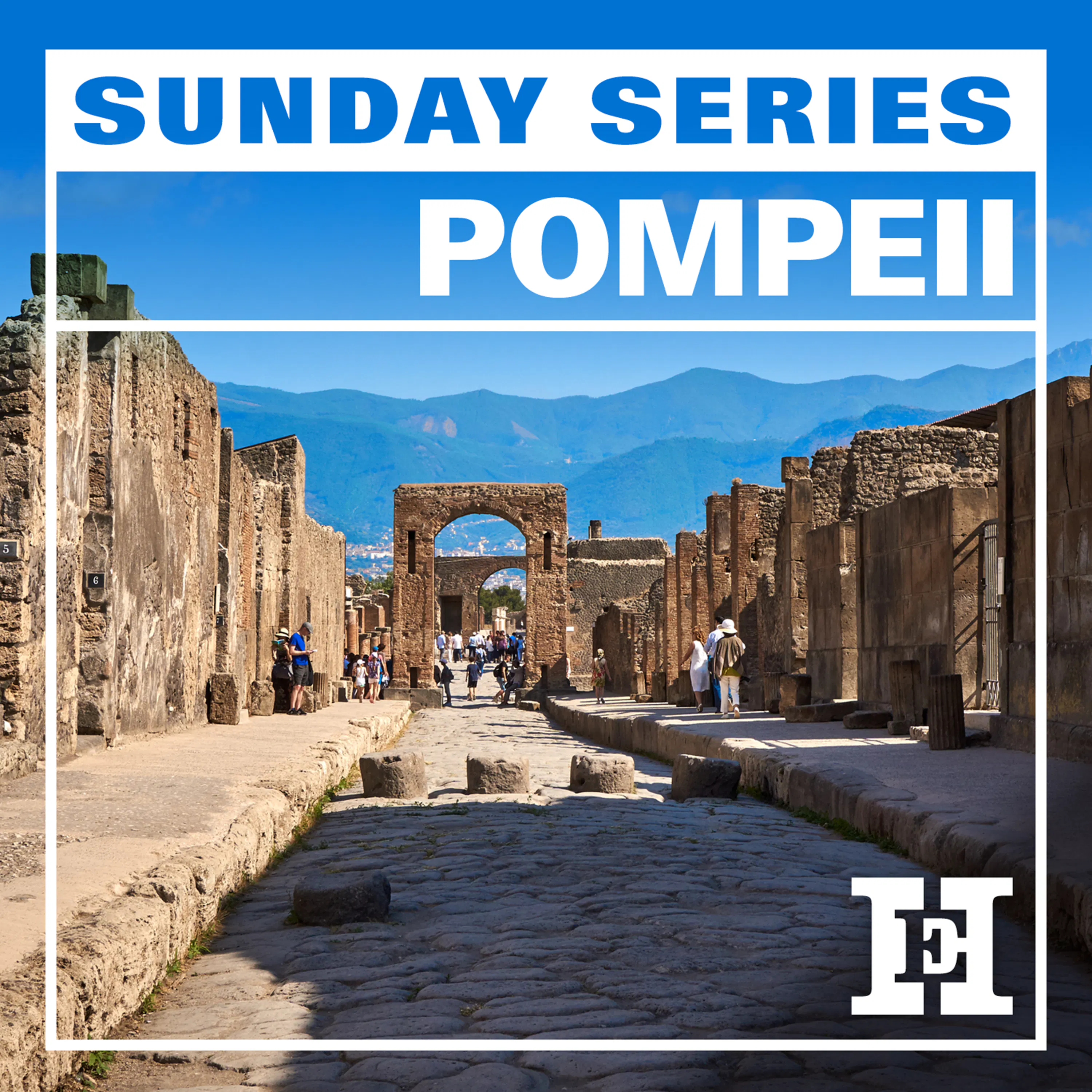
Welcome to the History Extra podcast. Today we've got the fourth and final Part of our Sunday series in which Kev Lottchen is joined by Jess Venner to explore the last days of ancient Pompeii. And if you've enjoyed this series, join us next Sunday when we'll be delving into the creation of and legacy of Magna Carta. But for now, it's over to Jess and Kev.
- [02:59]
Kev Lotchin
Once a thriving Roman city, life in Pompeii stopped suddenly in AD 79 when the nearby volcano Vesuvius erupted, burying the city and its inhabitants under meters of ash. I'm Kev Lotchin and I'm joined today by Dr. Jess Venner, a Roman historian and an expert in Pompeii. Jess, welcome back. Great to have you.
- [03:22]
Dr. Jess Venner
Thank you. Yes, it's good to be back.
- [03:24]
Kev Lotchin
This time we're going to be talking about the artifacts and the arts that have been discovered at Pompeii. But first, we're going to begin with a slightly more ghoulish line, which is, as well as those pieces of art and inanimate artefacts, we've also got quite a lot of human remains and brilliant casts of them. How have we been able to study those in such detail?
- [03:48]
Dr. Jess Venner
Yeah, so one of the first excavators that was really, really important in Pompeii was Giuseppe Fiorelli, and he developed this method of creating these plaster casts. So this was around 1863 that he started doing this, I think. So what he did was you would excavate and you would find a cavity. The reason there was a cavity was because during the eruption, obviously people were overwhelmed by the pyroclastic flows that we've talked about that solidify, so it becomes cement around their bodies and their clothes were preserved and everything. It was such a specific condition that they still had their clothes on, their bodies were preserved in this material. And over time, the bodies decayed, leaving the skeleton. But then there was a cavity. So it preserved the imprints of clothing, of shoes, of jewelry, of facial expressions, and they were sort of petrified in that state. So you go down, you have the cavity and you fill it with plaster of paris. You wait, it sets and then you have the perfect outline of someone's body.
- [04:57]
Kev Lotchin
Are we saying that we have a lot of moulds?
- [05:01]
Dr. Jess Venner
Exactly, yeah. So it's sometimes misinterpreted as this being the body and the body was petrified in some way? No, it's plaster of paris that has filled the impression that their bodies left.
- [05:14]
Kev Lotchin
But it's incredible. You can have all these details. Like, it's not just like the outline of the face. You're saying there are clothes as well, and the kind of imprints of jewellery.
- [05:22]
Dr. Jess Venner
Exactly. There are some that are so, so, so detailed. So there's a mule driver, who we'll speak about later, who's covering his mouth and he's crouching against a wall in the palaestra, where people used to sort of exercise and things. And he's got his knees up, so he's just like sitting on the floor with his knees up and his hands covering his face. He's got, like a cloak on that was typical of what they would have worn, so, like a hooded cloak around him. And then there's other people that have literally can see, like, straps on their sandals, their actual sandals, and the studs on them. And their faces are so distinctive, it's incredible. And over time, these plaster casts have deteriorated themselves as well, so they would have been, in a lot of cases, even more detailed when they were first freshly done. We have over a hundred of them.
- [06:09]
Kev Lotchin
It's still quite small in the context, even of the number of bodies that were found. Right. And is there a difference, then in what we were able to gain from both Pompeii and Herculaneum in that sense? I was just thinking back to the boat sheds and the differences in the pyroclassic flows. Does that make a difference to how we've been able to learn from the people we found?
- [06:28]
Dr. Jess Venner
Yeah. So they only practiced this at Pompeii. Fiorelli did it there. But at Herculaneum, they were overwhelmed by such a huge amount of heat and it cooled down by the time it got to Pompeii. So we have the skeletons there with their cracked skulls and things. So it's a lot more gruesome, but it gives us a different thing again. So they sort of stopped doing this plaster cast method. So when the boat shed people were discovered in the 80s, I think they chose not to do that, but it may not have been possible. Actually, I'm not sure if it was possible because of how it was preserved. So, yeah, it has to be. Again, it's always this thing comes back to very specific conditions that need require these things. But, yeah, very different. We learned very different things from them all.
- [07:11]
Kev Lotchin
And what do the different poses tell us about what we think happened is people? There's one that he's kind of got his arms held up close to his face, almost like he's guarding. But that's given us a particular view. Right, of something that happened.
- [07:23]
Dr. Jess Venner
Yes. That's telling us that they died under extreme heat because their muscles contracted and the human body does that. The muscles contract and the limbs go. It's not just humans either. So we have horses, pigs, dogs, Casts of these animals. Yes. Yep. And they're all doing this sort of this thing with their bodies where they've contracted. The dog in particular, his legs have sort of stretched out and they look all contorted. Cause he's suffering the same fate as everybody else.
- [07:56]
Kev Lotchin
Oh, that's so sad.
- [07:57]
Dr. Jess Venner
Yeah, it's really, really sad. But that is what causes these almost strange poses that they're pulling. But in some cases they're not pulling that. So in the garden of the fugitives, we have quite a few fugitives, hence the name. And there's a man that's leaning up on his elbow. He's leaning over to a child and what seems to be a mother. He was clearly trying to comfort them. It looks like that because he's sort of leaning over. And then he was overwhelmed and he's still leaning to this day.
- [08:27]
Kev Lotchin
So we've kind of got him imprinted at their moment of demise.
- [08:30]
Dr. Jess Venner
Yeah. So even though this force is so, so forceful, it's so quick and surrounds them so quickly that it just fixes them almost in that position.
- [08:40]
Kev Lotchin
Is it possible to identify individuals?
- [08:45]
Dr. Jess Venner
Yeah. So the mule driver that I mentioned, he's a good example because he was found near his mule and he was dressed in the way that we know that they would have been dressed. So that's why he's been called the mule driver. And that does make sense. It's really, really hard in general in Pompeii to work out who anybody was and trace them. And we have names. We just can't always work out where they lived. So we've got a character called Julia Felix. She's very famous. She's sort of like reconstructed in literature and things quite often. And she lived in this huge estate. We know about her because she left a sign that was advertising the use of her Venus baths, which she opened up to the people after AD 62, but only to distinguished people. It says in the theme.
- [09:33]
Kev Lotchin
Gotta have some limitations. Right, sure.
- [09:36]
Dr. Jess Venner
So they were like the posh baths, and she had shops and flats and then her own gardens as well. A businesswoman. So we know about her and we can confer that that was exactly where she lived. Because you have the private part of the house and then you've got all the things that were mentioned in the advertisement. That's a rare case where you can tell where they are in other Cases. So, for example, in the Temple of Isis, we actually have a body under a column, and we can. We can guess that that is one of the priests. They wouldn't necessarily have been Egyptian, the priests. They were often actually Roman in Rome.
- [10:15]
Kev Lotchin
It didn't occur to me when he said that.
- [10:16]
Dr. Jess Venner
Yeah, yeah, yeah. And it's an Egyptian religion, but weirdly, they weren't always Egyptian, which seems wrong, but we know that he was probably working there and protecting the temple. So there are cases where you can trace them, but it's very, very hard to do with any certainty.
- [10:31]
Kev Lotchin
Is there any difficulty in, like, we want to humanize these people? Is there a difficulty in projecting a story onto a human, essentially, that we don't know? How does that challenge play out?
- [10:46]
Dr. Jess Venner
Absolutely, yeah. So so often, I can tell you, it happens so often with women, especially in Pompeii. So often they are related just to brothels. And this is something that's just sort of continued from, you know, the 18th and 19th century where they would view women in this way. And it's still done today. People go to the site and go, oh, ha, ha, there's the brothel. And you think, well, there's Julia Felix, for example, who was a very successful businesswoman and in her own right. And that was unusual in the Roman period on surface level. And what Pompeii is now telling us is actually that wasn't as unusual as you'd think. There are other women that are conducting business. And when I was trying to research my book into ordinary people in Pompeii, I was starting to find all these women on this same street where Julia lived who were putting out electoral programmata, so notices to say, vote for this person, vote for that. They couldn't vote, but they were very much involved in the political process in that way. They had a voice, you know, and it's very easy to imprint ourselves and say women weren't, you know, because the literature says women weren't involved. No, the archaeology is showing they are, you know, and the same thing happens for slaves. They, you know, had very different conditions of living. Some lived very well, others didn't. So the archaeology is telling us a lot that we can't get out of the literature. And it's actually contradicted it in a lot of ways.
- [12:10]
Kev Lotchin
So this is something I find really interesting about Pompeii, conceptually. It's because it's had that, like, moment in time, if you like, of the disaster, that we have a lot more of all levels of society, not just the elites. I'D be really interested what you can tell us you've learnt. That surprised you about what we've learned about those kind of more everyday Pompeians.
- [12:34]
Dr. Jess Venner
I just think this is the most fascinating part of Pompeii for me. I come from like a working to lower middle class background. And so for me, the ordinary people are really, really interesting because we can see ourselves in them. It's hard to see ourselves in the elite and they seem very distant, but they're also the ones that have been pushed the most in reconstructions of Pompeii. And so when you go to the city, they have reconstructed as much as they can or preserved as much as they can, the wealthiest properties. Only now in these new excavations are they starting to find sort of slave quarters and things that are being, you know, we're paying attention to them at last. And we're starting to learn how these people actually lived. Because as we were talking about previously, excavators historically would treasure hunt and disregard those boring, in their words, elements of life, which were actually very normal and ordinary. And they tell us about people like us that were working and living and having friendships and rivalries and, you know, that sort of thing. So, yes, so there are some really lovely examples. And I'm sure we'll talk about the recent excavations, but I think graffiti is one of the most wonderful ways to find about ordinary people.
- [13:51]
Kev Lotchin
We've been talking about graffiti throughout these episodes, but there's lots of it. Is that an unusually high amount of graffiti for a Roman city, or is this kind of what we'd expect?
- [14:01]
Dr. Jess Venner
Really hard to tell because we don't really have comparisons, but there's not a lot in Herculaneum. It's nowhere near as much as in Pompeii. And as we talked about, they were very like, politically savvy in Pompeii. It was quite a harsh environment to be a politician, so they took it very, very seriously. And they were Roman colonies, so that was part of the reason why. Because Herculaneum wasn't a colony, hadn't been colonized, so it was made Roman in quite a forceful way. They would settle Romans in Pompeii after it was colonized in the. So, you know, it's quite recent and that changes how we see the graffiti. So there's such a lot of it. People seem to be quite literate and there's a lot of poetry in the graffiti that you might not expect.
- [14:45]
Kev Lotchin
Is it good poetry?
- [14:47]
Dr. Jess Venner
Good poetry, yes. We've got like Virgil in there and everything. So. Oh.
- [14:51]
Kev Lotchin
So quoting famous poets.
- [14:52]
Dr. Jess Venner
They're quoting poetry. And they're doing their own as well. It seems as well they're also illustrating games on the walls. Or there's one lovely graffiti which is like Minotaurs palace in the labyrinth. They've drawn the labyrinth and said, this is the Minotaurs labyrinth. So there's like, all these different wonderful things. They're just sort of passing the time. And they've got shopping lists which are fabulously interesting for me.
- [15:18]
Kev Lotchin
What is on an average Roman shopping list?
- [15:21]
Dr. Jess Venner
Bread. This sort of, like, porridgey gruel. Pieces of, like, fruit and nuts. Bits of sausage. Yeah.
- [15:29]
Kev Lotchin
That I didn't expect.
- [15:30]
Dr. Jess Venner
Yeah, they would eat that a lot. And pork was really important. Like, it was very popular pork in Pompeii, whereas in Hycarinum it was fish. So you'd have had a different shopping list there. But it's just funny that they were writing their shopping lists on the wall. This shopping list says, on this day, I bought a loaf of bread. And then it's like two bread, one porridge. Like poles.
- [15:53]
Kev Lotchin
It's fascinating. This graffiti ranges from the highly artistic to the surprisingly banal.
- [15:58]
Dr. Jess Venner
Mm. Oh, yeah. No, it can be really, really boring. Yeah. Or this date that we were talking about, the charcoal graffiti, why did they write, you know, on this day, I had a meal.
- [16:09]
Kev Lotchin
It's going into, like, Claudius Wazir territory.
- [16:11]
Dr. Jess Venner
Oh, my God. It's literally like that. Yes. In the brothel, for example, we've got the names of the girls that worked there, but we also have people that are talking about their experiences in the brothel as well.
- [16:21]
Kev Lotchin
So it's kind of like leaving an online review.
- [16:24]
Dr. Jess Venner
Ye. Yes. Yes. It's very Yelp. Yes.
- [16:26]
Kev Lotchin
That's so. I mean, interesting. Worrying. I don't know which adjective I wanna make it.
- [16:31]
Dr. Jess Venner
I don't know how I take it, to be honest, but at least the girls were in a relatively secure environment, I suppose is the only way you can probably put that, to try and put a positive spin on it. But clearly they were working there regularly because their names were written out. Like, I was with so and so and. Yeah, so really, really vivid image of these people's lives and their names.
- [16:53]
Kev Lotchin
Yeah. And it's really interesting to get that as well, just from these kind of, like, graffiti sources, as well as, like, being able to infer from the casts as well.
- [16:59]
Dr. Jess Venner
Yes.
- [17:00]
Kev Lotchin
We've spoken so much about graffiti, this feels like a good time to bring in our regular segments. Every week, I've asked you to highlight a piece of graffiti that you found particularly wonderful. Whimsical. Jess, what have you got for us this time?
- [17:15]
Dr. Jess Venner
Okay, so I might do two.
- [17:18]
Kev Lotchin
Do two. Let's go for it.
- [17:19]
Dr. Jess Venner
Ha, ha. One of them is an image of a politician with a huge nose.
- [17:26]
Kev Lotchin
Okay.
- [17:26]
Dr. Jess Venner
Yeah. He's got, like, the laurel wreath around his head. It's very distinct. He kind of looks a bit Julius Caesarish, whereas his side profile, and he's got a huge, long, bulbous nose and a bald head. And they've tried to draw it underneath and they clearly didn't like that. So they started again and it's over this, like, fresco, this black fresco. That's quite nice.
- [17:47]
Kev Lotchin
Yeah.
- [17:48]
Dr. Jess Venner
So I don't know who's done this, but above it they've put Rufus est, which means this is Rufus. So I tried to have a look and I was trying to find. And it's in the Villa of the Mysteries, which is very famous because it's got that. Yes, it's got that Mysteries painting. So that's where it is. So it's a very, very wealthy villa and someone's taken the time to draw that out. I tried to find Rufus, and there's many different Rufus characters in politics in Pompeii. So clearly this was one of them. So we've got this incredibly, incredibly unique image of someone that must have lived in Pompeii.
- [18:25]
Kev Lotchin
My question would be, if this is a politician, is the big nose, Is that representing a kind of sense of Roman stature? Is that a positive thing or is it actually a satirical.
- [18:37]
Dr. Jess Venner
Yeah, it feels satirical, this. It looks like a caricature, the drawing. It's quite a good caricature, actually. You've sort of got his feature of his chin sticking out and a little ear and little eye with, like, a sort of, like, eye. It's almost like he's got his eyes closed and the nose is just sticking out a bit. Like that Chad character. Do you remember Chad? Oh, yeah. He used to put his nose over a wall and that was, like a thing you would draw and it was.
- [19:03]
Kev Lotchin
Just a nose, right?
- [19:04]
Dr. Jess Venner
Yeah, yeah, yeah. But Rufus, it sort of refers to, like, being red haired.
- [19:08]
Kev Lotchin
Yes.
- [19:09]
Dr. Jess Venner
And he's got no hair. Maybe that's a joke as well. I don't know. They were very funny. I think they had a good sense of humor. So I thought I would talk also about this other piece of graffiti which is put inside a box and they've written, secundus greets his prima, wherever she is, I beg you, lady, love me. And this is funny because Secundus and Prima is second and first. And we see these names pop up in this sort of context in graffiti elsewhere as well. So whether they actually existed and this secundus keeps writing about Prima and they just happen to be called second and first or. Cause that would be common. That's quite a common thing. Or it's something that people do as like a code maybe. So this is a bit of a mystery, this one, this love letter. And there are lots of different comparisons. We get lots of love letters throughout Pompeii in graffiti. So we've got one that says, lovers like bees, lead a honeyed life. And then someone replied underneath, I wish. It's just lovely. So we've got all these funny things, all like, Sabinus, handsome guy, Hermarus loves you, just so sweet. I just love them. I think it's really nice. And then there's another one that says, if anyone should look upon my girlfriend, she'll see that she looks like Venus. And this lovely, heartfelt graffiti of these relationships that are happening all over the city.
- [20:36]
Kev Lotchin
Post. Does that kind of thing exist?
- [20:37]
Dr. Jess Venner
Yeah.
- [20:38]
Kev Lotchin
Do you just write on a wall and be. I hope someone sees it.
- [20:40]
Dr. Jess Venner
Yeah, well, exactly. And it would be in areas that were highly frequented. Usually they sort of cluster around busy streets. And the amphitheater has loads as well. So we've got like inscriptions that say, this is so and so's booth. Basically, don't use it. Cause this is my spot for my stall.
- [20:58]
Kev Lotchin
Yep. Chuck your towel down. There you go.
- [21:01]
Dr. Jess Venner
Exactly. We have other reviews as well. Like it's quite a common one for them to say, oh, the innkeeper keeps the good wine for himself. Or there was one that's really graphic who says something like, he didn't give me somewhere to go to the loo, so I went in his inn and it's like this review that they've left and then they're like, okay, yeah, that's.
- [21:23]
Kev Lotchin
The other side of it. It's like. It's like the Internet. It's part Yelp, it's part Reddit. Seems to be a lot.
- [21:30]
Dr. Jess Venner
Oh, yes, it is a bit like that.
- [21:32]
Kev Lotchin
Yeah. When you got people's sassy comments on the bottom and it's like you're adding nothing to this conversation, but you're getting involved anyway. Thank you very much.
- [21:38]
Dr. Jess Venner
Exactly. And they just sign off. They're like, mic drop done.
- [21:41]
Kev Lotchin
Yeah, that's incredible.
- [21:43]
Dr. Jess Venner
So funny.
- [21:47]
History Extra Podcast Narrator
This History Extra podcast is brought to you by Rocket Money. Throughout history, experts have offered various solutions for ensuring your financial well being. In the medieval era, for instance, carefully managing an unlikely resource eels could ensure that you had an effective, if unusual, way of paying your debts. For steely eyed Victorian industrialist Andrew Carnegie, ruthless efficiency was key to balancing the books. But it's not always easy, as my own attempts to keep track of my finances suggest. But help is at hand. Rocket Money is a personal finance app that helps find and cancel your unwanted subscriptions, monitors your spending and helps lower your bills so you can grow your savings. Rocket Money automatically categorizes what you're spending across your accounts, letting you choose the categories and tags you need to successfully manage your finances and track patterns in your outgoings. It also consolidates checking, savings, loans and investments into a single helpful dashboard offering a crystal clear view of your financial picture. Let Rocket Money help you reach your financial goals faster. Join@RocketMoney.com HistoryExtra that's RocketMoney.com HistoryExtra RocketMoney.com HistoryExtra.
- [23:00]
Kev Lotchin
Now, as well as the graffiti, we also have erotic R and it seems to be everywhere in Pompeii as well. Again, is that usual for Roman cities? As a very Pompeian thing?
- [23:09]
Dr. Jess Venner
Yeah. No, they weren't prudes like we might be today. A bit more. They were very much more open about this sort of sexual relationships and how they view. I think they had a good sense of humour as well. I think there was some level of that. It's always presented in the brothel, like, oh, these are advertisements of what you can be experiencing here and it is kind of like that. But you can also see erotic art in mythology as well. There's some of those too. A good example is in the House of the Vetti. So we think that they were two freedmen brothers who were vintners, potentially. Again, it's all this potentially because we can't really know for certain about these people or where they lived. But it's called the House of the Vetti. It's a beautiful house, not huge, but very well decorated and they were big on like showing that they were in business. So I love it anyway. But you walk in and you haven't even entered the house yet. And on your right you've got Priapus. Now, Priapus was a God of fertility and a symbol of luck. He would sort of ward off the evil eye with his huge phallus. And to the right he's measuring his phallus with money. So they're making this like crude reference not only to being wealthy but also having him as their protector.
- [24:25]
Kev Lotchin
Depictions of purpose. They're not subtle Are they?
- [24:27]
Dr. Jess Venner
Oh, not at all, no, they're. No, no, no. This isn't subtle at all. This is an incredibly graphic image. And I think everyone that goes there today are like, oh my God, what's he doing there? It's so in your face and 100%. It was like a bit of a joke as well, I think. Cause it's like he's weighing his phallus. So. So you've not even got in yet and there's already some. Something. We would view it as erotic. They wouldn't view him as. But then you get in and in the house of the Vetti, in the left wall of the entrance hall, we have a bit of graffiti that says Eutychus, Greek, nice mannered for two coins. So she. And they're the smallest coins as well, an as. So she is being offered. She's potentially a slave in this house, Greek slave. And she's being offered for prostitution by the owners of this house. So anyone that enters the atrium. An atrium is quite a public space. It's inside the home. But technically anybody can enter into that because it's the public part of the house. And then beyond that you have to be privileged to enter and have a relationship with the person of the house, the owners of the house. So we've got that there. And that's quite confronting and horrible to think about because it's so sad. Like describing her as nice mannered. And they're the smallest coins you can have. Pretty much like amongst the smallest coins you can have to pay for her with. I just think that's awful. And then we have a really, really interesting and rare instance of what seems to be a brothel. It may be a brothel, it may be like a small room that's used for that sort of activity. Now these sort of places are liminal in the sense that they like where the kitchen is. So the kitchen usually has a latrine in it, which we would think is disgusting now. But they thought, well, all of the smells go together. You can chuck up, you know, your wastewater into the latrine. That works quite nicely. So they would do all their business in there and just off of that kitchen. So we're in the lower class area of the house. Here you've got this room with this erotic art, people in bed together, doing all these different moves. And this is in that room. So Utica's probably used that room. So they've got this incredibly rare instance where we can link a person to a house that isn't the owner and where they would have been operating as well. Prostitution was really, really common. They would walk around in togas. That's how you could identify a prostitute. There are about 20, between 25 and 35 brothels in Pompeii, we think. There's the very famous one, the Lupinate. Lupinar. It comes from she wolf, which is potentially why there's a wolf. That's the sign of Rome, because it was a she wolf and they probably mistranslated on purpose the fact that it was actually a prostitute that looked after Romulus and Remus, which is interesting anyway. But, yes, it's a really confronting place to go. I think people look at it in good humour, but I'm not in that camp, unfortunately.
- [27:23]
Kev Lotchin
And is the Eroto car, is that limited to aristocratic dwellings? Would we find that all over Pompeo?
- [27:29]
Dr. Jess Venner
Yes, that tends to be the case. Although part of that problem is the fact that we haven't really preserved lower class houses as well as we have the elite ones, so. But I would say yes, because it's a huge investment to have a fresco painted, especially a detailed one. And then you've got humans in it as well, which are hard to depict, so you have to be quite skilled. So, yes, it is in those cases, or in the cases where that activity seems to be happening.
- [27:56]
Kev Lotchin
Yeah. And we shouldn't be surprised they find this. I mean, the phallus, as I'd say, is actually kind of a symbol of protection as much as anything else.
- [28:02]
Dr. Jess Venner
Yeah. It wards off the evil eye. So we have, again, this is where we're imprinting our modern ideas onto these things. They're not seen as erotic. The phallus. You'd wear it as jewelry or you would have it as his wind chimes were big phallus with, like wings and things. It was just a common thing.
- [28:23]
Kev Lotchin
You say that, you know, we're a bit more prudish about it and they didn't view it as erotic. How did that kind of disconnect manifest itself, do you think, when Pompeii was rediscovered in, like the 16th, 17th century? I mean, there's a clash there, isn't there?
- [28:39]
Dr. Jess Venner
Yeah. And Catholicism was so, so prevalent and still is, and it was a shock and an embarrassment to them. They were like, this is fantastic. We found Pompeii. Look at all these wonderful things coming out. Oh, my God. They're depicting in very graphic detail these sex scenes, essentially. And it was like, oh, no, we can't have this. And then there was, you know, these phallic symbols coming out in jewelry. And in wind chimes and stuff. So they locked it all away in this secret cabinet.
- [29:10]
Kev Lotchin
So they did excavate it and then just be like. But no one can see it.
- [29:13]
Dr. Jess Venner
No, no, no. You had to be very important to get into this secret cabinet.
- [29:18]
Kev Lotchin
And a cabinet's like a gallery, right? It's not like literally a cabinet.
- [29:21]
Dr. Jess Venner
Exactly. Yes. Yeah. And you can go to it today. Naples Archaeological Museum. I always, funnily enough, struggle to find it when I go there. It's very secret, but it is literally, like behind this wall and then you, like walk in and they've kept all of this stuff and some of it's not. And some of it is incredibly shocking. Like Pan fornicating with a goat.
- [29:44]
Kev Lotchin
Pan is a God who is also a goat.
- [29:47]
Dr. Jess Venner
Yeah, yeah. And he is having a good time with this goat. And it's very graphic. That's in there. But then you've got stuff like we were talking about Priapus, who wasn't seen as erotic. And so there's like. Yeah, there's a lot in there. It's a shark. Actually. I think it's even worse because they've put it all in one place, so it just makes it very.
- [30:07]
Kev Lotchin
Yeah, it's overload, isn't it?
- [30:09]
Dr. Jess Venner
Yeah.
- [30:09]
Kev Lotchin
Right.
- [30:09]
Dr. Jess Venner
Yeah. They've almost made the situation worse, but. Yeah. So they tried to downplay all of this and sort of keep it on the hush hush. But equally, like, they were very high quality statues and things, so they wanted to keep them. They knew they should.
- [30:21]
Kev Lotchin
Thankfully, Pompeii has some wonderful examples of Roman homes. Now, we don't have space in this episode to talk about all of them, but my colleague Emily Brifitt has recorded a wonderful interview with historian Hannah Platz, answering listener questions about the Roman home. You can hear that on the History Extra app. Have a look for a link for that in the episode description. Now, Jess, the other thing we need to talk about, as well as, you know, erotic art, there's one particular fresco of what we would consider today something intrinsically Italian. Pizza. You know exactly what I'm talking about.
- [30:54]
Dr. Jess Venner
I do. I got so many text messages on that day when it was announced. It was very funny. Yeah. So what we have is what looks like a pizza with toppings on the top. And it was discovered in 2023. It's a fresco, so it's very beautiful fresco. Cause it's very colourful. It's lovely. And it's actually just. It's not pizza. It's really just a flat focaccia style bread that they still have in the region today, which is sort of like the precursor to pizza, I guess, because you would just have flatbreads and then you would sort of put like fruit and cheese and like herbs maybe on top. So it does kind of feel like a pizza. But because of the colors they've used, it looks like you've got tomato and cheese on the top. We didn't have tomatoes until much, much, much, much later. So obviously it's a very Italian thing now, but. Nope, didn't have those. And then the cheese. Yeah, you would have cheese, but they'd usually have like hard cheese or ricotta type cheese. But, yeah, unfortunately, no, it's just a flatbread.
- [31:51]
Kev Lotchin
Breaking my heart here, Jess. Absolutely. So the pizza, not pizza. Is one of the more recent finds from Pompeii. What else is going on in the world of recent excavations that's really exciting. You.
- [32:04]
Dr. Jess Venner
Oh, my God, there's so much. So in 2021, they were excavating a villa of Civita Giuliana, rustic villa, where they would have produced, like, vines and things. And this is very common outside of a city. You would have all the villas and then it would progressively become more and more farmland. So tragically, they found, like, this tiny space that seems to have been the room. It's like a cupboard. The room that it was used by slaves to sleep in. They had three beds. I don't think they even had mattresses on them because I think they've got the impressions of the, like, strings that would have been on the bottom and a chamber pot. And there was also a mouse found in there. So you kind of get an idea of the fact that it wasn't clean even. It was, you know, really, really graphic stuff. So that's. That's a real shame. And then on that theme, more recently, the slave bakery was found. And there's sort of like a small window, but not really. So it had been really dark in there. And they had the mills. So the mills are in the ground and these slaves would have just walked round and round and round these mills and they were chained in there and that was just their existence. So that was a really hard one to find. I think the archaeologists would have really struggled finding that one. And then we've got the black room, which is much more light hearted, thankfully, despite the name. Oh, yes. Yeah. Lavishly painted dining room with mythological frescoes. It's really beautiful. We've even got like a little panther and things. It's lovely. It would have been black because it would have been preventing the soot from sticking on the walls.
- [33:40]
Kev Lotchin
But.
- [33:40]
Dr. Jess Venner
Well, you wouldn't prevent it, but you wouldn't be able to see the soot as much. So this was very typical in a dining room to have black. And it's a lovely effect because then you've got the lamps in there and like, I guess the paintings would have looked like they were dancing around a little bit and stuff.
- [33:57]
Kev Lotchin
It sounds magical. Is that a typical Roman thing from what you're saying, that black was a dining room colour?
- [34:01]
Dr. Jess Venner
Yeah, yeah, it was, yeah. You do tend to find this. And again, in the museums in Rome, we've got some. We've got some rooms of like, frescoes and you do see this theme coming out where there's black frescoes and they're beautiful. They're amongst my favourite, the black ones. Yes.
- [34:17]
Kev Lotchin
So interesting we discussed earlier to kind of get this kind of view from something that isn't an elite home.
- [34:23]
Dr. Jess Venner
Yes, yeah, exactly. This is coming out more and more and more in the excavations. And it doesn't mean that it's because this area that they're excavating has more of that stuff. It just means that previously we've ignored it, tended to ignore it, and they've just been gutted, basically, these rooms previously. This is a really unique opportunity to start looking at these lower class lives and reconstructing them from the archaeology instead of hearing about it through literature. Because that obviously carries its own biases, the ancient literature about what slaves were like and what lower class people were like and what business people were like. So it's really nice that we're starting to prioritize these things in archaeology, thankfully. I'm very pleased. So then there's another example of these two wax tablets that were found in the Palaestra baths in Pompeii. So this is these baths that had been converted in. In the other side of the city and they relate to alone between two women. Oh, it's just great. So we've got a freed woman who was Poppaea Note. And we've got Decidia Margaridis. I think I'm saying her name. Right. So Poppaea borrowed money from Dikidia and transferred two of her slaves as collateral. And they were called Simplex and Petronas. So we know the names of the slaves and we can see this loan happening between these two women. And it was quite a lot of money. It was a lot of money that she was leaving to loan. So these slaves were clearly worth about that. So it's amazing. I just think that's wonderful. These, like Tablets were just preserved there and it was in the 60s AD, so during the eruption, someone seems to have panicked, grabbed some materials. Things like wax tablets would have been good because they'd have had records and then ended up in these palatia bravs because it would have been quite open and people would have been hiding in there and at some point has left those behind. And so now we have this amazing record of alone between two women and.
- [36:13]
Kev Lotchin
Our finds like that. The wax tablets, are they rarer than, say, finding a fresco?
- [36:17]
Dr. Jess Venner
Yes, yeah, yeah, yeah, definitely. We had loads from Kaecilius House.
- [36:20]
Kev Lotchin
Yes. My friend Kaikilius.
- [36:22]
Dr. Jess Venner
Yeah. That fell through the ceiling. They were in, like, a lockbox, it seems, and there were loads of them, whereas elsewhere in the town they do pop up, but it's very, very rare. So we've got all the scrolls in Herculaneum, of course, and they're now being translated, but it's very, very rare to find these sort of records.
- [36:41]
Kev Lotchin
We've not covered the scrolls at all. Can you tell us about those, what they are?
- [36:44]
Dr. Jess Venner
Yeah. So it's in the Villa de Papyri now, appropriately, it wasn't called that. Yes, exactly. And they've so far found a philosophical library of these scrolls which are now being translated with the help of technology and AI, and they're making great strides. And all these incredibly intelligent young individuals are using technology and particularly, they are mostly very young and they are doing these incredible things to translate. And we've had words come out of these scrolls now, so we've got. Purple was one of them. But what's interesting about this is that you usually in these elite houses, have philosophical library and then you have a Latin library. We haven't found the Latin one yet. There isn't the Latin one. So there's probably one in the villa to be excavated somewhere.
- [37:31]
Kev Lotchin
It's in the missing third.
- [37:32]
Dr. Jess Venner
Yes. I can't wait.
- [37:34]
Kev Lotchin
Jess, we've talked about Pompeii. We've got two thirds of it excavated. I wonder. You give us, like, an overview of what the city looks like. Try and almost walk us through it, if that's possible.
- [37:44]
Dr. Jess Venner
Yeah, I can. So it's about 66 hectares, I think. So it's very big city. I think people are surprised when they go. So you'll go through one of the gates. There are various gates to go through. You'll probably enter from the harbour, which would have been the harbour area, and you'll walk up this hill and you're in pretty much the forum, and you've got the Forum that opens out this big rectangular space and around that there's like a market building. There was what we think might have been like the slave auction building. Places that are dedicated to religion. So like the temple of Jupiter loomed down over the forum and behind it was the image of Vesuvius. Vesuvius is literally looming behind him. And then you come out of the Forum and you go into one of the streets. Now there's this street called the Via della Bondanza and it is the street of abundance and it's where people would go to shop. And there's many, many, many shops down this street. You would go and eat and get some fast food from one of the taverns and you would go and have a drink and you would take your washing because there was a fuller's down there as well with all the vats inside.
- [38:52]
Kev Lotchin
The urenvats, right?
- [38:53]
Dr. Jess Venner
Yep, the urenvats, exactly. And the streets had the stepping stones so you could avoid the muck that was flowing down the streets. They had one way systems too. Yep. And fountains that would block the one way systems so you could just go and get your water from one of the fountains. So in the southeastern corner we have the large amphitheater where all of the gladiator fights would have happened. So that's a very good little district there. And quite a lot of wealthy houses there too. And that's surrounded by lots of gardens. It's very green. There was a lot. I think it was like a third of the city was green. There was a lot.
- [39:31]
Kev Lotchin
That's a good ratio.
- [39:32]
Dr. Jess Venner
Yeah, yeah. Cause everybody, everybody that was worth something had a garden of some sort. But this part is like the urban agricultural area. So we had vineyards and orchards which people don't really realise. You come out of that bit. And there's the Greek sector. To the left of that we've got like the Temple of Isis which is attached to the Greek theater. And this is where you would go to see all the plays. And we've got another sort of like forum ish area, small and some baths. And the baths in Pompeii are huge. We've got a couple of really, really big ones and then we've got some smaller ones as well. One being in Julia Felix's estate which is opposite the large amphitheater and the palaestra. And then throughout the rest of the city you sort of have these different districts that seem to be there of like wealthy pockets almost or shopping streets again. So yeah, there's a lot. And then outside of the city you Walk, you know, not very far. And there's the Villa of the Mysteries. The Villa of the Mysteries. It was a vineyard, a very prolific vineyard. But the Villa of the Mysteries has Dionysiac ritual going on, we think. And it might be a marriage as well, marriage preparations. Because this is one woman that's looking at the audience and everybody else seems to be engaged in what they're doing. She's looking right at you. She's very mysterious. We're still not sure exactly what was going on, but it makes sense that Dionysus, who was the God of wine, was in a vineyard. So it doesn't seem too mysterious when you think of it like that. But we've got, like, all these different characters frolicking throughout the house in these frescoes. It's just. It's great.
- [41:07]
Kev Lotchin
Jess, we've talked a lot about Pompeii. Why do you think it is that Pompeii is the town we think of, rather than Herculaneum, where many of these events happened in similar or exactly the same ways?
- [41:20]
Dr. Jess Venner
Yes, exactly. And actually all these other towns that are in the surrounding area sort of stabii never talked. Exactly. They're just never really talked about. Most people don't even know they exist. Pompeii is one of these things. It became a bit glamorous, and it was partly down to what we discussed previously about kings and people in high positions using it to legitimize their own rule. So I think that it started there. You then had the Grand Tour, which was sort of like. It glamorized it again. And it was like this rite of passage that you would go to Pompeii and you draw and you would talk about, you know, recite Byron or whatever, I don't know. And then that just sort of became. It became part of popular culture, and it was something that you would go. It was like they would produce these souvenir books, even of, like, these illustrations of the site. And that happened. You know, that's been happening for two, 300 years now. So I think that's just stuck, unfortunately, even though Herculaneum, most people prefer when they go, because it's so much smaller and, you know, not all of it's excavated. It probably won't ever be because people live on top of most of it. But it is a fascinating place. Herculaneum, you can get around it in half a day, whereas Pompeii, you'd have to spend days to do it properly.
- [42:37]
Kev Lotchin
Yeah, as you said, 66 hectares. Massive.
- [42:40]
Dr. Jess Venner
It's huge. Yeah.
- [42:42]
Kev Lotchin
It's really interesting, this idea that Pompeii is such a touristic site. And I wondered how you felt in terms of. It's a tourist site, but it's also a site of disaster. And it's a place where we are looking at human remains in a way that maybe we wouldn't. Rubber disasters. And I just wondered what your feelings were about the way we combine those.
- [43:05]
Dr. Jess Venner
Yeah, it's a really hard subject, as an archaeologist, to make sure you're honoring their memory. And I think, you know, particularly the Romans had a really strong feeling towards legacy and being remembered. If you were forgotten, you sort of didn't exist anymore. So in that way, we're doing them a justice. However, you know, there is a fine line between education and presenting someone's body in their final, most painful moments. And I just think that I struggle with that. And I have many a time turned up at Pompeii and been there many, many times, and it still makes me cry looking at them, you know, like with the garden of the fugitives, where they're all lying out and there's toddlers. I just think. I feel like this should be private because I don't think that anyone would want to be remembered like that. And so we probably need to put more into talking about the ordinary people and remembering how they lived and that it was a vibrant, beautiful city where there's a lot going on and a lot of characters that we've gone over, particularly in the graffiti, instead of these last horrid moments that they were sad, you know, unfortunate enough to experience.
- [44:19]
Kev Lotchin
There's a lot of conversation with Pompeii about when you're seeing the cast of these people, you're kind of like capturing a moment that's frozen in time. And there's also a sense in some court as well, frozen in time conversation is a bit of a simplification. I wondered where you sat on that.
- [44:35]
Dr. Jess Venner
Yeah, it is. Yes. And as we discussed in the episode where we were talking about the timeline, you can see that it happens over a day, plus, you know, it's a long period of time, so they're not being frozen like it didn't happen, and that was that. And they had no idea like it was happening. But saying that, you know, the bodies in particular are frozen in their last, literal, last moments. Like the guy that's leaning on his elbow, you know, he wasn't even in the boxer pose. He was literally in that position, leaning over to talk to someone, to comfort them. So in that sense, it is frozen in time. And it is frozen in time in the sense that everybody died from the same thing in the same way. And so that gives us a snapshot, a slice of Roman life, and we can look into that and understand how they were exactly on that day.
- [45:24]
Kev Lotchin
Jess, thank you so much for all of us. It's been wonderful.
- [45:27]
Dr. Jess Venner
Oh, I've loved it. Thank you so much.
- [45:30]
Kev Lotchin
So that is the story of Pompeii, from foreboding tremors to unimaginable terror, right through to archaeological marvels. You can find out more about the story by going beyond the podcast on the History Extra app. Check out the episode description for my curated list of content on Pompeii, Vesuvius and the wider Roman Empire.
- [45:59]
Chandler Garcia
Hi, I'm Chandler Garcia. As a PICU nurse and global health advocate, I've cared for women and children all over the world, from Costa Rica to Egypt to Kenya and beyond. And no matter where I go or how tough the conditions get, I always wear my figs. These scrubs are lightweight, breathable and super soft. Perfect for long shifts in any environment. They've got pockets in all the right places, the fit is flexible and they're durable through every admission, surgery and post op. But it's not just about the scrubs. Another big part of what I love about figs is when they say they're committed to supporting healthcare workers all over the world, they mean it. I recently joined them on an impact trip to India, where I worked in triage caring for babies in a mobile clinic. My figs aren't just what I wear, they're part of the impact I want to make. Wherever my work takes me, FIGS helps me show up ready to make a difference while looking and feeling my best. Get 15 off your first order at Wearfigs.com with code FIGSRX. That's Wearfigs.com code FIGSRX.