Loading summary
Transcript37 lines
- [00:00]
Navy Recruiter
You say you'll never join the Navy, never climb Mount Fuji on a port visit, or break the sound barrier. Joining the Navy sounds crazy. Saying never actually is. Learn why@navy.com America's Navy forged by the.
- [00:15]
Navy Advertiser
Sea Support for this podcast and the following message comes from America's Navy the Navy offers new graduates hands on training and experience in careers like computer science, aviation and medicine. Plus education and sign on bonuses. Parents help your grads start their career today@navy.com.
- [00:37]
Podcast Host
This is a history extra production.
- [00:40]
Rob Attar
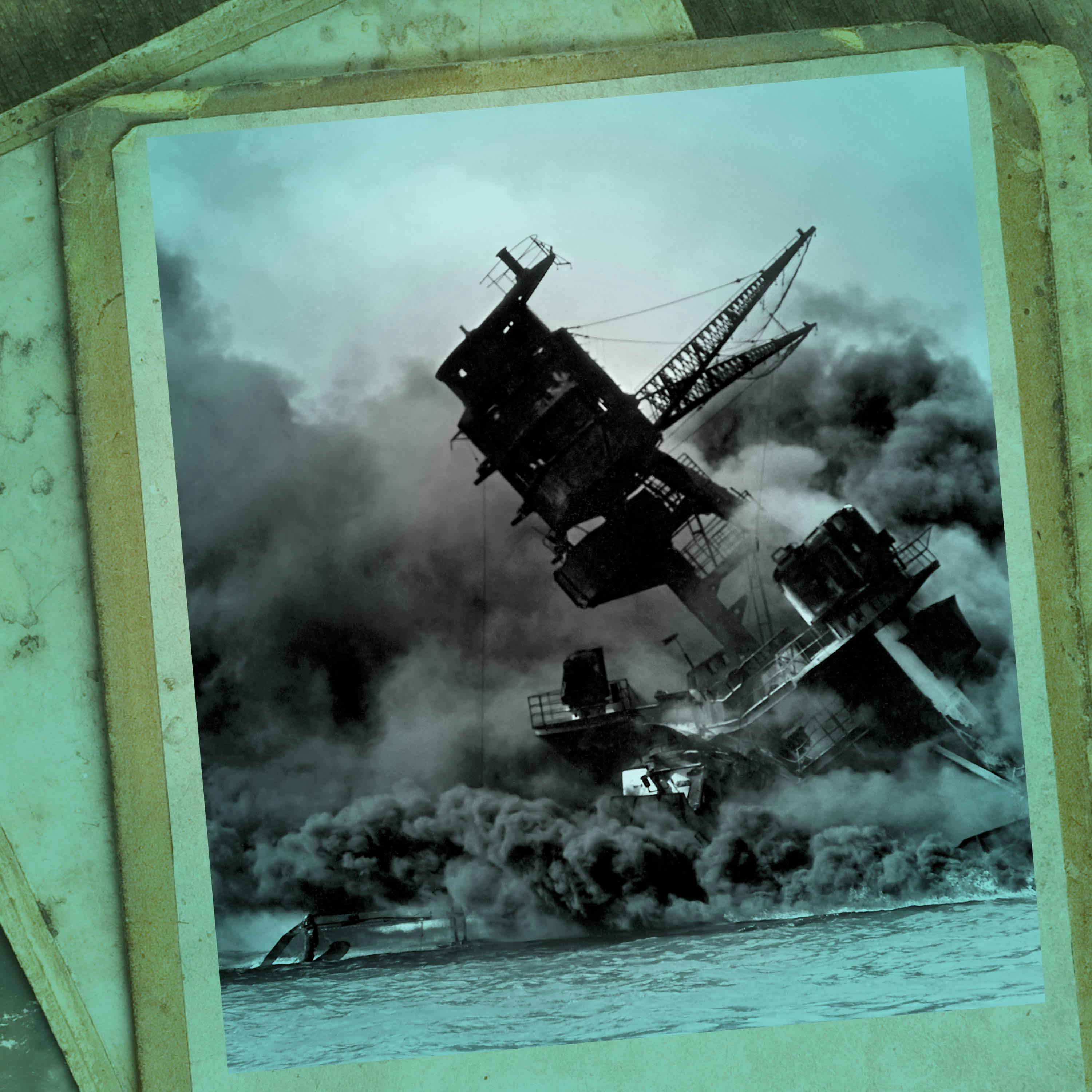
On 7th December 1941, a day that would live in infamy, Japan attacked the US naval base at Pearl harbor, killing more than 2,400 people, sinking a number of ships and destroying dozens of aircraft. It's one of the most notorious surprise attacks in history. But how much of a surprise was it? Did US President Franklin Roosevelt know the attack was coming and even encourage it as a means of propelling the US into World War II? Welcome to episode one of season two of History's Greatest Conspiracy Theories from History Extra, I'm Rob Attar and to explore this backdoor to war conspiracy theory, I was joined by Steve Toomey, a Pulitzer Prize winning journalist and author of Countdown to Pearl Harbour. The 12 days to the Attack.
- [01:34]
Steve Toomey
Before we dig into the conspiracy theories, I wonder if you could briefly explain the events of 7 December 1941, the attack on Pearl Harbor.
- [01:43]
Podcast Host
The attack occurred at a time of incredibly tense relations between the United States and Japan. For months the two sides have been negotiating about how, my phrase, to get Japan to behave better. It was already at war in China. It had already extorted Indochina, or at least part of it from the French. There were negotiations going on in Washington about how to resolve things, the issues in the Pacific, amicably and peacefully. Those negotiations were ongoing in Washington in the first week of December 1941, unbeknownst, and we'll get to this to the United States, Japan had already made the decision to go to war with the United States as well as with just about everyone else in the Pacific. And so the attack occurred during these negotiations, which added to the sense of betrayal and surprise that followed the attack itself. So this was not a case of the Pacific being a calm theatre of war while war raged in Europe, the Pacific was waiting to explode.
- [02:47]
Podcast Guest
Really.
- [02:48]
Steve Toomey
So you're talking about using words like surprise and betrayal. Now, a lot of the conspiracy theories about Pearl harbor centre on this idea that actually the U.S. and its president knew the attack was coming and allowed it to happen anyway. So on that you mentioned the Pacific was not a calm ocean at this time. To what extent did the US Know or suspect that some kind of Japanese attack was imminent?
- [03:12]
Podcast Host
The United States expected war in the Pacific any minute. One of the difficulties in discussing the conspiracies surrounding Pearl harbor is the fact that many people think a surprise meant that it came out of nowhere. There was no reason for this. There was no context for this, and that's not true. Everyone in the United States government, from the President on down, expected war in the Pacific to break out at any minute. They had a lot of evidence of that. Everyone in the world knew that a large Japanese invasion force had set sail and was bound for the southwest Pacific, toward Malaya and Singapore, Indochina, Indonesia, and most importantly, toward what was an American colony at that time, the Philippines. So the knowledge of that advancing force was widespread. It was literally in all the papers. So great or so concerned was the White House about where things were headed that it sent a message to Congress not to adjourn for the Christmas holidays because it might be needed to declare war. And this was all prior to the attack. So Franklin Roosevelt expected war. The American Navy, the American army expected war. What they didn't expect is where it actually also broke out.
- [04:35]
Steve Toomey
One of the things that's put forward quite often in support of the conspiracy theory is that various Japanese codes or forms of US Intelligence had given the US Advanced knowledge of exactly where the attack was coming. What did they actually know from Japanese code intercepts and things like that? Did they have that kind of specifics?
- [04:56]
Podcast Host
The Japanese had many different codes, and the one that was broken was the Japanese highest level diplomatic code. Diplomatic code means the code that Tokyo used to converse with its embassies and consulates around the world. The US had broken that code in what really is an amazing feat of engineering and was reading Japanese diplomatic messages in real time. It wasn't a case of them reading them weeks later. They were reading them within 24 or 48 hours. Those codes which they were reading clearly indicated that something big was going to happen. Tokyo was telling its embassy in Washington where the negotiations were taking place that big things are going to happen very soon unless we get a breakthrough here in terms of negotiations with the Americans. At no time did the diplomatic code disclose to the diplomats the targets of any attack or when it would occur, and there would be no reason for that. Tokyo had no reason to tell its diplomats the specifics of military operations. It simply was trying to alert them to what it was bent on, which was war in the Pacific. And when the US Read about these things that were automatically going to happen. As one message put it, that comported with what other intelligence showed them about the advance of Japanese fleets in the Far eastern Pacific, southwest, Pacific, north. So simply being told that something big was going to happen very soon didn't say Pearl Harbor. It comported with what seemed to be the plan of the Japanese, which was to expand their empire in their portion of the Pacific. The United States had not broken the most important code, at least in military terms, which was the Japanese naval code. How the Japanese military hierarchy in Tokyo communicated with ships at sea. The United States was not reading that code and wouldn't break it until after the war had started. Just as an aside, it broke that code in such a way that it enabled the United States to surprise the Japanese at the Battle of Midway. But that was six months into the future and had not occurred. And I think people misunderstand when they hear that a code was broken that that means, aha, we knew what they were thinking and what they were going to do. It didn't. It was much more complex than that.
- [07:24]
Steve Toomey
So one of the, again, pieces of evidence put forward in support of the conspiracy theories, the idea that Pearl harbor didn't seem in any way prepared for a Japanese attack. Had the US Authorities been warning bases such as Pearl harbor of potential attacks and encouraging them to be prepared?
- [07:42]
Podcast Host
Absolutely, it had. As a result of what I just mentioned, the breakthroughs in the diplomatic code and other evidence, Washington sent a truly extraordinary message, unprecedented in the history of the American Navy. Sent it on November 27th. And its opening line, if I can remember the nine words, was, this dispatch is to be considered a war warning. No American commander in the field or at sea had ever received a message like that. And it stunned everyone in Pearl Harbor. It also went to the Philippines, to the American naval forces there. It went to Panama, which was then a US Possession. It went to all of the fleet bases on the west coast of the United States. So Washington had told the fleets in the Pacific that war was about to break out. In addition, it gave them a single order in that message, which was execute an appropriate defensive deployment. I think that's pretty clear. It basically, in English, says, protect yourselves. And the question then becomes, why didn't Pearl harbor do that? Well, this gets to the character and personality of the commander, the American naval commander in Hawaii, and to other factors that basically added up to, well, they couldn't mean Pearl Harbor. It's too far away. It would be an impossible feat of sailing to cross the Pacific. And attack Pearl harbor, which was 4,000 miles from Tokyo. This gets into another factor that I think is important. Maybe we'll get into it, and that is there wasn't a whole lot of respect for the Japanese as a fighting force. And so the thought that that message meant that Pearl harbor should begin to actively defend itself didn't really register with those in Hawaii. And they didn't do the most obvious thing. The most obvious thing was to begin to look to see if someone was coming their way. That meant air searches. The US commander in Hawaii did not begin air searches in response to that warning. And there are several reasons for that. He didn't want to use up his aircraft. He didn't think a fleet was coming. So why waste the planes on what would surely be a fruitless search? And interestingly enough, once the attack occurred, on the evening of the attack, the US Chief of Naval operations in Washington telephoned Hawaii. And he kept asking, was there air search? Was there air search? And he was finally told no. And he had assumed they were looking in response to the message that had been sent 12 days before. And the greatest failure of the navy in Hawaii at that point was its failure to take prudent steps in light of what everyone knew was coming, which was war in the Pacific. And the Japanese had a reputation for pulling off surprises. They had done it to the Russians in 1905 in the Russo Japanese war. They had caught the Russian fleet sleeping, just like they would eventually catch the American fleet sleeping in Pearl Harbor.
- [10:46]
Steve Toomey
Now, the second aspect of this conspiracy theory is that not only did they the Americans, Roosevelt know that it was coming, but they wanted it to come. They actually engineered an attack on America by Japan. So to begin with, why, according to a conspiracy theorist, would FDR want his own country to be attacked?
- [11:08]
Podcast Host
On its face, it makes no sense. Why would you want to be attacked? Franklin Roosevelt, One of his highest priorities was to keep Great Britain in the war. The US was already violating any notion of neutrality by actively aiding Great Britain with weapons, with ships, even escorting convoys in the Atlantic. And according to what is called the backdoor theory of Pearl Harbor, I want to say endorsed by conspiracists, is that, well, if we got the Japanese to attack us, we'd be in the war because Germany was an ally of Japan. And if Japan and the US were at war, then Germany and the US would be at war, which meant that the US could then legally and fully start helping the British in the Atlantic. The US considered the European theater by far more important. And during the actual Days of the war, FDR's entire focus, primary focus, was the Atlantic, not the Pacific. The answer to the question is that FDR had this desire to provoke or incite the Japanese or wink at a coming attack because it would lead to what he really wanted to do, which was help Great Britain.
- [12:25]
Steve Toomey
Obviously, Japan is not Nazi Germany. So according to the conspiracy theorists, how could FDR be sure that a Japanese attack on America would somehow then enable the United States to join a European war?
- [12:40]
Podcast Host
Well, because there was an alliance, a formal alliance binding Japan, Italy and Germany, the. The fascist powers. And so the assumption was that if Japan went to war, Germany would help its ally by declaring war on the United States. Relations between Japan and Germany were technically they had a treaty, but in spirit, they weren't really that fond of each other. So the theory that by going to war with Japan, we would go to war with Germany was a little shaky. But it in fact happened a few days after Pearl Harbor. Germany did declare war on the United States in one of Hitler's oddest decisions. I mean, you can. This is a whole other topic. But if Germany had not declared war, what would have happened in Europe? It was a fatal decision on his part, much like attacking Russia in 1941. But the theory of conspiracy surrounding Pearl harbor is aided by the fact that, well, fdr, if he wanted war with Germany, got his wish. I think all the evidence points the other direction. War in the Pacific was absolutely not what he wanted. And I can give you several reasons. One occurred within days of the attack on Pearl Harbor. Example of one of the reasons. By starting a war in the Pacific, the US now had to be wary on two fronts, not one. It had to be wary in the Pacific and the Atlantic. Within hours and days of the attack, the US Began shifting warships from the Atlantic to the Pacific. That hardly helped the British. The US had to reduce its military forces in the Atlantic because it had suffered such terrific losses in the attack on Pearl Harbor. In addition, The Japanese on December 7th didn't just bring the United States into the war. They went to war with Great Britain. Malaya and Singapore and Hong Kong were all British possessions. So suddenly, on December 7th and 8th, Britain had another enemy, Japan. So war in the Pacific hardly improved the situation of the British. It was counterproductive. Over and over, Franklin Roosevelt said, in effect, I can't afford a war in the Pacific. I don't have the forces for it at this point. Eventually he would, but only after the war started and the American navy and the American army had told him, we're not ready for war in the Pacific. They didn't expect to be ready for war in the Pacific until 1942. So the idea that he was helping the British by instigating a war in the Pacific is frankly just defies common sense.
- [15:20]
Advertiser
On WhatsApp, no one can see or hear your personal messages. Whether it's a voice call message or sending a password to WhatsApp, it's all just this. So whether you're sharing the streaming password in the family chat or trading those late night voice messages that could basically become a podcast, your personal messages stay between you, your friends and your family. No one else, not even us. WhatsApp message privately with everyone.
- [15:49]
They say to only bring what you can carry. So with the all new 2025 Ford Expedition Tremor, bring a lot like three dirt bikes, a few tents, an entire crew ready to make memories, a panoramic 24 inch display, and the confidence to push your limits. The all new 2025 Ford Expedition Drummer.
- [16:09]
Podcast Guest
Always consult the owner's manual before off road driving. Know your terrain and trail difficulty and use appropriate safety gear. Max payload varies based on accessories. Vehicle configuration See label and door jam for carrying capacity of a specific vehicle.
- [16:17]
Advertiser
Always properly secure cargo this episode is brought to you by LifeLock. Between two factor authentication, strong passwords and a VPN, you try to be in control of how your info is protected, but many other places also have it and they might not be as careful. That's why LifeLock monitors hundreds of millions of data points a second for threats. If your identity is stolen, they'll fix it, guaranteed, or your money back. Save up to 40% your first year. Visit lifelock.com podcast for 40% off. Terms apply.
- [16:50]
Steve Toomey
It's interesting that a lot of these conspiracy theorists point to Churchill too, and the idea that Britain knew an attack, or Churchill knew an attack on Pearl harbor was coming, but they also kept it secret in order to bring America into the war. I guess you don't have any truck with that theory either.
- [17:05]
Podcast Host
I don't, because the happiest person on December 7, 1941 was Winston Churchill. There's no question he was thrilled that the US was in the war. He I can't remember his exact quote, but he said he went to bed that night sleeping the sleep of the saved, because he knew that the strength of the United States would eventually overwhelm both Japan and Germany, and he and Great Britain would survive. That doesn't mean that he conspired to have that happen, and I'll give you a couple of reasons for it and These apply not just to Churchill, but just generally. If the United States knew that a Japanese fleet was on its way to Hawaii, there were far simpler and more productive ways to get into the war than by allowing your principal fighting force in the Pacific to be crippled. What am I talking about? Well, if the United States had known a fleet was approaching, telling the commanders in Pearl harbor that information would mean they could take their fleet to sea, set up on a route they knew that Japan would likely take and ambush the ambushers. Now you could say, well, that would mean the United States is starting the war. I don't think anyone on earth would have objected to what was a, would be a legitimate, sensible, rational exercise of your right to self defense. If the US had encountered a Japanese fleet crossing the North Pacific with six aircraft carriers, clearly on its way to do what would be obvious to all, you wouldn't have lost your Pacific fleet. You would have severely crippled the Japanese right at the outset of the war and no one would have thought you were committing an unfair act. And I think that's one of the crazy things about the theory of conspiracy, is that it implies that the only way to get what Roosevelt wanted, if you really believe he wanted war in the Pacific, was, was to sit passively and let yourself be destroyed.
- [19:10]
Steve Toomey
So one of the arguments put forward by conspiracy theorists in support of the idea that FDR wanted a war is the trade embargo on Japan which the US implemented. And the idea being that that would force Japan into war with America. What do you think FDR was hoping to achieve with that embargo?
- [19:26]
Podcast Host
I think he was hoping to present to them the idea that there was cost for what they were doing. People often cite the oil embargo as an out of nowhere, belligerent act intended to leave the poor Japanese starving at home because they had no oil. And what it really was was at long last the United States taking a definitive and powerful step to tell the Japanese, you have to stop what you're doing. They had already attacked China in 1937. That war was still going on. They had basically extorted North Vietnam. What is today North Vietnam? Or what was North Vietnam? From the French after the French were defeated in 1940. Japan was an aggressor. It was on the move in the Pacific. And the oil embargo came after it extorted Japan, extorted all of Indochina from the French. And Roosevelt said, that's it, we're cutting off your oil, which mostly came from the United States. It was in response to Japanese actions, not a weapon to get them to declare war on the U.S. now, one.
- [20:36]
Steve Toomey
More thing that I think I should probably put to you is a paramount quote from fdr, which I think was Stimson recorded in his diary. The idea of trying to maneuver the Japanese into taking the first shot. I mean, do you think, firstly, that's a genuine quote from fdr? And if it is, what do you think he meant by that?
- [20:52]
Podcast Host
I vaguely recall that quote. I'm not familiar with the the ins and outs of conspiracists because I think much of what they argue is simply implausible and nonsensical. I think the evidence suggests that FDR was as dumbstruck as anyone on December 7th. He had not foreseen this coming. And the first shot, let's take that quote at face value. If that's true that he wanted them to take the first shot, it didn't mean that he wanted Pearl harbor attacked. The Philippines were, as I said, an American possession. And it seemed incredibly likely that as the Japanese naval forces move southwest to invade Indochina, Indonesia, Singapore, Malaya, they wouldn't leave the American colony of the Philippines right smack in the middle of all those new conquests. They would be leaving the US in a position to reverse what Japan was doing. And the fear that the Philippines were going to be attacked was so great that after he received the war warning message that I mentioned earlier, the American naval commander in the Philippines took his fleet to sea and scattered it to save it because he was so convinced that what was coming was a Japanese invasion of the Philippines, which Indeed happened on December 8. Japan invaded the Philippines. If there had been no Pearl harbor, the United States would have been at war simply because the Japanese attacked an American possession. And so if FDR meant I have to maneuver them into taking their first shot, he assumed, I think, that it would be the Philippines. But I don't think he wanted that. I really don't. I don't think he believed that instigating a war with Japan served his ends. I think peace in the Pacific served his ends for the reasons I mentioned before.
- [22:45]
Steve Toomey
So is it fair overall, do you think, to describe the whole disaster at Pearl harbor more to cock up than conspiracy?
- [22:51]
Podcast Host
Oh, absolutely. I think the causes of Pearl harbor were much more human and much less suspicious than the conspiracy theorists would have you believe. Let me offer what I think is one of the most telling reasons why I don't think there was a conspiracy. FDR was not a one man gatherer of intelligence. He didn't have personal spies in Japan who reported directly to him, he couldn't decrypt Japanese messages all by himself. He certainly didn't speak Japanese. Once you decrypt a Japanese message, you still have to translate it from Japanese to English. FDR sat at the apex of a pyramid of people. How many? I don't know. Dozens. Hundreds of radio operators, translators, code breakers, their immediate commanders, White House aides. All of those people would have had to know and elected not to do anything about it. And it defies human experience that all of those people would have gone to their grave possessing this astonishing secret evidence of what would have been the most treasonous act in American history. The deliberate sacrifice of thousands of sailors and many warships just to get the United States into the war when there was so many other ways to do it. As far as I know, no one ever came forward, nor their relatives, nor their neighbors to whom they conveyed this through the 60s, the 70s, the 80s, to say, boy, I had a secret. I gotta unburden my guilty soul. If they manage to do that, it is a first in the history of humankind, which is the perfect conspiracy. There's no. Everyone stayed silent. They kept all the pieces of paper out of circulation. And to this day, the conspiracy continues. I think that it doesn't make sense, it doesn't reflect normal human behavior. And I would add one other thing, that the United States was already in the war. I don't think people appreciate what was going on in the Atlantic at the time of Pearl Harbor. The United States had advanced far beyond the laws of neutrality in its effort to help Great Britain. An American admiral said after the war that Germany would have been well within its rights to declare war based on American naval activity in the Atlantic. American warships were escorting convoys on part of the way to Great Britain. That is not the act of a neutral. And Germany, in response, was actually shooting at American warships. I have the dates here somewhere, but I think it was on October 17th. A German U boat torpedoed an American destroyer with 11American lives lost. And a few days later another destroyer was torpedoed and 100Americans lost their lives. There was a shooting war in the Atlantic. And Washington had told its warships in the Atlantic, if you see a German ship or a German submarine, you can shoot first, protect yourselves. Roosevelt had walked right up to the line of war in the Atlantic. And we can discuss whether eventually full on declared war would have happened in the Atlantic. But I think the evidence suggests that the US and Germany were days, weeks, maybe months away from full war in the Atlantic. He didn't need the back door of the Pacific to get into a shooting war in the Atlantic because it was already happening.
- [26:30]
Steve Toomey
So despite all these arguments you've outlined against the idea of there being this backdoor to war, this conspiracy, why do you think these arguments have taken hold and been fairly popular really for ever since. Really since the 1940s, these revisionist arguments have been heard again and again. Why are people so drawn to them?
- [26:48]
Podcast Host
That's a great question. Great question. And I have several answers for it. I think one is an obvious one. And that is whenever you have an event that is so shocking, so unfathomable, I think you've got a table set for conspiracy. I mean, think of the Kennedy assassination. Think of the attacks on the twin towers in New York City on 911 when the word spread across the country of what had just happened that Sunday in Pearl Harbor. There were a group of New York elites having Sunday dinner, an early Sunday dinner at a house in the suburbs of New York City. And the telephone rang, and the person who answered it came back and told the assembled smart people that Japan had just attacked Pearl Harbor. And one of the savviest members of that group told the others, don't worry about it, it's a hoax. They simply couldn't comprehend what had just happened. A member of Congress the next day said that America was stunned beyond belief. This was. This violated every sense of what they thought about the world. And why was that? Well, I can give you several reasons. The American people have been told over and over and over again that their navy was the best navy in the world. On the morning of December 7, copies of the New York Times arrived on the doorsteps of the east coast with a story that had been printed the night before and before the attack. And the headline of that story was Navy Superior to All Others. Well, by the time people read that story, much of the Navy was burning in Pearl Harbor. And so people were trying to reconcile how this great navy could have been surprised. And I think on one level, the answer to them was, oh, there must have been a conspiracy. I'll give you a couple of others. Over and over, the public had been told that Pearl harbor was an incredible fortress. It was called the Gibraltar of the Pacific. It was could not be conquered, and that it was searching far out to sea to make sure that it was safe. 24 7, said one newspaper, were the air searches going around Hawaii? If anyone was approaching, they would be detected long before they could reach the islands. Well, that wasn't true. There were no searches. There never were any searches. But that's what the public was told, and I assume it's just because newspaper reporters got carried away and kind of to help everyone at home feel comfortable, boasted of something that simply wasn't happening. So the fact that an air raid had surprised Pearl harbor conflicted with people's prior knowledge of what was supposed to be going on at Pearl harbor also, and I think this is really important. The Japanese had been repeatedly described to the American public as an inferior military power. Their planes were second rate. Their aircraft carriers were not like America's. They suffered in one astounding allegation from limited eyesight and a bad sense of balance because they had been carried on the backs of their mothers as children. And it upset their inner ear. You know, people who worked in Japan were told, don't fly on Japanese airlines because you'll crash. And suddenly here were these supposedly inferior people surprising the best Navy in the world at Pearl Harbor. How could that have taken place? Well, conspiracy. That's how. Somebody let them in. Somebody knew they were coming and decided to wink at that. Together, these laid the foundation, I think, for people to assume that the only explanation that made sense for what happened was some sort of plot.
- [30:35]
Rob Attar
And it seems to me, and I.
- [30:36]
Steve Toomey
Think to a lot of people listening to this podcast, too, that these conspiracy theories around historical events are proliferating in recent years. Do you have a sense of why that might be?
- [30:46]
Podcast Host
I haven't. This is not a subject I've explored deeply, but I would suggest that part of it is. It's always safe to assume the negative. I cannot be made to look a fool if I say that something suspicious was going on. If something suspicious wasn't going on. In fact, no one laughs at me for thinking there was. They understand that I was simply being skeptical. And skepticism is a good thing. That's my seat of the pants theory, is to that it's protective. There's someone out there always trying to manipulate us, play with us, and doing things to our disadvantage and being certain of that is self protective. I think one of the things I spent many, many, many years as a newspaper reporter and one of the hard lessons I think I learned was if you write a positive story, someone is always going to come forward with some piece of evidence that shows that the person you just said who was doing a good job was really a scoundrel. And so skepticism becomes a method of protecting yourself so that you look smart and you don't look naive. And it's in and of itself a virtue, which I don't doubt. I think skepticism is a virtue it's just unhealthy when it goes into unreasonable levels, I think.
- [32:03]
Steve Toomey
Are there any aspects of this story that we haven't covered yet that you think I should have put to you at all?
- [32:07]
Podcast Host
I think the only thing I would leave you with is something I've said already, and that is all the evidence suggests that the idea that an American president and his administration would endorse silently the idea that we're willing to sacrifice our principal weapon in the Pacific for a suspicious, I think, ulterior motive, it's just. It's incredible. And I appreciate that people have trouble processing what happened at Pearl harbor, but it's so much easier to look at the reasons Pearl harbor occurred have to do with the American side and not the Japanese side, the failures on the American side. We haven't gone into the evidence that was coming into Pearl harbor that suggested clearly being wary would be a virtue. And the miscommunications between Washington and Pearl harbor were Washington, let me give you an example. When they sent the message of November 27th saying be alert, nobody in Washington followed up to find out what was actually being done in response to that message. They assumed that the two commanders, one army, one Navy in Hawaii, would do the right thing. They do the obvious thing, and that would be to protect themselves against possible attack. They didn't. They just assumed that an attack was not possible. And as I've already alluded to, the Navy, which was in charge of air search, simply didn't take the most prudent step possible, which was to find out if anything was anyone was coming their way. This has had to do with the commander of the fleet. He had a particularly aggressive personality and he didn't want to use up his planes in a defensive scheme. And it had to do with Washington's belief that you don't have to tell commanders in the field what to do because they'll always do the right thing. That's why they're there. And that assumption, more than any other underlays, what happened. I think.
- [34:12]
Rob Attar
That was Steve Toomey. Countdown to Pearl Harbor. The 12 days to the Attack is published by Simon and Schuster. And that's all for this episode, but do join us next time where we'll be exploring the theory that Elizabeth I was actually a man. Thanks for listening. This podcast was produced by Jack Bateman.