← Hold These Truths with Dan Crenshaw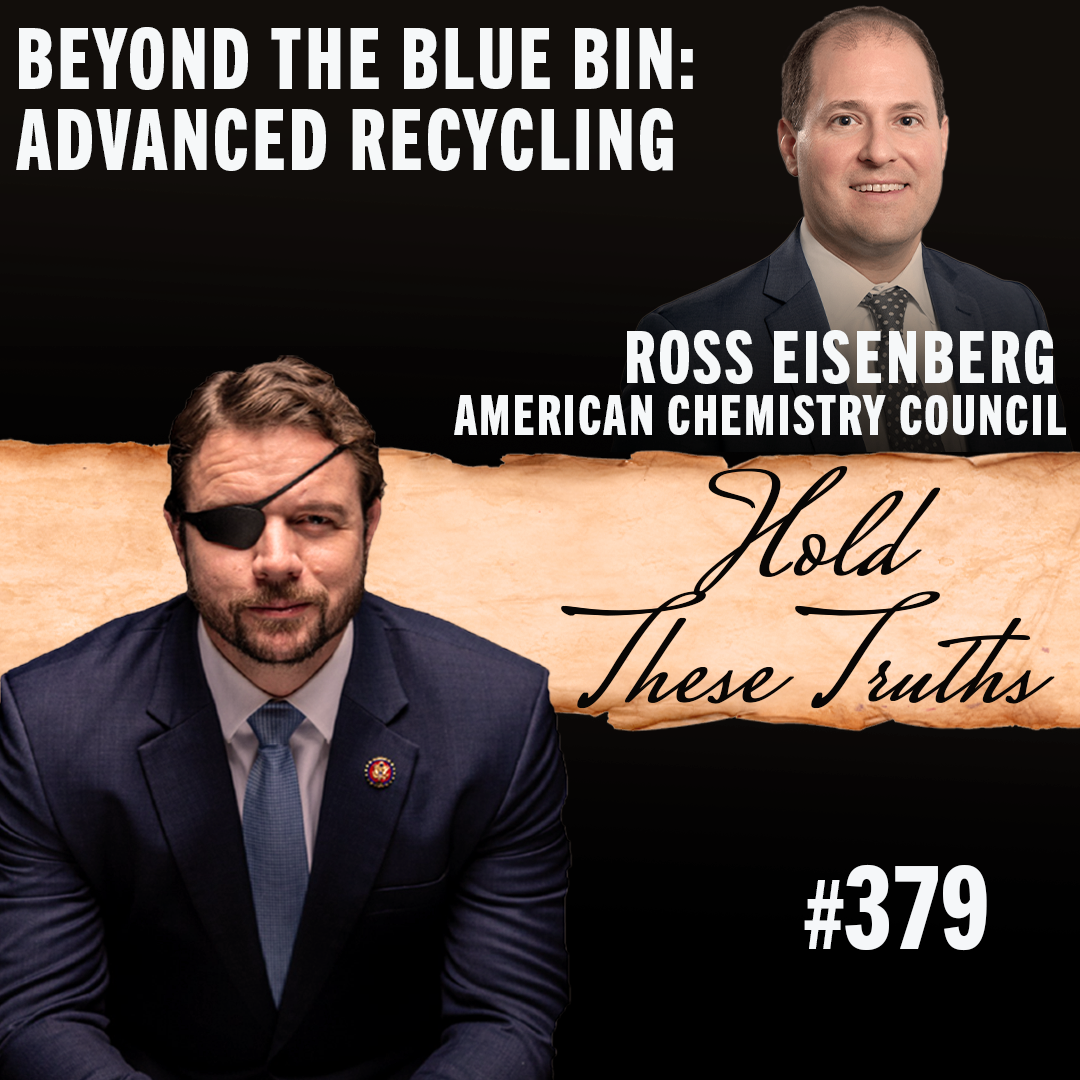
Loading summary
Transcript238 lines
- [00:00]
A
We hold these truths to be self.
- [00:02]
B
Evident that all men are created. As a member of Congress, I get to have a lot of really interesting people in the office, experts on what they're talking about.
- [00:09]
A
This is the podcast for insights into the issues.
- [00:12]
B
China, bioterrorism, Medicare for all. In depth discussions, breaking it down into simple terms.
- [00:18]
A
We hold. We hold.
- [00:19]
B
We hold these truths. We hold these truths.
- [00:21]
A
With Dan Crenshaw, the eagle has landed.
- [00:25]
B
Welcome back, folks. To hold these truths, please give us five stars. So we're talking about energy dominance. Today we're going to talk about plastics and more importantly, recycling and advanced recycling. So the term energy dominance is obviously a theme these days amongst Republicans in Congress. And of course it is. You know, we've been tackling this issue from all sides, whether it's grid reliability, permitting, reform, unlocking our vast energy sources like natural gas. Today I want to talk about another critical angle in that energy space and that's advanced recycling and plastics because we use them all the time. So you're familiar with all forms of recycling, the blue bins from everyday life or the, or the multicolored bins, depending on what part of the country you live in, bin or like you're in Germany and they want to sort everything. Either way, we're going beyond the blue bin today in Texas, we actually don't even have a blue bin there. We have a smaller, slightly smaller bin where I live and there's a recycling thing on it anyway. We just kept them all the same color. Probably saves us on costs. But let's talk about the technology behind this, the chemistry behind it. Advanced recycling, different than normal recycling. We'll explain why it turns plastic waste into valuable products that meets consumer demand and draws in billions in private investments. That's a win. So the truth is many, especially on the, I'll call it the radical environmentalist left. See, because I like to just be careful about who I'm talking to. And I don't want to say everybody who's a Democrat, but there is a radical environmentalist movement. They see plastic as a problem. The existence of it is a problem unto itself. I don't think we have a plastic problem. I think we have a plastic waste problem. And advanced chemical recycling is a common sense solution to that real problem. So joining me today from the American Chemistry Council is Ross Eisenberg. Ross, thanks for being on. President of America's Plastic Makers. So you know a little bit about plastic making. Thanks for joining me.
- [02:12]
A
You bet. Thanks for having me.
- [02:13]
B
So I mean to get right into it and we have a little less time than usual, unfortunately. What is advanced recycling versus normal recycling? Start there.
- [02:22]
A
So. So there's two. There's two main types of recycling for plastic. One is mechanical recycling, the traditional recycling. And that is essentially. And they've been using that for decades. This is what we typically do. When you put in the Bl in, that's where that plastic goes. This plastic sitting in front of me. This water bottle.
- [02:37]
B
Yeah, we were just talking about this. Yeah, we'll get into that a second. Go ahead.
- [02:40]
A
So. And it is. It's. It's a fairly sophisticated manufacturing process. But realistically, what they're doing is they are grinding it and they are melting it, and they are essentially pushing it back out, extruding it, and turning a new plastic again. So that same plastic, it basically just gets melted and turned into new plastic again. It doesn't work for a lot of plastics, particularly some of the. The bags of the films and the shrink wrap and things like that.
- [03:01]
B
You know, people throw that crap in the recycling bin all the time. They don't know.
- [03:05]
A
And. Exactly. So advanced recycling, which is a technology that is. That has been around for a while, but is really starting to scale up, can basically take all these other things. What it. Advanced recycling, in a nutshell is it takes the plastic. It takes it back down to its raw materials, the chemicals, essentially, and then it turns it into the new plastic again. So I like to. The analogy. I like to use.
- [03:23]
B
So it can utilize all of those other things.
- [03:26]
A
It absolutely can. And it's like unbaking the cake. Right. So imagine you had a cake. You can actually just unbake that cake and turn it back into flour and eggs and milk and all those other things, and then bake that cake again and again and again. That's advanced recycling.
- [03:38]
B
Okay. You would think that would have always been recycling, but it's not. So I also want to start with some of the problems through traditional forms of recycling. Course, we were talking about this bottle, and I noted wrongfully, you corrected me, but I noted that, like, one of the problems with even something simple like this, it's like everyone's like, I'm just throwing that pl. Bottle into the recycling bin that says plastics.
- [04:01]
A
Right.
- [04:02]
B
I'm doing a good job. But the truth of the matter is, like, there's a bunch of different types of plastics within that same bottle. This one, not so much. And now why. So this company, whatever this company is. Right. I guess, took the steps to ensure that all of the plastic, from the lid to the little whatever you Would call that part.
- [04:18]
A
Right. The mouth. I gave me the thing of it.
- [04:23]
B
To the, to the. I don't know about the paper on the side. And that is a, that is a plasticky. Yeah, but it's all. But you're saying it's all the same. So that's. Yeah, that's good that they're moving in that direction. So at least there's less sorting that is required.
- [04:33]
A
That's right. That's.
- [04:35]
B
But of course, you know, but, but also like what happens if there's still liquid in it? I don't even know. Can they. How easy is that to deal with? They have to empty it. Wash.
- [04:41]
A
They empty and wash it.
- [04:42]
B
Yeah, it's a lot of work. It's very highly labor intensive.
- [04:45]
A
It is a. Yeah. I was at a mechanical recycling facility in Indiana a few months ago. It's. It's sophisticated, right. I mean, I've been to a ton of manufacturing plants over the years. This is no different. I mean it is, it's the hard hats and the, you know, the safety goggles.
- [04:56]
B
And is it profitable like this, the old style?
- [04:59]
A
It can be, can be.
- [05:00]
B
It can still be profitable.
- [05:01]
A
It absolutely can. It is still generally cheaper to landfill that stuff, which is, which is one of the real struggles for why this is. Has really not taken off the way that we hoped it would. But, but no, it's still absolutely profitable. You have to figure out ways to get there. What I've noticed with a lot of the recyclers is that the, it's not, it's not a lack of customers. Right? It's, it's, it's where you can get the plastic from Their sort of secret sauce is figuring out, okay, I can get these plastics from these guys and these plastics from these guys. What we need to figure out is how to get it from that blue bin where the plastic is readily available and get it all recycled. That's. That's our goal, essentially.
- [05:32]
B
Gotcha. And yeah, let's continue on the old recycling. So there's plastics and that's the main source of our conversation today. But look, there's metals, there's paper. You know, when it comes to paper, like, I think a lot of us are just throwing a bunch of random pieces of paper from paper towels to all sorts of like in our recycling bed. Should we be doing that? What's happening to that?
- [05:57]
A
Yeah, I mean, paper actually has a very high recycling rate and a lot of it's mostly cardboard.
- [06:02]
B
It's like cardboard.
- [06:03]
A
The cardboard gets recycled pretty routinely. But their, their numbers Are real high. I mean, it's like close to 70, 80%.
- [06:09]
B
I want to give people good advice, right. Because I. Me and my wife kind of fight about this. I'm like, that's. No, don't throw the paper towels in there. Am I crazy or like.
- [06:17]
A
So I wish I could give you a straight answer on that one. I don't know. But, I mean, frankly, I assume that goes in. Right. I mean, the technology to recycle paper doesn't have to be quite as. As nuanced as the plastic stuff. Right. Because it's all similar kind of components.
- [06:30]
B
Okay.
- [06:30]
A
Challenge with plastics, there's so many different.
- [06:32]
B
Paper fibers and that.
- [06:34]
A
I think so. I think so.
- [06:35]
B
I feel like there's a lot of different types of.
- [06:36]
A
There are cellulose things of that nature.
- [06:40]
B
And then to make the metal is the easiest. Like a tin can is the easiest thing.
- [06:44]
A
Yeah. Aluminum is extremely recyclable.
- [06:46]
B
Right.
- [06:46]
A
I mean, and I think the stat step that they typically use is that most of the aluminum in the economy right now is recycled aluminum, because they have a pretty good.
- [06:53]
B
Well, it's recently kind of a bad recycling story about the microplastics, especially in this black plastic. Can you talk about that for a second?
- [07:03]
A
So black plastics are kind of odd, the color black. So when you send it to the recycle bin or you send it to the recycling center, they usually use what's called optical sorters to sort through. And, you know, it's a machine to figure out where to put the plastic so they can be either mechanically recycled or not mechanically recycled. It doesn't see black, and so it doesn't do anything with them. So it's a challenge. They're not being recycled. They wind up in landfills.
- [07:26]
B
That's not what I heard. I heard that just the. The recycled. The recycled products, the end product of the black plastic containers that were. That we all get when we order takeouts, that there's. There's. There's some study on this that shows a problem with that, specifically.
- [07:41]
A
I don't know about that one.
- [07:42]
B
You don't know about that one? Okay. All right, we'll move past that. I don't know about it either. I just read a story and something. Something for us to look into.
- [07:50]
A
Perhaps this is a challenge. We've got. There's so many stories flooding the zone on plastics, and we. We occasionally we'll read them and we'll say, man, they. You know, you go behind the story, and it's like a sample study of, like, eight people or something. Like that. So it's. It's tough to know what's right.
- [08:03]
B
So, I mean. Well, then also, you know, we used to really ship out our. Most of our recyclables to China.
- [08:10]
A
China.
- [08:11]
B
Then they stopped taking them. So why did we like. Well, let's talk about the economics of recycling for a minute. Why did we ship them out in the first place? Why do they not want to take them anymore? Kind of glad they don't, because they were all ending up in the ocean anyway. So maybe I'm glad we stopped that. I'd rather they're in our landfills than in the ocean.
- [08:28]
A
Yeah. So my assumption is it was economic to send them overseas.
- [08:33]
B
Right.
- [08:33]
A
It's just that, you know, landfills here are fairly overburdened. Right. I mean, most big cities that have landfills want less things coming to the landfill. And so my guess is in California, in the west coast, that was a big, big problem. And so they were probably sitting overseas as you know, it was winding up sometimes in China, sometimes in Southeast Asia, but often in the. In the ocean. Right.
- [08:52]
B
I mean, the statistic is out there. Like, what, 95% percent of the plastic in the Pacific comes from 10 different rivers, all from Asia.
- [08:59]
A
Yeah, exactly.
- [09:00]
B
I don't think anyone's disputed that.
- [09:02]
A
Yeah. The eu, the Nature did a study last year, and I want to say US EU and Australia combined is literally just 0.3% of global plastic pollution. So we make a lot of the plastics. But like you said, the pollution is coming from largely Asian countries.
- [09:17]
B
That's always been my argument against the paper straws, aside from the fact that they suck and don't work and are annoying and melt in your mouth and your drink. But, like, guys, when you throw away that plastic straw, you're not killing a turtle, Right. If you throw it away in China, you might be, I don't know. But you're not in China, you're in California. And they. California is not dumping its garbage into the ocean. It's just not.
- [09:39]
A
No.
- [09:39]
B
So, like, it's just. It's very frustrating.
- [09:43]
A
But Southeast Asia was right. I mean, it absolutely was. And so China basically said, we're going to stop taking your trash. We have enough to deal with. So we're not taking any. And. And that created the conundrum that we're in now, right?
- [09:53]
B
Well, they were dating trash or recyclables or both.
- [09:56]
A
I think they were just saying, no more trash. I think that was it.
- [09:59]
B
I thought they did our recycling. I thought we literally were. We're sending like recyclables there.
- [10:03]
A
Yeah.
- [10:04]
B
And that was part of. Maybe it was both. In the end, I think it sounds like they viewed it all as trash and just threw it in the ocean, which. Hence the.
- [10:11]
A
Or on beaches. It's bad. And so.
- [10:13]
B
Oh yeah, you've seen the pictures.
- [10:14]
A
It's disgusting, it's terrible. So, yeah, so it's a great opportunity for us to modernize the stuff here. Right. So we have a system much like every other system in this country that was set up on the infrastructure side that was set up decades ago for a very different set of priorities, very different set of products, and we need to modernize it. And that's frankly where advanced recycling comes in. This is a modern technology that we need to upgrade.
- [10:35]
B
Okay, so what is it?
- [10:36]
A
So this is. Then I'm baking the cake, right? So you basically you take it to a manufacturing facility, they'll bring in the used plastic and they can take. The great thing about advanced recycling is it can take all the stuff that the regular mechanical recyclers can't, or at.
- [10:49]
B
Least had to sort out very carefully.
- [10:50]
A
Precisely.
- [10:51]
B
Super labor intensive. In theory, this would be a much cheaper way to do it.
- [10:55]
A
If you can scale it up. Yeah, it can be much cheaper. And it can be done in two, two different kinds of ways. One, there's standalone facilities that exist in the US Right now. There's one in Atlanta, there's one in Ohio and Akron that literally just take, you know, they find the plastic, they bring it in and they recycle it. And they, they, they turn into what's called pyrolysis oil, which is essentially the building block of new plastic, and they send it to the plastic manufacturer and they turn into new plastic. The other way to do it is at the refinery because they already have a lot of these units at refinery. So down in Baytown, just down the road from. From your district, they have. ExxonMobil is actually doing advanced recycling in Baytown right now. And again, it makes a lot of sense, right? You already have the equipment in place. You can bring in the used plastic. It's just one more feedstock besides oil. And you can make plastic out of it the same way that you can make oil out of it. So really not really good technology. It will definitely work. Right? That's the great thing about super new.
- [11:47]
B
It's.
- [11:48]
A
It's really not that pyrolysis has been around for, for a long, long time since, since really the 70s.
- [11:52]
B
It's been just the business model.
- [11:54]
A
The business model we're working On.
- [11:56]
B
So maybe that's what we need.
- [11:56]
A
And the ability to make it economic is what. Is what became.
- [11:59]
B
So what's stopping us from doing that? Some companies that do it. I mean, like, I've had Huntsman, Peter Huntsman on this podcast. You know, they. Their big thing is they take these kind of bottles, they turn them into insulation foam. They got to get the bottle somehow. They have their ways.
- [12:14]
A
I suppose it's a mixture of economic conditions, but really, it's just kind of. It's hard to build a manufacturing plant here. Right. I mean, there's a lot of points along that chain that make it challenging. One is access to the plastic, just like Peter said. Right. Like, getting. As crazy as it sounds, if you ask most recyclers of plastic what their biggest problem is, they say getting plastic.
- [12:33]
B
But what about, like, in a place like California where it takes. They take their recycling super serious? They do. You know, again, in Texas, we got one bit. It's not a different color, but we still have it. Okay, but, like, California is pretty rigid about it, you know, that has its own costs, I think. But in theory, it should be easy to get the plastic, but. But I bet it's harder to build a manufacturing plant. There.
- [12:56]
A
It is. And it's equally difficult. I mean, think about so. So city of Los Angeles. Right. I don't even know who controls. It's a municipal control.
- [13:03]
B
And I want to know how much of that stuff being, like, put in the recycling bins is actually getting recycled. Do we have any idea?
- [13:09]
A
It's a pretty low number that's in that price.
- [13:11]
B
So what happens if the rest just gets thrown into landfill, ends up in the landfill?
- [13:15]
A
Right. So the haulers will figure out a way to get it to the landfill. But realistically, I mean, you're dealing with 7,000 different jurisdictions that do that, do it 7,000 different ways. So I live in Arlington. We don't take glass. Right. But down the road they do. And so everybody's doing it differently, and that's creating sort of this glass pretty easy to.
- [13:31]
B
I would assume it's kind of easy to recycle.
- [13:32]
A
It just depends. It depends on the.
- [13:34]
B
Depends on the type of glass and.
- [13:35]
A
The color of the glass and the economics of it, because you have to really heat it up pretty high. Yeah, but. But, yeah. So that is the challenge. So you have the municipalities who are all doing it differently. Some of them want to do it. You have the location of where the sorting facility is. Like, it's just all these different points in the chain make it Hard. And that's before you get to my side of the problem, which is it's just really hard to build one of these in the United States. It's just getting the permits and all this other stuff.
- [13:57]
B
And that's kind of where we come. You know, we had a hearing on this recently. I think that's what spurred us to wanted to dive deeper as a podcast into this. So what can government do to make it this easier? This seems like. And that hearing wasn't super partisan. Democrats aren't going to have an easy time arguing against advanced recycling. So we agree on it. I'm just not sure what we need to do to make that business proposition easier.
- [14:24]
A
Yeah. And frankly, that was a great hearing. It was one of the few where I've actually had all the witnesses on the witness stand were saying the same thing. Right.
- [14:30]
B
Yeah, exactly.
- [14:32]
A
It was a really nice one. So it wasn't to your point. It was not super partisan at all. But there's some things that can be done right. Government policy really does make a difference here. There's been a significant debate in the states around how to treat this. And I keep calling it manufacturing. There are some that want to treat it as solid waste incineration. And from a regulatory standpoint, it's not that big a deal. The reason that, and largely environmental groups want to push it to solid waste incineration and call it that is because you can't see sell it as recycled content if it's been incinerated, Right?
- [15:02]
B
What?
- [15:03]
A
Yeah, you can't. It's, it's, it's waste.
- [15:05]
B
Why would the environmental groups be against this?
- [15:07]
A
That's a great question.
- [15:08]
B
Again, that's why I call them radical. There's environmentalists, right? I'm an environmentalist.
- [15:12]
A
I like the environment.
- [15:14]
B
I don't like plastic in the ocean. I'm not a radical environmentalist. They're. They're crazy. So, so why are they against this? Just like they. Just like they were against nuclear for years. We kind of beaten them over the head so many times about that that we've kind of won that discussion. But yeah, why are they.
- [15:26]
A
So the public stance is questions about emissions, questions about, you know, things in the environmental space. Realistically, what's going on is it perpetuates plastic, Right? And where you started out, this whole podcast, right. There are folks that just don't want plastic. If you can recycle the plastic and keep it in the economy, you still have plastic and folks don't want plastic. And I think there's that, that Mentality is really pervading a lot of it. It's a shame because obviously we need it. I mean, my dad was in the hospital for July and August and he made it, but, like, plastic kept that guy alive.
- [15:54]
B
Like, plastic keeps us alive every single day. You have. You have potable water, clean water, because of plastic. I mean, look, I guess we could put it in aluminum cans, and then some companies obviously do.
- [16:04]
A
Right.
- [16:05]
B
But plastic just has this weird, like, anger about it, you know? Yeah. Because. Yeah, you're right. It doesn't. Doesn't go away quickly. Right. Kind of all the more reason to recycle it. But, you know, it's. I don't know. I don't know why. I don't even know what to do about it. I just. I just point out to people all the time, I'm like, look, I don't. Like, everything you're wearing right now has some form of plastic in it.
- [16:28]
A
Precisely. And people don't realize that, but it is.
- [16:30]
B
It's keep your food, your water, like, clean. Like human prosperity and health has grown dramatically because of plastic, not the opposite.
- [16:39]
A
Yeah. Your car, your car, your house. I mean, these are all, I mean, dominated by. By plastic products. And for a good. For good reason. Right. They do so much good things. We're limiting so much food waste because of the packaging that we have on meat. That sleeve on the cucumber is. It prolongs the cucumber by, like, two, three weeks. Right. So from what it normally be. So. And it prevents all of the other environmental things that would happen if that cucumber just were thrown up after two days. Right. I mean, so food waste. So it.
- [17:06]
B
It's like, what's the alternative? And, like, there's the other studies, like, well, we hate plastic bags. Okay.
- [17:10]
A
Right.
- [17:11]
B
Okay. Well, then you're. But, you know, then it turns out, and I, you know, I don't think this study has been debunked, but, like, they looked into basically the. The carbon emissions associated with one of those, you know, you know, like permanent satchels. You might.
- [17:24]
A
Thicker ones.
- [17:24]
B
Yeah, the thicker one that. Like a reusable bag.
- [17:27]
A
Right.
- [17:27]
B
And like, I like the reusable bags just, you know, because I just don't want to keep piling up. But the reality is, is the carbon emissions were like, I don't know, like 70,000 plastic. It was some absurd number. Like, you had to use 70,000 regular plastic bags to meet the same carbon emissions of just one of these other. One of these reusable bags because the material is more Carbon intensive because of the production process.
- [17:51]
A
It's regrettable substitution is what sort of the researchers, researchers will say. And they use it for everything. Right. So the, the can of soda is using more material than the bottle of soda. So the can of soda is going to have, have a higher greenhouse gas sort of.
- [18:06]
B
That's interesting.
- [18:06]
A
Right, and it's for like usually. Yeah, for, for most applications.
- [18:10]
B
Why is that? Because it just, it takes more heat.
- [18:13]
A
It takes more heat and you're using form metal like precisely.
- [18:16]
B
Actually using more material.
- [18:18]
A
Precisely, precisely. And so for most applications, that's the case. Just because plastic is so much lighter and you can do more with it, it's going to have a lower carbon footprint for almost every one of those applications.
- [18:28]
B
Yeah. And like, like back to the point about, you know, I mentioned, you know, food safety and, and preservation, but the medical side of it is extremely important. I mean just almost every single piece of important medical equipment uses some form of plastic.
- [18:44]
A
It just does the trach tube, the IV bags. Right. The whole thing. And this is where advanced recycling really shines. Right. So again, the traditional mechanical recycling where you're literally grinding it and melting it, you can't, the output of that, it's not food grade, so you can't use it to package your meat and it's not medical grade. But advanced recycling is. Right.
- [19:03]
B
So the stuff you can make the.
- [19:05]
A
You can do it again and again. You're baking that cake again and again and again.
- [19:08]
B
Yeah, that, that's an interesting point. I'll kind of repeat it. So I understand it like traditional recycling, mechanical, you call it mechanical recycling, you're getting low quality plastics out of it. You're getting the kind of, you know, the, the Tupperware sort of stuff that.
- [19:22]
A
We'Re seeing good plastics, without question.
- [19:23]
B
It's plastic, it's fine, but it's not, you're not going to use it to build your medical devices. But you're saying with, when you, when you use advanced recycling techniques, you're starting all over because, because you're going down to that molecular, molecular level. You can do whatever you want with.
- [19:37]
A
It from that point. You can make a dashboard out of it. You can make an IV bag out of it, you can, you can shrink wrap your food with it.
- [19:43]
B
So the industry exists, it's just not scaling as fast as we think it should. So I mean, kind of, I mean we, I asked you the question already. You know, eventually I want that, I want that answer translated into a bill that I can write, you know, and that's what that's what, that's it. In the end, that's what we care about in Congress. Like I see the problem, I see that, but I don't. I need a solution that I can write into legislation.
- [20:09]
A
So 25 states have, and Texas is one of them, have in place a law that says that it is that that advanced recycling is a manufacturing process.
- [20:18]
B
Okay.
- [20:18]
A
And if you want to. And where the advanced recycling is happening is those states. States, right. There's a bunch in Texas, there's a bunch in Georgia, North Carolina, Ohio, Pennsylvania. The places where we're seeing it kind of happen are all of those.
- [20:31]
B
Okay. So you need a definition. Who would provide. Would it be the EPA that would oversee.
- [20:36]
A
You could throw it in. You could, you could. But yeah, I mean it wind up probably in an EPA statute. Yeah, yeah.
- [20:43]
B
Well, I like that idea. Yeah, I think it's a great idea. It's an easy button.
- [20:47]
A
I think it's a great idea.
- [20:48]
B
And that would encourage it. Like a lot of curiosity, like is California one of those states?
- [20:52]
A
No.
- [20:53]
B
That's so interesting because they love recycling.
- [20:55]
A
So much in California. They actually. And they have a law that is requiring produce responsibility. Right. So they're actually forcing the. They're essentially bringing in that you have to pay a fee on every one of these when you know, when it's made, when it's purchased.
- [21:09]
B
Which. What do you think about that by the way? Because I've gotten that from like hardcore or good people, like people who just want to see more bottles recycled. They want Texas to adopt one of those five cent things. And I'm like not. I don't, I don't. I'm not. I'm a federal legislator, I'm not a state legislator. But what do you think about it? Is that helpful to getting the feedstock that's needed?
- [21:29]
A
So. Yes, so it is.
- [21:31]
B
It's an extra tax.
- [21:32]
A
Producer responsibility does work. Right? So it absolutely does work. And we typically are, we're for epr, although we think that there's some, you know, some guy. What is EPR producer responsibilities? Essentially it's the take back. Right. You're essentially paying a fee on the product so that you can recover that product.
- [21:45]
B
It's the five. Are we talking about the same thing?
- [21:47]
A
Like it's a variation people will like.
- [21:50]
B
You'Ll see people collecting a bunch of cans and bottles because they know when they turn them in, they get five cents.
- [21:55]
A
Okay. And, and typically we don't play in the bottle bill space. But the to your question which was do they work? They do work, right?
- [22:01]
B
Yeah, it's an incentive structure. I imagine they work.
- [22:03]
A
Yeah. I mean, and, and, but it's also.
- [22:04]
B
A tax on everyone who doesn't want to do it. And there's a contentious issue.
- [22:07]
A
Yeah, there's kind of, it's not, it's harder. Right. So you were in Europe and, and they sort out their, their, they don't do single stream recycling. They do, they do multiple stream recycling. So you got to put this in this bin and this and this bin and it is a little bit more burden on the consumer. Their recycling rates are higher though, right? I mean actually a lot higher than ours. And so it's that trade off and finding that, that happy place. We, I, we really do hope Congress eventually does, you know, get to the point where they're debating this and kind of the pros and the cons and trying to figure out a way to actually solve this problem.
- [22:35]
B
It, Well, I mean that's at least one idea is make sure that it's not a, again like moving categorically defining it as a manufacturing process as opposed to a solid waste incineration, which it most clearly is not. I know like why that would even be on the table. Other states that actually define it that way or they just don't define it.
- [22:56]
A
Nobody's defined it that way. There's always a movement to get there. But quite frankly, scientifically, it's wrong. Right. So you hit it with facts.
- [23:02]
B
Yeah, it's very, very much wrong. Okay. So most states define it that way. But then again, if you don't define it, define it as a manufacturing process. And it leaves the manufacturers themselves just, just like wondering if they're, you know, going to get screwed by what they're investing.
- [23:16]
A
If you're building a plant, the number one thing you want is certainty so that you know the rules don't change. And so knowing what the rules of the road are, they're going to, they're going to be the states where people go. And that's what, that's what we're seeing.
- [23:26]
B
So talk about the Global Plastics Treaty. This was in Geneva last month. It doesn't seem like anything really came from it, but what was your thoughts?
- [23:36]
A
Sadly, no. So, so this is the, this was the sixth one of these we've done. So the UN back in 2022 set itself about trying to come to a global, a binding legal agreement, global agreement that all, all countries would sign to address plastic pollution. And they're close, but they've been close for a few years now. They are stuck on essentially 33 issues that they cannot seem to find agreement on. And so once again, we were there for two and a half weeks.
- [24:04]
B
What are the three issues?
- [24:05]
A
And they. So the three issues are, should the original assignment from the UN to the group that was doing it with a smaller body within the UN was address plastic pollution, particularly in the marine environment. So the stuff in the ocean, right, like the problem that we all know needs to be solved. The UN's an interesting body, right? I don't know. If you've had to spend a ton.
- [24:24]
B
Of time, how hard is it to address it? We know there's 10 rivers. Like, we know exactly what the sources are. So it couldn't be an easier problem to solve.
- [24:31]
A
There were about 150 of us from industry there again, the regulated entities. There were about 1,000 NGOs and then, you know, another thousand of the negotiators from each country. So it's a very charged environment.
- [24:43]
B
It's a lot of people. There's so many people it's impossible to get anything done.
- [24:47]
A
And this one's like, so this is an NDA, right? So the NDAA is a bill that gets done every single year, and everybody knows that. So it becomes a Christmas tree for policy ideas and things like that.
- [24:56]
B
Here a minute.
- [24:57]
A
That's what this was, right? So this treaty, knowing that it's headed towards possibly getting done, became a Christmas tree on a whole bunch of bad ideas. One of them, well, let's start banning plastic production. So that's one they're stuck on. The other one is we should regulate chemicals in the treaty and start putting ban lists of chemicals in there. And then the last one is financing, which has just been an issue that has been plaguing every environmental agreement since they started doing them. Essentially, who's going to pay and how is China treated in that environment? We stay out of the last one, right? That's for the US and China to figure out and hopefully they can. But the first two, obviously we care deeply about this because quite frankly, stopping plastic production maybe not the best way to stop plastic pollution. Let's focus on plastic pollution, chemicals. It's just, there's folks that just want to take a whack of chemicals. This is a way in. But chemicals go on a ton more than plastics. But where we are stuck right now is there about. There are countries that strategically see a need to do it the hard way, right, to start banning things. EU is one of them.
- [25:58]
B
They're gonna kill themselves.
- [26:00]
A
And then small island nations, things like that. And then there's sort of the rest of the world, right. It's most of the plastic producing countries, us, China, Middle East, Brazil, Japan, Korea, who are pushing back on that. And so finding that agreement should happen. They just don't seem to be able to get there. And these negotiators, in the meantime, we.
- [26:24]
B
Got to focus on what we can control. And I think naming shaming countries that push a lot of plastic into the Pacific, I think is one way it tends to be more effective than some UN conference and then just making sure our own industries are pushing forward with. The richer a country gets, the cleaner it gets. And this is kind of another. This is like another example of that.
- [26:46]
A
It is. I mean, there's so much. Plastics are such an interesting story because they really are an energy story. Right. So, so the shale gas. So until 2010, 2008, there really wasn't a lot of expansion in the plastics space in the US Shale gas happens. And shale. And shale gas, as you know, it's good for energy, but it also is a feedstock for making largely chemicals and by chemicals, plastics. And so since 2010, there have been about 200 billion worth of new starts in the chemical industry just from shale gas. 40 billion of that has been plastics. So we went from it being, you know, not necessarily a huge industry in the country to being a gigantic industry.
- [27:24]
B
In the country because we have so much more feedstock.
- [27:26]
A
Because we have so much more feedstock.
- [27:28]
B
Just to be clear, we're winning that plastic comes from oil.
- [27:31]
A
Right.
- [27:32]
B
And gas.
- [27:33]
A
You can make it from oil or you make it from gas. Because we have shale gas, we have a competitive advantage. And so the US has just dominated.
- [27:39]
B
Yeah, I mean, what I point out to people is like, you know, the intricacy of how things work in supply chains. You know, so that gas comes from West Texas, then it's, it's probably sent somewhere in the Houston area. Right. Some kind of refinery. Then it's, it's made into these polymer pellets sort of thing. Like what's the right term for that?
- [27:59]
A
Pellets.
- [27:59]
B
Yeah. And then those things are shipped to China because what we don't do is like plastic injection molding to like that thing was probably not made here.
- [28:09]
A
I don't know that one. Maybe not most. The straws are not. The higher value stuff typically gets made in the higher value.
- [28:15]
B
Yes. But like, you're typically like, okay, so like I've tried to make dog bowls, like for my campaign. Just like with our campaign. You can't, can't do it. And I'm like, I won't sell something that's made in China.
- [28:25]
A
Now I hear campaign merch.
- [28:26]
B
You cannot make this in the United States. Cannot do it. It is not possible.
- [28:30]
A
We found that with straws, right?
- [28:31]
B
Straws. Or these glasses I'm wearing, like, they're probably say, made in China somewhere on there. I can't read them because without my glasses I can't read what's on there. But I'm in the same boat. I mean, it's, you know, that's why this print is so large. But like, so what's interesting. I mean it was so. It's so freaking interesting is like that like your coffee, like the top of your travel mug. It's just plastic. You know, it's. It went from west Texas, it went from a dinosaur to West Texas, out of the ground in West Texas to kind of a, you know, some kind of production plant. What was the. What's the right terminology for a chemical production plant? That would make the.
- [29:08]
A
It'd be refined, right?
- [29:10]
B
Refining. Yeah, some kind of refining that turns into that polymer resin. It is then shipped across the world to China so they can put it in some kind of plastic injection molding and then they ship it right back to us.
- [29:19]
A
We are net exporters. I mean, we have a $20 billion trade surplus in plastics. So we're actually supplying the rest of the world in plastic. That's how much manufacturer we have here in the United States.
- [29:27]
B
Yes, we support. What we're providing is the feedstock.
- [29:30]
A
Yep.
- [29:30]
B
You know, and that's a whole other conversation about whether we should be pushing to also own some of that plastic injection, like molding part. What do you think about that? So I don't know if that's really your business.
- [29:43]
A
It is. So we are, we are just the resin manufacturer.
- [29:45]
B
Exactly.
- [29:45]
A
Right. So. So. But that being said. Yeah, let's make in the U.S. right. I mean by all means, 100%. And there's a fair amount of. In the United States. But again, it has the economics of it. Yeah, it's more, the more they really.
- [29:57]
B
Yeah. Like the high end plastics that are required for medical use.
- [30:00]
A
That it's a very different cars and planes and.
- [30:02]
B
Yeah. Like the typical. Your toys. Everything from Toys R Us to find your kit, like it's all made in China. Just because their base is just so huge.
- [30:10]
A
The economic model is different. Yeah.
- [30:11]
B
I don't know how to. I don't know if we need to change that. It just is what it is. I just.
- [30:18]
A
We're the American Chemistry Council, so let's make it in the U.S. right.
- [30:20]
B
I just, I just, I pointed out one of my civics classes. I use that example because I, you know, how do things work? And, and I use that example1 to demonstrate that like as simple as you think the lid to your travel mug is, it is not simple at all. And there's so much technology and so many people who are involved in getting that thing to you. And how much did it cost you? Six bucks. Yeah, like maybe. And, and really it cost you six bucks, but the total cost is probably much lower, which is just a fascinating, just economics lesson. That's just kind of my lesson.
- [30:53]
A
The global economy is an amazing thing, right? It's a fascinating thing.
- [30:56]
B
Yeah. Okay, so last question. As we kind of round this up, you know, see Europe going the direction it's going on energy on plastics. I wouldn't, I'd be very concerned if I was a European at the moment. How, how does this conversation about advanced recycling wrap into the energy dominance conversation? It's a great, we've sort of answered it because we just noted that the feedstock comes from.
- [31:20]
A
Well, and, and it's relevant to what I was just doing in Geneva for the UN as well. Right. So the, the EU is de industrializing, right? It just is. And it's becoming very, very difficult for our industry in particular to compete in the eu. So we're seeing almost daily, weekly plants shutting down because they just, the economics.
- [31:39]
B
Just don't work over counter to what you would think they want. Because it's recycling is good.
- [31:44]
A
Precisely. So they actually do have more advanced recycling in the EU than they do here, which is annoying for a variety of reasons. But at the same time they're de industrializing and the recycling is going to be where the production is. And so if we, you know, if we can scale this up here, here we have a really, really good opportunity to own this technology and send it everywhere in the world. Right. I mean this is, this is not just about fixing our problem because like we started the problem is really elsewhere, but man, we can solve it. We can solve it in a big, big way. It can be a real big business model. Bigness stream, business stream for, you know, for a lot of companies in the United States.
- [32:16]
B
How big is this business right now? How big is the industry at the moment?
- [32:19]
A
Pretty small right now. I mean there's, there's really only about 10 of them operating in the United States and very few of them at, at a, like a refinery scale. So like Eastman's got a big one in Tennessee, Baytown, Exxon Baytown. But. But it's really a lot of smaller, smaller scale ones, but, I mean, because.
- [32:34]
B
There'S no, like, tax credit for it. There's nothing.
- [32:36]
A
We don't. We don't ask for any of that ST stuff.
- [32:38]
B
Right.
- [32:38]
A
We just need.
- [32:39]
B
You just want certainty on.
- [32:40]
A
Just need regulatory certainty. And they will invest.
- [32:42]
B
And you've given me one idea on regulatory certainty.
- [32:44]
A
Yeah. Which will go a long way. Go a long way. I think fixing the permitting process is a big deal. Right. Just. Just like everything else.
- [32:50]
B
General permitting for anything. Yeah.
- [32:53]
A
Just like building anything.
- [32:54]
B
Well, I think that we are fixing that at least.
- [32:55]
A
Yeah. I mean, if, you know, if you can give them the ability to know that. Okay. It's. If I'm gonna. If I'm gonna put this here in Galveston or wherever, in two years, this thing will be up and running. My guess is you've got a pretty good shot at them opening up.
- [33:08]
B
Yeah. Love it.
- [33:09]
A
All right.
- [33:10]
B
Thanks so much for being on.
- [33:10]
A
Thank you.
- [33:11]
B
Yeah, thanks for your testimony at the hearing the other day, too.
- [33:13]
A
You bet. Really appreciate the time.
- [33:15]
B
All right. All right, let's wrap it up.