← Hold These Truths with Dan Crenshaw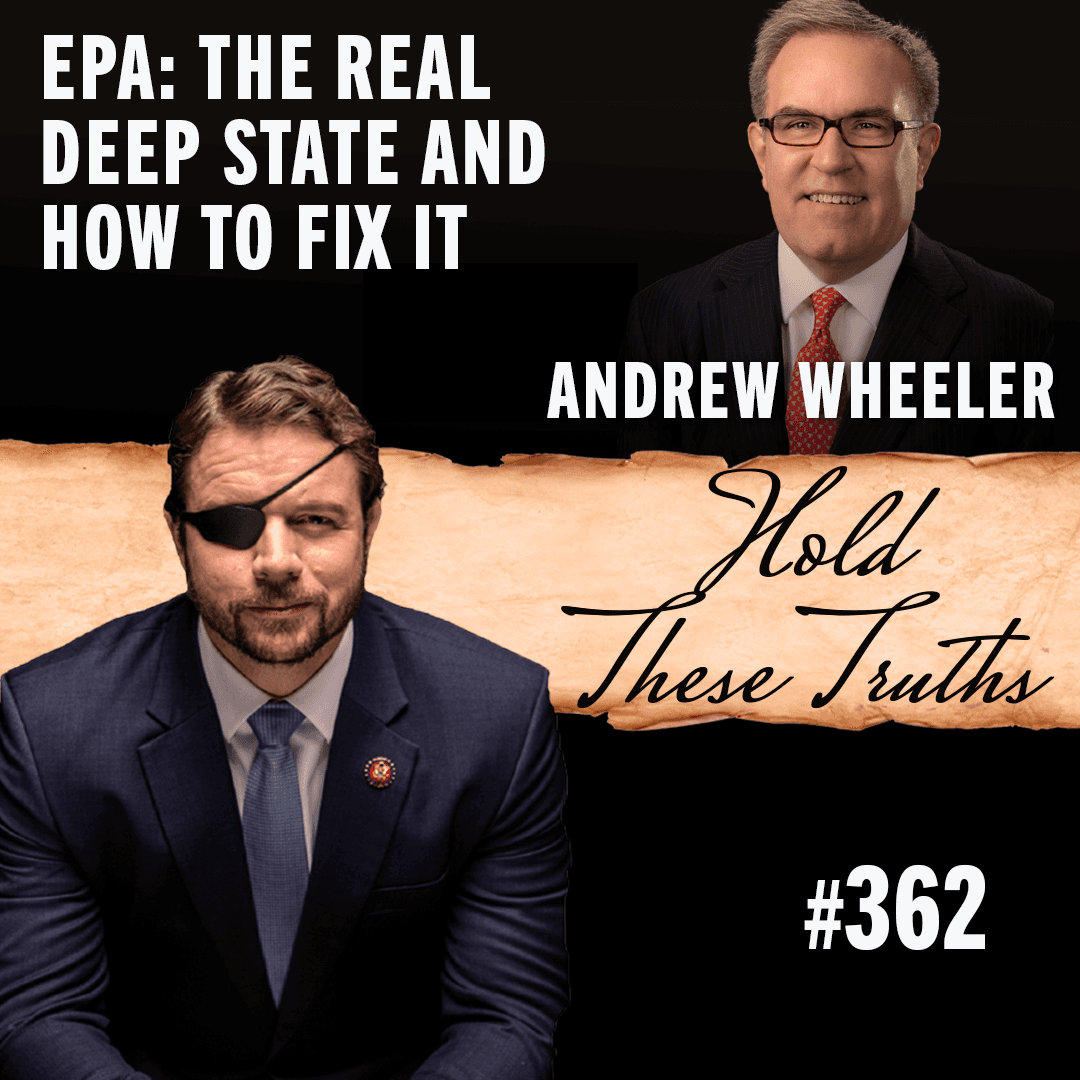
Hold These Truths with Dan Crenshaw
EPA: The Real Deep State and How To Fix It | Andrew Wheeler
00:50:41
Andrew Wheeler, former EPA Administrator under President Trump, joined Rep. Crenshaw to discuss some of the most promising reforms to fix American’s broken environmental bureaucracy. They discuss the flaws in permitting processes, the inefficiency...
Loading summary
Transcript264 lines
- [00:00]
Andrew Wheeler
We hold these truths to be self.
- [00:02]
Dan Crenshaw
Evident that all men are created. As a member of Congress, I get to have a lot of really interesting people in the office, experts on what they're talking about.
- [00:09]
Andrew Wheeler
This is the podcast for insights into the issues.
- [00:12]
Dan Crenshaw
China, bioterrorism, Medicare for all in depth discussions, breaking it down into simple terms. We hold.
- [00:19]
Andrew Wheeler
We hold.
- [00:19]
Dan Crenshaw
We hold these truths. We hold these truths. With Dan Crenshaw.
- [00:22]
Andrew Wheeler
The eagle has landed.
- [00:24]
Dan Crenshaw
Welcome back to hold these Truths, everyone. Joining me today is the honorable Andrew Wheeler, former EPA administrator and current partner at the law firm Holland and Hart. Great to be with you. Thanks for.
- [00:35]
Andrew Wheeler
It's great to be with you too. Thank you for inviting me.
- [00:38]
Dan Crenshaw
So read a little bit about your background first for the audience. You were appointed acting EPA administrator in July of 2018 under the Trump administration, later confirmed as the 15th administrator of the Environmental Protection Agency in February 2019. Prior to that, held senior positions in private practice. At the end at the Senate Committee on Environment and Public Works. I think there's a few people who understand the basics of environmental laws and regulations as well as you do. So appreciate you taking the time. Maybe also worth noting, I saw in your BIO you in 2022.
- [01:13]
Worked with Governor Youngkin.
- [01:16]
Andrew Wheeler
Yes.
- [01:17]
Dan Crenshaw
Trying to the goal being to slash regulations in Virginia by 25%. So we did that.
- [01:23]
Andrew Wheeler
And also permitting reform.
- [01:25]
Dan Crenshaw
Yeah.
- [01:26]
Andrew Wheeler
And so far permitting reform has shown a 70% improvement and permitting time that's excellent.
- [01:33]
Dan Crenshaw
In Virginia.
- [01:34]
Andrew Wheeler
In Virginia. So I think it can be modeled and expanded to other states and even the federal government.
- [01:39]
Dan Crenshaw
Maybe we'll start there. I mean what, what are some of the lessons you learned at the state level that could be applied more broadly. And of course I want to get into the first administration.
- [01:48]
Andrew Wheeler
Sure.
- [01:49]
Dan Crenshaw
Story there and what kind of challenges you had. But let's, let's start with that one. What did you learn from the state level that we should be thinking about now as like the term permitting reform is thrown around all the time around here. Now the thing about permitting reform is that's cross jurisdictional to many committees here.
- [02:05]
Andrew Wheeler
Yes.
- [02:05]
Dan Crenshaw
It could be natural resources, it could be my committee, the environmental subcommittee on anc. It could be tni.
- [02:16]
How we organize committees in the cross jurisdiction is up for debate, to be honest, given all these, given all these complexities. But what are some of the things that could be applied more broadly and what should like maybe to Texas, for instance.
- [02:29]
Andrew Wheeler
So in when I was in the Trump administration, we implemented the lean management system, which is also called the Toyota system or cross epa, which is a management review Top down, bottom up.
- [02:40]
Dan Crenshaw
Okay. And why is it called the Toyota system?
- [02:43]
Andrew Wheeler
Toyota, I think, is the originator of the lean management system, where they're the first big company to implement that. That was back in the 70s, I believe. Okay, 70s, 80s.
- [02:53]
Dan Crenshaw
So lane management, Lean, Lean management, Lean management.
- [02:56]
Andrew Wheeler
And it's a process review management structure. And we had some really good successes from that. And so then when Governor Youngkin asked me to come down to Richmond and start his Office of Regulatory Management, which was an office we created and to look at permitting review, permitting process and reforming it, we basically implemented some of the concepts from lean management into the state. But the biggest thing is transparency. You can't improve a process unless you know how long the process takes. So we basically created Gantt charts for each permit and you can go online and it's for it's permits.virginia.gov and every permit in the state of Virginia is available online. And you can see where it is in the timeline. So you can see who has it within the. Within which agency and the office within each agency. And we established timeframes for each type of permit. So, you know, permit a may take 30 days and it goes to four different shops. Permit B may take 90 days or 120 days, and we track each one. And then you track the progress for each one. So you can see where it gets held up, where the bottleneck is. And the managers have the information as far as the staff people, and they have their phone numbers. They can pick up the phone and call them and say, where's this permit? And the public can see where the permit is in the process.
- [04:21]
Dan Crenshaw
And was there teeth to that? So if, if an agency is taking too long and goes past their timeline, is there like an automatic approval?
- [04:28]
Andrew Wheeler
Not an automatic approval, but for the, the, the due date for the permit. If it's due in say 60 days, that doesn't change. And if it gets held up on the, the day before the permit is due, the permit rider gets an automated email saying, you have one day left. The day of another email saying, today is the deadline. Day after an email saying, you're now a day late with a permit. After one week, the manager gets an email generated by the system.
- [04:56]
Dan Crenshaw
Who's the manager in this case?
- [04:57]
Andrew Wheeler
It would be a career manager.
- [04:59]
Dan Crenshaw
Okay, somebody. Somebody in government.
- [05:00]
Andrew Wheeler
Yes, government. But then after two weeks, the manager's manager, and then three weeks, the manager's manager's manager goes all the way up to the head of the agency, gets an email saying, I think in every case it's within Four weeks. This permit is now X number of days late. Once you start tracking that process, that.
- [05:19]
Dan Crenshaw
Alone kind of creates accountability.
- [05:21]
Andrew Wheeler
We saw speeding up of permits across the board, but then what we also discovered was we don't really need 20 days for this part of the permit process or 10 days for that part. So you can start making reductions in the time and you can go in and you can, you can shorten the time span. And we've seen the environmental permits for the state of Virginia are now being processed just after two years, 70% faster than they were before we started tracking the progress of the permits. Transparency just does an amazing thing. Shine light on something. Yeah. And you get a lot of reforms.
- [05:55]
Dan Crenshaw
Okay. How many states do you do something like that?
- [05:58]
Andrew Wheeler
As far as I'm aware, we're the only one. Now, I've talked to a number of states since we started it that are interested in what Virginia was doing. And then I'm hopeful maybe the federal government or the DOGE Committee will pick up some of this. I've sent some of the materials to them. But there's, again, you can't, you can't just tell your, your team or your staff, okay, I want you to improve, I want you to do permits 10% faster because you don't know how long the permit takes or where this, where the bottlenecks are or the steps in the process. You have to. And it's working with our computer people in the state. And we did it relatively cheaply. It was, we're talking a few hundred thousand dollars, not millions of dollars, to implement this computer system that anyone can go in online and look for.
- [06:42]
Dan Crenshaw
Is that something that would make sense as far as legislation goes?
- [06:45]
Andrew Wheeler
I think so, yes.
- [06:46]
Dan Crenshaw
You think it would work? I mean, we're always looking for ideas. Again, the buzzword permitting reform is thrown around so often and it's not always obvious to us legislators. Okay, what do we do exactly with that? But that's a pretty concrete, at least procedural change in the federal government. Yeah. Maybe putting it online down. I'm not sure what they're up to these days, but.
- [07:10]
It'S.
- [07:14]
But I, I, I wouldn't mind seeing some of that on paper. We, we just, we, we come out of every meeting, you know, whether with energy folks or whatever it is, and like, what can, you know, what can we do? I, I tend to like that idea. So it's called Lean Lean Management System. Lean Management. Okay. So it's, this is already a well established idea.
- [07:35]
Andrew Wheeler
That's, and supply.
- [07:39]
Principles to government. Right. And making government More accountable.
- [07:43]
Dan Crenshaw
Well, you know, so that's. Let's talk about that for a second. Applying business principles to government. Because I think sometimes, like, and this is an obvious case where that works.
- [07:51]
One of the interesting philosophical points I make to people is, you know, you got to have expectation management when you talk about bringing in, you know, a businessman to fix a bureaucracy, because these are by definition very different things. And I point out that in a business you have built in efficiencies because everybody is profit driven. And so there's a very obvious mission to that business. And you can also.
- [08:22]
And what that means is you can empower employees in that business to make decisions a little bit more quick.
- [08:31]
And delegate authority more easily because you're not trying to control for bias, because profit is, is the bias that keeps everyone on track. That's not the, that's not the same in a bureaucracy. And so at the epa, for instance, the, the mission is not profit. The mission is help the environment.
- [08:49]
Andrew Wheeler
Yes.
- [08:50]
Dan Crenshaw
Well, that's a very subjective mission.
- [08:52]
Andrew Wheeler
Or it is.
- [08:53]
Dan Crenshaw
And you've got a lot of bureaucrats in the EPA who have very different ideas of like, of like how far they should go to help the environment. And obviously I want to talk about your experiences there, but you're dealing with a lot of people who, who only join the epa. I mean, why do you join the epa? You join the EPA because you care most about protecting the environment. And so you're not getting a lot of bureaucrats who think very much in terms of. Right. But how does this affect the efficiency of a business and our ability to grow the economy?
- [09:23]
That's really not high on their list. That's not why they joined.
- [09:28]
And so one of the things we do as a government is to control for that bias. You might call that bias the deep state.
- [09:36]
That's kind of what the deep state is, right, that internal bias. And to control for that, you wrap them in red tape. You give them these, these ridiculous numbers of procedures and regulations that they have to follow because we're actually trying to control for the deep state. But what that does is create a massively inefficient bureaucracy. And so not all Prince. That's why I say, like, you got to have expectation management about whether, like this romantic idea of a businessman fixing a bureaucracy, because you are talking apples and oranges. And that tension between efficiency and bias will always be there. And it's our job as policymakers to kind of figure out.
- [10:17]
The right way through. And. Well, you just gave a great example of one way to find that right way through. What do you think about that analysis?
- [10:24]
Andrew Wheeler
I think you're spot on. There is a difference between government sector, government employees versus the private sector and having worked in both. I think that helped me as a manager. But one thing that I always emphasize, whether I was at my current law firm, my previous law firm, when I worked for Governor Youngkin, or when I was at EPA or when I worked at the Senate with my Senate committee staff, I was a staff director of a senate committee, was getting the staff to focus on who their customer was. So you don't have the same. You're right. In government you don't have the same profit losses and financial incentives like you do in the private sector. But no matter what job you have, you should, you need to stop and figure out who is your customer. And so many people, particularly in the public sector, don't do that.
- [11:12]
Dan Crenshaw
No. Well, they think the customer is epa. They think the environment's their customer.
- [11:16]
Andrew Wheeler
Right. And it's not. It's the American public. Right. And to make sure that you're serving the American public. And when you start looking at it in those terms, I think you can have better performance and you can get better performance out of your team and out of your staff. When we implemented the Lean management system, the senior career managers weren't crazy about it, but the middle managers liked it because they were able to use it to get their staff to get better results.
- [11:46]
Dan Crenshaw
Focus.
- [11:46]
Andrew Wheeler
Yeah. I mean it gives you focus and get better results.
- [11:50]
And that's what it is. It's getting. And I went down to our Atlanta region. They had implemented lean management for the state implementation plans. These are the plans that the states submit to EPA for approval. And we had a huge backlog and they put just on a giant, on giant whiteboard, they put little yellow stickies for each implementation plan that they had in the works and they moved it along a timeframe, 0 to 30 days, 30 to 60 days. And if it got late, it changed color and it moved to the bottom of the board. And what the managers told me was that they had some really well performing staff who still were well performing. But the poorer performing staff, when they saw that everybody could see their work and could see where it was in the process started performing better. Now we did notice in Virginia some of the more senior people, and I was not seniors management but had been there for a while, didn't like the new system and they just retired.
- [12:49]
Dan Crenshaw
But now why do you think they didn't like it? They didn't like the, they didn't like.
- [12:53]
Andrew Wheeler
Accountability, they didn't want change. They want to have to be held to, you know, having to get something done in two weeks or three weeks or whatever the timeframe is. But when you, when you have that peer pressure, in addition to having manager over subordinate pressure, you have that peer pressure where you have a team of five people and everybody can see that one person isn't pulling their weight and the other four people are doing a great job, then that puts peer pressure on that fifth person to start performing better. That's why I really believe in sunlight and transparency. And whether it's private sector business or whether it's a government agency or department, I think that that transparency really helps motivate people to do better work.
- [13:36]
Dan Crenshaw
Yeah, I love that. I'm going to ask you after this, after we're done recording, to help us write a bill for that. As I said, I like doing this podcast because I learned something every time. That was one of the better ones I've learned so far, so. All right, well, tell us about the, the environment.
- [13:53]
And by that I mean the political environment under the first Trump administration and becoming the EPA director under. It's a bit of a different environment now, politically speaking. But back then, I mean, it was just hell all the time. I remember I only came into Congress the second half of Trump's term, but it was Russiagate. It was this. The administration was under constant fire. You were certainly under constant fire.
- [14:18]
Democrats accusing you of just trying to pollute our rivers and air and just destroy every, everything that we hold dear and kill all our children. And I mean, you tell me what the worst of, the worst of the accusations were against you.
- [14:30]
Andrew Wheeler
It was pretty bad at times. And I got a lot of accusations and the press was horrible.
- [14:36]
I have a story about the press if you, yeah, if you want to get into that. But it's, I just, you know, focused on the job and I focus on our team and we set goals, we set measurements and we just went forward when we did more major regulations in that first Trump administration than any other previous four year period at epa. Now, the Biden administration, I don't, they came close. I'm not sure if they actually did more than we did or not, but we also did a lot of things that people didn't realize we were doing. You know, the superfund, the toxic waste sites around the country. We cleaned up twice as many toxic waste sites in our country as the, as the Obama administration did, and there is no news about that at all.
- [15:19]
Dan Crenshaw
And what do you attribute that success to?
- [15:22]
Andrew Wheeler
And same type of management principles. Getting in there and getting the staff to focus on the risk, getting in their focus on measurements and goals. My predecessor, Scott Pruitt started the administrator's priority list of Superfund sites and he had about 30 sites on it.
- [15:40]
Dan Crenshaw
Let's define real quick what a super fund is. Superfund site.
- [15:43]
Andrew Wheeler
A Superfund site is where you have legacy toxic material pollution. A lot of the old ones were old oil refineries that are closed down or old mines that have been closed or paper mills that have been closed.
- [15:57]
Dan Crenshaw
And how does it get designated a Superfund site?
- [15:59]
Andrew Wheeler
The EPA can designate a site, but most the, the usual process is for the state to recommend a site to the EPA and then the EPA takes a look at it, does a number of this and this. And the studies can take several years to determine whether or not it should be put on the Super Fund list.
- [16:15]
Dan Crenshaw
Yeah. And if there is a response, it's a weird name.
- [16:20]
Andrew Wheeler
It is.
- [16:20]
Dan Crenshaw
Why is it called Superfund?
- [16:22]
Andrew Wheeler
Because back in the 80s there were, there were a few really big toxic sites around the country and there were no responsible parties. There's no, there's no business that still owned the property was abandoned. So Congress created a very large fund to clean up the sites.
- [16:39]
Dan Crenshaw
Okay. Large fund, otherwise known as a super super fun. Okay, got it.
- [16:43]
Andrew Wheeler
And over years, over the years, EPA has cleaned up sites that, that have corporate ownership and there's what's called a responsible party and they can go to court and get an order for this for the company to clean up the site. Or if there is no, if it's called an orphan site, if there's nobody left around who still owns the property, then the, the EPA can use funds out of the super fund to clean up the site.
- [17:10]
Dan Crenshaw
Okay, so, so we, and so why, why, why wouldn't. The Obama administration can do more of that?
- [17:17]
Andrew Wheeler
In my opinion, the Obama administration was mostly focused on climate change.
- [17:21]
Dan Crenshaw
Okay. Just climate change more generally.
- [17:23]
Andrew Wheeler
Which we came in, we took a look and we said, okay, there's not been much attention on the Superfund program. There wasn't a lot of attention on some of the water programs. Some of the other air programs. We tried to move the ball forward across the board. And all the environmental indicators, the end of our administration, air pollution was down 7%. If you care about climate change and CO2 emissions, those were down under our watch. Water quality went up. I already mentioned the twice as many Superfund sites as the previous administration. Across the board, all the environmental indicators improved during the first Trump administration.
- [18:01]
Dan Crenshaw
Right. This gets to a broader philosophical difference between what environmentalism is, I think between Republicans and Democrats and Democrats, like you said, just tend to focus on this climate change, this, this global phenomenon that, that frankly, in my opinion, not obvious. You can do a whole lot about, with whatever new regulation you want to implement. I mean, we get into this fight all the time on, on our committee, which is. Okay, so you want to. I'm just going to have a real, a real simple cost benefit analysis. You want to implement this regulation and you're going to tell what you're telling me that all our weather is going to look like San Diego weather in 100 years. Is that because it's not, you know, it's going to have barely, if any negligible effects and a massive cost. But that's just where their head is. And meanwhile there's, there's tangible things like I don't, I'm not against having an epa. We need one.
- [18:55]
Andrew Wheeler
We do.
- [18:56]
Dan Crenshaw
It's, it's for, but it's, but it should really be focused on these tangible benefits to, to quality of life.
- [19:03]
Andrew Wheeler
Yeah.
- [19:03]
Dan Crenshaw
For your customer, which is the American people. I mean, American people don't like it if there's a toxic wasteland near them. That's what you know. And so, yeah, there's, you got to have a super fun cleanup.
- [19:16]
So I think that's not something that's been talked about very much in the first administration at all. And that's, I mean, I've never even heard those numbers that.
- [19:25]
With CO2 emissions, you said went down 7%.
- [19:28]
Andrew Wheeler
Air pollution.
- [19:28]
Dan Crenshaw
Air pollution. Okay. Just air particulate pollution. And meanwhile, I think went down even more meanwhile in one of the Biden regulations was changing the standards. I'm forgetting the exact name. Help me out here.
- [19:42]
Andrew Wheeler
The.
- [19:43]
Dan Crenshaw
Yeah.
- [19:44]
Andrew Wheeler
Particular matters.
- [19:45]
Dan Crenshaw
Yeah. The particulate matter standards, which is massively detrimental to future industry. So I'll let you explain exactly what that means before I like muddle through it because I'm kind of forgetting this was like six months ago or more. We dealt with this.
- [20:00]
Andrew Wheeler
The particulate matter, and that is a part of the Clean Air act dates back to the 1970s. It was amended in 1990. And the law itself, in my opinion, needs to be changed because the law requires EPA to keep ratcheting down the standard based upon the impact to human health without any regard to cost or any regard to background levels, which is a big problem that we find in Texas and out west because particulate matter is part is only by particle size. It can be anything so it's, it's basically dust. And you're talking about PM 2.5 is 2.5 microns. So you're talking very fine dust that gets into the lungs.
- [20:40]
Dan Crenshaw
Yeah.
- [20:41]
Andrew Wheeler
And it could be caused from, it's typically caused from burning fossil fuel, burning wood, what. Whatever you burn creates the small particles you can get into your lungs and it can cause health impacts.
- [20:54]
But they don't take costs into account or background levels. And we're getting to the point where the science is starting to show that there is human impact below where the background level is in some parts of our country. And if you are in non attainment, if you don't meet the standard, then you can't increase your industrial output until you get below the standard. And in some areas of the country, it would be impossible to, to go below the standard because of background levels.
- [21:25]
Dan Crenshaw
And so maybe a simple way of putting that, for example, so people understand what you mean by background levels so naturally occur like. Yeah, like California wildfires.
- [21:35]
Andrew Wheeler
So yes.
- [21:38]
Farm dust, dust on roads, if it's not paved. Yes, any of that.
- [21:44]
Dan Crenshaw
But even all the Californians listening to the many who listen to Mike, you know, conservative policy podcast and I bet a lot do. You know, it's worth noting that, because you know, if you lower those standards, which the Biden administration did do, but then you have a bunch of wildfires, well, you just made it impossible for you to build anything in California because it's going to be deemed.
- [22:08]
Non attainment. But the non attainment is, is a result of the background particulates, which is a result of wildfire. So does that mean you shouldn't build any, you know, you shouldn't widen the highway? I mean, but that's, that basically is what it means.
- [22:22]
Andrew Wheeler
Exactly, that's what it means.
- [22:23]
Dan Crenshaw
But that doesn't make sense to anybody who has common sense.
- [22:26]
Andrew Wheeler
I mean, to our air quality today, most people think our air quality is getting worse. Our air quality is between 80 to 85% cleaner than it was in the 1970s. Yeah. And, and there's not a realization. We don't.
- [22:40]
Dan Crenshaw
And water quality too, water quality, oil.
- [22:41]
Andrew Wheeler
Is much, much cleaner and safer than it ever was.
- [22:44]
Dan Crenshaw
Like every river in America was disgusting. Now it's, you know, you can, it's not.
- [22:49]
Andrew Wheeler
I mean, our water quality has gone up dramatically over the last. We have incredible environmental successes and they're never talked about because the media, and quite frankly, the environmental community raises a lot of money off of scaring people. And they're not going to raise money if they say Air is cleaner this year than it was last year. People aren't going to donate to that organization. There's so many newspapers aren't going to sell. And, and, well, it's, well, MSNBC and cnn. I just saw the ratings come out. They're not getting viewers anyway, but they were getting fewer viewers if they weren't trying to scare people.
- [23:22]
Dan Crenshaw
Yeah.
- [23:23]
Andrew Wheeler
So they have to scare people. And there's not a recognition of what we've accomplished so far. And the big problem you mentioned cost a minute ago is we got 80% of the reductions in pollution at 20% of the cost. And now we're chasing after that remaining 20% or less of the pollution and it's going to cost 80% more because it's just, you're getting to the point of diminishing returns where it's much more expensive to go after the remaining sources of pollution.
- [23:53]
Dan Crenshaw
Yeah. And that gets to a comment I always make in committee. I'm like, look, just because one regulation is good doesn't mean that 10 more are better.
- [24:02]
There is a law of diminishing returns here. And, and it's, and it's, at a certain point you're not taking your customer into an account. I mean, the goal should be a clean enough environment for humans to prosper in. Yes. Humans and animals, all of us. Like, I'm not, not, not against the animals, an animal lover, but like we, you know, the richer a country gets, the, it's, it's just by definition, the cleaner it gets. That's, that's, yes, that's been the case around the world. This is, this is well documented.
- [24:31]
Andrew Wheeler
And wealthy countries can afford to focus on environmental problems.
- [24:38]
And. Which is part of the problem. I get so frustrated when we offshore our jobs, when we're importing more energy from other countries, when we're importing manufactured goods from other countries, we're creating more minerals as well as pollution problem.
- [24:55]
Dan Crenshaw
Yeah.
- [24:55]
Andrew Wheeler
You know, I was down when I was EPA Ministries down in Florida at a phosphorus mine and they had almost had to shut down during the Obama administration. The Obama administration went after him on some water violations. We worked with them to make sure they came into compliance.
- [25:10]
Dan Crenshaw
Yeah.
- [25:10]
Andrew Wheeler
And they started thriving. And when I met with the CEO and I said, who's your biggest competitor? He said, a company in Morocco. I said, well, what do they do with their waste? He said, they dump it in the ocean.
- [25:22]
Dan Crenshaw
Yeah.
- [25:22]
Andrew Wheeler
And they just literally dump it in the ocean. So we, we produce whatever we produce here in the United States. We produce a much cleaner and sustainably sustainable than any other country.
- [25:33]
Dan Crenshaw
So I mean, even from a business policy perspective, how do you think we one day get around to, to taking away some of the Chinese market when it comes to that, that, that the, the processing of, let's say, rare earth minerals. But they don't have to be rare earth minerals. I mean, any kind of thing that is mined generally is processed and in a place like China where there are no environmental concerns. And by the way, that's the, the CO2 emissions from that processing, which is a, which is a lot. It goes into the global atmosphere. So if you're concerned about climate change and CO2 emissions, well, again, you're just importing it as opposed to doing it in your own country where you could do it cleaner.
- [26:13]
Andrew Wheeler
Absolutely.
- [26:14]
Dan Crenshaw
But what can we do to make that?
- [26:16]
Andrew Wheeler
You know, Treasury Secretary Bassett, when in his confirmation hearing, Senator Wyden asked, asked him, you, I need you to be strong on because we're in a renewable energy war with China. And the Secretary said, no, we're in an energy war with China. China is building a new coal fired power plant every week. You know, their energy costs are much lower than ours. We have to have, if you look at what if you're a manufacturer, you've got, you've got the cost of raw goods, you've got the labor cost and you've got the energy costs. Those are your big three costs in deciding where you're going to put a new facility. And we have higher labor costs and we should, Americans deserve a good standard of living, a good labor cost. So where else do you have to look? You have to look at the energy costs. And we're competing against China and other countries that are just spewing pollution. You said CO2 Mercury. We get more mercury because mercury is emitted when you burn coal and fossil fuels, goes up in the atmosphere. It can travel all the way around the world before it's deposited. We get more mercury emissions in the United States from coal fired power plants in China than we do from anything that we put out here in the US and that's been true for over 20 years.
- [27:35]
Dan Crenshaw
Wow.
- [27:35]
Andrew Wheeler
The pollution just circles around the globe and it can be deposited anywhere. So our majority source of our mercury pollution today is coming from China. And then you had the Obama administration and before that the Clinton administration trying to really ramp down.
- [27:53]
Our mercury levels here and it was important to reduce mercury, but we were already so much cleaner than our competitors and we're getting more pollution from our competitors. So there's a trade off there. You have to have Energy.
- [28:06]
I worked for Jim Inhofe for 14 years and back in the 80s, he and former Energy Secretary Don Hodel from I believe the Ford administration did a dog and pony show where they went around the country. They had gone back and analyzed all of the armed conflicts over the last hundred years. And I think every case but one, the side that had the greater access to energy was victorious. Energy is so important in national security that we cannot disarm ourselves on the energy side. We have to have energy production here.
- [28:43]
Dan Crenshaw
In the U.S. well, yeah, and four more years of a Biden or Kamala presidency would have been rough. I mean, I think we can survive four.
- [28:52]
But I think the energy sector is certainly cheering this just being left alone. There's a lot of things I ask them what, you know, what we can do to make them more, make an American energy more dominant. And frankly the answer is often just, just leave us alone. We don't like, that's it. We can, we can out compete everybody. We, we have abundant resources.
- [29:15]
But again, back to the processing question. Maybe this is too detailed of a question, but it is something we would like to eventually legislate. You know, like what incentives need to happen. What is it? Is it a permitting change plus incentives that would help us uncorner the Chinese market when it comes to processing? You know, and you know, just to explain that a little bit clearer to the audience, I mean, you mine something, you mine rare earths. Let's say you got a bunch of dirt, but mining rare earths is just, is just, is just digging up a bunch of dirt and then there's a massive amount of processing which involves a lot of energy, a lot of heats, a lot of chemical use to get the rare earth separated from the dirt. They're not really that rare, as it turns out. It's just that there's, there's just little tiny bits of them in large amounts of dirt. Right, Right. And they're less rare in certain parts of the world. But in any case, it's the processing that the Chinese have managed to corner because they just don't care about, about. They subsidize it and they don't care about environmental degradation. Is, is there a, do you see a path forward to us to at least slowly claw that back? What kind of permitting reforms would we need on our end? I'm assuming we had a 60 vote majority. So let's assume some political fantasy here.
- [30:34]
Because the first step to solving any problem is at least knowing how you would solve it. And then you got to get the Politics in place, which means winning elections. But let's maybe assume that that happens. Is there, is there a path forward there or, or is it too far gone?
- [30:50]
Andrew Wheeler
I don't think it's too far gone. We have a lot of reserves for rare earth minerals, but a lot of them have been taken out of, of the, out of potential because of, you know, both Obama and Biden took so many acres of land in our country and made it.
- [31:09]
Made declarations for the, you know, the Antiquities act or, or wildlife areas or there's several different.
- [31:16]
Dan Crenshaw
And is that easy for Trump administration to undo? Because I think we went over this like some of it, the way the law is written, it's actually hard. It's easy to do, but hard to undo for some reason.
- [31:27]
Andrew Wheeler
And so the law may need to be.
- [31:29]
Dan Crenshaw
Then again we could change the law.
- [31:30]
Andrew Wheeler
Exactly. Because it's all based on laws. So that you can change the laws and make it easier to undo. And I think we're going to have to do that at some point.
- [31:37]
Dan Crenshaw
That's in the Natural Resources Committee though, I think. And that's.
- [31:41]
Andrew Wheeler
Yes.
- [31:41]
Dan Crenshaw
Yeah.
- [31:41]
Andrew Wheeler
And but the near the Chinese, you know, they have forced labor in China and then they have cornered the market in rare earth minerals in Africa and other countries where they go in and they exploit the local, local governments and they take the minerals and they don't. They, they leave environmental messes behind.
- [32:01]
Dan Crenshaw
Yeah.
- [32:01]
Andrew Wheeler
So, you know, there is a real problem there. But we can and we do, we can when we mine today. You know, people think when enviros complain about mining and Democrats on the Hill complain about mining, they paint a picture of a mine from the 1800s.
- [32:20]
They don't talk about the new technologies that are being deployed that can be deployed that are perfectly safe and won't impact the water and won't impact the air quality. We can mine just about anything here in the US and make it environmentally sustainable, but you have to have the will to do that and then you have to unlock our reserves. But we have a lot of reserves here in the U.S. yeah, back, back.
- [32:44]
Dan Crenshaw
To what it was like trying to clean up a, an Obama era epa. Again, we will refer to this term as the deep state. And you know, so how did you even go about that? I mean, first of all, how many political appointees besides yourself really are there at the epa? So if the Trump administration right now is trying to clean house, what's their ability to do that? How many positions are actually political appointees?
- [33:15]
Andrew Wheeler
So.
- [33:17]
We had about 120 politicals at the agency to between 12 and 14,000 career employees. And I think the EPA now is up to about 16,000 career employees. So the ratio is a little bit outnumbered. Yes, you're definitely, definitely outnumbered.
- [33:40]
Dan Crenshaw
And then what's your general vibe of these 16,000 employees? I mean, are they kind of as. I just, you know, I sort of threw that out there. I mean, I described them as.
- [33:48]
Their primary objective being only the environment and not helping a business get to where a business needs to get to. Where to. But I mean I, I, that can't be 100 true.
- [33:58]
Andrew Wheeler
It's, it's not. You know, I started my career out of law school working at EPA as a career employee. I was a GS9 entry level and I worked for, my boss was a division director. She had about 120 people under her and she told me that her philosophy on managing in the government is that about a third of the employees are really good, high performing people and will work hard with little oversight. And about a third of the employees are not. And you don't give them anything important to do and you just let them go off and then the middle send.
- [34:31]
Dan Crenshaw
Them an email and ask them to resign basically.
- [34:33]
Andrew Wheeler
And then the middle third though will produce if they have a manager that stays on top of them. So her philosophy was trying to make sure that she had two thirds of the organization performing really well. It is very difficult to fire somebody without a government wide rift reduction in force. That is hard to do.
- [34:56]
Dan Crenshaw
You know, I haven't heard that term before, government wide reduction in force. So is that what we should be looking at as we try?
- [35:03]
Andrew Wheeler
And I think that's what President Trump is announcing or talking about at the cabinet meeting today.
- [35:07]
Dan Crenshaw
Interesting.
- [35:08]
Andrew Wheeler
When I started as EPA administrator, I gave a speech to the staff and I said, you know, there is a reason why the EPA was the villain in the Simpsons movie and there's a reason why EPA was the villain in the original Ghostbusters movie and was.
- [35:24]
Dan Crenshaw
I didn't even know all this.
- [35:27]
Andrew Wheeler
And they sat there, they had shock looks on their face. And I said EPA is an easy target. And part of that is because of, of not knowing who the customer is, not doing what the American public need or want or not communicating to the American public what it is that we're doing. And so we worked on that.
- [35:49]
Dan Crenshaw
What about to, you know, in defense of some of these bureaucrats and why certain permits take so long. One thing I've heard a lot of is, well, because they have to, they have to dot every I and cross every T to a, to a real Maniacal level because of the way the courts are weaponized by environmentalist groups.
- [36:11]
Andrew Wheeler
There is definitely some of that. Yes. You also have slow walking from some people if they don't like the project.
- [36:16]
Dan Crenshaw
Yeah, well, and that, and that's, that's like the definition of the deep state right there.
- [36:20]
Andrew Wheeler
Yes.
- [36:20]
Dan Crenshaw
Like, that's why I tell people if.
- [36:22]
Andrew Wheeler
They don't like an industry, they can slow walk, they can take their time. It's, you know, it's, it's much harder to.
- [36:30]
To discipline a federal employee if they're taking too long on something they say, well, this is really difficult.
- [36:36]
Dan Crenshaw
Yeah, it's difficult. I got to be careful. We're going to get sued if. And then. But that's also true. They will get sued.
- [36:44]
Andrew Wheeler
They will get sued.
- [36:45]
Dan Crenshaw
Yes.
- [36:45]
Andrew Wheeler
And the courts are out of control there.
- [36:47]
Dan Crenshaw
They, and they have been in, in that's again going back to. That's laws we need to change.
- [36:52]
Andrew Wheeler
Yes.
- [36:53]
Dan Crenshaw
I don't know exactly what that law would look like and hell, I'm not even sure what committee of jurisdiction that would be. Would it be judiciary? This is the problem with Congress. Like we have all these solutions, but they're so cross jurisdictional, which is why sometimes you need to create a select committee to deal with a certain problem.
- [37:08]
Andrew Wheeler
It's, it's tough to legislate on environmental issues. It's tough to get 60 votes in the US Senate. Extremely tough for, for an environmental issue.
- [37:19]
You know, a perfect example is the wetlands. You know, dredging and filling, the filling in of wetlands, also called the waters of the United States. The Supreme Court has issued five Supreme Court decisions now telling the government what to do and the government keeps ignoring it. The Biden administration ignored. There was a new lotus case that just came out a year and a half ago and the Biden administration completely ignored it. And they're, and they're starting to get hit by some of the courts saying you're not following the Supreme Court case. But you know, Supreme Court ruled on waters of the US 20 years ago and they came back and ruled on it again. And then the opinion. And it was, I believe that was the Scalia opinion. He criticized the lower courts for ignoring the Supreme Court.
- [38:00]
Dan Crenshaw
Yeah.
- [38:01]
Andrew Wheeler
And you know, part of that is it takes so long to get to the Supreme Court. You know, there is, there is the, the Mercury case in the Obama administration that went up to the Supreme Court and one of my predecessors, it took like four or five years to get there and they overturned the EPA regulation. And one of my predecessors at the agency, her public Comment was, well, the utility industry has already implemented it anyway, so it doesn't really matter what the Supreme Court said. That got the Supreme Court upset. And then a lot of people think, and I agree, when the Obama clean power plan regulation was, the D.C. circuit was going to hear it. Somebody appealed it for a stay, and the Supreme Court issued a stay on that. And they issued the stay because they wanted it to be stayed until they got to hear the case on its merits. So that's part of the problem is it takes so long to get a case through the court system. The only reason we have the WOTUS decision, there's a. The.
- [38:55]
Dan Crenshaw
And what is the WOTUS decision?
- [38:56]
Andrew Wheeler
Waters the U.S. yeah, but, and, but.
- [38:59]
Dan Crenshaw
What exactly was the decision about.
- [39:00]
Andrew Wheeler
And it was a. I'm confusing the cases because there's so many different cases. I believe that one was the wetlands adjacent to the. To the water of the US and whether or not the wetland had to actually touch or just be near. And it started in 2012. It went up to the Supreme Court and it was remanded back to the agency. And then the family went ahead and kept at it, and they appealed it again in 2022. It took them 10 years to get to the Supreme Court. Over 10 years. But there's 10 years between their first case and their second case. Most people, most businesses won't stick with an issue like.
- [39:39]
Dan Crenshaw
No. They have no power to.
- [39:40]
Andrew Wheeler
No. It's expensive.
- [39:42]
Dan Crenshaw
What is this? Maybe spending a little bit of background time on. Because I don't think anybody knows what we're talking about right now.
- [39:46]
Andrew Wheeler
It's if you need a permit to fill in a wetland.
- [39:49]
Dan Crenshaw
Yeah.
- [39:49]
Andrew Wheeler
Or a pond on your property, and you have to go to the Army Corps of Engineers to get their approval.
- [39:54]
Dan Crenshaw
Which seems kind of ridiculous. And I don't think that was the intent of the original legislation. Right. There was.
- [40:00]
Andrew Wheeler
Original legislation was navigable waters.
- [40:02]
Dan Crenshaw
Navigable waters within the US Are subject to. To an epa.
- [40:07]
Andrew Wheeler
Yes. EPA and ARM engineers regulations.
- [40:10]
Dan Crenshaw
So that's. That's a logical. That's a logical thing. It's a logical law that Congress passed. I don't know when.
- [40:18]
Andrew Wheeler
Late 1800s.
- [40:20]
Dan Crenshaw
Okay. So it's been around a while. So when did it start just, Just spinning out of control and becoming a pond in your backyard?
- [40:28]
Andrew Wheeler
Like 1970s.
- [40:30]
Dan Crenshaw
Yeah.
- [40:31]
Andrew Wheeler
Yeah. Going into the 80s.
- [40:32]
Dan Crenshaw
And we've been stuck with this crap ever since.
- [40:35]
Andrew Wheeler
Yes.
- [40:36]
Dan Crenshaw
And even though Supreme Court overturned it.
- [40:37]
Andrew Wheeler
When they did it again in 2023 was the last Supreme Court decision on this.
- [40:43]
Dan Crenshaw
And so what is the current EPA regulation on this if they still the Biden administration. Okay, so we need to bring this up to the current Trump administration. Be like, you immediately need to just, just erase it. Just fucking erase it. It's not law, it's, it's not legal. It's not what Congress intended.
- [41:00]
Andrew Wheeler
And so now what the Supreme Court.
- [41:01]
Dan Crenshaw
Said, yes, this is the easiest thing in the world. When you were in charge, what was the law of the land then?
- [41:08]
Andrew Wheeler
Well, when I was in charge, we did a, we over, we repealed the Obama regulation and we put our own regulation in place. And what we had in our regulation, actually the Supreme Court went a little to the right of us. So, you know, I feel pretty good about our, our cases, our regulations. The Supreme Court affirmed what we did for the power plants and they affirmed what we did for waters in the United States. Both of the two really big regulations that we worked on.
- [41:38]
Dan Crenshaw
Are you familiar with what the, what the current EPA is? Is this a part of their priority list?
- [41:44]
Andrew Wheeler
It is. Both of these are part of their priority list. I think Lee Zeldin's doing a great job over there. He's only been. Yeah, he's a serious, been there for 30 days now.
- [41:51]
Dan Crenshaw
Yeah.
- [41:52]
Andrew Wheeler
And I think he's doing a great job.
- [41:54]
Dan Crenshaw
What else can he do, you know, looking forward besides, I mean that seems like low hanging fruit obviously since it's like it's, it's just a book regular, a regulation on the books that's totally illegal. That's, that seems like an easy one to redline. I'm always curious and this, my curiosity stems from what I can control on my subcommittee. So my subcommittee oversees epa and again we talk about permitting reform, but a lot of that permitting reform reform spans across tni, spans across natural resources. What when we say permitting reform regarding epa, besides the great idea you initially led with about lean, lean management and more transparency, we're going to take that one. But what, what else should we, what should we be prioritizing as members.
- [42:41]
As, as we look to get put some wins on the board and, and what might even be. Now here's the thing. There's, there's room for permitting reform ideas these days because Democrats have started to realize they need them because they want to build all their green crap. And hell, even if you want to build a transmission line and you know, I love using the example of the 10 west transmission line from like California to Arizona, 125 miles, 10 plus years. Is it done? I don't, it's, I don't think it's done.
- [43:07]
Andrew Wheeler
I don't Think so.
- [43:08]
Dan Crenshaw
It's, it's an. I'm like, we went to the fucking moon in less time than that. Like we can't even build transmission lines. And, and there's a lot of, and I know that the Trump administration actually expedited that.
- [43:22]
Andrew Wheeler
Yes.
- [43:24]
Dan Crenshaw
And it's still 10 years.
- [43:27]
Andrew Wheeler
Yes. And you know, in, in the first administration, President Trump did NEPA reform, which is the, the National Environmental Policy act for the environmental impact statements. And we put in there a stop clock that you have to get the federal permit done in two years. And enviros went crazy, the Democrats went crazy, the media beat us up. But what I like to point out was the Empire State Building was designed, permitted and built in under two years.
- [43:54]
Dan Crenshaw
Yeah.
- [43:55]
Andrew Wheeler
We should be able to get a federal permit done in under two years. So I think it's, I think it's shortening the, the.
- [44:01]
Dan Crenshaw
Would it be automatic approval after two years? Was that what the policy was?
- [44:07]
Andrew Wheeler
Almost. It didn't quite go to the complete automatic approval, but it had, it had some requirements that if you didn't meet, you could go forward. But I think shortening the, the, the legal challenge time frames would be important. It shouldn't be litigated in courts for five or 10 years.
- [44:28]
Dan Crenshaw
No.
- [44:28]
Andrew Wheeler
And then putting some real deadlines.
- [44:31]
Dan Crenshaw
I mean, there's some crazy examples out there, like, like an on ramp to a high highway in New York litigated for five, 10 years. And it's like, what, who are you protecting here?
- [44:41]
Andrew Wheeler
Like, it's crazy.
- [44:43]
Dan Crenshaw
It's nuts. The other thing Democrats will say a lot is, well, you need to hire more people so we can have more people to review these permits. I mean, is that, is there any truth to that?
- [44:52]
Andrew Wheeler
If you have a lot of permits, but you don't need to put 100 people on one permit.
- [44:56]
Dan Crenshaw
Yeah. And because I'm sympathetic to the idea that with a ever increasing demand of an ever increasing economy, you know, sometimes you need more regulators just to make the system work faster. And like, I do think conservatives get confused about small government definitions sometimes. Like, in my mind, small government means small roles. You know, we get wrapped around like how many federal workers are working. And I'm like, that's. There might be too much.
- [45:22]
Andrew Wheeler
What is it they're doing?
- [45:23]
Dan Crenshaw
Which is what are they doing that's more important. No, more important is what power do they have. Yes, that's to me is everything like. And, and that's what we have to be tackling.
- [45:33]
Andrew Wheeler
We, we need to delegate more to the states. I mean, EPA is 50 years old states have been doing this for 50 years.
- [45:40]
Dan Crenshaw
What we end up, Texas already has, we have a very, I think good TCEQ environmental agency.
- [45:45]
Andrew Wheeler
But what we end up doing is the, the, the EPA standing in on top of or next to too much. You need to delegate the program, review the program on an annual basis to make sure milestones are being met, metrics are being met. But you don't, you shouldn't have the second guessing by the feds at every step of the, every step of the process.
- [46:05]
Dan Crenshaw
Right.
- [46:05]
Andrew Wheeler
It's, you need to delegate it and let the states run with it. You can, you can shrink the size of the EPA and the EPA budget, although epa, a lot of the EPA budget goes to fund the state programs around the country. It's a pass through that's interesting, a pass through of grants to states to fund their own program.
- [46:24]
Dan Crenshaw
Those grants got a, that's a whole other conversation about the IRA and the tens of hundreds of billions of dollars that went to the EPA to that then went to, I don't know, Citibank or whatever other NGO to fund. We'll never see that money again.
- [46:41]
That's one of the most massive scandals in history.
- [46:43]
Andrew Wheeler
There's definitely some oversight that that needs to occur. And Congress, regardless of administrations can do oversight. You know, Republican Congress can do oversight of Republican administration. When I was working for Jiminoff during the George W. Bush administration, we did oversight on the way the EPA regions were operating. At that point there were a lot of problems in the regions headquarters. The Bush people in the headquarters were okay on a lot of issues but the way the regions were doing their permits and enforcement actions, we stepped in and we started going region by region. And so there's certainly oversight because you can shine light on processes within the agencies. And it's not always sexy, it's not always attention grabbing headlines. But it can improve the way government functions.
- [47:30]
Dan Crenshaw
We need to know what to look for too and what questions to ask. And I think that's one of the problems we often have with any kind of oversight. But real quick, we ran out of time real fast. More of an interesting conversation I guess than I thought realized it was going to be. And I've got to run to another meeting. But the, one of our goals on the subcommittee, one of the chairman's goals is codified the epa. I mean it's, it's, there's kind of an interesting history and how the EPA was created by executive order.
- [47:58]
Andrew Wheeler
Sure.
- [47:59]
Dan Crenshaw
And it's sort of been authorized. You can argue whether it's been authorized or not by nature of being appropriated.
- [48:07]
And so one of the goals is to kind of wrap our arms around it and just like put into writing in a bipartisan way. This is all the offices in the epa. This is their budget, what they do. Do you think there's some benefit into doing that? The logic is like, well, that once you actually have it codified, you can know what to cut.
- [48:25]
Andrew Wheeler
Yes, there, there is certainly. Yes, there's some need for that. You know, it was created in 1970 executive order. We don't have an organic statue like a lot of departments have.
- [48:36]
Dan Crenshaw
There's a bunch of laws that are assigned to the EPA to conduct like wotus.
- [48:42]
Andrew Wheeler
Like it's been tried a couple of times and by both parties during the Clinton administration, they tried to look at it and they wanted to put environmental justice and climate change and some of those concepts into the statute creating epa. And then the conservatives, when they, when they tried to do it, they wanted to add more cost benefit analysis and more sound science.
- [49:05]
Dan Crenshaw
Crazy, crazy conservatives and their cost benefit.
- [49:08]
Andrew Wheeler
The Democrats oppose that. So, you know, both sides, it's going.
- [49:12]
Dan Crenshaw
To be tough to come up with.
- [49:13]
Andrew Wheeler
When the Democrats had their bill, the Republicans panned it. When the Republicans had their bill, the Democrats panned it. So again, you get to the 60, 60 vote issue.
- [49:20]
Dan Crenshaw
And I think the chairman's goal is to just to have neither of those things, like, like no actual policy changes, which is going to cause consternation now that there's political pitfalls. And doing that because your own side is going to be like you're just codifying what's crappy. And you're like, and it's hard to explain to them this is a first step into getting to what might be a better outcome later. Because you have to know what to cut. You have to know what to change.
- [49:42]
Andrew Wheeler
You have to have that transparency first before you can get a process improvement.
- [49:46]
Dan Crenshaw
Well, I've got to go.
- [49:50]
To the, our classified, our classified offices and start talking about defense intelligence agencies. But we've. This has been super helpful and I really can't wait to get with you more on lean management. And I think that's as we congressmen always struggle with what new ideas to come up with to help this administration along and what its goals are and making government, because that can apply not just epa, but to any agency that does any kind of permitting or whatever.
- [50:23]
That would be extremely helpful. Look to Virginia of all places, and Glenn Youngkin's work and your work as, as an example, maybe Texas can learn something from that as well, thank you.
- [50:33]
Andrew Wheeler
All right. This has been great.
- [50:34]
Dan Crenshaw
Yeah, it's been great. Went a little fast. I'm sorry about that. Appreciate your being here.
- [50:38]
Andrew Wheeler
Sure. Thank you.