← Hold These Truths with Dan Crenshaw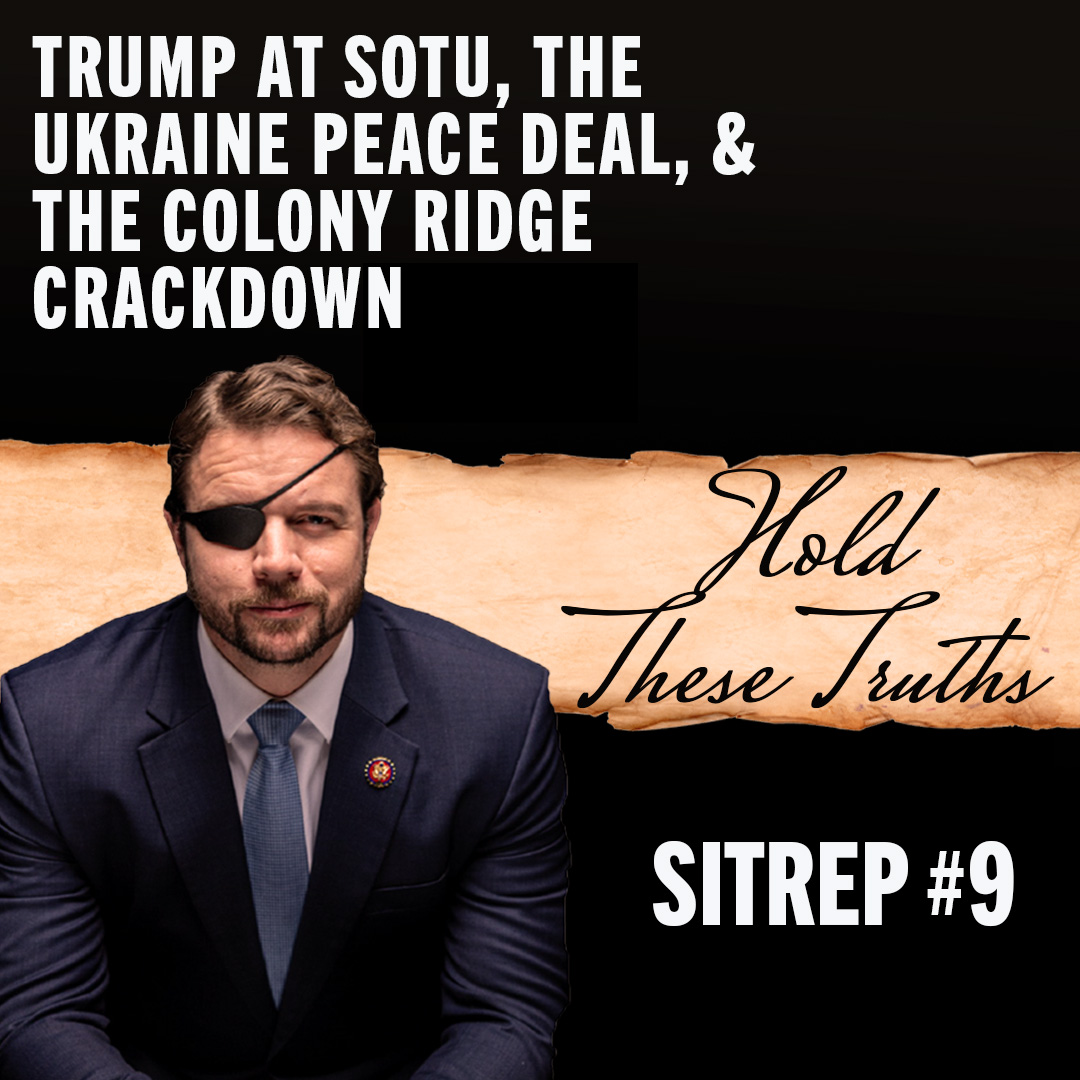
Hold These Truths with Dan Crenshaw
SITREP #9: Trump at SOTU, the Ukraine Peace Deal, & the Colony Ridge Crackdown
00:19:38
On the latest Situation Report, Rep. Crenshaw analyzes President Trump’s first State of the Union address as 47. He covers the latest developments in the Trump’s peace negotiations over Ukraine and Europe’s acceleration of military spending. And...
Loading summary
Transcript25 lines
- [00:00]
A
We hold these truths to be self evident that all men are created. As a member of Congress, I get to have a lot of really interesting people in the office, experts on what they're talking about. This is the podcast for insights into the issues. China, bioterrorism, Medicare for all. In depth discussions, breaking it down into simple terms. We hold. We hold. We hold these truths. We hold these truths. With Dan Crenshaw, the eagle has landed. Syrup number nine. The situation report. News that is unbiased and allows you to go to work, listen to some news and hopefully not have to waste your time scrolling forever to figure out what's going on. In my own news today, I can't help but point out that I got this interesting card, I guess you would call it looks like a cutout from an envelope.
- [00:50]
To our official mail here in Washington D.C. office. It says it's from Ms. 13.
- [00:57]
Sinaloa Cartel, the Jalisco New Generation Cartel, the Northwest Cartel, and the Mikoacan.
- [01:04]
Family.
- [01:07]
United States. That's weird. Okay. It's also addressed to Representative Ben Crenshaw. So that's interesting on the picture. There's a picture on the back, just has a bunch of Blackhawks. Looks like, like some kind of operation, Maybe from the 60s, maybe from Vietnam. I don't know what that picture's from. I'm not sure this is really from the cartels. I don't think it's a threat from the cartels that they generally don't send a message that's, you know, from all of them. And the fact that it says Ben Crenshaw tells me it was, it's a boomer golf fan. Who, who. Which is the one, they're the ones who often mistake me or call me Ben. My name is Dan, but they call me Ben because Ben Crenshaw is a famous golfer that our parents generation is a fan of. So that's in Dan Crenshaw news for the day. Now it's been three weeks since I sat down and gave you a sit rep on what's going on around the world. Boy, we got to start doing these more often. So there's no shortage of things to talk about. Obviously last night as I record this, the state of the union was last night. And that's of course dominating the conversations this morning. This is his first day of the union, in his second term to the Congress and.
- [02:23]
He had quite a lot to say. I think it was the longest in 60 years. Of course, your typical heckling from the opposition party. And like any speech, it's stuffed Full of every possible issue and policy request from every corner of the president's constituency that you can imagine. And that's sort of what state of the unions have become. You know, nobody wants to leave out any part of their constituency, so they have to mention every single thing. And these things have become pretty long.
- [02:55]
Because of that. This one clocked in at an hour and 40 minutes. He didn't hold back, of course, and it had its typical Donald Trump flair, which was always fun, and went head to head with Democrats, baited them into jeering him. And this led to Texas Congressman Al Green being removed from the chamber. Trump addressed a litany of issues, including the border security, combating drug cartels, challenges posed by AI, altered images, foreign policy in Ukraine and Greenland, energy deregulation, doge, military readiness, protecting women's sports and make America healthy again movement. It was broad. It was an unapologetic display of his agenda.
- [03:39]
Now let's go back to world headlines. So a lot has happened on the Ukraine, Russia issue in recent weeks and it's a little bit hard to keep up to it. So we'll just summarize what's happened so far. Now, after months of back channel diplomacy, the Trump administration is accelerating efforts to scale down US Involvement in the Ukraine war and really just make good on a campaign promise. He wants to bring peace, he wants the war to end. And now how you go about that is a much more complicated discussion as we're clearly finding out. One of his key demands, of course, is that this be European led. He's been banging the drum on this since his first term, that Europeans, and I agree with this, should be able to defend their own continent. That should be a given. They need to be an asset to us as an ally, not just somebody we're protecting. Protecting for what? Now, as part of this effort to reach a deal, one of the main efforts has been signing a critical minerals deal, rare earth minerals deal, about the same thing between Ukraine and the U.S. this sort of 50, 50 partnership. Now, the idea being that if there's mutual involvement and economic interests, and that's an implicit security guarantee, it's a great deal for Ukraine, it's a good deal for the US Ukraine is not just the breadbasket for Europe and much of the developing world, but also has quite a bit of the world's rare earth minerals.
- [05:07]
For some reason.
- [05:09]
And we've talked about this at length and on other platforms, that that day in the White House went from what should have been an easy meeting to a very contentious one.
- [05:21]
I saw it I saw how it deteriorated.
- [05:26]
My personal opinion, it looks like Zelensky just felt the need to be litigating some past historical diplomacy efforts with Putin and litigating the efficacy of those with Vice President Vance and then with Trump. Didn't know when to stop talking. This led to just a very contentious meeting that ended with them just kicking the Ukrainians out and Trump stating, well, look, you're not ready for peace. Don't you know, come back when you are. Soon after that, in the coming days, Trump announced a temporary halt to weapons sales to Ukraine. So this has Ukrainians absolutely freaking out.
- [06:06]
Zelensky, I guess, talked to the right people and understood the assignments and recently.
- [06:14]
Wrote back publicly to Trump that he would be willing to sign the mineral deal. He very much appreciates US Efforts that have taken place so far and that he's willing and ready to talk peace.
- [06:31]
President Trump read that letter live yesterday at the State of the Union and said he appreciated it and was willing to move forward. I think that's a sigh of relief there. Again, again, this is a good deal for a lot of reasons. Now, this all came from the initial meetings weeks ago. Secretary of State Marco Rubio, National Security Advisor Mike Waltz, special Envoy Steve Witkoff went to Saudi Arabia where they listened to the Russian counterparts and they didn't have Ukrainians present. And people say that's leaving Ukraine out. To be honest, I think it's perfectly normal for the US as the self designated arbiter here, to go talk to both sides separately. You have to do it that way. And you know, our Rubio and Waltz and Wyckoff, you know, they had to listen to the earful of Russian complaints. And I think the general.
- [07:27]
You know, strategy here by the Trump administration is, look, you're not going to get a deal if you don't talk to them. And you're not going to get a deal if you're just yelling at them and chastising them all the time. And to be fair, that's a very American way of looking at it. Like you can look at the past and all the, on all the wrongs and rights done, or you can look to the present and the future, which is what Trump wants to do. And, you know, I agree with him. This is, this is the time to do it. You haven't talked to Putin for two years. You being the United States has not had a conversation with him for two years. It's time to try that out. Let him be the one who says, no, it's war only is a maximalist view and he might very. He might still very well have that view, a maximalist view, where he wants to completely conquer the country of Ukraine, which we cannot allow, but a negotiated peace settlement, or at least even if it's a temporary cease fire for a while, there's benefit to that, and it may have been while still maintaining American deterrence and deterrence for our allies. So I think we should be cheering on Trump's success here and hope that there is success. A key part of all of this is, is Trump's demand that NATO countries pay more of their fair share. We heard this a lot when I was in the Munich Security Conference. Europeans talking about how they needed to do this. Of course, you know, I think you need to do it a lot faster. You can. You could increase the percentage of defense spending by 1 to 2% of GDP right now, and that's going to have effects maybe five to ten years from now. The reality is, is if Europe wants to.
- [08:53]
Show a viable defense of their continent, they've got to do more actions. You know, I made it very clear at the time when we were getting chastised because of Trump's efforts in negotiation. You know, you have, like, say, the Germans chastising us for it. I said, well, you know, if you want to see at the table, then you've got to put troops on the ground, but you're not willing to do that. So of course you don't have a seat at the table. It's really that simple. We shouldn't be talking about them matching our spending. They should be doubling it. It's their continent. And I think most Americans agree with that. This is obviously Trump's message to them. And I think a lot of European leaders, to be fair, are taking it more seriously and moving in the right direction. Maybe not the Germans, but the British. The British Prime Minister Keir Starmer, made a promise to Parliament to raise their military spending. Denmark has accelerated efforts to invest in its military, and French President Emmanuel Macron made a similar promise. I think the French have really been leading on this. It looks like Trump's strategy is to accelerate this growing trend of economic military investment, which had started after the invasion of Ukraine. But then it begins to wane because the public opinions begins to wane. You know, the Europeans are very comfortable, like all of us. I think a lot of people, too many people, have forgotten the prehistory of World War II. It wasn't pleasant. Now, despite these conversations, to begin to end the war, which are good, it should be said, both sides are stepping up offensives with some of the largest drone attacks since the war began. That's what this war has effectively evolved into. It's a drone warfare war. Both sides have the ability now to, to manufacture quite a bit of drones at a cheap rate. The Russians, you know, used to buy them all from Iran. Israelis took care of that problem. But the Russians are able to manufacture their own and are even sending far more kamikaze drones than they have in the past. The Ukrainians are able to shoot a lot of those down and manufacture domestically their own stuff, which actually has some of the best technology in the world. We're copying it and do similar attacks. The good news for the Ukrainians is they rely less and less on American weaponry than they used to, but still the best possible weapons that for the long term defense of their country do come from the US and they're most concerned about lack of air defense support. This is the biggest concern that they have at the moment. Again, the good news, back to more news, because Zelensky has agreed to sign it. In theory, this will happen on Tuesday as long as he can keep his mouth shut during a meeting in the White House. And I'm sure President Trump will be testing him on that. Moving on to domestic policy and the dirty word reconciliation that you've heard so much about. Last week, the House passed the first part of reconciliation, which really just means we passed a budget resolution that's the required framework with which to even conduct reconciliation. So I think a lot of people at heartburn about the budget resolution, you know that it increases deficits. That's a complicated discussion as to whether it really increases deficits. It should be said that the budget resolution instructions, which basically give instructions to each committee and it tells each committee, hey, you're supposed to either cut or spend. And, you know, whatever you do has to affect the budget. And only the budget. It can't be policy related. Okay, so the Energy and Commerce Committee, my committee, was given instructions to save, slash, cut, whatever, how you, whatever you want to put it, $880 billion over, over 10 years. That's a lot of money. The Ways and Means Committee was given instructions to, basically, they can spend four and a half trillion dollars now. What are they really spending? They're not actually spending anything. They're what they're going to end up doing. This is, you know, what Trump's goal is, is to just keep our tax rates the same as they are right now. And now that's actually scored as a spend. Now, should it be scored as spending? Hard to say. So what's actually happening in that budget resolution is, you know, if we actually got it all passed and each committee did, did its work, you'd actually cut about a trillion and a half dollars in spending and your tax rates would remain the same. That's, that's the shortest, quickest way to describe it. Now, that's scored as a massive deficit increase. Just the only reason being because the tax cuts from the 2017 tax cuts are set to expire this year. So in theory, the government would be getting more revenue if we just did nothing. But I don't think Americans want us to do nothing. I think Americans would rather keep their taxes the way they are as opposed to increasing them. That's the goal in reconciliation. We just did a deep dive podcast on this. It was that just dropped with Paul Winfrey. And some other interesting news in some President Trump announcements on immigration. Spoke at length last night about this idea to overhaul our current immigration investor visa, visa, the, the EB5, replace it with a simpler, faster program, the gold card. He touted it in his State of the Union speech last night. It's an interesting idea. Could help significantly reduce the national debt by growing revenue. We'll see how many people take up on that.
- [14:02]
You know, typical outside the box thinking by President Trump. He also wants to create a golden dome, right? Modeled after Israel's iron gold is the theme here, folks. And, you know, there's the iron dome that Israel has to protect itself from rocket attacks from Hamas and Hezbollah. And this, you know, the idea of a kind of a ballistic missile defense system or a missile to any kind of missile defense system really dates back to the Reagan days, which, you know, it didn't really end up.
- [14:31]
Happening the way maybe he envisioned, but the Soviets certainly thought it did, which made them spend a lot of money and ultimately contributed to, I think, the Soviet Union collapsing. But overall, it's just a good idea. And it's helpful for our sake of deterrence to have the ability to shoot down enemy weapons and missiles coming at your country. This is, this is a priority of Donald Trump's moving on to something more close to home. A lot of people in my district have written me, asked me about Colony Ridge. It is a development. Not it's outside of our district, but it's nearby.
- [15:07]
So in a bold domestic enforcement move, Texas Governor Greg Abbott, working with federal authorities, launched a major crackdown on an infamous housing develop known as Colony Ridge. Now.
- [15:19]
Your Texas congressmen, Republicans had gotten together a while back. We wrote a letter to Ken Paxton, our attorney general, to open an investig into Colony Ridge. So this past week, U.S. immigration and Customs Enforcement agents, supported by Texas Department of Public Safety troopers swept into Colony Ridge. It's again, it's a sprawling community. It's like many of the other big communities you see in the larger Houston area. They arrested 118 individuals in a single operation. According to officials, the results were significant. Those taken into custody included criminals without standing warrants, including several accused sexual predators. At least one individual previously convicted of homicide. In fact, ICE highlighted the arrest of a suspected child predator as a key win for public safety. Former ICE director Tom Homan, now Trump immigration adviser, the border czar said this raid is just the first phase of a larger crackdown targeting criminal illegal aliens in the area. So they are still going after people who have known criminal like additional criminal charges besides just crossing the border illegally. The operation scale and coordination. Federal agents working hand in hand with state law enforcement, for instance, really underscores the new administration's commitment to an aggressive interior enforcement. This is meant to be a deterrent.
- [16:38]
Now, tragically, there was a recent incident in South Texas, which underscores why officials are cracking down on cartel activity. In late January, a 74 year old Texas rancher from Brownsville was killed by an improvised explosive device planted on a road on his ranch in northern Mexico. The rancher, Antonio Cespetes Saldierna, hit the hidden bomb while out on his property just across the border. Authorities believe a drug cartel operating in the area left the device. So while this occurred on the Mexican side, it powerfully illustrates the spillover of cartel violence. This is just to be clear, this is an American ranch owner he owns seems to own property on both sides of the border, I suppose.
- [17:16]
Now Abbott, President Trump and I have frequently pointed to cartel violence and drug trafficking like fentanyl as a reason to tighten border security and step up interior enforcement. This is just another example of it and some cool scientific news. Microsoft dropped a major quantum computing breakthrough with its new Majorana one chip, a processor that uses an entirely new state of matter to push quantum computing closer to reality. This isn't just a step forward, it's a, it's a huge leap to a whole new era of computing, one that could reshape industries from cybersecurity to medicine. Now, for those who aren't familiar with quantum computing, you're not alone. No one really understands it. It's a totally different way of processing information than traditional computers. Quantum computers are super powerful. They have exponentially more computing capacity than traditional computers.
- [18:07]
It's primarily because A traditional computer uses bits, so it's either on or off. It's one or zero. But a qubit can be in a variety of states at the same time, which just exponentially changes the amount of information that can be processed. How that works is honestly just like science fiction stuff. I mean, the people who can explain it really well still don't explain it really well. It's amazing that we're even building these things because they've been theoretical for a very long time.
- [18:36]
This isn't just about making computers faster. It's really unlocking entirely new capabilities in cybersecurity areas. I, I mean, energy, medical research. It's, it's, it's quite astonishing how much more computer power, computing power these single chips potentially have. I've heard, I've heard, you know, that one chip has as more computing power than all the supercomputers combined in the world. It's rad. It's a radical advancement, something that we need to continue to lead on and invest in before the, the Chinese do. Developing the chip is different than developing an actual computer that's workable. You know, the first is the stability of these things, qubits. The chips that power quantum computing are so sensitive that the slightest bit of interference causes interruptions and errors. So this new chip, it reinvents the game, uses a type of chip that's naturally more stable, meaning it can hold information longer and make quantum computing more practical. That about wraps up this, this week's sitrep. Thanks for listening.