← Hold These Truths with Dan Crenshaw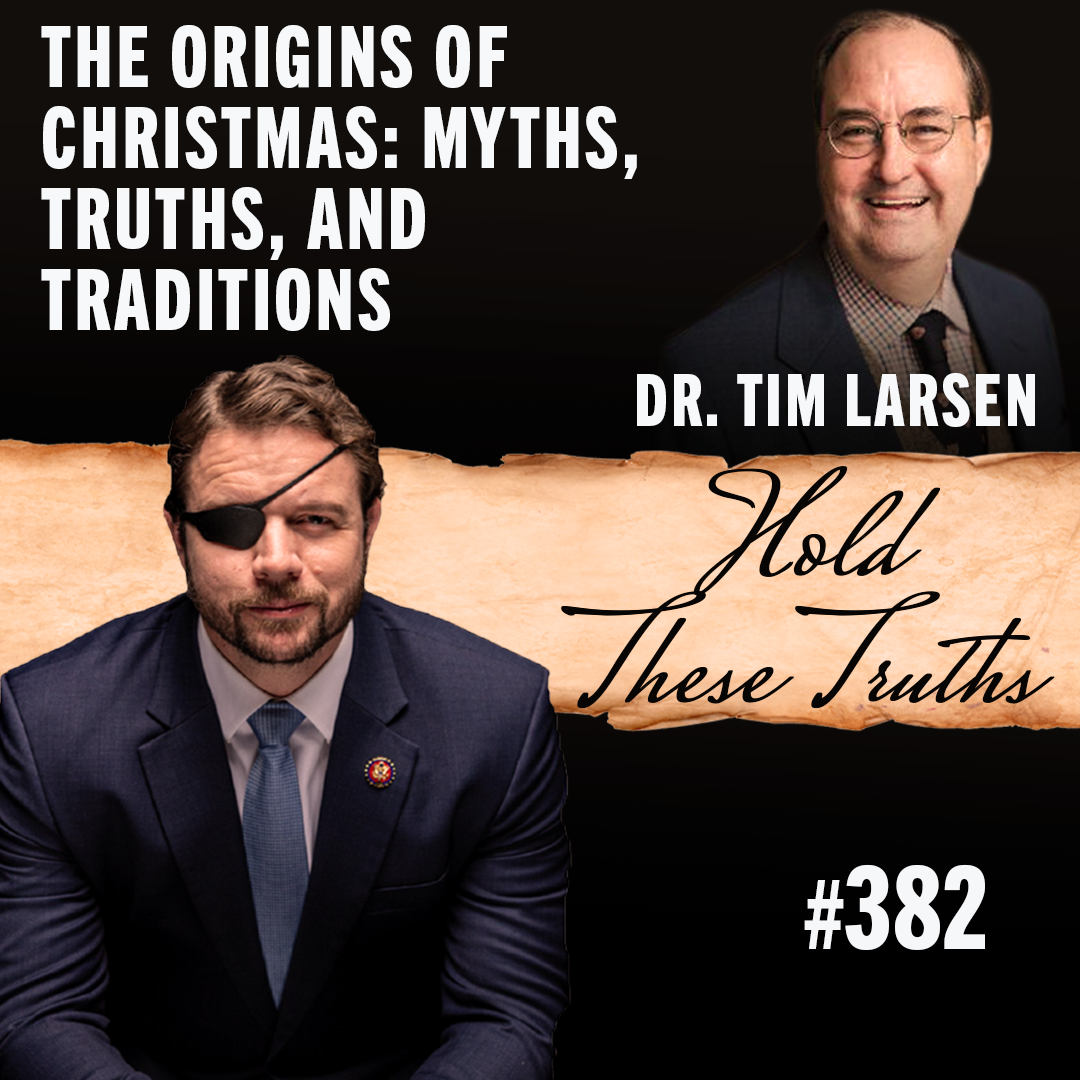
Hold These Truths with Dan Crenshaw
The Origins of Christmas: Myths, Truths, and Traditions | Dr. Tim Larsen
00:48:20
Loading summary
Transcript188 lines
- [00:00]
A
We hold these truths to be self evident that all men are created. As a member of Congress, I get to have a lot of really interesting people in the office, experts on what they're talking about.
- [00:09]
B
This is the podcast for insights into the issues.
- [00:12]
A
China, bioterrorism, Medicare for all. In depth discussions, breaking it down into simple terms. We hold. We hold.
- [00:19]
B
We hold these truths. We hold these truths.
- [00:21]
A
With Dan Crenshaw.
- [00:22]
B
The eagle has landed.
- [00:24]
A
Merry Christmas, everyone. Welcome back to hold these Truths. And like every year, I like to do some kind of Christmas episode. This one's going to be super interesting. You know, I think we all take our Christmas traditions somewhat for granted. We celebrate it as the birth of Christ, if you're a Christian. And then we add all this other stuff like Santa and reindeers, Christmas trees and ornaments, which I've never read about any of that in the Bible. Um, and so some say, well, this is a pagan holiday and it's, you know, it's been paganized and it's, you know, it's secularized and, you know, I don't know, it does make people happy. So I guess what I want to figure out today with my expert who is Joining me today, Dr. Timothy Larson, who's professor of history at Wheaton College in Illinois, president of the American Society of Church History. I want to figure out where all this stuff comes from. And good news is, look, I, I think the answers we're going to come to are, are not going to make anyone upset. That's, let's just say that out from the, from, from right from the start. So Dr. Larson is a expert in the Victorian area, which is a period that's done a lot to shape Christmas celebrations today. An expert on Christmas generally, author or an editor of 20 books, including 12 classic Christmas stories, A Feast of Yuletide Tales, and the Oxford Handbook of Christmas. So, Dr. Larson, thanks for being on. I'll call you Tim, if that's all right.
- [02:03]
B
I'm Tim. Merry Christmas. I'm glad to be here.
- [02:06]
A
Awesome. Well, I'm glad to have you. Thanks for joining us today. So, you know, we'll debunk some myths, but let's start with some historical context. So in your work, you say Christmas is best understood as extra biblical, not unbiblical, that it's a church tradition, not, not commanded in scripture, but also not forbidden. And it's practiced, obviously it's practiced by Christians of many denominations. So what do you mean by that? Let's start there.
- [02:36]
B
Yeah, Christmas is very biblical in the sense that our story of the nativity is from Scripture. The coming of God incarnate in Jesus Christ into the world is the heart of the gospel. So it's a very Christian biblical story. But the particular thing that people sometimes get hung up on is the date. December 25th is not in the Bible. So we have decided when we're going to celebrate this important gospel story, at what time of the year. So that is the extra biblical bit. We don't have that part in the Bible. We've just chosen to choose this time of year to celebrate, but it's not unbiblical. It's a very biblical thing to do to teach our children about the coming of Jesus and to celebrate that. But the specific date is the part that's extra biblical.
- [03:21]
A
Where did that day come from?
- [03:24]
B
You know, so many things about origins are hard, and part of the reason why they're hard is because the church was persecuted for its first few centuries. And so it didn't have. We don't have records. So things pop up in the 4th century when things are no longer being persecuted, when Christians are only being persecuted. And it's already been going on, but you're not sure for how long and quite, quite lie. My own theory is that it's tied to the winter solstice in the Julian calendar. That's our Christmas. And I think Christians did it for theological reasons, that what Christmas means to Christians is that the light comes into the darkness and the darkness cannot overcome it. And what the winter solstice is, is from now on, the light gets stronger and stronger. And I think Christians are like, yes, that communicates a truth about who Jesus is and his ministry that we can connect to the annual year.
- [04:16]
A
That's interesting. And, and, but it's a good. The theory. But you're also saying we don't actually have evidence that, that that was thought of. We don't even know when the first, you know, December 25th celebration happened.
- [04:30]
B
Yeah, exactly. You just see churches that are celebrating, but they're not saying, oh, we're trying this new thing for the first time. They're doing it, but now the records are showing up.
- [04:39]
A
Interesting, interesting. Gosh, I hope one day we actually know. I mean, one of my questions was, when do we first see Christians treating Christmas as this sort of proper feast day? Is that, Is that the right way to phrase that question? So do we know that at least? Is that a different question? That's a different kind of question, yeah.
- [04:57]
B
Again, no. It's just. It's the same thing. In the fourth century. We get the records. But the records are. Are what's new. Not necessarily celebration.
- [05:05]
A
Got it. So fourth century. Fourth century is about. About for sure, the era.
- [05:09]
B
But we don't have when we could point to specifically. Yes.
- [05:15]
A
And they didn't have Santa back then. There was no.
- [05:19]
B
In the actual 4th century is St. Nicholas. So you start. You can start a trajectory from the 4th century with St. Nicholas.
- [05:27]
A
Okay. And. Well, let's do that. Let's. Let's start there. My questions are kind of all over the place, but. So St. Nicholas, let's tell the story of Saint List real quick.
- [05:37]
B
Yeah. All right. So the part that connects him to Christmas, he's a bishop, and so, you know, there's a lot to his story, but the part that connects him to Christmas is that he sees these very poor girls. They have. They have, like, an elderly father, and there's three girls, and they. If they had a dowry, they could get married and their life would be happy and respectable. Otherwise, they might get sold into slavery or something really horrible could happen. And so he throws money through their window into their house secretly for each of these girls to get a dowry, some say into their sock hanging over the fireplace, where you get that idea. So the part that kind of really connects to Santa Claus is that this is done secretly. He doesn't want credit for it. He's seen the last time. So the first time it happens is just a mystery. And then they're on the lookout because this is so interesting, and they catch him at it. So that's how we know the story. But the. The point is, he didn't want credit for it. He wasn't trying to kind of make himself look important. He just wanted to help somebody. He just wanted to be kind. He wanted to be generous. And that's the spirit of St. Nicholas. That kind of goes down the ages.
- [06:49]
A
Interesting. And then. So the socks hanging over the fireplace. Yeah. Presumably that's how they were drying their socks.
- [06:56]
B
And it was practical originally.
- [06:59]
A
Yeah. That's where you get the stockings from. And, you know, is there pretty good. There's pretty good evidence for this story, or is it something that just sort of filtered into our imaginations over time? What is your take on that as a historian?
- [07:17]
B
I completely believe it. I don't see. It's not like we're not at the flying reindeer stage yet. You know, it seems perfectly, you know, plausible that a bishop, you know, whose part of their duty is to care for the poor, would want to help these women. Okay.
- [07:32]
A
Yeah. There's enough. There's enough actual Recorded history on it. I'm just, I was just curious. I don't.
- [07:37]
B
Yep.
- [07:39]
A
And what, what time frame are we talking here again? Is this 4th century? Yeah, more or less.
- [07:44]
B
Yeah. We're like in, in the three twenties, somewhere like that.
- [07:47]
A
Yeah. Okay, so this is all starting to happen together. Fast forward a little bit. I mean, you work a lot on the Victorian era. Yeah, but there's a, there's a lot in between 4th century and Victorian era, Dark Ages, things like that. But how did Christmas survive? What would they even call it, actually, first of all, I mean, what were they calling it? Some, some version of Christmas at this, at this point in time? You know, we're talking about 4th century celebrations. Or is it just a. Very much a religious celebration of the Nativity and Jesus Christ? Is that.
- [08:31]
B
Yeah. So Christmas, our word Christmas comes from the Mass of Christ. So the celebration, the worship service celebrating Christ, the Feast of the Nativity is another common old way of saying that. So. Yeah.
- [08:45]
A
Okay. And it manages to survive. Christianity managed to survive. So presumably its traditions did in the church.
- [08:55]
B
It's the second most important feast for all those centuries. So Easter is the, is the greatest feast in the church in the medieval period, and Christmas is number two.
- [09:05]
A
Okay, but like you said, it's a, it's a feast. It's a, it's a, it's a very biblical celebration. We haven't yet, we haven't yet pulled in, you know, even, even the, even the story of St. Nicholas. Is it. When does it even become tied to, let's call it again, Christmas, for lack of a better term.
- [09:27]
B
Yeah, sure. So St. Nicholas's feast day is December 6th. So you're kind of already in this holiday season as we think of it, and that helps. And then this idea of giving gifts. And again, the anonymous part to me, I think is the key. So you have medieval. I think a key link in the chain is you have some medieval nuns who start leaving gifts for poor people and just writing on the card from St. Nicholas. And again, what they're saying is, we don't want credit for this. We're not trying to make our own reputation. We're just trying to do something good and kind. And so this kind of giving in the name of St. Nicholas is a way of saying it's just the pure joy of giving. It's kind of fun and mischievous. It doesn't make you feel like you're being patronized, like we're superior to you. It's not about me being somebody who's better off than you. It's just about this magic of St. Nicholas.
- [10:22]
A
It's.
- [10:23]
B
It's meant to kind of put a kind of playful spin on relationships.
- [10:27]
A
Okay. So. So that gift giving, anonymous gift giving, that does happen fairly early.
- [10:33]
B
Yeah, in the medieval period for sure.
- [10:35]
A
Okay. With the socks stock.
- [10:39]
B
Yep.
- [10:40]
A
Even the socks and stockings. Okay. Sometimes we're painting a picture here.
- [10:44]
B
Yeah.
- [10:45]
A
Where did they have trees? Is there a tree for the gifts? When did that. Where did that come from?
- [10:53]
B
So the trees don't become a really big deal until the 16th century. So a little after the medieval period, but they start in the medieval period. What happens is that in the Christmas season, there would be a sacred play which would tell the story of salvation. And so he would start with the Garden of Eden. Here are humanity created good by God. There's going to be a fall. There's going to be need to be redemption. And that's how you get the story of Christ. And so to tell that story, you would start with the Garden of Eden, with a tree of life in the garden. And so you would see on the stage a tree that was decorated to be the tree of life. And so in people's imagination, a decorated tree became associated with the Christmas season. And then they started, like, leaving it up. It was so much fun to decorate. Let's just put it in the town square center. And then maybe I want one in my home as well. So that's how that gets going.
- [11:40]
A
Got it. When we think of the tree of life symbolically, I'm not sure which tree that is, but it certainly doesn't look like what we would think of as a. What. What is it? A conifer pine? It looks very different. Right. So is there. Do we have any idea how it became that kind of tree?
- [11:57]
B
So, yeah, it's an evergreen. And the idea of the evergreen is winter is supposedly this time of death and decay. But then life comes into it again. It symbolizes the gospel message. Christ is bringing life. And so here is this tree that's alive when all the other things look dead. And that's why it's an agriva green. Okay.
- [12:18]
A
That makes sense in that. That decision. You just sort of evolved during that time as per what kind of tree it is.
- [12:27]
B
Yeah, I think. I think evergreens in winter is a kind of natural symbol of life. And so I think that's pretty common. People are saying, like, you know, getting the holly, those. All those kind of things are the same idea, which is like, even though it looks like it's darkness and death, it's actually life. Coming into it. Yeah.
- [12:44]
A
Okay. And then we fast forward a little bit. And so we've got these, these basic traditions in place. This, this, this, the, the St. Nicholas tradition, the celebration of the birth of Christ. And we sort of settled on this winter solstice idea because of the coming of light. And, and, and we figured out that, we figured out the Christmas tree decoration part, but we haven't, we haven't talked. We haven't figured out why Santa exists yet. So obviously Santa, St Nicholas, there's an obvious connection. Connection there. But then there's, you know, but now we're getting into like reindeer and elves and North Poles and I mean, now we're getting really wild here. So. So you talk about a lot about the Victorian era, the 19th century, as, as really the beginning of this sort and Christmas as we know it. So talk about that, if you will. Yeah.
- [13:44]
B
So Santa Claus is definitely a gift of the United States of America to the entire world. He, he is definitely welcome.
- [13:50]
A
World.
- [13:51]
B
Yes. He's, he's a enormously popular figure around the world, but he's definitely. Americans are the one who figure out about Santa Claus.
- [14:01]
A
So that we discovered Santa Claus, we discovered his real.
- [14:04]
B
We're the ones who track them.
- [14:06]
A
Track them on norad.
- [14:08]
B
Absolutely.
- [14:08]
A
For those who don't know, the US Government has a program called NORAD stand for. Actually, it's like North Pole. No, it's like, it's like a missile. It's like a missile tracking. It's like a, it's a very, it's a very serious radar system. It's not. Yeah, it's not a joke. Like, this is a, this is not a joke. NORAD is designed as a, as a, as a homeland. It's the North American Aerospace Defense Command. Okay. It's very real. Okay. I know they, and, and everyone should look this up. Every year they start the Santa tracking. I think, I think it already started. And so kids can go on NORAD again, this very real serious military command, and they're tracking Santa as he goes around the globe. It's pretty cool. So we, we track them. We invented him. But I interrupted you, so keep going.
- [15:04]
B
No, no, that's, that's all people want to know that. All right, so in New York City, there's a big Dutch population and the English speaking population is hearing them talk about St Nicholas and it's sounding to them in Dutch like Santa Claus. Santa is just the Latin name for saint. So Santa Claus is like a way of talking about St. Nicholas in America, which kind of got picked up from hearing Dutch people say it in Dutch. And then American writers start adding to it. So Washington Irving is America's first kind of, like, internationally famous kind of fiction writer. He, you know, did Legend of Sleepy Hollow and, you know, Rip Van Winkle and all those kind of classic stories. He. A lot of terms that we still use, the almighty Dollar and Gotham City and stuff like that, like, all come from Washington Irving. And so he started writing, like, his kind of pretend history of the Dutch in America. And he gets St. Nicholas then flying. And then Clement Moore writes his famous Twas the Night Before Christmas home. And that's where you find out that actually not only is St. Nicholas flying, and again, he's called St. Nicholas still in that story, but people are now swapping the word Santa Claus for that. He also is flying with reindeer, pulling it. Um, so again, that is like. I guess all that comes from this sense of like, well, how. How did St. Nicholas get in our house? How did he be this present? So there's this tradition of anonymous gifts and. And the. And the Americans add more explanation for this with the. With, again, the name kind of becoming the American version, Santa Claus. And then the flying and the reindeer and the. Down the chimney. We already have the socks on. The chimney is. Now he's coming down. It's. And so he's. Maybe he's an elf like, figure. Those kind of things start getting added in.
- [17:03]
A
So, I mean, creative writing. I mean, it's. It's. It's fiction writing that becomes just part of our culture, as often does happen. I mean, that seems to be the. That's the simplest explanation. There's not, like, some deep reasoning behind why it's reindeer.
- [17:18]
B
Yeah, no, Clement Moore is definitely the first one to tell us that it's reindeer. But obviously North Pole. And, you know, North Pole is great because it's. It's a mysterious place that you haven't been to. So you're kind of left to, like, say, well, I wonder what happens up there. Smart.
- [17:33]
A
It's smart writing. It's smart creative writing.
- [17:35]
B
Yeah.
- [17:36]
A
That's all it is.
- [17:38]
B
Okay.
- [17:38]
A
I mean, we don't know these things. I mean, that's. This is why we're asking. It's interesting. What. What's your favorite example of a tradition? People assume that's ancient. That's actually pretty recent.
- [17:54]
B
Wow, that's such a fun question. There's this. There's this very odd ritual in a town in England where they have barrels of fire and they go on a procession for Christmas time. And they think if you ask them that. It's like a pagan ritual that goes back, you know, way before Christianity. It was actually started by a Methodist church who were doing a prayer meeting and they like had a procession for like an all night prayer vigil and they started doing this. And the town loved it so much it caught on. So that why I like that illustration a lot because people often will say, oh, this is some ancient pagan thing. Like I explained with the Christmas trees, there were certain kind of German kind of folk thinkers in the 19th century who claimed, oh, the Christmas tree is actually an ancient pagan Nordic thing. But they just made it up. And so, yeah, a lot of things are like that.
- [18:53]
A
Let's go back to the flaming barrels. What, what, what are they doing? So, and what, what town is this? This is worth the visit? This is worth the visit. It's got to be on a bucket list.
- [19:05]
B
Yes. I'll have to look up the name of the town, but yeah, I think, you know, it's a time before there's artificial light. So I think that it was partly just because it was a nighttime procession. So it was kind of like having torches. And I think that they probably are deliberately trying to create a bit of a spectacle to hopefully like interest people. Maybe pull a little bit of a larger crowd into their prayer meeting. So, yeah, it's just, it's a really good.
- [19:32]
A
So that like literal barrel, like your typical. What you think of as a, is like a like oak cast barrel. And then they just set them on fire and they roll them down.
- [19:40]
B
Like they're like putting a fire inside it. So it's kind of like, it's like a container. Okay.
- [19:46]
A
I was imagining these rolling balls of fire, which would be pretty cool, I'm gonna say. I'm gonna say it's really old too.
- [19:55]
B
Very ancient. Yes.
- [19:57]
A
Yeah. This comes from old scriptures nobody's found yet. Okay, so they. Okay, so just. It's like a bonfires, but in, in barrels.
- [20:08]
B
Yeah, it's okay.
- [20:09]
A
All right, I gotcha. And then there's the, the stuff from. Yeah, I mean the Germanic traditions, I mean they, they, I mean they take Christmas pretty seriously in, in places like Germany. And you know, it's. Jesus, the unfortunate reality. It's often a target of terrorism for, for whatever reason. And you know, but it's, it's pretty magical. I mean, they really take it seriously. Why? Even though like, again, like we exported so many of these, these traditions, but like, it's a little, it feels a little different in Europe. How would you characterize that?
- [20:47]
B
Yeah. So again, Partly looping back to Santa Claus. There are distinct traditions in some other European countries of their own magic gift bearer. So they have a different name and certain different traditions. There's one in France, there's one in Holland, there's one in Italy. Actually, even the Germans themselves, they talk about the Christ child being the gift bearer who. Who, for reasons that I can't quite follow, is depicted sort of like this kind of angel figure. So. So. But Santa Claus, like, has kind of beat them all out big time. So. So the American export is winning that. Like, so those even, like, in England, it was Father Christmas was the older term, and that was kind of a vague figure that meant kind of like, we would say like Father Time at New Year's. Like, just like the personification of time, the personification of Christmas as Father Christmas. But Santa Claus is taken over in Britain. Even if they use the term Father Christmas, they think he has reindeer that fly and he wears a red suit. So it's very much like the American Santa Claus has captured the imagination of the world for the gift bearer. But, yeah, every country, you know, I shouldn't say every country, but lots of countries have added something foods and traditions. And Germany became a major maker of, like, the kind of Christmas ornaments that we use. Those. Those glass ornaments and balls and things.
- [22:03]
A
They. Nutcrackers. Yeah.
- [22:05]
B
They became like big exporters of that. And so. Yeah.
- [22:09]
A
Who made the. Yeah, well, yeah, nutcrackers are huge. I mean, where would that come from? That feels very German.
- [22:15]
B
Yeah, it's a German folk tale. And that, of course, becomes the nutcracker ballet that everybody watches every year for Christmas. And so I guess Christmas is a time for reading, it's a time for including children. So I think you just get a kind of fantasy folk tale that gets associated in people's minds with Christmas, even though it's not a Christmas tale. Again, in Britain. I lived in Britain for several years, so I know, well, and even here, the Sound of Music somehow got associated with Christmas. You'll hear Sound of Music songs on Christmas albums, and it's just like. Well, kids love it. We watch it at Christmas time. And it doesn't have a Christmas scene, but it's kind of like migrated to Christmas time. And that's kind of like the Nutcracker has happened that way.
- [23:02]
A
Like some easier ones. I mean, Rudolph Rednose Reindeer, Frosty the Zone man. Again, this is more just creative writing.
- [23:12]
B
Yeah. So Rudolph is a great story. Rudolph was Montgomery Ward, a kind of straight up kind of department store. They would give Away a freebie something at Christmas season as a way of pulling in customers. And they told somebody in their, you know, kind of marketing department, write us a Christmas story as a free giveaway for this Christmas season. And he wrote Rudolph the Red Nosed Reindeer. So it's like American commercial kind of enterprise at its best. And gave away the store. People loved it. It got turned, of course, into a very popular song that people loved. And so then that became like, gave it new life and then, you know, animated specials and those kind of things. But it was a decision of the marketing department of a department store in America.
- [24:00]
A
Wait, wait, but to do what exactly? To give what away?
- [24:03]
B
The book. Yeah, they made the book as a, as a freebie. They made a little. Yeah, Rudolph reindeer book as a freebie giveaway.
- [24:10]
A
Got it. And then, and then they marketed to that and it became movies and then.
- [24:14]
B
It became turned into a song. Yeah, the song was like really kind of like the next step. Yeah.
- [24:18]
A
Okay, so the book had already idolized Rudolph as the, the, the front runner in the reindeer whatever mix just because, you know, he lights the way. Right. And okay, but, but the real fame came from just good old fashioned capitalism.
- [24:39]
B
Yes.
- [24:40]
A
I mean, I don't even know what kind of billion dollar industry Christmas is these days. Frosty the Snowman, Anything interesting about that?
- [24:50]
B
Yeah, no. Again, I mean, it's, it is like.
- [24:53]
A
I'll tell you so many, there's so many of these, like, side quests.
- [24:56]
B
But like, you know, the Christmas season is over 10 of the year. It is an engine of the economy in a huge way. I, I started doing this by accident. I thought it'd be fun to write a Christmas book. And, and it turned out to be a much better commercial move than I realized because Christmas comes around every year. It's a big part of the year. People want to spend money. So. Yeah, I think, you know, a lot of these things are just like, you know, if I was thinking like, you know, could I write a Christmas song? Like, if you could write a, a Christmas, you know, like, pop hit, that thing will never die, you know, where, you know, if you, if you, I listen to, you know, country Music station here in Chicago and like a song will like you play to death for like, you know, six months and then you'll never hear it again. And, and, but like you, you write a Christmas song, it'll come back every year. So yeah, I think somebody just like, I need to write a Christmas story. But, and that's how Frosty came. You know.
- [25:52]
A
You know, we, I think some Some people bash Christmas as, as, as being overly paganistic because of all these new traditions. What do you think about that? Why, why do you think people go that direction? And, and those claims sort of keep coming back every, every December. Yeah, because, I mean, because from going through this history with you, it, it, you know, there's clear, clearly an evolution to it. It's, it's clearly not rooted in some kind of pagan tradition. It very much is, from what I can tell, very much rooted in what we, what we of course thought of as Christians as the birth of Jesus Christ. And of course all these things were added to it to just make it more fun and interesting. Just like that's humanity. Right. So why do these claims keep coming back? Is it just because people like to tear down good things? I've noticed that that's pretty popular. I'm in politics after all.
- [26:54]
B
So some of it is atheists and secularists like deliberately trying to tweak Christians. Oh, that's really, it's actually wrong. But like, but like Christians take debate a lot and they get worried like, oh, maybe it is pagan. So I'm, it's really important for me like to like, just like take it. Like why do you think that? Like just take it, take it one by one. Some of it is like a kind of misguided Christian piety. So the Bible is very clear that there are feast days under the Lord and you celebrate a feast with both better food and drink than usual and with gift giving, with joy, with celebration. That's all in scripture. But people think, oh well, to Christian is to be self denying. It's like, well, there's a time for that, but there's also a time to feast. And that's very biblical. The same with gift giving. The Magi gave Jesus gifts. Gift giving is a natural instinct that's perfectly Christian and is there in scripture. So of course it can become overdone. It can become. People can make foolish financial choices or whatever. But all these things are perfectly biblical and good and sometimes people worry about them for reasons they don't need to worry about them.
- [28:14]
A
Yeah, I mean, yeah, and that's, you know, do you think people should be worried about the what, what may be seen as the, the thinning out of the, of the Christian traditional aspect of Christmas and making it overly commercialized and Santa and reindeer centric? You know, is, is that really something Christians should worry about? You know, I, I don't know that it is.
- [28:47]
B
I, I'm, I'm much more of a glass, glass half full kind of guy. I think the, the culture hears the gospel more in Christmas season than any other time of the year. Again, I listened to another pop station here in Chicago and the rest of the year they're just playing the regular pop, pop hits and they turn to a full Christmas format for December. And I could turn on this pop station and hear about a savior being born, about sins being forgiven, all these amazing things. I think people, people are much more willing to accept an invitation to come to church in the Christmas season than they are at any other time of the year. So I think it's actually rather than kind of being grumpy and fearful, I think we need to celebrate that actually.
- [29:33]
A
At least there's some attention on it.
- [29:34]
B
Yeah. People even, even, you know, I did as you mentioned, the Oxford Handbook of Christmas and I had a guy who was a well confident atheist write a chapter on secularity because I wanted to get that perspective. And he basically, he worked on, he actually told me he wanted to not do it for a while. He was not finding his way. And finally he wrote this chapter which was like, let's face it, even atheists love Christmas. It's a great holiday. And I think that that connection with other people is actually something to be cherished. Sometimes I think people are a little like they're actually pointing the finger outward when they should be pointing it inward. You can make your, your Christmas more Christian if you want to. You can read Luke 2 with your family, you can go to church, you can sing Christmas carols that talk about Jesus. So it's a, it's, it's a wonderful time and go ahead and make your own Christmas. Make sure it has of the gospel message in it.
- [30:34]
A
Yeah, no, I, I agree with that sentiment. You know, delight again, glass half full. Just maybe one last kind of interesting question about just practices and I'm kind of all over the place here, but do you have something that you think is the strangest one? I mean just the strange. He might have already named it with that, with that story from the, that in England. But maybe, maybe not just a modern one, but an historical one that seems really strange but actually makes sense in its context. I don't know. Is that too specific?
- [31:15]
B
Yeah, you know, it's, I mean a lot of it is just like choose your own, you know, adventure. So like some of the foods, I'm like why, why are we eating this? Why are we buying this? A lot of it comes from just the fact that, that they didn't have refrigeration and preservation the same way in the old days, ingredients had to last longer. So, like, a fruitcake is not a great food, I think, you know, why are we doing this? And the reason is because it's traditional. And why is it traditional? Because it's a cake that basically is indestructible. You know, if you. They found, you know, you know, a fruitcake from like, some explorer in the North Pole and like, that was like, left 100 years ago and it's probably still good. Like, you know, it's like this is designed to be food that doesn't. That doesn't go off, but it doesn't taste very good. It's just. It just has a practical advantage, rather. So why are we still doing it? And the answer is, well, just tradition.
- [32:05]
A
Yeah, that's funny. You know, I saw a video recently and we posted it. It was somebody making the case that Home Alone was this actual Christian movie. And a pretty interesting case when you start looking at all the symbology that they. That they reference. I don't know if you saw it. Yeah, it was. She's up top my head. What were they talking about? I mean, you know, when. When what. What the heck is the kid's name? Kevin. You know, Kevin. First is this gets lost. I think this is the second hole in two. First one, yeah. See, I'm so confused. I don't know. But, you know, but he. But he runs into this kind of homeless character. And you notice actually later on, if you're really looking closely, his hands are bandaged, he's giving Kevin this advice, comes back later to actually save Kevin. I don't know. They had a few other interesting symbological notes in there that. That were kind of interesting. And it sort of gets to this point of like, yeah, what makes it a Christmas movie, you know, and, you know, Home Alone's a Christmas movie just. Just by the fact that it's around Christmas. But then apparently there was all this. This added symbology. Now maybe, you know, if you're talking about what appears to be wounds on your hands from a nail, you might be more talking about Easter than Christmas. But nevertheless, it's still Christian in its origins. And. And interestingly enough, are there any other movies that you can think of that maybe we didn't notice are not just commercialized secular Christmas stories, but maybe have a little bit more faith wrapped into them than we realized? I just thought that was an interesting thing that came across my feed and we posted it.
- [34:04]
B
That's wonderful. So I think what makes a Christmas movie a Christmas movie besides the fact that There's a Christmas scene, or it's set at Christmas time is reconciliation in relationships. It's about people finding one another, which, again, is resounding the gospel. The gospel is about goodwill towards men. It's about God and man being reconciled. It's about forgiveness. And if you look at a Christmas story, like, the emotional heart of it at the end is like, these people have found one another again. You've been estranged, you've been misunderstanding, you've been holding a grudge. But I actually love you. You're part of my family, or you're somebody who's going to go, part of my family, whatever it is. And so I think that, to me, like, a good Christmas movie is echoing the gospel story of Christmas. But one of my favorites is the Bishop's Wife with Cary Grant, which is a classic angel story. It's a Wonderful Life, of course, it's the most famous angel story of Christmas. But I love the Bishop's Wife, and it was remade with Whitney Houston called the Preacher's Wife. And I actually like the remake as well. I get to watch.
- [35:10]
A
Well, add that to the list this year.
- [35:13]
B
There you go. I think they're super fun.
- [35:14]
A
What about. Okay, so I, I've never watched A Christmas Story. Like, it's, it's, it's just famous symbology in American culture. A Christmas story with, like, the BB gun and like, you shot my eye out. People, People just attribute it to me because my eye. And then, like, you know, there's like the, the, the leg lamp is from A Christmas Story, right? Like, we Christmas party once and we bought like, a bunch of leg lamps. I'll be honest. Never saw the movie. I watched the movie recently and I was like, what is this movie?
- [35:49]
B
I don't even know what the.
- [35:50]
A
I can't even tell you what the plot of that movie is. I just, I was like, I was waiting for it. It was just, it was, it was almost. It felt like a Stanley, Stanley Kubrick film. I'm not going to lie. Like, what is your, what's your take on that?
- [36:04]
B
Yeah, it's not, it's not one of my favorites. There are, I have favorite. It's very episodic. Yeah, it's like watching a series of sketches. Like, it's kind of like, you know, like, here's, it was just like a set piece. Like, here's a little funny scenario and another one and another one. And so, yeah, I, I, yeah, there, there are definitely funny, funny things and great lines, but it is just like one little episode after the Other is. Yeah, it's not the same like you're saying, I agree. There's not a plot the way there's a plot.
- [36:35]
A
But it's strange because it's like, it's so famous for. For. And after watching it, I'm like, I just. I'm sorry. I just don't get it. I don't know. It's iconic for whatever reason, but I don't know.
- [36:47]
B
Yeah, I try not to get it in the rotation. It's not one of my favorites.
- [36:51]
A
Okay. What's your opinion on the ultimate question? Is Die Hard a Christmas movie? Yes.
- [36:57]
B
You see, I was setting that up, actually. I think my answer is yes. And the answer is because not only is it set at Christmas, but it really is about turning towards the people you love and seeing that they matter in your life. That's really what it's about. It's about him and his family. And so the emotional heart of it is, can you see the people who really matter in your life and love them? And that's what's happening in the movie.
- [37:25]
A
You're Sacrifice for them, you know?
- [37:26]
B
Yeah, absolutely.
- [37:27]
A
Fight for them. Sacrifice for them. Yes, of course. That. Of course. Just playing devil's advocate. That's not the right turn of phrase when we're talking about Christmas. Sorry. But you know what I mean? But. But that. But that kind of plot is common in all movies. Movies. Right. Like, that's what makes a good movie. A hero who's. Who's. Who's taking us. Who's making a sacrifice to care for his people. A movie's not so great if the hero's not doing that. And so, you know what else makes it a Christmas movie? And, you know, but I mean, I. I don't disagree with you necessarily. I'm just. I'm just sort of thinking through it.
- [38:06]
B
Yeah, no, there are a lot of other movies that don't do that, but I think, like, that that is like, also the plot of a classic disaster movie. A disaster movie is usually like, you know, this guy's not, like, been paying very good attention to his family. Maybe he's estranged from his wife or whatever, but, like, in this crisis, he's gonna step up and he's gonna save them and they're gonna, like, reconnect and find each other. Like, that's like. That's like, you know, every disaster movie.
- [38:30]
A
And.
- [38:30]
B
And so that does rhyme to me with, like, what a Christmas movie does as well.
- [38:33]
A
Yeah. And, like, I guess the other argument would be, like, is the movie about Christmas or is the setting in Christmas. I think this is why it's the ultimate debate about Die Hard. And, like, I would almost argue a Christmas story is not even about Christmas.
- [38:49]
B
Yeah, Yeah, I agree.
- [38:50]
A
For some of the. For some of the reasons you just stated. It's like, I don't.
- [38:54]
B
I don't.
- [38:54]
A
I can't think of anything in that plot where there's a sense of sacrifice, a sense of love for one another. It's actually very tense relationships in that family, and it doesn't really go anywhere. You know, you just. I mean, maybe there's. I think kind of does. Like, you know, there's this, like, harsh relationship between him and his father, and he. And he. But he gets the gift that he'd always wanted, and so he's excited and he shoots his eye out. Well, he's glass.
- [39:22]
B
So, I mean.
- [39:24]
A
And then there's forgiveness. I think. I. I think maybe I'm right. So maybe. So maybe it's a. There's some. There's some of those moral. What we would think of as moral Christmas elements to it, but it's just. It's a little haphazard. It's not as obvious as Die Hard where you're like, I'm sacrificing for the people I love. I am Bruce Willis. You just can't. I mean, you can't get better than Bruce Willis.
- [39:46]
B
So you were talking about, like, finding, you know, kind of Christian themes. One clear example of that is A Christmas Carol, which is really a Christian conversion story. It's about a man who is lost, who becomes found, who, you know, has been, you know, in the depths of a sinful way of behaving, who then is literally transformed overnight. And so it's actually like. It's resounding the hope of the gospel that somebody's life can be transformed. And you see that happen. You know, it happens through ghosts, and it happens in a mysterious way, but it's really a conversion. Christian conversion story in lots of ways.
- [40:22]
A
That's a very Christmas movie, for sure.
- [40:24]
B
Yeah.
- [40:24]
A
Yeah. No debate on that one. Right. I'm thinking more of the ones that are kind of on the edge.
- [40:29]
B
On the edge, yes.
- [40:30]
A
And. And, you know, there's. That. There's an interest. Some interesting ones out there, just even ones that are Bad Santa. And I want to know. Yeah, is that a Christmas? I'm really. I'm not. It's been a long time since I saw Bad Santa. But is there like a. Does he. Does he come in to be a good Santa? I think is the point of that movie. I don't remember, actually. Or maybe it's just a comedy. Maybe it's just a dark comedy.
- [40:57]
B
Yeah, I think. I think there are, like. There are. It's a certain kind of person, or maybe all of us in a certain kind of mood is, like, just, like, ready for it to be mocked a bit for, like. Okay, I've been doing this kind of sentimental thing for too long. Can I get, like, a cleanser? And so you'll always have, like, those kind of movies like. Like, that are about, like, kind of like, you know, misbehaving at Christmas or, you know, like more satire that are. They're kind of like, you know, like just the. The kind of, you know, palate cleanser from the sentimental side, I think is how I see them.
- [41:33]
A
Yeah, yeah.
- [41:35]
B
Yeah.
- [41:35]
A
I mean, it's.
- [41:36]
B
It's just.
- [41:36]
A
Just Hollywood, right? It's entertainment. We go on forever thinking about Christmas movies. What's your favorite Christmas song? I'll tell. I'll tell you. I'll tell you mine.
- [41:48]
B
Yeah. I've got so, so many. I. I love Silent Night. I love oh, Holy Night. I love to hear Ave Maria. Those three are so beautiful that when I. I gotta perk up when I.
- [42:04]
A
Hear them, so I. What's that one? Carol. The Bells. Carol the Bell. That's my favorite love carol. The Bells.
- [42:16]
B
Yeah. It just kind of makes you happy.
- [42:18]
A
Yeah. Well, my favorite pop song is just Baby, Please Come Home Christmas, but sung by you. Sung by you, too.
- [42:26]
B
Oh, yeah.
- [42:27]
A
It's. Bonnet is. It's just so good. Yeah, that's my favorite. Let's see. What. Okay. Lightning round, Most misunderstood Christmas symbol. Talked about so many. Maybe we've already answered this, but I don't know.
- [42:48]
B
Yeah, I think. I think candy cane gets overthought.
- [42:50]
A
Like, you haven't talked about candy canes.
- [42:53]
B
Hecker.
- [42:54]
A
Candy canes.
- [42:55]
B
Yeah, I. I think they're just. They're just food. And the reason. Why are they food?
- [43:00]
A
I think blocks of.
- [43:04]
B
Have you seen Elf? Oh, that's.
- [43:06]
A
That's my favorite Christmas movie. Elf is my favorite Christmas movie.
- [43:10]
B
Let's get into the four major food groups.
- [43:12]
A
Yeah, the four major food groups. Candy. Candy canes, Syrup and. What was the last one?
- [43:20]
B
Candy cane. Oh, yeah. Syrup is the last one. There's one more in there.
- [43:26]
A
Candy canes.
- [43:27]
B
Candy corn.
- [43:28]
A
Candy corn. Yeah. Which makes no sense given it's Halloween origins.
- [43:34]
B
Yeah. Candy cane is just the same thing. It's like. It's food that lasts. It can't be preserved, so you make hard candy. It lasts Forever. But there's always like, oh, it's really the shepherd's crook. Or it's, you know, the. The red is like Christ's redemption through blood. And all that is just like. No, it's just candy. Okay. It's. It's just candy and it. And it sticks around.
- [43:54]
A
What about red and green?
- [43:57]
B
Yes, I think it's. It's from the holly. So holly comes in again because it's. It's alive when nothing else is alive or few things are alive. So that makes for decoration. And the holly's red and green, and I think that kind of becomes then a color coding.
- [44:12]
A
And the red is the blood of Christ again.
- [44:15]
B
That becomes a symbolizing. But yeah, the holly has red berries on it, and it has got green leaves. And so you've got red and green as a. As a pattern.
- [44:22]
A
Okay. I was going with blood of Christ.
- [44:24]
B
But yeah, well, people. People. Yeah, and that's fine. Like, anything can be like a way of. Into a conversation about the meaning of Christmas. And so people do that.
- [44:34]
A
Mistletoe.
- [44:37]
B
Yeah.
- [44:39]
A
That comes from tradition under the mistletoe. I have no idea where that came from.
- [44:46]
B
Yeah, it's the same thing. It's alive in the winter when most things aren't. It's got berries on it. And so it seemed, you know, people associated it with fertility. So it's a kind of fertility symbol. It's alive and berries mean reproduction. And this is happening in the winter.
- [45:01]
A
And so it comes like when this is a mistletoe, like its own plant. I'm sorry. I'm so stupid. Like, what?
- [45:08]
B
No, yeah, it's like a. It grows on trees inside. It's not that it's not a. Not. Not the tree, but it's like a parasite. So I'm trying to say it's a kind of. Grows on other plants, so it's like a kind of vine parasite.
- [45:23]
A
Any idea, like, when this tradition. Do we have like an origin story for this tradition of hanging the mistletoe, kissing under the mistletoe?
- [45:31]
B
We. We don't know. And so again, people like to say, oh, it comes from the pagan past, but there is no pagan evidence at all. People just make that up. So again, I think people are just going out and collecting interesting live plants when most things are not. Are in dormant stage. And that's one of the ones that's coming in. And then traditions are developing.
- [45:51]
A
You know, we see the word pagan a lot as a scientist and historian and academic. Can we real quickly, like, define what we even mean by pagan? Because it Kind of just feels like we're just saying that anything that is non. Not a major religion.
- [46:11]
B
Yeah. So the word pagan actually comes from people in the country. And so how it was being used was that Christianity was spreading. And so the people in the cities, we're Christians now, but maybe there's a few people out in the hills who haven't really got it yet. And so they still keep to the old ways. So it basically just means the pre Christian folk religions, polytheistic religions in Europe is kind of how that term is being.
- [46:43]
A
Yeah, yeah, that's how I understand it. I just wanted to get a better academic definition. Okay, last question and then I promise to let you go. What should we be putting on top of our Christmas tree? Star or angel? Or is there a third thing that I'm not thinking about?
- [47:00]
B
I'm an angel person myself. Not putting any shade or disrespect on the star, people.
- [47:07]
A
Seems like y', all. I don't know, you really just created some divisions there.
- [47:12]
B
I actually have in my lawn a nativity scene, and it does have a star at the top. So the stars in the lawn and the angels on the tree, that's how our house works.
- [47:19]
A
Okay. Yeah, yeah, yeah. Both. Yeah. I mean, it makes sense to have the star.
- [47:25]
B
Gotta do it.
- [47:26]
A
That's obvious. That's great. Now, this has been super interesting. I know I've learned a lot. I think the audience has. Has learned a lot. And it'll hopefully give everyone something to talk about during your Christmas dinners, during your time spent with family. Haven't seen in a while. And, you know, you could choose to argue about politics or some other whatever crazy thing, or you could choose to tell stories about the origins of Christmas based on this podcast. I highly recommend the latter.
- [48:01]
B
Amen.
- [48:02]
A
Amen. Merry Christmas. Tim, thanks so much for being on and illuminating all of that for us. Really appreciate it.
- [48:11]
B
Congressman Crenshaw, thank you so much for this time. Merry Christmas to you and yours for this season.
- [48:17]
A
Thank you. Merry Christmas.
- [48:19]
B
Merry Christmas.