← Hold These Truths with Dan Crenshaw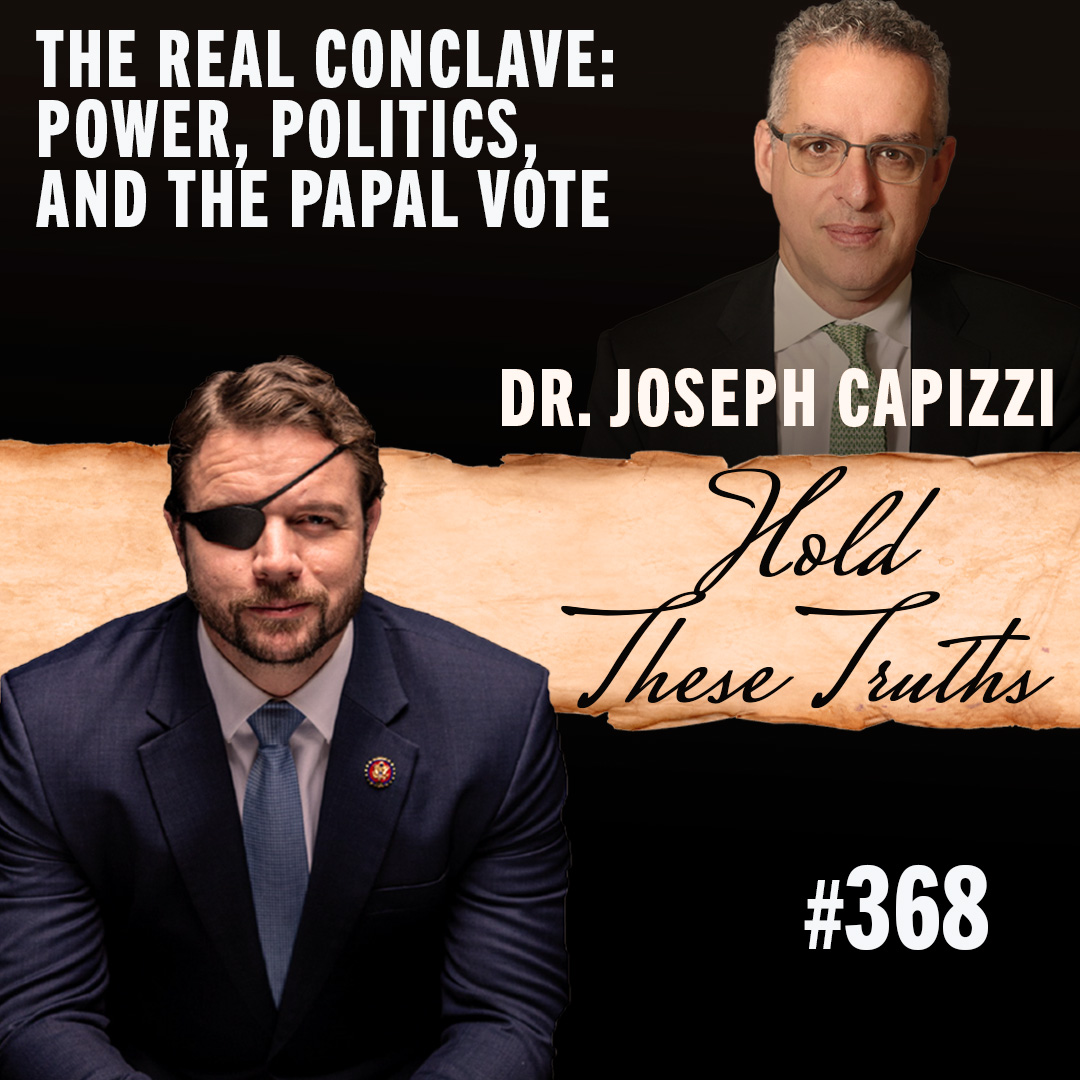
Hold These Truths with Dan Crenshaw
The Real Conclave: Power, Politics, and the Papal Vote | Dr. Joseph Capizzi
Loading summary
Transcript374 lines
- [00:00]
Dr. Joseph Capizzi
We hold these truths to be self.
- [00:02]
Podcast Host
Evident, that all men are created. As a member of Congress, I get to have a lot of really interesting people in the office, experts on what they're talking about.
- [00:09]
Dr. Joseph Capizzi
This is the podcast for insights into the issues.
- [00:12]
Podcast Host
China, bioterrorism, Medicare for all. In depth discussions, breaking it down into simple terms.
- [00:18]
Dr. Joseph Capizzi
We hold.
- [00:19]
Podcast Host
We hold.
- [00:19]
Dr. Joseph Capizzi
We hold these truths. We hold these truths.
- [00:21]
Podcast Host
With Dan Crenshaw. The eagle has landed. Welcome back, folks. Your favorite podcast, and you should be giving it five stars because it's your favorite podcast. It's called hold these Truths. Now, we're having, having a very topical discussion today because as you well know, Pope Francis recently passed away. Now, anytime a Pope dies, it triggers a series of events, but what are they and why are they done? And why are they done the way they are? There's a lot of tradition and mystery and interest surrounding these processes, and that's why they're the focus of Hollywood. As recently seen in the movie Conclave, Angels and Demons or the Netflix show, what is it, Borgias. They show a level of intrigue and backroom politicking. But what's, what's really happening in the Sistine Chapel come May 7. Now, with Pope Francis's passing the day after Easter, there's been more coverage, reporting, and interest in them as well. Here today to talk to us about what happens during the Conclave is an expert from Catholic University of America, Dr. Joseph Capisi, Dean of Theology and Religious Studies. He's been making the media rounds and he's here with us today to shed light on the process. So, Dr. Capisi, thank you for joining us.
- [01:30]
Dr. Joseph Capizzi
It's my pleasure to join you.
- [01:32]
Podcast Host
So let's, I guess, get started with the basics. You're a practicing Catholic?
- [01:36]
Dr. Joseph Capizzi
I am.
- [01:37]
Podcast Host
You know this well enough.
- [01:40]
My wife is the same. I was, I was married and in the Catholic tradition, although I didn't grow up with Catholic. And I've been, I've been told that my daughter will be raised Catholic. So. There, there. So that's, that's that.
- [01:55]
So what's the role of the Pope? Obviously, it's the only religion that has this, well, talking Christian religion that has this, this, this head figure.
- [02:04]
Dr. Joseph Capizzi
Right, right.
- [02:05]
Podcast Host
It's the oldest Christian religion, is it? Correct.
- [02:08]
Dr. Joseph Capizzi
So, yeah, yeah, there are arguments about that a little bit.
- [02:10]
Podcast Host
Okay, we could get into that. But you know, just generally speaking, I mean, what's the. Why do they have a Pope?
- [02:16]
Dr. Joseph Capizzi
Yeah, great question. There's different pieces of an answer to that question. The first thing is we believe the Pope is Spoken of not by name, but in Scripture. When Jesus speaks to Peter in different ways about how Peter is different from the other apostles. He's the rock on which the church will be built. He has the keys. Sort of like the juridical power that Christ is handing over to Peter especially. He's the first among the apostles.
- [02:45]
Podcast Host
Interesting.
- [02:46]
Dr. Joseph Capizzi
Yeah. There's all this language that distinguishes Peter from among the others that indicates we believe that, in a sense, he's first among equals.
- [02:54]
Podcast Host
Yeah.
- [02:55]
Dr. Joseph Capizzi
And that's really what the Pope is. He's first among equals. The other equals being bishops. And so there's a governing authority within the Catholic Church.
- [03:03]
Podcast Host
I don't think a lot of people realize that there's some biblical texts that actually led into this.
- [03:09]
Dr. Joseph Capizzi
That's correct. So sometimes. What? Yeah, sometimes. Some of the Protestant criticism of the papacy might, in fact be around surprises.
- [03:15]
Podcast Host
Peter because he's just so slow. I mean, compared to John, you mean.
- [03:19]
Dr. Joseph Capizzi
Why is it Peter that Jesus chooses? It's a great question.
- [03:21]
Podcast Host
I'm making a joke.
- [03:22]
Dr. Joseph Capizzi
Okay.
- [03:23]
Podcast Host
Am I getting that right? It was Peter and John, right? Yeah. In John 20, the. The res. You know, the resurrection. And then John is, of course, writing the. The account of the resurrection and has to note that the other disciple got there first.
- [03:38]
Dr. Joseph Capizzi
Right.
- [03:38]
Podcast Host
The other disciple being John, who is writing this account. And I just think it's hilarious that he's like, well, I just had to tell everybody that I beat Peter. I mean, I beat him. I mean, he's just slower. Well, beat him.
- [03:50]
Dr. Joseph Capizzi
Competition among the apostles is probably related to conversation we'll have soon, in a few minutes about the way the bishops relate to each other.
- [03:58]
Podcast Host
Right.
- [03:59]
Dr. Joseph Capizzi
People compete with each other. You know, that's human being, human nature. That's right.
- [04:03]
Podcast Host
But Jesus has designated Peter as.
- [04:06]
Dr. Joseph Capizzi
Yeah. And Catholics claim that there are scriptural foundations for this, even though, of course, other Christians will say, where do you get this papacy thing? And we'll say right there, you know, in the words that Jesus uses about the. The distinctiveness of Peter. But he also serves as a governing. In a governing role. That's part of what the Pope does. The Church is a governed institution. I think a lot of people don't realize this. It has its own body of law. Right. The Vatican City is a political entity. It's not simply a spiritual entity. There are laws and there is governance within the Church. And the Pope is the head of the governance of the Church, both spiritually and also temporally or practically.
- [04:50]
Podcast Host
Yeah.
- [04:50]
Dr. Joseph Capizzi
So he does. He does a lot, and he's a sign of Unity as well. That's one of the big marks. Sometimes people get drawn into the Catholic Church because of the Pope as a symbol of unity. You know, when we have arguments about, you know, what do we think about this kind of question, we have a means of deciding this in the Catholic Church that is not always available to other communities.
- [05:11]
Podcast Host
But, you know, Catholics, though, you know, what you're getting every time you go to Mass, it's. It's very specific. And, you know, and the sacrament.
- [05:17]
Dr. Joseph Capizzi
And you're getting the sacrament. Right. I mean, the real. The real thing there, however good or bad the homily is, is I got the body of Christ, I received the body of Christ. That's what we are getting. And that's, you know, ultimately why we go to Mass and why there's a kind of uniformity to the practice. And you might come out complaining about Father so. And so's homily, which becomes just, you know, it's a little bit of sport. Right. We can go over breakfast.
- [05:39]
Podcast Host
Or homily is sort of. That's the part where they're supposed to, you know, talk. Yeah, but that's what we're used to in. In maybe.
- [05:46]
Dr. Joseph Capizzi
Right.
- [05:47]
Podcast Host
This congregation. Yeah, yeah.
- [05:48]
Dr. Joseph Capizzi
But the important thing is the sacrament. Yeah.
- [05:51]
Podcast Host
So the politics of it is interesting. I mean, like you said, it's its own. Technically its own sovereign country.
- [05:57]
Dr. Joseph Capizzi
Correct.
- [05:58]
Podcast Host
And so. But.
- [06:01]
That, that. That's one way of saying it. But. But how politicized or, or political is the papacy? Or how. How political has it become? Like, what's, and what's. What's the history of that? I mean, it used to be, obviously quite a powerful political force in Europe.
- [06:15]
Dr. Joseph Capizzi
Sure.
- [06:17]
Podcast Host
I'm sure that that's changed over time. But it's not as if the Pope doesn't. It's not as if Pope Francis didn't speak on politics on a regular basis.
- [06:23]
Dr. Joseph Capizzi
Yeah, no, that's a great question. And yeah, in history, popes were politically more impactful than they are now. So there are famous instances in history where emperors will go and.
- [06:39]
Basically walk through the snows on their knees, begging forgiveness from the Holy Father because. Because they're in danger of being excommunicated from the Church for something that they've done and that was wrong. And those days are long gone. And really, since the French Revolution, there's been a kind of laicization of many of the states that used to have a kind of fusion of the Catholic faith with their own governments. And then the Pope would play a more outsized political role. So since that time. And really, since about the early 20th century, popes have been more like sort of public figures from a moral perspective, kind of enjoining better treatment of human beings through different ways. Let's treat each other better.
- [07:29]
Podcast Host
Lead by inspiration, not by authority.
- [07:32]
Dr. Joseph Capizzi
Yeah. Maybe moral exhortation, even like a kind of, look, politicians, you can do better with regard to this or that question. And like you said, Francis was not afraid to do this. John Paul ii, famously challenging the Communist government in Poland.
- [07:45]
Podcast Host
Right, right, yeah. Massively influential.
- [07:49]
Dr. Joseph Capizzi
Yeah, yeah. So they can have that kind of force on which very few other religious figures can have. And there's something about being a juridical thing, being in their own state that kind of allows. That gives it a little bit more gravity.
- [08:03]
Podcast Host
And just, you know, before we get into the how to choose a new one, I mean, what's. So what was Pope Francis's general outlook? I mean, he's accused of being too liberal in some places and. But, But. But also maintaining the traditions in others. What's sort of the. The base. Maybe not your take. You don't have to give your opinion on it. Sure you can.
- [08:24]
Dr. Joseph Capizzi
Sure.
- [08:24]
Podcast Host
But, you know, the different sides of the arguments.
- [08:28]
Dr. Joseph Capizzi
Yeah, yeah. So I think first, the first thing that people, you know, should be aware of is that by definition, the papacy is a conservative institution. Right. It. The church, The Catholic Church is a conservative institution in the sense that it's.
- [08:41]
Podcast Host
Designed to conserve the tradition.
- [08:43]
Dr. Joseph Capizzi
Right. There is a tradition.
- [08:44]
Podcast Host
Small seat conservative.
- [08:45]
Dr. Joseph Capizzi
Yeah, yeah. There's a tradition that we're trying to hand on and have to hand on, have an obligation to hand on. So the arguments about how liberal this or that pope is or whatever, they're always a little bit skewed already, because even Francis was coming from a kind of conservative posture. We have a tradition. It's a valuable thing. I need to shepherd it and hand it on forward to the next person. I think in terms of his disposition, he was much more a person concerned about.
- [09:23]
Almost like the physical level of human interaction and things that might be obstacles to that. Whether it's becoming too intellectual to almost like impractically spiritual or something. Francis just wanted, like, to. And exhorted us all to kind of engage each other as people with much less pretense than may have been the case in the past.
- [09:47]
Podcast Host
Speaking a little bit more layman's terms than biblical terms. Is that.
- [09:50]
Dr. Joseph Capizzi
Yeah, right. And this. So sometimes he would say things like, look, let's stop navel gazing about doctrine. Right. Which if you're somebody like me, who I study doctrine, that's what I do for my living. You're kind of like, wait a minute, like, doctrine's important.
- [10:03]
Podcast Host
What do you mean by that? Yeah, because that sounds like you're trying to get away from tradition.
- [10:06]
Dr. Joseph Capizzi
Correct. And doctrine is teaching. And that's just the Latin rooted word for teaching. Teaching matters. And. And I don't think he meant it didn't matter, but he did mean we're obsessing about it and we're starting to lose contact with people who ought to first just be encountering Christ. So I think he really did this, have this kind of pastoral instinct that the first move needs to be engaging with people, especially those on. You use the term peripheries, like the edges of society who are there for very different reasons. They could be criminals, they could be migrants, they could be the disabled, they could be the elderly, they could be the unborn. There are people who are out there on the edges of society, and the center is comfortable. And he was always challenging us to get this. Get uncomfortable. Right. And go out to these kinds of people, which is why, you know, he kind of. He did some things sort of famously or symbolically to suggest even the Pope needs to do this. Washing the feet of the homeless, visiting criminals, moving out of the Papal palace.
- [11:17]
Podcast Host
Yeah. I mean, he was. One of the interesting things about his papacy was. Was this. He didn't just say those things. Right. He lived by it. I know. Lived. He lived in. In a different apartment. That's not the.
- [11:29]
Dr. Joseph Capizzi
Right.
- [11:29]
Podcast Host
Like the.
- [11:29]
Dr. Joseph Capizzi
I don't know, not as palatial as the other.
- [11:32]
Podcast Host
Whatever. The other one is.
- [11:34]
Dressed differently. You know, the rings he wore, the pendant he wore, or the cross he wore was just not the normal ornate one.
- [11:41]
Dr. Joseph Capizzi
Right.
- [11:42]
Podcast Host
So we wanted to symbolize, I guess, this, this, this different approach.
- [11:46]
Dr. Joseph Capizzi
Yeah. Even his name. Right. Taking the name of Francis. It's the first time a pope took Francis and it exhibits his own first Francis. He's the first Pape. He's the first pope as Francis. And it exhibits his own devotion to an attraction to St. Francis, who's rather famous for getting rid of all of his wealth, sort of walking away from family wealth, embracing poverty and founding a community that wanted, you know, itself to embrace poverty. So this, all of this was.
- [12:15]
Podcast Host
What is like the list? Does it have to be a saint that wouldn't choose a name? This is like another question coming from.
- [12:22]
Dr. Joseph Capizzi
Yeah, listen, honestly, I don't know if it has to be a saint.
- [12:24]
Podcast Host
Yeah. What's the name choosing happen?
- [12:27]
Dr. Joseph Capizzi
He chooses the Pope chooses it on his choose.
- [12:30]
Podcast Host
Like Charles, like. Or, I don't know, like Dan. Well, no, that's even LeBron. Yeah, yeah, yeah. Something random. Yeah. He's like, Daniel's still like, I. I've been a pope, Daniel.
- [12:39]
Dr. Joseph Capizzi
Not that I'm aware of. I suspect that. Yeah.
- [12:42]
Podcast Host
One day.
- [12:44]
Dr. Joseph Capizzi
Yeah. Yeah. Well, maybe after this podcast, you know, they'll feel the influence.
- [12:48]
Podcast Host
Maybe they'll think about it. So there's not, like, a set of rules about how that name is chosen?
- [12:54]
Dr. Joseph Capizzi
There may very well be rules about it. I honestly just don't know that. Like, I mean, it's funny. It's a question I've never even sort of asked myself. But. But the point is, he was drawn to the poverty of St. Francis. And so from the very first moment that he was asked, will you consent to being the pope? And said, saying yes. He had in mind a. A move of stripping away a lot of the fashion and pretenses associated with maintaining the tradition still. Right. But trying to get rid of some of the stuff that maybe looked like it distanced the pope from really what is his mission, which is serving the church. Right. He's the servant of servants is another, like, name for the pope. The ser was ser. Warum, the servant of the servants. And that was something that I think he embraced as well.
- [13:43]
Podcast Host
You can go back in time a little bit. How was he chosen? We were talking about how the next book will be chosen and the processes there. Looking at some history. How. How. What brought him to that stage? In hindsight.
- [13:55]
Dr. Joseph Capizzi
Yeah. And so, again, the process is secretive. So a lot of what we know about this is based in, you know, gossip, you know, people talking about it afterwards. He apparently was.
- [14:08]
A candidate when Pope Benedict was elected. He was somebody that was thought of as a kind of live alternative at the time when Pope Benedict became pope. And then I think there's some thought that after then, Jorge Bergoglio lost, you know, that's his name. Before he became Pope Francis, after he lost. That might have been his moment. You know, maybe his moment had passed. Of course, Pope Benedict resigns, which is unprecedented. Hadn't happened for roughly half a millennium.
- [14:40]
Podcast Host
Right.
- [14:41]
Dr. Joseph Capizzi
Popes don't resign. Or even more than that. Excuse me. Longer than that. So popes don't resign.
- [14:48]
Pope Benedict steps down, and now all of a sudden, a candidate who was a live candidate before, who people thought, well, you know, his time has come and gone. All of a sudden, he becomes a kind of live candidate. And because the church has become increasingly global in terms of its. In terms of the cardinals, the cardinals are the guys who vote on this, and more and more of them are not from Europe, from Africa, Asia, Latin America. There was, you know, a sense that this is where the church needs.
- [15:17]
Podcast Host
Why do you think that is? What's the reasoning behind that? Is it just a.
- [15:21]
Dr. Joseph Capizzi
Why is there. Why are there more.
- [15:22]
Podcast Host
Yeah. Is it just because a more secular Europe is on trend?
- [15:26]
Dr. Joseph Capizzi
That's a part of it, yeah. For sure. There's fewer and fewer priests coming out of Europe, and the church is most vibrant in Africa. Africa is the place where the Catholic Church is growing the fastest. I think the largest Catholic population, if I remember correctly, is in the Congo, and I would not have. Or maybe the fastest growing. It's one of those two. And it's also the. Where it's the youngest. The church is old in Europe because.
- [15:52]
Podcast Host
I mean, like, young. The entire continent of South America is pretty much Catholic, right? Pretty much.
- [15:57]
Dr. Joseph Capizzi
It is. And. But that's diminishing. In fact, evangelical churches, the Mormons and others have gained ground. Of course, secularizing tendencies have gained ground over time. But Asia is another place where there's growth, especially Southeast Asia. Vietnam is a place where there's lot of growth in Catholicism.
- [16:14]
Podcast Host
What do you think draws people to Catholicism versus another denomination? What do you. What do you think it is that the Catholics are doing right to be expanding in some of these places? Is it just doing the job of actually going on the mission? Because it's not like Mormons aren't trying all the time.
- [16:29]
Dr. Joseph Capizzi
Well, look, I think there's a lot of growth among the faiths in these parts of the world. And. And when Catholicism is successful, there's, I think, a few reasons. One is like, you're saying they're just doing a lot of good work. So a lot of really good, like, high schools in the Philippines and other places.
- [16:47]
Podcast Host
Practical.
- [16:48]
Dr. Joseph Capizzi
Yeah.
- [16:48]
Podcast Host
Are run by the resources to do it. They're run maybe unlike some other.
- [16:52]
Dr. Joseph Capizzi
Yeah, well, they're run by religious orders, typically. So, like there'll be Jesuits high schools or redemptorist high schools. You know, orders that will run schools and schools have in history, whether it's in the United States or in the Philippines or Vietnam or wherever else, vocations come out of these high schools. Cardinal Gregory, who just stepped down as the Cardinal of Washington, D.C. he came out of Chicago, and if I remember correctly, he was trained in a cath. In a Catholic high school in inner city Chicago, is a young black kid. And so it's just access, doing these things, bringing education.
- [17:30]
Podcast Host
Then, of course, couple thousand years of infrastructure Being built.
- [17:33]
Dr. Joseph Capizzi
And the tradition, like you said before.
- [17:35]
Podcast Host
People are attracted to look, this is what it is. I can wrap my head around that. There's not a lot of Catholics don't give you a lot of space to like, interpret.
- [17:46]
Dr. Joseph Capizzi
No.
- [17:47]
Podcast Host
How you want to kneel and stand. Right.
- [17:48]
Dr. Joseph Capizzi
Well, and also, we're seeing this even in the United States among young men, which is interesting. There's a kind of the. The people who are coming into the church are young men.
- [17:59]
Podcast Host
And.
- [17:59]
Dr. Joseph Capizzi
And it also gives you purpose. Right. There's a sense of, oh, now I. Somebody's answering, why are you here? Right. Which is a question that our culture, if we both know. Right. Like, American society is struggling to answer that kind of question. Young men in particular, but young, young people, why am I here?
- [18:17]
Podcast Host
Very much a larger problem.
- [18:18]
Dr. Joseph Capizzi
It's a huge problem. And the Church gives you an answer. Well, God created you out of love, and he's given you a purpose. Your purpose is to love other people. You know, to share the love that you've been given with other people. You don't even earn it. Right. Like, a key element of our. Of our teaching is this is love you didn't earn. Yeah, right.
- [18:37]
Podcast Host
And a lot of us, confusing, but it's.
- [18:39]
Dr. Joseph Capizzi
It's important because a lot of us, you know, if you look at yourself, you're kind of like, look, I'm kind of, what have I done to deserve what I got? You know, and if gratitude's a big part of this.
- [18:48]
Podcast Host
Yeah. Yeah, it is. Real quick, I want to go back to something.
- [18:52]
Dr. Joseph Capizzi
Yeah.
- [18:53]
Podcast Host
The history of the papacy and how, again, like emperors would crawl on their knees to gain. To gain the affection or gain the pension, the pension, penance, whatever it is, that, that just. It's not that way anymore. But in those times, it feels antithetical to the entire purpose of Jesus's teachings and Christianity because to me, Christianity.
- [19:21]
Was the ultimate moment where humanity moved toward equality. Because you think of. This is what Jesus was rebelling against, this idea that, that the priest class was. Was in charge. And like, you had to ask them, you know, you had no access to God only they did. And they.
- [19:39]
Dr. Joseph Capizzi
Right.
- [19:40]
Podcast Host
Very hierarchical structure. And, and he's, you know, Jesus said, no, no, God lives within you. You, you, you get to have that relationship with God on a personal level. So that's empowering. And there's an. And eventually, I think that's what led to, you know, your dissertation, your doctoral dissertation on slavery. I think that's what ultimately leads. And of course, the abolitionists would make biblical arguments about Even though there's slavery mentioned in the Bible over and over, they're still using the teachings of Jesus to argue against slavery to free people. And so.
- [20:15]
How do you square that circle, I guess, with that authoritarian style Pope back in the day?
- [20:23]
Dr. Joseph Capizzi
Right. I guess, to some extent. What I would do is I'd say it wasn't authoritarian. Right. And go back to, like I said really quickly, the Latin phrase, one way of describing the Pope is the servus, servorum, and that's the Latin word, you know, word for servant. Right. Or even slave, the servant of the servants. In fact, the Pope is supposed to be almost like the most debased of all of us. And the. The fact is, he's not. Right. I mean, this is. This would be the criticism. He. He's not. He, you know, flies first class, you know, or what.
- [21:01]
One of Pope Francis concern was something he identified as clericalism. What has happened? Instead of serving as priests, instead of serving as bishops, instead of serving as the Pope, we look like we've just assumed a kind of royal role. And so he wanted to be critical of that and wanted the Church to recognize that her primary mission is one of service, and we need to sort of strip that away as much as possible. Now, on the other hand, it is also, like I said before, it is also an institution. It's a state, in a sense. And so there is a kind of governing authority that he possesses. So when the Pope is asking the Emperor, you know, or the emperor feels himself the need to go bow before the Pope, The Pope is the rationalization there would be. He's not bowing before me. He's bowing before Christ. Right. I am bringing Christ to this moment. And this is where this emperor or the sinner, you or I, actually can free ourselves by this submission of ourselves to Christ, not to the man.
- [22:12]
Podcast Host
The confession.
- [22:13]
Dr. Joseph Capizzi
That's right.
- [22:14]
Podcast Host
Doesn't really exist in that form. And other denominations.
- [22:17]
Dr. Joseph Capizzi
That's right. It's not to the man, Pope Francis, it's to this bearer of Christ into this moment. That is what we're supposed to be submitting ourselves to. And, you know, we claim every knee will bend right before Christ, the, You know, the priest, prophet, and king. And so that's. That's the idea. But in practice, too often, you know, people can be themselves seduced by the power that's associated with the thing and distort it, you know, and make it about themselves.
- [22:50]
Podcast Host
Yeah.
- [22:52]
That'S interesting. Okay, so let's talk about what happened when a Pope dies.
- [22:55]
Dr. Joseph Capizzi
Okay, sure. Yeah, no problem.
- [22:57]
Podcast Host
So it Happened. What's. What happens next? What's. What's the karma? Lengo.
- [23:04]
Dr. Joseph Capizzi
Karma? Lengo is essentially like the head administrator for the Pope. This is this Cardinal Farrell, who actually used to be here in D.C. he's like the chief of staff, basically like his chief of staff. And he confirms the Pope's death and then also sets in motion all of the processes that are kind of just click into motion upon the death of the. Of the Pope. Most of us just watch this play out over time. So there was the viewing right after the confirmation of his death. We had the viewing of his body. Yep.
- [23:39]
Podcast Host
And then my chief of staff here got. He was actually there to go see it.
- [23:43]
Dr. Joseph Capizzi
I know, which is amazing. And then Saturday was the funeral, and then, you know, he was interred in. In Rome, in. In a church again, which was not typical for the Popes, but there are a couple of other popes.
- [23:56]
Podcast Host
I was getting my question in his will or whatever.
- [23:59]
Dr. Joseph Capizzi
Yeah, he specified. Yeah, he specified where he wanted to be buried or laid around.
- [24:03]
Podcast Host
Is there a place where normally they're all buried?
- [24:05]
Dr. Joseph Capizzi
There is, but he chose, again, to do something that was important to him. And apparently, there's apparently an icon in this church that. That he prayed to often, and he wanted to be buried there. And there are a couple of other popes who were there. So it's not unprecedented for him to be there. And then once the funeral ends, we enter into this period of mourning, the nine days of mourning, and after which we go to the, you know, the exciting movie subject, you know, the Conclave, which we've been given a date, May 7th. That's when the Conclave will begin. And it'll begin with a Mass between now and then. Between now and the beginning of the Conclave.
- [24:48]
Podcast Host
And it's sort of chaired or led by the. The bishop. You mentioned his chief of staff. Right.
- [24:54]
Dr. Joseph Capizzi
Yeah, the Kamarlengo. I think so. Honestly, I don't remember. I don't even.
- [24:58]
Podcast Host
In the movie, the Conclave, I don't even. I didn't finish it. So I was gonna ask your opinion on it. But there was somebody who was clearly in charge of at least, like, managing the votes.
- [25:08]
Dr. Joseph Capizzi
There is.
- [25:08]
Podcast Host
Right.
- [25:09]
Dr. Joseph Capizzi
Yeah. The Church is really good at managing things in some ways, and this is the sort of thing it's very good at.
- [25:16]
Podcast Host
So if you figure it out after.
- [25:19]
Dr. Joseph Capizzi
A couple thousand years, and if people have not been to the Vatican City.
- [25:22]
Podcast Host
Right.
- [25:23]
Dr. Joseph Capizzi
So you go to Rome, you're in a city, and it's a little bit like almost. It's almost like entering Central Park. Right. Like, there's this. It's a place within a place, except it's behind walls. So you go into the Vatican City and to do. To demystify it. I've been there myself. I've stayed in the Vatican City. I think I even stayed in Casa Santa Maria, which is where this will all take place. Which is just. It's just like a. Most. Most tourist travelers will think of it as a kind of B level hotel. It's nothing special.
- [25:56]
Podcast Host
So what takes place there?
- [25:57]
Dr. Joseph Capizzi
This is where the Conclave will be. I mean, or where they will be staying while they're at the Conclave.
- [26:04]
It is in the Sistine Chapel. Right. But this is where they're staying. I'm just like, trying to, like, like, put you there, in a sense.
- [26:09]
Podcast Host
It's just in the movie. I don't remember the Sistine Chapel again. I didn't finish.
- [26:15]
Dr. Joseph Capizzi
I didn't see it. No, they're there. They should be in there.
- [26:18]
Podcast Host
Yeah. Yeah. Oh, great. I was gonna ask you what you thought about Conclave, but it got mixed reviews that I. I started watching some of it on the plane.
- [26:24]
Dr. Joseph Capizzi
But I mean, once I read about the ending, I was like, do I really want to see this?
- [26:27]
Podcast Host
I heard. Yeah, I heard it. Don't tell me.
- [26:30]
Dr. Joseph Capizzi
I won't tell you about it.
- [26:31]
Podcast Host
I heard it was controversial.
- [26:32]
Dr. Joseph Capizzi
Yeah. I just. I don't want it like. Like, I mean, we're gonna get off. I just don't want to see another movie where, you know, you're trying to bash the Church. Yeah. The Church has been made to look either foolish or, like, sinister.
- [26:45]
Podcast Host
Yeah.
- [26:45]
Dr. Joseph Capizzi
And it's neither of those things. I wish it were that interesting. You know, it's just, it's.
- [26:49]
Podcast Host
It has people in it and people are sinners and not perfect. Yeah.
- [26:54]
Dr. Joseph Capizzi
And again, like, to the. To put you there, the cardinals are all there. They're in this B level hotel. They're eating B level food together. Many of them are getting to know each other for the first time. So they've been there since the funeral, or they're just arriving and they're having these things called general congregations. This is where the. A lot of the work gets done. I'm sure there's something similar to this here. Is that happening now? This is happening now.
- [27:21]
Podcast Host
So they're just doing all this kind of work up to the getting to know each other. So it's May 7, like the first vote.
- [27:27]
Dr. Joseph Capizzi
May 7 will be the first time they vote. They'll vote that afternoon.
- [27:30]
Podcast Host
So prior to that, they're Doing just. They're. They're conversing. They're some, some are politicking. Right.
- [27:36]
Dr. Joseph Capizzi
Do we all. If we all remember backroom politics. Right. Those days and where.
- [27:41]
Podcast Host
Where guys vote counts feels very similar to mine.
- [27:43]
Dr. Joseph Capizzi
Yeah. Guys will get together and they'll talk about stuff and they'll say, like, are you going to get behind so and so. And you'll be like, no, I'm not going to get behind him. He's an idiot. And here's why. He's an idiot. And you know, or. Or whatever. Like you have. There's a lot of that kind of conversation happening. You know, who are we going to get behind? What do we want to see happen? Where should the church be headed? Should we get another Italian in? Right.
- [28:07]
The last time there was Italian was. Right. Was John Paul the first. So it was, you know, nearly said it was 78 when John Paul II was elected. You know, the first non Italian. And again, like a half a millennium, 400 and something years, John Paul II, a pole is elected, then you get a German and then you get the Argentinian. So, I mean, that's going to be a conversation.
- [28:29]
Podcast Host
Yeah.
- [28:30]
Dr. Joseph Capizzi
You know, should we return it to.
- [28:32]
Podcast Host
You know, that affects their votes. Like, what's the region? Yeah, yeah. Regional diversity.
- [28:39]
Dr. Joseph Capizzi
I imagine again, in Congress at the, in the cafeteria, when you guys get together, the Texans, you know, get together sometimes and, you know, the, or the, you know, the guys from the south get together or whatever. Like these things happen. And so it's. There's no mystery with regard to the way human beings are going to, to politic this, which I think is fair.
- [28:56]
Podcast Host
To say in the movie is if you didn't watch the movie, but that.
- [29:00]
Dr. Joseph Capizzi
That I'll watch, I'll commit myself to.
- [29:02]
Podcast Host
That's what it was. Now they were. I don't. I don't know where they were hanging out. It felt like they were in some, like, it could be cafeteria.
- [29:08]
Dr. Joseph Capizzi
It could. It could be Casa Santa Maria, which is.
- [29:10]
Podcast Host
It might have just been there. Yeah, yeah. That's what they were trying to.
- [29:13]
Dr. Joseph Capizzi
I've been there for conferences. And so what happens is.
- [29:16]
Podcast Host
But they were voting and they were definitely not assisting Chapel. I think that would have been obvious in the movie. I don't know.
- [29:20]
Dr. Joseph Capizzi
Okay. Okay.
- [29:20]
Podcast Host
But the point is, is, yeah, there was a lot of what you're describing.
- [29:22]
Dr. Joseph Capizzi
It was a lot.
- [29:23]
Podcast Host
It was a lot of politicking. It was like, okay, who's a supporter here? Okay, we really don't like that guy. So maybe I need to drop out. So it's just like any race that you see in politics.
- [29:32]
Dr. Joseph Capizzi
Yeah, that's right. And that's. Look, as Catholics, we believe the Holy Spirit is animating this, but the Holy Spirit operates through human instruments. Right. I mean, this is how this works. Right. Is that human beings getting together are.
- [29:45]
Podcast Host
Kind of like, you know, your consciousness as an effect. Yeah, yeah.
- [29:50]
Dr. Joseph Capizzi
So that's. These congregations are very important. They'll be sorting through these kinds of things, and I'm sure already they're making decisions about this guy. Seems, you know, not. Not really a candidate. This guy we thought might be. Turns out to be less charismatic than we thought he was. Maybe one guy. Do we want a more muted papacy, for instance? Like all of these kinds of things are going to be discussed and I'm sure are getting discussed right now, but before May 7, when they vote for the first time that afternoon and almost certainly will not elect the Pope.
- [30:21]
Podcast Host
I just have this in my notes. What's the set? What's the se vacante?
- [30:24]
Dr. Joseph Capizzi
Vacante is the period we're in right now, just as Latin for an empty seat.
- [30:28]
Podcast Host
Got it.
- [30:29]
Dr. Joseph Capizzi
Right. The seat of St. Peter, the papal seat. Right. Right now is empty.
- [30:36]
Podcast Host
So then they have the con. So the conclave is technically the May 7th event, correct?
- [30:43]
Dr. Joseph Capizzi
That's right. Yeah.
- [30:43]
Podcast Host
And it comes from this Latin word, conclave, and it means a room that can be locked up.
- [30:48]
Dr. Joseph Capizzi
Yes.
- [30:51]
Podcast Host
So high amount of secrecy in there. So let's talk about maybe like, like. So who's in there?
- [30:58]
Dr. Joseph Capizzi
Yeah.
- [30:58]
Podcast Host
This is interesting. I have in my notes, only cardinals under the age of 80 are permitted to vote.
- [31:03]
Dr. Joseph Capizzi
Correct.
- [31:04]
Podcast Host
Where'd they come up with that number? Why is that?
- [31:07]
Dr. Joseph Capizzi
It's just the sort of decision you make in the way, like, insurers might make decisions and so on. It's just like there's just a notion at some point you become perhaps less sharp, less involved in the politics or whatever. I think in the future we might see that even pushed up a little bit for different reasons. That's the sort of thing. It's not like dogma. That's just a kind of bureaucratic decision. Not every cardinal ought to be elected thing. There's some point at which, you know, you just reach a certain stage in life where you're just not as capable. Maybe you're more persuadable even. Right. You know, like if you. I have elderly, you know, an elderly in a mother. My in laws. You know, you're not your own person in the same way you were before. And I think that's partly what's Good.
- [31:50]
Podcast Host
That's why they do it.
- [31:51]
Dr. Joseph Capizzi
They're really concerned about influence, people being influenced.
- [31:54]
Podcast Host
So because there's 252 cardinals worldwide, but only 135 are eligible to vote.
- [32:00]
Dr. Joseph Capizzi
Correct.
- [32:01]
Podcast Host
So is that just because of age?
- [32:03]
Dr. Joseph Capizzi
It.
- [32:03]
Podcast Host
Is there any other reason you wouldn't be eligible?
- [32:05]
Dr. Joseph Capizzi
No, it's about your age. I think 133 will be present and voting. I think there are two people who, for illness, I believe, will not be showing up at the Conclave.
- [32:16]
Podcast Host
So how does this, how does this actually go down? They show up to the Sistine Chapel. Are they, are they like filling out ballots?
- [32:24]
Dr. Joseph Capizzi
They are, yeah.
- [32:25]
Podcast Host
How exactly?
- [32:25]
Dr. Joseph Capizzi
I, I understand that the movie represents that pretty well. Yeah, yeah. That they present the ballot and each person individually walks up and places their ballot in a box or, you know, a vessel of some sort and makes a kind of statement of, you know, this is my vote and, you know, I vote before God and, you know, returns to their seat. And they all do that. And they have as many as, I think, maybe three votes a day, no more than that per day.
- [32:53]
Podcast Host
And you need what was 60 or 80%?
- [32:58]
Two thirds. Two thirds. Okay.
- [32:59]
Dr. Joseph Capizzi
Yeah.
- [33:00]
Podcast Host
Two third majority to get there. What's the longest that's ever taken that?
- [33:03]
Dr. Joseph Capizzi
I don't know. It's a good question. It's been pretty quick recently. Yeah.
- [33:09]
I don't think this one will be quick.
- [33:11]
Podcast Host
There was one that was like years, but that was like a thousand years ago.
- [33:15]
Dr. Joseph Capizzi
Well, yeah, look, in the modern papacy, it's pretty well done. It's pretty efficient.
- [33:21]
Podcast Host
Was it always done this way?
- [33:23]
Dr. Joseph Capizzi
No, no, no.
- [33:26]
I don't know exactly when the tradition.
- [33:27]
Podcast Host
Started, but it's my understanding is actually started based on that instance. I'm talking about. We, we did a quick podcast about it. There was an instance. What? I don't know, like 13th century. 13th century. Took years to do it. So I think after that they established the tradition.
- [33:43]
Dr. Joseph Capizzi
Yeah. Makes sense that they would want a speedier process than that.
- [33:47]
Podcast Host
Right.
- [33:48]
Dr. Joseph Capizzi
The sede vacante. You know, that's a little long.
- [33:50]
Podcast Host
Yeah, yeah, yeah. How do they, how do they enforce any. This, this sense of secrecy. Is there a way to enforce it?
- [33:59]
Dr. Joseph Capizzi
Well, sure. I mean, there are, number one, you know, you hold each other accountable again, I'm sure, like you do in Congress. Right. I mean, the, the best way to do that sort of thing is you have to have certain personalities that are forceful enough, you know, to make other people accountable.
- [34:13]
Podcast Host
So, so say cardinal goes and talks to a reporter, gives them, gives them some insight, figure.
- [34:17]
Dr. Joseph Capizzi
So they are secluded. This is the, this is the idea of the Conclave is they're, they're secluded.
- [34:23]
Podcast Host
There are any phones on them.
- [34:24]
Dr. Joseph Capizzi
They are not supposed to leave. They, they don't have their phones. They're not supposed to have contact with anybody other than the people who serve them while they're there. And there are those people. You know, nuns serve priests and bishops all over the world. Yeah, there will be nuns there who will be serving them. They are. So they are supposed to be as. I mean, we keep using the phrase secrecy everybody and making it sound, again, like it's mystery. It's not. It's just the idea is you want people secluded from outside forces so they're not influenced by them. Exactly. Like a jury. That's right. I mean, it's a really good comparison because you don't want somebody.
- [35:04]
Podcast Host
But if a juror. But if a juror breaks that rule, they get kicked off the jury. And is there the mechanism to. So again, when there's a will, there's a way. It might be difficult to go talk to reporters, but when there's a will, there's a way they'll figure it out. Will they be kicked off the.
- [35:19]
Dr. Joseph Capizzi
Well, they can be excommunicated.
- [35:20]
Podcast Host
Yeah.
- [35:21]
Dr. Joseph Capizzi
In fact, the punishment for this is great, you know, which is separation from the church.
- [35:27]
Podcast Host
Not just kick out of the Conclave.
- [35:28]
Dr. Joseph Capizzi
No, it's actually. So it is grave. And again, that's why I think, like, the, the key feature is holding each other accountable, taking seriously their own laws and commitments. Yeah.
- [35:40]
Podcast Host
Well, that's interesting. So, but do you have any predictions on.
- [35:45]
Dr. Joseph Capizzi
Well, so go. Let's go back to a point that we discussed earlier, and that is how.
- [35:51]
How diverse the cardinals have become over time.
- [35:55]
Podcast Host
Right.
- [35:55]
Dr. Joseph Capizzi
And this is something you probably have read. Pope Francis elevated most of these men to cardinal status.
- [36:02]
Podcast Host
Interesting.
- [36:03]
Dr. Joseph Capizzi
And he did this in a manner that was departed from some norms. So, for instance, the current archbishop of Los Angeles is not a cardinal. And almost every other time, you know, the Archbishop of Los Angeles has been a cardinal. So he passed over that cardinal, I mean, that archbishop, and named people in smaller places cardinal cardinals. And he's named a lot of cardinals from Africa, Asia, the Americas, atypical places. So there's a good chance that will inform who the next pope is. Just if you think about predictions.
- [36:39]
Podcast Host
Because who's there? Okay.
- [36:41]
Dr. Joseph Capizzi
Well, just because you're going to get guys who, in the past, they're not as many Europeans. So if there's this desire to bring it back to Europe and have a European Pope or even an Italian pope. They just don't have the same numbers that they used to have. They'd have to make a different kind of case in order to make that sort of appeal. There are people that people talk about as papabile is a term which means like, sort of pope able. There are some people that people point to. One is an alumnus of my own university. Cardinal Tagli from the Philippines is somebody that people point to as a potential, you know, papavile, Somebody who might be. But I, I just think, like, I think if there's a prediction, the longer it goes, the less likely it's somebody that anybody's identifying as a kind of papa bile. The longer it goes, the more likely it's a wild card, the shorter it is. You're probably going to come out with. With somebody like a parin, who's somebody people have mentioned was an Italian cardinal.
- [37:41]
I don't know. You know, there's some others, you know, people. There are a couple of Americans. Yeah, Prevost. Cardinal Prevost is one. Cardinal Tobin is another from New Jersey. So there are a couple of American cardinals who, you know, I could see the case for and, you know, maybe they'll get around.
- [37:59]
Podcast Host
Yeah.
- [38:00]
Dr. Joseph Capizzi
Get around behind them.
- [38:01]
Podcast Host
First time.
- [38:02]
Dr. Joseph Capizzi
It would be the first time. I don't know if the world's ready for, you know, President Trump plus an American pope. That would be a lot, you know, on the. A lot of the global, Global stage. Right.
- [38:14]
Podcast Host
So let's talk about the. The black smoke and the white smoke. Yeah. In 2005, the Vatican added a new way to announce a new pope. St. Peter's Basilica. Largest bell will ring. So how is this going to play out?
- [38:26]
Dr. Joseph Capizzi
I didn't even know that. Yeah, there's a bell. Look. The white smoke indicates we have a pope. Right. And that's the first sign will be the white smoke that every day we're gonna, you know, if it is the.
- [38:37]
Podcast Host
Smoke always from burning the bell because.
- [38:38]
Dr. Joseph Capizzi
They burned the ballot and they add something. Yeah.
- [38:42]
Podcast Host
Black or white.
- [38:43]
Dr. Joseph Capizzi
Exactly.
- [38:44]
Podcast Host
Is it. Is it environmentally friendly, chemical? So Pope Francis had some concerns about that. I think that's an example, by the way, of, like, where it's. I wonder if you're stepping out of your lane here. You know, we can talk about that criticism of Pope Francis.
- [38:59]
Dr. Joseph Capizzi
Yeah, we could talk about that if you'd like. I didn't. I have no problem talking about whether he was stepping out of his lane there. But.
- [39:06]
Is it environmentally friendly? I suspect it's not.
- [39:09]
Podcast Host
Smoke generally isn't. Right but that's how it is generally. Yeah, but. So they burn the ballots just by. Is there a specific reason or it's just tradition?
- [39:17]
Dr. Joseph Capizzi
I mean, it's tradition, but also, I think it's good bureaucratic practice, as we would call it.
- [39:22]
Podcast Host
Yeah, operational security.
- [39:23]
Dr. Joseph Capizzi
Yeah, exactly. That's right.
- [39:26]
Podcast Host
We'll see. Okay, so we get to that point. Maybe it happens on May 7. What are what chances?
- [39:31]
Dr. Joseph Capizzi
Almost happens. Almost impossible.
- [39:32]
Podcast Host
Possible, yeah. How long did it take last time.
- [39:34]
Dr. Joseph Capizzi
Do you remember, for Francis? I think it was just a couple of days. Yeah. I think it might have been the second day, but it was. It. But it was relatively quick.
- [39:43]
Podcast Host
Yeah.
- [39:43]
Dr. Joseph Capizzi
And I. And I. I don't. I don't think it'll be more than three days, but, you know, who knows?
- [39:49]
Podcast Host
Who knows? Well, we will be waiting with bated breath.
- [39:53]
Dr. Joseph Capizzi
I want it to get done, you know.
- [39:55]
Podcast Host
Yeah. Well, as a Catholic, I'm sure both Catholics. I want it done. I got to see Pope Francis last time I was in Rome. I thought that was pretty neat. We got to go to Mass.
- [40:04]
Dr. Joseph Capizzi
Oh, good.
- [40:05]
Podcast Host
My wife was super excited about it. I was excited about it. Yeah, it's. It's something to see the Pope. I mean, it's. I mean.
- [40:12]
Dr. Joseph Capizzi
Did you actually get to shake his hand, like an audience kind of thing?
- [40:15]
Podcast Host
Oh, no. Just so. No, no, he was. He was giving Mass, so there was. We were somewhere in the back and some like. That's.
- [40:22]
Dr. Joseph Capizzi
I was at a conference in early December of this past year, and so. And I got to shake his hand because, you know, he opened up the conference and welcomed everybody who was there. He was wheelchair bound at that point, but pretty vigorous, you know, despite that. So the decline was relatively quick, you know. Yeah.
- [40:43]
Podcast Host
Now, you can't vote if you're. Last question. You can't vote if you're over 80, but can you be elected if you're over 80?
- [40:51]
Dr. Joseph Capizzi
I think it's unlikely they would elect somebody that old, but it's not against the rule. Yeah. I don't know why it was. Yeah, I don't know why it would be against that, but I'm pretty sure they're not looking for anybody that old. And that's another thing, too, is that when people talk about, like, sort of who's popable, it's not as mysterious as you think. Again, like, in anything, you start looking at the age range. Well, do we really want to elect somebody, like, we did this in the United States recently who's in his 80s? You know, I mean, they're right. You know, people decline abruptly when they're in their 80s, so probably not.
- [41:28]
Podcast Host
Or they're like Trump and they just keep going. Or on a diet at McDonald's and no sleep.
- [41:35]
Dr. Joseph Capizzi
It's pretty remarkable.
- [41:36]
Podcast Host
Yeah.
- [41:37]
Dr. Joseph Capizzi
Or do you want to elect somebody who's 59? There are cardinals who are pretty young and. And I don't know that anybody really wants to elect somebody for 30 years. So you're probably looking at a window, let's say, of like.
- [41:53]
68 to 70, you know, mid to late mid-70s. And all of a sudden, you know, the 133 gets reduced to, you know, 40 or something. And then there are other reasons why you might reduce those numbers pretty. So it's not like. Like, it's a super guessing game. You know, people go in, you have a sense of who's going to lead this committee or who's going to become the Pope. You know, it's just like that. It's not that mysterious.
- [42:17]
Podcast Host
Right. Well, that's interesting. Thank you for sharing that with us.
- [42:20]
Dr. Joseph Capizzi
My pleasure.
- [42:21]
Podcast Host
Yeah. I appreciate it. It's been. It's been. Our listeners will be more informed as May 7th approaches.
- [42:27]
Dr. Joseph Capizzi
I hope so. Yeah. I hope so.
- [42:28]
Podcast Host
All right, we'll end it there, but then when I have a bonus round with a few other questions. Okay.
- [42:32]
Dr. Joseph Capizzi
Happy to. Yep.
- [42:33]
Podcast Host
All right, so bonus round on. On Catholic traditions and such from our. From our guest, Dr. Joseph Capizzi. Did I get that right?
- [42:42]
Dr. Joseph Capizzi
You did. Well done.
- [42:47]
Podcast Host
What? Have some funner questions. Sure. You said you hadn't seen the Conclave, so we can't really talk about the accuracy.
- [42:52]
Dr. Joseph Capizzi
I'll talk about it anyway.
- [42:54]
Podcast Host
But what about, like. What about other movies, like in famous books like Angels and Demons, you know, in the symbology surrounding the Vatican. And I mean, all this stuff and these ideas. I mean, what's. What's the academic point of view on nonsense? Just. All of it's just nonsense.
- [43:09]
Dr. Joseph Capizzi
Yeah.
- [43:11]
Podcast Host
Are they ever referencing something that's real or is it just fiction?
- [43:15]
Dr. Joseph Capizzi
I think they're typically fiction.
- [43:18]
Podcast Host
The.
- [43:18]
Dr. Joseph Capizzi
There are certain things about the Catholic faith, really any faith, that make them seem exotic. Right. Number one, we're an increasingly secular society, so just the fact that people, like, sort of willingly believe certain things already seems exotic. Number two, in the case of Catholicism, you have a lot of the trappings of the faith that look ancient. Right. They look bizarrely old. The way the men dress.
- [43:49]
The. The fact we. That Latin is spoken, which always ends up in the, you know, featuring prominently in the ome or, you know, these sorts of books. They're speaking Latin. There's something mysterious and secret about it. And it's like. No, it's not mysterious and secret. It's a language. In fact, you know that there are still people alive who in England and elsewhere were trained in Latin as young people in school. It was a vibrant language, a kind of language of literature. So there are just certain features that make it seem exotic. And then there are in some cases, like the religious communities associated with these sorts of dramatizations. People think of them as secretive and conspiratorial. Like Opus DEI is sort of the object of the angels and demons.
- [44:38]
What is the other book that Dan Brown wrote?
- [44:40]
Podcast Host
The first one was.
- [44:43]
Dr. Joseph Capizzi
Da Vinci Code. Yeah, right. And there's this tendency to make it seem super duper, like sinister and to the point you made earlier. It's just people. It's just people who are looking for something, you know, and sometimes they find, like a particular religious spirituality appeals to them. And so they. They enter into a community within Catholicism. You know, some lay Catholics become drawn to, like, lay Franciscan orders.
- [45:13]
Podcast Host
Is there. Is there an Illuminati?
- [45:17]
Dr. Joseph Capizzi
I'm not allowed to answer that question.
- [45:22]
Yeah, yeah. I. Not that I'm aware of.
- [45:26]
Podcast Host
Look, and if.
- [45:27]
Dr. Joseph Capizzi
Look, it could be to their credit that they would. They never approached me about joining.
- [45:31]
Podcast Host
Yeah, yeah. Well, it's like all the rumors about D.C. you know, the famous. The famous parties and whatnot. I'm like, where are these parties and like, where's this crazy stuff that you're talking about happening? I'm not invited.
- [45:44]
You know.
- [45:45]
Dr. Joseph Capizzi
Well, that's. Look, I think one of the things, if we're now talking about conspiracies, one of the things that I always used to, when I'm taught, teaching, like just to caution young people about believing conspiracies is do you know anybody who keeps a secret? Well, yeah.
- [46:01]
Podcast Host
Yeah.
- [46:01]
Dr. Joseph Capizzi
Right. So I tell everybody because I don't. Right. And so if we have some, you know, centuries old conspiracy, you know, I can't figure out who these people are. Are so good at keeping secrets because everybody I know tells everything to everybody else.
- [46:16]
Podcast Host
Right, right.
- [46:17]
Dr. Joseph Capizzi
That's my experience.
- [46:18]
Podcast Host
And it's so secretive, it's hard to be powerful.
- [46:20]
Dr. Joseph Capizzi
Yeah.
- [46:21]
Podcast Host
Because to gain influence, you have to use communication.
- [46:24]
Dr. Joseph Capizzi
Right.
- [46:25]
Podcast Host
And so. Yeah.
- [46:26]
Dr. Joseph Capizzi
And you know this even from the military.
- [46:28]
Podcast Host
Right.
- [46:28]
Dr. Joseph Capizzi
Even, like in terms of keeping secrets within the military, you have to keep the circle super tight. Right. Because you expanded even like one man. And it just. It almost like exponentially increases the likelihood you can't control it.
- [46:43]
Podcast Host
Right.
- [46:43]
Dr. Joseph Capizzi
So, yeah, I. I'm not sympathetic to conspiracies, you could tell. And I don't think there are many or any, you know, operating in the church.
- [46:54]
Podcast Host
Yeah, well, your, your PhD dissertation focused on, on what was it?
- [47:02]
Dr. Joseph Capizzi
It's called, like, the problem Slavery.
- [47:05]
Podcast Host
Yeah, the, the development of doctrine, the challenge of slavery. It's a moral theology.
- [47:10]
Dr. Joseph Capizzi
So, you know, one of the things.
- [47:11]
Podcast Host
You, you said you study a lot is just the, the, the, the, the, the study of ethics and morality. And so it's kind of an interesting topic. So let me walk us through that.
- [47:21]
Dr. Joseph Capizzi
Sure.
- [47:21]
Podcast Host
That. In that entire dissertation in just a couple minutes.
- [47:25]
Dr. Joseph Capizzi
Yeah. It'll be fascinating for your listeners.
- [47:26]
Podcast Host
Yeah.
- [47:27]
Dr. Joseph Capizzi
So just. Yeah. So real quick, like the, the idea is.
- [47:33]
The, the abolition of slavery happens very quickly in, in the west, and it happens very late. Or another way to put it would be really recently. It's literally the 1800s. Right. And forward when slavery gets abolished. And up until that point, most human beings thought slavery was a kind of unfortunate feature of life in human society. As Christians, we would say human beings fell. Right. They fell from grace and we treat each other lousy. And there are institutions that bear the marks of.
- [48:12]
The fall, and slavery is one of them. It's not in itself immoral. The question is, how do you treat those who are your slaves? Right. Or how. What are the obligations and responsibilities masters and slaves have towards each other? That's how most of most people approach that question for much of human history. And at some point in the 1800s, maybe a little earlier, but not much, you get people saying, wait, that's not a good, that's not a good enough response to this question. It's not simply a problem of how people treat each other. It's the state itself. Right. The state of one person owning another person, not merely like owning their labor, but owning the person. That's immoral. And so what I wanted to do is look at, number one, why did people think this for so long, that it was permissible? And number two, what's going on as they're changing their moral views towards this question, and in particular the Catholic Church, because the church is in the United States of America at that point. Point. And there are bishops who are arguing on both sides of the abolition case. There's Bishop John England in South Carolina arguing there's nothing per se wrong with the domestic slavery system. We have to treat slaves better than they're being treated. He opened up schools for black children in South Carolina which were burned down by, you know, people who thought he was abolitionist, but he was clearly not. And then, of course, in the north, you had bishops saying, no, slavery's. Well, some, some, some arguing in its defense, but some arguing in its favor. So that's what I'm looking at is just sort of tracking that change over time to the late 1800s where you have the Church condemning slavery. And then again, it's more recently than we would all, we'd all think about in the early 1900s, pretty forcefully saying it's immoral. So that, that, that was what I was looking at.
- [50:14]
Podcast Host
Well, did you come up with any answers or any epiphanies as to. Is there any moments in time that, that caused that change in perception?
- [50:22]
Dr. Joseph Capizzi
And yeah, I mean, the epiphany is not that there's a moment, but there are a lot of other variables that are going into this. One of the most important things is what you might even almost call like evolutionary theory with regard to societies themselves, that societies are evolving and progressing and in some ways good and in some ways bad. But there is change. And for much of human history, people didn't think things change like this. So even in the scriptures, if you go to the letter to Philemon, right, You know, where Paul sends Onesimus back, right. You know, and says, you know, or yeah, you, here's your, he's your brother. Treat him like a brother. He doesn't say he's manumitted. He doesn't say, you know, he's freed from slavery. It's treat him like a brother.
- [51:13]
Most people think we're going to live with that institution.
- [51:16]
Podcast Host
Yeah.
- [51:17]
Dr. Joseph Capizzi
And you might even argue we still do.
- [51:18]
Podcast Host
Right.
- [51:19]
Dr. Joseph Capizzi
I mean, if you pay attention to.
- [51:20]
Podcast Host
Human trafficking a lot of places. Yeah, yeah. Like, it's not like slavery is gone.
- [51:24]
Dr. Joseph Capizzi
Yeah, right. That's right.
- [51:25]
Podcast Host
It's just not in vogue the way it used to be. It's not, it's not accepted.
- [51:29]
Dr. Joseph Capizzi
Yeah, that's right. So, yeah, it's a long, gradual process and there's always regression, you know.
- [51:35]
Podcast Host
Yeah, well, and I guess one of the, you know, your, your typical atheist would, would say, well, I mean, how can you believe in the, in the Bible when it effectively condones slavery? What's your, what's the best argument against that?
- [51:50]
Dr. Joseph Capizzi
Yeah, that's a really tough question. And you may know this, that, that one of the issues in the 19th century is the, especially the Protestant churches are splitting over this issue. Right. So you get like the Southern Methodists splitting from the Northern Methodists and others precisely over this question. And, and there are, there are good historians who've looked at this kind of question. Mark Noel at Notre Dame was one of these guys, used to be at Wheaton College.
- [52:24]
What they. Part of what's happening is there did some of them, especially the abolitionist types, are detaching from scripture. They're moving away from it and saying basically like scripture isn't very good on this question or the underlying principles of scripture are anti slavery, even though a lot of the language and the instances are not, are in fact more like not pro slavery, which is a technical term, but they're more like, look, slavery you're going to have with you. So, so the scriptural thing here, you, you have to go to the freedom that Christ promises us. I mean that's really the message is there's a message of freedom there and it's delivered to us as individuals.
- [53:08]
Podcast Host
Like, like I said, like it's, it's the first form of equality that I think Western civilization.
- [53:12]
Dr. Joseph Capizzi
Yeah. Neither slave nor. Right. Free. I mean it's in there neither Greek nor Roman. Like, you know, gentile. Excuse me, Gentile or Jew. Sorry, what am I talking about? Gentile or Jew. Right. Slave nor free. Christ is coming to us as human beings irrespective of our status. Irrespective of we would say today our color. Right. You know, and so on. He, he offers something to you that liberates you. And then there's this. You would write, we would say, well, in fact, like what really animates the global rights tradition, the freedoms that we all, you know, value and want to defend and so on, is the scripture. It is that underlying message. And it just took a long time for the abolition of slavery to be possible and for people to recognize its possibility. But once it did, like I said, you know, it happens in about a 70 year period. Very quickly it collapses throughout the West. But that's driven by Christians. It's delivered by, you know, abolitionist British Christians and others.
- [54:16]
Podcast Host
You know, in my counter argument is always. Well, you know, it's, it's. Condoning is a strong word to say the Bible condones slavery. I mean, it's, it's, it's written in a time where it is an institution that is, that is, that simply exists. It looks eternal just, just as bread is. Exists, you know. And like we can find out, look, bread is bad for you. Now we know that. But, but, you know.
- [54:40]
I know, but it's, it's got gluten and stuff and it's just too many bad carbs. Anyway, you know, I'm anti, I'm anti gluten. The, the, the, the point is, is you know, it's. It's. You have to take everything into context, the lens of that time. And. And they're. They're describing a world they live in. And. And that's.
- [54:59]
Dr. Joseph Capizzi
Right.
- [54:59]
Podcast Host
What you have to do is, as you said, focus on the underlying moral foundations that Christ teaches and that eventually we as fallen humans figure out.
- [55:12]
Dr. Joseph Capizzi
That's right.
- [55:12]
Podcast Host
Eventually get better at, like, our own founding is similar. Right. The Declaration of Independence is. And the Constitution itself is, you know, it's very much an abolitionist document. And the founders had that problem where they were like, we can't write it too hard, but if we write these words, I think eventually people have to go back to these words and say, like, we can't have slavery because we said it in the Declaration. We laid out our principles very firmly from the beginning. Right.
- [55:43]
Dr. Joseph Capizzi
They're liberating principles. Right. Ultimately. And it just takes time to play it out. And we also. Look, if you know yourself, right. Which are always invited to do is explore yourself, you just know, like, look, I'm fallible and I'm. I favor myself, you know, all the time. And people just. They don't want to see things that challenge them. And that was part of what was happening for. For a long, long time was interesting.
- [56:06]
Podcast Host
I know we've gone over your time, and I appreciate it. Thanks for the bullish round, Doctor. It's great to have you.
- [56:12]
Dr. Joseph Capizzi
Anytime, anytime. Thank you for everything that you do. Thanks.
- [56:16]
Podcast Host
All right, let's wrap up.