← Hold These Truths with Dan Crenshaw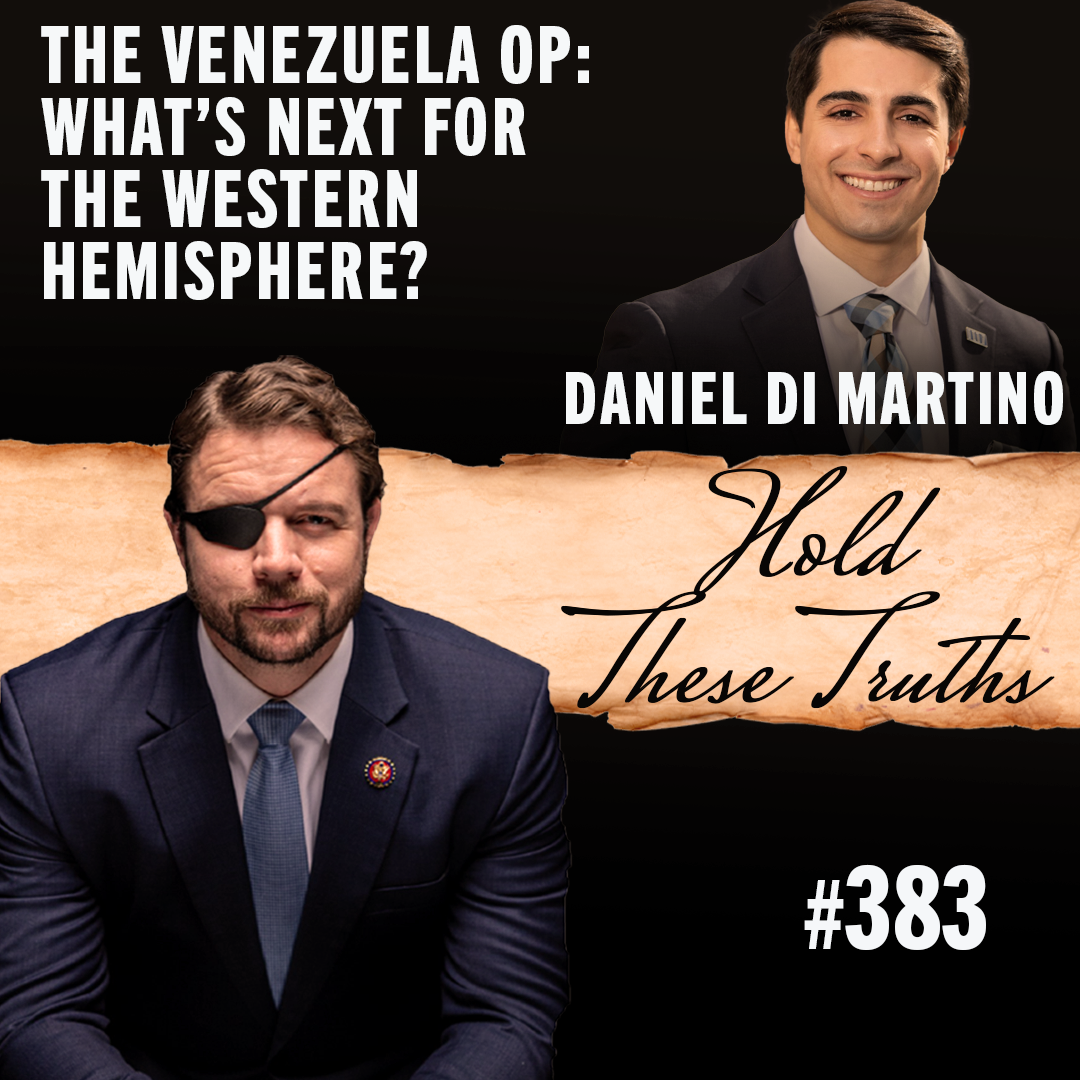
Hold These Truths with Dan Crenshaw
The Venezuela Op: What's Next for the Western Hemisphere? | Daniel Di Martino
00:53:56
Loading summary
Transcript156 lines
- [00:00]
Dan Crenshaw
We hold these truths to be self evident, that all men are created. As a member of Congress, I get to have a lot of really interesting people in the office, experts on what they're talking about.
- [00:09]
Daniel DiMartino
This is the podcast for insights into the issues.
- [00:12]
Dan Crenshaw
China, bioterrorism, Medicare for all. In depth discussions, breaking it down into simple terms.
- [00:18]
Daniel DiMartino
We hold. We hold.
- [00:19]
Dan Crenshaw
We hold these truths.
- [00:20]
Daniel DiMartino
We hold these truths. With Dan Crenshaw. The eagle has landed.
- [00:24]
Dan Crenshaw
Welcome back, folks. To hold these truths. Happy New Year. And quite a way to kick off the New Year in 2026, take taking down narco, terrorist socialist dictators. So of course, we're still doing a lot of winning on the foreign policy front. So just a quick recap before I introduce our guest to speak on this. Today, on the morning of January 3rd, we carried out a strategic operation in Venezuela that resulted in the capture and extraction of Nicolas Maduro. He was the illegitimate leader of Venezuela, also his wife on charges of narco terrorism and threatening the national security of the United States. It's been described as it's quite the mission. It's the amount of intelligence that went into it, the intelligence cooperation that resulted in this, the planning. It's a lot of details that we can't get into but are very, very impressive and of course, successful. So as we speak, Maduro has been arraigned in federal court in New York City. He pleaded not guilty. He will stand trial and face the American justice system. And joining me today to talk about this is Daniel DiMartino. He's a fellow at the Manhattan Institute and the founder of the Dissident Project. He's been on the podcast before, if those of you remember. He shared his story of growing up in Venezuela, experiencing the country's downfall into a socialist regime and then coming to the United States. So, Daniel, thanks for coming back on.
- [01:51]
Daniel DiMartino
Thank you, Representative Crenshaw. I really appreciate it.
- [01:53]
Dan Crenshaw
Yeah, it's great to have you again. I can tell you're happy about what's transpired based on your comments on social media and the news. Deservedly so. What was your first reaction? Personally, did you see this coming? I mean, I'll be honest, I'm not sure. I didn't really see it coming. I've talked to Venezuelans like yourself a lot over the years, and the question is often asked, I mean, how do we get rid of Maduro? And my answer is always the same. It's like we'd have to go in and actually physically get him. And I don't see the political appetite to do that. I'm Sorry. You know, as much as I would want to do it, I never saw the political appetite. So I was a bit surprised and proud of President Trump. What was your reaction and did you have that expectation?
- [02:46]
Daniel DiMartino
I would say I thought the same thing as you, that that's the only solution. And I have been advocating for that solution for many years. But I didn't think it was going to happen, in part because I thought it was difficult. And I thought that even if I wanted it to happen, I didn't want to give myself hope and then be let down. I would rather be a pessimist and then be pleasantly surprised. And that's what happened the morning of January 3rd when I woke up and my phone was blowing up. And he was the happiest day of my life, to be honest. It was incredible. I couldn't believe it, the videos. And you said there was no political appetite. I think we were wrong about that. I think it's been shown, it's showing now, that this is going to prove a very popular action because it was a very successful action and people like success. And I think that if Venezuela becomes a prosperous country from this, it's probably going to become the most successful foreign policy achievement of the US since the end of the Cold War because of the energy, the drugs, the migration, and the regional implications of this.
- [03:57]
Dan Crenshaw
Yeah, fully agree. And I'm not sure the politics change. It's just that President Trump was willing to take a risk and do what needed to be done. You know, the same, the same voices that chirp about inter American interventionism are chirping as they usually do. And, you know, the politics, politics of an intervention like this, an action like this are always difficult. And President Trump just went ahead and did it and. Because I think, I think they thought, and I give Rubio a lot of credit, too, for, you know, as a Secretary of State who's followed this problem very closely for many, many years, being a really rational voice here that makes the case that you're making, you know what it's going to be. It's going to be difficult to do it, but we can be successful and think about the legacy that we leave with that success. So let's kind of start. Well, how do we start? How do we get into this mess in the first place? You know, how old are you?
- [04:58]
Daniel DiMartino
I turned in 27 today, actually.
- [05:01]
Dan Crenshaw
Okay, so you were like, right when.
- [05:05]
Daniel DiMartino
You were months before Chavez took office?
- [05:09]
Dan Crenshaw
Yeah, I mean, because I was so. And I was living in Colombia, going to high school when Chavez took office. And you Know, Venezuela wasn't ruined right away. I visited Venezuela a lot in those years and, and even after high school, to the early 2000s, it was really Maduro who took it down, now being Chavez's successor and also I guess just a worse dictator.
- [05:41]
Daniel DiMartino
I would say. He just continued the policies and the oil situation didn't help him. And a lot of things like not doing maintenance to electricity and water and oil infrastructure just came crumbling down after 13 years.
- [05:57]
Dan Crenshaw
Yeah. And so, you know, I guess you don't even really. When did you come to the US?
- [06:02]
Daniel DiMartino
2016.
- [06:03]
Dan Crenshaw
You were just born and. Okay, so.
- [06:06]
Daniel DiMartino
So I lived it.
- [06:09]
Dan Crenshaw
Yeah. Okay. I mean, but you were just really a kid when, when like Venezuela was doing well.
- [06:14]
Daniel DiMartino
That's right.
- [06:16]
Dan Crenshaw
When did you start to notice growing up that it wasn't doing so well? Or was it just always that? Is that, is that your only memory since. I mean, geez, if we're for doing the math here, the Venezuela I'm thinking of, you're like six years old.
- [06:34]
Daniel DiMartino
Yeah, for me was just very gradual things and just every day becoming worse than the previous one. And then just learning from my parents about kind of like the good old days. Right. It reminds me a little bit of this phrase of Reagan about, I think it was in a time for choosing when he was talking about, you don't want to be the generation where you're telling your children about the good old days. And that's where my parents generation is in Venezuela, them telling us about the good old days of Venezuela. And so I. But, but by 2016, you know, as I was growing older in my teenage years, it became not just bad that, you know, we were making less money, but like actually we need to tap into our savings to not starve so that we can buy food, we need to sell things, we need to do side gigs, we need to. We don't have electricity now, we don't have water. It's not like you can purchase electricity when there is a blackout. So it became really desperate.
- [07:37]
Dan Crenshaw
Yeah. Well, what were some of the signs? Because you study this maybe not. Maybe you didn't notice them growing up, but as you studied this boiling frog scenario over the years, what were some of the signs that at least from an academic perspective, we could take away so that history doesn't repeat itself? Whether those signs are slogans even made by leadership that convince people that this is okay, or policy actions that seem well intentioned at the time, it had terrible effects after. Was there other certain things you can point to over the years?
- [08:19]
Daniel DiMartino
I mean, certain things are very simple, which is that if you have a politician that just doesn't respect or believe in fully in private property, that is an easy no. Right. And we're seeing it now in Mamdani. Right. In New York City. I really say that the people who are going to rule New York City now would be part of the Maduro regime if they were Venezuelan. I have no doubt. This new person, that's the tenant rights person, she doesn't believe in homeownership. She wants to end homeownership. So, I mean, how are you going to do that? You're going to come with a gun and take my home? That's what happens in socialist countries and that's what these people believe in. So those are some warning signs. Private property. I would also just say any ideology based on resentment and envy is. Is never gonna end well. And that doesn't just include socialism. Right. I mean, the Nazis were the same. It was based on resentment against the Jews. It was the same with all these evil ideologies. And they all end in disaster because nothing that comes from sin can end in virtue. Right. So that I would say is the biggest takeaway.
- [09:23]
Dan Crenshaw
That's a good way to put it. When did elections really. Excuse my. You just have a better feel for Venezuelan history than I do. I mean, Chavez was democratically elected. When did.
- [09:36]
Daniel DiMartino
At the beginning. Yes.
- [09:37]
Dan Crenshaw
Yeah. And then very obviously in this last election, Rush Maduro, he was very obviously not democratically elected. You know, and this gets to the legality of this situation. And I've said this, defended this a million times by now on the news. But you know, keep in mind, this is a. This was not. We were not going after a head of state, which would be in effect an act of an aggression, you know, a military act of aggression. We don't consider him act. A head of state. That's right. Neither this administration or the Biden administration considered him a legitimate head of state. In fact, Biden increased the bounty on his head. So that's number one. Number two is this is a DOJ action. And the legality of that is that the Department of War supports that action. But this guy was read his Miranda rights right there on the target. And then he was protected as how good is America?
- [10:33]
Daniel DiMartino
Right?
- [10:34]
Dan Crenshaw
Yeah, we're very good as America. Yeah. I mean, read his rights and then protected him from all the shots coming in as they were, as they were going on their exfil to the helicopters. Because that's what you do. I mean, that's as they're supposed to That's. You treat it like a. It's a capture mission. It's never. It was not a kill mission. And so it's just quite the operation. It's. It really is. It'll really go down in history. When's the last time there were any kind of legitimacy to those. Those elections? Is there a pin we can put on that, or is it gradual?
- [11:08]
Daniel DiMartino
It was a gradual rigging. So at the beginning, you know, obviously, Chavez was fully free and fair elections. December 98. And then he also won the following two in 99, their constitutional referendum, and then the 2000 general election. After that, there's been always cheating, whether that means it's fully rigged or not, but it's still cheating with cheating. I mean, you use state media and resources to pay for your campaign and advertise. That's already not a fair election.
- [11:40]
Dan Crenshaw
Right, right.
- [11:41]
Daniel DiMartino
You force government workers to wear your campaign attire and you force. You take them to the polls with government buses. Is that a free and fair election? And then already, really, I would say elections that were certainly rigged were already in the mid 2000s under Chavez. The constitutional referendum in 2009, not the previous one that he lost. I would say the 2012 election, his last election before he died. Maduro's. All the elections in which Maduro has been declared the winner since 2013 have been rigged. But at the beginning, it was dead people voting or forcing government workers to the polls. Prisoners, because prisoners have a right to vote in Venezuela. Inside the prison, you can bet they won those prison precincts by a landslide. That's how you know. And then by 2018, and then this last election in 2024, they didn't even bother doing all that. They just make up the number. They even had the referendum. Remember when they had the referendum on Guyana and taking over the zoning? That's disputed. Nobody went to vote. We all boycotted the election. So the streets were empty. And then they just made up the turnout number as if turnout was super high. And I'm like, where are the voters.
- [13:05]
Dan Crenshaw
Your average Venezuelan? I mean, what are they feeling right now? You've got your perspective. You know, we can see the celebrations around the world. How close are your contacts in Caracas right now? How are generally people feeling about this operation?
- [13:26]
Daniel DiMartino
Yes, well, the operation. Everybody's very happy and expectant about it. They would love to celebrate it, but obviously would be too risky for them. The regime has deployed police and military in the streets to take your cell phone and see if you support this. And if you do, they'll arrest you. And they have put an arrest warrant for anybody who supported the operation. And I don't mean supported as in like participated, but just celebrated.
- [13:54]
Dan Crenshaw
And then we've heard reports of that, that these kind of. That is happening gangs are still, still kind of roaming the streets. Still an issue we need to deal with.
- [14:06]
Daniel DiMartino
And I'll say Venezuelans are desperate on the ground. They want a transition to take place. As one message I try to send to people today on my social media, the Venezuelans who follow me, is that they have to understand it's only been four days. We have to have a little patience. Secretary Rubio this morning put out, I think, a very good statement of what the next steps are with the transition. Now, I think the problem was that before this weekend, the Maduro regime thought Trump was bluffing, that the USS Gerald 4 was there for show they were just going to strike drug boats and that's it. Maybe take an oil tanker. That was an escalation for them that I think they didn't expect. But take Maduro, go in, send airplanes and helicopters into Caracas. They never thought this was going to happen. And now Trump has shown them that actually your life is at risk and you better cooperate and do an orderly transfer of power or you are next.
- [15:06]
Dan Crenshaw
Yeah, that is, that is very clear. And it is clear we have an immense amount of leverage over the government at the moment. What is your thoughts on that and what's her name, the vice president who's now president? Yeah.
- [15:21]
Daniel DiMartino
Yes.
- [15:23]
Dan Crenshaw
Thoughts on her and how she'll navigate this?
- [15:27]
Daniel DiMartino
Well, Delsey is just as evil as Maduro. She, in fact, I would say she was raised to be evil and a Marxist because her father was a terrorist Marxist, who kidnapped an American CEO and held him in captivity for three years. Then he died. The Venezuelan police killed him and her and her brother, who's the President of Congress? Jorge Rodriguez, who's the chief negotiator for the regime. They grew up thinking that their father was wrongfully assassinated, and they are now taking it out on the entire people of Venezuela. They're really psychopaths. Her brother is actually a psychiatrist. He's really. We call them the Joseph Goebbels of Venezuela. That's how they are. And so Venezuela, she's not really in charge. That's another important thing. Venezuela, since Chavez died, is an oligarchy. It was Maduro alongside Delsey and her brother Diosdaro that you know very well. Vladimir, who is the minister of defense. Imagine the guy's name, Vladimir. He's not Russian descent. Okay. That Means his parents named him after Vladimir Lenin. That means his parents were communists too. That's how you tell in Latin America where the thing. So it's all those people who rule as kind of like a council. And now, because of the leverage that Trump gained by capturing Maduro, who, by the way, may give us information he's alive, we can get a lot of information from Nicolas Maduro right now, not just about what's happening in Venezuela, but throughout the world. I would love to talk about that. And the question is, will they negotiate a deal to say, we're going to hold free elections, we're going to give you power to whoever wins, and we're going to take the next flight to Doha or Tehran or Moscow, take all our money, gold bars, wire transfer, guarantee, whatever, and be free. Or we want to suffer the fate of Maduro or be killed.
- [17:25]
Dan Crenshaw
Yeah, it's interesting. I mean, they're already cutting a deal today over the oil, which seems like a promising first step. Seems like an indication that they know that they just don't have any leverage at this point. And I think that's also why we continue to go after these cargo ships, one yesterday, one today. And just to reinforce the idea that we're actually serious about the embargo and that there's just no getting around it. So don't try to. You know, I think right now it's a. As you said, Rubio has laid out a really good plan ahead, a very realistic plan, too, because ideally we're going to just have. Look, ideally they would all disappear and be. And we'd have free and fair elections all of a sudden and things would stabilize. But we know from experience it's not that easy. And so the reality is that there's a practical measure that has to be taken, which is you got to work with people you don't like for a little bit and then, and then move, and then move at the right pace.
- [18:23]
Daniel DiMartino
We do have one time constraint, which is President Trump storming office.
- [18:27]
Dan Crenshaw
Yeah.
- [18:28]
Daniel DiMartino
Delsey and her cadre are going to try to lengthen this process enough to outlast Trump.
- [18:34]
Dan Crenshaw
Three years. Don't see that happening.
- [18:36]
Daniel DiMartino
They stay forever. So we need to ensure this happens within this period, as soon as possible. Obviously not in a matter of days or weeks, but of months.
- [18:45]
Dan Crenshaw
Yes, month is realistic. I see no scenario where Trump lets this, lets this go past his term. Um, because as you noted before, this is a legacy building foreign policy item for him. I'm curious about and always curious about Venezuelan opinions on this stuff. You know, Again, I don't think I've met any Venezuelans that I can think of. And there's a lot in Houston who.
- [19:11]
Daniel DiMartino
There's a lot in Houston, you're right.
- [19:13]
Dan Crenshaw
Yeah. I don't know who are supportive of Maduro and I think most of which, if not all, are celebrating this, but we did arrest him on criminal charges. And I'm curious how Venezuelans even. Even think about that or, you know, because. Because for Venezuelans, it's much more visceral than drug trafficking. Of course, that's, that's how we got him on an indictment, so that we could have a legal reasoning for getting him. But because there's, again, it's not illegal to ruin your country. It's not against US Law for you to ruin your own country. So we can't get him on that. How do Venezuelans even think about that? Do they or do they even care? Is that, is that something that's ever. That's often talked about, that he's basically, that he's in. That he's in collusion with these cartels, the farc, the guerrilla groups, like, absolutely, we have this going to come out.
- [20:02]
Daniel DiMartino
It's obviously not his greatest crime. His greatest crime is the torture, is the human rights violations. And I'll say there are some legal theories. I mean, the Germans do try people for crimes and foreign soil against human rights. I don't know if that's within our framework. And now I've read some interesting legal theories that because of the Alien Tort Act, I think it's early in tort claims, something like that Venezuelans could potentially sue Maduro now that he's on U.S. soil. So that's interesting. And Florida, the governor already announced they're bringing state charges in Florida, which I find very useful because imagine, you know, 10 years from now, 20 years from now, we got an AOC president, God willing, God forbid. Right. We don't have anything like that. And they cut a deal and they pardoned Maduro. If we have him convicted on state charges, he's staying in prison forever. So it's a great security valve. Right. And Maduro also had a very good lawyer, very evil lawyer that represents a lot of bad people. And obviously I believe in the right to having a lawyer. I just don't think that Maduro should be using drug money to pay for the best lawyer in the world. He should have a public defender. That's my opinion. So that's how I see the trial situation. Get him on whatever you need.
- [21:20]
Dan Crenshaw
Yeah, I think there's A lot of evidence.
- [21:24]
Daniel DiMartino
And it's true. I think this is not an excuse either, Congressman. These are real things. He did traffic drugs. His nephews were convicted already. I mean, that evidence of his nephew's case is going to be used here.
- [21:36]
Dan Crenshaw
Yeah. No, what about the region? I mean, how do you think this. This. What do you think our ability will be? Obviously, our intent is to get the Russian and Cuban, Chinese, Iranian influence out of Venezuela as quickly as possible. How quickly and how possible do you think that is? How scared do you think the Cuban regime is at the moment?
- [22:06]
Daniel DiMartino
I saw a video earlier today of a Cuban TV host talking in their news channel, trying to appeal to the Trump administration that if they stay in power, that's a stable vow for the US that you don't want to destabilize Cuba because it will cause a migration crisis. All this. They're trying to appeal to the president because they're scared they're next. And the truth is that if Venezuela becomes a free country and we have a democratically elected government, the Venezuelan government is going to go after Cuba, not just the American government.
- [22:39]
Dan Crenshaw
That's probably true when you think about.
- [22:41]
Daniel DiMartino
It, how much power Mario Corinna has already said so that we would cooperate with that. And I think it's about, in part payback, because the Cuban regime supported the Maduro regime and in part solidarity. The Cubans are going through the same thing the Venezuelans are going through, but for longer and worse. And I think they deserve freedom. And they are really the head of the snake Right. In Latin America. But you mentioned the regional consequences if this regime falls. The things we're gonna find out about Petro in Colombia, about Lula in Brazil, about the Kirschnerists in Argentina, about the Mexican government, the things we're gonna find out, governments all over the region are gonna fall in the next election because of this. It's going to be like the Panama Papers, but times a thousand. The scandals of thieves, of drug traffickers. It's going to be glorious because a lot of bad people are going to be rooted out of governments, and that's going to create a pro American environment in Latin America that's going to benefit us here a lot.
- [23:47]
Dan Crenshaw
Yeah, we've at least seen some movement towards that in Bolivia recently, in Chile, Argentina. Colombia's not the greatest example, but that's really just Petro himself. Colombian institutions remain very, very closely tied with America, and Petro will be. Either way, Petro is going to be gone this year. That's the good news for Colombia. But you Know who replaces.
- [24:14]
Daniel DiMartino
And it's very important for the Venezuelan transition. Same as Brazil. There are elections this summer in Brazil too, for president.
- [24:22]
Dan Crenshaw
And how are those looking?
- [24:25]
Daniel DiMartino
It's tight. But the government, I mean, Lula, the things they're doing to Bolsonaro and you can think whatever you want of Bolsonaro, but they're like violating his human rights. I mean, he's in a precarious health situation. It's very sad.
- [24:38]
Dan Crenshaw
Yeah, it is. And what isn't sad at least is that we're finally taking our own hemisphere seriously. President Trump has mentioned the Monroe Doctrine various times as he's talked about this and said, hey, what the heck happened to that? And well, we did forget about it and we're not doing that anymore. What about, what about. It's. What are your thoughts and what are your comments on what we've seen back here at home? So you're. I haven't, I can't think of any pictures I've seen of a bunch of Venezuelans protesting this. Maybe there are like, there's got, there's got to be some, right? I'm sure maybe they've never lived in Venezuela.
- [25:18]
Daniel DiMartino
I, I don't, I, I don't really know. I had really haven't seen them. I really haven't seen any Venezuelan upset about this.
- [25:23]
Dan Crenshaw
It's, it's, it's, it's. I mean, Delcy think it is the. What?
- [25:28]
Daniel DiMartino
Delsey is upset? Yeah, well, she says, who knows, maybe she's the one who readed them out. That's why they have internal problems right now. Nicolas's son and all of them. I bet they're all paranoid right now.
- [25:41]
Dan Crenshaw
Yeah, I read that in the news and I'm very curious. I love it's true or not that they leaked it because of the exact effect that you're talking about. It'll absolutely make them paranoid. But I think that the local politics are exactly what I would expect that Democrats who have long been saying that, look, to stop illegal immigration, we have to start with root causes. It's not about the border, it's about root causes. Now that's always a cop out. That's always a cop out. They use to just. To just deflect from speaking in normal terms about basic border security because it's like, okay, what do you mean root causes just make the country better all of a sudden. Make it a place you don't want to leave. And by the way, no matter how you can make it 10 times better, they're still going to make the calculation that they'd rather be in the United.
- [26:39]
Daniel DiMartino
States, by the way. No, but it's true. I mean, if Latin America was as rich as the United States, people wouldn't be coming.
- [26:46]
Dan Crenshaw
Yeah, and Venezuela used to be actually. Or just as pretty close.
- [26:51]
Daniel DiMartino
Don't cross the border illegally, right?
- [26:53]
Dan Crenshaw
Yeah.
- [26:54]
Daniel DiMartino
In large numbers.
- [26:55]
Dan Crenshaw
Yeah. No, it's, it's nice to think about root causes, but it's also hard to like, build a country, you know, and, and in this case, like, we, we do really have a root cause, you know, it's the leadership. You can't always say that about most Latin American countries because the leadership does change. And, you know, the root causes are indeed more to the root. Of course, this is one of those cases where like, hey, we are going after the root cause. I thought you guys wanted this. And of course now they're saying it's nation building and it's like it's the wrong term to be using.
- [27:28]
Daniel DiMartino
No. If anything, Venezuelans just want to build our own nation. We're not allowed to by their regime in power. That's like, you know, Venezuela doesn't have a government. It's like the Taliban. Is the Taliban the government of Afghanistan, I guess they rule Afghanistan, but they're a terrorist organization with control of a territory. That's what the Maduro regime is. It's a terrorist narco trafficking group. We control over, you know, 900,000 square kilometers. I'm not sure how much that is in square miles. Sorry, that's my, my Latin American coming out on that.
- [27:58]
Dan Crenshaw
We have no idea the size of something.
- [28:02]
Daniel DiMartino
It's bigger than Texas, Venezuela, and I'll say the, this is definitely getting at root causes of migration. I think Democrats should be very happy. And if you see the polling, I mean, a lot of Democrats are happy. It's just that there's the knee jerk reaction to whatever Trump does is evil and, you know, therefore he's a dictator and it's ridiculous.
- [28:22]
Dan Crenshaw
Yeah, it's your typical he hawing. I like how we did. I just, we shouldn't have done it this way. Well, then what, what other way would you recommend? It's, it's, you know, you're either with it or you're not. It's. I think it's just this reactive opposition that is honestly just very dishonest.
- [28:43]
Daniel DiMartino
Or they come with the argument of international law. Right. To which I always say, point to me, which treaty that the Congress ratified this violates, because that's the only law that applies in the United States. The Constitution and the laws that Congress Approves not some abstract principle that the Security Council or whatever passes this.
- [29:04]
Dan Crenshaw
Yeah, yeah, we were talking about that earlier privately. It was. International law is, it's not really real. It's, you know, there's a set of agreements that it assumes that, that the UN is indeed this all powerful globalist entity, which of course it is not. And in any case, yeah, it's just, it's a very, you know, if you.
- [29:27]
Daniel DiMartino
Really want to talk about international law principles, there's one called the responsibility. Responsibility to protect and the principle of humanitarian intervention. They actually come from Catholic social teaching from Aquinas, that is that when a state has failed at very, very basic duties, not that there's a policy disagreement or something, but there's like a genocide or for example, in the case of Venezuela, the largest peacetime refugee crisis in human history. Nine million people, 30% of the population. Then neighboring states actually have their responsibility to protect the human rights of the population. Now in this case, it happens to be that it's very much in the US interest because you don't want illegal immigration, you don't want the lower oil production that raises our energy costs. You don't want the drugs, you don't want the Chinese, the Iranians and the Russians. There's so many reasons that would benefit us and at the same time it's really benefiting the Venezuelan people.
- [30:22]
Dan Crenshaw
Yeah, yeah. Well, how many. Do you have a sense of how many Venezuelans there's been. It can exodus of maybe 8 million, I think is the number I saw over the years.
- [30:32]
Daniel DiMartino
It's nearly nine.
- [30:34]
Dan Crenshaw
Yeah, no, it's hard, it's hard to like dive into this question with any certainty. But, you know, assuming, let's, let's, let's assume a new election happens and the opposition wins, do you think there's a pretty good amount of Venezuelans who have a strong desire to turn to come back home?
- [30:53]
Daniel DiMartino
Yes, millions. And I will tell you, it's not like most will we actually have some past experience to know how many migrants return to their home country after a crisis. I think the best example is after the Yugoslavian wars that were pretty bad. Right. So Germany gave temporary essentially tps. What we have here is TPS and permits to all Yugoslavs escaping to Germany and then they let those permits expire after the war ended, approximately half of all the refugees who went to Germany in the previous five years went back to Yugoslavia in the following period. So how many Venezuelans have left in the last five years out of all the 9 million? I think it's about 5 million out of those nine. That means that maybe 2 1/2 million people to 3 million if you count some of the people before will return to Venezuela out of the world. Most of those people I expect to be the ones who are in Colombia because it's next door. But I do expect that a lot of the Venezuelans who are in the US illegally will go back because it's just they're more recent, they are less established legally. So I do expect a lot of people to return.
- [32:13]
Dan Crenshaw
Yeah, yeah, I would expect that too. I mean, it's a country that has a lot going for it if it's run correctly. It's still confusing to me though, how you get so many. I mean, we did like you used Mamdani as an example earlier. As far as warning signs, it's ironic, I suppose, that this trial for this socialist dictator will be held in New York.
- [32:39]
Daniel DiMartino
Um, can you believe he condemned it? Isn't it shameful?
- [32:43]
Dan Crenshaw
Of course I believe it. I mean it's again, against so many of these, these Democrats who don't even label themselves as socialists are condemning. I know it's, you know, another. But he didn't have to say anything imperialists thing. It's just. Yeah, it just makes him look silly because it's so easy to, to confront with I think some simple logic. You know, if you're going to accuse Trump of nation of another, you know, quagmire nation building exercise, which some have. And well, then you'd have to show that we're actually trying to do that. I mean, we literally don't even have anyone on the ground doing that. I think we've learned a lot of lessons from the past. And those lessons are, let's take Iraq for example, and people just sort of wave their hands and say, well, that was a mistake. Well, we don't actually know what the counterfactual is. You don't really know it's a mistake. We do know mistakes were made, that's for sure. And as far as sending a message to the region, well, it's worth noting that 2004 Iran publicly declared they would not pursue a nuclear weapon. And that's because of the Iraq. Same with Qadafia. That's because of the Iraq invasion. But we definitely made mistakes. One of those mistakes was just dismantling the entire regime right away. And so nobody see hundreds of thousands of soldiers with all of a sudden had no job. So this is, this is really in my mind a lesson taken from history, which is rare, that we actually do that Right. And taking the most pragmatic approach that, that we can, even if it's not as, as fulfilling as taking out all the bad guys all at once. So.
- [34:15]
Daniel DiMartino
But also, Congressman, Venezuela is not Iraq either. Venezuela is not a Muslim country. Venezuela doesn't have ethnic, religious or language divisions.
- [34:25]
Dan Crenshaw
Right, Right.
- [34:26]
Daniel DiMartino
It's a totally different situation. It's way more like Panama than it is like Iraq. Panama is one of the richest countries in Latin America. It's a great place to live.
- [34:38]
Dan Crenshaw
Yeah, no, it's. That's very true. There's a lot of institutional memory in Venezuela of democratic norms and market, a.
- [34:48]
Daniel DiMartino
Very united populace against the government. Very popular opposition leader. I'm very like organized opposition movement that even places like Cuba don't have.
- [35:00]
Dan Crenshaw
Speaking of that opposition movement. And again, what you're currently seeing, which is military patrols on the streets still, what can we do or should we not do to ensure that that eventually stops and that we do get to where we need to be in the plan that Rubio laid out, which is eventually to proper elections.
- [35:23]
Daniel DiMartino
Yeah, I think that there needs to be a direct demand. And my understanding from what I've read on some reporting, is that this demand has already been done. It's just, it's been four days. To be fair. There's been already a direct demand to release all the political prisoners and stop the prosecution. Let's see if that happens. If it doesn't, obviously the US Will need to enact some sort of consequence on them. Supposedly the next target is Diosdado. I don't know how that. True. It is based on the report voting. But I think that they need to be scared and they need. We need to ensure they follow the orders of the Secretary of State. We need to tell like, people were upset that they said that Rubio is in charge of Venezuela. Are you kidding me? Venezuelans would make Marco Rubio president if they could of Venezuela. Like, yes, make Marco Rubio in charge of Venezuela. Please welcome. You know, the people who are there are criminal thugs. I have a friend, her name is Mario or Pesa. She's been in prison for 18 months. She's in the torture chamber in Caracas. The. And it's really, really, really sad. The president, President Trump yesterday morning said that they're closing down the torture chamber very soon. So, you know, he said that unprompted. That is a signal to me that clearly that message has been sent to, to the Venezuelan regime. The question is whether they follow the orders. And I think the administration is going to say if they don't then they're not really cooperating with us. Right. And we need to do something.
- [36:57]
Dan Crenshaw
Yeah. It gets a little more complicated from there. We'll hear the same voices, I think, trying to defend any of our enemies at every chance they get, whether that's the American left who will defend who hated Maduro a minute ago, but we'll defend him if it's Trump who gets him. And then you, of course, have the populist right, like the Tucker Carlson's of the world, who will always defend every enemy we have. I don't know what he's been saying about this.
- [37:26]
Daniel DiMartino
I don't really care about global homo. Remember the one he said that the reason this is before the attack, he said that the reason we want to do regime change in Venezuela is global homo gay marriage is because we want to impose gay marriage in Venezuela. Like we don't give a crap, okay, about gay marriage. We want people to not starve to death and have capitalism. This is a pro capitalist revolution. It's, it's.
- [37:55]
Dan Crenshaw
I can't keep track of every stupid thing Tucker has said, but that. Because that one's, that one's news.
- [38:00]
Daniel DiMartino
Well, he brought.
- [38:01]
Dan Crenshaw
It's just so crazy.
- [38:02]
Daniel DiMartino
This is another benefit of what's happening in Venezuela for us, politically, internally, in the U.S. and that is that the Maduro regime is actually very heavily involved in destabilizing America, just like all the enemies of America. And one of these is, for example, one of Tucker's guests on his show was a man named Robert Amsterdam. Robert Amsterdam is a FARA registered agent that got paid $4 million by the Venezuelan government in 2020 to lobby the Trump administration to lift sanctions. Really, there are many people who are on the dole of different foreign governments, as you know, to try to destroy us from the inside. The dsa, the democratic sources of America, they travel to Venezuela every year to meet with major. These are American citizens. I, look, I happen to think that there are a lot of laws being violated here that we need to investigate all the Americans.
- [38:52]
Dan Crenshaw
And of course, like what. What kind of money did Tucker take from that guy to be on his show? What's his incentive structure there? That's wild and completely unsurprising, to be honest.
- [39:06]
Daniel DiMartino
So we need to ensure that if there have been criminal acts committed by Americans collaborating with Maduro, that there are investigations, because that's part of the rule of law.
- [39:16]
Dan Crenshaw
Yeah, yeah. It depends on what they've done. The unfortunate reality is you can be an agent of a foreign country in the media these days and not Technically illegal.
- [39:30]
Daniel DiMartino
Oh, but I don't mean.
- [39:32]
Dan Crenshaw
But we want to certainly work exposing it.
- [39:34]
Daniel DiMartino
The people in the dsa, for example, if you're in the DSA and you're traveling to Venezuela to meet with the care of Maduro, there are sanctions against Maduro and the regime. Who paid for your trip? Did you get paid while you were there? That's against U.S. law. That means you violated U.S. sanctions. Are we enforcing sanctions correctly? We weren't until the Trump administration came in and said actually we going to seize the oil tankers and if you are getting money that is illegally gotten, that's a crime. Right?
- [40:04]
Dan Crenshaw
Yeah. I hope we could uncover a lot of that. You said something earlier about if the regime fell, we'd find out a lot of information. I mean, how realistic do you think that prediction is? Do you think right now they're destroying hard drives and shredding a bunch of papers?
- [40:24]
Daniel DiMartino
That's a good point.
- [40:25]
Dan Crenshaw
I don't know.
- [40:26]
Daniel DiMartino
Maybe you know that the Nazis did that as they were falling apart. Right. To hide the Holocaust, to hide all their crimes. But you know, we live in the 21st century now. It's much harder to shred evidence in the 21st century than it was in the 20th century.
- [40:41]
Dan Crenshaw
Yeah. Lives, it lives in the, in the electronic airwaves. I mean, you mentioned a few names in particular. I mean the, you said the Mexican government, you said the Petro. But yeah, Petro is kind of a, you know, obviously well known. Ties to Maduro. Mexican government's complicated. I think you mean President Amlo or do you mean the current president? Or do you mean.
- [41:01]
Daniel DiMartino
I mean, I think Claudia Sheinbaum, I think she's part of it. You know, Is she the same as Petro? Is she the same as Maduro? Probably not, but there's a reason she supports Cuba. She's not. Mexico just became the top supplier of oil to Cuba. Mexico is a big sponsor of that. Obviously the cartels are embedded in the government now. It's not, this doesn't, I'm not trying to say that Trump should do to the Mexicans what he's doing to Maduro. You know, she was legitimately elected. Right. And I, I, my understanding is that she's even popular. But what I'm trying to say is.
- [41:39]
Dan Crenshaw
That they're about to increase their, their assaults against the cartels by about a million. I don't even know what the number is. But it's, it's, what I'm trying to.
- [41:47]
Daniel DiMartino
Say is that she's no friend of ours ideologically. She's somebody that we need to understand what her incentives are. And ideally there would be a hopefully better, more pro freedom government in Mexico at some point. I wish it's my desire.
- [42:03]
Dan Crenshaw
Yeah. I think more realistically, just kind of knowing their administration, my work in Mexico, I think what you would find is lower level government officials, corruption because that's really the problem in Mexico now. Amlo is a different story. There's. There's some, definitely some suspicious ties with Amlo, but he's gone now. But definitely suspicious ties with him to the cartel business. And she's. Petro's, you know, he's. The good thing is Petro and he's incompetent, he's a drunk, he's an alcoholic and, and he's, he's gone no matter what this year, so. And Colombia again is one of those countries with some institutional memory at least and remains strong. So I'd say things are better than, better than we've ever hoped in Latin America at least. I think over the next couple of years, I think we'll see some pretty positive changes. It's good to see Venezuelans happy for a change.
- [43:01]
Daniel DiMartino
Yeah. I mean, if the conservatives win in Colombia and in Brazil this summer, that's going to be very key for the transition that the United States is pursuing in Venezuela because we can't have a destabilizing force in Colombia next door.
- [43:14]
Dan Crenshaw
While, you know, what's interesting is growing up in Latin America, you hear a lot about this, this kind of anti gringo sentiment. It's just very much just sort of, it's just, it's just part of the culture. I don't even, I never even took offense to it really. Maybe it did it first, but over time you just kind of realize it's just sort of ingrained. Right. The CIA coups and this and that. You know, knowing what I know now, I just kind of laugh at these charges and, and think, well look, you're just looking for somebody to blame. You know, it'd be pretty cool if the CIA had that much power to choose governments.
- [43:46]
Daniel DiMartino
That's right.
- [43:48]
Dan Crenshaw
But also like, you know, there's, there's. That sentiment is, is alive and well in the United States as well where, where it's, you know, this imperial hubris and that we should never engage. And I'm like, it's some sort of crime to, to, to be, you know, caught on tape supporting one party over another in whatever pick your country. And I'm like, I would be this, this was in like the Ukrainian one, for instance. It's like, oh no, this is like from Tucker Carlson. He would say, well, you know, I mean, look at this tape of American diplomats supporting this, this, this side over the other side. I mean, of course the Russians are worried. Well, our diplomats aren't doing their job honestly, if, if they're not actively trying to, to push for a, a pro American government. And that's right. Another country. That's literally their jobs. And I think as leaders, we have to make that more clear to the American people. That's kind of like the whole point. Like we want.
- [44:49]
Daniel DiMartino
You need to advance your interest.
- [44:51]
Dan Crenshaw
Yeah.
- [44:51]
Daniel DiMartino
As the United States. That's, that's rational. Like also, people are allowed to have opinions.
- [44:57]
Dan Crenshaw
Yeah, yeah, right.
- [44:58]
Daniel DiMartino
It's not, it's not that you're overthrowing the government. Maybe that would be wrong under some circumstances.
- [45:04]
Dan Crenshaw
But there's been some cases of that where you could point to, but they're all very old and I think, but that memory lives, lives very strongly in Latin America.
- [45:13]
Daniel DiMartino
But it's a very less opinion. It's a very left wing opinion. It's not shared in Venezuela because in Venezuela, as we found out the hard way, the problem is the Marxists. It's not the CIA, actually, we want the CIA. I love how President Trump also just said before all of this strike happened, he's like, yes, I've activated CIA operations in Venezuela. And he just said it out in the open. And everybody was so nobody knows.
- [45:38]
Dan Crenshaw
Well, it's so mysterious, right? It's like. It is, it is, it is. Does make me laugh a little bit because that could mean anything.
- [45:46]
Daniel DiMartino
That's right.
- [45:47]
Dan Crenshaw
I can't speak to any of it publicly. But it's, it is, it is quite hilarious how he talks. And by the way, and unfortunately for our situation in Mexico, nobody is more suspicious and it is that left wing rhetoric, but nobody's more suspicious of American intervention than in Mexico. And I'm like, I mean, I've learned this from the many times I've been there as my focus is on the cartels and they're, they'll, they'll bring up issues about their sovereignty. You know, it's been infringed on before. And I'm like, what, what are you talking about? Like, well, 100, over 100 years ago, over 150 years ago. What are we talking about right now? It's, it's very irrational and most Mexicans don't feel that way. So I, I've never understood why it's even a left wing talking point in Latin because it's just. It's just not shared by your colonialism.
- [46:35]
Daniel DiMartino
Thing, you know, it's just blaming it. You need to have somebody to blame because your ideology produces bad results. You know, you were mentioning American intervention, the CIA. The picture that you see here, the black and white, that is the capture of Che Guevara by Felix Rodriguez. You might know him, who was a CIA agent. Cuban, American. He was CIA agent from 18 years old until he retired. He dedicated his life to fighting against communism. And he's the one who in 1963, America sent to Bolivia and with the help of the Bolivian army, captured Che Guevara, who was in a way, one of the biggest fugitive of his time. Right. A Marxist guerrilla killer. Horrible man. And America brought him to justice. The Bolivians killed him, to be fair, but we can go over that. But it had to be done. And, and that's part of. Of America doing something good.
- [47:31]
Dan Crenshaw
Yeah, yeah, yeah. And then, and then a bunch of. And then in American pop culture, the Che Guevara becomes a cool T shirt. I mean, and nobody knows what the heck that T shirt means. Like, and that's the problem we'll continue to have. I mean, it's a good day for Venezuelans, but.
- [47:46]
Daniel DiMartino
That's right.
- [47:47]
Dan Crenshaw
I'm not, I'm not, I'm not as optimistic about our, our younger population in America understanding the lessons here. And that's why you do the dissident project, right?
- [47:58]
Daniel DiMartino
Yes. And by the way, we just released a video. I. You would love to watch it. Maybe your team has already with the Free press and this other guy, Sac Sage, a Jewish influencer. I went to Washington Square park in the streets of Manhattan and this girl approached Mamdani voters, asked them if they support Mamdani. And then when they say yes, she's like, well, I want to introduce to my friend Daniel, who is from Venezuela and escapes socialism. And then I have a conversation with all these young Mamdani voters and it's really enlightening. I actually changed a couple minds. But then you also see why people are misguided.
- [48:32]
Dan Crenshaw
Yeah, I mean, I love those kind of videos because he asked some basic questions and they sort of fall apart really, really quickly. You know, it's like, what are you doing here? You just need a cause. You're that bored? It's just disconcerting, to say the least. I get asked a lot about Mandani, but I remind everyone, just like, you know, I can only focus on one problem at a time and I don't have any, I don't have any authority or jurisdiction over New York City. That's their problem at the moment. And you know, the good news is he's making a lot of promises he just can't keep because even their own Democrat governor is putting the stop on a lot of, a lot of those policies, from what I understand. I mean, that's a whole other podcast. But it's scary that he can get elected in the first place. And that's.
- [49:21]
Daniel DiMartino
Right. You know, that's the risk for, for the rest of us.
- [49:24]
Dan Crenshaw
And sometimes that just speaks to, you know, political abilities. That's not an excuse for electing a socialist who's gonna. Just wants to enact the craziest policies possible. But that's how democracy is. People might vote on feelings. Right. On a gut, on a gut instinct.
- [49:44]
Daniel DiMartino
But I, I Margaret Katharine Hammer on her podcast today that the reason really most elections are decided is the charisma of the candidates, not even the policies. The reason Reagan was so popular is because he was a great communicator. If Reagan was this ugly person that didn't know how to speak, I kind of see it hard that he would have become President of the United States. Mamdani was a great communicator, great social media campaign. You have to give him credit. And he faced somebody who was a really bad one with a lot of baggage.
- [50:17]
Dan Crenshaw
Cuomo.
- [50:18]
Daniel DiMartino
That's why, you know, mom, Danny won. I didn't even win by that much. When you, when you look at.
- [50:23]
Dan Crenshaw
Yeah. If we'd taken out the New York City, where would have won? Yeah.
- [50:28]
Daniel DiMartino
So if this is why for the conservative side, we need to put people for, to run for office who are actually charismatic, that, that actually matters a lot. Just as much as the idea is to win.
- [50:41]
Dan Crenshaw
Well, we still have primaries. Right. So, you know, it's whoever's, you know, your first election is always a primary. And, and we don't, you know, the rule always needs to be, I remind all voters of this. Pick the most conservative candidate that can win. And also not embarrass us. Yeah. Because we might. Because. And I have to say that last part because while it might be a super red district and you know.
- [51:08]
Daniel DiMartino
Nationwide.
- [51:09]
Dan Crenshaw
Yeah. Whatever candidate you pick is going to win. But are they going to actually do anything for you? Are they going to, are they going to fight for you or are they going to put on this facade like they're fighting for you and fighting. Really what they're fighting for is your attention. And we've seen that too often. So that's very right. And, and to me it's like what it is, is really copying the left. What I would I note in this kind of like new right wing populism is really, I don't distinguish it too much from liberalism. It's the same and at least in the way they think and in some policy issues as well. Well, not only in situations like this where it's like, hey, we're always going to defend our enemies of America no matter what. Like that seems to be the common, the common theme between the far left and that populist right.
- [51:55]
Daniel DiMartino
John, John Kirkpatrick called them the Blame America first crowd.
- [52:00]
Dan Crenshaw
Oh, I like that. That's pretty accurate.
- [52:02]
Daniel DiMartino
She has a great RNC speech from the San Francisco RNC. I think it was 1984 and she gave a great speech about the San Francisco left and she called them the Blame America first. Because everything is America's fault. Everything is our fault.
- [52:17]
Dan Crenshaw
Yeah, it's been a very common theme in left wing academia for a long time and it's been disappointing to see that creep in to the right side.
- [52:25]
Daniel DiMartino
That's right. They're literally the blame America first crowd, not the America First.
- [52:29]
Dan Crenshaw
Right, right. But at least Trump is, is very much the opposite of that. And absolutely like he's showed it in this intervention. I mean he's the one who's, who's made the slogan great again. So he gets to define it.
- [52:42]
Daniel DiMartino
And America first, like America first is about pursuing the interests of America and that sometimes mean you're going to take out Maduro in Venezuela and sometimes mean you need to cut out some deals with some other people. Right?
- [52:56]
Dan Crenshaw
Yeah, yeah. No, I think it's, I think it's been fascinating to watch. I mean Iran, Venezuela, a lot of these actions have been very extreme and decisive in nature. And the interesting part about it is all the hand wringing over the potential fallout, whether it's Iran or Maduro and Venezuela really just don't come to be. And that's interesting lessons for the future. Strength really does matter. It's a, it's a, it's a deterrent of bad behavior. You know, everyone likes to chant peace through strength, but people get really scared of the strength part and. Yeah, this is the strength part. Yeah, you have to have it.
- [53:36]
Daniel DiMartino
That's right.
- [53:37]
Dan Crenshaw
I gotta let you go. Thank you so much for being back on and, and being a voice for, for Venezuelans and, and a voice to educate young people the, in our own country, which is I view as more important than ever. So thank you.
- [53:54]
Daniel DiMartino
Thank you.