Loading summary
Transcript94 lines
- [00:00]
A
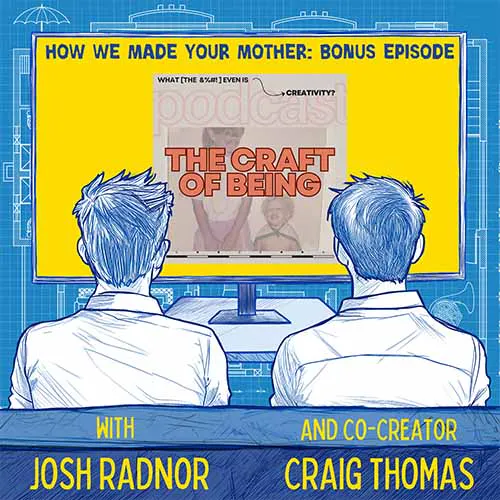
Welcome again to another bonus episode of How We Made youe Mother. It's our final bonus episode before we launch season two towards the end of October. In this upcoming season, we've already got a bunch of special guests lined up and a very special announcement about our podcast, which I'm just not quite allowed to announce right now. So stay tuned to the Internet. This week we bring you an interview that I did on the new podcast, the Craft of Being. Hosted by Anna Schumacher. The Craft of Being is a podcast via a series of conversations where Anna digs into the question, what the heck even is creativity? I got a chance to talk to her about producing the podcast and working with Josh and Craig, and then we go into other projects I've been involved with throughout the years. You can listen to the Craft of Being wherever you get your podcasts and there's even a link in our show Notes. Also, fun fact, Anna's voice can be heard in the opening montage of Himyum fan voices in the very first episode of how we Made your Mother. And now, the Craft of Being.
- [01:17]
B
Hi. Hello, and welcome to another episode of the Craft of Being. This is a podcast by way of a series of candid conversations where we dig into what the heck even is creativity. Undefined, yet definitive. We will talk about the types of innate creative muscles that live within all of us. Within you? Yes, you. We will talk about how these creative muscles evolve with us across life, work, art, and the pursuit of everything. Today, we're going to chat about film and podcast media. My guest today is well versed in both. He wears many hats. And our conversation takes us through the systems that support and interact with the artistry across the board. There's this kind of double consciousness in the way artistic creative work finds its way into the world. On one side, there's the intensity of the creative work itself, the hours of writing, rehearsing, shooting, editing, stitching together details until they finally resolve into something coherent. On the other side, there is the preparation, the scaffolding of validation, the decks, the pitches, the budgets, the endless like me, trust me gestures. You'll hear Alec talk about that that are required before many projects can even begin. And by begin, I mean here. Begin with the goal of being seen, being picked up, becoming the thing that launches someone into a place where the work can speak for itself and that someone can keep working in this stream. And so far as capitalism runs the game. Okay, Hollywood, Capital H. Hollywood has built an empire on this double consciousness. It is a city where art and commerce are bound together. So Tightly that they appear inseparable, where the beauty of a scene and the pressure of an opening weekend are measured on the same ledger. To speak about Hollywood is to speak about an entire architecture of creativity, a system that provides opportunity and exposure and. And also dictates form, funding and legitimacy. A film is not simply the work of its director and cast. It's also the work of financiers, distributors, marketing teams and executives who determine whether the work will even see the light of day. This structure is at once enabling and constraining. It allows something as vast and complex as a feature film to even exist. But it also requires the artist to frame their own imagination in ways that appeal to some gatekeepers. The creative act begins long before a camera rolls right. It begins in the translation of vision into the pitch deck, into the log line, into a concise justification of why the work deserves to exist. The podcast world has inherited many of the same dynamics. Just like Tarantino once used to be able to make Reservoir Dogs in a warehouse on a whisper in a dream, so too can I sit here in our tiny spare room that quadruples as bicycle storage and my desk and a dumping space for outdoor gear and TOD toys, and put my thoughts and craft out there. Though I don't have Harvey Keitel, and thus it's just you and me. What might have once seemed like a freer medium. Just press record, let the conversation flow, upload it for anyone to hear. Has quickly developed its own economies of scale, its own validation structures. A podcast needs a host, yes, but it also needs production schedules, advertising, partnerships, distribution platforms, and metrics that prove value behind every hour of conversation. Released into the world are countless invisible acts of coordination. Emails, calendars, edits, sponsorship, copies, social media, prompts. The work disappears into the final product. And yet, it is essential to the very possibility of the show. To be clear, I am all of the roles, and we do not have a sponsorship department. There is a paradox of much of modern artistic creativity. The the most ephemeral media often require the most relentless scaffolding. Episodes vanish into a stream, but the labor that sustains them is constant. Movies may be remembered for decades, but before they can exist, they must pass through this obstacle course. In both cases for film and podcasting, the act of creation is inseparable from the structures that allow it to reach an audience. There's something instructive in noticing how creators move between these systems. Directing a film and producing a podcast may seem like entirely different crafts, yet they share a common rhythm. Establish the outline, the framework, set the stage Line up the ducks and then let the unpredictable alchemy of collaboration bring something to life. A director can block a scene, but the actors will always bring their own nuance. A producer can schedule the recording, but the conversation will always unfold in ways that no outline can fully anticipate. Creativity, as we've heard on many of these episodes, so often thrives at the junction of order and play. In today's conversation, we get into the way projects are set up, spreadsheets upon spreadsheets, sequences of scenes ordered and reordered, and then the joy of stepping back to watch collaborators bring the unexpected. And what emerges is the broader truth about film, television, podcasting, creativity itself, that it oscillates between the structure and flow. Too much order, the work becomes lifeless. Too much freedom, the work risks incoherence. This is not a lament, it is a recognition that modern creativity is always entangled with its systems of distribution and visibility. To. To make something, it's also to navigate the infrastructures that allow it to be seen, heard, or streamed, experienced. You'll hear today that my guest Alec reflects that this negotiation is not a distraction from his creativity. It is creativity. To build a schedule makes weekly episodes possible, to reorder sequences in a screenplay until they lock into place, to coordinate your collaborators. These are acts of invention. So to hear him in his own words. Without further ado.
- [07:30]
C
Hi, welcome to the show.
- [07:33]
A
Thank you.
- [07:35]
C
Baseball. I'm talking about baseball. You've been called up in.
- [07:38]
A
Put me in coach. I am ready to play.
- [07:42]
C
Excellent. Well, please introduce yourself. What's your name, what do you do and how do we know each other?
- [07:50]
A
My name is Alec Lev. I am a director and a producer. I'm going to go with that. And we know each other well. We met twice. I would say at least we in other lives, definitely past and vaguely present. For me. We are were sign language interpreters and we interpreted at the Marlton School for the Deaf. I say this with. I was going to say great confidence, with near confidence, but it should be known that years later, you, through a mutual friend, you hired me to direct some public service videos, I think we call them, and I don't remember exactly, but the meeting probably went something like where I said, hi, nice to meet you, and you said something like, you idiot.
- [08:43]
C
We met, I think we called them tone poems at one point. Can you expand a little bit on what it is that you produce and. Or direct?
- [08:54]
A
Sure. So, as we speak, I am producing the podcast How We Made youe Mother, which is a re watch podcast of the Hit television show How We Met yout, How I can't even say the name of the show anymore. How I Met yout Mother, that's the TV show. And our podcast is with the I in How I Met yout Mother, Josh Radner and the co creator of the show, Craig Thomas, who, with whom I went to Wesleyan back in the day. So we've been great friends for decades. And I worked on the show for a little bit back when it was on and so I'm producing that now. And I've produced a couple of other podcasts. Meeting Tom Cruise, people telling insane stories about how they met Tom Cruise. And as a director, I have done a lot of theater. I was a theater major like you. I was a theater major back in college and I've done a bunch of directing, mostly with deaf theaters. I guess we could talk about that. And then I directed a couple of films, one of which you produced. And you and I, as of this recording, are gunning towards the next collaboration that I will direct and you will produce again.
- [10:11]
C
Then the question I always ask everyone is, do you feel like a creative person?
- [10:17]
A
I better. Yes. The only. I have no caveats to that whatsoever. Yes. That is the only thing I'm interested in doing professionally. And I don't even call it professionally, really. It's what I want to do when I wake up and it almost doesn't matter the form that is. I enjoy the act of directing the most. Like of all the things I'm doing those few hours after so many months or years of preparation, when I'm actually just there doing the directing thing, that's the most fun. But I love directing and producing and editing and writing and just sitting around coming up with stories. So all of it. Yes. So the, the caveat, if there, there, there were one is I think it would have been harder for me not that long ago to proudly declare on a podcast, I am a creator, I am an artist, that kind of thing. But maybe it was passing my 50th birthday where I was like, I gotta be. I'd like to be something. And so, sure, let's go with artists who create stuff.
- [11:34]
C
Yeah, that's great.
- [11:36]
B
Right?
- [11:37]
C
There's also the aspect of all of this that we talk about fairly often, which is where my friend Kit put this very well. Where art and commerce are uneasy bedfellows, she said, which I love because that is always playing in the back of your mind when you are thinking, how can I be the version of myself that I love the most and that I am the best for other people, while also keeping the lights on in my house and feeding my children, which is the.
- [12:07]
A
I should do that, right? I knew I was forgetting to do something. You and I and our collaborator Josh are working on something right now, and I think all three of us are loving every step of the way in what we're writing as an act of creation, as an act of writing. When we get together and do it. When we do it separately, I think we're enjoying that moment just in and of itself and all. Of course, the back of our heads is also. Because it means one day we'll get to make the damn thing.
- [12:44]
C
I think our collaborative dynamic, the three of us, is a good example of what happens a lot of places in creative projects or art projects where you have. You figure out where each of your creative skill sets kind of lock into the larger picture. For example, during our recent writers retreat, there was the kind of messier version of like, oh, and then they should. And then they shouldn't. And then you're there with the laptop being like, let's talk about the actual sequence number, the actual place this goes. We're moving this here. And that's where. Where the different skill sets and interests and like, where people tend to like to be creative, get to come together and make something cohesive.
- [13:26]
A
Right? Though I think I have pulled the two of you into my evil realm of enjoying those numbers. Also. I think that for both of you, that's not your tendency necessarily. You're not that kind of spreadsheet head quite that I am. We're also dealing with something so complicated structurally that it's part of it. Putting them in a certain order is part of it. But for sure, yes, we. We each tend towards a slightly different side of things, though there are definitely collaborations that are exciting because the collaborators work so differently. I think we're freakishly on the same page. I look forward to the explosion. I look forward to where we're just like, fuck this. And someone throws a digital piece of paper down on the ground, walks away and says, this is over. But until now, it's been lovely.
- [14:21]
C
I'm not looking forward to that actually, at all. I don't want this at all.
- [14:27]
A
The podcast, which is available, by the way, anywhere that podcasts, or I mean anywhere that podcasts are available, you can listen to how we made your mother. The merch is there too. Don't worry about it. Is the role of producing something like that, which has lots of moving parts, is a little bit like it's. It is finding a Constant order within the chaos. Definitely that there is someone over here doing something. Someone over here doing something. They all don't know what the other vegetable in the soup. Thank you. Is doing. And I. The chef or the person eating the soup. Why am I doing this? I am the only one that sees the whole soup stop. And I like that. I enjoy that. I definitely enjoy pulling all those pieces together, getting them in order, making sure that A is talking to B. But I also. And I guess if you were to walk into a new project that had not been yours and you had to walk into chaos and organize it, I'm down with that. I'm a step by step kind of person.
- [15:37]
C
Well, I'm going to challenge you on this, sir, because the feature film that I produced, nebulously produced, because as I'm going to describe it, how did you produce a thing that was not. That didn't exist until it existed? No plans this weekend was all about. We're going to go into this place with absolutely no plan. And we just so happen to have a cast full of obscenely talented people who are going to kind of make this whole thing connect together. But we went into that without an idea. And it was the structure and the dream around the chaos that was there to. To hold it. But everything that happened on the day was really just spaghetti, spaghetti everywhere on every wall.
- [16:22]
A
So we, yes, we, we. We shot a film called no Plans this Weekend presents Breakdown. And we arrived on a. On a soundstage that had 12, 13 standing sets with a group of seven or eight actors. And we literally had no scripts, no characters, no story, absolutely zero, zero, nothing. And we, on the first day, we just got the group together, walked around and our collaborator, Josh, who we knew would be the lead. I'm sorry, that is one thing that we just decided. Josh came up with an idea right away. We're like, okay, pretty much said, okay, that's the movie. And then we made scene by scene and we shot behind the scenes of it. So you get to see that whole process. I always knew it would be a bunch of scenes that were going to tell a story and there'd be a behind the scenes aspect to it. So very, very ordered chaos was that. And I would say that I love that more than anything I've ever done for sure. And it. Because actually it fits what you were talking about, which is, as we know right now on the new movie, we are writing words on the page. Human beings have to speak words. We've been developing this for a couple of months and now Our characters, we have to just make them talk. And I'm enjoying. Question mark the words that I'm putting down on the page to make the humans talk to each other. But I also know that getting these improvisers into that room, they were definitely going to come up with funnier things than I when I was writing it down. So the idea of each person in the collaboration having their own skill that you lean on and don't think, oh, I wish I could be doing that. Like, I don't wish I could be doing that. The. The people we worked with are better than me at the doing of that. And so, again, it's very, very ordered chaos as chaos goes.
- [18:13]
C
This is why we're not writing a.
- [18:15]
A
Comedy, are we not. Wait a second. We're not writing. So he should not. The clown nose. I didn't. I wasn't sure if I should keep the clown nose.
- [18:22]
C
No, we're tossing it. The tiny car stays. I want to walk back and talk about. Do you remember when in your life you first felt like creativity mattered to you, what that felt like? Like even a sense memory of that?
- [18:43]
A
There was definitely in, I want to call it kindergarten, someone was making a film. We were making a film. And when I say film, it might have even been on film. This was a while ago now, but it was all done. It was all stop motion. I think it was all stop motion, if memory serves. And my. I think the character I drew was like a magician. So that's. That. That's a deep cut there that I. I like to make the magic happen there. But I do remember seeing the miracle of that. I don't remember thinking any other way. There wasn't any other thing I was really interested in ever. I liked math for a while, but that wasn't like going to. I wasn't going to career myself through math. And now I have my spreadsheets as a producer, so I need my math. But I don't remember thinking another way. It was always making stuff and play acting, and Star wars was a huge part of it. Star Wars. I was born 1975. And so. And I have a. I think I have a memory of seeing Star Wars, Episode four in the theater. Certainly Return of the Jedi, certainly Empire Strikes Back and then Indiana Jones, then Return Jedi. So it's like I was. I was all in on movies very, very early. They were everything.
- [19:56]
C
And then my start in on Harrison.
- [19:58]
A
Ford, specifically a little bit on Harrison Ford. Witness was very big in my life. Dying young. It was very important to me as a As a young child.
- [20:06]
C
Keep going. This is a litmus test right now.
- [20:10]
A
K9 was a big one, but playing with Star wars figures was a, was a full time job. And making up those stories with those figures and imbuing them with personalities that weren't necessarily from the movies. The huge part, huge part of, of storytelling growing up.
- [20:33]
C
You touched on before your role as a podcast producer for how we made your mother. The Rewatch podcast for how I met your mother. Anywhere available, Anywhere there's merch.
- [20:45]
B
What, what T shirt.
- [20:48]
C
But I am hoping you can expand a little bit on what the tasks and kind of creative solutioning you do for the average life cycle of a show from making to posting.
- [21:02]
A
Sure. So it's, you know, the, the, it's a, it's a great collaboration. I mean the ultimately truly. And I have no reason to puff myself down. Can you do that? I mean the reason you're just going to enjoy that is because you're going to love listening to these two guys talk. And we could just press record and then I could post the thing that they say. But I do think of each episode as a tiny little work of art and it's not a work of anything else. So it's got to be that. And so it involves we planning a little bit. And when I say planning, I mean scheduling, getting us all in the same place. And that involves many phone calls and many emails and assistance and calendars and all that. And so okay, that's the first part. Not wildly thrilling, but you got to do that. You get in the same place. We record ads. We have to think about, oh, three weeks from now. I actually need this one piece. So we're going to record this little thing now too. So you're puzzling that out as you think about a full season. We do, we have a 22 week season, but actually maybe 40 episodes within those weeks. And so I'm planning a little bit in advance. We do special episodes where people ask questions. So I have to go onto the Internet, I have to ask people questions and there's a creative moment there where I post a little square on Instagram and I say, do you have any questions about such and such an episode? But then I make a little joke and a little inside joke taken from that episode. So that's a fun bit of writing that I get to do. And then, I mean it goes on and on and then you have, then I have to edit it. And then within the editing process there's three different, four different programs I'm using while I'M doing it. And by the way, as I feel every day, the train does not stop. Every Monday comes and a new episode has to happen. So I'm think I'm editing an episode, planning for the next one we're going to record. Thinking about the fact that I have three others in the hopper that need to be edited. And then also, oh, what about next season? I mean, we are. There's 200 episodes of this show. There's no end to when I have to stop thinking in advance of what's gonna happen next. And then, you know, it's producing and like, editing is such a. It disappears. Right. When you listen to the podcast, I guess the hope. I guess one says that the hope is you're not thinking about a single thing that I, Alec, have done on this show. Right. And it's my goal to make you not think about that. And it's my goal to make the hosts not think about that. I just want them to have this place where they can do their best work in front of the microphone and then have that get out to the world. And so what I do disappears and the editing kind of disappears. But it's very satisfying on those Mondays when the episode is posted. And even though I've heard it five times by then, you pick up your phone, it's just sitting now. It's just there. It's just one. There's no more. Nothing you got to do to it. It's just sitting there on your phone. And that. That's a very satisfying moment.
- [24:16]
C
Yes.
- [24:16]
B
We have a very.
- [24:19]
C
Ephemeral job often.
- [24:23]
A
Yeah, certainly. Ephemeral. Paint. What's the right word? Media medium. Right. The stuff that I'm doing, the stuff that you're doing here that we're clicking away just constantly is not the work. Is not the physical work of art that anyone's looking at. Kind of sort of. It totally is and it totally isn't.
- [24:48]
C
Right. There's that difference between the art of the making, you know, it's all the. The chips of marble on the floor versus the statue of David that you actually see.
- [24:59]
A
Yeah.
- [24:59]
C
At the end. And you don't look at the sculpture and think about the rectangle it used to be.
- [25:05]
A
Right.
- [25:05]
C
You know, that kind of thing.
- [25:07]
A
You know, he also has. I'm going to get myself in trouble attempting to talk about art at all. But he's also got those statues of the figures that are still coming out of the stone. It's in the same museum as David and I. I totally took to those. And now thinking about like, what I do with my life is only making stuff. But I also am a constant stream of making behind the scenes stuff of the stuff I'm making because I'm fascinated by that. And so the idea that I like that this is the. I saw this 20 years ago. I'm now putting this together. I like the statues leaving the marble because I like the behind the scenes of it. I get to still see that.
- [25:53]
C
That's interesting. How do you know when something that you're making is done or if it's resisting being done?
- [26:02]
A
It's a. It's a great moment. You do need to decide that it's done. I mean, I guess one doesn't. And it's, you know, you listen, read stories in Ron Chernow's book on da Vinci to read about the Mona Lisa of like 15 years of painting over and over and over and over and over. But then he stopped at some point. And so I guess, no, you don't ever have to have to stop. There's a church in New York on 110th Street. Part of the mission is that it's never done. And so it is always being. It is always being remodeled in some way, refurbished in some way. But I love it. I love when you're editing. And so let's say that two people have said something. Person A says something and person B says something. But at the end of person A's sentence, there's some gibberish or some. Something garbled. And you can't use that. So you have to edit that out now. You have to make it sound like these two people spoke to each other, but the part in the middle where the actual overlap with is gone. So now I need to make a new overlap. I need to make it sound like this conversation happened that way or just any edit in a movie, someone's running in this direction. Then you cut to the next shot. There's something. When you, when you make that edit happen, you get those two clips next to each other and you figure out where one should end and one should stop. And I might be right, I might be wrong. Someone else might do it a different way. But I definitely have a moment where I go, that's exactly the way it should be. That's it. I'm not changing. And when you're editing, you're dealing with as little as 1 24th of a frame. And there is a difference between moving it here or moving at 1 24th of a frame over there. And there's just something in me that goes, I am done with this moment, which is not how I feel necessarily about writing words on a page that.
- [28:03]
C
Especially dialogue to that. Have you ever felt like a project or a task is really more like making itself and you're kind of along.
- [28:14]
B
For the ride, or do you usually.
- [28:16]
C
Feel like you're definitely molding the thing?
- [28:20]
A
Yeah, I. I don't. I've heard a lot of writers certainly talk about that. The characters are sort of starting to speak for themselves, and you're a bit along for the ride. I guess I'm just. I'm not that mystical a fella, and I don't really see things that way. I'm open to it being that way, but, no, I do feel like I'm. I'm pulling it. Pulling or pushing. When I'm making something or when we are making something, we. The collectively or literally, you and me or. And our other collaborators. I feel like it's us doing the thing, making the thing. But I feel like I get into that flow pretty quickly because I'm so desirous of starting. Of working. I mean, sure, when we hang up, I'm gonna jump back into, you know, something or other.
- [29:11]
B
Let's wrap this up.
- [29:13]
A
I'm done. I'm done.
- [29:14]
C
I got work to do. Yes, as do I. Yes. But I do think that getting to that state where you're really just in.
- [29:26]
B
It comes.
- [29:28]
C
Comes swiftly and. And comes beautifully because the other things have been set up in such a way, in an intelligent and. And capable way, because you have done this for a long time. You actually. And the royal. You have done this for a long time, whatever your thing is. And then you can gift yourself the chance to really just swim around.
- [29:52]
A
Right.
- [29:53]
C
And so to that, I think there's kind of the two sides of. Of art making or thing doing. How do you like that? Where it's.
- [30:02]
A
It was at the alter name of this podcast.
- [30:04]
C
Yes.
- [30:05]
A
Schumacher is thing doing.
- [30:07]
B
Just.
- [30:07]
C
It's actually the craft of thing doing. It's still ends. And that part of anyone's creative process or use of those muscles can be more structural and some can be more loosey goosey. And they can coexist.
- [30:24]
A
I think they completely coexist. You will remember that there was a scene we were doing during our California connect where we were doing these short videos with these. With these communication devices, where the scene took place in a theater. We were shooting in a theater. And the idea was that rehearsals for a show were going on. And there, of course, was no show. We were just approximating. We were saying, okay, we're doing Midsummer Night's Dream. But of course, we didn't stage Midsummer Night's Dream at all. So there were three or four actors on stage, our actors who were then playing actors who were characters in the show. We like stuff like this. And so I'm directing this. And it's. We're going to basically just. All I need is a lot of shots of it looking like you're rehearsing a show, but you're not. You don't know where to go. And I just wasn't going to block. I was going to sit there and take an hour to go, okay, you walk here, you walk, you work there. Add to the fascination here is our director of photography, our mutual friend Ruan, who is deaf. He was on the camera. He was. He was operating the camera. And he and I planned absolutely zero whatsoever. And so what we did was we just let the camera run for 10 minutes and he and I are running around like lunatics. I believe you actually were interpreting in the moment for him. If, if. But I don't even know that he was watching much of what you were doing. We were. I was just screaming out to the actors. Okay, of course, I don't remember anyone's name now or then, but we'll call them John. John, you walk down left. Okay, now cross over to her now, she said, and it's like, okay. I use my theater, my theater director brain to be staging a play while guiding a camera to come over here and go over there. And that was using all those. All the things all at once in a. In a distinctly ordered, distinctly ordered chaos.
- [32:33]
C
I do remember that I was interpreting, but what's. What stood out to me then, and I remember now, and I'm reminded in this moment is that Ruan also seemed to instinctively go where things needed to go. I was certainly not facilitating the communication really at all. And I think that speaks to both of you having a really strong. It's kind of like eye for. For storytelling and the movement, like you both understood from communicating about it in some general way beforehand. We need to capture the feeling of this space, the movement of this space in these people. It needs to feel like this. And then you just made it happen.
- [33:21]
A
Yeah, yeah. I'm both a planner, clearly. Definitely my spreadsheets have spreadsheets. But I think what I want. I think what I want to do is plan all the way up to a certain moment and then let the plan trust that the scaffolding is there, the structure is there. Everyone also has the skills to perform in the moment. And then the fun part is the question marks. Right. It's not as much fun to say, okay, now you specifically, I want you to take four steps over there. I mean, you could work that way. And that's why no plans this weekend and the podcast too was just, okay, I got. The stage is set. I have set the stage for y' all and then do your thing. And whether it's Josh or Craig doing their thing for an hour or a bunch of actors doing something in front of the camera for a couple minutes, that's, that's a joy for me is the stuff I could not possibly have planned and I just get to sit back and watch it.
- [34:28]
C
Yeah. This comes up so often with people that I talk to about the way that they have retooled what was a more freeform creative self into a more career based creative self. That there is the. This, the same word comes up. There's this scaffolding in place or some structure in place. Because when you have that there, then you can have also the more play part where you can be a little bit more experimental in what you're doing. And you say, ah, that doesn't really work. But it's okay because you have all the shelves of other options there. And there is also a certain self trust necessary to say, I built, I built a good skeleton here. Great. Now we can kind of dress it up. And that's applicable in so many different creative paths, career paths.
- [35:20]
A
It's also a very sad. You know, it's like a soup, you know, for no. Yeah. For no plans. We really just shot what was there. You're. Yes. You did not have a huge amount to do. In fact, you were planning, I believe, our next thing while you were sitting in the, in the kitchen typing away. But for the, but for the California connect stuff. The beauty also for a director is to have a producer like you where things appear. It's just, it's, it's just, it's, it's so cool that you've, you've made these plans. But I, as the director, I don't bring stuff anywhere. I just blissfully show up. And when they're there, that's a, that's an incredibly inspiring creative moment that the tools you think you wanted were put there by someone that has the skills to put them there. And now I get to move them around and someone else gets to, you know, play in front of them too.
- [36:16]
C
How would you describe in your own words, the difference in. Difference in is, is not exactly what I mean to say. The difference How? Look, I can only be me. Okay? How would you describe the difference in creativity and art in your own experience of a relationship to either of those things being not mutually exclusive?
- [36:42]
A
Sure, I got it. I got this one. I think creativity is putting something new into the world. That's all, folks.
- [36:56]
C
We'll see you later.
- [36:57]
A
Thanks, Podcast. Thus ends season one. We've solved it.
- [37:02]
C
The craft of thing doing, season one.
- [37:04]
A
Thing doing is putting something new to the world. It is. And I guess the, the, the. The What I would put in what I would suggest as not being art but being creative is any task you have at your job. Say you're waiting tables and you do it a certain way, and then you realize, oh, if I walk around this table that way, or if as I'm literally collecting the plates, I should stack it this way. That hasn't been done before, or at least hasn't been done before by you. Who cares if someone else has done it hasn't been done before you. So you've created a solution. You created a plan. You have used. You have not just listened to what someone told you to do. You haven't just copied what someone told you to do. You have made something new. But I think art, a piece of art, has a kind of unity to it, to all of its. All of its parts are telling the same story or all of its parts are actively telling disparate stories, if that is the story you want to tell. But there is a big spiritual, philosophical, temporal beginning, middle and end to your work of art that you have created as compared to a solution, a spreadsheet, a path taken, a way to sell something, a way to walk away, to think that is creating but not art. Yes. Good. Did I do. How'd I do?
- [38:31]
C
You did great.
- [38:32]
A
Do I get to clip that? It's on the Internet. Is that on the Internet?
- [38:35]
C
It will be. It will be, Yes. I love that I think about these differences all the time and where that line is and how to describe the. The conversation that a work of art might be trying to suggest to the world by being viewed or consumed in some way versus the creative solution of a logistical profession or even a spreadsheet. There's. I work with someone now who I will say, I need these nine things to be possible in a sheet. And he'll go, okay. And he'll create formulas where it's all speaking to each other. And I just go, wow, that's awesome. Is there a creative skill set that you don't have, but you are interested in learning or growing more In I.
- [39:27]
A
Would say that directly related to the work I do. The. I made a film called what. Which is a silent film with deaf actors. And I really did it as much as I could in. In borrowing from a tradition of silent black and white films that pretty much use master shots, just wide shots of. Of people in the frame. They're performing on stage for you and the camera is there to show you that. Then the next one, when we did no plans this weekend, there's some cinematic choices made there, but we're really trying to just capture the comedians saying the things. And still that was pretty much wide shots of people talking. Like we didn't really do a lot of. Not that many close ups. Here they are. We really do that many close ups. But we did some here and there. I would say that this next one, what we want to do, I want it to be nothing less than the most beautiful movie ever made. So I'm gonna have some work to get done.
- [40:26]
C
You're aiming between now and there. Now and then utterly drop off. Okay.
- [40:31]
A
Oh, please, please. Nice.
- [40:32]
C
Neat.
- [40:33]
A
So that. That's something is. Is really ingesting some movies in the style. Ingesting some art in the style that opens my brain up a little more to how to use that camera to. To tell a beautiful story beautifully.
- [40:52]
C
Well, I'm rooting for you think so.
- [40:59]
B
Great.
- [41:00]
C
This has been great. Thank you for talking to me about this and all the things that you do and all of the. I'm. I'm really. I admire the fact that you are able to so freely go between a lot of order and structure into allowing yourself to enjoy that for yourself in all the fun ways. And then before we go, you might.
- [41:22]
B
As well tell us for the third.
- [41:24]
C
Time what you're up to, where we can find it and how we can support the show.
- [41:29]
A
Sure. How we made your mother is available everywhere. Super fun podcast. If you're a fan of how I met your mother, start watching again and listen along with us. If you've never seen it, this is your time to get started. Start from the beginning. And we are going episode by episode. And the show is not quite a scene by scene breakdown. It's kind of a. What is this episode talking about? And Josh and Craig made this in their 30s and now they're in their early 50s and they're thinking about life very differently and art very differently and thinking about what they made back then in a new way. And so I think it's exciting to listen to for that reason and how we made your mother.com. it's, it's all right there. Check out what question mark is on all the things I think you can get it on on on. You buy it from Apple and watch it in various places. I don't actually know Amazon stuff like that. And then, then we will just stay tuned. Just stay tuned for what comes for what comes next.
- [42:35]
C
All right, well, we'll do this again after we make our next movie. Just keep running credits of things for.
- [42:40]
B
People to keep their eye on.
- [42:42]
A
Excellent.
- [42:50]
C
The Craft of Being is produced and hosted by me. Music is wide eyed by Colin o' Brien.
- [42:55]
B
Lux.
- [42:56]
C
Big thanks as always to my dogs for barking through at least six minutes of every single recording session. Definitely check out the show notes for Collins Bandcamp, more about today's guest, their links and socials, and anything else we mentioned on the show. And if you want to get in touch, come find me on Instagram at the Craft of Being or send me an email at the craft of being pod gmail.com thanks for being here. And until next time.
- [43:33]
A
Sam.