← Human Events Daily with Jack Posobiec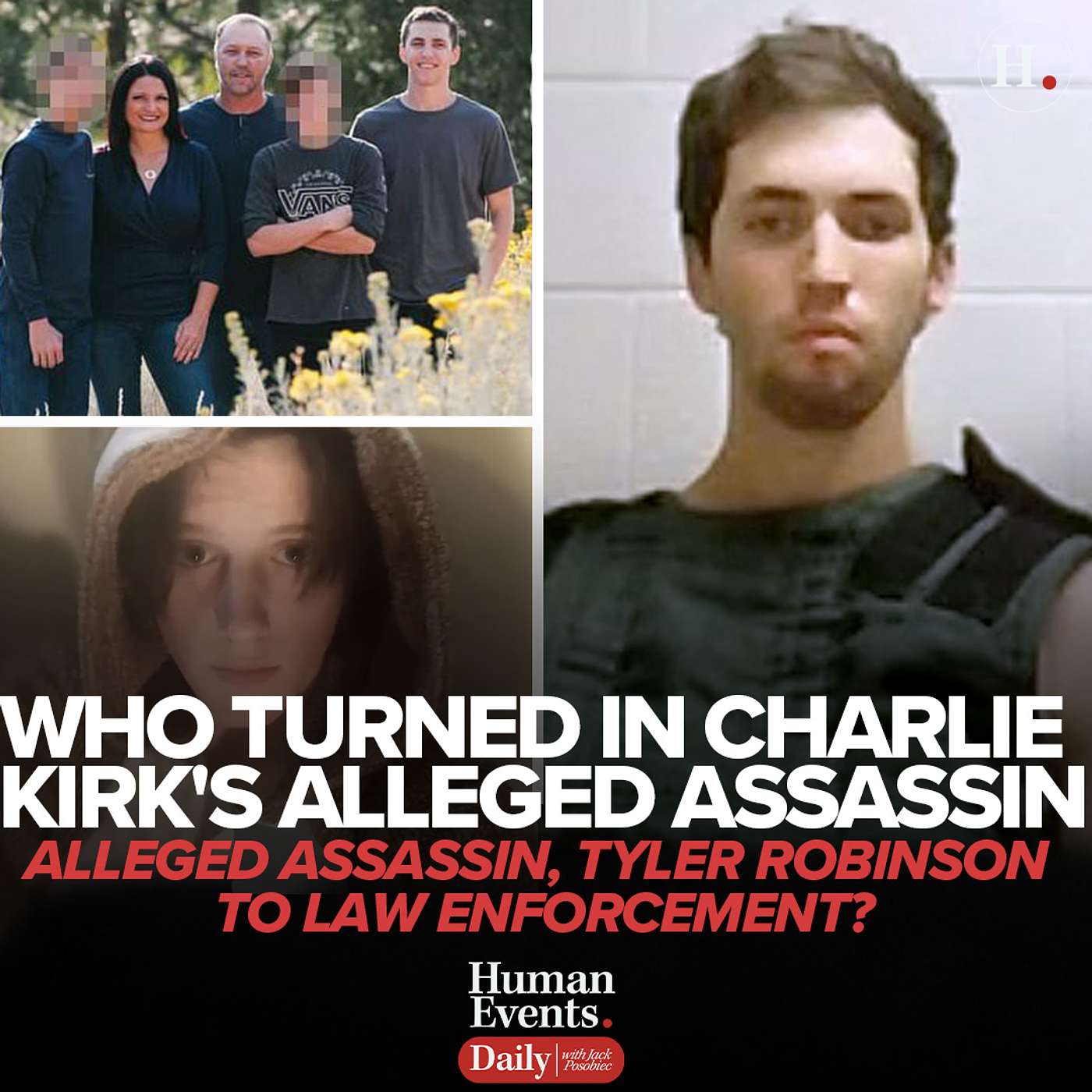
Human Events Daily with Jack Posobiec
Who Turned in Charlie Kirk's Alleged Assassin, Tyler Robinson to Law Enforcement?
00:20:02
Loading summary
Transcript38 lines
- [00:02]
Jack Posobic
I want to take a second to remind you to sign up for the POSO Daily Brief. It is completely free. It'll be one email that's sent to you every day. You can stop the endless scrolling trying to find out what's going on in your world. We will have this delivered directly to you totally for free. Go to humanevents.com poso Sign up today. It's called the Poso Daily Brief. Read what I read for show prep. You will not regret it. Human Events.com poso Totally free the poso Daily Brief. This is what happens when the Fourth Turning meets fifth generation warfare.
- [00:41]
Libby Emmons
A commentator, international social media sensation and former Navy intelligence veteran.
- [00:47]
Jack Posobic
This is Human Events with your host, Jack Posobic.
- [00:50]
Christ is king.
- [00:52]
Unknown Guest/Commentator
I thought that New Jersey would do better. I didn't think that Virginia was going to do very well. I didn't think the candidate, well, you know, didn't really have my support. The Cuomo situation. It just, he had too many, too many things against him. I'm so torn because I would like to see the new mayor do well because I love New York. For a thousand years, communism has not worked. It just communism or the concept of communism has not worked. I tend to doubt it's going to work this time.
- [01:21]
Stephen Gardner
Thousands of flights here in the US are about to be canceled. Day 36 now the longest shutdown in US history, breaking the record set during the first Trump administration. Because of air traffic controllers not getting paid, air traffic now will be reduced by 10% into 40 major airports. Thousands of flights to be canceled as of today.
- [01:39]
Jack Posobic
The government shutdown is now the longest in US History. Several senators are tentatively predicting it could end soon.
- [01:48]
Stephen Gardner
I'm optimistic that we should get something done this week.
- [01:51]
Jack Posobic
Multiple sources say a possible deal between senators is being negotiated. It involves some kind of stopgap funding bill and a promise to vote later on rising Obamacare subsidies. Some Democrats say that's not good enough. But two sources say about a dozen Democratic senators have privately signaled an openness to such a plan. If Republicans agree, that would be enough votes for the chamber to pass the bill.
- [02:17]
Erica Kirk
One of the law enforcement guys comes in. He's very sweet. But what do you say to someone whose husband just was assassinated so publicly? He said, you know, I've been doing this for 30 some years. He said, I will never tell you that you cannot see your husband, he said, but I, in my professional opinion, think that you should wait to see him once he's at the mortuary.
- [02:46]
Stephen Gardner
Because.
- [02:47]
Erica Kirk
I don't think you want to see him like this. The room got quiet because half the room knew it's probably a good idea. And the other half of the room was like, there is no way she's listening to you right now. And I responded back to him and I said, with all due respect, sir, I said, I want to see what they did to my husband and I want to give him a kiss because I didn't get to give him a kiss this morning.
- [03:15]
Stephen Gardner
Morning.
- [03:17]
Jack Posobic
Well, ladies and gentlemen, welcome aboard today's edition of Human Events Daily, here live on Real America's voice. Today is November 6, 2025 Anno Domini. You just saw there Erica Kirk giving her first sit down interview since the murder of her husband by a crazed leftist. And incredible interview. Heart wrenching, a gut punch, many, many gut punches throughout the entire interview. But important interview at the same time, and perhaps the most newsworthy section of it that came out was when Jesse Waters asked her whether or not she supported this ban on cameras in the courtroom. And as you know, here on Human Events Daily, we issued a letter to the courtroom urging them to oppose this ban on cameras. Erica herself also came out in opposition to the ban. She said, let the cameras roll. Let everyone see what true evil is. And so wanted to get on a panel to kind of discuss some of the ins and outs of this. So we are joined. We're honored to be joined by two illustrious guests today. We've got Libby Emmons, the editor in chief of Human Events in the Post Millennial. What's up, Libby?
- [04:38]
Libby Emmons
Not much. Doing well. Thanks for having me.
- [04:40]
Jack Posobic
And of course, Stephen Gardner. The Stephen Gardner Show. How are you, my friend?
- [04:44]
Stephen Gardner
I'm doing well. Thank you for having me on.
- [04:47]
Jack Posobic
Well, Libby, just, just right off the bat, you were such a driving force behind that issue. And that letter about the cameras. How important is it that Erica came out in favor of this?
- [04:59]
Libby Emmons
I thought it was very important. I was really glad to see her take that position. She had a similar view that we had at Human Events, which is that the assass of Charlie Kirk was public. Everyone could see it. It was right there on live stream. And I think the justice in the wake of that assassination should be public as well. The trial of the suspected killer should be public. The entire process of this trial should be transparent so that there are no questions left unturned and no question as to whether or not justice was served.
- [05:32]
Jack Posobic
And now I want to turn over to Steven. Steven, I know you've gone to the UVU campus itself. I know you've done some great videos and have worked with people as well on the ground there that have dug into this. What's your sense of this going into the trial? Because I know there's, you know, been questions. People say, oh, the affidavit and Erica herself got asked yet last night, do you think they got the right guy? She replied that she had trust in the team, she had trust in their team. What's your sense of this as it goes to. And we don't have a trial date yet, but I believe the next hearing is ever January.
- [06:12]
Stephen Gardner
Yeah. So my understanding is based on recent court documents where Tyler Robinson's legal team was involved, they have a very strong case. There is an entire folder full of evidence from GEO fencing to his car to DNA on the roof, on the gun, on a screwdriver. So there's a lot that the defense is going to have to overcome. At the same time, I can see how an attorney who is advocating on behalf of their client wants to put as much in their favor as possible, getting them out of the suicide vest, having him come in in regular clothing. But as Erica Kirk said, he was assassinated in public. He should be tried in public. There's already so much doubt around whether the FBI is doing enough, whether the Utah police are doing enough, whether the Utah County Attorney General is doing enough. Let us just see the court case and we will be able to decide whether enough is being done. But lots of, lots of trial data and evidence has been handed over in discovery. We're going to learn a lot more starting around January 16th.
- [07:34]
Jack Posobic
I think it's right. And yeah, I just pulled it up as you were chatting. So it's January 16th is the next preliminary hearing and then an arraignment on January 13th. So we're already pushed out two months into next year. Libby, I want to get you back in on this because there was a clip of me. So I was on the Charlie Kirk show the other day and I was having a discussion about how I, you know, just as a father, how incredible it was to see and just, just, just, you know, almost unbelievable it was to see Tyler Robinson's parents play a role in turning over their son. And now this has gone viral online. People are saying that's not true, that didn't happen, that, you know, that know, somebody else turned him in. And, you know, I went back and pulled up the affidavit and it's got his mother, that's Amber Denise Robinson, his father, Matt Robinson. Obviously the. You see the two younger brothers there, Austin and Logan, their faces blurred out. But in the affidavit it's very clear that the parents were the ones that first identified him and then reached out to a friend of theirs who is retired law enforcement. So, Libby, what's your sense of this? Why are people, you know, do people think that they don't know who their own son is? I'm kind of at a loss here, or what the implications of this would be.
- [08:55]
Libby Emmons
Yeah, I find that really surprising, too, that anyone would push back on that. In the days after Charlie was killed, there was a manhunt. There was an investigation. The FBI had to decide whether or not they wanted to release the surveillance footage. They did release that footage. And after they released that footage, Robinson's parents recognized their son in that footage, tried to contact him. There's text messages that were revealed, Robinson saying that he wasn't answering the phone of his father, that he wasn't wanting to talk to them. But it's all in the affidavit. And not only is it in the affidavit, if you go back to the press conference that was had, the sheriff of Washington county in Utah explained all of this and discussed it at length and took questions and talked about it. It was right there publicly, on camera, on tv, like this entire thing has been from the start. And part of the, you know, the parents recognized him. They reached out to him. I'm sure they didn't want to believe that this was their son, but they did believe it. He came over and talked to them and indicated that he had been the one who was responsible for this killing. Imagine how terrible it feels as parents. You don't want to recognize your child as a killer, but parents will recognize their children. You know, how they walk, you know, everything about them.
- [10:12]
Stephen Gardner
So.
- [10:12]
Libby Emmons
So obviously they, you know, they didn't want this to be true. It turned out to be true, and they dealt with it in the way that. That a person probably should deal with it. Right. Turn in their child, talk to them, get them to turn themselves in, is what happened.
- [10:29]
Jack Posobic
So, you know, I'll cut it over. Libby. No, I think that's. I think that's right. I cut it over to Stephen. Stephen, you know, you've read over this as well, and. And I remember at the first, there were questions. The parents reached out to a family friend of theirs that they knew through a church group. Turned out that he was also retired law enforcement. There were questions about the surrender. Is that your understanding of what went down when it came to the identification?
- [10:54]
Stephen Gardner
Yeah, my understanding is the FBI was very reluctant to release any video footage or Photos. However, they were in a bind. They needed public assistance. And so they made the decision to release a couple of photos of his body, of his face, and of him after taking the shot, running and jumping off the roof. And you know, you can say whatever you want, but that footage is what triggered the mom to call the dad and say, hey, are you seeing this? This looks like our son. And the father confirming, yeah, you're right. I think that is now, you know, there was some confusion because as soon as his photo was released, people started trying to use AI to enhance or sharpen the photo. And so the fake AI photo of Tyler Robinson started circulating just as quickly as the real one. But as Libby mentioned, a mom and a dad, they're going to know their son, they're going to know the clothing. They also identified. Hey, I think I remember washing that American flag shirt. And then now we've got video footage of him being pulled over where he's wearing a very similar hat. He's wearing the glasses. He uses some of the, the language inside of the text messages that people are doubting. So yeah, I believe story about his mom and dad.
- [12:22]
Jack Posobic
Pause it right there because I want to get back on this.
- [12:26]
Stephen Gardner
In our wave.
- [12:27]
Unknown Guest/Commentator
And our golden age has just begun.
- [12:29]
Jack Posobic
This is Human Events with Jack.
- [12:31]
Now it's time for everyone to what America first truly means. Welcome to the second American Revolution. All right, Jack was up with back live here Human Events Daily. Real America's voice. Folks, did you know that in the last six weeks, 86 million AT&T users had their name, address and Social Security numbers leaked? Or that the CCP is harvesting massive volumes of Americans personal data to train Deep Seek and other AI systems? When you are online doing the work like I am, you need digital camouflage. And that's why I partnered with our newest show sponsor, Patriot Protect. Patriot Protect removes your personal data from the Internet. And whether it's Google, Amazon or Apple, your personal data will be wiped so that scammers and cyber criminals and swatters like the ones that came after the Poso family will not and cannot find your data and you can take back your security and privacy. Once Patriot Protect scans and scrubs your personal information, they'll continuously monitor your info to make sure every new instance of a possible data breach is eliminated immediately. I'm talking 24. 7 protection for the cost of keeping the porch lights on. The only thing worse than getting hacked is knowing that you could have stopped it and didn't take action when you could have. So go to patriot-protect.com poso and use promo code POSO for 15% off a yearly subscription. That's patriot-protect.com poso & use promo code POSO again, 15% off a yearly subscription. Patriot-protect.com poso I'm going to throw it back now to Stephen Gardner. Stephen, you were talking about the, the evidence that's going to come through here. And to be clear, all of the evidence is going to present, be presented at trial. That's why we at human events have been pushing so hard that the cameras stay rolling. And I'm just overjoyed at the fact and that Erica is backing this obviously as horrible of a situation it is. But, but her, her voice lending, lending itself to this is obviously going to be a big push. But Stephen, the point here is, of course, that these statements being made in the affidavit, they're not just being made, you know, haphazardly, they're meant to be backed up in court by hard evidence. Isn't that right?
- [14:44]
Stephen Gardner
Yes. Everything that is being talked about by you, me, Libby, others, it's all going to be under a massive amount of scrutiny. We're talking about the best of the best lawyers are going to clash on their experts trying to refute the other side's experts. And this is one of the reasons why the court date was pushed back to January 16th. Tyler Robinson's defense attorney, she said there is such an abundance of evidence that we're simply not prepared at this point to make a strong defense. So I think that there is a lot that they're going to be up against. We're going to find out even more about the parents and the story. All of these details are going to come out in trial.
- [15:33]
Jack Posobic
I think that's right. Going back to Libby Emmons now, you know, Libby, when, when you look at this, and I know obviously you've written a lot about transgender shooters here. And while the shooter himself in this case, you know, alleged shooter was not trans, his boyfriend was, you know. Libby, do you see this as the next in a long line of increasing transgender related violence?
- [16:01]
Libby Emmons
Well, there has been a long line of transgender related violence. We've seen it over the past few years. There's been a number of trans individuals who have committed shoot school shootings, both male and females who have undertaken that. And I do think that deciding that you're that out of touch with reality, that you don't even recognize your own body and self for who you are and what it is is, you know, going to lead you down a pretty bad path. The evidence about the the boyfriend has been pretty interesting. There's been some blogs and stuff that have posted discord messages and text messages and other exchanges about what was going on in the home that they shared, that Lance Twigs and Tyler Robinson shared. And it does seem like it was a pretty bizarre relationship that they had going. This roommate, Lance Twigs, was apparently alcoholic and using a lot of drugs, creating nests in the living room, lashing out at people, and seems to be substantially pretty controlling. And if he was giving both masculine and feminine energy, that's definitely a recipe for intense manipulation to be going on in this relationship. So, yeah, I think that trans is hopefully on the decline because it is something that has been a fad. It's been a big trend, and statistics have shown that perhaps that might be starting to decline. I think the Trump administration has perhaps something to do with that, too, in terms of regulating whether or not these kinds of medications are allowed. But, yeah, I think that it's definitely concerning to see leftists with their own leftist ideology. And then when you mix it up with a rejection of reality, you have real problems.
- [17:50]
Jack Posobic
And that's, that's certainly right. Back to you, Stephen Gardner. Now, what, what more what key piece? Because I know you've been digging so much on this. What key piece are you looking for next? Is there any sort of, you know, sort of skeleton key or missing link that you think that's out there that you're going to be looking for at this trial?
- [18:09]
Stephen Gardner
Now, according to the court hearing in late October, the evidence that they have against him lines up his cell phone data, GEO tracking to the UVU video footage that everybody is wanting, right? I mean, I see dozens and dozens of influencers saying, just give us the, just give us the tapes. Just give us the tapes. Those are the very tapes that they need in order to tie him to this crime and bring justice to Charlie and Erica and the Kirk family. So at this point, I am just waiting for the court case to start revealing all of the information that I've shared with my YouTube community. But, you know, they're going to tie him to the gun, going to tie his shoes to the location, they're going to get the gunshot residue off of his hands and on the steering wheel of his Dodge Charger. They're going to use the GEO fencing, they're going to line all of that up when the shots taken there. Again, as, as his own defense attorney, who's trying to save him from the death penalty said, there's such an abundance of evidence, we're simply not prepared to try this case at this time. So there, there is a lot of evidence we all wish we could.
- [19:29]
Jack Posobic
That's about all the time we have. Stephen Gardner. Go give him a follow. Stephen Gardner show Libby Emmons, Human Events Post Millennial. And yes, if there's any other video images, footage, data, let's get it all. And that's exactly what I'm going to be looking for at this trial. Thank you so much to the panel. Be right back with special guest Human Events Daily.