← Proven Podcast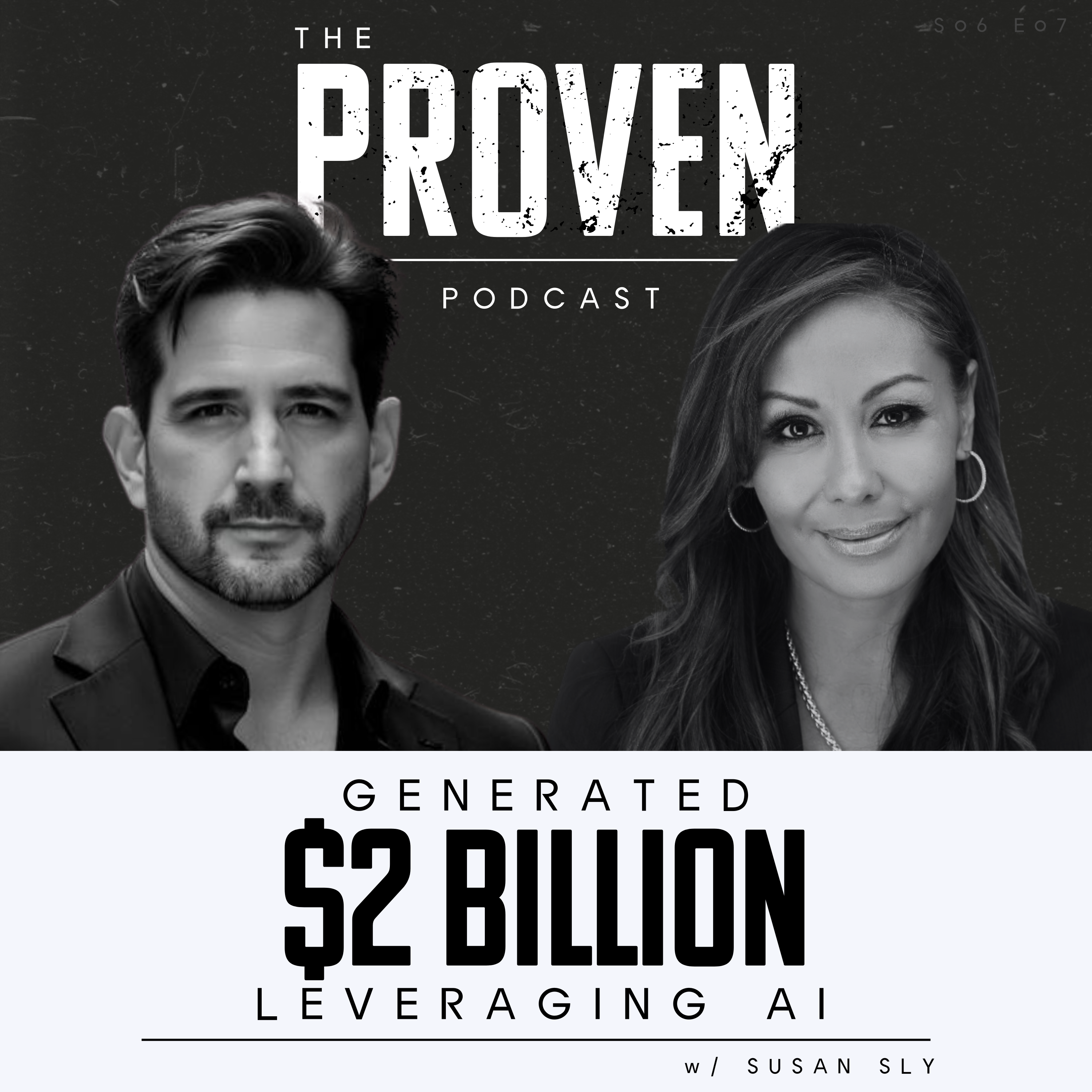
Proven Podcast
Generated $2 Billion Leveraging AI
01:01:48
In this powerful episode, Charles sits down with Susan Sly—tech entrepreneur, AI innovator, and health warrior—to unpack how she rebuilt her life from rock bottom to billion-dollar impact. Susan shares her gripping story of being diagnosed with...
Loading summary
Transcript63 lines
- [00:00]
A
Welcome to the proven podcast, where it's not about what you think, only what you can prove. Susan Sly was told she had months to live. She lost her business and watched her marriage fall apart 25 years later. She has built billion dollar brands, led the largest AI rollout in US History, and lives a life that most of us can only dream of. Buckle up. She's here to prove how it's done. The show starts now. All right, everybody, welcome back to the show. Susan, thank you so much for being on.
- [00:25]
B
Charles, I am so excited to be here. Thank you for having me.
- [00:28]
A
Absolutely. So for the few people on the planet, which I can't imagine many don't know who you are, can you give me a breakdown of who you are and what you've done?
- [00:35]
B
Oh, so for the 7,999,000,900. So for everyone listening, we've all had those moments that either define us or refine us. And Charles, you and I are cut from the same cloth. Like, we're never going to be a victim. So they're always going to be refining moments. And for me, the big one happened coming out of 1999 into 2000. So we were all worried about Y2K. You and I are both technologists, and everyone in the world's freaking out. And at that time, I owned a health club. I had about 52 employees. I was a professional athlete, Ironman, distance triathlon. I was a media celebrity. I was on radio, television, doing all this stuff. But my body started breaking down and. And my first thing I want to say to everyone is, don't just put something on a Post it note and be like, oh, I need to go get this checked out. Because I was that person. I just kept pushing, pushing, pushing. But finally I was dropping things. I started slurring my speech. I wasn't drinking. And I went to my doctor. I was like, listen, Ross, I need these tests. And he's like, susan, you're just stressed out. I knew I wasn't stressed out. I went on vacation anyway. I slept the whole time at a five star, all inclusive resort. I didn't get out of bed for seven days. I flew back, handed him the Post it note, and I said, ross, listen, you come to me. You want to know what to eat, you know what running shoes. I want these tests. And I had the test. January 13, 2000, Charles calls me in the office. We didn't lose the world with Y2K, but my world shifted. And he showed me a scan, and it was. It looked like a fishbowl. Full of fish. And he said, this is your brain. These are lesions. You have progressive multiple sclerosis. This is the worst kind. You are going to be in a wheelchair in 10 years and dead in 23 days. Later, my marriage fell apart. Sixteen weeks later, I walked into my health club. There was a padlock on the door. We'd been shut down for failure to pay taxes. I had been burying my head in the sand financially. So in a 16 week period, I end up homeless as a single mom, completely lost everything and diagnosed with a terminal illness. And that was a refining moment for me. And I, you know, as we get into my story, the thing I want to say to anyone listening, if you're going through something, the, the biggest thing I'll say is, as Winston Churchill said, if you're going through hell, just keep on going. And, you know, I'm here today, 25 years later, because I made some very deliberate decisions and that's what refined my career. Not just in sales and marketing, where I've generated billions of dollars in sales for large companies, or as a technologist doing the largest deploy computer vision AI at scale that has been done in US history.
- [03:32]
A
So there's a lot to unpack there. And so Ms. For most people is devastating for Ms. When you get diagnosed that it's an autoimmune disorder, it locks the legs out of you. Now, I know this will come a surprise, but you're not dead, not in a wheelchair.
- [03:47]
B
I'm an AI. No.
- [03:48]
A
Yeah, you're an AI. You're not real at all. This is, this is just. Hey, Jen, so you, you got, and you, you went, you got remarried and, and you've done all these things and you just recently, at a wonderful place in Montana, how get punched in the face that hard? Because most people are like, hey, how do I pay my bills? But they're not understanding again. I spent eight years in hospice watching people die who didn't, you know, curve the way you did and have that gift. How do you withstand that? When you get that type of a hit, what are some of the proven strategies? And you go, okay, I just found out that I'm diagnosed with Ms. What do I do?
- [04:18]
B
And for you, spending all that time in the hospice and you've read, I know, those studies on death and dying and people's biggest regrets, right? For me, the blessing came just prior to the breakdown. So there was this guy who was also an athlete and he said, you know, Susan, you define yourself by the Mercedes you drive and the handbag you have and blah, Blah, blah, the people, you know. And he's like, if you lost everything tomorrow, these are his words, literally. You lost everything tomorrow. You were naked alone. This is before the show naked alone, by the way, but you're naked alone in the woods. You had nothing. Your family didn't exist, nothing. Who would you be? And I was like, that is a question. And it was a snowy day, but the road was clear. And I took my bike out and I biked for about three hours. And I kept going, who am I? Who am I? And little by little, this small voice was like, you're a teacher. And I went, I'm a teacher. What have I got to teach? And so when the end came, I literally got down on my knees and I was like, God, you know, if I'm meant to be a teacher, what am I meant to teach? And I want to spend the rest of my life empowering people. But first I have to get out of this situation. Like, to your point, Charles, an impossible situation. And it's you. And I know a lot of people in common, people who have been on the show, people like Jeremy Delk, right, Or John Lee Dumas. People who have been like, Jeremy's situation, oh, my gosh, impossible. Not just one time, two times, three times the FDA rating him, like, you know, all of it that happened. And yet people who are clear on who they are, they're clear on the fact that there, there is a source, whatever someone wants to call it, I say, God, that ultimately is benevolent. You can get out of it. And that's, that's how I did. And so I began to turn my life around. I began to. On the health side, biohack my health. On the wealth side, I knew that we are who we surround ourselves with. And I made a declaration after I lost everything that I would have memorized the names of seven people who made over a million dollars a year. And so this was before cell phones were really a thing. And I said, I will have those names memorized. And within two years, I did. I started listening to Jim Rohn, I started to listen to Tony Robbins. I have shared the stage with Jim Rohn and Tony Robbins. All of the people from those days that, you know, you had John Asroth on the show. I've done multi speaker. All of those people that people can name. Jack Canfield, Mark Victor Hansen is a good friend of mine. That's what I set out to do. And it was. I knew who I was. I was intentional. I wasn't a victim. And I just, every single day was leaning into that power of belief and source, and that's how I got through it.
- [07:17]
A
It's interesting a lot of what you just shared, because a lot of people will talk, you know, they'll make things up, like, oh, well, I see that way the same way. Or I. I felt this, or things of that nature. Literally wrote a book called who Changes Everything? Which is all about identifying who you are. And I think a lot of it came from being around those type of situations. I've been very blessed. I haven't had to face that wall. And, you know, some things that Jeremy ran through and that you ran through, if you don't understand who you are, the what, the how and the why are useless. You have to identify and really dig into who you are. It just, it's militantly clear when. So, selfishly, I have a dear friend of mine who has just come into the world that there's a strong possibility that he has Ms. So I'm going to selfishly take time on this podcast for him. If there were five or six things that you did that you're like, hey, these are the things that change the ball game, be it relay therapy or oxygenating your blood or different type of things when it comes to Ms. So, you know, we're going with this. What are kind of the five things that I can selfishly steal from you and pass over to him, say, hey, this is how you. You pivot over, and then we'll get into AI and some of the other stuff you're doing. But if you're running into some Ms. Hurdles, which you're thriving in your life, what are some of the things that have produced the best results for you?
- [08:24]
B
I love that. And to whoever it is listening that Charles knows how to contact me, I'm happy to do a call with you, and we can talk through some of these and do a deeper dive. It doesn't have to be a terminal life sentence. So the first thing is, I didn't go to any support group. I do not have time to sit around with people complaining about problems, because then where's the solution, right? So, firstly, I never went to a support group. I was like, screw that. I'm not going to do that. The next thing is, I was. I decided to biohack. And the first thing, it's like anything you do real estate investing, Charles. So you're not going to pay attention to people who lost millions of dollars in deals and went bankrupt and never came back. You're going to look at people who crushed it in real Estate. And they're not just making money from teaching people about it. They're actually, they did it and you know, same thing. So in those days, Montel Williams, he living exceptionally and he was one of the first people to start talking about essential fats for Ms. And specialized diets. I'm like, if Montel Williams is doing it, I'm doing it. So I started to first and foremost, like really clean up my diet. I drank Diet Coke like crazy prior to that. So I haven't had a Diet Coke in 25 years. So none of I. No aspartame, gluten, every nothing with sucralose in it, no msg, nothing. Super, super clean. That is one. Number two, I started to also look at what were the therapies that were effective. And here's the thing, I'm going to disclaim the statement that everyone needs to speak to their primary health care practitioner.
- [10:12]
A
Go advice.
- [10:13]
B
But I was a certified holistic nutritionist and so I decided to go back to school. I stayed homeopathic medicine, I stayed traditional Chinese medicine, I looked at ayurvedic medicine. And the best progress was actually with what I call complementary therapies, acupuncture, all of those things. So I started to really ensconce myself in that. So my practice still currently is acupuncture, ozone therapy, IVs, so infusions, I every Monday I detox. And even though I'm in my 50s and there's new evidence that's like, oh, women in menopause shouldn't be doing intermittent fasting. That's not why I do it. It's not a weight issue. It's just to recalibrate my body. Once a year I go to a place called We Care and that is in Palm Desert. And I do a whole week long fast. And Matthew McConaughey has gone there to get ready for Dallas Buyers Club. It is the most healing place on the planet, medically, physically. And there's no medical interventions. You just, you fast, you meditate, you pray, you, you know, all sorts of. They wrap your body in castor oil. It's the best feeling. So it's very healing. I also go to, I'm just laying it all out. So I, you know what? Again, this is what I do. It's just like if we were talking about the stock market, you know, you have to get your own advice. But I also go to a place in Cabo San Lucas called Stem Maid. And so they do stem cell therapy. They're doing, they do eboo so they'll pull your blood out, they'll ozonate it, they'll clean it, they'll put it back in. They do all of different therapies. So those are the things I do on a daily basis. Every morning I'm doing 45 minutes of prayer or meditation. I don't look at my phone in the morning. I get exercise every single day, seven days a week. If I don't move my body, I feel it. So lots of yoga, stretching, I run, I cycle, you know, all of that stuff. I do heavy strength training. I just did. I just did my first CrossFit workout with Marcus. Will Willson, who founded Noble Shoes, and Marc and I were at this summit in upstate New York, and he's like, let's do CrossFit. I'm like, sure. So I just did that. It was a lot of fun. So I mix it up and. And then I always do gratitude. Every day I write 10 items of gratitude, and before I start my day, I leave three gratitude voice texts for people. And I've been. That's, you know, 23 years of practice now, so I am not full disclaimer. I do not take the medication for it. I do have my days. Some days I do feel like, oh, it's a little bit more challenging, but, you know, that that's how I roll.
- [13:02]
A
I love that. It's. It's interesting because I've done triathlons as well, and a lot of it. Because for those of you don't know triathlons or. I've never done it. It's for crazy people. But you go swim, bike, run. And I'm. I'm a swimmer by default. I'm a swimmer. I'm exceptionally fast in the water. The bike, it is what it is. But I have 17 inch cabs. So the, the run is like running as a. It's brutal. All of everyone who's ever done this, and you could probably speak to this. The mind game that you get to play and finding out who you are in the run is the whole reason I do the tries. And when you were talking about some of the stuff with stem cells and ozone and doing the infusions, luckily he's doing some of that. But I will 100% take you up on getting the two of you guys connected, because he. Giving him the idea that the light at the end of the tunnel is not a train would be a gift because he's a great human being. So. But back to the stuff we're talking about here. So you get diagnosed, you find this stuff and you find your way out through everything that you shared, which was beautiful. You didn't just find your way out. You've knocked down and done some really impressive things. You know, you talked about your father a little bit and some of the things that he was doing. I'd love to hear you to share that, just to give him some tribute as well. What were some of the things you've done professionally now as well?
- [14:14]
B
Yeah, I was raised and to all the men out there, you know, even though I'm such an advocate for women and we know that women led startups receive less than 1% of all VC funding, it's actually gone down, Charles, from 2.5% to 24 to under 2 to last year in 2024 it was less than 1%. And yet women led startups are 60% more profitable. It's crazy. And so my, you know, I was raised by a single dad who taught me that he had five sisters, no brothers, poor guy that I could literally be due and have anything I wanted. When I was 10 years old, he handed me the book Sun Tzu, the Art of War. And one of the biggest lessons from Master sun was for me, adapt to your train. So one of the things I've always been adaptable. So we turn on the news, there's tariffs, adapt. You turn on the news, there's suddenly no grant funding. Adapt. Just I have to be scrappy and adaptable. And as a triathlete, you don't know you could show up for that race and it's raining, it's sleet. It could be. I did Ironman Malaysia. I kept flatting out my tires. I did the last 10k of the bike on flats. I ran out of tubes. Like just stuff. Right. So for me, professionally, in my, in my book of work, if there were headlines. Yes. Largest deployment of computer vision AI at scale in the United States. The that company I co founded, we now have eight patents and counting. We're just crushing it there. Doing a new company, being the first company to really dive into the perimenopause and menopause space using AI. And we could talk about that. Building sales teams, as I mentioned, that generate over $2 billion of sales for domestic companies in the U.S. in both CPG, consumer packaged goods and also in technology. And so yeah, I've done a lot. I think the biggest thing for me when I got the diagnosis. So we. Elizabeth Kubler Ross the Stales the stages of death and dying. Charles, you know all about those. I wasn't angry. I wasn't shocked. The first thought in my head was, crap. I haven't done the Boston Marathon yet. And I think of all the professional things in my body of work. My big thing was doing six Boston marathons. After getting diagnosed, I want to do four more to make it 10. And for people who don't know, you have to qualify for Boston. You don't just get to do Boston. You don't show up and do 26.2 miles. So that's one of my. My big achievement, of course. You know, having my kids and. And everything else. Even being with my husband Chris for 25 years, that's in dog. You know, like a marriage these days. It's like dog years. It's like, you know, 200 years.
- [17:08]
A
You've done a lot of things that other people haven't. And, you know, we both share a tech background. Normally in tech, when there's something going on, normally you can just pull up. You read the white paper, which I've written way too many of those. There's. There's going to be instructions. A lot of things you've done that didn't come with instructions. There's a lot of people right now who are finding they're adapting to a new world and it's ever changing, especially with AI. And we're going to jump into a lot of the AI stuff you've done. But when you're sitting there and there isn't that plan, what is the first kind of things you go into? Okay, I've got to build these sales team to do this, or I've got to penetrate this market differently. Or as an angel investor, how do I look at things differently? Because we're pitched all the time. How do we go into that? It's really annoying. Please stop bitching me. For any of you guys who are listening out there, please stop pitching me.
- [17:50]
B
Me, too. Me too. Please, no more.
- [17:52]
A
Please. Please. No. I love that you found out what a Sequoia deck is. I love you for that. Please stop pinching me. Thank you. So as you're going through and you're trying to. To break in those. There's those steps, those proven paths of like, okay, new problem. No matter what it is, this is what I walk through. What are some of the things that you do? Because you've overcome and done some amazing things. What are things? You're like, okay, these are my tangible first three or four steps.
- [18:16]
B
You know, it's so interesting because there are different schools of thought. So I'm going to reference Mark Zuckerberg because I, this is how I build software. So one of the things people might not know about Mark Zuckerberg, other than he gives his wife interesting statues or he has his uniform or, you know, the Harvard story and you know, we all saw that movie. So the way Zuckerberg builds software and this is directly from him, is that he will say, okay, we're going to, you know, kind of survey people or get a vibe for what people want. And then we're going to push out a feature. We know it's going to be really ugly. We're going to get user feedback and we're going to be totally fine knowing that some of the feedback is going to be really horrible. We're going to refine the feature, push it out, refine it, push out until people love it. And then we're going to wash, rinse, repeat, and do the same thing. So the question about how do we solve for problems? So what are the problems people want to solve? I went to mit Sloan and then I, I graduated from MIT exec ed in the engineering school. And that my one wish from my dad was I go to mit, but I failed calculus first year university in my undergrad. So I thought MIT was not in the cards, but it became my Covid project. You know, some people got chickens. I, I went to school. So anyway, but the, the big piece around that problem you want to solve is at mit, the way we look at solving problems is how can we do it cheaply, get our proof of concept, but get something called a mmp, not an mvp. So a minimum marketable product. So how do we take some off the shelf tools, put together a tech stack, put it out there in the world and then see if people will pay for it. So that's what I'm doing with my current company, with my past company. We were at the bleeding edge of AI before there was off the shelf tools. So we had to build all of our own tools. That's why we have so many patents in that company. And we were, you know, we were looking at problems we could solve and then suddenly the, the way that company was really bootstrapped was because we, we went into computer vision because no one else was there. And the whole thing with computer vision and we can dive into that, and I know you know all about it, is that essentially for listeners who don't know there are different forms of AI, computer vision is when you're taking artificial intelligence models, looking at cameras, security cameras, ideally existing cameras, and then doing motion interpretation of, and vehicles are doing, or weather or Whatever it is through those cameras. And so we decided to go into the gas station convenience store industry because there were already existing security cameras, but no one was solving for customer analytics using vision. And that's where we decided to play and to dive right in. So the way I look at it is the way Zuckerberg does, we're going to solve a problem, we're going to get feedback. It's going to be ugly, and we're going to start with a solution that we know people are going to pay for. And we're not going to have cycles of spending tens of millions of dollars building stuff that no one pays for. Like, that's get it out the door, get some early revenue and just keep charging that mountain and listen to the.
- [21:31]
A
Feedback that comes in because it will change it. Now, one of the things that have changed, and I love that you jumped into AI. AI is changing the world. We were talking about this before you were in tech, when it was Y2K and we were installing cards that. That did nothing. They're like, oh, this will protect you from white. We installed tons of those things. And I remember during that environment, I had multiple networks running. None of them even skipped a beat. Nothing happened. So we're like, what the heck? We thought the whole world was going to die. Darn it. Lots of extra overtime. It was wonderful. We're now into a world of AI and where every. There's a lot of people like, oh, well, this is a fad. Like the Internet was a fad. Now we're in the world of AI where this is. This is the new world. I was on stage, I was talking to John about this. John said, there are going to be two type of companies in the next six months. The ones who use AI and the ones who call me towards bankruptcy. He goes, and that's just how it is. And John as hit it really well. And I was like, okay, that. That makes sense for those of us who are walking into it. And you're kind of tip of the spear when it comes to this. You've already done this and you've created some amazing things. For those of us who are not tip of the spear and are trying to catch up, what are some of the things when it comes to AI, when you're starting to use it, where some of the mistakes people are using, be it based off fear or just implementation or being tactical with it, what are some of the problems that they're running into?
- [22:42]
B
Oh, that's a great question. And. And as a side, I do. If people Listening want me to I do do AI innovation workshops and consulting with companies because that what we here's a big mistake. You've got someone's like oh we have to do AI and they don't know what they're talking about. The first thing is the question I have is who is on your board? Does anyone on your board have experience scaling AI? And I'm not talking about they read some Frickin McKinsey report or like they have a Gardner consultant. Like I mean does anyone actually have experience doing an AI implementation that scaled and by scaling? Charles and I, what we're talking about is a piece of technology that can go to multiple users, multiple divisions in multiple geographies, graphic locations. That's what scaling is. Not all technology is scalable. There are a lot of ideas that are cooked up in a lab that will not actually scale. So who on your board has experience scaling AI number two? I always ask in my workshops, do you have an AI committee? If so, who is on the committee? Do you have multiple stakeholders? Because you know what people always do on their AI committee? You and I know this. Charles, big number one mistake. We're just going to put all the tech people on the AI committee. Wrong. No you're not. You need people from hr, from legal, I even love people from finance on there. You have to get the buy in from the multiple stakeholders. And in my, in my past company we worked with large hospital ecosystems, some of the, you know, one of the biggest retailers in the United States. And so the multiple stakeholders, that's the next thing. The third biggest mistake is you don't know why you're using AI. To John Asra's point, yes, companies that aren't AI forward, they're not going to exist. And the other thing in startups, if anyone's doing a tech startup, is that with AI forward, what the VCs are looking for is lean teams. We saw that in one of the most recent news cycles. Intel is laying off hundreds and hundreds of employees just in their Silicon Valley location. That's not globally. We've seen big layoffs from all the major hyperscalers. And the reason is because even we use no code tools too that with these tools one person can now do the work of three or four people. And so you have to know why you want to use AI, what is your problem you're trying to solve. And those are the big things I always say before any company starts to think about AI and the, you know, it's like, it's like the doctor who isn't prescribing certain medication. Then the pharma rep comes in, is like, hey, you need to use this. And by the way, if you prescribe a lot, you get to go on a cruise and suddenly they're just giving this out to every patient. That's what we're seeing with a. It's like, oh, I saw this AI tool and now we're just going to use it for everything. You're not thinking about all of the different levels of complexity that you should be going through in your organization in order to scale it and use it effectively.
- [25:49]
A
What have you found as far as tools or methodologies with AI have been the most effective? You know, we were talking about how corporations are changing and, you know, Microsoft just announced that they saved like 50 or $500 million and they're like, hey, we just changed the ball game. This is only going to continue.
- [26:03]
B
You.
- [26:04]
A
So what are some of the tools and the methodologies that you have found that like, hey, this has really proven to be the best thing when it comes to using AI and implementing it. Where have you seen its shining stars?
- [26:15]
B
So it's so interesting because this year I was speaking at CES on agentic AI and I also hosted a panel on bci, which is Brain Computer Interface. We don't have to get that nerdy because some of your listeners like, what the heck is she talking about? But, but two years ago at ces, everyone was talking about Gen AI and just going back a little bit in recent time, generative AI. And what OpenAI did was the democratization of AI. Prior to this, AI was reserved for enterprise because it was very expensive. And my background is edge AI. So there's a, there's a server component, there's, you know, a cloud component. You know, it's. It can be pricey to do those deployments. But everyone's talking about gen AI. Gen AI now is several iterations old, which means that some of the things like the hallucinations and the things that were happening early on, those things have been ameliorated. And where I see companies getting a great return on investment are using Gen AI tools. And I use Gen AI tools myself all the time. Our team uses them. But I'm like, do not show me something that you ran through GPT that wasn't like a, you know, that that particular GPT wasn't given a proper instruction set. Don't just spit something out. I don't want to see the word thrive. I don't want to see delved. I don't want to see the friggin dashes, I don't want to see the stupid emojis. I, you know I can do that myself thank you all very much. Right so but generative AI tools can be used I think for the following three things. So one we all get decision fatigue especially in the C suite founders, middle managers. That's a great time to go to your gen AI model and say hey help me come up with 10 ideas that we can use to lift sales 5% and you don't even have to put in proprietary data. You could, I'll give a real world example. So I trade my own stock portfolio so one of the things I'm using my GPT4 model one of my custom GPTs is saying okay, let's take a look at the news cycle for Nvidia. I want you to read the charts for Nvidia. I want you to take a look at the global landscape for semiconductors and build a predictive model of this target of the estimated share price for the next 18 months. Right so that's something I'm doing in my personal life for my portfolio the same thing is true using it Charles for, for saying hey I want you to take a look at the news cycle. This, this is a great freebie that anyone can do. Look at the news cycle look at put your competitors websites in. Put your website in. Give me 10 ways we could you know drive, drive profits by 5% so that's one love gen AI for that. Number two I think caution against putting your proprietary data into a GPT. But that being said you could put dummy data that's lookalike data into the GPT and say where can we cost optimize that is phenomenal. The third way if you have your own generative AI models and you are putting your own data in it's the questions you ask and things we previously and sorry I have friends who work for these companies but I have said consultants. Two years ago I said there will be no consultants, there will be no influencers. These are the top things that AI is going to replace and even Gary Vee is like there'll be AI influencers. Last year Mango, the Spanish clothing company did their whole spring campaign with AI looks like humans. So we won't be needing consultants because of generative AI sorry friends in that world you don't need them. So we're, that's, that's the biggest low lift playing with content creation we all know like white papers, blog posts, all of those things Just make sure you go Sanity. Check them another way. I just save money. We have a patent we're applying for. I love patents. Most female founders. To the female founders listening. You don't do enough patents, you don't do enough trademarks, girls, you need to get off your ass and do those things. So I had my GPT do this, the preliminary search on the USPTO. So I wasn't paying an attorney $5,000 just to search. And then I went in and verified the links myself. So all sorts of ways, but Gen AI is the bright shining spot. But we're moving into agentic AI, then robotics. I know many investors. I was just at an event with Jack Selby. They're like doubling, tripling down on robotics. We can talk about that. But all of this has been leading to this inflection point in technology where we're headed within the next, I would say 18 months.
- [31:20]
A
Short. Yeah, closer. It's going to go a lot faster. It is what it. So for a lot of people who are listening to this, especially the, you know, the SMBs out there, that people are like, hey, I just made my first, you know, I've made my first 10 million. This is what it is. A lot of them are terrified because they, they contact me and they reach out, they're like, hey, where is AI going to go? What, what jobs are going to be left? And you know, I've got people who are friends in LA and they're like, I'm going to be an actor or an actress. I'm like, oh, that's cute. No, not anymore. So where do you see. Because everyone talks about the doom and gloom, like, you know, these are going to get wiped out. These billions of jobs are going to get wiped out. And when that comes across my desk, I'm like, like, yes, absolutely. Just like when we went from industrial and went from agricultural to industrial, and when technology boom happened, where these things are changing, where do you see the opportunities that are coming in? Because you're, you're an individual who has not only found the opportunities, but capitalized them on a high level. Where should people be saying, okay, I own this type of business. Maybe it's time to systematize, scale and sell that and enter into a new industry that has a better path ahead of it.
- [32:22]
B
So I love that question, Charles. So I'm going to answer it first through the investment lens. So in order for us. So I was having this discussion about Tesla as an example and with a fellow founder who's also in AI, because we were talking about our investments and I said, I want to use Tesla as an example. So we know that Elon's just launched the robo taxi and my home base is Phoenix. So Phoenix is the only location right now currently where Waymo can pick you up and drop you off at the airport. My kids use Waymo all the time. It's cheaper than Uber. But in order for us to get to where we are in artificial intelligence and robotics, it's been the years culminating, culminating, where I came out of Iot and computer vision. It's for the average layperson. You have data inputs coming in from, from computers, from audio, from cameras, from all sorts of different kinds of sensors, and then to be able to combine them and to have a car that can make decisions, right? And you know, that's where Elon, starting with Tesla and then going to the Robotaxi and then to Optimus, we're having these personalized robots, those personalized robots. Robots are built on the technology from the autonomous vehicles, which is came from the EV vehicles that were computerized. So I just wanted to give a brief history of this. So where we're going. Robotics. Robotics, Robotics, Robotics. And that is what the vision is, is that, you know, for Elon's vision, everyone will have their own personalized robot and it, it will fall in the price point of somewhere anywhere from 35,000 to 55,000. So just like we all you and of the age where we remember life without cell phones. And when the first cell phone came out, I, it looked like a huge box of tissue. I had one of those. And then everyone's was like, not everyone's gonna have cell phones. Now everyone has cell phones. Like, you know, everyone has cell phones. So the vision is everyone will have robots where the opportunity is and invest as you see fit. I'll share where I'm personally investing. I'm investing in Nvidia. I have friends that work in Nvidia. I did business with Nvidia when we were in Vision. And Nvidia is the premium chip maker. And Jensen is, in my opinion, one of the top CEOs in the entire world. And one of the things Jensen does is his VPs when they have their monthly one on ones. Do you know what he asked them? Charles? I don't bring me an idea that is going to make us an extra billion a month. Month. Now, I have heard that from friends, but that's how he operates. And so he's. When people say Jensen that, you know, he, they just became a $4 trillion company. When people say Jensen is at the Bleeding edge. It's because he knows how to ask the right questions. So the question shouldn't be anyone listening if you're an SMB, should we incorporate AI? Like, please don't call me. Because that's the wrong question. The right question is how do we use AI or how do we use robotics to generate an extra a 10 million a month or billion dollars a year or whatever your size of your company is. That's the right question. That's the interesting question. And so where we're going is robotics. Where we're going is aging in place. We have a massive shortage in the United States of hospital beds. You came out of hospice. You and I have seen many, many people die. So aging in place, we don't have the hospital beds. Most people are retiring out to poverty. So using robotics for home monitoring, home assistant, that kind of thing, we're going to see that very widely adop within, I would say, the next 15 years. And that's what I want. I want to, I want to age in place in home. I don't want to be living in a home. Forget that nonsense. So that's, that's where we're going. So I'm, I'm an optimist because. And I want everyone listening to hear this the moment you flick your switch and start to think of yourself as an investor. So, you know, Charles doesn't drink. So, you know, instead of getting the $45 martini, you don't have a second martini. You put it an investment account. And you know, the other thing I'm looking at is cryptocurrency. I've had crypto for a while. Not smart enough to get Bitcoin was $50. But I have friends who did, and they're doing okay.
- [37:00]
A
They're doing great. Yeah, I turned, that is, I turned that down. One of my guys, and he knows who he is scanning me, he's like, hey, there's this thing, it's this virtual currency. It's like a hundred bucks. We should buy some. And I was like, why am I buying this? And I thought it was like World of Warcraft stuff. I mean, I, I, I've missed that bolt multiple times. I, it's okay. There will be more boats. I'm okay with that. But yeah, crypto is good.
- [37:21]
B
Yeah. If, if you think of yourself as an investor, then the big thing is I would, you know, this is common sense, right? And we hear this a lot on your show. Like, you know, there no one on the show that I've seen as a guest was like, oh, I just woke up and got lot lucky, won the lottery. Like, they, the, the great entrepreneurs are the ones that are able to see the opportunity that's even just a little bit further ahead. Right? So the, when I'm looking at, in order to have the technology that we're all using, you look at the, Microsoft's the world. You look at what Zuckerberger is doing with his AI. You know, it's been, you know, he, he's, he's, he's trying to get the top talent from other companies. He's offering them huge salaries and packages. I said years ago, he was never a social media company. I had a financial advisor and I, and I got rid of him because when Facebook IPO'd, I wanted to buy it. He said, that company is never gonna go anywhere, Susan, because there, it's a free platform. And I'm like, you don't see it. And it, and he has the largest facial recognition database in the world. And we all annotated his data. So we're. If, if, if you're afraid, number one, it's inevitable. I did a talk for mit. I'm like, why would you be afraid of something that's inevitable? You have to figure out how to adapt to the train. Number two, everyone is an investor. There's, you know, regardless of your financial position right now, you need to get out of debt, you need to save money, you need to live on less than you, you know, you need to, and then take every extra bit of resource and invest and, and find a mentor. So Charles does real estate investing. Find a mentor who can mentor you. Get advisor. And if your investment advisor doesn't know anything about AI, doesn't know anything about cryptocurrency, doesn't know anything about robotics, they're not the right person for you. That person who you know, hasn't looked at anything since they did manual calculations in 1985 is not your investment advisor. You need to find somebody who's on top of it. And then I would say the last thing about being optimistic is good people create good technology, bad people create bad technology. And, and I the cautionary thing, just knowing some of your guests, who I know as well, I'll be very blunt. Our enemies are not going to use technology for good.
- [39:47]
A
Correct.
- [39:50]
B
So it's very Pollyannish of us to think that there are people out there that don't want to use drones, robots for war, and America also will too. And so that is also, you know, nothing that you know, you can, can really change. It's just human nature. So you can either invest or you can write your congressperson or you can protest or you can do whatever you want. The way I look at it is through the investment lens because at the end of the day my goal is to become wealthy enough that I can invest in the next generation of startups that can really change the world.
- [40:29]
A
One of my first mentors said it, he goes, accept the world how it is, not how you want it to be. Yes, are the way what they are, period. So part of that of accepting the world and doing better, you brought it up before, is asking better questions and everything starts with better questions. And you were talking about Nvidia CEO. What are some of the better questions that you ask not only of your in the finance world but in your health world and then also with your kids because we'll find out that we perform at different levels. And if you're coming in, you're like, hey, I just found out that I was diagnosed with Ms. And that I got a divorce and that I lost all the money of. You are asking different questions. There are questions you asked that led you to a 25 year marriage and how the relationship you have and the health you have. Those are different questions. What are some of those questions that you ask?
- [41:13]
B
The first question I always ask when confronted with a like any challenge because like believe me and everyone listening, like I have them all the time that who has been in the same situation and gotten through it and prospered. So they didn't just come through it. It's like they came through it and they like went on to soar. And that's why I love what you get to do. And what I get to do is like interviewing people and, and finding out, you know, how did they get through it? How did Jeremy get through what he got through? Right? And everyone listening go back and listen to Jeremy's episode and read his book. It's awesome. So how did they, how did they get through it? And, and so that when you we think about that it shifts our mind. I, many years ago I did my NLP master training certification and I did you know to do those big multi speaker events with like Tony Robbins and Pitbull and Mel Robbins and all the folks, right? So I used to do these, these transformational leadership training events. I learned how to ask better questions from who I surrounded myself with. Right? And you don't last very long on a stage age if you're full of nonsense and you didn't really transcend because you get, you get busted Pretty quickly. Absolutely. So that's the first question I always ask. The second question I ask is, who do I know? Who knows that person? If I don't know? Anyone that knows that person is how do I learn about that person? So, thank God we have podcasts, we have books, we have, you know, multi speaker events, we have all sorts of things and I always want to get access and find it out and I'll give a real world example. So I have an, an amazing friend. I won't name who she is. She's a huge influencer with a very specific area of specialty. And she and her husband were on the verge of divorce and she's like, I'm done. Then suddenly they're happy Charles. And they're like renewing their wedding vows. I'm like, what the heck? And I called her up and she's like, Susan, I went to this transformational training in la. She's like, lewis Howes went through it, Beyonce went through it. All these people went through it. I was, I was thinking it was going to be like $60,000. It was $600. So the first thing I did is I signed up for it. I didn't need to know anything else then. My husband and I were going through a really rough patch of our marriage and it was like, he was like, and I don't mind saying, if it helps you, and. And he was like, susan, you know, I think we just want different things. And you know, I was spending, he was spending more time in Montana, I was spending more time in, in Scottsdale. And we were not really seeing each other. But I said, you know what if we could fix this, would you be all in if we could? He's like, yeah. He goes, I don't know how. We've tried therapy, we've tried this. I said, okay, here's the deal. I'll go to this, then you go to the next one. That's what do. And that's what we did. So I went to the first one, he went to the second one. Then we did the advanced course together. And then it was like, suddenly we let go of all this trauma stuff we were carrying. And it was like two weekends and we were like a newlywed couple. It was crazy. So that's how I look at solving problems. When I see someone who has transcended a similar health condition, how they do it, where they go. One of the best things I heard recently, and it was a guest on Lewis's show, he said, said, wealthy minded people, I want everyone to make sure they Hear what I just said? Minded, not wealthy. Wealthy minded people figure out how to get money and use that money to save time. Poverty minded people trade their time for money, and often those people will become exhausted, broke, or more sick in that. And it comes down to that mindset set. So that's how I look at things, whether it's technology, whether it's, you know, no matter what it is. When I'm looking at stock splits, Charles, so I'm like, okay, what stocks are likely to split, right? And then I start to, like, go deep in the rabbit hole in that research. What is the outcome of that? Do I know anyone who was invested when that split before? Can I call them up? Are they still in that position? Same thing.
- [45:38]
A
So it's the idea if you want to go fast, go alone, you want to go far, go together.
- [45:43]
B
Yes.
- [45:43]
A
And one of the things that we don't talk about enough is something you're really passionate about. And I know this is a hard gear shift, but I want to talk about it. So I was raised by single parent as well, and the entire world I spent at hospice was all female. And you're doing something with Paul's AI guy. That was probably the main reason I wanted to bring you on the show. I was like, I want to talk about that. Because not only are you doing something where, you know, you've got internal plumbing and the entire society doesn't give you a big enough ability to speak to that. We talked about this before. Less than 2% are getting funding, but 60% have a better rate. So it just, it's. It's wild that your side of the species isn't celebrated more. But you guys also, if you're blessed enough to live long enough, are going to run into some something. And, you know, we jokingly call it men on pause, because it's not menopause, it's men on pause. It's go away. You have something with Paul's AI. Can you tell everybody a little bit about that and then some of the infrastructure behind that?
- [46:41]
B
Yeah, sure. So as we go into this, this part of the conversation, I don't think it's a hard pivot because we, we've been talking a lot about, like, change in the world and, and I want everyone to think about, especially for the guys, is, is, you know, a woman in your life you love. It could be your sister, it could be a partner, it could be a coworker, colleague, whoever it is, best friend. And menopause is the only inevitable health condition every woman will face. Not Every woman will have a baby, menstruate, all sorts of things. By 2030, from a TAM perspective, a total addressable market, there will be over a billion women in menopause globally. And every woman navigates menopause differently. Some women have hot flashes, some women don't. Some women gain weight, some don't. Some have brain fog, some don't. And then we go into Charles, which I knew is an area you're passionate about too, is cultural differences. So, like, women from India have different size blood vessels than white women. And so none of this has been studied. Up until just over 20 years ago, women weren't allowed in clinical trials. So there isn't the data. And so how the story begins for me is when I, after I had my last baby, I was 38, I started getting my period for two weeks a month every year for 13 years. I was misdiagnosed. I was told it was PMS. I was, you know, like every single wrong thing and I just suffered in silence. Because I'm an athlete, I pushed through. It was debilitating. And in 2023, I was invited to speak in New York at the Women in AI event. And what this event is, it's put on by Nvidia, HP and 32 women. And it's very, very prestigious to get an invitation. And then what happens is you do this AI collab with these top women from all these companies, then you go to a fashion show and there's champagne involved. So I'm there, I've been suffering. And we're now on the party bus to go to the Badgley Mishka fashion show. And my girlfriends, who are VPs, sea level at these huge hyperscalers, we're not talking about AI and we are the leading women in AI. Like last year I was voted as one of the top women in the entire world in real time AI alongside Meera Murty, who is then the CTO of OpenAI. We're not. Mira wasn't there, but we're not talking about AI. We are talking about, about how much sleep did you get and do you have hot flashes? And. And one of my girlfriends, Charles, goes, can you solve this with AI? And I was like, I want to solve this with AI, but you can't build AI models without the right data and the data doesn't exist. There are electronic medical records, but there isn't real data. So how I went about solving the problem was to say, we're going to start with a consumer facing application. So the Pause AI app is available in the App Store, in the Play Store store. And I'm building like Zuckerberg. We're pushing features out. They're ugly. We're getting the refinement. We only launched it like six months ago. And we have a, like we're, we're spending the next. Whenever someone's listening to this, it'll look different by the time you see it. But we're spending the next seven weeks where like my, my developer team, like all of our engineers were just heads down with all these features because we have some big, big announcements that are coming out and big collaborations and. But in order for us to build the three Ps, which are the trifecta of any healthcare app, which are predictive, prescriptive, preventative, we have to create data that doesn't exist anywhere on the planet. And so that's what we're doing and solving it in a different way. So already Our subscribers almost 90% improve better well being in the first 90 days using the platform, which is amazing. We have gamification, we have integration wearable so women like at their biofeedback and it's like, oh, my resilience score is whatever it is, this is what you need to do. And then we have an AI agent that named herself Harmony with an I. We have the trademark for that. And she'll have the conversation with you and help you feel better. If it's two in the morning and you want to like punch someone or you're having a hot flash, you can talk to Harmony and Charles. I'll say from the personal side. Women in this cohort is one of the fastest growing suicide rates in the United States. It is one of the biggest divorce rates and men are suffering. I get men messaging me on LinkedIn all the time. Please solve for this. And it breaks apart families. I had one woman tell me that her mother when she was in her 50s, committed suicide. And so we. This is a big problem to solve it. It keeps me up at night. Like I try not to work seven days a week, but I just, I've got to solve it. Gotta solve it, gotta solve, solve it. So that's what we're building.
- [51:40]
A
That's the sign of any entrepreneur. We just, we're like rabid dogs. We'll just bite them. We won't let go of that bone.
- [51:45]
B
Yeah.
- [51:46]
A
This side of the species, since I have external plumbing, what can we do? What can my side of the species do to help out with this for the listeners out there? Because a lot of the, the people who listen to the show, they are married and, and, and mazel tov. But they're also running into that because it just is. You've got your spouse who you adore, who is going through this. And for us who have external plumbing, it's. It's hard for us to understand. We're like, we. We don't understand. Tony talks about this. Am not a hairy woman. You are not a hairless man. We are not the same creatures. We are very different creatures. So from our side, what can we do to help out and to help Paul's AI or just even our spouses, like you talked about wearables. What is the number one wearable that works well for this? So I question.
- [52:27]
B
It's one thing to know your data. It's another thing to know what to do with it. And I grew up in a Buddhist, Jewish, Christian household. I just want to say there are a of lot, lot of people listening who, you know, maybe culturally, you came from a country where women are a little bit more cloistered. And I will tell you, in a lot of cultural backgrounds, talking about painful intercourse, talking about vaginal dryness, women just don't feel comfortable. And so one of the big pieces around what we've created with the AI agent is you can have those conversations with her and she can give you the, the right guidance. And that's the, the thing I want to say, because there are a lot of men who don't know how much their partners are suffering. Charles. Because it's, it's, you know, it. Women will tough it out. And I say the number one thing is having a conversation and being okay with the conversation. Number two is, especially as her body is changing, your body is changing to Andrew Paz is real. Mark my words. I will solve andropause next, because once I solve this, I am going to solve for men. Men, when testosterone starts going down, other hormones, there are so many things. And I'm going to solve this for men. Guys, I am coming. I am going to do this. It's really important to me as a mother of a son and a daughter of a single father. And, you know, watching my husband go through it, coming out the other side like, you know, thank God, have the conversation and know that things are going to change. But that's not the time to check out. It's the time to dig in more. Sex is going to change. Intimacy is going to change. But the good news is we have a lot of resources that those things don't have to change. But not all women can go on hormone Replacement therapy. There was bad data, a bad study, and over 2 million women have died so far because they, they were given bad information. And, and that number is growing. So less than 4% of women in the United States are on hormone replacement therapy. Some women can't. If they've gone through cancer, it doesn't mean they can't do other things. And so we have the conversation, go out for dinner, go for a walk and say, you know, are you having symptoms? What can I do? And my, you know, my ask is, of course I want every woman, the 50 million women in menopause, to be using our app. We want the feedback where women found a company, the leading period, a tracking app, was founded by two guys. So definitely women. You know, kudos to them. We are female founded company. That's one. Number two, you know, we are, we are going into benefits. We already have customers lined up. So if you are an SMB and you want to have an accessible, like plug and play benefit that women can just get and you can just give them, this is a gift. Reach out to us through the Pause AI website now.
- [55:30]
A
I'm just saying, if you love the women in your life, please go to this website. We need to solve this, please. And yes, for on the guy side. It's. It's amazing because I know menopause as a word. Like, that's a word that's very. I know that word. Then you said the male version of that word, and I was like, I've never heard that word.
- [55:49]
B
What? I was like, you haven't heard of Andropause?
- [55:52]
A
Nope. The ignorance in my side of the species. Like, we don't. We just don't even talk about men, especially. I mean, some of us change our eq, right? We, we're. We. We have evolved. Some of us been blessed to have your side of the species in our, in our lives, and it changes our trajectory of our lives. But as a whole, you know, we, at least for me in my generation, you didn't cry. It was always, you know, if you, you get up, you will. I'll give you a reason to cry. And remember when the Lion King came out and I just bawled? I was like, what? No, shut up, dude. It's. It's taken a while. Luckily, I've been blessed by your side of the species to open that side of me up. And I had a dear friend of mine, he was like, he was. Men don't cry. I was like, cool. Give me a second. I called up a buddy of mine who's an Operator, I was like, former Navy seal, tell him he's not a man when he starts crying. I dare you. I wish you the best of luck. So it's just this idea that you can be in touch with it, but also being comfortable that there is a side of us that we need to let out and have that testosterone let go. We need to be able to find that balance in a healthy way. So there is that finding that balance on both sides. But the ignorance that exists on what happens to men on our side. I don't even know word for if.
- [56:56]
B
I could do a quick PSA for men. And I'm not talking about prostate.
- [57:01]
A
The.
- [57:02]
B
So the symptoms of andropause are very similar to PMS for women. So moodiness, crying, when it's like, I've never been a crier. And yes, it's great, you're emotionally in touch, but it's like suddenly you're crying and there's kittens in the, you know, or the bud riser horses or something. That's not normal, of course, the.
- [57:23]
A
Watching the news. Sorry.
- [57:25]
B
Yeah, yeah. Erectile dysfunction is another symptom of andropause. Brain fog. Low libido, low Drive.
- [57:32]
A
Drive.
- [57:33]
B
And the, you know, we. I am going to solve this. This is. This is my life's work. It is. I am going to solve it. It is, and I'm going to solve it fast. The, the big thing for the guys listening is there are things you can do naturally to raise your testosterone, not just injecting the tea, the interval training, even things like, I know this sounds crazy, but watching movies that are like, you know, have fighting and Game of Thrones and all that stuff, watching sporting events, doing that kind of stuff we would traditionally call guy stuff. And the problem is there's been this movement where men are being told that that stuff's not good, but it actually is. That's how the species was designed. And so my message to guys, if you're feeling all this stuff, it doesn't mean you just go buy a Harley and mortgage your house. It's more than likely go get your blood tested. And that's why we're seeing, like, going back to the investment convers. One of the things I'm researching with my GPT are what stocks are going to benefit the most of both menopause and andropause and men having those, you know, actually waking up and going, hey, wait a minute, I'm not supposed to feel like this. So I, I think this is such an exciting time in technology and investments. An Exciting time to be solving problems. And of course, like anyone listening, if you want to connect, reach out, you know, I'd love to. We would love to support. Support.
- [59:03]
A
Yeah. That was literally my next question. If someone wants to track down because there's so much more and you and I could probably talk about this for days and days and I have so many other ways I want to go, but I want to be respectful of your time.
- [59:12]
B
Yeah.
- [59:12]
A
If someone wants to track you down. If someone's like, oh my God, I want to do this, I want to help out. I want to learn more about AI. I want to learn how to invest, I want to learn how to help out the women in my life. I am a woman. I want to be helped out there. If someone wants to track you down, what's the best way to get a hold of you?
- [59:25]
B
Yeah, absolutely. If you're interested in having a menopause benefit that's accessible, then just go to the Pause AI. Do the contact forum that is going to come to me. I'll see it through the marketing team. If you're interested in having me come in. And as someone who scaled AI and do a workshop with your company, just go to susansly.com and then I'm on all the socials. I'm on Instagram. I haven't done anything on X in a while. I had one TikTok video go viral. It was one of my AI robotics videos. And I haven't like done much with TikTok because I've just been heads down building product. I'm on LinkedIn almost every day. But follow me on Insta and, and that's a great way to reach out.
- [60:06]
A
And what are your.
- [60:07]
B
Susan Sly.
- [60:08]
A
That's what I was looking for. So it's Susan. Sly. Susan. This has been a wonderful conversation. I'm really glad. There's so much more I want to ask you, but I want you to respect your time. Thank you so much for coming on the show. I really appreciate it.
- [60:19]
B
Well, thank you, Charles. And I love everything you're doing in the world and I would just encourage everyone to go back and listen to some of the other episodes because everything builds on each other. When you see someone who's created a $30 million know re like revenue stream, or when you see someone who's overcome the odds, like, you know, every day we want to be learning and growing and you know, Charles's podcast is amazing. I. My podcast is slightly different. Ron Real entrepreneurship. We've had some of the similar guests. So if you love Jeremy's episode. I did an episode with Jeremy where he doesn't swear, so you could check that out. But yeah, that's my show.
- [60:59]
A
I have no idea. He got Jeremy not to swear. I still have that problem with him every day.
- [61:03]
B
Yeah, I, I, I, I said, listen, dude, we're both parents, and I have kids listen to the show and I get messages from parents that play my show in the car with their kids. And I said, so that's why. And yeah, Steve Sims didn't swear. Brandon Steiner? Nope.
- [61:20]
A
Y impressive that you have to go, guys. Not to swear. We made it almost all the way through mine. I haven't sworn yet. So we're doing what? Thank you, Susan. I really appreciate you. Thanks so much.
- [61:28]
B
Thanks, Charles.
- [61:29]
A
That concludes this episode of the Proven podcast. Remember, it's not what you think. It's only what you could prove. We proved a ton of things on this episode. Go prove it yourself. Don't guys trust us? Don't trust our guests. Go out there. Implement. You want more? Go to TheProvenPodcast.com and there's more examples just like this. Thank you for joining us.