Loading summary
Transcript102 lines
- [00:00]
T Mobile Advertiser
Like your favorite startup's growth curve, T Mobile's coverage keeps scaling because T Mobile helps keep you connected from the heart of Portland to right where you are on America's largest 5G network. Switch now. Keep your phone and T Mobile will pay it off at the $800 per line via prepaid card. Visit your local T Mobile location or learn more@t mobile.com keepandswitch up to 4 lines via virtual prepaid card. Last 15 days qualifying unlock device, credit service port in 90 plus days device knowledgeable carrier and timely redemption required. Card is no cash access and expires in six months.
- [00:31]
Dennis Black
Ever notice your dog slowing down and having health issues and wonder what can I do to make them better? Well, my friend, add rough greens to your dog's food for 90 days and I guarantee you'll see changes that will amaze you. Greetings naturopathic doctor Dennis Black, inventor of Ruff Greens here, and I invite you to give your pup the Ruff Greens 90 day challenge. In the first 30 days, you'll see shinier coats and increased energy. By day 60, your dog will have a stronger immune system, less shedding, improved joint function, all due to the live nutrients that you've added to their diet. And at 90 days, better digestion, reduced inflammation, improved heart health and you may even have reduced their cancer risk. Fetch your dog a free Jumpstart trial bag today. Go to try roughgreens.com use promo code Try rough. That's T R Y R U F F Go to try rough greens.com use promo code Try rough. You just cover the shipping. You don't have to change your dog's food to improve your dog's health. Just add a scoop of rough greens.
- [01:30]
Charles Schwartz
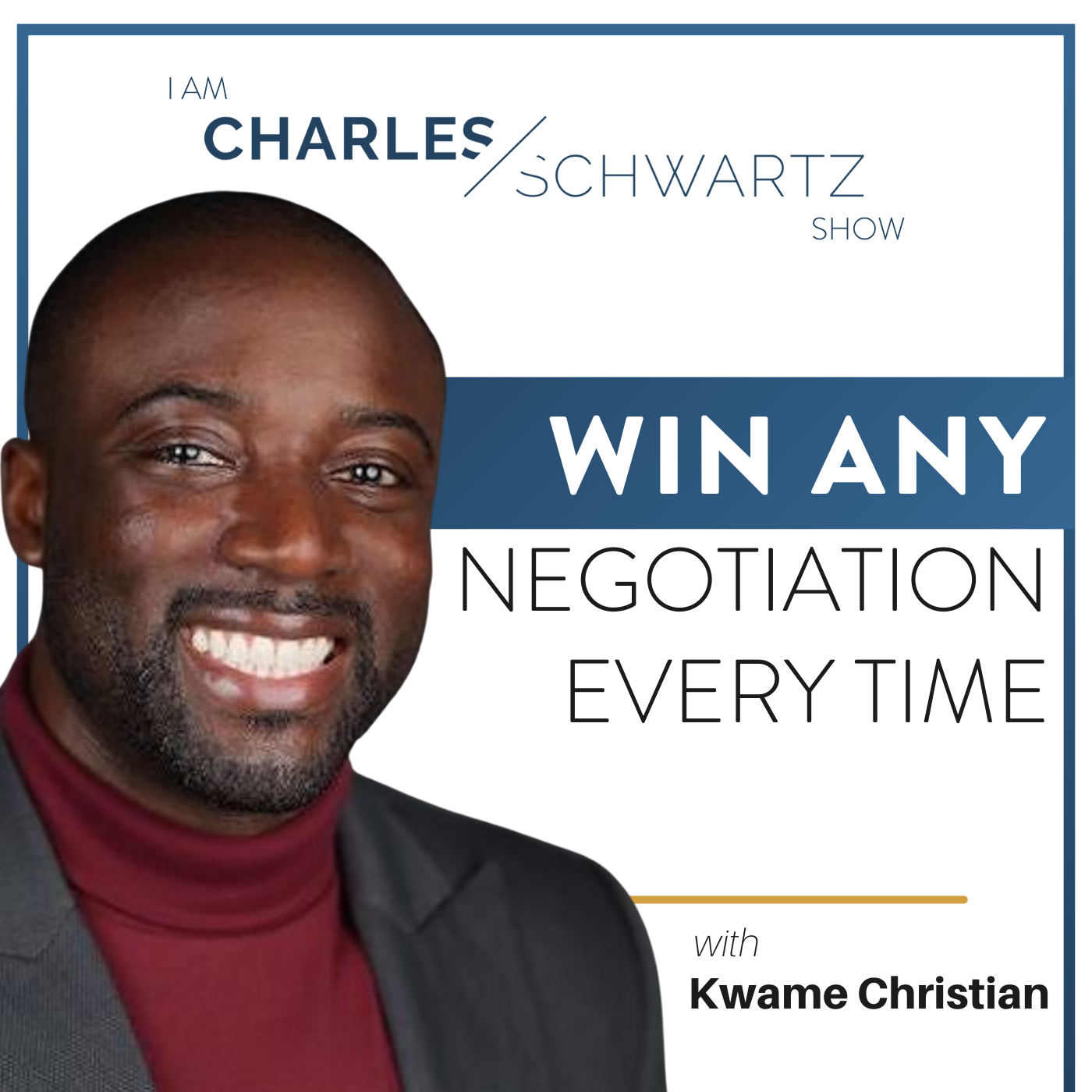
Welcome to the I Am Charles Schwartz Show. In this episode, we're diving deep into the psychology of negotiation with Kwame Christian, the founder and CEO of the American Negotiation Institute and host of the number one negotiation podcast in the world. With thousands of negotiations under his belt and a client list including Google, Apple, and NASA, Kwame has cracked the code on winning any negotiation every time. From winning the American Bar Association's Negotiation Competition to transforming how major corporations approach difficult conversations, Kwame's journey is a masterclass in negotiation excellence. He's discovered that most people have been approaching negotiations all wrong, focusing on tactics when psychology is what truly drives successful outcomes. In this conversation, Kwame unveils his compassionate curiosity framework that has revolutionized negotiation training. He reveals why most negotiation experts are missing the mark and how understanding the psychological elements can transform anyone from a Nervous people pleaser to a confident communicator. You'll discover why your negotiation tactics aren't working and how mastering the psychology of human connection can help you win any deal. So if you're ready to elevate your negotiation skills from ineffective to unstoppable, grab your notepad and prepare to revolutionize how you approach any conversation. Kwame's insights are practical, evidence based, and packed with actionable wisdom that could transform your personal and professional relationships forever. The show starts now. Welcome to the I am Charles Schwartz.
- [02:55]
Show, where we don't just discuss success, we show you how to create it.
- [02:59]
On every episode, we uncover the strategies and tactics that turn everyday entrepreneurs into unstoppable powerhouses in their businesses and their lives. Whether your goal is to transform your life or hit that elusive seven, eight, or nine figure mark, we've got the blueprint to get you there. The show starts now.
- [03:16]
All right, everybody, welcome back to the show. I'm excited about this one. We've already been talking for an hour before we even started recording, so you're going to catch some different energy on this one, man. Welcome to the show.
- [03:26]
Kwame Christian
Hey, man, it's great to be here and thanks for brewing out beforehand too.
- [03:29]
Charles Schwartz
Absolutely. It's been a lot. We talked about things that we could not talk about if it was being recorded. It was a lot of faux pas stuff here. So walk everybody through, Terry, who you are and what your claims of fame are. Wow.
- [03:40]
Kwame Christian
Okay, so my name is Kwame Christian, founder and CEO of the American Negotiation Institute, host of the number one negotiation podcast in the world, Negotiate Anything, and two time bestselling author. So for me, my goal is to help to make difficult conversations easier. And I know, Charles, you know this. When it comes to negotiation, there are some ways that we can overcomplicate things, but when it comes down to it, at the end of the day, we need to have two things we have to have mindset and skill set. Not only do we have to know what to do or say, but we have to have the confident mindset to be able to do or say what needs to be said or done when it needs to be said or done right. And for me, I've recognized for too many years in the negotiation industry, we've been giving recipes to people who are afraid to get in the kitchen. It's not that they don't know what to do. They just don't have the confidence to overcome those fears. And for me, there's a different approach for negotiation. For me, like my entry point into it Because a lot of folks might say, yeah, I've been a corporate executive, so now I'm a negotiation expert. Or I made millions in sales, so now I'm a negotiation expert. Or I was a hostage negotiator, now I'm a negotiation expert. But for me, my story is different. I was a people pleaser for the majority of my life. And it wasn't until I found negotiation in law school that I started to recognize this was a skill, not a talent. And so from there, it was just about developing the skills and sharing it with the world.
- [04:56]
Charles Schwartz
So there's a lot to unpack there. So we're going to roll it back a little bit. So you've done an immense amount of negotiation. I've done immense amount of negotiation. Both certified in it. For those of you who want to play that game, we're going to skip that. If you want to know what Zopa is, you want to know what Batna is, you want to do that, go on YouTube, have fun, you'll go figure out what those things are. They're negotiation. That, that's really, really simple. I want to talk more about what you were talking about earlier, about being a people pleaser. And going in the situation is also people not feeling comfortable or confident. Because if you have all the skills on the planet, but you're not willing to step up to the plate and swing the bat, it really doesn't matter. So if we can, let's start with the people pleasing side because I think you and I share a little bit this in common of how we ended up the way we are. Be it good or be it bad. Before therapy, we both ended up a certain way. You said you were a people pleaser. Walk me through that.
- [05:45]
Kwame Christian
Yes. So oftentimes people have a different origin point for where this comes from. And so for me, I'm a first generation Caribbean American and I grew up in a small town called Tiffin, Ohio. And if you're saying, where's Tiffin? That's the point. That is the point. So I used to say that there were only four black people in Tiffin. Me, my mom, my dad, my brother. And we stood out, not just visibly, but also audibly because we, we had Caribbean accents too. So I remember one time in first grade going on the playground during recess and trying to find people to play with me. And I went to one group of students and said, hey, can I play with you? They said no. Then another group, hey, can I play with you? And they said no. Then like time was running out. So I said, okay, let me try this last group. Can I play with you? No. And so the bell rang, and I walked inside and just started bawling. Just couldn't control the tears. And then my teacher said, what's wrong? And I said, nobody will play with me. And so, Charles, that day at age six, I said to myself, I will never, ever feel this way again. Everybody's going to like me. I'm going to have a lot of friends. I'm not. And I'm never going to feel this lonely and embarrassed again. So from the outside looking in, you would see it was a success because you would say, okay. He went through eighth grade. He became the most popular kid in school. Same thing in high school. Captain of the basketball team, created the chess team, you know, captain of the tennis team. All of these things, right? But they don't recognize the hidden and silent sacrifices and compromises I made to do that. I would say yes, what I meant to say no, and I would just get along to get along, you know, And I was getting other people to like me. But at times when I was making those sacrifices, I wasn't liking myself. And so I didn't know how to overcome it. I thought I was doomed to be like this. I didn't even make that connection at that time, like, how I got to this. So I studied psychology, and I studied how to overcome fears and phobias, and then, like, the. The mindset of top performers. And I realized, okay, I can start to work on myself to overcome this fear. And then when I got to law school, that's when I took that negotiation class, and I went to Ohio State, and they have the top ranked dispute resolution program in the country. So I loved the class, and I said, oh, my gosh, this is how I actually do it. And so they had these negotiation competitions. So it's like mock trial, but for deal making. So my partner and I, we won the competition at the school, and that gave us the opportunity to represent the school at the American Bar association competition in Ottawa, Ontario. And we won that competition, too. So I was sold. And so for me, Charles, I was saying, all right, this is great for me, because every time I stand up for myself, every time I have a tough conversation, I am casting a ballot in favor of the man that I ultimately want to become. But at the same time, I realized, wait a second, there are probably other people out in the world who are struggling with the same thing. I want to create something for them. And so that's what got me on the journey with The American Negotiation Institute and the podcast, and the rest is history.
- [08:30]
Charles Schwartz
So when you started talking about this, it seems like the root of this is not being accepted or not being enough. And I think a lot of people, when they go into negotiations, whatever it is, they don't feel that their position is worthy because they don't feel worthy. And there's a bunch of different ways of going into negotiations. When you start going into negotiation, what are the key things that you want to sit down and say, hey, how do I make myself feel like I'm enough? How do I make it so that I can at least step up to that plate or walk into the kitchen and actually implement those recipes? Because knowing the skills is one thing, but implementing them is completely different.
- [09:05]
Kwame Christian
You're 100% right. And so let's think about the short term scenario, right? Because like you said, long term therapy, journaling, introspection, that's what we really need. You know, that self love is important, but, you know, we don't always have the time for years of therapy before a difficult conversation. So what do we do? One of the things that I've done is I, I created a survivability test. So think about taking the batna to the next level. So, batna, we talk about the best alternative to a negotiated agreement. Then if you go down, we have the other ones that don't sound as cool, so I don't think they're as popular. We have malatna, we have watna. So most likely outcome and, you know, worst, you know, but batna is usually good enough. But for me, I think about the survivability test in terms of my worthiness and feeling of enough and feeling of safety. So I say, like, worst case scenario, let's walk through it. What are the things that I'm afraid of? Well, and what's interesting, Charles, is that when you go through this, like when you go through it without doing it in a structured exercise form, what ends up happening is we go through this catastrophizing cycle where for minutes, hours, days, weeks, months, maybe even years, we just cycle over the worst possible outcomes. And so I say I turned it into an internal negotiation. And we can talk about my frameworks for internal and external negotiation in a bit. But I say, all right, cool. You want to freak out, let's freak out. Let's do this. So I'm going to set the timer. We're going to freak out for 10 minutes, but I'm going to write out everything that I'm afraid of, and then I'LL realize, like, there'll be maybe five to eight fears, but then I just start cycling. It's not a lot of stuff, it's just a few things that I think about a lot. And so every time I'd say, okay, if this worst case scenario happens, how will I survive? If this one happens, how would I survive? And I realized there's a path to survival and happiness. And, you know, at the end of the day, I might get the deal, I might not, they might like me, they might not. And I'll just say, I will continue to breathe, I'm still going to live. Exactly. And so once I start to see that really clearly, then I have less fears because I say no matter what happens in this situation, I will find a way to be okay. And that allows me to then be more present in front of the person and actually engage with the person rather than having to fight the demons of my fears in the middle of the conversation.
- [11:16]
Charles Schwartz
Right, so now it's just you and that person having the conversation. And I tell people this all the time. In negotiation, the person who has the most power is the one who's willing to walk away.
- [11:23]
Kwame Christian
Yeah.
- [11:23]
Charles Schwartz
Period. That's just how this works. So no matter what's happening, that is the king of the negotiation. But when you're walking into these and you're trying to break things down in a way, everyone thinks that they go to the negotiation, they want to spit out everything they have first. The problem is the person on the other side has been recording and doing it in their head, playing this game, and they're trying to spit out everything they want first. So neither one of you are listening to each other. So going through these frameworks and figuring out, hey, what is the worst case scenario is at the end of the day, am I going to live? Is the person that I love the most, they're going to love me. And, you know, having that, that worthiness conversation, which again, creates the please your moment that you and I both have gone into of that, that deprecating cycle, which on a side note, you brought up again, therapy. Please go to therapy, everyone. It's, you know, it's the gift you give yourself. It's really, really important. If not, you're going to hurt some people when you're going through these. You talked about an internal and an external framework. Walk me through that. How do you prepare internally? Because you can't do externally until you do internally. Walk me through.
- [12:20]
Kwame Christian
Exactly. So let me start off with two quotes and then I'll break down the framework so two quotes Da Vinci and Bruce Lee. So Leonardo da Vinci said, simplicity is the ultimate sophistication. Bruce Lee said, I don't fear the man who knows 10,000 kicks. I fear the man who has practiced one kick 10,000 times. And compassionate curiosity, this framework is your one kick. Because for me, having done over over 1500 episodes of Negotiate Anything Negotiate, learning from the best in the industry, teaching at Ohio State, teaching, going, working with like Google, Apple, NASA, intel, all these big companies, I'm realizing, yeah, there are tons of different negotiation strategies, but for the majority of situations you just need a simple mental model where you can flow and use the fund foundations. Right. So with compassionate curiosity, it's a three step framework that is intentionally simple but used in the exact same way for internal and external negotiation. So step one is acknowledge and validate the emotions, Emotions, feelings or beliefs. Step two is get curious with compassion. And step three is using joint problem solving. So if there's an emotional issue, you want to address it, label it, and lower the emotional temperature of the room. Once we get to a productive state where we can actually think clearly, then we go to step two, which is getting curious with compassion. And then when we have enough information, by asking those questions with a compassionate tone, with the emotional temperatures at a manageable place, now we just work with the other side, not against them, to find a solution. So you see how a lot of the core principles of negotiation are just embedded in it, but it just helps, you know, it make better reads. So internally I'm going to say, okay, I'm going to label what it is that I'm feeling. What am I feeling? Let's say I'm feeling angry. Well, I'm going to go deeper because anger is often a secondary emotion, not a primary emotion. There's something else that's making you feel angry. I will feel disappointed. I feel disrespected. All right. Anything else? No, I think that encapsulates it. Great. So then I go to number two with myself. So I'm saying, all right. Then I'm going to say, well, why do I feel that way? And I'm going to answer those questions until I get to the root of it. And as you're going through this, you start to calm down and we can run through like the, the psychology in a second if you're interested. And then lastly with the third step, joint problem solving, we're saying, okay, I want to figure out what would satisfy me emotionally, what should I. And then what should I actually do in this scenario? So now I'M actually thinking proactively and planning. And so that's how you would use internal compassionate curiosity before the conversation to gather yourself so you can be clear headed and perform your top level.
- [14:44]
Charles Schwartz
Absolutely. I, I, I love. The last one is probably my favorite one. In negotiation strategies, the when you do things joint, it's the only time and without getting political, it's the only time where I will really intensely jump into pronouns because I will change how I'm interacting with a person. Instead of saying, what do you want? Like what do we want? What, how, how are we going to? What is the best solution that works for us? I will change that narrative. I also will change physically where I'm sitting. We talked about body language beforehand. I will hand them something and then I'm like, oh, wait, is that the right one? And I'll swing my chair around. And so now I'm not against them when I'm talking to them. I'm next to them like, this is the right one. And now I'm sitting to their left or their right side. So it's kind of like when you're talking to someone I know you're married, you sit down, you don't sit and go, what do you want for dinner? Horrible. It's a disconnect. The minute you use you, even though this is the love of your life, the minute you use you, you're gonna, you're gonna disconnect. So being able to say, hey, what do we wanna eat? What are we hungry for? That simple pronoun change. Change the bug. And that's joint. And people don't do that in negotiations. They're all like, oh, I wanna have this. Then if I want this, this is my, I'm going to die on this mountain. Well, that thing, whatever that this is that you want, they probably don't care about it. At the end of the day, it's probably not the thing that they want the most anyway. So it's. If you do that as well, I'm getting this. How do we make sure you get what you want as well? They're like, wait, what? Huh? Oh my God, this. How are we doing this? What is the best way to get there? And all of a sudden the narrative changes and now you guys are buddies and you guys are friends and there's people don't do this on a high enough level because they get focused on what we're trying to avoid on this conversation, which is the strategies of negotiation, which YouTube. If you want something, you want to start pivoting your mindset and showing up differently. I think that's something that you do that's unique to everyone else. And what are some of the things that you have brought that have created those changes that have been the most successful in negotiation? Because again, you've won some pretty high awards. I do love the fact that the negotiation event was in Canada, the American one was in Canada. So that's kind of fun. But. All right, cool. You guys went to Canada for the American award. Just. That's weird. So can't do that anymore right now. How do we, how do we go into right now? What are some of the things that you're like, hey, this are some of the things that I taught the Googles, and this is some of the things that I taught that were really, really valuable, that people walked away going, God, I didn't know that.
- [16:55]
Kwame Christian
Yes. So I think, I think it comes down to this man. Again, simplicity is the ultimate sophistication. So it's never a question about whether or not compassionate curiosity applies. It's just a question of how, you know. So for me, when I'm working with these folks who are negotiating hundreds of millions of dollars in their deal, compassionate curiosity is the base. And then let's say, but how do we do that?
- [17:18]
Charles Schwartz
So I'm gonna.
- [17:18]
Kwame Christian
So here's an example. Here's an example. So let's say it's a procurement situation. And so they are trying to deal with a really difficult supplier, single, single supplier situation, right? And so then the supplier says, hey, I'm going to make this unilateral threat. I'm going to demand, you know, a unilateral, unilateral price increase. This is a threat, it's going to happen. Sit here and take it or you're never going to produce your thing, right? So now it's a situation where typically this is where it turns into a fight where we might say, okay, we're going to dig in our heels, we're going to lash back. And now it becomes like a tug of war where it's very, very ugly or it's a situation where you might just go straight to your negotiation tactics, right? So, okay, I'm going to re anchor in this type of way. I'm going to use bracketing and all these things, right? But the thing is, we have not done a couple of things. Number one, we haven't taken the time to gather information. And number two, we haven't taken the time, most importantly, to create the conditions for persuasion. So think about it. If somebody is threatening you, they are not always operating from the strategic part of their brain. They're not using their prefrontal cortex and frontal lobe. They're often threatening you from a position of fear. And you use these rational tactics. You make these rational points to an irrational actor. You haven't taken the time to lower the emotional temperature of the room. So there's psychology behind compassionate curiosity in this situation is that when you're very, very emotional, you're using the amygdala within the limbic system. So you're responding emotionally, which is counterproductive to clear thinking. So it's an antagonistic relationship between the amygdala and the frontal lobe. Frontal lobe is rational thinking, clear thinking. Amygdala is just emotions. You can't think clearly, so we need to walk them to rationality. So I'm going to say, hey, in this situation, what I'd say is this. So, hey, correct me if I'm wrong, Charles, but it sounds like something's changed on your end. Can you help me understand what's changed? And so then they're going to give some information or they might play it a little bit guarded. I'll say, okay, I'm still in step one at this point. There's still some barrier in the situation. It sounds like there's some pressures on your side. And I understand that the market's really tough. If you could help me to understand what these pressures are that are pushing you to do this, then I can help to work out a solution. But if I don't have an understanding, then I can't just make a decision here. So now you start to lower that emotional temperature, gather that information, pull that out. Right? So in this conversation, the early conversation, I'm aiming right now, I'm not making any decisions, nothing at all. I'm just gathering information, managing the emotions, creating the this, this connection. And then I'm going to gather the information, put a stop and say, hey, listen, can't make any decisions right now. Let me go back, talk to my team and figure out what we can do. So step one in that really tough hostile negotiation is compassionate curiosity. So you don't damage the relationship, but you also create the psychological safety necessary to extract information. Because negotiation is an information game. Now I can come back to the table with some of these high level strategies and I can put these high level strategies together within a really simple mental model for flow of communication. Because a lot of times what these really tactical negotiators end up doing is conversationally, they speak tactic to tactic. They don't talk human to human. So by having compassionate curiosity as the tactical glue that keeps all of these together, you can create a connection and actually create the conditions for persuasion, which amplifies the likelihood of you actually using the tactics effectively because the person's now receptive.
- [20:46]
Charles Schwartz
I think what was really powerful in there is you immediately said, hey, you know what? It seems like things have changed on your side. I want to how we make this happen. You automatically went from you to me back into us, and you immediately started working on rapport and relationships. And it wasn't a tag. It's like, hey, I can't make a decision right now. So now that thread is gone. So they know no matter what happens, you're not making a decision right now. You can't. I don't have enough intel. However, what's going on? Things have changed. How do we make this work? Because I obviously, I need your stuff. How do we make this work? What's going on? What pressures are you running into? How do I help you out? Because now all of a sudden, you become part of their team and we talk about this people all the time. Based on how old you are, I'll have to give two examples. Don't be Luke Skywalker. Be Obi Wan Kenobi, or if you're a little bit younger, don't be Harry Potter. Be Hermione Granger. You want to be the best supporting actor with them. So if you come in like, no, look, I'm the most important person in your life, they're like, oh, that's cute. No, I'm not talking to you. Versus, how do I help you? How do I help you get to your goal? And by the way, I'll do my goal as well. So I thought that how you disarm them, really, really easy going. Hey, it seems like things have changed. How about what's going on? So on and so forth. I think that's really, really, really powerful.
- [21:55]
Kwame Christian
Thank you. I appreciate that.
- [21:56]
Charles Schwartz
Absolutely. What are. What are some of the things that you've learned that blew your mind when it came to gosh, you're like, oh, my God, I can't believe. First of all, I can't believe that worked. And I. I know it's a question. We didn't prepare for it, but it. What. Because I'd love to share one as well. What is the one that completely like, I cannot believe this works. This is. This is. This is a hidden superpower.
- [22:18]
Kwame Christian
Yeah. So this, it was. It was mind blowing, Charles, but also, like, frankly annoying. I didn't like, it. I. I always wanted. I wanted to have this. Oh, this revelation where I. I create something really, really, that's, like, academic. Right. Compassionate. Curiosity is very, very. It's very powerful. Like, I believe in it, too, but.
- [22:39]
Charles Schwartz
I wanted time and skill to develop it, though.
- [22:41]
Kwame Christian
100% right. And a lot of discipline and. But I wanted something that, like, sounded fancy.
- [22:48]
Charles Schwartz
Okay, I have one that's not fancy. When I give mine, you'll be like, okay, okay.
- [22:52]
Kwame Christian
So I was thinking to myself, all right, what are the. What are the skills of the top negotiators? Like, after. When I'm having these interviews with them and they go down their methodologies and things like that, and I pushed them to tell me a story. Tell me a story of some of the toughest negotiations you've had. The thing that was surprising is that they stopped naming tactics. They aren't saying, oh, I did this, and it's that tactic. I did this and this. That tactic, and citing books and stuff. They just relied on these core skills. So when the heat is on the best professionals in the industry, they're not using these name tactics that they often teach in their methodologies. They're just. They're flowing. How are they flowing? So that led me to two discoveries. Discovery number one, you only need three core skills to be a good negotiator. Just three. Just three. And any tactic is really just a combination of those three used at the right time. So, number one, become a better listener. Number two, become better at asking questions. And number three, what was the first one? You almost got me. You almost got me. And the third one is, become better at managing emotions. All stated through continuous improvement. Because the thing is, there's going to be something that leads to a performance gap in certain situations. Maybe you have a bias against somebody. Maybe somebody has a bias against you. Maybe it's a certain circumstance where you just struggle to listen or ask questions. Because everybody's listened effectively. Everybody's asked questions effectively. The real power comes in recognizing in those certain circumstances where you're not good at it. So you can amplify the skill at necessary. When it's necessary.
- [24:18]
Charles Schwartz
So what is a way that someone right now can become a better listener? Because we hear about it all the time. Become a better listener. And then I just make jokes about it. But what are the ways. Ways that, you know, you have tactically. Tactically learned. I should learn how to speak, since it's a podcast. How to become a better listener.
- [24:32]
Kwame Christian
So let me give you the ultimate listening tactic, and then I will talk about how you can do that. Self evaluation. So first, I like to use the empathy loop. So again, three steps. First step. This is going to blow your mind, Charles. Step one is listen. Now step two is summarize. And again, use your own words. But you could say, hey, correct me where I'm wrong. But it sounds like you're saying this. Tell me if I got this right. But it seems like you're trying to say this right. So you're going to summarize this. Now, this is the third step.
- [25:02]
Charles Schwartz
Words, though, that's really important. If someone says, I went to the store the other day. Did you go to the store the other day? No. No. Reword it.
- [25:08]
Kwame Christian
So.
- [25:08]
Charles Schwartz
Because it's not regurgitating, parroting back. So this is something that people get wrong all the time.
- [25:12]
Kwame Christian
100.
- [25:12]
Charles Schwartz
They regurgitate the same words. Please don't do that, please.
- [25:15]
Kwame Christian
And it sounds. It sounds condescending, right? Because you and I have both have been in conversations with our significant other, and they're like, what did you just. What did I just say? You're not listening. What did I just say? And then you, like, verbatim say what they just said. Do they feel good about that?
- [25:28]
Charles Schwartz
They do not feel hurt. That's. That's why I have a very comfortable couch. Saying, it's very comfortable.
- [25:35]
Kwame Christian
And then with step number three, this is the magic, because we don't advance in the conversation until they give us the green light. So I summarize, and then I'll say, hey, was that a fair synopsis? Am I close on that? What did I miss? Right? And so we don't go. This is like a checkpoint in the conversation. Right? And so this is really important because I don't. We don't want to do this with everything that they say because then it becomes clinical and weird. But you do this at certain times, like when you recognize that this is a very important point. You recognize that their voice is elevating in volume. That usually signals that they don't feel heard at the moment. So slowing down and doing that. And then, honestly, man, I do this sometimes where I don't know what to say next, or I'm feeling flustered or I'm lost. And I just kind of call this, like, a little time out. Right? So I'm just going to do that to slow down the pace of the conversation so I can gather myself. But that's the tool. But I. One of the things that I like to do, or I've. I shouldn't say I like to do, I don't like. I don't like this at all. What I. I found is effective, Charles, is after certain conversations with people like family, friends, folks in my team is saying, how did I make you feel during that conversation? Or asking them to rank. You're like, rate. You're listening from 1 to 10, man. That can be humbling sometimes.
- [26:52]
Charles Schwartz
So those are the little tactics. Those are the ones that I want to get. Like, for example, you were talking about, did I get everything? Did it resonate? Did you know? Did I do all that? I will sit there and one of the things that I will do is I'm like, oh, I think I'm missing something. I'm like, where? Where am I missing? Can you help me out here? What did I miss? I think. And all of a sudden I've changed the power struggle here.
- [27:09]
Kwame Christian
Yeah.
- [27:09]
Charles Schwartz
And putting them in a place of power. I'm showing up with vulnerability, which is an illusion. And absolute vulnerability is complete strength. And you understand. But I'm like, I think I got it all. I think I. I swear I'm missing something. What am I. Help me out here. What am I missing? All of a sudden, we're automatically working on a problem together because I want him to see me or he or she to see me as an ally. Because I'm like, I just. Yeah, I know I'm missing something. And what am I. Like, what am I missing? So that is one of those doing in a way that feels exceptionally authentic. But it's very much a tactic.
- [27:40]
Kwame Christian
And 100.
- [27:41]
Charles Schwartz
But you have to. It has to come from a source. Because even if I'm. When I'm. When I go to a restaurant, when I go to a really nice hotel, I know the maitre d or the waitress or whomever it is doesn't care about me very much. I'm just part of their day. I know the game, they know the game. But if I know at the end of their day, they actually authentically care a little bit. I'm going to interact with them differently versus if they're shooting the tactics. So this is where you were talking about understanding the psychology and having that compassion and that empathy is really important. There's a huge difference between empathy and apathy. Which people go, look it up. There's a huge difference. I'm going to steal a second and explain mine, which is not that. Not that.
- [28:19]
Kwame Christian
Yes, please, please.
- [28:21]
Charles Schwartz
Mine is foe. Do you know what FO is? It's not an acronym. It's the food.
- [28:26]
Kwame Christian
Yeah, I had it last night.
- [28:28]
Charles Schwartz
I was like, so this is Based off psychology. I love this one. They took a lady and they male, female, didn't matter. They gave. In this case, it was a female. They gave her a board with questions. And they walked up to people and they said, hey, do you mind? Can I ask you some questions? And she had a board. She's like, okay, cool. She goes, well, can you hold this for me while I'm answering, while I'm writing? And they would hand a glass to the person and it would either be a warm cup or a cold cup, either an ice drink or whatever. And they did this. And then they're like, hey. They would leave and she'd answer the question, they'd walk away. And then someone say, hey, we just hired Susie, whatever it is, what was your perception of her? And they'll be like, oh, well, you know, she. She felt really cold and distant if they gave her the cold drink and if they gave her the warm drink, they're like, warm and friendly and connected. Whenever I get in a negotiation and get stuck, I'm like, guys, I mean this without any offense. It's a medical thing. I need to eat. There's this phenomenal faux place. Do you mind if we go have pho? I go, I'm just starving. I can't think anymore. I will take them to go have foe. And I said, guys, the only rule is we're not talking about the deal. It's a non negotiable. That's just, we're going to eat pho, for God's sakes. Every single time it happens, the team's like, okay, we're going to bring up the contract. We have to change the numbers. He's going to get more every single time. I've used foe as my secret weapon. I've sat with them, we ate a warm thing. We feel connected. When I deal with individuals who are extremely hostile, we're going to go have foe and my team knows it. And they'll just clear reservations at the restaurant as it goes in. They're like, we're going to have fo soon. I'm like, oh, yeah, Even if I don't want fo, because I'm putting it in there now. I've tried this with sushi. I get the exact opposite reaction.
- [29:53]
Kwame Christian
Yeah.
- [29:54]
Charles Schwartz
Breaks the connection.
- [29:55]
Kwame Christian
Sartman. So, yeah, and this is. And what's cool about this, because you see how the psychology plays a real role. Everything. And that's with my methodology. I said, okay, cool. Yeah, I know the tactics. I'm a tactician in many ways, but I want to use that psychology degree to understand the psychology, to teach people the psychology for two main reasons. Number one, it gives people the strength and resilience to utilize the tactics. Because now that they understand why the tactics work, they have more faith in the tactics. Because a lot of times the difference between an expert and novice negotiator is just belief. Belief and resilience. A novice or a baseball bat. No. Or a baseball.
- [30:32]
Charles Schwartz
Exactly.
- [30:33]
Kwame Christian
The novice will say, okay, well, I tried this for five minutes, it didn't work. And the expert would be like, yeah, I'm just going to keep on using the psychology that works.
- [30:41]
Charles Schwartz
I also think a novice will read a book and they'll just use tactics over and over and over and over and over again. And you know, there's phenomenal books. There's like getting to yes or getting to know. And what happens is they yes, stack. And it doesn't work because when everyone went out and they read the book, they're like, we're going to get to yes. So all of a sudden it's like, do you like air? You're like, yes. Do you want your kids to have air? Yes. Do you want it to be clean? Yes. And all you want to do is say no because you've been yes, stacked. And then everyone's like, well, if it's not yes, then it's got to be no. Well, then now you've no stacked and that doesn't work. Or hey, I've learned open ended questions. Well, everyone's read the damn book. So everyone is pushing that in. Which is one of the reasons I want to bring on the podcast is you come in not from a tactic side. You're like, you're going to teach psychology because there's going to be time and a place with simple body language, which for those who are listening, no one can read micro expressions. Get over yourself. It just doesn't happen. They happen too fast. There's a bunch of other stuff you have to put together, but as you're going into it, you, you focus more on the psychology side of it. So I'd love it for you to kind of go through that side and say, listen, anybody can read tactics. Go spend $12, buy a book, simple and easy. But if you want to learn the psychology so you can actually be effective and win the American award in a foreign country, which makes no sense to me. I did not realize that prior to this podcast. That is, is wild. It's like, I'm gonna win the World Series, but we're never gonna leave the United States.
- [31:55]
Kwame Christian
You know how we do here in this country.
- [31:57]
Charles Schwartz
We're not egotistical and ignorant. I don't know what you're talking about. Yay, America. America. When someone comes in and you're working with them and you want to teach them the psychology, how do you do? What does that process look like? I know you do it for a lot of people. How does yeah do this?
- [32:14]
Kwame Christian
Well, I think first of all, I've recognized, to use a term from, you know, pharmacology here. It's, I want to find the minimum dose because I recognize, Charles, that I can go really deep into psychology. I think it's super, super cool. And so I'll go to the level of depth that they want to take it. So most people, they like as much as I don't like tactics, they want tactics. So I have to take the psychology and make it seem like a tactic, you know, so I'll, I'll go over it really short, quickly. So going back to the amygdala, limbic system and frontal lobe, just explaining why with the, the labeling of emotions, why that works. Because a lot of times, especially when you're talking to people who like, there's money on the line. I don't have time for feelings. Want to talk about the deal terms. The money is the only thing that matters. I'm like, why are you here? You're here because it doesn't work. So can we like level set on this here? So by breaking that down, they can say, okay, now I see where this is. So I tell them it doesn't make sense to send a message to a person who is not psychologically ready to receive it. You know that brilliant thing that you just said doesn't work because they're not psychologically ready. You got to get them in the right mindset. So when you label the emotions, the part of the brain that accepts or rejects the label is located in the frontal lobe. And so by activating the frontal lobe in that way, that's what calms people down. Then when you think about cortisol secretion, it takes that, that is the stress hormone. It takes some time for that to work out of your system so you can think clearly. Like 10, 15 minutes sometimes. So at the first quarter of the conversation, like you, you should just be in relationship trust building mode to get the person to feel psychologically safe to so you can actually have the conversation. And the thing is too, going back to what you were talking about with the yes stacking, this is a perfect ex of why this tactical approach doesn't work because persuasion is at its best when it's imperceptible. So after negotiations with me, I don't want people to say, yeah, Kwame just like, steamrolled me or overwhelmed me or anything like that. It's like, no, I had a conversation with Kwame, and after we chatted it out a bit, I, I, I decided to do this right, because at the end of the day, if you can use compassionate curiosity to create a connection and create trust and lower the, the, the barrier and defenses, then you don't even need to really negotiate. You just have a conversation. It's, hey, Charles, me and you, we have the same goal. Ultimately. Let's try to figure out how to work this out that feels better to everybody else. So we're not taking it into a negotiation. We're just saying, this is a natural conversation. And that's really what I want people to do. I want to make this more approachable. Because if we say to ourselves, oh, yeah, these are these smoky back room deals, you know, this is a really hard thing. Everybody's stressed out. No, there's one word I've never used in a negotiation.
- [34:46]
Charles Schwartz
You.
- [34:47]
Kwame Christian
Well, there are lots of words, but for the sake of this podcast, for.
- [34:50]
Charles Schwartz
This exercise, I was like, I, I can think about 15 different words right now.
- [34:53]
Kwame Christian
I know. It's like, whoa, only one.
- [34:56]
Charles Schwartz
What is the one word you refuse to use?
- [34:58]
Kwame Christian
Negotiation. I never use it. I never say, hey, we're going to have this negotiation. Let's talk about the negotiation. I was just say, hey, let's, let's hop on the phone and chat. Hey, let's talk through this. Hey, when are you free to, to, to work through the numbers, whatever? Because I know as soon as I say the word negotiation, now they're gearing up for war. No, we're just having a conversation. That's, that's what it is at the end of the day.
- [35:18]
Charles Schwartz
And I think it's important to sit down and understand that certain ways of interacting won't work with other people. Because if you don't understand the psychology behind it, these tactics won't work with these people. Those tactics won't work with you. For my favorite example of this is Saturn. It used to be a car, not the planet, the car company called Saturn. Their deal was, we're going to go in, we're not going to negotiate any way, shape or form. They're like, this is great because it fed to the people who are terrified to walk in the room and negotiate with someone.
- [35:44]
Kwame Christian
1.
- [35:45]
Charles Schwartz
Well, you just Paid a whole lot more money and they didn't care because their fear was more important to resolve that than I'm going to pay an extra 5, 10K. But ultimately, Saturn went out of business for magnitude of reasons. So understanding that human beings react on a psychological level before they do anything else. And I can't sit there and say, hey, let's have foe if I, if you're afraid of me. We talk about this all the time. Please don't do it. But if I ask you to sing Happy Birthday, don't do it. You probably could sing Happy Birthday. If I put a live grenade in your hand, pulled out the pin and said, please sing Happy Birthday. You're not singing Happy Birthday to me because you're like, oh my God, there's a live grenade in my hand. This happens with negotiations. If you don't understand the psychology of a human being, think that's across from you, this, this, I'm not gonna use that expression, this ball of flesh that's in front of you. If you do not understand how to interact, connect, and get the cortisone levels to go down. I don't care about any tactics you've used ever. So if someone comes in and they're trying to learn these psychological things from you.
- [36:42]
Kwame Christian
Yeah.
- [36:43]
Charles Schwartz
And they're like, where do they start? What is a way that they could go into it? Is it, is it books? Is it showing up at your house and knocking on the door at 4 in the morning? What is the way, what is the way that people start learning these things? Because, you know, there's people I know who know these tactics better than anyone I've ever met. And they can't close the deal and negotiations are garbage because they haven't learned. For me, the most important part was the psychology of it. How do you, how do they get that environment? How do they start that process?
- [37:13]
Kwame Christian
I think honestly, and this is going to sound just very basic, but because it is, we have to first be curious because we can sell it right here, Charles, you and me, we can talk about how important it is, but it's not going to. People aren't going to do anything unless they generate some genuine curiosity. Right? So let's just spark that in people. So the first place for us to start is just by paying attention. So when I'm watching tv, Whitney, my love, my wife, she's very patient. But when I'm watching TV and like we're trying to turn off our brains and watch some like reality TV shows, trash or something like that, and I would always be pausing it. I was like, you see, that's why that didn't work. Did you see their facial expression change a little bit? Body language shifted.
- [37:51]
Charles Schwartz
You see this had the same frustration. Yeah, yeah. Oh, that's this. He's doing this. Just do that. Yeah.
- [37:58]
Kwame Christian
Yep. But that's how you start, man. You start paying attention because you start to see, oh, wait a second. Like, when you start to recognize body language, which is incredible, and start to actually think about it like a la. Like an actual language, you realize people's bodies are screaming all the time. Right. So you start to become better at people watching. Oh, is that interaction going well? Is that interaction going poorly? Right. Why or why not? Okay. In my negotiations now, I'm going to think back to some of the ones that I had, and I say, well, this tactic worked really well, just like the book said in this conversation. But the same tactic didn't just not work. Oh, it blew up. Yeah. Like, what is. So what happened? Right? So we have. Now you start asking the right question. Now we start triggering this. The. The curiosity necessary. So start studying up on body language. Start studying up on personality. Start studying up on culture. Start studying up on emotional intelligence. Because again, if we bring this back to compassionate curiosity now, you're good. Putting yourself in a position to make better reads in the moment.
- [38:57]
Charles Schwartz
Right?
- [38:58]
Kwame Christian
I can connect with people and I can understand the things that are causing the barriers to connection. Right? So that. That's the thing. And think about this, Charles. Imagine which would you rather be? Would you rather have the. All of the negotiation skills in the world and no trust or connection with the other person? Or all the trust and connection and zero negotiation skills?
- [39:20]
Charles Schwartz
I want all the ice cream. Is that.
- [39:22]
Kwame Christian
Is that a valid listener? You see, he's negotiating. He's negotiated.
- [39:26]
Charles Schwartz
The question, I think you know, because language and one of the things that I do when I get curious, because you and I, for me, this is fun. I would do body language and influence and persuasion. And there's a difference, right? There's influence, persuasion and manipulation. Influence and persuasion is based on awareness. Manipulation is based on intent. It's just the basic ball game of that when you do this. But I will use it every time I travel. I'll say, okay, well, I'll see if I can get upgraded. Let's find out. Let's play the game. If. If I'm out and I'm trying to get food, let's see if I get a free desire. Let's see. Because it's just a fun game. How Do I influence? How do I proceed? How do I get to do these things? There was a person that was in my life, we would sit there and we would play with body language. Because I'm curious what your favorite body language is, but. Yeah, based on cultures, distance is important. So if you're from one side of the planet, your distance between each other is much, much more intimate. If you're in the United States, it's farther apart. So we would go to events, and we just get a little bit closer to the person. Person. And then when the game was, see how far you can get the person out of the room? Like, can you get them in the parking lot while they're talking and move them out? I never won this game. The partner that I did this with, she would get them outside of the hotel. I was like, how the hell. She would walk them down the hall. I was like, what the hell? And we'd laugh. Because everything comes with that curiosity that you were talking about. Have fun. Human beings are amazing to play with, and they don't know what they're giving away because most people haven't studied it. And you're giving away. People give away everything. And if you had a favorite body language, which. Which one would it be? I know. It's hard.
- [40:54]
Kwame Christian
Yeah, I know. So let me say. Let me do favorite in two ways. Entertainment and practicality. I'll give you the practical one. So the, The. The. The body language becomes more truthful the further away we get from the head.
- [41:06]
Charles Schwartz
Yes.
- [41:07]
Kwame Christian
Because. Right. We were taught to lie. Young. Your. Your aunt gives you these socks for your birthday, and you open it up, you're like, oh, thanks. And then you're.
- [41:14]
Charles Schwartz
These are amazing.
- [41:15]
Kwame Christian
Fix your face. Be happy. Right. You know, so people don't know how to lie with their feet. So in networking situations, if I'm meeting somebody, I'm just going to, you know, I'm not going to stare at their feet like a creep, but I'm going. But I'm going to be aware. Okay. Are their feet pointing toward the exit or. They're pointing toward me. So as soon as I start to see it, they want to go, all right, I'm going to wrap this up at a high point before it starts to go low and, you know, get the contact. Whatever, whatever the follow up is. So that's the practical one. Now we get into the fun one. So when you're out. When you're out, like at dinner, whatever. Don't. Yes. Pay attention to your date. Be a good date. But then look at the Other dates. And so what I want you to pay attention to is blocking behavior. So for instance, if you're, if you cross your arms, of course you want to focus on clusters of body language, not gestures in isolation. So it's going to be something else. But crossing your arms, closing your eyes for extended period of time, that's exam. Those are examples of blocking behavior because you're, you're, you're, you're protecting yourself from the stimulus that's in front of you. But when you're out at dinner, this is where it becomes really fun because you start to block with the things around you. So my cup might have been to the side. And now if I don't like you, I'm putting the cup between us, right? The, the, the carafe of, of water. Okay, cool. Yeah, that was to the side. Now it's between us. And so it's like, hey, man, look at the table setting over there. The flowers are in the middle. Everything. This is not going well, you know, so that's one of the really subtle ones where they don't even realize they're giving it away. They just constantly build this blockade in.
- [42:51]
Charles Schwartz
Front of the other person. I will sit there. So the feet one, I, you, you literally hit on my two favorite ones. So the feet one, whenever I do an interview, they're all at glass tables. It's non negotiable. They're always at glass tables. Because I can see your feet.
- [43:03]
Kwame Christian
I have to see.
- [43:04]
Charles Schwartz
It's happy. This is why if I'm ever playing poker with someone, which I'm horrible at poker, I will sit there and look at their feet.
- [43:09]
Kwame Christian
Feet.
- [43:09]
Charles Schwartz
I'll know if they have a good hand because they get happy feet. They bounce. When I'm doing a negotiation or anything, I will physically, when I'm across the table from someone, if they say something I don't like, I will drink out of my glass and then put it physically in between us because even subconsciously they don't know what I did. But they're just like, I screwed up. I don't know why I screwed up. And they will. And I can literally change the conversation from that. So remind me to give you about where you put your microphone during podcast. I was, I wasn't going to give you a crap about it, but your microphone is right in the center of you.
- [43:38]
Kwame Christian
I was like, what are you doing? Listen, no body language. Do you. I liked, I like it to the side. And my producer told me for sound quality, put it here. And then I kept on. I'm super expressive. I kept on hitting it, so I'm like, okay, if I keep it, like, right here, now I can still, because it's literally right.
- [43:53]
Charles Schwartz
Did we talk about break of report?
- [43:54]
Kwame Christian
I know. Literally everybody I know.
- [43:56]
Charles Schwartz
Oh, my God.
- [43:57]
Kwame Christian
Okay. I know.
- [43:58]
Charles Schwartz
Fun to call you out on it. All right. With that said, there's a lot we could go over. There's an immense amount of things. And I do believe that if they haven't gone into the psychology of it, how do they learn this from you? How do they track you down? How do. How does someone sit there and say, okay, hey, you and Charles hanging out. That's adorable. Y'all are cute. But I need to learn some stuff. How do people track. Where do they find you? Where's the best way to gain access to you? Do you give this, this information away, or do I have to go to Canada and watch you win an American award?
- [44:24]
Kwame Christian
What is that? Yes. So check out negotiate anything.com and we have the podcast Negotiate Anything, of course. But also we're putting on a series of virtual trainings. So we have one that is going to be for realtors, but then we all have another one that is for difficult conversations in general. And then the third one that is from called from people pleaser to Confident Communicator. So how to overcome those fears, fight those internal barriers so you can be the confident negotiator you always wanted to be. But the best place is just check out negotiateanything.com if you want any of those resources or want to work with us in other capacities. And then if you can manage to afford just $0, you can have access to over 1500 episodes of Negotiate Anything as well.
- [45:05]
Charles Schwartz
Well, love it. I mean, I really appreciate it. You and I could probably talk for another couple hours at this point.
- [45:09]
Kwame Christian
It just.
- [45:09]
Charles Schwartz
It is what it is. Going, going in and coming in from this angle, not as a tactic, but as, hey, here's the psychology that you have to master first even if you don't negotiate. If you never would negotiate in every aspect of your life almost all day if you don't do that. Learning psychology changes how you interact with your friends, your family, loved ones, complete strangers. It has gotten me meet walls, walls of free upgrades on planes. Super fun. Ended up in first class because of it. Fun, fun thing. Learning the psychology without it truly is useless if you just learn the tactics first. So go to the webinars. I really appreciate you coming on. Thank you so very much.
- [45:48]
Kwame Christian
Hey, my pleasure, brother. Appreciate you.
- [45:50]
Charles Schwartz
That wraps up our enlightening conversation with Kwame Christian we hope you found his insights on negotiation psychology as valuable as we did. A sincere thank you to Kwame for sharing his wealth of experience and practical wisdom with us today. His approach to compassionate curiosity and psychological understanding in negotiations is truly transformative to our listeners. Your commitment to improving your negotiation skills and building more meaningful connections drives us to continue bringing you high quality content. If you'd like to delve deeper into the strategies we discussed, we've prepared a companion guide for you. This resource summarizes the key points from our conversation, including Kwame's three step framework for internal and external negotiation, techniques for managing emotions during difficult conversations, and practical exercises to build your negotiation confidence. You can access the companion guide@podcast.im Charles Schwartz.com Remember, as Kwame emphasized, effective negotiation isn't about tactics, it's about psychology and authentic human connection.
- [46:52]
T Mobile Advertiser
Like your favorite startup's growth curve, T Mobile's coverage keeps scaling because T Mobile helps keep you connected from the heart of Portland to right where you are on America's largest 5G network. Switch now keep your phone and T Mobile will pay it off at the $800 per line via prepaid card. Visit your local T Mobile location or learn more@t mobile.com keepandswitch up to 4 lines of your virtual prepaid card. Allow 15 days qualify and unlock device, credit service port in 90 days, device and eligible carrier and timely redemption. Required card is no cash access and expires and saved months.
- [47:21]
Kwame Christian
This podcast is sponsored by IQ Bar.
- [47:24]
Will
I've got good news and bad news. Here's the bad news. Most protein bars are packed with sugar and unpronounceable ingredients. The good news? There's a better option. I'm Will and I created IQ Bar Plant Protein Bars to empower doers like you with clean, delicious, low sugar, brain and body fuel. IQ bars are packed with 12 grams of protein, brain nutrients like magnesium and Lion's Mane and Zero Weird Stuff. And right now you can get 20% off all IQ Bar products plus free shipping. Try our delicious IQ Bar Sampler Pack with seven plant protein bars, four hydration mixes and four enhanced coffee sticks. Clean ingredients, amazing taste and you'll love how you feel. Refuel smarter, hydrate harder, Caffeinate larger with IQ Bar.
- [48:10]
Kwame Christian
Go to eatiqbar.com and enter code BAR20 to get 20% off all IQ Bar products plus free shipping. Again, go to eatiqbar.com and Enter code BAR20.