Podcast
If/Then
Hosted by Stanford GSB · EN
How do we lead with purpose, make better decisions, and navigate an uncertain future? On If/Then, Stanford GSB faculty break down cutting-edge research on leadership, strategy, and more, exploring enduring questions and the forces reshaping business and society today, from AI to geopolitics. Hosted by senior editor Kevin Cool.
18episodes
Episodes
Newest firstAll episodes
Stanford Legal: "The Importance of Critical Thinking and Civil Discourse in Today's Polarized World"
3w ago00:32:34Tap to summarizeHow do you engage effectively across deep disagreement without shutting down the conversation?This week on If/Then, we’re sharing an episode from our colleagues at Stanford Legal, the podcast from Stanford Law School that looks at the cases, questions, and conflicts shaping public life.In a world where confidence is rewarded and humility can feel like a liability, Stanford Law professor Robert MacCoun argues for something radical: fewer unwavering opinions, more critical reflection, and a better way to disagree. On Stanford Legal, MacCoun joins co-hosts Pam Karlan and Diego Zambrano for a conversation about how “habits of mind” borrowed from science can help citizens, lawyers, and policymakers think more clearly, listen more carefully, and build better public debate around difficult questions that don’t have easy answers.Trained as a social psychologist, MacCoun's work sits at the intersection of law, science, and public policy, with decades of research on decision-making, bias, and the social dynamics that shape how evidence is interpreted. In the episode, he draws on his most recent book, Third Millennium Thinking: Creating Sense in a World of Nonsense, co-authored with Nobel Prize–winning physicist Saul Perlmutter and philosopher John Campbell, to explain why probabilistic thinking, intellectual humility, and what he calls an “opinion diet” are essential tools for modern civic life.Related Content:Robert MacCoun faculty profileThird Millenium ThinkingStanford Legal PodcastChapters:00:00:00 Introduction00:01:23 The course, the book, & what motivated it00:04:06 Habits of mind for better decision-making00:06:20 Probabilistic thinking and intellectual humility00:09:57 An “opinion diet”00:12:16 Reasonable doubt, community, & collective judgment00:14:13 Scientific optimism and the problem of cynicism00:17:31 Why trust in science has eroded00:20:10 Law, science, & the value of procedure00:22:50 Steel-manning the other side00:24:58 Public policy as provisional problem-solving00:30:07 Deliberative democracy and informed public debate00:32:03 ConclusionSee Privacy Policy at https://art19.com/privacy and California Privacy Notice at https://art19.com/privacy#do-not-sell-my-info.
Transcribe →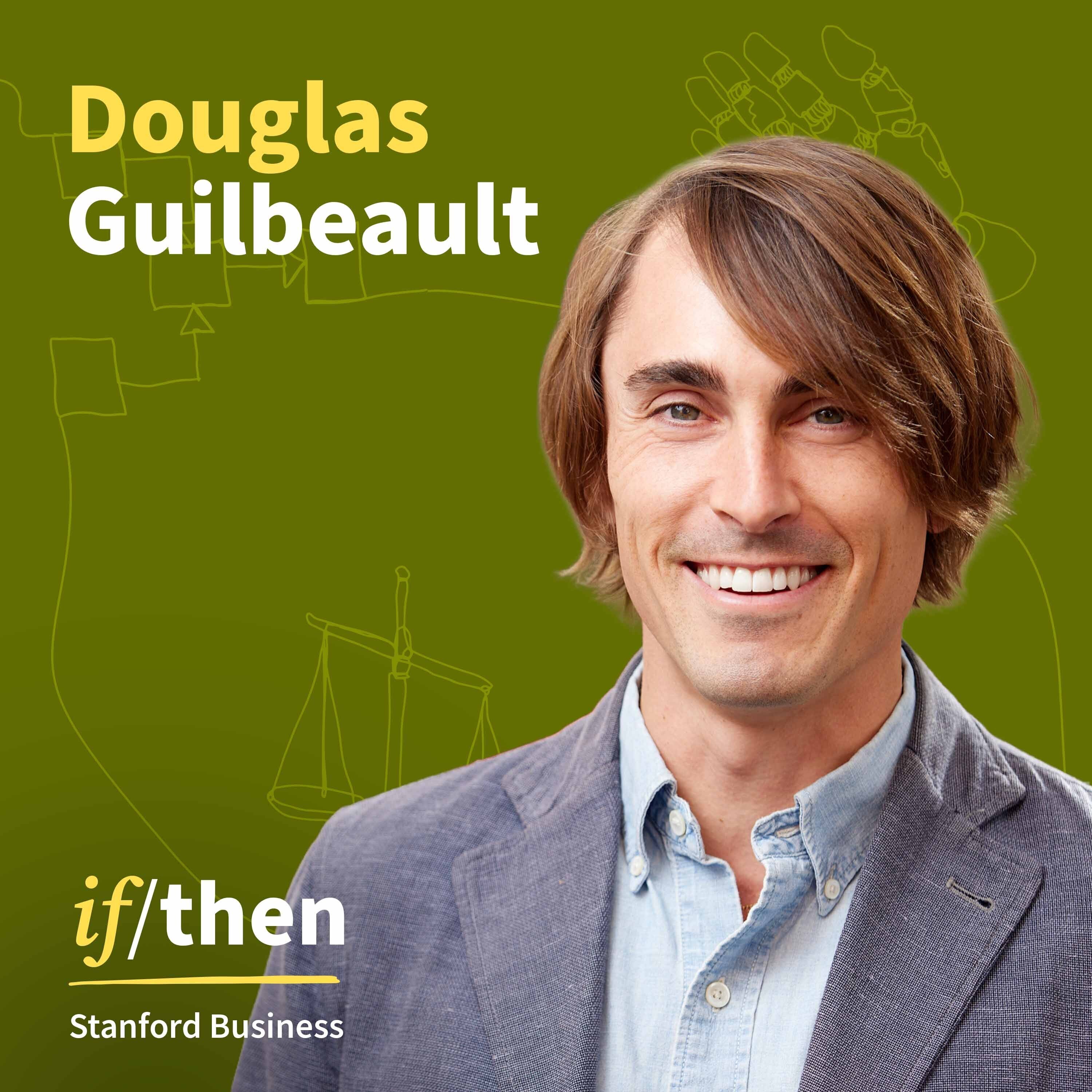
What AI Can’t Do — And Why
Jun 2500:28:50Tap to summarize“Humans manage to do so much with surprisingly little,” says Douglas Guilbeault, an assistant professor of organizational behavior at Stanford Graduate School of Business. “Whereas AI, by comparison, is doing relatively little, but with so much power, so much compute, so many resources, and by comparison, relatively fewer constraints.”On a bonus episode of the If/Then podcast, Guilbeault describes the implications of his recent work. Although he readily acknowledges that AI is “increasingly able to do quite a lot,” Guilbeault and his colleagues believe they have identified a key principle that distinguishes human intelligence from machine intelligence — and one which illuminates the limitations of machine thinking. Although some researchers and AI boosters believe both humans and AI learn via optimization, Guilbeault and his colleagues have shown that another process more accurately captures how people distill the seemingly infinite complexity of the world and act based on limited information. “You encounter a lot of noise, a lot of chaos, a lot of randomness,” Guilbeault says. “We somehow figure out how to make meaning and establish strong understandings from within that.”What limitations have you encountered in your work with AI? Share your story with us at ifthenpod@stanford.edu.Related Content:Douglas Guilbeault faculty profileRead "A Simple Threshold Captures the Social Learning of Conventions" hereChapters:00:00:00 Introduction00:01:40 Why human learning matters for AI00:05:03 Satisficing and the limits of optimization00:06:41 Why LLMs learn differently from humans00:09:58 The stakes of AI hype00:13:11 “Humanity has had a good run”00:15:19 Intuition, insight, & conceptual leaps00:17:38 Beyond statistics: metaphor, vibes, & reasoning00:19:39 A simple rule for social learning00:21:18 Is there a ceiling for AI?00:23:00 Randomness, disorder, & the path to insight00:25:00 What an optimization mindset leaves out00:27:54 Conclusion If/Then, from Stanford GSB, features conversations with faculty that explore how their research deepens our understanding of business and leadership.See Privacy Policy at https://art19.com/privacy and California Privacy Notice at https://art19.com/privacy#do-not-sell-my-info.
Transcribe →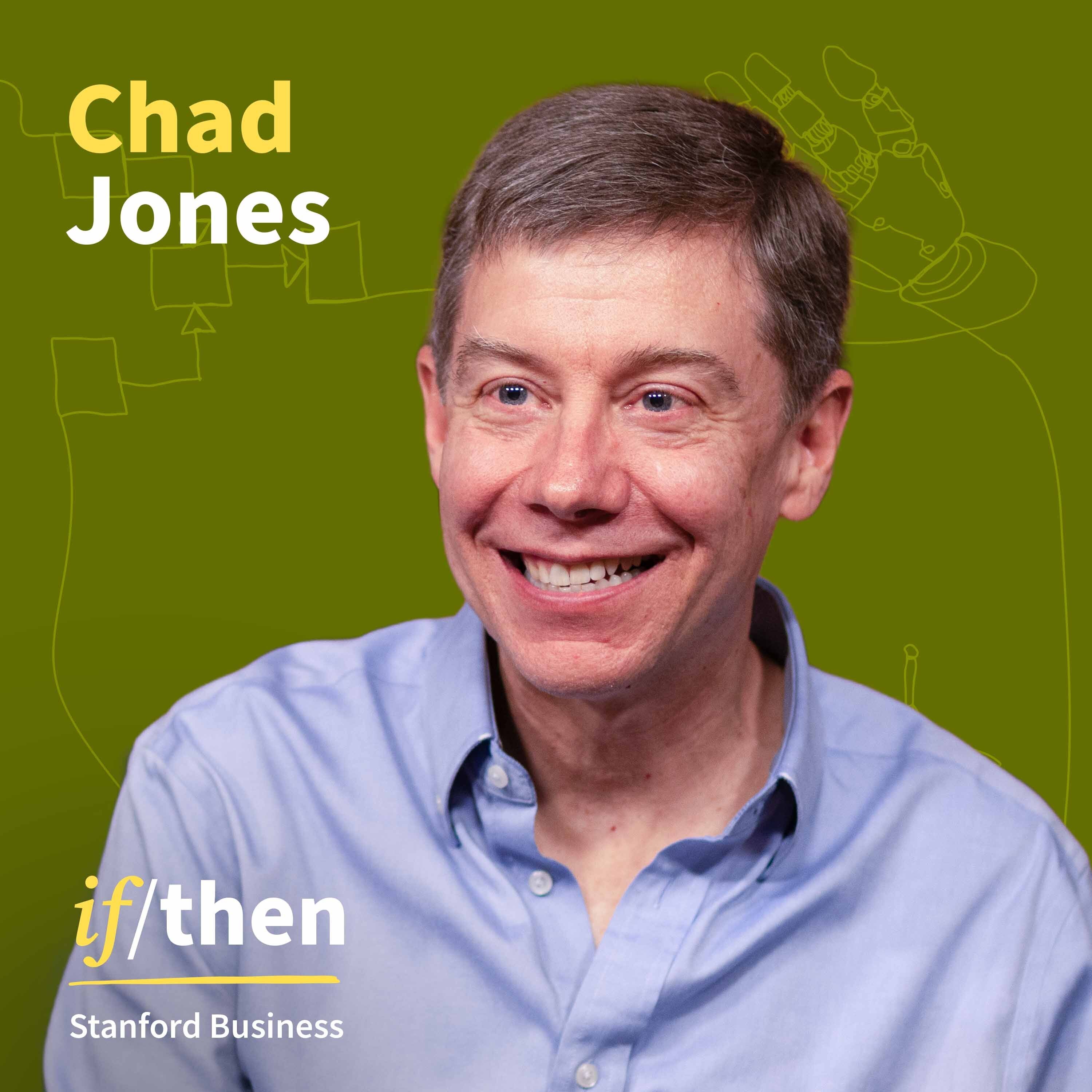
Our AI Future: From Abundance to Apocalypse
Jun 1000:45:10Tap to summarizeChad Jones, a professor of economics at Stanford Graduate School of Business, recently published a paper, “AI and Our Economic Future.” Using more than 100 years of economic data, he modelled several potential AI-infused economic futures we may experience. These include the good (abundance, we never work again), the not-so-bad (business more or less as usual), and the ugly (a superintelligence that turns on us, among other catastrophic options). Cheery stuff, Jones acknowledges, but essential to face.“I think the ability for an AI to do everything on a computer that the best software engineer can do, that seems like it’s either here now or will be here within five years easily,” Jones says. “Hacking the electric grid, hacking the financial system, these kinds of scenarios are things that we definitely have to worry about. The good news is, I think if we get through that, the ability of AI to transform the economy for good, it is really there and present. And, that would be a very great and bright future.”Related Content:Chad Jones faculty profileWhat’s the Price Tag for Preventing an AI Apocalypse?At What Point Do We Decide AI’s Risks Outweigh Its Promise? Chapters:00:00:00 Introduction00:01:32 The difference between now & previous periods of innovation00:02:29 Two scenarios for AI-driven growth00:06:18 The case for business-as-usual00:11:06 Weak links and the limits of automation00:17:53 What the models are showing about growth00:19:58 The economics of abundance00:25:29 The weak-link model’s timing & possible adaptations00:27:51 Who gains in an AI economy?00:29:55 Catastrophic risk and the downside of acceleration00:34:31 The downsides of the weak link model00:36:38 Meaning, identity, and human value00:39:55 Leisure in a post-work world00:41:43 What the next generation may inherit00:44:07 ConclusionIf/Then, from Stanford GSB, features conversations with faculty that explore how their research deepens our understanding of business and leadership.See Privacy Policy at https://art19.com/privacy and California Privacy Notice at https://art19.com/privacy#do-not-sell-my-info.
Transcribe →
The Art of Friction
May 2000:23:52Tap to summarize“Friction for us has to do with obstacles,” says Hayagreeva “Huggy” Rao, a professor of organizational behavior at Stanford Graduate School of Business. “Obstacles can disable you. Obstacles can enable you.”Rao compares friction to cholesterol: Some is good, but some is bad. “Good friction actually slows you down, gets you to pause, and most of all, gets you to reflect,” he explains. “But there’s also friction that overwhelms you, exhausts you, confuses you.” On this episode of If/Then, Rao explores how to cultivate the productive kind of friction, reduce the unhelpful kind, and manage your team’s most precious resource. “Great leaders are people who think of themselves as trustees of other people's time,” he says. Do you have any favorite examples of good or bad friction? Share one with us at ifthenpod@stanford.edu.Related Content:Huggy Rao faculty profile The Friction ProjectHow to become a friction fixerChapters:00:00:00 Airport baggage claim, waiting, & good friction00:03:20 Introduction00:03:48 What friction means in organizations00:05:42 Where friction comes from00:07:52 Scaling through smart subtraction00:08:24 DropBox’s approach to meetings00:10:45 The problem with meetings00:13:53 What good friction looks like00:16:56 Friction, trust, & institutional legitimacy00:19:31 Why Huggy Rao started studying friction00:22:20 ConclusionSee Privacy Policy at https://art19.com/privacy and California Privacy Notice at https://art19.com/privacy#do-not-sell-my-info.
Transcribe →
Unconventional Wisdom
May 600:26:11Tap to summarize“I don’t see things like anybody else,” says Jonathan Berk, a professor of finance at Stanford Graduate School of Business. “And so I can see things people don't see.” On this episode, Berk explores recent research that pushes against conventional wisdom, from questioning the utility of the debt-to-GDP ratio to asking whether regulation is actually in the best interests of the consumer. “If you disagree with me… You have to write down a convincing theoretical model and analyze [it].”Berk admits his unique lens doesn’t always make life easy. But on the other hand, “it confers an enormous advantage” — and he believes that organizations which are able to harness the power of unconventional thinking can gain a competitive edge.“It’s allowed me to solve problems that other people couldn't solve,” he says. Has seeing the world differently helped you resolve a conundrum? Tell us more at ifthenpod@stanford.edu.Related Content:Jonathan Berk faculty profile What If We’re Looking at the National Debt All Wrong? Chapters:00:00:00 The Fosbury Flop, innovation, & unconventional thinking00:03:18 Introduction00:04:24 Questioning conventional wisdom00:04:57 Rethinking the debt-to-GDP ratio00:08:21 A finance perspective on national debt00:10:36 Why theory matters before alarm00:12:38 Regulation, charlatans, & consumer interests00:16:22 Licensing, certification, & competition00:19:51 The cost of pushing back00:21:16 Building organizations that welcome dissent00:24:59 ConclusionIf/Then, from Stanford GSB, features conversations with faculty that explore how their research deepens our understanding of business and leadership.See Privacy Policy at https://art19.com/privacy and California Privacy Notice at https://art19.com/privacy#do-not-sell-my-info.
Transcribe →
Why Who You Are Affects How You Think
Apr 2200:24:43Tap to summarize“When people come to view attitudes and opinions towards, say, political policies or issues as relevant to their identities, they become more extreme in their attitudes,” says Christian Wheeler, the StrataCom Professor of Management and Professor of Marketing at Stanford Graduate School of Business. “I become more positive or negative towards an issue the moment it becomes relevant to who I view myself as being.”Wheeler’s research offers insight into our increasingly polarized politics. However, his work has also yielded ideas for bridging divisions — beginning with how we listen to each other and how we see the people we disagree with.The moment we see someone as an individual rather than a category, we become more likely to find common ground. “Instead of viewing you as a Democrat or a Republican, I can view you as an individual,” Wheeler recommends. “Anything that humanizes you and moves you away from this simple category will help me to view you as an individual and less as just an interchangeable member of a category.” How much do your opinions define who you are? Tell us more at ifthenpod@stanford.edu.Related Content:Christian Wheeler faculty profile In a Polarized World, an Open Mind Can Hurt Your ReputationYou May Not Be Who You Think You AreClass Takeaways — How to Build Connection Through Better ListeningChapters:00:00:02 Tattoos, identity, & personal evolution00:03:26 Introduction00:03:59 Why identity matters00:04:56 Identity relevance & its implications00:08:03 Why openness to the other side gets punished00:10:57 Identities vs. opinions00:13:53 The power of individuation00:15:53 How to break the cycle of polarization 00:19:41 Organizational applications00:23:26 ConclusionIf/Then, from Stanford GSB, features conversations with faculty that explore how their research deepens our understanding of business and leadership.See Privacy Policy at https://art19.com/privacy and California Privacy Notice at https://art19.com/privacy#do-not-sell-my-info.
Transcribe →
The Paradox of Masculinity
Apr 800:26:52Tap to summarize“Masculinity is my new frontier,” says Ashley Martin, an associate professor of organizational behavior at Stanford Graduate School of Business. Martin, whose work examines why gender plays such a central role in how we perceive and make sense of others, has been looking at how traits associated with masculinity are simultaneously organizationally rewarded even as they’re personally harmful to men. “We spend a lot of time talking about gender inequality through the lens of women’s disadvantage,” she says. “I think that many of the problems that we’re seeing today… are actually bound up in masculinity.” What impact do you think masculinity and femininity have on our work and our world? Tell us more at ifthenpod@stanford.edu.Related Content:Ashley Martin faculty profile Is that Self-Driving Car a Boy or a Girl? Why Taking Gender Out of the Equation Is So DifficultChapters:00:00 How movies shape our ideas about masculinity04:02 Introduction05:15 How Ashley Martin got into studying gender05:58 When gender is removed from hiring07:10 The “pet rock” study10:35 The universal use of gender13:02 Gendering objects15:12 How masculinity affects men18:13 The current implications of Martin’s research20:41 What healthier models of masculinity might look like23:47 Ashley’s next frontier: masculinity, material culture, and social problems25:07 ConclusionIf/Then, from Stanford GSB, features conversations with faculty that explore how their research deepens our understanding of business and leadership.See Privacy Policy at https://art19.com/privacy and California Privacy Notice at https://art19.com/privacy#do-not-sell-my-info.
Transcribe →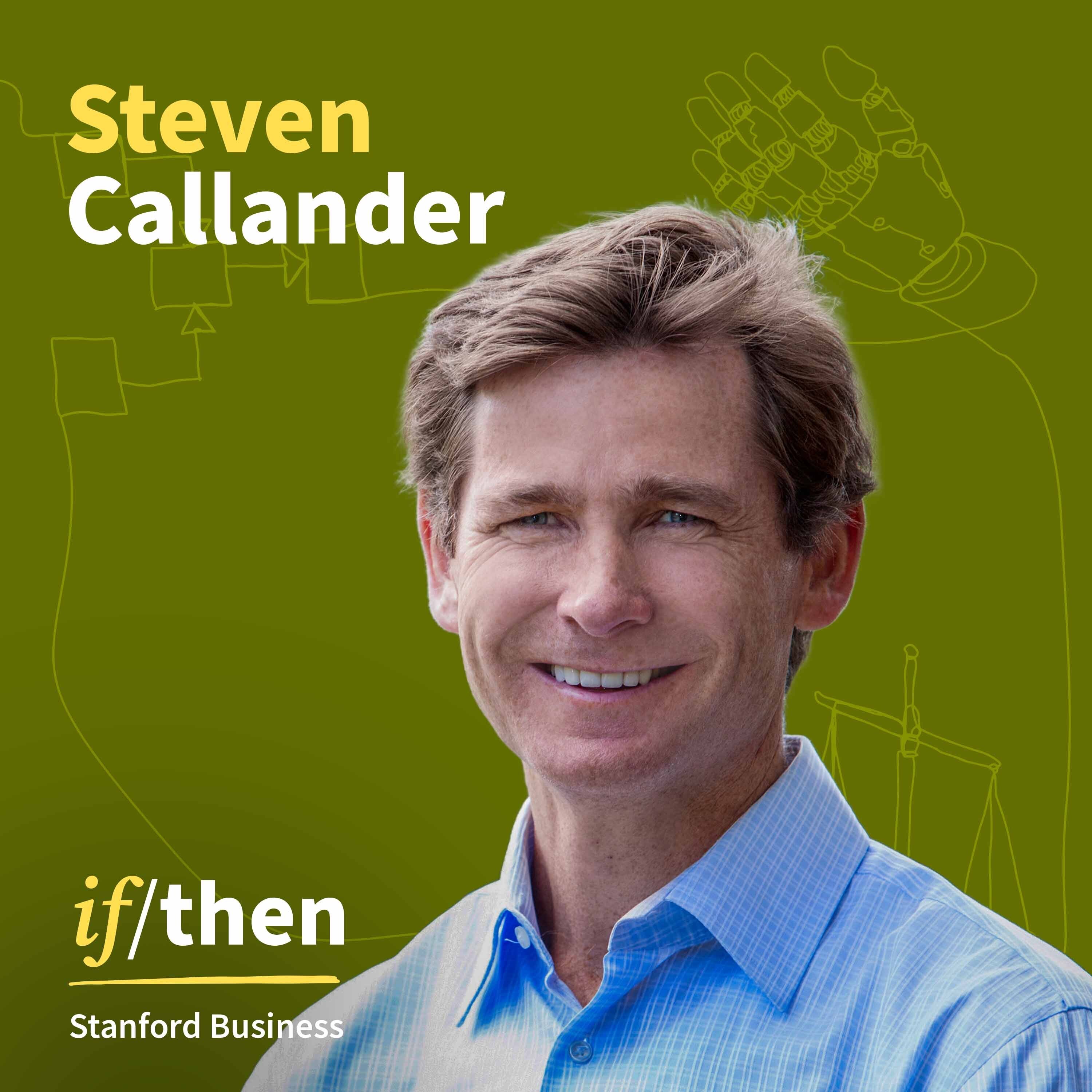
What We Actually Learn From Experience
Mar 2500:25:56Tap to summarizeSteven Callander has spent years building a mathematical framework to answer the question of how people learn from experience. “Here in Silicon Valley, the expression that you learn from failure is very widespread and very intuitive. But the question is… what do you learn? How do you optimally learn from that experience?”In this episode, Callander, the Herbert Hoover Professor of Public and Private Management and Professor of Political Economy at Stanford Graduate School of Business, explains the hidden, deceptively simple logic of correlated learning — and it may change how you think about finding the right job, the right market, or the right strategy. “It fascinates me and I can't stop thinking about it,” he says. Has theory made an impact on your life? Tell us more at ifthenpod@stanford.edu.Related Content:Steven Callander faculty profileHow to Turn Old Ideas Into Creative Solutions to Modern ProblemsWhat We’re Still Learning from Silicon Valley’s Bank CollapseChapters:00:00 Ann Miura-Ko on learning and the search for patterns in Venture capital02:51 Introduction05:23 What is correlated learning?06:40 Where does this research apply in the real world?09:28 Brownian Motion12:45 Steven Callander’s Framework15:25 Examples of correlated learning when seeking expert advice20:53 Applying correlated learning23:57 Why correlated learning research?24:51 ConclusionIf/Then, from Stanford GSB, features conversations with faculty that explore how their research deepens our understanding of business and leadership.See Privacy Policy at https://art19.com/privacy and California Privacy Notice at https://art19.com/privacy#do-not-sell-my-info.
Transcribe →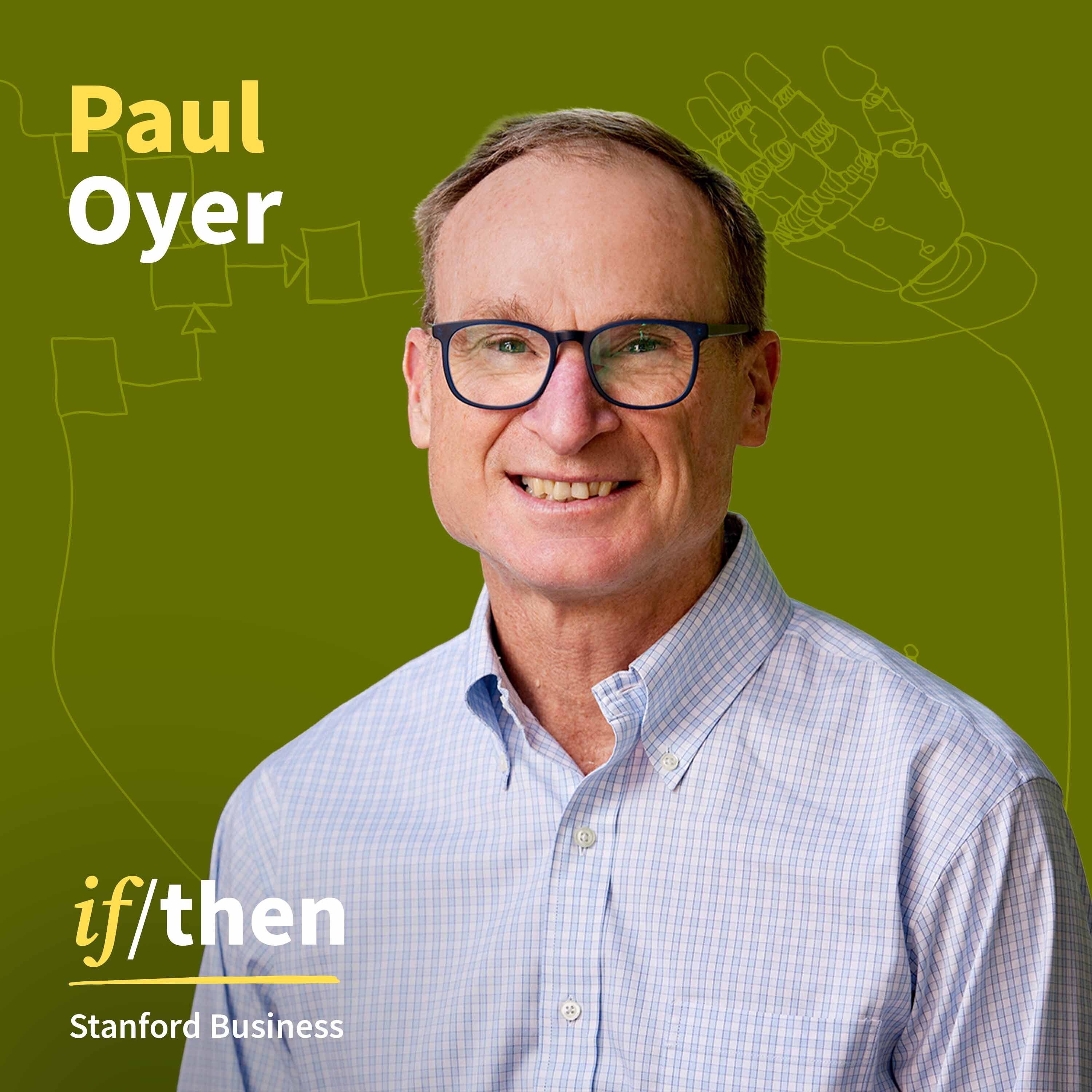
How Dating and Sports Explain the Job Market
Mar 1100:25:19Tap to summarizeSeemingly unrelated activities — like taking a soccer penalty kick or crafting an online dating profile — involve an embedded economics. “Understanding and applying economic logic can be valuable in pretty much any job or any other endeavor in your life,” says Paul Oyer, a professor of economics at Stanford Graduate School of Business. On this episode, Oyer digs into the shared economic logic of online dating and the labor market, explains why pro athletes and sports fans think like economists, and explores how AI has reduced the beneficial friction that was once a part of job searches. Got a question about the economics of dating, sports, or the job market? Ask us at ifthenpod@stanford.edu.Related Content:Paul Oyer faculty profileUtility Player: Paul Oyer Explains How Economics Can Make Sports More FunChapters:00:00 Strategic decision-making in air traffic control03:06 Introduction03:27 Why sports are a useful lens for understanding economics09:53 Why economics matters far beyond money10:54 Economics & online14:36 Applications of game theory16:54 How AI is reshaping hiring and the labor market22:25 The labor market challenge economists still have not solved24:18 ConclusionIf/Then, from Stanford GSB, features conversations with faculty that explore how their research deepens our understanding of business and leadership.See Privacy Policy at https://art19.com/privacy and California Privacy Notice at https://art19.com/privacy#do-not-sell-my-info.
Transcribe →If/Then Returns: Season Three
Mar 400:01:25Tap to summarizeWhen should we leap instead of take the obvious next step? Why do we instinctively see gender everywhere? When do our opinions begin to feel less like ideas and more like our identity?If/Then, from Stanford Graduate School of Business, is back with a new season of sharp, surprising conversations that deepen our understanding of business and leadership.Each episode brings you into the room with a Stanford GSB faculty member as they discuss their research and how it challenges conventional wisdom, sharpens judgment, and reframes the way we approach complex decisions. Join us on Wednesdays for a new season of If/Then.What do you want to hear on If/Then? Email us at ifthenpod@stanford.edu.See Privacy Policy at https://art19.com/privacy and California Privacy Notice at https://art19.com/privacy#do-not-sell-my-info.
Transcribe →