Loading summary
Transcript60 lines
- [00:00]
Matt
Conversations like you're about to hear do not happen unless you support indefensip plants. And now, more than ever, we need conversations like this to reach as many ears as possible. One of the best ways to help keep In Defensive Plants up and running is to become a patron over@patreon.com indefensipplants in return for a tiny bit of support, each month, you will get access to a completely separate podcast. It explores a lot of really fun gardening topics, everything from seed collection and storage to growing native plants, the struggles of trying to garden in different climates, and. And so much more. It's a heck of a lot of fun. We're learning so much, and we're trying to share that with you. So come on and join the patreon over@patreon.com indefensive plants and help keep this show up and running in the process. I hope to see you over there, but in the meantime, on with the show. Hello, everyone, and welcome to the In Defensive Plants Podcast, the official podcast of Indefensive plants dot com. What's up? This is your host, Matt.
- [00:52]
Interviewer
Welcome to the show.
- [00:53]
Matt
How is everyone doing this week? Today, I thought we would revisit a conversation I had back in 2020 about Earth's first forests. This conversation takes us all the way back to the Devonian period, which the Devonian was for plants what the Cambrian period was for animals. It was an explosion of new niche space that early land plants were readily taking advantage of. But these forests were nothing like what we experience today. So that's why we're revisiting the conversation with paleobotanist Dr. Chris Berry, who was part of the team that discovered the oldest fossil evidence of forests. This was really fun and insightful, and it transports us back to a time that couldn't be more alien to life as we know it. So. So let's just jump right into it. Without further ado, let's revisit my conversation with Dr. Chris Berry. I hope you enjoy.
- [01:49]
Interviewer
All right, Dr. Chris Berry, thank you so much for coming on the podcast. How about we start off with a little bit about who you are and what it is you do?
- [01:57]
Dr. Chris Berry
Well, I'm Chris Berry. I'm from Cardiff University, where I teach paleontology and sedimentary geology. I research the origin of forests and the earliest forests in the Devonian period.
- [02:08]
Interviewer
Excellent. And I'm really excited to talk to you about this today. But what brought you to where you are today? I mean, were you always a paleontology type person, or did you like plants? And just found that paleontology was a nice fit. Where did this all come from?
- [02:21]
Dr. Chris Berry
It's a long story really, but I got interested in natural history with my father taking me out fossil collecting when I was a kid. I was very lucky to have the opportunity to do some geology at school as a subsidiary subject, which got me further interested in geology. And then I went to Cambridge University to do natural sciences, which meant math, physics and chemistry. And I had subject. So I carried on with my geology and by about six weeks in, I'd made the decision that physics and chemistry were not for me, but geology was a really exciting subject and I was fortunate to meet with real life paleontologists at that time because I never really thought of paleontology as a real subject, more something that you read about in books. And so I was fortunate to meet with Simon Conway Morris, who worked on the Cambrian explosion of animals, and some of his colleagues, and with Harry Whittington, who was a member of my college. And I got more and more interested in paleontology and followed that until half of my final year degree was paleontology. But to be honest, most of it was about animals. And in my second year I decided to take up biology again and I walked into biology department and said, I want to do a second year biology course. And they said, well, when did you last do biology? And I said about four years ago. And they said, well, you must be really keen, why not? So I never unfortunately touch plants while I was at university, apart from a few lectures about Devonian plants from a graptolitologist called Barry Rickards, who dated some of the earliest Silurian Devonian plants. And he got me enthused about Devonian plants because I could see a sort of parallel between the Cambrian explosion, which was really fascinating me at Cambridge, and the Devonian explosion of plant life. So I was very fortunate that when I was looking around for PhDs, I applied for, I think, 10 PhDs on animals and one PhD on Devonian plants with Diane Edwards, which is at the time here in Cardiff. And I was very lucky that she was enthusiastic about taking me on as a student. And so I came down to Cardiff and got stuck into Devonian plants and botany.
- [04:45]
Interviewer
Wow, what a chance encounter. And lucky for you, right? I mean, that's amazing that, you know, just kind of the law of numbers worked out for you.
- [04:54]
Dr. Chris Berry
Yeah, yeah, it was good. And I mean, I sort of found a niche for myself because at the time Diane was working very much on very early Devonian plants. She still is, actually. And she gave me a project which was to work on middle Devonian plants, which are whole order of magnitude bigger, and that she. Although she was interested in them, she only dabbled a little bit with them. And so I really had full reign to just really get stuck in with them. And I was very successful with the project in Venezuela. First description of big assemblage of Devonian plants from South America. And then my external examiner for my PhD was Muriel Ferrand Amirais from Liege in Belgium. And she invited me over to Belgium to work on one of the groups of plants that I'd found in Venezuela, which is a cladoxyl opsid. So I spent a whole year or more just studying cladozalopsids, and this led me into the work on the first forests.
- [05:56]
Interviewer
Incredible. And it's so cool to see someone that found their niche, so to speak, early on, or niche. Sorry for the American pronunciation there, mostly to my audience, but that is really awesome to see someone that's, you know, you were bitten by the Devonian bug and it's stuck with you ever since. And now you're making massive contributions to our understandings of what was going on at that time. But to outline sort of this focus on the Devonian period, this is a very special time for plant evolution, and you've compared it in your work and earlier in what you just said to the Cambrian explosion, which was really the explosion of animal life in the oceans, that really set the stage for a lot of the sort of animal phyla. But what is so special about the Devonian and plants? Why is that comparison so well aimed at describing what was going on at that point?
- [06:43]
Dr. Chris Berry
Well, strangely enough, the first time in my life I've actually had to teach the Cambrian explosion this last couple of weeks. So I've been thinking about it quite a lot. And during the Cambrian explosion, you have the establishment of all the major phyla of animals, really. And in the Devonian, you get this, not the first land plants, because we know that there were land plants before the Devonian, but you get this explosion of form and to some extent function in plants, which is quite extraordinary to follow through. It's very exciting. So the plants get bigger, you've got more and more complex anatomies, you get completely crazy. Anatomy is a bit like in the Cambrian Explosion, you get completely crazy animals, you get crazy anatomies of plants. The anatomy and the morphology are obviously very deeply connected in plants. So you get some very strange plants and then you get wood and then you get leaves in plants, and these Things just get bigger and bigger as you get more secondary growth. And eventually by the end of the Devonian, some point in the Devonian, we have the origin of seeds and then that's really it. I was, I was just thinking about this with a potential student I was talking to. And then you get flowering plants turn up some point during the Mesozoic, I won't say exactly when because sort of hotly debated. And then maybe you get C3, C4 thing later on, but really by the end of the Devonian, you know, it's pretty much done really plant evolution. So that's my take on it as a non botanist looking at plants. Yeah. So why, why not? It's got to be the best time to look at fossils. Yeah.
- [08:31]
Interviewer
And I like the sort of emphasis on how strange things were at that time, because as anyone that enjoys life, whether that's past or present, you know, the strange stuff really catches your eye or catches your interest a lot more because it seems like evolution was experimenting with different things. And this transition in the Devonian is, like you said, it's a really interesting time because, you know, you have these little scraggly land plants transitioning onto land and, and the Silurian kind of getting into the Devonian. But then it was pretty much a world for the taking for terrestrial plants. I mean, there wasn't a lot of competition out there, so these things could be experimented on, but this explosion aspect of it, and like you said, these, these initial stages sort of setting the major foundations for what plants were going to be like for the rest of history. This kind of happened relatively quickly, you know, we're talking millions of years, but it all kind of came on board during the Devonian. And do you think that's sort of like a really hard selection? There was a lot of experimenting going on, but only a few things really could stick and be efficient and compete well with others.
- [09:29]
Dr. Chris Berry
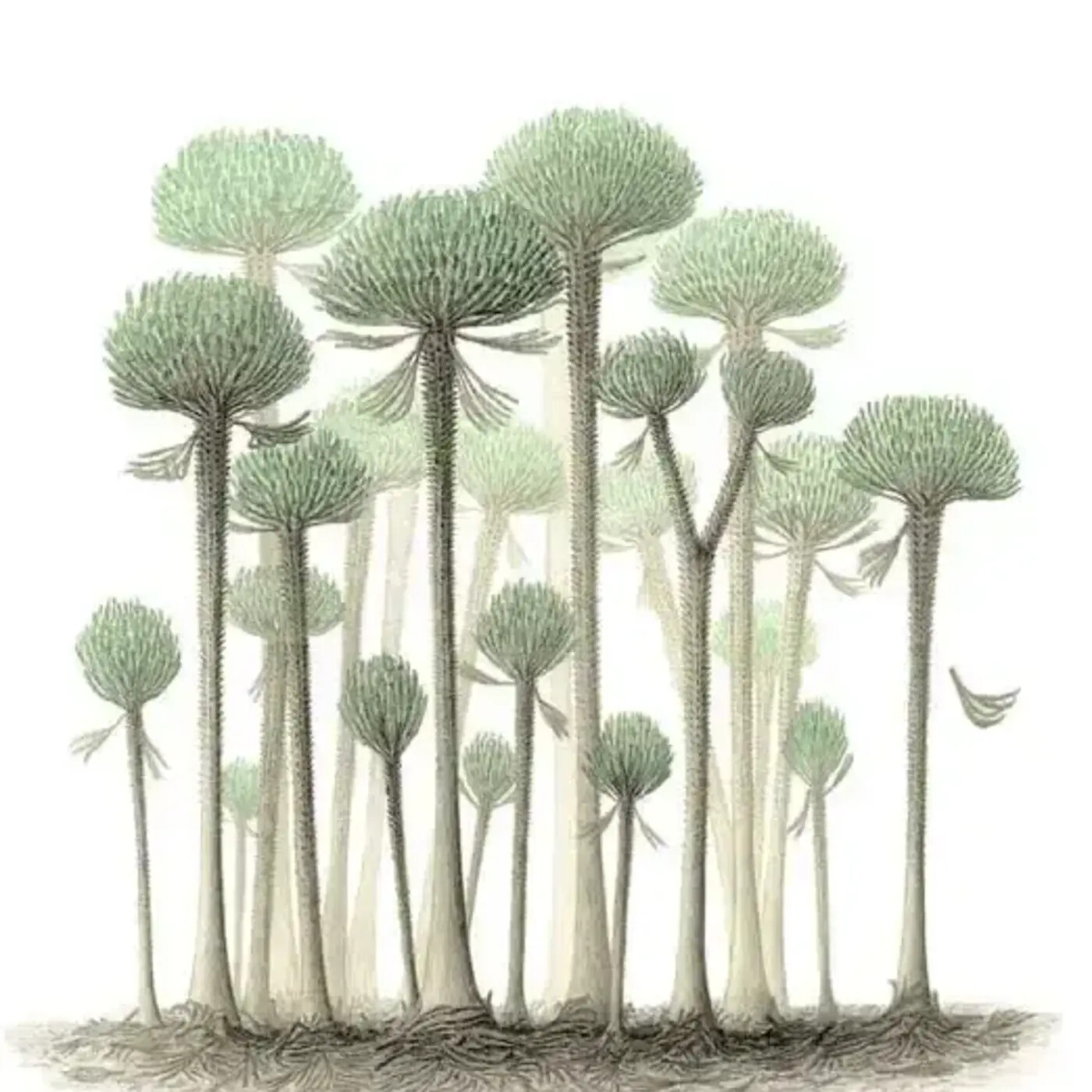
I don't think there's such a massive pruning of form as maybe we see in the Cambrian explosion, but there's a few odd things which just try their luck and then disappear as perhaps the modern types of trees really come to the fore. So it's a complex world with just strange, strange forms. And it's quite hard to illustrate because one of the things that one struck with is the fact that there are no animals. So you can draw a forest and then you have this problem of scale that there's nothing that you can put in the picture, which gives you a sense of how big it was. So it's quite curious from that point of view as well. Yeah.
- [10:13]
Interviewer
I love looking at these reconstructions, but you're right. In most of the early days you just kind of see some plants with maybe a giant millipede crawling over. It was really just arthropods on land at that point in time. Time other than plants, Right?
- [10:25]
Dr. Chris Berry
Yeah. And at least until, at least until you get to the uppermost Devonian, by which time things are pretty much done. The sea plants are appearing at that point, but before that, apart from a few enigmatic footprints and these strange fish that sort of look like land and walls, but really a fish, there's this nothing around. And the problem with millipedes is how in an image do you tell the difference between a tiny millipede and a huge millipede, this sort of scale in a difficult way? I think so. So, yes, there's one image that, the image of the Gilbert Forest that was on the front cover of nature back in 2012. Yes. There's a little millipede in the corner, but it's still quite difficult to get a sense of how big that millipede was.
- [11:19]
Interviewer
Yeah, yeah. And only until you see a fossil in person does the, the true size of what was going on with that type of arthropod really hit you. But the other side of this is really thinking about what it took to develop forests, why forests were developing, and then the odds of these ever becoming fossilized in the first place. And you've got a lot of things working against you as a scientist trying to understand this stuff. But it is curious to think about the evolution of forests in general, just because it's something we take for granted. Nowadays we go outside and in most areas of the world you can find trees. They might be stunted, they might be 300 foot monsters like we see on the California coast. But forests are something humans can get their head wrapped around. But forests didn't immediately appear onto the scene. And trying to figure out when and why and how this all happened has been historically kind of difficult.
- [12:08]
Dr. Chris Berry
That's true. Plant fossils have this difficult property whereby the plant, when it dies, usually falls into lots of different pieces and these are scattered around and washed around rivers. And it's quite hard to get a sense of how everything fitted back together. And as many people aware, the early reconstructions of the Gilboa forest, for example, a very good example where Winifred Goldring, the New York State paleontologist at the time, she took the two most common plants that are at Gilboa and she Basically connected them together to make a non existent plant which is still commonly reproduced in, in books to this day. So one of the jobs of the paleobotanist working in the Devonian is try to assemble the plants back into a living form. I think we've really made huge successes with the cladozolopsids as a group. These are the now famous Gilboa trees in the, in the true sense. They have a big swollen base and a slightly taper trunk, maybe a bit more of a taper at the base. And then these sort of arm shaped branches which come off with long fingers and little appendages attached to the fingers. They were misconstrued in all sorts of ways over the years. For example, there's reconstructions which are just the branch stuck in the ground. There's reconstructions with bits in the wrong place, the wrong plants attached to them, and then there's ones where the side of the plant has been put on the top of the plant and it, it's just been a mess. And I like to think that one of the things that I sort of cut my teeth on was when I was in Liege and I managed to find the evidence to connect the branches and the trunk of the cladozolopsid Pseudosprotinus back together in the right way with Muriel Ferron Desmarais. And this turned a sort of archaic looking plant into a plant that seemed to have the possibility of grow to, to be alive and to be sort of modern in the sense that it looked a bit like a palm tree and you could recognize it as being a real tree. But that was an achievement of years and years of study. I think we started that in 1994 and published it in maybe 2002.
- [14:34]
Interviewer
Oh, geez.
- [14:35]
Dr. Chris Berry
Yeah. So, you know, it's not something that's done quickly. And then of course, within the last seven or eight years, then we have actually found these trees complete. First of all in the South Mountain Quarry in upstate New York, quite near Gilboa, where we found the whole crown of a tree. Or at least my colleagues in the New York State Museum and Bill Stein found the crown of a tree and in fact the whole trunk with the roots at the bottom as well. So it's more easy to stick together two fossils to make a whole tree, rather than 100 different fossils to make a whole tree. And then in Germany, some older and smaller cladozolopsids just a couple of meters tall called Calamiphyton. My friend Peter Giessen, he founded Lindlar Quarry, blocks of sandstone with two or three complete trees embedded in just one massive block of rock. So you can be lucky and find the whole trees. At Gilboa, we found some of these lying down woody rhizomes which we could connect using only anatomical evidence to branches of Neurophytalium pregimnosperms. And the lycopods are not too difficult to reconstruct because they essentially just branch into two. And so you can sort of mathematically work out how they get together. But we still haven't really got a good model for what early Archaeopteris looks like. An Archaeopteris is a very important tree in the middle Devonian as well as in the upper Devonian.
- [16:13]
Interviewer
Wow. Yeah. So thinking about some of these lineages, you know, lycopsids, they have extant relatives or representatives of that lineage still alive today. You know, the pro gymnosperms, it's arguable where they sit, but we can kind of get our heads wrapped around those. But these cladoxilopsids, you know, these Archaeopterus, do they have extant relatives or is this a lineage that died out long ago?
- [16:34]
Dr. Chris Berry
Okay, so there's two things there. Archaeopterus is progingosperm. Oh, yep. So the cladosolopsids that we might know as a Gilboa tree, which is probably a plant called Watiesa, and then the Pseudosprochnus from Belgium and Calamophyton from Belgium and Germany. These different plants are of different sizes and really only recognized from differences in the construction of the appendages, which are the sort of proto leaf like structures which run along the branches. Yeah. So we don't really know where they sit. They've always been considered to be proto ferns, or they're always called fern ancestors or something like that, which system with the fern lineage, in terms of the most recent fossils we found of this type of plant, which come from Xinjiang in northwest China, recently described with a Chinese colleague, Hong he, from Nanjing. These have wood in them, and it's secondary wood in the sense that it's wood that's grown from a vascular cambium. The main difference from real trees that you see outside today is that the wood grows in a couple of hundred distinct strands around the outside of the plant and not as one big cylinder. So there's 200 cylinders of growing wood within this plant, each with its own vascular cambium. And that first real proof that these claddylopsids had wood draws them a lot nearer to the lignophytes. Rather than to the ferns. So that's a problem, you know, I'm working on at the moment, and there'll be news about that before terribly long, as long as we can get into China and out of China freely to finish that stuff off. So, yes, we don't exactly at the moment know which branch of plant life they really belong to.
- [18:34]
Interviewer
I love the. The ongoing mysteries, though, and the detective work involved in trying to figure this stuff out. And you don't know what the next crack of the rock is going to. To give you. I mean, like, you just outlined there, finding that there's wood, but it's growing in a different way than what we know today. But still it's there. It's. It's so many cool questions that. That probably come with every smack of a hammer or crack rock.
- [18:55]
Dr. Chris Berry
Yeah, yeah. So, I mean, the next thing is, does that plant have secondary phloem or not? Because if it's got secondary phloem, then, you know, it's a lignophyte, really. So that's what we're paying attention to at the moment, to find that out and prove it one way or the other.
- [19:12]
Interviewer
Very exciting. And you mentioned a lot of these sites, you know, scattered throughout the world today, but setting the stage for what was going on in the Devonian. I mean, the reason you're finding similar trees and similar fossils in China and Germany and New York, it's because the continents were all connected at that time, or at least there was one major landmass that was, you know, sharing all of these as biota within and among itself.
- [19:39]
Dr. Chris Berry
That's a simplification of the truth. It's not a giant supercontinent in the same sense that we have in the Permian Triassic, and there's no big true Pangaea, but things are sort of coming together and it's clear that probably Laurentia and Gondwana, the two major supercontinents, were quite close together, but there were lots and lots of bits of China floating around in the sea and lots of other small continents, and Siberia's probably doing something up in the north. So it isn't that there's one continent. What there was was probably, especially at the beginning of the Devonian, a fairly equitable climatic gradient, at least falling away from the lowest Devonian into the middle Devonian, that things seem to get a bit sort of more even in terms of the climatic gradient from the equator to the poles. So some similarity of floras. But having said that, when we look at particularly the Chinese floras in the Lower Devonian. It's very, very distinctive from what you might find in Belgium or Germany at the same time.
- [20:53]
Interviewer
Oh, wow.
- [20:54]
Dr. Chris Berry
So by the end of the Devonian, then Archaeopteris is more or less everywhere. So there's changes in the amount of global diversity of plants, I think, through the Devonian, and. And one would have to look at specific times to be very sure about these things. For example, in the middle Devonian, I've worked in two in South China particularly China's broken up into many different pieces. Worked in the major block of South China, the Yangtze Block, and there are no proginosperms as we recognize them in the middle Devonian. And yet over in New York State there's lots of them. But then by the late Devonian, Archaeopteris starts appearing in China and somehow has managed to get there. So each of these blocks has its own history of plants and we don't know enough about enough of these fragments to really be confident that we understand how plants have changed on a global basis through the whole Devonian. That's there's another century of research to be done.
- [21:58]
Interviewer
That's absolutely fascinating. I had no idea. And that's really nice to get your perspective on that because. Yeah, I mean, I'm just as guilty of it as the next person. Oversimplifications make communication a little bit easier. But it doesn't get at the point that these words, ecosystems with different biogeographies, different distributions, and as you just mentioned, probably different species altogether. And it is nice to simplify. But it also, you know, ecology is complex today. It probably was just as complex back then.
- [22:27]
Dr. Chris Berry
I imagine that that's true. I mean, perhaps in the Devonian we don't have the tropical forest with the hum of diversity that you get today. In the middle to late Devonian in Spitsbergen, we certainly worked there. And it seems hard to think that Spitsberg in the Arctic, Norway, 80 degrees north today, was on the equator back in the Devonian, but it was. And there we find distinctive types of forests, lycopod forests, archaeopterous forests, but there's no cladoxylopsid forests there. But they're not really diverse. There's not that diversity of so many species that you would get if you had 100 square meters of an Amazonian forest, for example. So perhaps you don't get the tiering. You haven't got the height of the trees to have all those different microenvironments and so on that you get going up through the canopy. And you don't have the co evolution with animals either. So, you know, all these different species that evolved to live with various animals, that's not going on in the Devonian. So I don't think it is as complex ecologically.
- [23:38]
Interviewer
Fair enough. No, that's a really good point to make, is so much of what we see today is co evolution, arms races, that sort of stuff. But in thinking about, you know, putting pieces of individual trees together or finding a few whole trees or large portions of trees in the fossil record, that's very exciting in and of itself because like you said, it allows you to piece together what these organisms actually were and infer something about their biology. But to go from that to finding fossilized forests, I mean, that is remarkable in and of itself. But the level of inference you can gain from that probably grows exponentially from that discoveries.
- [24:15]
Dr. Chris Berry
Yeah, fossil forests in the Devonian are rare. That's not to say that fossil roots are not rare, but usually you'd see them in the side of a road cutting or something. You see a cross section through a few bits of roots. To be able to walk on a surface and feel that you can sense where the plants were growing around you through the evidence is. Is completely different. So there's only really, I think, four places where you can do that that have been described to this date. Two in New York State, of course, one in Spitsbergen and now a new one in China that was described only last year. And that one is from the very end of the Devonian, the last years of the Devonian, it seems. So it's a little bit more similar to the Carboniferous forests that you might expect to find. But yeah, there's these three wonderful forests. I'm lucky enough to have seen all three of them. One in Spitsbergen and these two in upstate New York. The first one I got interested in was the one in Spitsbergen because I was sitting with a colleague, Hans Kirp, in Liege at a meeting sometime after I'd left Liege to celebrate my teacher there, Miro Ferrand Demaray and Hans Kub drew a map on a piece of paper of the position of a fossil forest that he'd seen in Spitzbergen, a sort of treasure map. You know, turn left up this valley and cross the river and look for the hut on the right and so on. And it was a forest that was known about, but nobody had really studied. And that suddenly woke me up to the fact that, you know, fossil forests were possible to find. And I was particularly interested in, because it was like a pods. And I was very much into lycopods at that time. And that sat on the back burner for a while, but finally managed to get into the Arctic and see that in 2010. And that was very exciting. But by that time, a couple of other things had happened. I started working with Bill Stein and the people at the New York State Museum on archaeopteryce and was going back and forward to the States quite a lot in the late 2000s, and we started working at the Cairo quarry. And one of the times when I wasn't there, Chuck Verstraten from the New York State Museum discovered these massive branching systems on the base of the quarry. They look very much like somebody had just ripped trees out of the ground. To be honest, I was quite dubious about the photographs I sent. So I was very excited on my next visit to New York to go and see these incredible, massive rooting structures. And during that visit, Bill Stein pointed out to me that there was another type of potential rooting structures that were there. These had much finer roots, and it was just like a bowl or depression in the ground of the quarry between us. We pieced together the fact that these must be the bases of the giant cladozolopsid trees that we knew about from South Mountain. We were pretty convinced that that was the case, and we are, you know, excited to have made this breakthrough. Then, just a year or so later, Bill and Frank were in Gilboa Quarry, which had been opened up as part of the dam reconstruction project there. And they recognized exactly the same structures on the bottom of the Gilboa Quarry. And so, because that was so famous and we were only allowed to work there for a few weeks, that became the total focus of attention for the next while. So that's how we ended up with three forests, one in Spitsbergen and two in New York State.
- [28:01]
Interviewer
Wow, that is remarkable. And I have to imagine that, you know, when you put it all together, like you said, you're in there walking around looking at this stuff and realizing what you've actually uncovered. That had to be almost eerie, but also surreal and exciting as a scientist, as a paleontologist, to know what it was you're actually looking at and experiencing.
- [28:23]
Dr. Chris Berry
That's right, because I think I just got back from a trip to New York and we'd all been in Cairo Quarry and had a great time. And I'd only been back a week or two. And I got an email or a phone call from. From Bill Stein. He said, look, I think we've just found the Gilboa forest and maybe you should come and see it. And I said, you know, I can't, I've got Exam board meetings and everything. And eventually I worked out that if I flew out of Heathrow on a, and got to New York via Toronto, I think got to Albany by Thursday night, I could spend Friday, Saturday, Sunday and Monday in Gilboa, fly back on the Tuesday and then be in my exam board meeting on Wednesday morning. So that's exactly what I did. So you can imagine a very jet lagged Brit sort of staggering out on the quarry floor in Gilboa in a complete trance because I'd spent 20 years reconstructing this, these trees and then to sit there on the quarry floor and just see where they were standing around you and imagine that sort of vista of primeval forest was, yeah, was just mind blowing really. And I really, really appreciated having that experience. I just wonder what, what I'd feel if I'd said, oh no, I can't come, don't worry, I don't need to be there. So. And then of course Frank and Linda and Bill made the amazing disc discovery of these other lying down trees snaking between the cladosolopsid trees, which really weren't in my imagination. Big woody rhizomes really running across the forest floor with leafless branches poking up from them. Completely new concept for a Devonian plant discovered in that quarry. So I had to, you know, re evaluate my mental image a few months later. But it was very exciting to have it at the time.
- [30:27]
Interviewer
Yeah. And that emphasis on sort of the structure and imagining what this ecosystem looked like, like we've talked about, most of what you get is fragmentary evidence or pieces of evidence that you then put together. But to see a preserved ecosystem, essentially to know how the trees were spaced, where the roots were going and then to see some of the structure of it, like you said, here's something you pictured is probably an upright standing tree, but now you have this tree sized thing growing like we see with some club mosses today, ambling along the ground throwing up stems. I mean that gives you so much more of a picture of what that ecosystem would have looked like.
- [31:00]
Dr. Chris Berry
That's right. And the other thing was that we could investigate the soil and see what the soil was like and it was permanently wet soil. It wasn't maybe completely underwater, but it never seems to have dried out. That's what the mineralogy and the structure of that soil looks like. So we could understand the environment in which the plants were growing. We could see to some extent a litter of branches on the ground in places of the quarry, because these clad azolopsids, growing like palms or tree ferns, would shed their fronds down onto the forest below. And we tried to bring that into the illustrations. But one point is that the sandstone there is really quite coarse. It seems to have been washed in from a river or perhaps directly from the sea over a sort of barrier of some sort of barrier island or something like that. So it's not terribly good at preserving fine detail of morphology of the bits of plants lying on the surface. So it may be that there was a busy layer of understory that we just haven't any evidence for this. This forest, because nothing had leaves, probably wasn't very dark. And so you'd think that there would be some sort of understory there as well, if there were plants which could cope with being an understory in a. In a wet soil. So there's still a bit of mystery to exactly what was growing at ground level there, I think.
- [32:36]
Interviewer
Yeah, yeah. Lots of imagination running wild, I'm sure, in the. In the heat of it all. But, yeah, you really are at the mercy of how these things were fossilized. But that's the other cool aspect of this, is to see all of this in one spot. This isn't like one, you know, 1 million years of one tree being fossilized. Another couple million years, another tree gets fossilized. Hypothetically, these forests are one single fossilization event, right?
- [33:00]
Dr. Chris Berry
Yes. So they sometimes call these sort of t naught assemblages because it's just one moment when it. When it happened. Feel quite comfortable about that. At Gilboa, it does seem to be a big, thick slab of sandstone has been laid down on top of that forest floor, and the trees seem to have died and been infilled with sandstone themselves when they've rotted away. So we have the famous Gilboa stumps. So that all makes a lot of sense, actually. And the same in Spitzbergen, where we have upright trees which are cast by sandstone in very much the same way, but only a couple of feet high. They seem to have been swamped by material coming down off a alluvial fan, probably in a single flood event. So we can see that there's just very closely growing lycopsid trees, maybe with stems up to 10 cm wide there. Cairo is very slightly different because we have these cladosolopsids growing on the surface and also the enormous branching roots of the archae trees, these big woody roots looking very much like modern conifer tree roots. And a very complicated story to untangle about how the sediment was deposited on. On top of there, we definitely have a layer of green sediment which covers much of the site with fish on the top of it. And they were dead fish, and they've been taken away to study there. And some of them were in very good condition before they were collected. That really does look like a river or estuarine flood event, bringing in fish which then die in maybe the receding water. But there's not absolute continuity of that horizon across the entire site. We have to be quite careful about how we interpret that surface. And there's a possibility that one or two of the trees may have sort of intruded down through that layer somehow, although the evidence points largely against that. So we know that some of the cladozolopsids and some of the archaeopterous trees were both covered by the same flooding event, but it's not as clear cut as at Gilboa or in Svalbard.
- [35:26]
Interviewer
Hmm. Yeah. Again, emphasis on the collaborative sort of aspects of this and the sort of things you need to know and look for the detective work of all of this. But when you think about finding these root systems, you mentioned the sort of similarities to modern conifer roots, but when you read about this sort of stuff, you see this word stigmarian root come up time and time again. I mean, is that designating that these were different structures than the roots we'd see today?
- [35:53]
Dr. Chris Berry
Okay, so the stigmarian organ is a really interesting plant organ. It's found at the bottom of many lycopod plants, and it appears to exist in a very condensed form at the bottom of isoetes today. And it is often branching, sometimes cormose, sometimes sort of lobe, but often the lobes turn into big roots which come out horizontally from the bottom of the plant. And these can divide dichotomously. There's two clever things about it. First of all, it has rootlets which come out perpendicularly from the side of these bigger root systems. When they fall off, they leave a very distinct scar, which is why the organ is called stigmaria. And these rootlets come off and in the bigger forms could divide several times and produce a huge fuzz of big ball of roots, if you like, made out of these tiny roots, but they're not capable of secondary growth to any significant extent. So then the new roots are from extension of the large roots rather than anything else. And it seems that some of the roots or most of these roots were more or less hollow, which allowed air and gases to go down through the inside of them, and that would allow them to operate in very waterlogged conditions. So Stigmarian root is a really remarkable organ and it's what allowed the coal forest to really form coal, because, of course, these plants were growing in very, very swampy conditions and here probably withstanding water. And so when they died and fell over, they would then be in an anoxic environment and wouldn't decay in the atmosphere, and therefore they could build up as peat and become compressed to form coal seams. So that all comes back down to this ability to grow in very, very waterlogged conditions. So that stigma and root is a very significant thing. And in the last year's report of this latest Devonian forest from China, these types of stigmarium rootlets were demonstrated. I think probably those are the oldest ones that have really been described in the rock record with absolute certainty. They're small, but they're exactly the same type of structure. We have one very mysterious plant at Cairo which has a different sort of base and branching roots from the other things that we see there. And unfortunately, it's only one. But it does have to seem to have some of the characteristics of a Stigmarian rooting system. It's very large, it has roots coming off quite often perpendicularly small roots. But we don't have the fidelity of preservation to be able to say that that's definitely a Stigmarian system. It's sort of 20 million years too early to be one. So it's fair to report it. Of course, we should report it and report our suspicions about it. But it's reported with caveats. I mean, we cannot be 100% certain that's what it is. And so we hope, you know, somewhere else in the quarry, another one will come up and then we can perhaps investigate it further.
- [39:22]
Interviewer
I love that it's still like these ongoing mysteries.
- [39:26]
Dr. Chris Berry
Yes. Yeah, yeah. Nothing's ever solved completely.
- [39:29]
Matt
No.
- [39:29]
Interviewer
And that's, I think, one of the most exciting things, at least to me, about paleontology is, again, you never know what you're going to find. And these things kind of just sit there and go, what the heck are you? And. And if you're curious about it, and it doesn't stress you out too much on a professional standpoint, there's so many great things to do, I'm sure each field season.
- [39:47]
Dr. Chris Berry
Yeah, it's one of the great things, is just discovering stuff, just spending time seeing new things, breaking new rocks open, finding New localities. And occasionally, I think most paleontologists would agree that they have a heightened perception of sort of three dimensional objects and relating them to one another in, in terms of textures and all sorts of things. And so you, you can, you can look at something in a museum drawer and it'll suddenly bring into your mind something you saw in another museum drawer, another continent, you know, several years earlier. And these connections just form in your mind between specimens and rock types and all sorts of things. So one is permanently aware of the fact that you might be seeing something that nobody else has seen or connected or made the connection or understood the significance thereof. The downside of that is very hard to write grant applications and say if I wander around over there for long enough, I might just happen upon something which will really change our perception of how the world evolved 400 million years ago. Yet most of the things that I've done come from chance discoveries, whether by myself or by somebody else. So, yeah, we can be seen as quite old fashioned in the way that we go about our business and how we apparently pull down these publications, some of which are quite significant, as if by magic. But it's not by magic, it's by knowing things that other people know through experience rather than through spending money specifically.
- [41:42]
Interviewer
Yeah, I mean, talk about having to be very familiar with the literature and just really that's the only way to be good at what you do is just to read widely and understand that things that may not seem connected could always potentially be. But even then, you know, you say wandering around, but we're talking about all these discoveries happening in quarries. And even that to me is fascinating that I'm guessing those quarries weren't put into place, or at least most of them are not put into place for the specific purposes of fossils. It's resource extraction. But then through luck or some keen eye goes, oh wait, there's something else here. And then you get a chance to go in and hopefully see it before it's completely destroyed.
- [42:19]
Dr. Chris Berry
That's right. I think the thing about quarries, if we talk about upstate New York, then there's so much forest there that the places you can see things are road cuts and quarries and, and to some extent riverbanks. If you think about road cuts, you get a very sort of vertical view through the geology. So you see routes going downwards, but you don't see anything else about their behavior. Whereas we know that many routing systems are effectively horizontal in terms of their greater extent. That's where much of the action is in terms of route activity. And so Quarries. When they're sandstone quarries, sandstone tends to come in beds and there's usually a layer of something not so attractive to the people extracting it, where they stop digging. And that surface can be a soil horizon, because soils tend to break down minerals and form clays. So they're no longer hard sandstones, but they're more clay. And in both Gilboa and Cairo, it's one of these soil layers, which is where the roots are, that the extractor, let's call them the extractor. The quarrymen have said, let's call it a day here and go sideways instead of keep going down. And possibly you can put in a jemmy bar or whatever and actually split the rock at that level because it's that much weaker. So it's not a coincidence that these great discoveries have been on large expanses of horizontal quarry bottom. The one at Guilbo is just a bit more of a challenge, because the quarry had been filled in in 1922. It was only the building work that started clearing it out because there was a mixture of mud and clay and sandstone in there, which could be thrown in one of these big grinders and come out as a very good road, temporary road base. So that's why they stripped it out. And once the fossil forest started appearing, then the construction company working there very kindly, basically used massive pressure hoses and washed the whole of the bottom of the quarry off for us. So that was quite a. Quite a thing to see going on.
- [44:47]
Interviewer
Yeah. Interesting and unexpected collaborations, just as much as the ones you try to facilitate.
- [44:52]
Dr. Chris Berry
That's right.
- [44:53]
Interviewer
So thinking about this, I mean, there's so many more questions that can be asked, but for you studying, you know, essentially Earth's earliest forest ecosystems, what's just over the horizon? What are you most excited about and what's next?
- [45:07]
Dr. Chris Berry
So I'm really excited to try and finish off the work on cladysolopsids and how they grew. All the stuff in New York State is just plants replaced by sandstone. Essentially. The plants rotted away, lost all its structure, and B become infilled with sand. So you can see shapes, but you can't see much else. Our cladosa lopsids from Xinjiang are silicified, so they have the preservation that you find in the Rhini Chert, which I know you enjoy talking about. So we can see cell by cell biology of one of these massive trees and work out exactly how it grew and exactly what was going on inside it. We've published some of that work, but as I say, we're really Going for the flow now. And I think there will be an exciting story to tell about that when that's done. So that's work which I do in China with Hong Ho Hsu at the Nanjing Institute of Geology and Paleontology, and we're hoping to carry that on in May. So let's hope things improve over there. Yeah. So that's one thing. Then there's a whole host of morphological things which have been put on hold from New York State because we suddenly found these forests and the attention moved to forests and ecology, and we still have a lot of actual plant material to describe that has yet to be described. So that's another thing. And then what I'm interested, I think, if anything I've seen happen over the 30 years I've been doing this, is that we've really moved forest down from being a late Devonian thing. We've moved it down the column into being a middle Devonian thing. I think everyone's happy to talk about middle Devonian forest now, and perhaps they weren't before, but it's been exciting to work on the forest before the actual forest. So I'd like to carry on doing that. So I want to move down the column a bit into the beginnings of the middle Devonian and see what the vegetation was like before you get up into the forests of the middle Devonian. So, yeah, mini forests, I think, is my next hope.
- [47:35]
Interviewer
Wow. Excellent. And I very much look forward to what comes out of that work. So do keep us updated as research progresses.
- [47:43]
Dr. Chris Berry
Thank you. I look forward to it.
- [47:45]
Interviewer
Yeah. So if anyone wants to keep up to date on what you're doing, read some publications. What's the best way for them to find out more about you and the work that you do with your colleagues?
- [47:55]
Dr. Chris Berry
I think, I'm afraid Google is probably the best way to do it. But also I'm on Twitter and we have a small university website, which I'm attempting to improve to just say a bit more about what I do and where I do it. And then, you know, if you're in America, please check out Bill Stein, of course, at Binghamton and the New York State Museum and my colleagues in the New York State Museum, because they've been absolutely fundamental to all the things that we've done. And of course, they've been there doing this day after day, where I have the luxury of sort of flying in and out and taking more of the praise for doing it than I should. So I'm completely indebted to my colleagues there for their wonderful, wonderful work on the geology and fossil plants in New York State.
- [48:51]
Interviewer
Excellent. Well, give credit where credit is due, but thank you for your contribution as well. And thank you so much for talking with us. This is amazing work and you know I get goosebumps every time I see pictures or think about the stuff you're uncovering. So please keep it up.
- [49:04]
Dr. Chris Berry
Thank you very much. It's been an absolute pleasure.
- [49:06]
Interviewer
Wonderful. Have a great day.
- [49:08]
Dr. Chris Berry
And you.
- [49:10]
Interviewer
All right.
- [49:11]
Matt
What a ton of fun. It was so great to hear that again. I really wish I could get in a time machine and go back to the Devonian. It would just be so cool to see what those early experiments in forests were like. Of course, I thank Dr. Barry for taking time out of his busy schedule back in 2020 to talk to us about that. If you want to keep up on what he's been doing in the last six years, just head on over to indefensibleplants.com and check the show notes because that's where I put all of the links so that you can learn more. While you're over there, look at all of the great ways you can help support the show because conversations like that don't happen unless you support In Defense of Plants. We of course have the patreon patreon.com indefensoplants where supporting the show you'll get a bunch of great kickbacks, including access to an entirely separate podcast about learning how to garden better. The only way to get that is to sign up as a patron, so consider doing that today. We also have customizable merch and copies of my book for sale. All of those links are in the show notes@indefensibleplants.com as well. It's your one stop shop for everything, this show, so consider supporting it today. At the very least, make sure you hit that subscribe button and keep checking back in. But that is it for this week. I thank you all for listening. Until next time. Hang in there, stay healthy and get outside if you can. This is your host, Matt, signing out. Adios, everyone.