← In Good Company with Nicolai Tangen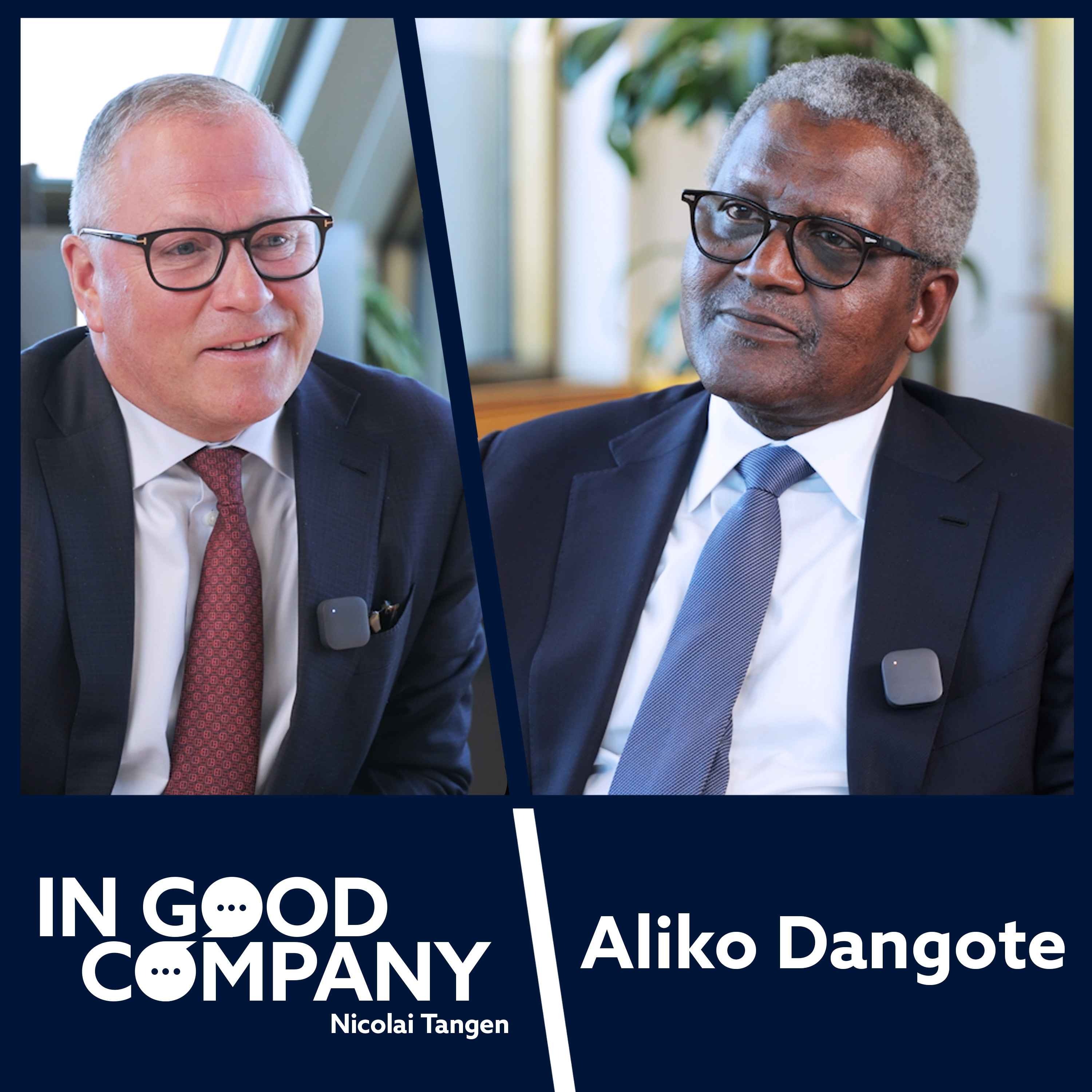
In Good Company with Nicolai Tangen
Aliko Dangote: Building Africa's industrial future from the ground up
00:49:49
Loading summary
Transcript136 lines
- [00:01]
A
Hi everybody. I'm Nicola Tangen, the CEO of the Norwegian Sovereign Wealth Fund. And today I have a real pleasure sitting down with Aliko Dangote. Aliko is the founder and the CEO of the Dangote Group, Africa's largest industrial conglomerate. Nearly 50 years ago, he started with a small trading firm in Nigeria. And today his empire stretches across the continent. He has built what many said was impossible, a large scale African industry from scratch. Warm welcome to.
- [00:29]
B
Thank you very much. It's a pleasure having to be here.
- [00:41]
A
How did it all start?
- [00:43]
B
Well, I started as a trading company in 1978.
- [00:49]
A
And what kind of things did you trade?
- [00:51]
B
Cement at that time. I started first with cement. I was getting four or five trucks and trading them there in Lagos. And then later on I got into fish, into rice, into sugar. And you know, we started. We continue to expand. My first import of sugar was actually in 1980, you know, and everything was under import license. So I got a license.
- [01:19]
A
And you. And you have family. I mean, your family had been into trading for several generations, right?
- [01:24]
B
Several generations.
- [01:25]
A
Your grand.
- [01:26]
B
My great grand. You know this if you. From the maternal side. My mom's grandfather, they call him Alhassan Dentata. He was actually even trading, you know, Nigeria, Ghana, you know. And he died in 1955, before I was born. But he was the richest West African at that time, during his time. And of course, my own late grandfather, Sanusi Dentata, he was actually the richest Nigerian too at some point.
- [01:56]
A
And you grew up with your grandfather?
- [01:57]
B
I grew up with my grandfather because my father died when I was just about 8 years old, you know, so.
- [02:04]
A
But was it your grandfather who.
- [02:07]
B
Yes.
- [02:07]
A
Who taught you how to trade?
- [02:09]
B
Who taught me how to trade? He sent me to school and this. But then actually I never, ever grew with my father. I've never stayed with my father, you know, because when I was born, I was the first grandson. I know in our tradition, first grandchild will now go and stay with grandparents. So my sister, my late sister happened to be the first grandchild, so they took her away. And then the next was me, a boy. So they also took me away. So both me and my sister, we grew up with my own grandparents. Wow. Yes.
- [02:49]
A
What's. What's the key to trading?
- [02:53]
B
Well, the key first of all is actually discipline. You have to be very, very disciplined. You have to know what to trade in. It's not that you'll be jack of all trades. No, you must choose what do you really want to do for your life. And then you pick up and Concentrate on that. And then pleasure and business, they don't mix at all. And that is the kind of discipline that I got. My grandfather used to start working from six in the morning and he work till, you know, late. Had a very simple life. Some days he drive himself. That is how simple that you know. He was very disciplined, honest person. I actually took a lot of things from him.
- [03:46]
A
What did you take from him?
- [03:48]
B
First of all to be very honest, to make sure that you are fair to everybody, to be also generous. He was very generous. To tell you how generous he was. He gave out all his assets and money before he passed. And then also in terms of business, he has always been very, very, very, very fair.
- [04:12]
A
When you say that business and pleasure don't mix, does it mean that you don't like what you do?
- [04:17]
B
I love what I do. So when you look at the business, for example today, right. Why is it that people see that I work so hard? Do you know why? Because my business is actually my hobby. I take my business as a hobby because if I take it as a job I won't work this hard.
- [04:36]
A
How hard do you work?
- [04:39]
B
I work. Let me give you an example. I go to bed maybe sometimes 11:12, but I wake up around 5 in the morning, I go to the gym, by 7:38 I'm done. Then I go to my office and I work as hard as any staff.
- [05:00]
A
And you are close to 70 now?
- [05:02]
B
I'm close to 70? Yes. I'm 69. I turned 69 just a month ago. Actually about three weeks ago I turned to 69. But I think that discipline is good because I don't want to. Let me tell you something, you know Nicola, for example, when I decided to go into industry, you know what I did? I sold all my properties in the us. I had two houses in the us, big mansions and I had a house in UK and I wanted to really sit in Nigeria and concentrate. Why? You know sometimes when you own a house, a holiday home, anywhere you have to create that time to go and use that property. So now my life is very simple. Wherever I go, I use hotels, I pay, when I leave, nobody will call me and say I have a boss pipe or something is wrong. So I'm committed to what I do and I just don't do things off it. I always create a vision. It's just like now we created a Vision 2030 so that I know I have a target to meet. I just don't do business on a normal this. And no, no, no, all my businesses, they are Targeted.
- [06:23]
A
How do you, how do you decide which businesses to be in? Because you could have chosen everything and then you've had a few things and you focus in on fewer things.
- [06:30]
B
Well, I first of all look at what do we need as people, what is it that we supposed to be producing and we're importing. So we do what you call a, you know, backward integration. Which means what we are importing now, we produce it. We produce what we need and we are now producing things that when you wake up as a human being every morning, you must use part of what you produce.
- [06:58]
A
So that's like cement, sugar, produce, cement. But you have also tried, you tried flour and you tried textile and you exited that.
- [07:06]
B
I exited that, yes, because of the foreign exchange challenges. That is why we left the flour mill. But today we are very, very good in terms of exports. If you look at it now, part of what you are announcing is that when you invest in any of our business going forward in the cement, for example, in the refinery, in the petrochemical, in the fertilizer, in the port, we guarantee to pay you dividend in dollars. Because we're very well into exports. 80% of our revenue will be in dollars. So that is why we are now saying that, look, yes, you can have a choice if you want for locals, we can pay you in naira. If you don't want naira, you don't want to de risk, you know, because most foreign investors, sometimes when they invest in a company, what actually matters to them is that when they get their dividend, it's difficult to also get money to buy and remit your money. But we have addressed that issue. We are saying that, look, invest and
- [08:16]
A
you generally reinvest the money back into the business.
- [08:18]
B
Oh, all our business. Because if you look at Demote Industries, right from inception to date, we have never ever paid any dividend. If we are going to get dividend, we only get it from companies that we listed. But companies that are wholly owned by Dangote Industries, which they are not listed, will never ever take a dime out of the company.
- [08:41]
A
But Aliko, when you look at the group now, what would you say are the, let's say, three most important decisions you have made that has made this a success?
- [08:52]
B
Actually major decision is to now go into cement. In trying to save a lot of African countries because they are struggling. Cement was selling for $250 a ton in countries like Zambia, in Congo, Brazil, in Nigeria, you have to pay and wait for three months. So we realized that, look, people who are in Cement. They are not really serious about making cement available. So we now came in and we have now invested heavily.
- [09:22]
A
And you're in 14 countries in cement.
- [09:24]
B
We're in 14 countries. Now again, when you look at, you know, oil in Africa, we have a lot of countries that they produce oil, but they don't refine. So they export the crude oil and now they import the products. Importation costs a lot of money. It actually goes deep into our own reserves. So when I look at Nigeria, for example, today, I say, okay, fine, but we've been having fuel queues for 52 years. Sometimes people used to stay at field during Christmas. You might have to go and cure for two days trying to buy fuel for a country that produces oil. And we have tried government refineries. They are all destroyed. They are not really doing well. So we say, okay, fine, let me take this bold decision.
- [10:15]
A
So then you decide, I'll make a refinery.
- [10:19]
B
I decided that I'm going to make a refinery.
- [10:21]
A
Let's make the biggest.
- [10:22]
B
The biggest ever in the world. In the world. Ever in the world. 50% more than the biggest.
- [10:28]
A
$20 billion.
- [10:29]
B
$20 billion of investment.
- [10:31]
A
Tell me about it.
- [10:33]
B
So we started with that. We launched the project in 2013. We have had issues of the land for five years. One land, three and a half years, the other land, one and a half years that we have not been able to get even access to it. All this will be blocked by what you call the mafia in oil business to make sure that we don't come and address these issues. But we were not deterred at all. We were actually focused. We knew what we are doing. And Nicola, when we started, right, the exchange rate of naira was 156. We even got up to 1,900. But we still went ahead. We had to build our port because there was no port in the country that could take those heavy equipment. One piece was 3,000 tons. We have another, which is the regenerator. Then we have another piece which is the crude distillation unit. That is 2,700 tons. So we have almost about 30 of these equipment and we build the refinery, importing most of these preheated in modular forms.
- [11:46]
A
So you have to build a harbor,
- [11:47]
B
you have to build roads. We have to do water. Water is 440 million liters of water, you know, which is treated water. So our water department alone is more than, let me say in hectare in size, more than 30 hectares.
- [12:09]
A
How many people worked on this?
- [12:11]
B
67,000 people worked on the building of the refinery. And it took Us, that's the size
- [12:18]
A
of the town where I grew up.
- [12:20]
B
Well, you know, but I mean, that is how we had to actually now because we are building something. And luckily, let me tell you what people don't know. Luckily for us, we didn't know what we were building. Because if you knew I was faced with the plan and the drawings all at once. Right. I wouldn't have built this refinery. I would have actually chickened out. Yes. Because I mean, you know, when we started, you know, it's like you started swimming across the ocean. When you get middle of the ocean, you realize that the tide was bad. When you go forward is bad. When you go backwards is. So you have to work forward. And that is what we did. We have to just keep working and working and believing that we will deliver.
- [13:08]
A
Where did you get your money from?
- [13:10]
B
We got a lot of support. You know, first of all, we were actually meant to fund most of this from our internally generated funds. But because of the devaluation, so we had to now rely on Africa Bank, African Finance Corporation, Zenith Bank, Access Bank, UBA and couple of some of the local banks. But of course we also have a very good relationship with the Standard bank of South Africa. And at the beginning, Standard Chartered bank of uk we were very, very, very, very lucky. And what happened when we finish the refinery? Things now have turned out to be much more than our own expectations.
- [14:00]
A
What are you seeing on the back of the crisis in the Middle east in terms of that business? Well, actually, all your businesses, what are you. What's the effect?
- [14:10]
B
Well, the effect on our businesses is actually more of beneficiary.
- [14:16]
A
Yeah.
- [14:17]
B
Then actually downside, because if you look at urea, where we are producers, which is the fertilizer. Which is fertilizer. Today, fertilizer is in a very high demand. Not really in the high demand. In February before the Middle Eastern crisis, we are selling a ton for about $400. Today we are selling a ton of, you know, fertilizer for $850 and were actually oversold in plastics. Polypropylene, it has moved from 900 in UK today is about $3,000. Okay. And for us, if not because of the polypropylene we are producing today, all the plastic industry in Nigeria, which they are very huge, they are almost like number two or number three in terms of employment. They, they would have shut down because there's nowhere you can even get it. Our aviation were oversold to end of, you know, till middle of July, you know, and we're producing 20 million liters
- [15:23]
A
a day, where do you source your crude now?
- [15:26]
B
We source about 56% from Nigeria, some from other Angola. We buy quite from Angola. We buy from Libya. We buy from us at a point we are doing almost about seven to eight cargoes of WTI from, you know, us. But we are getting more of Nigeria's crude now. So, you know, we have to buy now 21 cargoes every month. That's how big we are. And you know, we're more than doubling the refinery, you know, in the next 30 months will be at 1.4 million, which is huge.
- [16:08]
A
What are the forces which have been trying to work against you in this project? Just you, you mentioned kind of, you know, the kind of mafia.
- [16:16]
B
Well, the people who are actually benefiting because Nigeria was given almost about $10 billion every year as subsidy. So there are shippers who are making tons of money. There are traders who are making tons of money buying the crude and sending us, you know, product. They use it. They said that, you know, it's, it's a trade which they give you crude and then you supply them with products. They are also the local people because it was subsidized. So a lot of people, very few people are getting allocation. So they are making tons of billions of naira. So these are the people that are not agreeing for us to settle down because they believe that, no, we are coming here to displace them, which is, I mean, that's of, of course, that's what we have done now.
- [17:11]
A
Absolutely. And now you're going to replace more people because you are planning to do a project in Tanzania.
- [17:18]
B
Tanzania. There are a couple of countries that they say, okay, look, with what has happened in the Middle east, we don't want to rely on the supply anymore. From there we need our own refinery. So Uganda, Tanzania, Kenya and some of the other countries like, you know, I mean Rwanda, when we build the refinery, the same size 650, we'll be able to serve up to Ethiopia.
- [17:47]
A
Are you going to build all these refineries?
- [17:50]
B
Yeah, we're going to, we're going to build.
- [17:51]
A
So what's the total spend on this?
- [17:55]
B
We have now the group as a group wide. We have $45 billion to spend. But you know, we're also doing LNG in Nigeria. We're doing a gas infrastructure to remove all the gas we are flaring in the southern part and eastern part, bringing it to the west while we are setting off an LNG, you know, plant. About 12 million tons of LNG each train would be about 6 million.
- [18:21]
A
How are you Going to pipe, Are you going to pipe this together?
- [18:24]
B
We're piping from there down and then we have the gas treatment plant. You know, the Nigerian gas is an associated gas so you have to treat it before you can now use it to regulate, you know. So what we are trying now to do is to make sure that, yes, we look at our income, what is our income stream, what is our revenue and what is the EBITDA that we have in between 2026-2030. What is the gap that we have? What is the another insurance gap that we need to fill? And this is what we have done. And that's why we're coming off with selling part of the business, getting more investors into the business and also making sure that we continue to, you know, isolate on the business. Cement, going to 100 million tons in cement. Really, we don't even need much money. We are getting financing and the cash generation is very liquid heavy. So we'll be able to actually fund this 45 billion which will eventually take us to $100 billion of revenue. Because our target is to get to $100 billion by 2030 and with a market valuation of maybe more than 200 to $50 billion. Because as we speak today, last year our EBITDA was $3 billion. But the target by 2030 is to be 10 times that amount, is to be at over 30 billion of EBITDA.
- [20:06]
A
What's the difference between thinking big and thinking too big?
- [20:10]
B
What is the difference between thinking big? Because if you think big, you grow big. When you think small, you don't grow at all. So you have to first of all know that the business you are going in is a business that you know in and out. It's like myself and any of the staff, 10 of the topmost staff, when you work them late at night, they will tell you the process of each and every part of our business business. So we don't think small because first of all, we know that the market were operating. That's big gap.
- [20:45]
A
But how do you make sure you don't overstretch?
- [20:47]
B
No, we don't overstretch because we make sure that whatever that we do our own in terms of funding, we can fund it with no sweat. We have a lot of financial institutions that they believe in us and they are ready to go ahead and back us financially to be able to deliver. That's number one. Number two, they know that we have history of delivery of projects. So since we have history of delivery of projects, they know that, yes, their money is not going to be at risk. We have delivered a refinery that has never ever been built with petrochemicals and we manage 67,000 workers at site. We build during the most dangerous, difficult times, which is Covid. We built in a very difficult environment, which is Nigeria and were able to deliver. When we delivered, did we really commission? Did this really work? Very well. The answer is yes. The refinery has been tested. We have now processed even crude at 661,000 barrels per day. So we have demonstrated that capability with where now a lot of financial institutions are saying that yes, if it is dangote you are doing this project, we are there to back you because we know that you can deliver. You have the capacity and you have the knowledge and you have the experience.
- [22:09]
A
So now you have 18 businesses in 17 countries. What are the biggest risks, you think?
- [22:15]
B
Wow, well, the biggest risk for us is actually if there are civil war, which is not. I mean, it's not in the offing at all. The other biggest risk is, you know, government inconsistencies in policies of which we're addressing that one. Because if you look at like our refinery, the national oil company already owns 7 and a half percent, 7.25% and they are trying to buy more. Were those that saying that? No, we want to now spread it and have everybody to be part of. So these are the two biggest risks that we have. The other one was to do with infrastructure. But what we are doing also, Nicole, to tell you, the infrastructure, we are working with government. You know what we are doing today, we have roads which they are more than $3 billion which we are building. So the issue is that because our taxes, our companies are doing well. So the taxes are high.
- [23:20]
A
Because you're the biggest taxpayer in Nigeria.
- [23:22]
B
Well, yes. So now what you are doing is that we are building roads. When we build the infrastructure as roads, there is a government policy where they allow us to defray what we have invested in the roads over a period of three years. First year we take 50%. Second year, 25%. Third year, 25. So we don't really wait for government to give us that infrastructure. We are now building the infrastructure to be able to absorb the kind of businesses that we are doing. And not only for us, for the other investors in Nigeria.
- [23:56]
A
What are the challenges when you are the biggest employer in the country, you are the biggest taxpayer and you are dependent on the government? What are the challenges operating in that environment?
- [24:09]
B
Well, we are not depending really on the government. No, because if you look at it, it's like anywhere in the world today, people who are operating in America. For example, Tomorrow morning, if Mr. Trump wakes up from the wrong side of the bed, he can bring a regulation that can either help them or try to slow them down, which I think today those things are changing even in Africa, because the governments, they believe that the only way for them to, you know, create jobs, okay, to create employment, is through the private sector because the government is already full to capacity. They don't have the resources to do that. But depending on the private sector, where now you give very good investment policies, right? Given those good investment policies, it means that it has made the governments to be partners. How are they partners? You know, today if I run the business, even if I, when I don't make money, I've generated a revenue where the government will collect VAT and they collected minimum taxation. So government in some of these, like our cement business, I keep telling people that government is making more money than us because of the various taxes that we pay. But we're happy because we're also growing. So we're okay with that. You know, we want to also behave and be a good socially responsible company. And that's what we are. So it is a partnership where government will now give very good investment policies, good regulation, and making sure that, yes, we also don't abuse the system, which we don't.
- [25:51]
A
What is it that foreign investors don't understand with when it comes to doing business in Africa?
- [25:57]
B
What they don't really understand? There's one thing that really that is baffling them, that okay, fine, if we, while what you are saying is good, how come we Africans are not investing in our own economies? Because the mistakes that we've been making in the past is that we are looking for foreign investors, but foreign investors are only attracted by domestic investors. So. And that's what we are doing today, Nicola, because if you look at it, we are investing heavily. I mean, we don't even take money out of the business. So majority of companies today, I can just mention a few like adnoc, were in a very big discussion with them. And we want to have a very serious partnership in fertilizer, in the oil business, and in any other business. Businesses like infrastructure, people are looking at infrastructure. That's why we're building the biggest, deepest port in Africa in just about 60km away from Lagos. So these are the sort of things that we are doing, which I believe now the government also themselves, they realize that look for me to deliver on my electorate promises, I have to work with the private sector. So that has actually given us an insurance because if the government disrupts any of our business, they will be the first ones to suffer before us.
- [27:25]
A
How different are the African countries in terms of culture and company culture and how different is it to do business in the various countries?
- [27:33]
B
It's not really very difficult because it depends on what kind of culture you try to create in your own organization. If you have a very solid organization, you have very good culturally, you know, trained staff, it's as good as being operating anywhere in the world. So, I mean, there's actually no issues about that at all, you know, like what I told you. We just don't go and pick up people from the streets and employ them. No, we have an academy, we have graduate training. These are people that we employ the best or the best in universities. And we put them through what you call graduate training. And once they are, you know, we have always been giving them a choice to be fair because we are the big corporation in the country or even in the continent. We are saying that, look, if you are happy, stay with us, you have a guaranteed job. But after you are training, you might as well, even if you have a better offer from Shell or any other company, you can go there. So we're actually contribut to the national development of the country. And now we are in 14 African countries. What you always do also is to go to these 14 African countries and bring them in to train them. We have also what you have, what you call young global leaders, which you have now trained over 200 Africans. And it cost us a lot of money because it's in partnership with the Davos, with the World Economic Forum. World Economic Forum. So World Economic Forum, they are doing this thing for Africans. They are giving Africans only five slots. So I said no, increase it to 25 to 30 and Dangote foundation will pay the bill. So which you have now, I think it's a project that is costing us about 650, 700,000 Swiss francs every year. And we're picking up people that we don't even know. Some of them they are, you know, but you have to be below 40. Some of them are ministers. So they go now and join these young global leaders, you know, with a very, very good. And they are very happy. We have.
- [29:48]
A
But when you look at the demographics of Nigeria and Africa, you would need a lot of young leaders.
- [29:53]
B
We have, I mean Nigeria, I mean In Africa, by 20, even 30, we'll have almost one point, we'll have almost one. No, 20, 50 will have 1.6 billion working, you know, staff, you know, these are young people, you know, in Africa, majority of our population, they are below 30. Yeah, more than 70%.
- [30:19]
A
What are the reflections? When you think about that, what are your reflections?
- [30:23]
B
My reflection is that the future is Africa. When you now sit down, you reflect where we are today and what needs
- [30:30]
A
to happen for the future to be Africa.
- [30:32]
B
A heavy investment in infrastructure, in training, education first, because you have to work with an educated society of which a lot of the governments, they are putting average of about 15, some of them even 20% of their budget into education, you know, because we have to upskill to make sure that yes, we are producing the workers that we need for tomorrow.
- [30:56]
A
What are the most promising countries from that point of view?
- [30:58]
B
The promising countries, Nigeria, Ethiopia, Kenya, Tanzania. Rwanda is small, but it's very, very promising. You have, Egypt is promising. Algeria is also promising, even though they are not very open. So there are more than 10 very good countries in Africa that can go and invest. Ghana is doing extremely well. Cote d', Ibois, which is, you know, in West Africa, they are doing extremely, very well. Even guinea today you look at the mines that was just opened by Rio Tinto which cost over $20 billion. You know, so people are coming in now, they realize that yes, Africa is open for business and people are ready to go into these sectors.
- [31:53]
A
And who is helping Africa with business now? Can you just reflect a bit on China versus the US versus Europe?
- [32:05]
B
Honestly, Nicole, you want me to be very open? Totally. Yeah. So is China. China really have dominated business in Africa.
- [32:14]
A
And how do you.
- [32:15]
B
Because of the absence of the others.
- [32:17]
A
Yeah, how do, how do you see that?
- [32:20]
B
Well, they are making money, they are dominating the landscape. And obviously, you know, Africans, you know, even our own governments, they don't joke with China because China, they put their balance sheet on the table.
- [32:36]
A
So some examples of how China has helped you.
- [32:40]
B
Okay, let me. Some of the projects like in cement, like some of the things that we do. Purchase of their equipment and co, they give you a suppliers credit backed by their insurance company which is called Cynos Show. Cynosure has invested to talk about 1.2 trillion in supporting their companies to go abroad and sell their technology, sell their equipment and giving you a credit of four, five years. Okay. But if you are now going to, now if I now go to Italy, for example, and they're asking me to write a check of a power plant of $500 million that I want to, you know, build and I have one which is also good, might not be even as good as Italy. Okay, but the Chinese are saying that. No, no, no, just give me 20%. The rest I will give you five years. You know, financing. Which one are you going to take? If you are in my shoes, obviously you take the Chinese one. Because the Chinese one, it means that I can do more. These ones, they will suck out my cash and I won't be able to do more. So for me to grow that big, I also need to leverage. I'm not going to over leverage, but I need to leverage the business to be able to get to where I want to be. And where we want to be is something very, very, very big. You know, we want to do pause. We are spending $45 billion between 2026 and 2030. So if we are going to, you know, obviously I will le. But right now, today I've seen the US is also changing. This time around when I went to Development Financial Finance Corporation of US they just got about 208 billion. They are very hungry for infrastructure, they're very hungry for the ports and they are ready to lend. So with that one then they are ready for us to now look at them and do more business. I've had delegation of some people from the House of Reps of, I mean the assembly of Japan. And what I told them is that no, Japan, you've been missing for a very long time. And today when you are coming, make sure that you come with your own balance sheet on the table. Because we have choices of buying from many other countries. But if you don't really come with that support, I have to go to a country that can give me that support for me to be able to leapfrog to the next level.
- [35:31]
A
Yeah, I can see that. Do you think it's possible to increase efficiency in Africa without increasing inequality?
- [35:40]
B
Well, the inequality issue we have to address it will be very difficult to do that without addressing the issue of inequality. And that when I think various governments of Africa, they are working towards that and I'm sure we'll get there.
- [35:58]
A
And climate, well, the climate, you know,
- [36:01]
B
when you look at were not the biggest polluters in this whole thing. We're less than 6% of the of the polluting the environment. So we're doing quite a lot, you can see, but it's difficult.
- [36:14]
A
I mean cement production is difficult, right?
- [36:16]
B
Yeah. But we have quite a lot in cement today. Nikola. It's not like before. If you come to our cement plant in any, even under the kiln that is moving, rotating, you can sit down there and eat the process that we have is more stringent than that of even Europe. In our own plants, we're using robotic machines. We're using the dust emission is very low. We're using alternative fuel to make sure that we cut down all this. And if you look at it now, what are we doing today? You know, the biggest polluters are shipping companies. So we're stopping almost, maybe 500 ships from going in there to pick up crew to go and refine, to now bring back the, you know, products. Today, as we speak, almost all our trucks, maybe 90% today of our trucks are all CNG. We're not using diesel, even though we produce diesel, but we are using cleaner energy for that. We are looking at now not only generating power from hydro and gas, we're also doing solar and wind. So because we have massive land, especially in the northern part of Nigeria. So in every aspect of our own business, which is also driven by the government, is to see how do we actually. Because this climate change is real. But, you know, with us, we have a lot of issues to address first before we now get to that. So what we are doing now, we are doing them simultaneously, trying to provide for our needs at the same time working on the climate. Because, I mean, today we can't just say, hey, look, climate, from today we will not do this. We don't know. But what we are doing is that, yes, we are providing what we need, but at the same time bringing in the climate issues into place so that we will be out of these climate change issues.
- [38:36]
A
Aliko, let's move on to leadership. When I talk to people about you, one word that comes up again and again is patience. What's the key to patience?
- [38:46]
B
The key to patience, first of all, you have to have, we have very good people that were leading in the organization. So sometimes you have to be very patient for people to be able to pick up and be able to prepare themselves for that leadership. So we're preparing a lot of our people to be able to take over that leadership. And that's why we have to have the patience. Or in terms of, okay, fine, somebody will just not start running first day. So my leadership style is to make sure that, for example, when I'm hiring people, I always hire people who are more intelligent than me.
- [39:26]
A
Well, I don't, I don't, I doubt that. But how can you check whether I'm a patient guy? So now you're interviewing me, what do you ask for?
- [39:32]
B
Well, you know, if I'm going to have this, you know, in the interview, that's why we just don't do interview through the zoom or whatever. No, no, no. We have to first of all sit down with you and talk to you. You know, you can also ask us questions. But what you are looking for is, is to have that chemistry. We have to now make sure that we align. We have the same, you know, thinking. And you are not thinking of something totally different. You are not thinking of being socialist, for example, or we are thinking about being capitalist. So that chemistry has to come in.
- [40:09]
A
Are you more patient now than when you were younger?
- [40:14]
B
To tell you the truth? Let me be very honest with you. I'm more aggressive now.
- [40:20]
A
Why? Why?
- [40:21]
B
Because I've seen a lot of opportunities that I've never ever knew that they exist.
- [40:26]
A
Wow.
- [40:27]
B
Never. I've never ever. I told people that I've never ever dreamt of my own company. I've been an ambitious person right from childhood, but I've never ever thought of my company being 10% of where we are today. And we still have a lot of, you know, opportunities to go. Because I look at like China, I mean look at a country for example, like Singapore, they don't have natural resources, they don't have land, they don't have anything. But they've been able to create something out of nothing.
- [41:00]
A
So when you look at the opportunities that you didn't see before, what are they?
- [41:04]
B
Oh, a lot, a lot. I mean, we have the critical minerals. Africa controls about 60% of the world's critical minerals. We have young, energetic population. We have the most arable land in the world. 60% of the arable land of the world is there. Okay, we have land mass. So all this one and the minerals that we have were not actually processing any one of them. So the opportunities are enormous. A lot of now you look at what happened now between Ukraine and Russia, European countries are now running to see where can they get their energy from. Like lng, for example. Nigeria, like what I keep telling people, is not a country that we don't have oil. The oil that we have is not as good as, not as much as the gas that we have. Most of Nigeria's oil, I mean gas came out by accident as a result of looking for oil. So when we go now deep looking for gas, Nigeria can be one of the biggest suppliers of LNG in the world. And that's why now we want to do a gas pipeline which the government is promoting and they want us to join taking gas now all the way from Nigeria around up to Spain by the coast side. So now we are already in Ghana. So Ghana. The next phase will be Cordoba, Mauritania, where they would inject their own gas. Then Senegal, two will inject their own gas. Then we jump into Europe. So going forward, Africa will be supplier of most of these criticals, critical items.
- [43:04]
A
What do you think is driving you now? I mean, you're already the wealthiest guy in Africa.
- [43:09]
B
What is driving me is legacy. Actually, it's not about being, you know, richest, because, I mean, I don't have too much of needs, you know, I mean, that's why, I mean, today, okay, I have. I'm restricted. I cannot just do the giving pledge where now, now I pledge all my worth to this. You know, in my religion, Islam, it does not allow for that unless if the inheritors agree with you. But I have given now one third of my worth to the foundation. If anything happens to me now, one third will automatically go to my, you know, you know, foundation. But what is driving me the most is that we have a lot of needs in Africa and for people like us, for cooperation like us. We are the ones that are supposed to provide that leadership in terms of transforming the economies of Africa. If we don't, we will not be able to get support from anywhere. We have been waiting for long for foreign investors to come and invest and actually, you know, show what are the potentials of Africa. But today, we are the ones that will end up showing people that these are the potentials. And we believe, I personally believe that by doing so, a lot of corporations will join us in funding this massive infrastructure that will make Africa, you know, to be at the next level.
- [44:40]
A
What do you hope your legacy will be?
- [44:42]
B
My legacy will be that I'm one of those that actually pioneered, you know, the industrialization of Africa. That's my focus, to make sure that Africa produce what we consume. This is my main focus. And for us to, to keep pushing to make sure that we have one common market. I have a group which is called the African Renaissance. And there are quite a lot any big guy in Africa. 54 of us were in this group which we meet physically once in a year in Rwanda, which is Kigali. And we've been supported by a lot of presidents. And I think the more they understand what we are trying to do, the more that we'll achieve, you know, because nobody can transform our continent but us, we Africans. And that is why we're trying to mobilize all the entrepreneurs to make sure that they join us and at different levels. Some will be doing big things, some will be doing medium things, some will Be doing, you know, this, and then that one will attract foreign investment while now, because we don't have enough to be able to provide and take the continent to the next level.
- [46:00]
A
How do you. How do you use your foundation to try to improve the continent?
- [46:05]
B
Well, the foundation's work, you know, the foundation, about 2014, I did an endowment of $1.25 billion. So what we are now doing mostly is actually partnership. We have, I think, if I'm right, based on what Mr. Bill Gates told me, he said that, you know, we are one of the best partners they've had as a foundation. You know, we've been able to eradicate polio and we're working on quite a lot of things. You know, primary health care, nutrition. These are areas that we are working with them in some areas. In education, we are doing that on our own. But as we speak right now, my head of foundation, she's in Saudi Arabia trying to work with other foundations to see how do we really attract. Because we have, unfortunately in Nigeria, we have almost about more than 10 million kids out of school. So we're investing heavily in terms of education and as we grow more, we'll keep funding the foundation to be able to take care of all this poverty alleviation, health, empowerment of people, and also education. So these are the areas that we're really focusing.
- [47:28]
A
How do you relax?
- [47:29]
B
How do I relax? I try to sometimes take my grandkids, if they're around, take them to the beach. I love going to the beach, but I love also.
- [47:41]
A
What do you do? What do you do at the beach?
- [47:44]
B
We just go there and play. That's what.
- [47:47]
A
Talking of play, you're a big Arsenal fan. You nearly bought the team, right?
- [47:51]
B
I almost, yes.
- [47:53]
A
And tell me about it. Well, you know, you had to make a choice.
- [47:57]
B
When, when, when I was really very, very focused on buying Arsenal, then I was also facing the challenge of making sure the refinery gets to its own completion. The fertilizer, the petrochemical. And then when I look at it at that time, I say, okay, fine, but I have needs of funds. Will I go and put. At that time, Arsenal was worth just about $2 billion. Should I put my $2 billion in Arsenal and now allow the business to suffer, or should I now complete the business? Then I can continue to remain a very big supporter of Arsenal. So I decided that, no, I'm going to continue to support them, watch their games, go there. And I am an Arsenal fan rather than now trying to.
- [48:43]
A
Do you have a scarf? You have a red and white scarf.
- [48:45]
B
Yeah, I have even, you know, the teachers every day that any time that they are playing, I always wear the T shirt and I have one, you know, which was also signed up by the captain. So I mean, I'm a fan. It's better for me to remain as a fan and continue to fund my own business rather than just putting, I mean, today they are worth billions and it's not really worth my while at all.
- [49:09]
A
What is your advice to young African people?
- [49:12]
B
My own advice to young African people is to work hard and also have the belief that the future is greater than the current situation that we're in, that Africa is a promised sea land and they should stay at home and make sure that we collectively build our continent rather than just flying out somewhere else.
- [49:39]
A
Aliko, it's been amazing.
- [49:40]
B
Thank you so much. Thank you. Thank you. Great to be here.