← In Good Company with Nicolai Tangen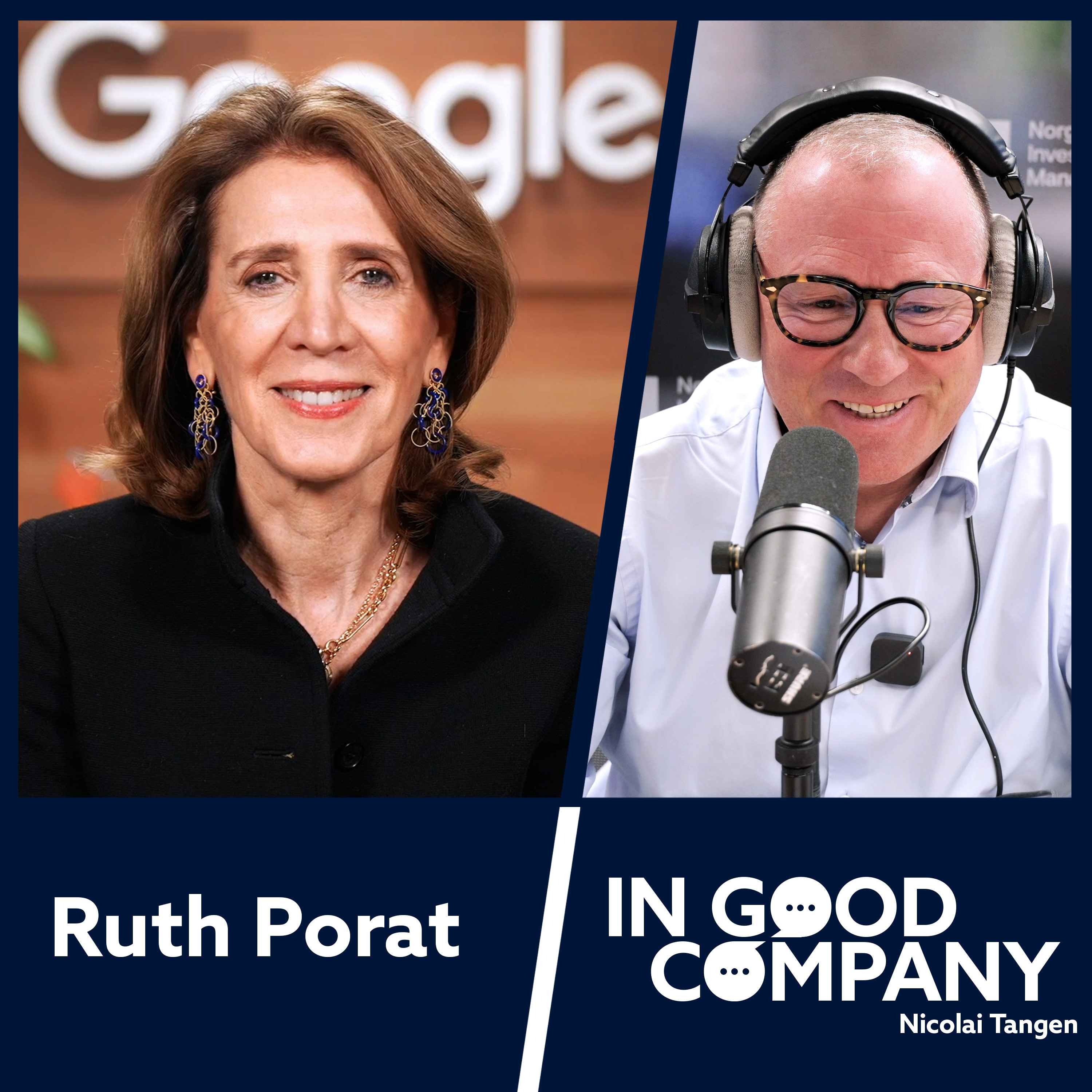
In Good Company with Nicolai Tangen
Alphabet President and CIO: Advancing AI, Quantum Computing, and Self-Driving Cars
00:51:19
Loading summary
Transcript88 lines
- [00:01]
A
Hi everybody. I'm Nicola Tangen, the CEO of the Norwegian Sovereign wealth fund. And today I'm in really good company because I'm here with Ruth Pohrat, the President and Chief Investment Officer of Alphabet, which is the parent company of Google. Now, of course, Google needs no introduction, but Alphabet in addition also makes self driving cars, AI chips, it owns YouTube and many more things. And we own 1.3% of the company, totaling roughly $30 billion. So big. Welcome, Ruth.
- [00:29]
B
It's great to be with you. Thank you.
- [00:40]
A
Who is going to win the AI race?
- [00:44]
B
Well, we feel we're in a really strong position for a number of reasons. I think when you look at the history of Google focused on AI, we started many, many years ago. And at this point we have a very differentiated approach which starts with the extraordinary team we have led by Demis Asabas, who obviously just won the Nobel Prize. That goes to the strength of the models. You look at what we're doing on chips with our TPUs and then we're already really using it across our various platforms. So billions of people are benefiting from AI. So this full stack approach we think is an important element. That being said, what's exciting to see is how much innovation there is broadly. And so what we're looking at is the opportunity, I think collectively, globally, to have an unlock from the upside, given the innovation that we're seeing not just at Google but at other places.
- [01:47]
A
So is it now a matter of who's got the best people or the most money or the best data or the best chips? What is it about?
- [01:55]
B
Well, the reason I started with what we're really proud of, our full stack approach, from talent and models to the platforms and chips, is it really is taking this full stack approach and I think very importantly, this intense focus on innovation and continuing to push forth. One of the things that really struck me when Demis was awarded the Nobel Prize this last fall and he was asked what was it that really started him on this journey? And he said what motivates him is to take on the most intractable, what were thought to be the most intractable problems facing humanity. And I think that ethos is another really important element of how one continues to drive forth and have the biggest impact with AI.
- [02:44]
A
Do you think generative AI can be monetized the same way as search is?
- [02:49]
B
I think generative AI is continuing to enable us and others to expand the quality of what is being delivered across a wide set of opportunities. Just to give you two examples, I'm often asked, where are we investing extensively, probably not surprisingly. You know this well given how close you are to all that we've been doing. But certainly search remains so core to who we are and we've evolved search meaningfully over the years and we're continuing to apply generative AI to what is that experience that one has when you search? And what we're finding is that it opens the types of queries that are being explored. It goes for a deeper, richer engagement. So that's one area. The other area that's really important is what we're seeing on the enterprise side and the ability to help companies and the public sector transform the businesses and their approach. Whether it's engaging with customers or on the efficiency side or on risk analytics or with constituents, each of those provides opportunity for monetization.
- [04:01]
A
Some of your competitors say that you were a bit slow out of the box when it came to AI models, but your latest Gemini is. It's phenomenal. So what happened here?
- [04:14]
B
Well, Google search for decades has really stood for extraordinary quality. It's what everybody around the globe expects of us. When you go to Google, quality answer very rapidly surfaced for you in the most potent way. One of the very important questions for us, Sundar's talked about this in the early days of of generative AI. Internally we were all talking about the risk of hallucination and that term now is very well known quite broadly. One of the concerns is if you in the middle of the night, wake up, your child is sick, you want to figure out how much Tylenol to give to a three year old, there can be no margin for error. That's what our brand stands for. It's very important to us to make sure that as we were evolving and applying generative AI, we did it in a way that was consistent with the quality that's expected appropriately from Google. And I appreciate your question because what you've seen is the really ongoing momentum in models and introducing models more broadly externally. What we've done with for example, AI overviews where when you search you'll get this kind of an AI cockpit is the way I like to think about it. You're seeing more in things like model advancement that can be applied in other applications. We're excited about the momentum that people have seen through 2024 and what is ahead in 2025.
- [05:48]
A
Talking of which you call the latest model for the model for the agentic area, what does that mean? What do you put in that?
- [05:56]
B
So that's one area that Sundar and Demis and the team are really Excited about, which is, how can AI actually be an agent working on our behalf? How can it help you do some of the administrative tasks that are going to make your life easier and actually free you up to do something else? Book a reservation for you, research something for you? How can it even be applied, for example, in science to do some of the basic inquiries? So set it out to do something to work on your behalf.
- [06:28]
A
So three years from now, what does your day look like? How is it changing your life?
- [06:34]
B
It's a great question. As it relates broadly to AI, I think one of the most important things for all of us is that AI can really be an assist. It can be operating leverage for every one of us. When I started my career on Wall street, how was it as you were moving from basically big computers to laptops to phone, this becomes operating leverage, if appropriately appl. And so one scientist once said to me that they view this as augmented intelligence, not artificial intelligence, in which that had been the word that was used. That's what it is for each one of us. I think what's really important is to understand that, in fact, it's not that we'll be replaced by AI in our roles, but we can be replaced by someone who's using AI, who's getting that operating leverage. If we're not, it's so important for people to just start experimenting, just start playing, so that you're on that learning journey.
- [07:34]
A
Now you make your own AI chips, the TPUs. Why? Could you explain just how they are different from other chips and why you do this?
- [07:42]
B
Well, we work very closely with Nvidia, they're a strong partner of ours. So we use both GPUs and GPUs. And many years ago the team started on this journey of developing our own chips, TPUs, to address some of the specific requirements that we felt we needed. And what we found is that we continue to have the type of performance that we're looking for, in particular in training. And as we've advanced the TPUs, what we're seeing is we're continuing to drive greater efficiency in all elements of energy requirements with TPUs. So there's a cost benefit for us and impact benefit. And so we're using both in the.
- [08:21]
A
Fleet, talking about various versions of things. So now we've had Deep SEQ being launched, which is an open source model. Now, just how do you look at open versus closed source models now?
- [08:38]
B
So open source has been core to Google really since inception. If you think about something like Android, which is such an important operating system globally, it reflects who we are. When you think about the transformer paper, which has been so critical for anybody who's thinking about how do you build in this AI world? Like, what's the next stepped the next iteration. So open source has been important to us. At the same time, this is a really powerful technology. And so what we're looking at is how does one maximize upside, but have the appropriate guardrails and controls over certain elements of it to ensure that you're protecting how it's used and where it's used, and getting that balance right will continue to be very important for all of us.
- [09:30]
A
What are you personally most excited about in terms of usage? I mean, you talked about medicine, AlphaFold and so on. You personally, what do you feel more strongly about?
- [09:43]
B
So when we look at AI, I think there are four primary areas that are really exciting. First is the economic upside. You know, globally the estimates are there can be $20 trillion added to GDP in the next decade. Again, if appropriately executed, if adopted across industry. When you think about the benefit to society, if in fact we have anything close to that economic uplift, I get excited about it. It's not to be taken for granted. As I said, it requires what economists call diffusion across industry adoption, a radical rethink of many elements of the way the public sector and the private sector works. Excited about that, Very excited about the breakthroughs in science. What Demis Hassabis and John Jumper awarded the Nobel this past fall. That was for something called AlphaFold, which you're familiar with, which has been described as the greatest contribution to drug discovery. That is exciting then just even sitting here today, the practical applications of AI in health care, in education, are really exciting. So I would put those at the top of the list.
- [10:53]
A
Talking about something slightly different. You, before the holiday season, sent shock waves through the world with your Willow quantum chip. So why, why is that such a leap forward?
- [11:05]
B
So we've been working on quantum AI, quantum computing for quite some time. Well over, I think a decade at this point. And what's really exciting is the computational capabilities with quantum. So the Willow chip is able to handle a computation in less than five minutes that previously on the best supercomputers on the planet today would take ten septillion years, which even I had to Google. It's 24 zeros on the back of it. What that means in terms of the ability to see and analyze more, whether it's in biology or other areas, is exciting and profound. And so we see this as another path that we will continue to Execute against.
- [11:52]
A
How do you view Microsoft's version of it?
- [11:58]
B
We're really proud of our own. We think that what you've seen time and time again is the breakthroughs from that team led by an extraordinary leader. Hartman published in all sorts of different places. And we just continue to build success to success with the Willow chip being the most recent.
- [12:17]
A
When do you think this will be commercial?
- [12:19]
B
Yeah, it's a great question. Not surprisingly, I ask that question all the time as well and have been for some time. I think there's still a number of years ahead. It's starting to point to different applications that we're excited about. But whether we're three years, five years, hard to say. But it's getting closer since I started asking that question.
- [12:40]
A
And when you talk about these kind of 24 zeros and so on, just what are the implications for this? What are the kind of things we can do when we have that kind of compute power?
- [12:52]
B
Well, when you think about it, take something like the human body and the complexity of the human body or anything in nature that's multidimensional. The ability to actually crunch data more efficiently, to have better insights is one area that's very exciting for us to think about and the possibilities that come from that.
- [13:15]
A
Another thing is where you're strong is a self driving taxi company. Now I'm not sure what the latest number is in terms of rides per week. Where are you now?
- [13:26]
B
200,000 rides. Paid rides.
- [13:29]
A
Wow. So what will the city look like in 5 years time or 10 years time? When do you think it would be properly rolled out?
- [13:36]
B
Well, I think if I just step back and talk a bit about Waymo because we are very excited about it. We started on that journey more than a decade ago as well. And the original thesis is that more than a million people die on the road every year in accidents. And if AI can help improve the safety of driving because our Waymo self driver, the AI does not get tired, it does not get distracted, it, you know, it stays focused on the road. You've got camera sensors everywhere. We can improve safety, we can help save lives. And that was a really exciting motivator for the team. We've been rolling it out. It's been extraordinary to see the take up. It's now one of the top attractions in San Francisco, if anyone's out this way. But we're also in la, in Phoenix and Austin and expanding and we're going to continue to expand because you see both the, the reaction to it when people get in. Some people are Anxious about it at first, and then within literally under a minute, they see. They just go right into whatever it is they wanted to be doing. There's a safety element around it. So we think it'll continue to be rolled out. We're doing a pilot in Japan right now, and there's an opportunity, we think, to help save lives and are excited about doing that.
- [14:50]
A
So 10 years from now, who is going to own a car?
- [14:54]
B
You know, I think it's too early to call. You know, a couple of reasons. One, many people in particular in the States, other developed markets, own more than one car. There are good reasons to own a car. And so we'll see human. Human nature and human behavior changes over time. The other is that Waymo is primarily now focused on, what are these, robo taxis, as you described it. But it's. It's reasonable to assume that this capability, this extraordinary technology, can also be an assist with cars that are owned. And so there are a lot of execution paths which enable you, me, others, to decide how they actually want to get around.
- [15:32]
A
Now, you're also the chief investment officer, and you are in a very fortunate position in that you are sitting on roughly $100 billion and you have all these interesting areas. Just how do you allocate capital between them?
- [15:46]
B
So capital allocation, I think when one of the core elements in capital allocation is that you need to ensure that you're continuing to invest aggressively for the long run. If you don't invest for the long run, you're sowing the seeds of your own destruction. And that's a lesson I've seen throughout my career, over and over, and so very important. It's been core to the ethos, obviously, of this company since inception. The early days, there was kind of a mantra which is 70%, 70 sent in your core, 20% adjacent, 10% moonshots. And that's evolved over time. But this core sense of you've got to continue to invest aggressively for the long run remains core to who we are. And we're at such an exciting time in history, given the opportunity with AI, you know, both on the consumer side, on the enterprise side. So we're certainly making investments there. I end up spending a lot of my time globally because what is really key is every head of state is saying the same type of thing, which is, I want to be a part of this digital transformation. It is key for all the reasons that we've already talked about. What we spend time looking at is as we're continuing to invest in our technical infrastructure globally, in Other words, data centers, subsea cables, how do we link up the world? The opportunity is how do we engage more deeply? What work are we doing on their behalf to help accelerate their digital transformation? How do we engage on the public client side? And so there's a really global view to this.
- [17:19]
A
Now you have this moonshot factory in house. What are the type of things you're working on there?
- [17:25]
B
So the moonshot factory, as it was lovingly named years ago, is one of the core areas within other bets called X. And out of X came, for example, Waymo. It was incubated in X and then got moved out to become an independent company. They've also worked on, for example Wing or incubated Wing, which is our drone business. Excited about Wing. They're doing work as an example with Walmart and we're seeing really exciting results there and see the upside. They're also incub, they've been incubating. And you'll hear more about a company called Intrinsic, which is a robotics operating system. And so they have a number of different things that they've been working on. I think one of the very important elements there is that when they are approaching any incubation, their mindset is obviously you can't incubate everything and have it work well and so kill things fast in order to move into the areas that are the most promising.
- [18:29]
A
That sounds really fun. I think it was Charlie Munger who said that Google appeared like a very rich kindergarten.
- [18:35]
B
Well, we've got everything from kindergarten all the way through to postgraduate robotics.
- [18:44]
A
Now you mentioned subsea cables. The fact that you also do subsea cables and so on. Does it make you more resilient, you think as a tech company?
- [18:52]
B
I think there are a lot of elements that build resilience and one of the important areas is continuing to invest in subsea cables. But it's also the what we call technical infrastructure more broadly. So it's data center resilience, data center redundancy, so that you can actually be positioned to serve customers when and where needed. And in the event of something that happens, and things unfortunately always seem to happen around the world, you've got the resilience needed to continue to operate at a high level. It's our cybersecurity defenses. One of the things I've learned in my career is it is much easier to prevent than to fix a problem. And so building in this strength up front is key and it's technical infrastructure. I'm happy to talk more about cables because really proud of the network we have Globally, but it's the other elements, like a zero trust approach on cybersecurity so that you're fortifying defenses in a world that is continuing to become ever more challenging. And I think that's one of the key additional applications of AI that's important.
- [19:54]
A
And how do you look at these additional challenges? I mean, we are seeing attacks on subsea cables. We are seeing of course, accelerating cyber attacks. How do you, how do you assess the state of the world?
- [20:08]
B
It's better to remain paranoid, which we do, and build in resilience, as you said. And so when we're looking at our subsea cable network, we do build in resilience to have alternate approaches. We're building globally. We've been building now in the southern hemisphere as well. When we build cables as an example, one of the things that has multiple benefits is we will build what I will call a trunk from say Africa to Australia and then we will have it in chunks with nodes along the way. That builds in a resilience for the cable itself. But it also provides something else that we're really proud of. It provides the ability off of a node to light up island nations along the way, oftentimes working with governments that say we want to help light up a nation, which maybe Google otherwise wouldn't. As an example, one of the ones I'm really proud of is when we lit up Fiji and I was talking about this at the Asia Pacific Economic Conference and we had the Prime Minister of Fiji happen to be in the room, I said, we lit up Fiji. And his comment was it was a gift to everyone in Fiji because what that does is link them to all the opportunities that come otherwise from having access. And what's really important to remember is a third of the globe still is not online, still it's not connected. So this gives us that added ability to provide something that as he described, is an economic opportunity for Fiji for generations to come.
- [21:45]
A
With all these tech companies chasing the opportunity. Do you think tech companies are now accepting lower returns for their investments?
- [21:54]
B
Well, I think that at this point what we're all looking at is this theoretical economic upside which, assuming it materializes, creates the opportunity for attractive returns. And I think there's a self calibrating element to the pace of investment that comes from that thesis. Now when I said, you know, 20 trillion, theoretical economic upside globally, it's 4 trillion in the US alone, what does it require to get that? You know, it's not applying using chatbots, it's actually radically rethinking every element of your business. It's how do you interact with customers to drive more revenue. It's what are operating efficiencies in the business? It's what are risk analytics thinking front to back on your operating processes because this gives you an opportunity to approach them differently. That's what leads to the economic upside which then drives the returns. And so I think that it's. We've each got to make sure that we're, we're calibrating as we go regarding the upside. And then the other part to your question about returns that we're very focused on and others are as well, is how do you increase the efficiency of that denominator, all the capex that's being invested. And so we're approaching that in a number of ways. Sundar's talked about it. The meaningful improvements in model efficiency, the meaningful improvements you've already asked about in TPUs. Our trillium chip, our most recent chip, is about 67% more efficient than the prior one. So we're continuing to drive efficiency in the capex utilization. We're while also trying to help unlock really that monetization upside.
- [23:40]
A
Now related to this is the corporate culture and how you structure innovation. Is there a particular way that you structure innovation at Google?
- [23:49]
B
It's been such a core part of who we are, I think the driver of everything that we do. And there are elements of it that are about how we bring in talents and apply them to explore different avenues. We have an extraordinary research team as an example. Everything that's being done in Google, DeepMind, the Demis is leading. And then on top of that, we have efforts, I think more to your question, for example, in the early days of Google there was something called Google Labs, small scrappy teams and told go find something. And Sundar reconstituted that a couple of years ago. And you've seen already a number of really exciting things come out of a small, scrappy, focused, empowered team. So for example, hopefully you and others listening have used NotebookLM. It's one of my favorite. It's the opportunity to take your content speeches you're interested in, anything you're interested in, ingest it into NotebookLM. It can give you some of the information that you need, but you can also listen to it as an AI podcast that can make things sort of more accessible, maybe within an enterprise or I've talked to some people in the public sector and their wow moment was wow, you mean I can take all these things that we publish that people probably don't read and make it easier for them to ingest the information. The answer is yes, it was the time innovation, product innovation of the year last year. And that's an example of something that came out of labs. So we're continuing to add on in a lot of different ways to make sure we're inspiring people to dream big and think big.
- [25:21]
A
But if I walk around a Google and let's say now you took down all the Google signs, I mean, you've got a Google sign behind you, right? You take away all the GS, all the Google signs, just how would I, how would I know that I was in Google? How do you, do you relate to each other in a different way? Do you talk to each other in a different way? Do you behave in a different way compared to the other tech companies?
- [25:41]
B
I have so many different ways to answer that. When I, when I first got here, I saw how different it was in the way we worked. And granted I was coming from a financial institution, not another tech company, but it's literally embedded in the technology that we. So it just starts right from square one with Google Docs, collaborative Docs, every, every way. We're constantly interacting and it just adds a velocity to the work that you do. Right across the street from me here we have a wonderful building that we put up recently. That is where our AI team, gdm, Google Beatmine team is operating. You just see people constantly coming together in ways that are exactly what the founders talked about at inception. It's about serendipity and the joy that comes from that. But then it is in the mindset that goes through our people ops and our workplace services teams to have serendipity in a lot of places so that people do congregate and exchange ideas. But I think the core point is it's the ethos from the people come in, there's a high bar that's set. We want to make the maximum difference to humanity. That's what we talk about a lot. It's, you know, I'll give you one more demos story. When he was embarking on AlphaFold and the concept of predicting the protein structure for every protein known to humanity. And previously it would take a year or two just to do one. He wanted to do all 200 million. It was one of the grand challenges that had been out there for a long time. And some scientists said, how could this be possible? And his answer was, why not? And that ethos, that why not is a large part of how I answer your question and you hear it in meetings, it's like, why not take it on. So that to me is the explainer.
- [27:33]
A
So tell me about a time recently when you learned something about a project and you just saw the wow, this is just like way cool. Or does it happen all the time?
- [27:44]
B
It does, frankly. That's why I'm like, where do I go? You know, it's, you know, when I saw Notebook lm, I'm like, wow, this is really amazing though, the ability and starting to think about what are all the applications. I remember calling the guy who runs Google Labs is extraordinary. And I said, if I'm running a government, can I ingest reports from across agencies and see where there are inconsistencies? And he's like, why not? Yes. Going back to the why not point. So that's really exciting. A little further back, this was years ago actually, but we now have 20 billion searches a month using your camera with Google lens. If I want your shirt, I can take a photo of it and then I can find where to buy it and priced and everything else. Or I do it with other things like art. Who's that artist? I still get an oh wow moment from that. I ride Waymos all the time in San Francisco and I always tell people when I'm in the car, watch the left turn. Because the left turn, that's pretty cool. And gives you a sense of what the engineers have accomplished. So I think the awe of what the team continues to do is there constantly. And then there are the human moments. Like, I am completely in awe of what we're able to do with healthcare and.
- [29:09]
A
Because you had. You had breast cancer, right?
- [29:11]
B
Exactly. Had breast cancer twice, actually. And Google, the amazing engineers, identified the opportunity to diagnose early stage metastatic breast cancer. And what's extraordinary is in the testing of it, they found that relative to the 80,000 sample set, they found 20% more cases, more incidences of cancer and no false positives. As we all know, the difference between survival or not or a really difficult course of treatment at stage four versus two is really meaningful. And so the ability, I still have a wow moment with that, that we with AI and with breakthroughs like that can give people the opportunity for the early diagnosis that's needed. And what's really important in discussing this with my oncologist, he said what it does is it enables any doctor anywhere across the US around the globe, to be operating at the highest level because they have this assist, this augmented intelligence. To me, that becomes an extraordinary wow moment when you think about what we can do and we're doing it not Just in breast cancer, there's early diagnosis in lung cancer, in something called diabetic retinopathy, which is blindness from diabetes. And in that instance, early early detection leads to early intervention. That's manageable around the globe many places. Early detection isn't the panacea. It's not an answer, it's an assist. But then you need the rest of the treatment as well. So there are a lot of wow moments that come and I think it goes back to the importance of each of us asking, how can we apply it?
- [31:09]
A
Well, thanks for sharing that. Now, how has the culture evolved during your time at Google?
- [31:17]
B
You know, when I got here, I think the one of the first questions I asked because I've always believed that culture is more important than rules, regulations, coming from a regulated financial services environment, it's such an important explainer. And so that's where I spent some of my early time asking people, so how do you define the culture? And I do think it comes back to inquisitive people who are, who believe that with technology we can have a positive impact on humanity. It's not a panacea, but we're technology optimists. We always, we often use that phrase. And, you know, it goes back to Demis's comment, I want to take on the most intractable problems in society. That's very much the ethos of the founders of what Sundar's been pushing. And it's what I've seen throughout and I think it's what is inspiring for a lot of what we've done and I've seen the application of it. So when I got here as a former banker, I was very excited to look under the hood and see, so what really are the numbers? The mantra, as you may recall back in 2015 when I arrived was the desktop is dead. Can Google actually make the transition to mobile? And who knows about YouTube? And it was sort of, we'd been sort of sliding for a bit and obviously history has shown the application of solutions on mobile. It's been a pretty wonderful decade and it's that intense focus on innovation and providing better ways for advertisers for people around the globe to use mobile, get what they want, access how and where. It's this innovation cycle that we've continued to see. And so I got here, 2015, the market cap was 400 billion. It's now north of 2 trillion. And I think to that questioning back then and yet the whole series of innovation that we've seen since then, and that is the evolution and it's been this recurring, let's keep pushing it. And there's another really important element, and I think it's two sides of the same coin, which is there's an incredible humility here, a sense every year that this is the last great year. And that started the moment I got here. And I remember as I was listening to this story, it's like, well, there are all these headwinds. They're always headwinds. And so that humility, I think, inspires people to push higher for themselves and their team and try and figure out what else can we do. And that's been an ethos, I think, search for innovation coupled with humility.
- [33:48]
A
How do you install humility in an organization?
- [33:54]
B
It starts from the tone from the top. I mean, if you look at Sundar as a leader, he brings this integrity and ethos about him. And that's the expectation, I think, for the entire team. We are privileged to be at this moment in history with the opportunity set that we've talked about, and we better approach it responsibly and boldly to have the right to continue to execute in the way that we are. I think it's. It's got to come. Tone from the top.
- [34:27]
A
Very interesting. Do you think it makes a difference that the founders are still around?
- [34:30]
B
Well, I think it's been Sergey in particular. A couple years ago, as the team was pushing forth on Gemini was very engaged and back in sitting with them, he made a comment that this is the most exciting time in computer science, that we had only just scratched the surface previously. And when you think Google's done pretty well, like when he first said that to me, I got chills because I think about how much has been accomplished by Google. But that level of excitement and the magic of what's to come, you know, has to be infectious for everyone. And so it's been, yeah, it's been a joy.
- [35:18]
A
I just saw him in an interview saying that 60 hour work during the week is perfect. That's where you have your optimal production and innovation and creativity.
- [35:31]
B
So, yes, he's certainly motivated and as I said, he's viewing this as the most exciting time in computer science. I think that when you look at that building over there that I described with the Google DeepMind team and the effort everyone's focused in, people are working because they're getting a real charge out of what they're doing. And you don't need to tell you or me how many hours to work. You know, there's the joy that comes from it, you know, At Google, we're still of the view that the way we get the best outcome is we want people in three days or more a week and teams can figure out what works best for them to get maximum kind of maximum productivity progress.
- [36:15]
A
Who do you hire?
- [36:17]
B
Really smart people. And it's a, it remains a rigorous process. The number of applicants remains, you know, daunting. I think that depending on the area, you know, there's, there's a mix of, I, you know, what I would say what I will look for is a mix of those people who come with what I will call pattern recognition. The experience that gives you a sense of predicting what's going to come from here or very specific domain expertise, but then evidence, high performance and creativity, pushing themselves, achieving remarkable things along the way.
- [37:01]
A
Talking of which, Ruth, you've achieved remarkable things and you worked in Morgan Stanley before you joined Google and you were there during the financial crisis and did an incredible job. What did you learn from the financial crisis? Because you were really involved at the very top.
- [37:20]
B
Yeah, I learned a lot. At the time I was running the Financial Institutions group, which meant responsible for banks, insurance companies, asset management. I was in the investment banking side. And one of the most privileged times in my career is when Secretary Hank Paulson, Secretary of the treasury, called and said he wanted a team to come basically be seconded down at US Treasury. And initially I went down in July of 08 to focus on the housing crisis, Fannie Mae, Freddie Mac, and to try and understand and diagnose what could be a trigger for what we would call a run on the bank, run on agencies. So we went through Fannie Mae, Freddie Mac with him, and then I led the group that went through the AIG crisis as well, and then onward. And there were a lot of really important lessons that came out of it. And when I got to Google, I was asked about them, which struck me as a bit odd because Google had only seen sunny days. And I think really importantly, the lessons are good for good times and bad. And I've already said it is easier to fortify oneself ahead of an issue to prevent than to deal with it in the moment. The most important lesson from the crisis is to identify your greatest source of vulnerability ahead of time and protect against it. So for financial institutions, that would be liquidity. Without liquidity, you couldn't operate. And in that moment, in that September, October 2008 moment, you couldn't procure liquidity, durable liquidity, if you tried and we did and you couldn't, but six months prior, you could have And I think a really important lesson for everyone is do that question, what is your greatest source of vulnerability? You can protect against it early on, but not in the moment. The second really came out of aig. As we now all know, the crisis in AIG really started because of the derivative sub in the uk, not the, not the insurance operation. And the problem was there wasn't visibility about the risk that was being taken on by the derivative sub. And so the metaphor that I've used since then is you would not drive a car with mud on the windshield. You cannot run a business or a country with mud on the windshield. Use data and analytics to clear away that mud and then you can actually go faster because you're taking calculated risk, you're taking smart risk. I think the other really important lesson was that there are no good choices in a crisis. And so go for the least worst and just keep moving because standing still can actually just amplify, magnify and you're not going to end up with a good solution. In any event, by definition, you're in a crisis. Say actually the last one is make sure you have a team with horizontal vision because you got to connect the dots across a lot of different issues.
- [40:17]
A
It's a lot of wisdom here. Now, how do you protect Google against future vulnerability?
- [40:23]
B
So I asked myself that. I then said, okay, I need to apply those same rules here. I think the greatest source of vulnerability for us, and frankly really across industries, is around innovation and long term investing. Notably, when you come to campus, you will see that Larry and Sergey put a dinosaur on our campus, that his name's Stan, to remind us every day that if we don't innovate, we too can become dinosaurs. I think it's really important to maintain efforts like what Sundar did with labs, Google labs, other things that are continual catalysts to continue to really spur small teams to think big and also from a capital allocation perspective to make sure you're investing for long term, long term growth.
- [41:20]
A
Talking a bit about the personal growth, you worked with what is called the trillion dollar coach, Bill Campbell, who has, well, worked with a lot of incredibly successful people. How did you, how did you end up working with him and just what did you learn from him?
- [41:36]
B
So when I was at Morgan Stanley, I've always had this view in life that I should ask what's my highest and best use and keep learning. And I loved being CFO with James Gorman. He was an absolutely extraordinary CEO. I joined him as his CFO the day he began as CEO.
- [41:56]
A
We've had him on the podcast. And I fully agree. Extraordinary person.
- [42:01]
B
So I started his CFO January 1, 2010, the day he started as CEO. But after about five years, I thought, I feel like I'm plateauing here and I'm wondering what my next chapter is. And as you said, Bill Campbell is one of the most extraordinary people that anyone could meet. Trillion Dollar Coach, because he had coached Steve Jobs and Larry and Sergey. And I sat down with him and said, I don't know what my next chapter should be, and I'd love to get your thinking about it. I was out at a Stanford board meeting where I'd served for years, and so got together at his house and we spent a couple hours together. And he started by saying, so the one thing you know is you won't leave Morgan Stanley as CFO to be CFO anywhere else. And I'm like, that's the only thing I know. But what's the next chapter? And at the end of the two hours, he said, I have the perfect role for you. CFO of Google. We both sort of laughed because I had been so adamant. The one thing I wouldn't do was be CFO again. I'm like, if it's Google, of course. I had run tech banking at Morgan Stanley, involved with the Google ipo, loved Google for years, and so that's how I ended up here. And then he was always an advisor who was here on campus and just the wise voice who was blunt and clear, and when something didn't make sense, you know, he's famous for saying, kind of throwing the flag on the field and just truly brought out the best in everyone. Told each of us, make sure you always have that human connection, and then go into the business item. He tragically passed away with cancer shortly after I arrived. But it was. He is a gift that is a gift that keeps giving.
- [43:46]
A
Do you mentor people?
- [43:49]
B
Yes.
- [43:50]
A
What's the key to good mentorship?
- [43:54]
B
Well, I think when you asked that question, I immediately thought of one of the most important discussions I had with someone who ended up becoming, whether you call them a mentor or sponsor, a key person in my career. It was back in 1996, and I was asked to lead Technology Equity capital markets, the part within a bank that's between banking and sales and trading that really launches IPOs. And this was right at the beginning of the whole Internet run of IPOs. There were not very many women on the trading floor. And the guy who ran Institutional equities called me into his office and he said, I think you're Going to soar. But if you stumble, I'm here, I will backstop you. I am your senior air cover. And what really struck me is that we all need senior air cover and we all need to be senior air cover for someone. And what he was saying is, I know you're going to run far and you're going to run hard, but I'm here if there's ever an issue, if you need me for something. And so for me, on people who work hard for me and I see this is a star who needs to be sort of unleash to run, to soar, I try and give them the advice that I think has served me best throughout my career. And it's about continuing to learn and have that senior air cover and really apply data and analysis to everything you do. And I just keep coming back to those rules. In particular, I think it's so important we each have senior air cover and are senior air cover.
- [45:37]
A
Did you have a need air cover?
- [45:41]
B
You know, there was. I was. I've reflected on. Did I actually run into issues? There were small ones. There wasn't a crisis moment where I needed to go to him, but the insurance policy of knowing he was there and the message that he said, I know you'll soar, but I'm here to backstop you in case there's an issue is actually a real catalyst. It's empowering.
- [46:07]
A
You mentioned the need and wish to continue to learn. What are you most exciting about learning now?
- [46:16]
B
Well, there's so much when I talk about AI in this moment and the conversations I'm having globally about the economic unlock. The real question is, what does it mean to radically rethink your business or radically rethink the way you run the public sector? I've had quite a number at this point of public sector leaders, finance ministers who said, I'm not going to get more budget. How do I get more out of my budget? And really trying to drill into what can we do that makes a difference? How can we be specific. So, for example, one of my favorite in the state of Minnesota, they wanted to do a better job delivering services to their constituents. And they came to us and said, can you help us in four of our critical. We have four critical languages in Minnesota. We said, of course, Google Translate, 250 languages, no problem there. We're going to help you rethink how you engage within six months. They came back and they said, actually, we need another 26 languages now that Minnesota experience for me can be repeated over and over around the globe. Like how do you interact better with customers, constituents? But there's more to it about efficiency, unlock. So I'm just, I think we're at this very early stage of something that's huge and possible and excited to make sure that I understand how does it actually work and what are the implications?
- [47:44]
A
How do you relax?
- [47:49]
B
I love what I do, so that's a source of relaxation. And then beyond that, you know, there's the biggest joy is family and kids. Taking hikes with my kids. I've got a book club with my kids. Comparing notes on books at dinner with one of my kids last night. It's everything that we can do together. Travel, explore new places and I work out.
- [48:15]
A
Last question. So we both went to Wharton, and if you were giving the commencement speech, which I'm actually doing in May, what would you be telling the graduate students?
- [48:30]
B
You know, I actually did do that a number of years ago and.
- [48:37]
A
But what would you tell them now? I mean, have you changed your mind?
- [48:40]
B
Probably not. Because I think the core principles for me never stop learning. My father was a Holocaust refugee. He had no high school or college education. He ended up enlisting in the British army and he fought in the two battles of El Alamein. And he taught himself engineering and physics because he knew or he assumed that if he survived, he wanted to get to a place that was safe and he needed a skill that people would value and he thought engineering and physics would be that skill. And as a child, he always told me that his fellow soldiers would tease him and say, you're going to be dead before you can ever use this. And he would say, I'd rather die an educated man. And then the lesson for me as a child, my siblings, was education is a passport for life. And I firmly believe that. And I think that one of the most important things is never stop learning. So that's why I said when I found myself plateau in my career, I would go to somebody I respected and say, what is my highest and best use? And I was open to change and continuing to grow. So I think that's one really important one. The other is anchor everything in data. At Wharton, you clearly get great analytical skills a lot of other places as well. You can argue with me in my approach to something, but you can't argue with data. And I always say, don't give me flat data. Put it into a sensitivity analysis so that we can debate your assumptions about the state of the world growth rates. How much do I need to invest? Let me engage you with the data and that should be the basis for the argument. And then the other thing I believe I told them, and I believe it as firmly today as I did then, is embrace life as it comes. Don't defer to a later time, something which you can do now because as I saw with cancer you don't know if you're going to have that later time. Unfortunately that was 20 years ago and I'm fine. But in the moment I didn't know but I was grateful. My bucket list wasn't very long. I had done what I wanted, been married to the same guy for many, many decades, have three amazing kids, professional career. I wanted don't put it off because life doesn't actually stick to your predefined schedule.
- [50:58]
A
Well Ruth, that's really motivational and beautiful place to to end this podcast. Big thanks for being with us and thanks for sharing sharing all your thoughts and backgrounds. Thank you so much.
- [51:10]
B
Thank you. It is always wonderful being with you. Thank you for having me.