← In Good Company with Nicolai Tangen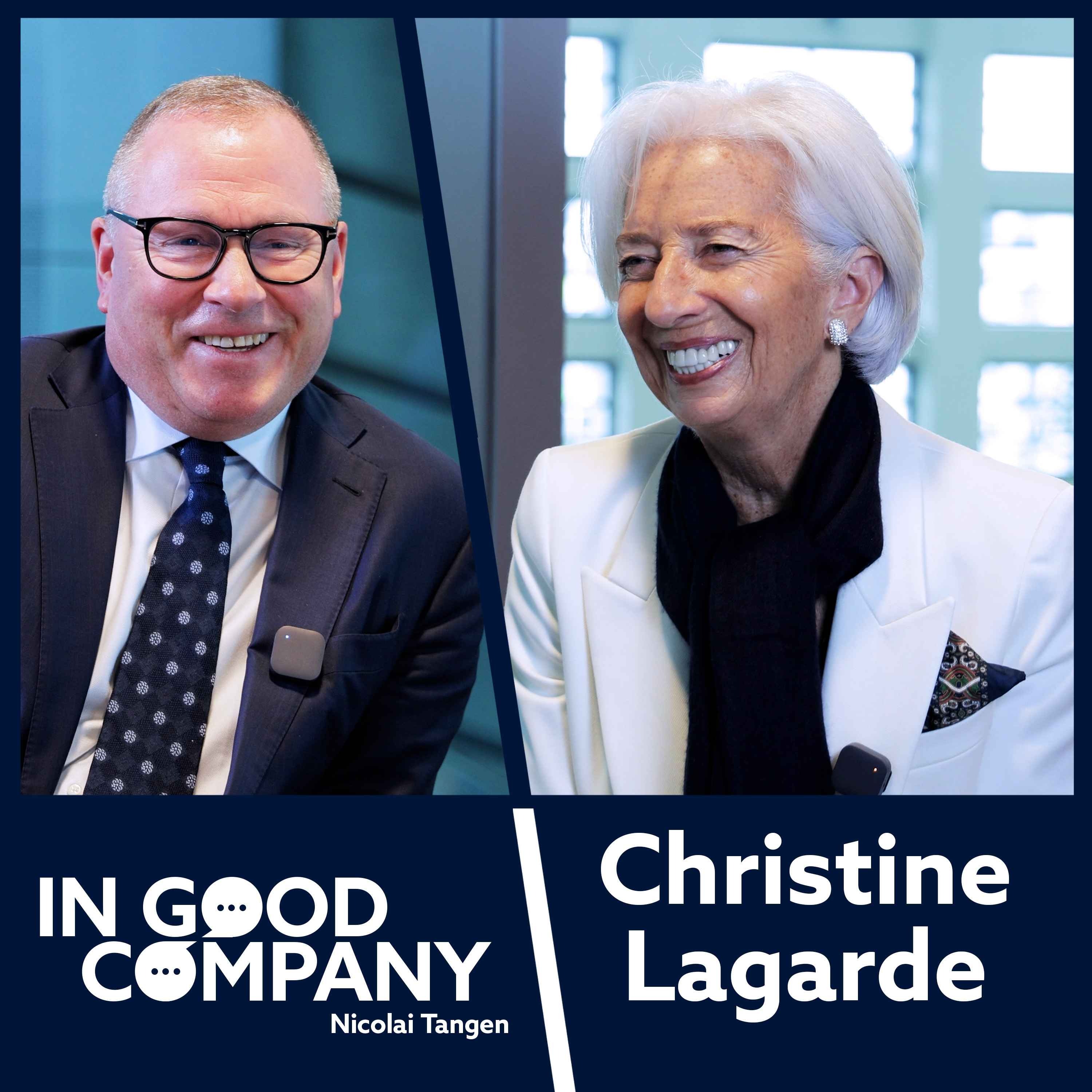
In Good Company with Nicolai Tangen
Christine Lagarde: Central Bank Independence, Geopolitical Fragmentation and What It Takes to Lead the ECB
00:42:24
Loading summary
Transcript124 lines
- [00:01]
A
Hi everyone, I'm Nicola Tangen, the CEO of the Norwegian Sovereign Wealth Fund. And today we are in particularly good company because we are in Frankfurt with Christine Lagarde, President of the European Central Bank.
- [00:12]
B
Lovely to see you, Nikolai.
- [00:13]
A
Fantastic.
- [00:13]
B
And welcome to Frankfurt.
- [00:15]
A
Thank you. Now, Christine, you've been. You had a tremendous career. You were running a global law firm, you've been the finance Minister of France, you ran the IMF for a decade and now you are steering the monetary policy of Europe. So thanks for seeing us.
- [00:38]
B
It's a great pleasure.
- [00:39]
A
I heard you recently say that the world now looks a bit like 1929. What is similar?
- [00:48]
B
I think the analogy I made was with the 20s because it's a time when there were major technology breakthrough that of course we take for granted, but which were new at the time, the combustion engine, the manufacturing line, all sorts of things that just came about together at a time when fragmentation started to also significantly change the way the world worked. Because it was preceded by a period of automatic open trade and the first globalization, if you will. And we are seeing a bit of that at the moment, technological breakthrough, which I would associate with the development of AI and the diffusion of AI on the one hand, and fragmentation challenges to the international world order as we have known for decades. So that's the analogy. And I think that we have to be informed by history and tried to avoid what came after those developments in the 20s that ended up with, number one, financial crisis, bankruptcies of banks in Europe and eventually, because the matter was not handled very well at the time, a global conflict that destroyed many of the advanced economies and made all of us at the time poorer and fewer.
- [02:17]
A
What do you think are the implications for financial markets then? Because we know what happened at the end of the 20s.
- [02:22]
B
I think there are implications for policymakers of all stripes. So it means putting the onus on diplomacy rather than war, the onus on good financial management of public budgets and being attentive to the real transformation and not so much hype, that's what I would see as favorable developments.
- [02:48]
A
The fragmentation we are seeing in the world just now, how does it impact Europe?
- [02:55]
B
Europe is of all advanced economies, probably the most open. This is very true for some of the Nordic countries that you know well, but it's true for the whole of Europe. So any shock to trade, for instance, is going to impact an open economy more than an economy that is not self sufficient but not particularly vulnerable to trade, whether export or import. Added to that, Europe has very limited own resources and own energy sources with the Exception of the renewable energies that we are pushing and the green transition that we are also trying to finance as a continent. But other than that, sources of energy are rare and that exposes us even more. So it's openness on the one hand, rare fossil energy sources on the other hand, and the two combined exposes us significantly in the current situation.
- [04:07]
A
What's the added complexity from what we are seeing in the Middle East?
- [04:13]
B
Well, I would say that the constraint, I mean, apart from the horrible drama that afflicts the life of people, the situation of families, the, the civilian population that eventually end up being the target of those wars. So putting that aside, which is a big put aside, it impacts the global economy in that energy sources, oil, gas, are under threat in terms of transportation, shipping. The Strait of Hormuz comes to mind right away. And as a result of that, we see prices increasing significantly and we see a volatility that is unprecedented in the last few decades where suddenly the price of oil can go up by 30% and go down by 30% in a matter of one day. So that's what the Middle east current war development is creating for the rest of us. Disruption in shipping, disruption in insurance costs, and obviously significant increases in the price of energy, which as we know is necessary for all economies and has ripple effects in a matter of months.
- [05:33]
A
What's the right way of Europe to dealing with all this uncertainty?
- [05:37]
B
I think you have to distinguish between the short term and the long term. In the long term, it is in Europe's best interest to focus on that green transition that has been identified a few years ago by the European Commission and the European Council, which comprises all the leaders of Europe. It's actually fascinating to see how only a few weeks ago this was almost put on the back burner, as if it was not a priority. Clearly what has happened in the Middle east is bringing this priority back to the front of the mind of leaders. And this green transition that would increase the volume of renewable energies versus the dependency on fossil energy is a long term objective that has to be pursued and at an accelerated pace. In the short term, you know, obviously every effort should be made in order to reopen the Strait of Hormuz and facilitate the passing of these 20, 25% oil traffic that goes through that particular strait. I think there is, there is. You know, it's neither nor. But the focus on nuclear energy is also one that we will see developing faster in Europe as well.
- [06:55]
A
Yeah. Now there's been some changes in policymaking in the US and we attended the same Opening dinner in Davos and you were sitting at a table next to where I was and you didn't seem very happy at the time. So what went through your mind?
- [07:14]
B
You could see that I'm very bad at covering up and having a poker face. So what I thought was not acceptable is the fact that a U.S. government representative, without contradiction and without any kind of dialogue, could, at the end of a dinner which had the participation of many European leaders, including royalties and representatives of those countries, that he could just harangue and bash Europe in the way he did. And I thought, okay, well, all opinions are welcome as long as there is a debate. But the way in which this came about was, to me, not acceptable. So I left the room.
- [08:01]
A
Were there some truth in what he said?
- [08:06]
B
I think that every economy, every individual, every corporate has elements of vulnerabilities and of being wrong. And Europe does not escape that particular, that particular judgment passing, if you will, but to bash the green transition, to bash the wind energy or the solar energy in the way it was done, I thought was just not in the cards.
- [08:36]
A
Do you think we can afford the type of system that we've had in Europe for the last decades going forward?
- [08:44]
B
I think it's imperative for Europe and for the Europeans to appreciate value and vote for the value delivered by social democracies. Does that mean that the entire social benefits can be maintained as is with the same financing and the same benefits that is to be assessed, determined and possibly modified over the course of time, given the demographic challenge that we are facing. But the principles of democracy, the independence, the freedom of speech, the individual rights, the economic development at entrepreneurial level that it facilitates, I think those are precious, precious principles that we have to secure. And if it requires reduced benefits in some areas, I think we should be prepared to consider that if we have to referee and trade off between military expenses because we want to secure that precious treasure that has been acquired over the course of time and generations, and if we have to have less of those social benefits of which cost accrues and increases as the demographic changes take place in Europe, aging societies, less working population, I think we should face it and decide what we want collectively.
- [10:15]
A
So to which extent has your job become more complicated or the job as the President of the ECB become more complicated with the change in geopolitics, demographics, defence spending, there are just a lot more things going into the mix than in the past. No?
- [10:31]
B
Well, we are lucky that we are driven by a mandate which I regard as the mission of the ecb, which is price Stability, that's our duty to the people of Europe. We have to make sure that prices remain stable and that people can decide to invest, to consume, to be employed in a landscape where prices are stable. That's the mission. And to deliver on that mission, we have to take into account all the developments that affect European economy. And that has internal elements and external elements. The geopolitical shocks is an external element that has ramifications in our economies. The internal element, such as demographics, for instance, such as the impact of artificial intelligence, such as the rise in productivity, such, you know, we have to take more and more factors into account in order to determine how we deliver on the mission. That is true. And it makes our life more complicated and it requires, you know, a very strong focus and strong analytical skills in order to deliver. Yeah.
- [11:43]
A
So do you think your background as a lawyer, as a finance minister, as an IMF and so on has been particularly useful in putting all this together?
- [11:53]
B
The answer is yes, for two reasons. I think having been a lawyer has taught me how to listen, has taught me how to separate the key arguments from the vicinity, the signals from the noise translated in economic terms, and that is very helpful. I think being a lawyer has also taught me a little bit of humility, because you're only as good as you lost advocacy, you lost pleading, and ultimately the magistrates will decide. I think having been a Minister of trade, agriculture, briefly, finance for a longer period of time has also told me a bit of the intricacies and the trade off in politics. And at the end of the day, things happen as a result of political development leaders taking a view, making a move, deciding a new policy, understanding how that fabric works has been very helpful. The IMF gave me a very broad view of what is happening in the world and has exposed me, together with the years as Minister of Finance to very talented economists. So you could argue, and I take this argument happily, that not having been an economist enough of my life, I'm vulnerable in my assessment and the decision making that I go through. And I would challenge that because I'm surrounded, and I'm so privileged to be surrounded by extremely talented economists of all stripes and colors. Do you think arbitrage between that?
- [13:42]
A
Do you think being an economist as a metier is overrated?
- [13:46]
B
I wouldn't say it's overrated. I tell you what I think is overrated. It's what I call the corridor thinking, the group think. When you put people having gone to the same schools, graduated from the same group of universities, having focused on the same issues, worked on the same models, all of them together. I think that is dangerous.
- [14:05]
A
And are they particularly susceptible to that?
- [14:08]
B
I think any profession is susceptible to that. If you bring about a group of lawyers and you leave them amongst themselves, you bring, you know, banking law experts, they can talk ad nauseam about a particular thing, but they will not see the ramification in terms of competition law, the impact on economics, the financial consensus consequences of what they do. So I'm a very strong believer of the value of diversity of thinking, diversity of upbringing, diversity of background, diversity of gender. You know, in all my jobs I have always tried to have one outlier in the group. And it's difficult for the group because you bring somebody who is, you know, different color, different gender, different background, different upbringing, different way of thinking, different way of talking. And this, I mean, the group resists.
- [15:01]
A
It can be very irritating. Can be very irritating, yes.
- [15:04]
B
But we have to welcome that irritation because that person is going to bring something different, he will see, or she will see the world in a different way. And we need to have that.
- [15:14]
A
Absolutely. Independence. You initiated a statement where you gave full support to the American Fed Chair. Why is it important? So naive question. Why is it important for a central bank to be so independent?
- [15:31]
B
For two reasons. One is we have a narrow mandate and we have to deliver on that mandate and we have to be accountable. But to do that we need the level of independence is the best word to describe it. In other words, being exclusively focused on the mandate requires that you are not sort of vulnerable and moved around and shaken by other imperatives that people have so to singly focus on, that you're better off not having others inserting their own priorities, their own prejudice in what you have to deliver. Singleness of mandate, that's one. The second one is an issue of timing. Because when we decide on the monetary policy front, whether you hike, whether you cut, whether you hold, whether you think that you are at such a lower bound level that you have to use alternative tools, those decisions take time. It doesn't deliver immediately a result. It's a matter of 6, 9, 12, sometimes more months. Whereas political leaders, fiscal authorities have different timing imperatives, they think about two things. The immediate effect in terms of the public opinion and their followership or their readership or their votership and the next election. That's the timing imperatives that they operate under. And there is nothing wrong with that. That's the way politicians operate. But if I tell a politician who says to me, we need to deliver some good for the public opinion because they are concerned about this or that. I cannot do that and I shouldn't do that because this is going to impact in a year's time.
- [17:26]
A
How worried have you been about the independence of the US Central bank, including also the quality of the data and so on being generated?
- [17:35]
B
I don't want to interfere with U.S. domestic policy and pass judgment on,
- [17:44]
A
on
- [17:44]
B
the current state of affairs as far as the Fed is concerned. What I was concerned about was the way in which somebody who many central bankers around the world regard as competent, independent, a beacon of integrity was being challenged. And we thought that. I thought personally that we should give him all the support that he deserved. And you know, I don't want to interfere with the political life of the United States, but this is how we perceive him and this is how we value the independence of our central banks, including the Fed, which is the largest in the world.
- [18:26]
A
How is the independence of ECB different from the Fed?
- [18:30]
B
At the ECB we are lucky because independence is engraved in the treaty.
- [18:35]
A
Yeah.
- [18:35]
B
And I cannot receive a call from any leader in Europe or from the President of the Commission asking me to do this or suggesting that I have not done enough of that or that I have done too much of this. They cannot do it and they know. They know that the Rockies don't know, but they find out.
- [19:01]
A
Let's spend some bit of time on, on Europe and what we're seeing here now. So we've had some quite weak numbers in terms of productivity in Europe, including recently in Germany. Just how did we get to this point?
- [19:19]
B
This is not a recent phenomenon. It goes back to. I would say that we in Europe have missed the Internet revolution. And when you trace back the evolution of productivity between Europe and the United States, it's pretty obvious that this is where it started diverging. But the US continued to increase productivity not at a very fast pace, but increased, whereas we remained stable and low. And we never caught up with that. The real question we need to ask ourselves now is the use of artificial intelligence, not in a pioneer way, as the US does, because there is a very strong concentration of data, capital, appetite and probably expertise that is in some parts of the United States. But the real question for us is will the diffusion and use of that help us move our productivity up? We're beginning to see some of that productivity numbers are beginning to shake up. We'll see.
- [20:31]
A
Do you think we realistically can compete with the US in AI?
- [20:37]
B
Not in the pioneering phase? Whether you look at chips, manufacturing and sophistication, whether you look at accumulation of data, whether you look at the price of energy, I think the US has a very significant advantage. But the pioneering is one thing, the diffusion is another one. And when we look at the diffusion, even at SMEs levels, Europe is not lagging behind. Europe is actually a little bit ahead of the US in terms of penetration of AI in the manufacturing process, in the services elaboration. Europe is not lagging behind at the moment.
- [21:15]
A
When do you think we could start to see the AI effect on productivity?
- [21:21]
B
Hard to say, because this AI creation, diffusion penetration is so much faster than anything we've seen before. When you compare electricity and AI, AI, new iterations and changes come about in three weeks. Well, maybe I'm exaggerating, let's say three months, but. And diffusion, probably a little more than that. Let's even assume that it's three years. The first ChatGPT was about three years ago. If you look at my organization here, everybody has one artificial intelligence agent that he or she uses all the time. Not yet in a very sophisticated way for most, although in some segments, yes, very much so. Three years electricity, the diffusion of electricity, 30 years. So when do we see the productivity impact? How do we measure it? Probably a lot faster than what we think. How we do that under review.
- [22:24]
A
Will AI be deflationary?
- [22:33]
B
I wouldn't say at this point in time it will. To the extent that it improves significantly productivity, it should. But you know, what other factors do we need to take into account?
- [22:47]
A
Which ones?
- [22:48]
B
Energy? Well, you know, to teach an LLM at the pioneering edge where they are now, cost an absolute fortune. Right. And it consumes masses of energy as well. We're talking about $1 billion at the moment. Close to that. How will that impact prices? How will it be amortized? Depending on the business model, and depending, and we circle back to the beginning of our conversation, fragmentation will. Fragmentation of the geopolitical world as we see it now, would that be conducive to the diffusion of AI and the leveraging of AI on a global basis, which would be necessary for those new LLMs to produce new artificial intelligence tools so that they can be properly amortized over the course of a big scale of users? Big question.
- [23:43]
A
Absolutely. There is an argument that the new Fed chair has a deep understanding of what AI will do to productivity and therefore that they will front load interest rate cuts because of that. Do you think that argument holds?
- [23:57]
B
That takes us back to the Greenspan days. Right?
- [24:00]
A
Yeah.
- [24:01]
B
I think what we're seeing around the world is going to possibly disrupt even that theory. If the price of Energy is reassessed because of the vulnerabilities that we have around shipping, transportation and insurance, the limited push for renewable energies. I think the jury's out. Let's see. The situation is vastly different. And if you look at public debt, for instance, we're not in the same situation as in the Greenspan days.
- [24:35]
A
We touched on the productivity in Europe and we had the Draghi report, but not so much has happened. Why is it so difficult to fix this problem?
- [24:44]
B
I would first of all contend that some developments have taken place and it's not fast enough. It's not enough of it. But. But it is taking place, and there are simplification programs underway. There is a move towards capital markets union, which I've been talking about for such a long time and which I'm beginning to see the development of. Is it enough? Is it fast enough? No. Why is it difficult? Because of Europe. Because Europe is a club of 27 member states who, in order to avoid the horrible wars that destroyed our continent, decided to bring themselves together with the same objectives. But it is hard because each of them is sovereign. Each of them has its territory, its defense, its voting. So you are talking about a lot of territorial aspects which are causing these changes that are necessary to happen slowly or to be delayed by what I call the gold plating that takes place at the national level. I'll give you an example. For example, you decide through a directive that, I don't know, supervision of financial institutions will take place in such a way. The gold plating happens because each and every national authority in charge of supervision will say, yeah, we'll do that, but we will also add this, and we will add another little ratio here, a little buffer there, and you end up with 27 different regimes. So I think the objective that the European authorities hopefully will have is let's implement together with regulation. Regulation. You cannot mess around. You apply the regulation.
- [26:32]
A
Do strong labor interests in Europe hold back change?
- [26:41]
B
The whole labor market is under the shock of demographic evolution, right? So working forces in most Europe is beginning to decline, which will require new forces. I think we've exhausted the women forces, although there might be some, you know, pockets of availability. We will be employing people for a longer period of their life. So I think we will have debates around pensions, about pension financing, about age of retirement, and we should face that. And we will have discussions, which will be difficult about immigration, because labor will probably be needed. And for those who hope that AI will substitute everything, I don't think so. Now, will that be a force that sort of withhold development, productivity, progress, entrepreneurship. I hope not. But it will require some cultural changes because at the moment the concept of vested interest, accrued rights, delay for anything that is decided, that's an impediment to the changes that are necessary. But it has to be taken in the context of the entire labor market and the changes that will affect it.
- [28:07]
A
But do we also have to rethink the combined power of employee, representative, labor, representative union, that type of strength? Do we need to rethink what it does to the change in Europe?
- [28:24]
B
I think given the history we have, those changes will happen if we can embrace everyone, if we include. And you know, I always keep in my mind a conversation I had with one of the Baltic a state prime minister who went through an IMF program and that process went extremely well and changes took place. And I asked him, I said, what was the recipe and how do you. Where do you attribute the success now? Many prime ministers would have said, oh, it's me, you know, I did the job. He was modest enough to say, one of the key reasons it happened so well in my country is because from the get go, we included the trade unions. We shared with them the difficulties, the progress we had to make, the changes that had to take place, and the reforms that we would have to take to parliament. And of course, it wasn't 100% of what we wanted to achieve, but it was 80%. And it was 80% with the consent and the support of all forces in the nation. I think that's the only way to go. It requires a lot of changes, but I think it's necessary.
- [29:44]
A
After Covid, you have said that you were slow to see the inflationary pressure. Have you?
- [29:51]
B
A bit slow. I didn't say slow.
- [29:53]
A
A bit slow. I would say pretty slow, but pretty slow.
- [29:56]
B
A bit slow, whatever.
- [29:59]
A
Have you changed the way ECB works so that you would have entered that situation differently now?
- [30:08]
B
I think history and past decision informs the analysis that we do, the decision making process that we will follow. And compared with that period of 22, for instance, I think we have better sensors and better analytical tools in order to really appreciate how soon we have to decide. But there is a huge, huge uncertainty around and a volatility that is just as I said earlier, I think, unprecedented.
- [30:41]
A
Did you have somebody at that stage who was just the odd one out who said, president Lagarde, you are wrong. This inflation is great and we are under messing it, addressing it?
- [30:53]
B
I had one, but I did not pay enough attention to that person. Right, yes.
- [30:59]
A
Yeah.
- [30:59]
B
And we should collectively have. We're not the only one, by the way. So it's not consolation and you know, it doesn't, doesn't, It doesn't eliminate the regret that I have to have felt completely bound by previous forward guidance. That's the regret that I have.
- [31:22]
A
Why is 2% such a magic number
- [31:24]
B
in the central bank from New Zealand of all places?
- [31:29]
A
Why is it. It's stark.
- [31:32]
B
Yeah, I think deviation from 2% will come after my time. I'm not going to change that.
- [31:39]
A
What do you think about the dollar as a reserve currency in the long term?
- [31:44]
B
Well, it's currently a reserve currency. It has about 60% of central bank reserves. It's about 40% of international trade invoicing. And it is, you know, in times of high crisis, it is still a destination for capital flows. There's no doubt about that. Are we seeing the level of confidence slightly undermined by various factors? Probably so. But these things move over the course of time and I see our job here at the European Central bank as to defend the Euro to make sure that it's available, that liquidities are there to facilitate the invoicing and the recourse to euros in terms of crisis. Which is why we recently changed the regime of our euro repo line in order to make it available on a much broader basis to national central banks around the world. And I think that our duty is also to make sure that our currency, the Euro, is available in digital forms because the world is going digital and I don't see why a central bank currency would not also adopt the digital form.
- [32:56]
A
Why is a digital Euro so important when it comes to making the Euro an important or continue to keep Euro as an important currency?
- [33:07]
B
If I talk to my children and my grandchildren, do they carry banknotes? Not much. Do they pay digitally? Yes. So do I think that central bank money is critical in order to structure, organize and hold the financial system? Yes. So my conclusion from those two elements is we should have a central bank currency which is available in digital form. Added to which I think that the, the railguards on which digital currencies and digital assets travel is a public good. And I think that we should be building it. Does that mean that only the digital euro travels on those railguards? No.
- [33:52]
A
When will we have a digital euro in volume?
- [33:54]
B
It will be in pilot phase, you know, parliamentary decisions, Volente in 2027 and then complete rollout in 29.
- [34:09]
A
I'm just wondering whether with all the AI agents which I believe need stablecoins and chains to transact with each other that we potentially could see a very big uptake here.
- [34:26]
B
I'm not convinced of the business case of stablecoins, to be perfectly honest. However, I'm confused.
- [34:32]
A
It's not my area of expertise. But I'm just wondering.
- [34:34]
B
But I think that there is a market failure which stablecoins have identified and that is the cross border payment payments. So if the financial agents, and in particular the traditional banking sector can remedy that and the digital euro can be an instrument, then that element of business case goes and the rest at the moment, if you look at the purpose that they serve, it's essentially to facilitate the transition between the crypto world to the fiat currency world. That's what stablecoins essentially do at the moment. I'm not sure that is necessary a single purpose that will be producing real outcomes and we see it in the numbers. If you look at the progression of stablecoins, for instance, they have significantly increased up until last October. Since last October, it's flat.
- [35:35]
A
Do you think quantum computing can break the chains and make these things worthless?
- [35:42]
B
I think quantum computing is going to be a significant enhancer of many of the work that we do in the digital world. And I think in particular the capacity to compute with the lower level of energy is going to be the result of quantum computing.
- [36:03]
A
Christine, moving on to leadership, how are you as a leader?
- [36:09]
B
You have to ask the other people, not me.
- [36:13]
A
What are your principles? What do you believe in?
- [36:19]
B
I believe in listening, in learning, in working and ultimately in leading as a result. But am I an inclusive leader rather than a sort of I'm on the top of the hill, follow my flag? I'm more of an inclusive leader.
- [36:43]
A
Are you a better leader?
- [36:43]
B
I don't take personal pleasure out of, you know, I instruct, I order, I exercise power. This is, this is not something that I find neither satisfying nor particularly productive. So I'm more of an inclusive person.
- [36:57]
A
To which extent are you a different leader now compared to when you led the law firm?
- [37:05]
B
I think I'm more impatient than I was.
- [37:08]
A
Oh, really?
- [37:08]
B
Yeah, passing of time, you see.
- [37:11]
A
Right. And how does that materialize itself?
- [37:17]
B
I have to sometimes refrain my frustration and my annoyance with things moving too slowly.
- [37:24]
A
Right.
- [37:25]
B
That requires a big effort on myself.
- [37:28]
A
Yeah. Is ECB moving fast enough for you?
- [37:34]
B
Well, we were just talking about the digital euro. I just wish it would move faster. And this is unfortunately not in our remit. It's external factors and external political rebalancing and balancing that are taking place outside our institution.
- [37:53]
A
Forbes ranked you as the second Most powerful woman in the world. Do you reflect on that?
- [37:58]
B
Not at all. But the first time it happened, my youngest son said to me, only second, why aren't you first? And I thought, oh, bloody hell, this is not bad. And he said, well, now you know how it felt when we brought back a B. And you say, why not an A?
- [38:19]
A
So the one who is number one is Ursula von der Leyen. Right. And so if you had her job, what would you have done?
- [38:26]
B
Probably not as well as she is doing.
- [38:28]
A
What is she doing particularly well?
- [38:31]
B
I think she's managing to keep 27 very sizable ego on the same plane. And that is very hard because of that European construction where you have 27 leaders who are in charge of their constituencies, accountable to their constituents, have electoral timeline, and as a result of that, not because of who they are, but as a result of that, lose sight of the medium to longer term horizon more often than not. Not all of them, not all the time. But I think her job is to keep an eye on keeping that ship with everybody on board, or as many as possible on board and looking at the destination and keeping the eye on the destination. That's hard.
- [39:23]
A
But you are kind of doing the same thing, right?
- [39:26]
B
Within my mandate. Within my mandate.
- [39:29]
A
You talk about when I listen to your podcast and so on, you talk about the age 16, 17, that's being very formative. You lost your father when you were 16, you moved to the U.S. spent time there when you were 17. Tell me about that.
- [39:46]
B
It's a crucial time in anybody's life. I mean, your body is transforming, your social network is different. You suddenly are moving very close to adulthood and all the responsibilities that go with it. And to lose you, I mean, for a girl to lose her father at that point in time, as I did, was hard, was very unsettling. And in many ways, at that point in my life, I was rescued by that year that I spent in the United States at a time when there was no cell phone, no emails, no fax machine. And, you know, in the scholarship that I received where there was very little money available to stay in touch with the family. So you have to. You suffer a big loss and you have to sort of strengthen up and be a little bit yourself in a different environment. So it shapes you as a different person. It certainly shaped me as a different person with a capital of love that I cherished, but a level of attention that disappeared.
- [40:58]
A
What's been your driving force in life?
- [41:03]
B
Love for. For all those that I love. So it's. It's it's the family circle. It's the people that I respect, that I cherish. It's what you, me, we can give to others that just helps them to rise and to accomplish what they can accomplish. So love is a driving force.
- [41:28]
A
And who is going to benefit from your love now? Is it World Economic Forum or.
- [41:33]
B
My grandchildren will be the first one. My husband would be very upset that I say that, but he does receive a lot of it.
- [41:40]
A
Will you run for president?
- [41:42]
B
Vote president? Forget it. I'm president. Thank you.
- [41:49]
A
What would be your advice to young people?
- [41:56]
B
My advice would be. Would be take risk in your life. Life is beautiful and you have to embrace it and you have to take risk and you have to give and receive. Love as much as you can.
- [42:14]
A
Beautiful place to end. Big thank you.
- [42:17]
B
Thank you. Nikolai.