← In Good Company with Nicolai Tangen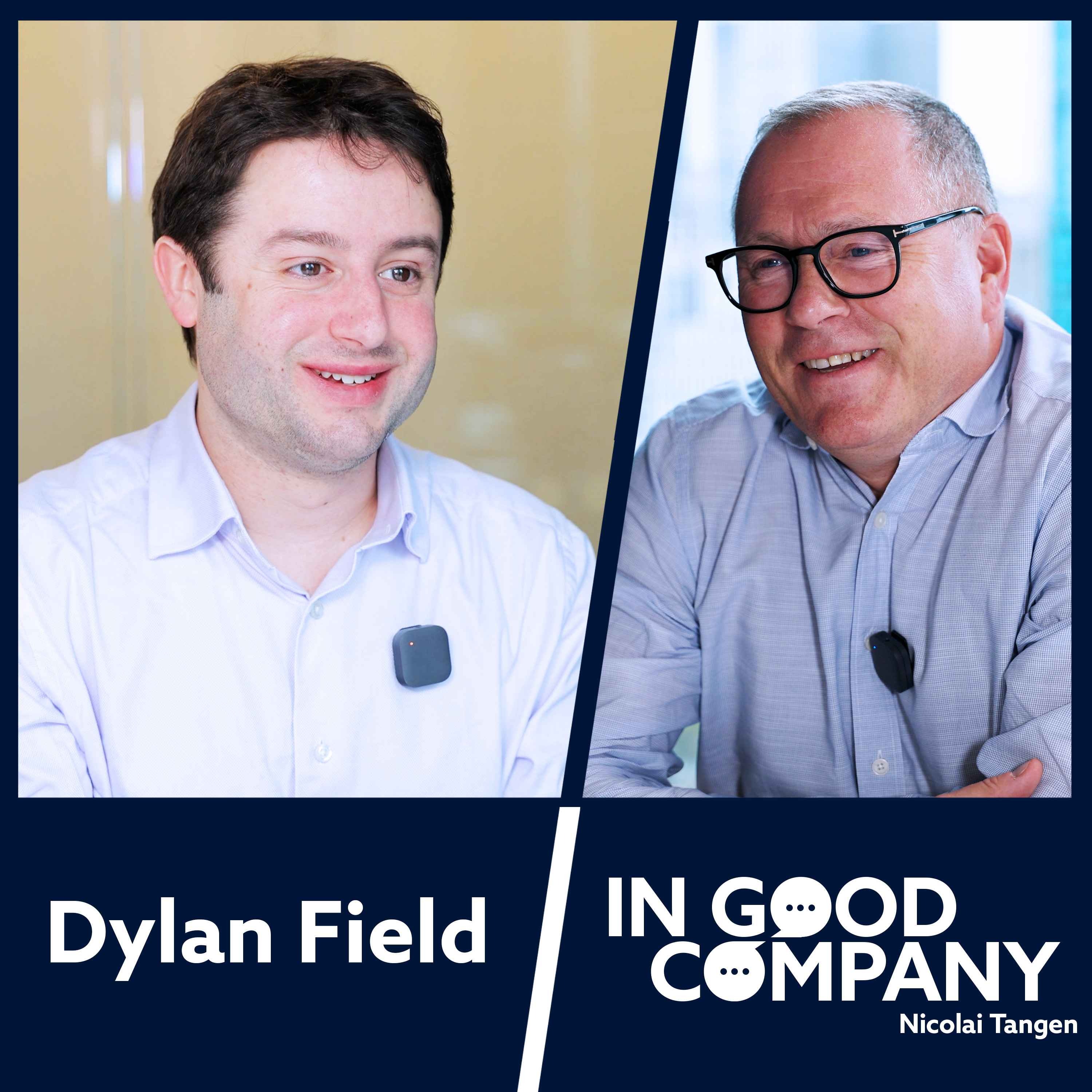
In Good Company with Nicolai Tangen
Figma CEO: From Idea to IPO, Design at Scale and AI’s Impact on Creativity
01:04:19
Loading summary
Transcript188 lines
- [00:01]
A
Hi everybody. Welcome to In Good Company. I'm Nicolo Tangen, the CEO of the Norwegian sovereign wealth fund. And today we have the founder and CEO of Figma visiting us, Dylan Field. Now, quite incredibly, Dylan founded Figma when he was 19 years old. And now 14 years later, Figma had one of the biggest IPOs of 2025. So warm welcome.
- [00:25]
B
Thank you for having.
- [00:35]
A
So, Dylan, we have to start. What does Figma do?
- [00:38]
B
Yes. So Figma is a platform that helps you go from an idea in your head to a production application in the software space. But also once you ship something, once you ship some software, you want to then market it. And we also help with that too. We help you get your brand out there and make it so you can create more collateral around it. And ultimately it's not just some linear process where you have an idea and you get to finished product and you're done. Perhaps in the industrial design world, we were talking about that before we started, that's more of what it is. But in software it's always a loop and you're always iterating and you're learning and you're trying to figure out how do I evolve this thing that I've created with my team? And we try to make it very collaborative so designers can bring their entire team in to do that.
- [01:26]
A
So let's say now I run a cup factory. Okay, so now I'm going to design a new cup. Here we go. We are like four people who want to design a cup. How do we use your software?
- [01:37]
B
We have people that will maybe draw cups or maybe they will market their cups on Figma. But we are not a piece of software for 3D or, you know, CAD design. And so that's typically not what people use us for. But I'm always amazed when people will draw 3D assets like a beautiful cup with an amazing shadow and incredible lighting in Figma. Not what it's made for, but people do it. That said, yeah, CAD is an entirely different area and we really stick to digital design.
- [02:10]
A
Why is design such an important differentiator?
- [02:13]
B
So I think going back a bit and speaking about digital product design, the history of design I think is interesting in the digital realm because for a long time there were very, very few designers. Almost none of them had a traditional art school background or very few did. And many of them randomly found their way into design, sometimes from engineering, sometimes they were in a band and made a poster. They could come from any different place. But there's a period of time in, for example, 2000 the dot com era, where the mantra was build it and they will come. And at that point, if you had a designer, which was rare, the sort of role of design was conceived to be what sometimes in America we call lipstick on a pig. You've got a pig, but we're going to put some lipstick on it to make it pretty. And it was really about making it aesthetically pleasing, but not thinking about the function, the form, how it works. And that has changed dramatically over the past 25 years. First we got to the 2010 era, where you not only have Apple evangelizing design and saying how it works matters, this is why you should buy this iPhone with Steve Jobs championing design, but also you have the advent of consumer applications like Facebook or Gmail, and suddenly the expectations rise. At the same time, things like AWS cloud computing are starting to pick up. And we've moved from a world of managed servers to cloud, from box software to app stores. And it's easier than ever to build software as well because developer tools are improving. And as all this is happening, what's happening to distribution? Well, no longer are we in the world of building. They will come. We're starting to transition out of that into a world where, well, if you build it and you have really great design and really great marketing, then you might have a chance because there's more software and it's not the case anymore that you're building something. It's the only thing like that that exists in the world. Competition is increasing and the value is moving up the stack.
- [04:35]
A
Your initial goal was to, I think you say, eliminate the gap between imagination and reality. What does that mean?
- [04:41]
B
Yeah, so when we started, I painted a pretty broad vision for where we could go, partially because I didn't know exactly where we were going to go. We had a hammer that was WebGL. And I think there's always this why now for great companies, something's changed in the world. And the why now is something you can look back on and you can point at one or two or three of them and say, this is why this company came to exist at this particular time. And for us, we thought, okay, let's look at technology that's changing. We're computer scientists. My co founder, Evan, he is beyond brilliant. He was my TA Brown and he had done quite a lot of exploration to WebGL. Evan is not just a 10x better engineer than I am, he's like 100x better engineer than I am.
- [05:28]
A
You call him Jesus or something, right?
- [05:30]
B
Well, I did not call him Jesus, but That was his nickname in middle school was Computer Jesus or CJ for short, I later learned. I called him Evan. But he is a brilliant man and I was very, very lucky to get to work with him.
- [05:46]
A
Design is some right brain stuff, right? But you have your background also in math and physics, so why is rigor so important here?
- [05:54]
B
Yeah, I wish I had done more physics. I can't claim that I've done some math, but not enough. And I think that you both want the ability to think in abstraction, in design, as well as the ability to have the EQ and emotionally connect with the end user. And so of course there's also aesthetic, there's judgment, there's thinking about things temporally, there's thinking about frameworks. But yeah, there's many skills that come together in order to understand all that context and to bring it into one place and to create a great user experience. And we're not even getting to sort of the top of the pyramid of the Maslow's hierarchy of needs for design, where you start to think about delight and joy and what does it mean to make something that people love. And that's, I think, more of the art of it. Not many people can do that, but when you can, when you can apply that craft, it's so special. And there's the process.
- [06:48]
A
So if you were to kind of distill down the design principles of figma, do you have such?
- [06:53]
B
We have many. I mean, what would it be? Some of the ones that I think about a lot, one is keep the simple things simple, make the complex things possible. So in figma, as with any tool, especially software, where you're constantly updating and you're adding more things to respond to the market, we're not talking about like a hammer, we're talking about something that is a complex ecosystem of operations and functionality. And you want it to be a staircase where you can take that first step or the second step very easily, but then if you keep going, you can actually achieve mastery. And that mastery is so important. So we want to make it so that there's a balance between power and simplicity at all times. That that balance is extremely hard to achieve. So we have to constantly remind ourselves and our users and our team of this, that we need to make those right trade offs. Because approachability is, I think, a flip side of it, which is you come into figma, does it feel like an inviting environment? Are you welcomed or do you go, oh my gosh, this is like stepping into an airplane cockpit. I don't know how to Fly. We want it to be that you're welcomed, of course, so you, but you.
- [08:00]
A
And you welcome a lot of people, right? You got like a huge community, you got a lot of kind of plugin solutions. Just how do you think about that whole ecosystem?
- [08:07]
B
So from the start the community's been critical for figma. We are so lucky to have an amazing design community around us and they gave us feedback and attention when frankly we had no reason for them to. I would cold email designers that were my heroes at the start of Figma and just ask them to check out this thing I built and they would sit down with me, I'd go get them a coffee and they would give me like an hour long masterclass on not just design, but advice on how to go build the tool they wanted.
- [08:41]
A
So how do they help you develop products now?
- [08:43]
B
Well, so many ways. We try to be very tapped into our community. So.
- [08:49]
A
And who are these community people? What type of people are they?
- [08:52]
B
Well, designers, like I said, come from all backgrounds, but We've got over 80% of our weekly active users outside the United States. And, and so it's not necessarily just United States, it's everywhere in the world. And we have friends of Figma chapters, user groups all over the place too that are community led. We also try to gather people together in one place every year for our annual user conference config, we're free for education. So student communities are extremely important to us because they're the future and they are always teaching us about what we need to go do in order to meet their needs because they're always a little bit ahead of everybody else. But yeah, we also have online forums, we've got, we're always trying to monitor and respond and engage on social media and we also do a lot of qualitative and quantitative research. And so all that along with just the standard sales process, creates dialogue and creates conversation, lets us tap into the headspace of our customers.
- [09:51]
A
How will AI change all this?
- [09:53]
B
Oh, I think AI is a force that will change everything, of course. And you know exactly how much that's what we're both trying to figure out all the time. But I believe that AI will both lower the floor, make it so that more people can come into the design process, but also raise the ceiling, make it so that creative professionals, designers will be able to do so much more than they ever could before and truly be able to lean into their craft. Because I think what AI does is it makes it so that you can explore an entire option space of what you can Build what you can design and then from that option space you can sample, you can see what resonates, what you think is great, what you think actually you shouldn't go into. You can use that to figure out a direction and you can push further in that direction. Whereas if you were going to do it without AI, you could only sample a few points from that option space. AI lets you sample more, so that way you can have more intentionality about the path you choose.
- [10:55]
A
How important is taste in this new world?
- [10:57]
B
I think it's incredibly important. Going back to the question earlier, Design as a differentiator, I believe that is like the world we are in and people don't fully appreciate yet. This has been my thesis for the past decade. Not just an AI thing, but AI accelerates it because we're on an exponential curve of the amount of software in the world right now.
- [11:18]
A
What is taste?
- [11:21]
B
This is a whole podcast in itself. I think that taste is a loop that you're in where you are always trying to develop an understanding of what resonates with you and what doesn't. And based on that, you're trying to create frameworks to figure out what it is that you value, how it connects to your not just aesthetic values, but your personal inner values. And based on that, working to express that in a form that others can consume. And I think it's not just discriminating in terms of I like this, I don't like that. But also taste is an enabler of building amazing things and it is the hardest skill to develop to have good taste. But also it is, I think it just brings richness to your life in a way that I don't think everyone appreciates yet. And the other thing is tasting.
- [12:29]
A
What is Dylan Field's taste on what open ended question?
- [12:34]
B
Well, I care a lot about complexity and being able to understand the world, so I think I've got a lot of taste when it comes to framework building. Mental models that applies to design as well. If you can clearly communicate a mental model to a user in a visual form, I think that's a great thing. And not everyone's able to do that properly. Because if you think about it, if I design the right chair for you, for example, that might not be the right chair for me. You know, we've got different bodies and perhaps, you know, we could create something custom for both of us. And yet there's a reason why we create the same software for everyone. And there's a reason why beyond mass production, we lean into how to create the same Chair in a bigger run. It's, I think, this opportunity to actually apply craft and figure out what is it that you can do to as an expression of yourself, put something into the digital or physical world.
- [13:52]
A
Does AI have taste?
- [13:54]
B
I think AI is still a pattern matching machine and humans have taste and it's been trained in that data. And so if you can RLHF the right parts of AI, you can emulate taste. But that's only with advanced prompting that you can access it. And so perhaps prompters have taste and can pull it out of this pattern matching machine with a sophisticated large model. But I think that's not the end of the journey. I generally think the first prompt that people do is only the starting point. Instead you need to keep going. And that could be. We have a product called figma make prompt to working application. And one thing we do with figma make is make it so that you can go from the code output and copy it into figma Design, which is a free form design tool not attached to code. The reason we do that is that way you can explore in this more open way across a digital canvas that's infinite, and you can riff and you can explore in a nonlinear way all sorts of variations to really figure out visually and reason visually about what it is that resonates with you, what feels right, what doesn't feel right, what solves your problems, how do you constraint solve problems for the different outcomes? And the more that you do that, the more you realize, okay, I have this path, but it has this trade off, I have this path, it has this other trade off. You don't actually understand that until you see those branching paths of where things can go.
- [15:23]
A
What part of this process is it that AI can't replicate?
- [15:26]
B
I think that the context that designers have is extremely hard, perhaps impossible to replicate. So think about yourself. You have a lived context, you have your identity, but also all of your experiences. You have all sorts of things you've interacted with in the physical world across your life. You're part of various cultures that you intersect with and interact with. And you come with mental models informed by the languages that you've learned. And from there you're coming into an experience, being used to other experiences. And then the designer's task is to create something for you that also applies to others. And it's a thing of the moment. It is related to the culture of the moment. And it also needs to achieve business goals. It needs to be something that's testable and that based on those tests, you can iterate on it, but you don't want to get to a local max, you want to get to the global max. And I just don't think that AI is very close to doing that task yet. It's definitely not close to the point of getting to where you can actually have AI do deep user research and understand the problems, the needs of the end customer.
- [16:48]
A
Do you think tastes around the world will diverge or come together?
- [16:53]
B
So I went to China in 2016, I've only been there once, and amazing culture, the most hospitality I've ever found in the world. And the people I met were just incredible. You ride the subway there and you look at the way that people use mobile applications and the way they're designed and they're just completely different in the United States, the density of the typography, the bias towards a super app in the way that people are in general interacting with technology there. Yeah, it's just completely different. So I think that divergence already exists. First of all, I think the counter example would be Hollywood, where somehow we've got this American export of media that has become a global phenomenon. And even in today's age where more content is being created bottoms up across the world, Hollywood and the sort of American media complex has incredible enormous reach and ability to influence culture. And so I think that perhaps for the lowest common denominator of taste, that's something that is pervasive and more uniform. But I think as you start to go into any given niche, which I think will see a lot more of those niches going forward, we already are. Then I think that those subcultures create their own esthetic, their own point of view and sort of their own language and sometimes around what they are valuing and how they see the world.
- [18:35]
A
What is design going to look like in 10 years time?
- [18:39]
B
10 years is a long time to make predictions about right now in a world where AI is a chaotic force, that could be exponential. But then if you really draw that exponential, the earth is covered every square inch with data centers. So something might not eventually keep up with exponential. Or perhaps we could have data centers in space, I don't know. Any case, I believe that the role of design will continue to elevate. And what are the real moats in software now? I think that liquidity, liquidity of data, liquidity in a marketplace, liquidity of social interaction, those are moats. There are businesses where you have these individuals interacting in a certain way, or there's regulatory constraints that could be a moat. But we can name many more but in general, I think that a lot less software has moats than in the past. And also software is so much easier to create now. I'm not of the mind that you're going to go and vibe code your way to Salesforce or Workday. I think the people that are saying that right now are maybe extrapolating a bit too much. But I think in general we're going to see so much more competition and design will be a huge part of why you win or lose, as will craft, as will point of view.
- [20:14]
A
But it seems like vibe coding is tailing off a bit. You are not tailing off.
- [20:18]
B
Yeah, we have seen it continue to grow and for Figma, I think that the opportunity to help in the B2B context, designers, product managers, anyone adjacent to designer, be able to prototype in an easier way as well as get things into production or make an internal app that is a use case that's just starting. So I think it's bifurcated. There's a consumer aspect too and we care about that, of course. I mean, getting people the access to design, their ability to create and express, that's so, so important to us. And also I believe that, you know, our focus right now and the thing that we are really trying to make sure that we are world class at is more of that B2B side because I think it transfers over the consumer side later on.
- [21:09]
A
How important is the integration with the ChatGPT?
- [21:12]
B
ChatGPT is a learning moment for us still. So we are exploring that in the context of FigJam, our whiteboarding, diagramming, brainstorming product. And it's been really cool to see how people are using the context they create in these ChatGPT sessions in order to then bring into FigJam with our Figma app on ChatGPT. And we're learning a lot. It's too early to really give an answer there.
- [21:43]
A
How is AI changing the way you lead the company?
- [21:47]
B
So I think that it's really important that not just our R and D team, but the company in general have AI fluency. And this doesn't just mean like cost cutting, because I think there's sort of two frameworks people come from when it comes to AI. And I always think back to this dinner I was at maybe nine months ago, 10 months ago, with a neighbor and they have two teenagers, a boy and a girl, both in high school. And the question at the dinner table was, how do you use AI? And the son says, well, I get to hang out with my friends more, I get to work out more loving AI. It's doing a lot of my homework for me. It's great. The daughter goes, yeah, it's been really, really helpful. I have used it to generate 3x the problem sets so I can really study for the tests ahead. And it's been amazing as a learning assistant for me, I suspect you are.
- [22:47]
A
In the letter camp.
- [22:48]
B
Yeah, I'm much more in the like. I want to learn as much as possible from everything, but I think it's applicable to companies too. And I'd say it's an either or, you can do both. But are you going to be exclusively focused on cost cutting or are you willing to look for the new opportunities that AI enables?
- [23:02]
A
Well, so I think if you focus in on cost cutting too early, you are just going to slow down the whole process because people don't want to be, you know, cut.
- [23:09]
B
Well, that too. But I also think that there's an opportunity to make it so that people are more productive but also doing their job in a better way. Yeah. Does it have implications going back to raising the ceiling?
- [23:23]
A
Does it have implications for what implications does it have for who you hire? So you know how many people you are? 1000. How many? Hundred.
- [23:31]
B
About 1800. Ish.
- [23:32]
A
1800 now. So what does it mean for who you hire?
- [23:37]
B
Yeah, I think this is one of the critical debates that the software industry is going through right now is does AI mean that you should hire senior people or mid level or junior? Or are all the jobs going to go away because AI will replace them all? I've heard that one the last one a bunch of times and then it hasn't come true yet. All the people have said that they continue to hire. So my bias actually is a lot more towards the junior folks. And I think that people that are younger are AI native in a way that folks that are older have to learn. And that doesn't mean that we don't hire a mix. We do. We've always had a mix of seniority levels at figma, but I think that it is important that people come in from, first of all, knowing that we're pushing full steam ahead into the AI era. So if you have a bias against AI, that's a great dinner table conversation between us, but we're very focused on making sure that we build for this AI age.
- [24:40]
A
What's the average age of your people?
- [24:43]
B
I don't have that number. Offhand, what do you think? I would guess about 35, 36. Okay.
- [24:50]
A
Does it have any implications for the pool you hire from? Is it narrower or wider than before.
- [24:56]
B
The pool we're hiring from has only grown wider over time. Been kind of incredible to see that growth because I think back to the earliest days of Figma and recruiting was so hard.
- [25:08]
A
No, but I mean, I'm sure you've got thousands of people applying, but the type of people, the type of educational background that they have, has that changed a lot?
- [25:14]
B
No, we don't. I made sure that we don't look at degrees as part of the hiring process, so perhaps there's bias that slips in somewhere. But my point of view is that it shouldn't matter whether you've graduated college or not, because coming from my own perspective, I didn't graduate from college and I think that unfortunately the value of a college degree will be plummeting in terms of external perception, not necessarily the value of the college education. I think that college will be a amazing place if you can afford it. But that said, I think that, you know, going back to the dinner table conversation, how do you know that someone actually learned all the things they said they did from their diploma?
- [26:00]
A
Do you think you would have done better in life if you had graduated from college?
- [26:04]
B
Just depends on the dimension you're talking about. You know, the counterfactual. Joke. Sorry, the counterfactual is always hard. Right, but I'm sorry, but so when.
- [26:14]
A
You hire, you don't care about what kind of degree they have, whether they are like doctor or scientist or, you know, economist or.
- [26:22]
B
I mean, how do you, I mean, look, we've had one of our first data science hires, for example, he came out of a chemistry PhD.
- [26:29]
A
So what do you look for then?
- [26:30]
B
So we look for the skill, right? And one indicator that skill can be formal education, but also projects you've done, job experiences you've had, the way that you spend your time, these are all things that also indicate, and I think what's most important and something that I'm always pushing for at figma is how do we find the people that are showing tremendous slope, they're improving at a rapid rate and if you extrapolate out, yes, it's high beta, there's some risk involved. You don't know if they're going to be a, or actually they are really junior and this is the ceiling.
- [27:06]
A
How do you assess slope?
- [27:08]
B
I just talk to people about their backgrounds, their history, how they've approached, approach different decisions in life and understand what it is that they value and how they've pushed themselves to grow. And I think that the decisions people make historically and the consistency of that tells you a lot about their growth mindset and the way that they like to level up and how they challenge themselves. So I always want people with a growth mindset because we're always growing a figma. We're always encountering new problems. We need people that are adaptable. And I think that, yeah, it's unfortunately such a bias on the human side. This is for all humans to really look at somebody as a point in time and it's just not a very helpful framework. Instead you want to think about, okay, where have they been and where are they going? And also if you meet someone two years after you met them the first time, it's another bias to think back and go, okay, my first impression. That is who they are in my mind. And they're always going to be that way. You really need to be able to update. And I've certainly been guilty of that and missed the top opportunity to work with people that I would have loved to work with because I didn't update fast enough. So I think that's something I'm hyper aware of too, is just making sure that you really do update your priors there.
- [28:30]
A
If we just move back to the moment when you dropped out of Brown. So you applied for this Thiel Fellowship. Right. I think you wrote in the application that you hated chocolate. So you're quite famous for one of the most famous chocolate haters in the United States.
- [28:47]
B
There are several of us.
- [28:50]
A
Now. How did you have the conviction of dropping out of college at age 20?
- [28:56]
B
You know, I didn't. I had conviction that I needed to go explore design. And so I had signed up to go work at Flipboard a second time. First time I was a software engineering intern and doing some data science work and recommendation engine machine learning. Very basic machine learning. Let me be clear. And then they were willing to meet back and have me on the design team. I had really no formal design background, so I didn't really know why they were open to it, but I was. I didn't want to, you know, say no. It was a gift and the chance to work with them for six months. I thought, this will inform my studies. Maybe I'll take more classes at risd, which is across the street from Brown, and perhaps this will help me inform where I want to go with the year and a half left.
- [29:43]
A
So RISD is the premier design school in America, Right.
- [29:46]
B
It's incredible, incredible place. And I wanted to just make sure I was informing my studies. Right. And so I decided I'll take a semester off from Brown I'll graduate, you know, instead of 2013. 2013.5. And at the same time, right before I was about to leave Brown, I started talking with Evan, who later became my co founder. And he was the smartest person I'd ever encountered. And I had worked with some incredible people at my internships, people that have gone on to start, you know, publicly traded companies that were then engineers who had run in the office, run into the office at 2am, like J craps, for example. That's what I'm thinking of there at LinkedIn. And I met, you know, people that had done things like created Java, the programming language. And at, you know, 22, 23 years of age, Evan was up there. He has genius level talent and insight. And, and I thought, okay, if there's a chance to work with Evan, I will learn more from that than from anything else I can do in my life. This would be the most unique opportunity I could ever have. And so I asked him, would you ever want to think about starting a company? And I was very surprised that he was interested. And from there we started to explore. And I didn't know if it would converge, but I applied for the Thiel Fellowship just in case. And then as we started to, you know, every weekend talk but ideas, prototype things pretty quickly, I was like, okay, well, whether or not we get the Thiel Fellowship, let's go do this. I have a little bit of savings. You know, maybe we're going to live on ramen and live in a bad apartment, but like, we'll make it happen. And then with the Thiel Fellowship and the ability to actually have that support 100k over two years, that made it a nice apartment with Whole Foods.
- [31:30]
A
So just to fill in here, for people who don't know, the Thiel Partnership is made by Peter Thiel. Right. Who's the venture capitalist? Tell me, what's the fellowship about?
- [31:38]
B
Yeah, so the Thiel Fellowship, I think of it as a way to empower young people to make it so they can go explore ideas and get off of sort of the traditional tracked existence that many folks have earlier in life. And I've really started to frame it in my mind as more of a life accelerant than anything else. I haven't done a study of it, but I actually think that tail fellows on average have. They get married faster, they have kids faster, they end up in the place that they're going to go anyway, but just on a much quicker pace. So there are teal fellows who they dropped out of undergrad, they worked on their own for two years, and they actually went back to academia, but in a PhD program. They just never did the undergrad thing. There are 20.
- [32:32]
A
How many are there now?
- [32:33]
B
Well, there's 20 per year. It's been going since 2011. The. I think.
- [32:38]
A
Do you hang out together?
- [32:39]
B
Yeah. I was actually a critical part of the fellowship. The social experience I had after leaving Brown was weird. Like, I had my friends back home who were amazing. I grew up in Sonoma county, so it wasn't that far away from Palo Alto, where I was living a few hours away. But they were all on very different tracks, trying to figure out their lives. And all their lives were going divergent directions. And I had my friends back at Brown, mostly computer science friends, some that were in the liberal arts as well and sciences, and they were all trying to figure out what's my job. After college, I had my friends from Flipboard. They were all a decade older than me or more, and they had very different lives. I did.
- [33:25]
A
And you were running a company?
- [33:26]
B
Yeah, I was running a company.
- [33:27]
A
20 years old, 10 people. So how did they.
- [33:29]
B
Not even 10 then? I mean, it was. It was just being evident at the start and, you know, it's. It's existential at that point in time. It took us nine months of sort of existential, looking into the void and, you know, really kind of absurdist thought to figure out what we were doing. We were trying to figure out, you know, which direction we go. We've got this hammer of WebGL, what's the nail? And we just kept trying things.
- [33:53]
A
So you spent quite. In retrospect, you've said that you spent four years building the product before you launched. Right.
- [33:58]
B
It was August 2012. We started. We launched our closed beta December 2015, and the GA, released in October 2016 didn't start charging until summer 2017. But, yeah, throughout that all.
- [34:12]
A
Should you have launched earlier?
- [34:13]
B
Oh, yeah, of course.
- [34:14]
A
And how did you have anything to launch?
- [34:17]
B
Well, we always had something. The question was, was it good enough? And then you ask, okay, well, how could we have moved faster?
- [34:23]
A
And were you just a perfectionist?
- [34:25]
B
You didn't want to launch until you're definitely a perfectionist. Was an am. I have to constantly check that bias. But also, I think that the real thing we could have done to move faster is we should have hired faster. And to hire faster, I should have been more on top of the culture. I should have figured out how to manage people faster. I was a bad manager.
- [34:47]
A
Okay, but did you have the capital to hire? Could you have Hired. We did have the capital and why. So tell me. So there is this thing called blitzscaling, right? You want to scale very fast. So just tell me, how were you thinking about speed at that stage?
- [35:01]
B
I was thinking about we got to get everything right. We got to make the perfect tires, we got to make the perfect product. I was too much in the mode of there's one solution to things. There's not. There's often many, many solutions to things. It's rare that there's one solution. And I think I didn't fully appreciate it then. And also I think I lacked at the start of the company the rigor and discipline to every day, many times a day, be looking at that recruiting funnel and going, okay, who's in process? Where are they in process? How am I going to get them to the next stage? And I think that should have been my obsession. Instead, I was obsessed with the product. And I'm not saying that was a bad thing. Obviously, I'm still obsessed with the product, but I should be obsessed about growth.
- [35:46]
A
So you should have been spending time hiring rather than writing software.
- [35:51]
B
I think I should have been doing both. I think the best founders figure out how to do it all, and I think I allocated my time entirely towards the product.
- [35:59]
A
What type of people were you hiring at this stage?
- [36:02]
B
Engineers, designers, you know, ops roles? Nothing that was too out there. But yeah, I think that, in retrospect, made some great hires during that time. But overall, if we had hired faster and if I had had the mindset I have now back then, we could have built it a lot quicker.
- [36:22]
A
Can you. Can you hire super people if you hire that super fast?
- [36:26]
B
Oh, yes. But I think it requires a recruiting muscle that everyone in the company has to embrace. Everyone has to really be aligned and on the same page that we have to go find and get, you know, we have to go find and we have to go attract and then retain the best folks in the world. And there's a momentum to it. If you don't have the momentum, if you don't have the ability to really push and get that ball rolling, it just never quite starts. And it goes instead in little sprints when you find one person and you really have to parallel path it.
- [37:06]
A
And is it right that you started to charge because Microsoft told you that if you don't charge, we can't buy because you're not going to survive? Is that right?
- [37:12]
B
Yes, it is. The story. It was a surprise when, I mean, they're so nice about it. The person that told me that is actually still at Microsoft, and he's just a wonderful guy. Um, but yeah, they came to our office and they're like, hey, got a lot of people using your software. It's starting to be kind of important for us. What's your business model? And I'm like, oh, well, we're gonna figure it out. He said, yeah, that makes sense. Why are you waiting? Well, I, you know, I know the product's not good enough yet, going back to perfectionism, and I. I just think it'll be spread faster if it's free. And they said, well, if it's free, you could go out of business. And so we want to make sure you don't. We cannot rely on software for critical operations that could go out of business. So please charge money. And that was the point where I'm like, oh, I think we're really behind here. Came back to the team. We got to charge. We got to get pricing in order. And everyone's like, yes, duh. We've been telling you this. So, you know, sometimes a little slow.
- [38:19]
A
How do you think about product innovation and launches? I mean, now you're launching loads of products, right?
- [38:24]
B
Yeah.
- [38:24]
A
How do you think about which problems to solve?
- [38:27]
B
So the interesting thing about figma is the figma design tool at the core of it all. Made for designers, made for people creating digital software. And despite that, we see people doing so much more with it. We see people creating complex illustrations. We see people, you know, using it for whiteboarding, diagramming, brainstorming, slides, using it for production graphics, making websites, making really complex prototypes, and more. And each time we start to see and notice and watch these use cases grow inside of figma, we try to pull them out into their own product surfaces. The reason we do that is because otherwise, if you're optimizing for a use case, like slides, for example, and you make it so that you really build around it. Okay, well, now Figma design needs presenter notes, and it needs all this other slides functionality. Or if you're trying to do diagramming and whiteboarding, there's a bunch of features you're going to need to pack in there. And that makes the digital design product, Figma Design more complex. It makes it less approachable. But if you pull it out into its own space, then you can actually help it find its own life and its own point of view. So, for example, FigJam is a product that we really lean into fun on. FigJam is a product that we explored all these ideas that we wanted to create to bring joy to folks Things like emoji reactions, cursor chats, stamps, stickers, as well as, you know, how can I set a timer, turn a brainstorm and have some music play? You know, all these little details that if we had started in figma design for those people have said, you're getting in my way, stop. But instead in figjam you can wave your cursor around and it gives you a high five if you intersect with someone else, you know, and it's just some of those things we later bring into figma design. But having its own space to develop and to grow and find its own voice, that was really critical for figjam.
- [40:28]
A
It's critical for many of the products. Tell me how you're building kind of fun into the product. Yeah, well, because that's been a deliberate strategy, right?
- [40:34]
B
For figjam it's definitely been. I don't think all of the products need to differentiate through fun. But for figjam, that was our point of view and continues to be. And it really started with a one day design sprint. It's kind of wild. It was one day. But yeah, we're in Covid. Everyone was remote and it just felt like in order to get people to open up in a brainstorm. How do you do that? Well, fun safety, psychological safety, that's important. And so we really tried to lean into that aspect of it and it was amazing. I mean, I think in one day we had a small team of designers generate 20, 30 ideas, maybe five of them shipped, several of them ended up, you know, being patented and all out of one day of brainstorming just, I think it's sometimes it's like if you can give clear direction and directive to a team, they can just do the most amazing things. We get out of their way.
- [41:29]
A
And now you do dogfooding, right? You use your own tools to create.
- [41:32]
B
You always have.
- [41:33]
A
Yeah. Use your own tools to create new products, always. How does that accelerate innovation?
- [41:38]
B
Yeah, well, it doesn't until you get to the point where the product's good. But I'll give an example from the earliest days of figma. I'll give you an example now. So in the early days of figma, we dog fooded figma design and the only thing we did design with after we got to a certain point, which was quite early, was figma design. And there were days where we broke the build and our poor designer said, okay, I'm going to go home early because y' all don't have a fix. And so that was rough and it very quickly became a culture of, okay, we have to have quality. We can't just have the app crash, we can't make our designer so angry when we mess things up. And so that really instilled right away a loop with the customer. The customer just happened to be on our team moving forward today, I mean, Figma make, for example, or our dev mode mcp. These are tools that really help us accelerate our work and our prototyping, our exploration of what we can do. And that's not even to mention some of the stuff that we've got in the pipeline.
- [42:41]
A
Now you mentioned that some of this was during COVID And so how did, in a way, how did Covid help you in designing products? Because you were situated in all different types of places. And in a way, the whole concept is to tie people together, right?
- [42:55]
B
Yeah, it's interesting. You know, we were fully in person before COVID I mean, I think there's one or two people that needed to go somewhere else in the team and they had had such context that you said, okay, fine, but I mean, it was a very small part of the population. And then overnight, like everybody else, we found ourselves a remote team. We had heard for ages that Figma was great for remote work, but we never experienced it. And then suddenly we found out, oh, yeah, it is. But yeah, I don't think that from a business standpoint, Covid either decelerated or accelerated us. Instead it was, I think we were already on a very strong trajectory at that point and that trajectory continued. But certainly there were many other challenges that everyone else faced too. But how do you create culture, especially for new folks? During COVID when we started, I would do these breakfasts for new hires where we'd all have breakfast for an hour and we would just talk about different questions that were on people's minds. But then we started growing faster. And suddenly I realized that if I were to do all the breakfast I needed to do with a group size I thought was right, I'll be doing breakfast five days a week for the next whatever amount of time. And that's when, unfortunately, I had to stop that one. So not everything survives scale, but that's not the reason to not do things. You should still do things, even if they're not going to be the long term solution. So we did lots of fun things together. For example, we made a musical during COVID remotely. We have a thing called Maker Week at Figma where the entire company gets a week to make anything that can be beneficial to the company. And this includes not Just engineers, product designers, people in the sort of R and D function. It's anyone that wants to participate. And yeah, we had a new hire who had come from a background of not just impeccable engineering, but also being able to create musical scores and making musicals. That's one of their passions. And we also happened to have a Broadway star on the team.
- [44:57]
A
Well, you were acting too when you were young.
- [44:58]
B
Oh yeah. But I wasn't a Broadway star. We had a legitimately like amazing Broadway star who had the most amazing voice, not comparable. And also a lot of other people that were just very excited about expressing and having fun together. And so that was what they did. And it's on the line. You can decide whether it's awesome or cringe. I think it's awesome for what it's worth.
- [45:20]
A
Cool. And then out comes Adobe and offers you $20 billion for the company.
- [45:26]
B
That's true.
- [45:27]
A
I mean that's quite amazing. But then it fell through. So how did it do to, what did that do to the organization? You think there is a big check coming and then it ain't coming.
- [45:39]
B
Yeah, I mean how much did you.
- [45:40]
A
Own of the company by then?
- [45:42]
B
I forget the exact ownership at that time. It's probably 10ish percent or so. Yeah, I think that first of all, I mean it wasn't the first time they had come. It's all publicly disclosed. Yeah, they are an amazing company and I think almost everyone at Figma has not just respect for them but also grew up using their tools. So yeah, we've, we're big fans but yeah, they at the start of Figma we really thought about them as a competitor. We thought we were going to go be the creative tools company and design. It was such a small market for software design according to all the data we saw. I mean the Bureau of Labor Statistics said there was 250,000 designers in the United States. And based on that we thought okay, this will be a start and then we'll expand out. Just so happened that market grew in a huge way that we had intuition it would grow like we talked about with the exponential rise of software and the value of design moving up the stack and the design being a differentiator. But I don't think we truly appreciate how much and how fast it could grow. And so we suddenly found ourselves in a world where we were really building out a platform for product design development. Again, fit into our framework, eliminate the gap between imagination and reality. Well, part of that is making it so you can go from idea to a shipped digital product, but it wasn't competitive anymore with Adobe. There's a period of time where they tried, didn't work. They deprecated it and put on maintenance mode. So to me it was like, okay, we're big enough now where we could be absorbed. This is a very like, well thought out valuation. And I think that the pitch, I thought it was good about what we could do in the context of Adobe. And also frankly, you know, I was looking around the corner at AI, it was before ChatGPT, but you could see that trend and where it might go. And I didn't know if it would 1/10 or 10x our business or 100th or 100XR business. I mean I really couldn't tell. It was just so chaotic. And so I thought, okay, strength in numbers and for all the reasons I mentioned and then some, let's do it. And yeah, the definitely thought that it would go through. It did not. The team really. I'm so proud of how they worked through that with me. And it was a moment where we needed to continue accelerating, whether we're going to be at Adobe or we're going to be independent. We had to keep our foot on the gas and the team did that. The team operated excellently. And coming out of it, we were able to launch dev mode and then the next year, four additional products. And I think our pace of innovation, our momentum has only increased from there.
- [48:32]
A
And then you IPO'd instead.
- [48:34]
B
That's correct.
- [48:36]
A
Are you happy that you IPO'd?
- [48:38]
B
Yeah. Odd question.
- [48:42]
A
No, because it's not odd because a lot of companies these days choose to be private.
- [48:47]
B
Well, look, I mean, I think that there are some companies in the world like SpaceX, where they have every right to be private as long as they.
- [48:55]
A
Want to OpenAI drop X. I mean, you've got lots of them.
- [48:59]
B
I think Stripe and SpaceX are maybe of a class their own there. And SpaceX in particular. Yeah, they have no reason why they need to go public or if they want to stay private, they should be able to do that. Not every company is a SpaceX and I think that we are an incredible company, but we're one that will eventually go public. And the question is, if you're going to go public one day, why not now? We were ready and I'm glad we did. Forces a level of discipline, of course, but that's a discipline that I think we should have had. Anyway.
- [49:35]
A
Now you are using your talent and your thinking and your visions to invest in other kind of startups like drones Crypto and so on. What are the kind of things that you are, the you think is interesting?
- [49:51]
B
I. It's more a question of what I don't find interesting. I can't think of anything. Yeah, I'm pretty curious about the world in general and whether it be anything from, you know, certain parts of the software market to hardware to the life sciences.
- [50:11]
A
But I mean, you can't invest in everything, so where do you choose to invest?
- [50:15]
B
Well, look, my time is very limited, so my focus is on figma and I spend sort of, I don't know, basically all my waking hours on figma. And so then something that I invest in has to be so exciting or be so helpful for the world and economically viable that. Because I think those two go together. If you are economically viable and helpful, then you can be more helpful. And scales that it has to keep me up at night because I'm literally going to trade off sleep in order to go evaluate and dive into an investment. And if that is true, then my curiosity is so piqued, then yeah, I'll dive in and spend time and understand the company. And then I have the additional test of do I want to keep spending that time. And if it's so exciting to work with that founder because they're so incredible, that's when I make an investment.
- [51:16]
A
Let's talk a bit about culture. So how do you think your leadership style has changed from when you started until now?
- [51:21]
B
I'm not sure my leadership style has changed so much. I think the way that I lead has certainly evolved. I think that the same lessons I'm learning now are the same lessons I've learned in the past. For example, I'm always learning that I need to unpack my context and give more of my thinking and articulate more of my thinking.
- [51:43]
A
Do you want to explain why?
- [51:45]
B
Yeah, it's like the, you know, you're doing math homework and you show the answer. Well, the teacher wants you to show your work and it's important.
- [51:55]
A
Why is that important?
- [51:56]
B
Well, I think it's really important that people in the company have frameworks and they understand your reasoning for things. Because if they don't, then they cannot replicate your point of view when you're out of the room. And if you don't elevate it to that level, they also cannot debate it properly.
- [52:13]
A
Takes more time.
- [52:15]
B
Yes, but also you get to better thinking. Even writing down something helps you think through it. And whether it's writing it down or it's in depth debate that then gets memorialized somewhere. I Think it's really helpful in terms of scaling your thinking and your thought processes to the team. So that's something I've continued to learn. I think I've also continued to learn that it's so important to empower and you hire these incredible people. Well, you both want to put them on the right path and make sure they have the right constraints going back to the previous topic. But also it's super important that you get out of their way.
- [52:56]
A
Well, it's, it's. But it's difficult for perfectionists to empower and get out of the way. Right.
- [52:59]
B
That's attention.
- [53:01]
A
Right. And how do you do that?
- [53:02]
B
Well, I try my best to give good feedback and identify when something is truly a one way door decision where it's irreversible or it will at least be very costly. And then if it's going to be a decision that I think we will really regret living with, then I will push back and I'll push back hard if needed. But in general I more try to give good feedback if I think that it's not being heard or actioned on. That's different. If we all agree on something and we don't do it and we're not improving the quality of something, then that's a different problem on the process.
- [53:45]
A
So when you say one way door, that's a decision that's been made and which you can't reverse.
- [53:49]
B
It's a decision that maybe is not made, maybe it's made. It doesn't matter about the state of the decision but rather the potential for it is that it irrevocably changes the organization or business in such a way or product that you cannot go back easily from it. You can't unship it without time, effort or cost.
- [54:13]
A
And then there are other decisions which it doesn't really matter because you can already.
- [54:16]
B
I mean there's plenty of things you can a B test, see if they work or not. And those are things that you know you shouldn't waste your time on. And so then it's about okay, well do I have folks on the team who are exercising and showing great judgment. And if you've got great judgment, then most time your batting average is pretty high. Everyone makes mistakes. If you're not making any mistakes, you're probably not being creative or exploring enough. So I think that it's good to have people make mistakes and learn. But if you're making like all mistakes, that's also bad. Of course.
- [54:49]
A
What are the non negotiable cultural elements that you have kept as you've scaled from the two of you to 1,800 people.
- [54:58]
B
I think that a lot of it we're very lucky because by virtue of being figma, we kind of put this bat signal in the sky of what we stand for, creative expression, craft, first principles, thinking systems, orientation and the people that resonate with that, they are attracted to figma. And so our population that comes to us looking for a role, they really do share a lot of those traits. But another one that I would call out is humility. Another one that is even harder in terms of screening sometimes is self awareness. Because if you're not self aware and I give you feedback, it's not clear that you'll take it. And so that makes sort of feedback conversations where you need someone to, you know, change course a little bit, very difficult. And I think if you are able to build a team of humble, self aware people who care about craft, who have a growth mindset, who care about community, that is an incredible team.
- [56:02]
A
One word that come up again and again when people talk about you is that you are kind. A kind leader.
- [56:07]
B
I try to be.
- [56:09]
A
Why is it? Why? Okay, do my best. Stupid question. Why is it important to be a kind leader?
- [56:16]
B
Look, I mean I'm Jewish but the sort of golden rule I think is a very good one. Treat others the way you want to be treated, such as like a moral thing. The energy you put out into the world is the energy you'll receive back, whether that be because of your perception, your way that you frame the world and sort of your viewport into the motivations of others. But people match you and if you want to create an environment that fosters creativity, then yes, I think you really need to create an environment that's supportive and kindness is a big part of that. But it's also, I'll be clear that kindness is not always saying the thing that feels nice or non confrontational. If I believe that you have something that you need to know, even if it's hard feedback, it's my duty to tell you. And if I don't, that's not kind because it's going to come up later and it's going to create an issue for you, for me, for both of us, and that could actually escalate. So the kindest thing is to be extremely direct in my opinion and up front make sure that people are communicating and that's something I'm always pushing on is how to get people to be more direct with each other.
- [57:30]
A
I think it's quite interesting because when you're young, kind is the opposite of cool.
- [57:35]
B
Oh, it is?
- [57:37]
A
What kind of. Isn't it? I mean, if you're in.
- [57:38]
B
I was never. I don't know, but I mean, I.
- [57:40]
A
Was never cool either. But I mean, it's like the cool guys, they were not very kind. But when you get older, kind is the only thing that matters.
- [57:46]
B
Yeah. I mean, look like, I think that there's all sorts of ways I can be more kind and I certainly get intense sometimes. Anyone on my team would probably tell you that. But that's always my goal is to deliver conversation, feedback and content with kindness and to treat other with others with empathy and to understand where they're coming from. Because also if you don't actually have empathy for someone else and what they're. What's happening in their life, then how can you effectively connect with them and actually understand where they're coming from and learn from them? And I think that you can learn from everyone.
- [58:30]
A
So you mentioned curiosity a bit earlier. I think your father said somewhere that you are. You were curious about everything.
- [58:40]
B
That sounds right.
- [58:42]
A
I think he even said that you were a bit weird when you were a child.
- [58:45]
B
Oh, yeah, that's definitely something he said. I was a weird kid.
- [58:50]
A
But weird is good.
- [58:51]
B
No, I think so. It was interesting, actually. My dad, he's passed and I miss him dearly. But yeah, when I got the Thiel Fellowship, his comment was, this is pretty cool. I thought this, this whole thing was very, very off. But now that I've actually seen all the finalists in one place, I get it. They're just as weird as you are. I'm like, thanks. Thanks, dad.
- [59:21]
A
So is he the one you want to kind of show? Is he the one you want to impress?
- [59:27]
B
You know, my dad was so loving and let me know so often as a kid, as a teen, when I had no reason for him to say this and as an adult that, that he was proud. So I feel, Yeah, I feel very, very loved, always have by him. I'm very lucky to have a great family and very supportive family. Yeah, no, try to do the same my life for the people I love as well.
- [59:57]
A
That's. That's great. You were a child actor, as we talked about. Do you think it's been important?
- [60:04]
B
You know, the. The thing that I think I've drawn the most from the acting as a kid. And by the way, I acted until I was a teen, then I got super awkward. So that's where I capped out real fast. But you know, as an actor, you go out for all these roles. And I was doing theater, I was doing, you know, commercial work. I was just seen for movies. It's kind of the whole gamut. And I was singing too. Terrible dancer though, at the time. So we had two of the three. But you go out for all these roles and you're constantly rejected.
- [60:36]
A
Yeah.
- [60:37]
B
And that was just normal. Like it didn't get to me at all. It was never like a me thing. It was a.
- [60:44]
A
Do you think that's you get your stamina from.
- [60:46]
B
Maybe I think it helps. But I mean, I just don't really have a fear of going up in front of people. I don't really have a fear of getting rejected. And so I do have a fear of not trying. To me, that's more of the framework. Like I don't want to look back and regret not trying something. So I think that maybe my brain is just a little bit different from others that way. What do you read right now? A lot of machine learning papers in the past. Literature, nonfiction, design books, blogs that I like. But right now, papers.
- [61:21]
A
What does your day look like?
- [61:22]
B
It is incredibly variable.
- [61:26]
A
When do you wake up?
- [61:27]
B
Somewhere between 4 and 8am Right. So just to show you the variability. Big range. Yeah. Or I think I actually went to bed last night at 4am Because I was working on our video for today's Gemini release. So I'm a little tired.
- [61:47]
A
I'm sorry, that does not come through at all.
- [61:49]
B
I'm trying to show you the variability is extreme.
- [61:52]
A
How do you relax?
- [61:54]
B
Just talking to my wife, who's very relaxing. We just got a sauna.
- [61:58]
A
All right, that's good.
- [61:59]
B
That's good. So that has Nordic. Well, I'm not as mentioning because it's Nordic. I'm mentioning because it has been the most life changing thing or purchase I've ever made in my life. Saunas are wonderful. Yeah, yeah. I mean just like you sit there and your entire body relaxes. You feel so refreshed afterwards. So that. And then I think also, you know, it's weird, but I find very odd prompting of LLMs relaxing these days. So I dive really deep into like how do I get weird edge behavior, jailbreaks and whatnot for lms. And that has been something that has relaxed me. I haven't been into a TV show for a long time though.
- [62:45]
A
Last question. We've got a lot of young listeners. What is your advice to young people?
- [62:48]
B
Well, I think that if you're young right now, you probably see a lot of problems in the world. A lot of things that could be improved. And I think that it's really important to feel the agency to take a design mindset, to think from a system standpoint, learn as much as you can, be curious, identify your passion, and then identify how that passion can connect to actually helping improve the world in some way. And I think that requires optimism. And optimism is a choice. You can choose to be optimistic, you can also choose not to be. But if you choose to be optimistic, then you actually can go and try and adjust or make a difference for your society, for your local community, for the global world. And that doesn't mean that you don't have to be cynical or skeptical. The two can coexist. Because I think that some folks that have a optimistic point of view are also running a sub process of, okay, what are all the ways they can go wrong so I can fix them, but you still have to have that element of optimism. That's a choice. So choose optimism.
- [64:04]
A
That's a good plan. Well, you for sure have the combination of a growth mindset and curiosity and passion. It's been tremendous speaking with you. Thank you so much.
- [64:12]
B
Thank you. Thank you for having me.