← In Good Company with Nicolai Tangen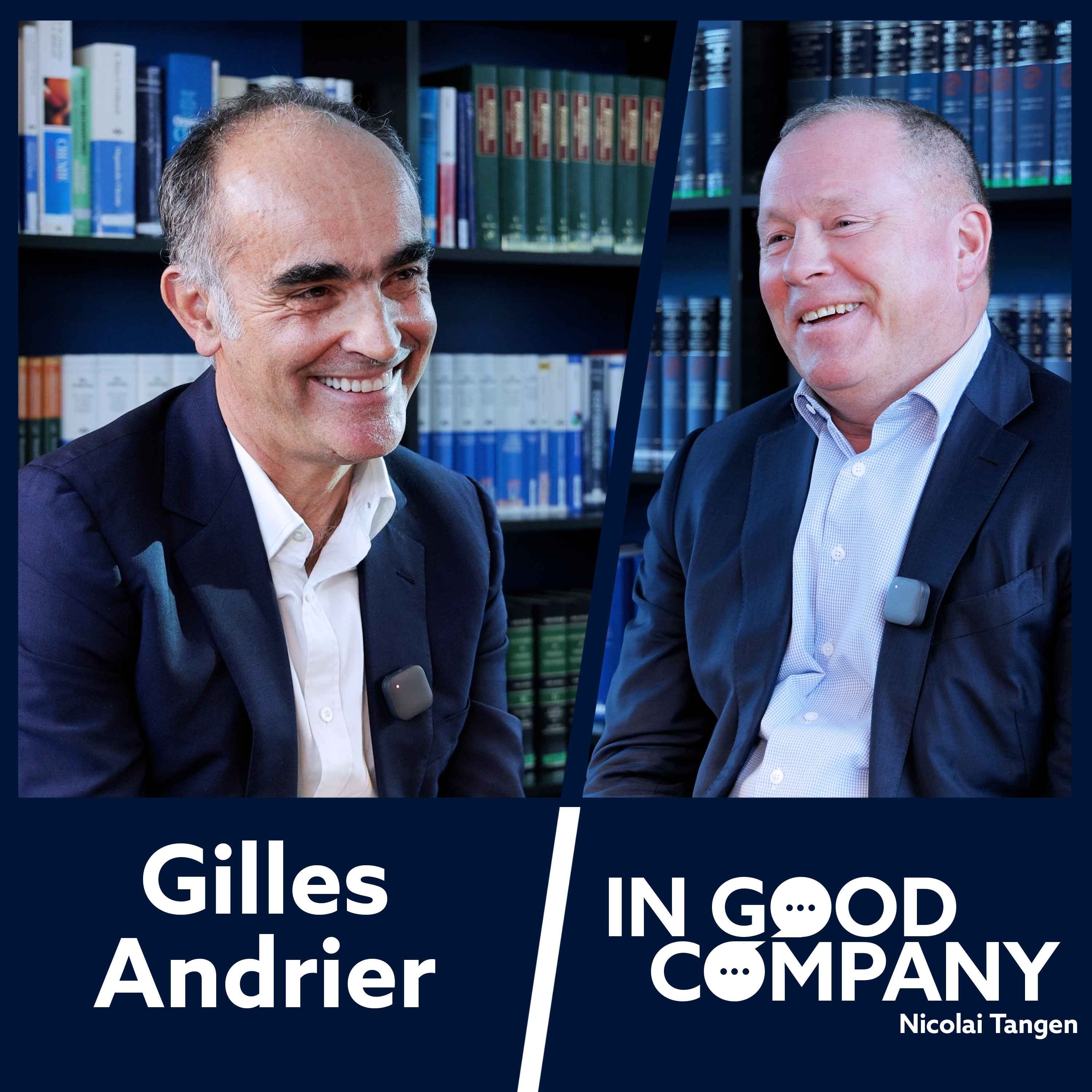
In Good Company with Nicolai Tangen
Givaudan CEO: The Art of Perfumery, Creating Iconic Scents and Building a Caring Culture
00:51:50
Loading summary
Transcript121 lines
- [00:01]
A
Hi, everyone. I'm Nicolai Tangen, the CEO of the Norwegian SO1 Wealth Fund. And today I'm in Switzerland and in really, really good company because I am at Givaudin, the world leader in flavors and tastes and smells and all these fantastic things which surround us. And I'm here with Gilles Henriet, who has been the CEO for 20 years. And warm welcome.
- [00:27]
B
Thank you. And warm welcome to Switzerland and to Giveaudan and here in Quentin.
- [00:31]
A
Wonderful. And it's kind of incredible to be here at your R D center, the center of the world's smell and taste. So let's kick off. What is Givaudin, in brief? What do they do? What do you do?
- [00:54]
B
I can say it in different ways, you know. Yeah, we make the world taste and smell very good, you know, but we actually thought about our purpose a little while ago, and we wanted to expand beyond just the world of fragrances and flavors. So the way we express what we do and what we are meant to do is to make consumers happier and healthier, which gives us a broader perspective on what we could do for them beyond the taste and smell.
- [01:24]
A
Why is smell and taste so important in connecting people?
- [01:28]
B
Because we are animals in the first place.
- [01:31]
A
Totally.
- [01:31]
B
Yeah. You know, just something which is interesting, which is, for me, always, you know, even after 21 years as CEO, 32 years at Givaudan, I'm still amazed by how, you know, this business is magic. So in the first place, for example, you know, in your body, in our bodies, we have 2,000 receptors, and you actually have 500, so a quarter of them, which are only dedicated to taste and smell. So it's basically the surviving kit in the first place. Yes, it's to have a pleasant life, to smell beautiful things and so forth. But in the first place, it has basically where it's a survival guilt. It's about, you know, bitterness is poison, foul is not good for you, but at the same time, sweet is. Calories is better for you. It's about energy. So it's all those things that obviously is at the core of consumers. And obviously we are dealing with memory because the body is designed in such a way that actually it has such a connection with the emotions, with the memories, and it's actually the fastest way to go from the senses to the memory. And that's why those things are being so linked. So that's the beauty of our business, and that's the cornerstone of what we do.
- [02:46]
A
Well, you do many things, and there are many ways to kind of get into this But I'd just love to kick off with the creative process. When you develop a new smell. Well, first of all, who do you create it for?
- [03:01]
B
So we are in a B2B business. Obviously Givaudent is not a brand in itself, where you will find Givaudan on the shelf. Because taste and smell is actually the key differentiating attribute. When a consumer wants to repurchase a product, any product, it comes at the top of the list before packaging, advertising, pricing, whatever the functionality of a product. It's not us saying that, it's our clients.
- [03:30]
A
So Gilles, let's say now, I'm Tom Ford, I come to you, I want to create a new perfume. How do we attack this?
- [03:38]
B
So basically that's what's called a brief. So you're going to issue a brief. You are the product manager, the marketing director of Tom Ford at the sell order and you're going to issue a brief and you're going to brief us, but alongside other fragrance households, because it's a competitive brief and you want to get the best out of the creativity of a broad range of perfumers. So that's how you go about it. We might actually define the brief together because we might help you in defining the brief. What type of consumers, how does it position itself with the other perfumes that you have under the Tom Ford area? You might have some ideals. So it's really, we enter a co development process together through the brief and then we have. So we have 200 perfumers around the world. We're not going to have 200 perfumers working on the Tom Ford brief, but we are going to have the fine fragrance perfumers out of New York, out of Paris, out of, you know, maybe some other places. And we're going to create some ideals and it's going to be like a funnel with the team of Tom Ford to actually select, collect, eliminate. And they're going to do that with the other fragrance houses and at some point we're going to find a few leads on which we're going to work together, make some consumer tests and so forth. And then that can take three weeks with a very small client, two, three years, it can take a long time and the best wins.
- [05:10]
A
But when you say lead, what is that? I mean, so now I have my existing fragrances and then what type of leads would they be?
- [05:20]
B
So you might have a range already in the top four, you know, which are very sort of woody or some of the fruity or some of the. And it might be interesting. And that's going to be us coming to you with some ideas to fit maybe a gap or something that you know essentially is going to fit the range of perfumes that you already have, but which also needs to echo to what Tom Ford is as a brand. Because the beauty of this business is that any brand has almost like an olfactive signature. It smells like Tom Ford, it smells like Gucci. So it needs to fit basically the strategic, you know, some form of strategy in the portfolio, but also to fit the signature of the brand. And that's what we do together. So you might have. And that's really based on the creativity of our perfumers finding ideas out of the blue as much as being a bit more rational in terms of how does this fit in the range of the. So there is actually very often we are fit by investors and so forth into the chemical industry. We are as far as the chemical industry, as you can imagine. We are actually closer to, especially when we talk about fine fragments to the advertising industry where it's all about defining the brand, defining the attributes of the brand and then translating that into a message and how you're going to communicate the Maldives. It's a bit the same process.
- [06:51]
A
How does smell fit into fashion? How, how do the fashion waves and smell? How does it work?
- [06:55]
B
So you have trends obviously, you know, for example today over the last 10 years there's been an enormous trend around gourmand. You know, it's about, you know, the gourmand sort of signatures and so forth. You might want obviously to jump onto the train of some trends or for example today what's extremely interesting. And our fine finance business has been booming for the last five years double digit. It's been very much fueled by the Gen Z, the Gen Alpha and suddenly it's a whole cohort of consumers who found so exciting to actually express themselves with multilayering fragrances. And it's really a matter of expressing yourself. And through that it came out very clearly that because it's a matter of expression, fine fragrances needed to bloom and to really diffuse. Very much so as compared maybe to 20, 25 years ago, where it was really about having fragrances for yourself and so forth. So those are trends which evolve with consumers and we also create some trends, you know, with newness, with new ingredients that we develop.
- [08:01]
A
So tell me about something on new. The new stuff. What's new stuff? So what should I wear to be modern in the fragrance world?
- [08:08]
B
There is not something. It's really about where it's like in fashion, you know, there are as many brands as fashion, you know, can propose. So it's really about how you. How you feel about the fragrance. You know, how you. There are so many families, there's an infinite possibility of fragrances. And therefore it's really about exploring. It's really about. And that's what new consumers do. It's very interesting to see them. They spend their Saturday afternoons in brick and shop, brick and mortar, you know, shops, exploring together and what fits you? So it's a matter of expression. What music do you like? I can't tell you. Just experiment. So it's a bit like this in fragrances.
- [08:48]
A
Okay, so say now we have had the brief. We decide that we want to go down the citrusy route, right?
- [08:53]
B
Exactly. So the freshness with a citrus top note on top of a woody ambery.
- [09:00]
A
Note, like au Sauvage type thing. So what do we. So what do we do? So we go into the lab together, you and I.
- [09:07]
B
And so we're going to. Obviously, yeah, we go there and then.
- [09:11]
A
What do you have in the lab? What does a lab look like?
- [09:13]
B
So you have. At the core. So again, you go back to the perfumers. So the noses, you know, they're going to write a formula. They're going to express, like, you know, you will write a piece of music on the computer. They write the formula, they know how the formula smells. This is also a piece of magic. You know, it's just a matter of expression, obviously. Then they.
- [09:34]
A
So it's like a musician, you can read the notes and feel in his head what it's going to look like.
- [09:38]
B
Exactly. Okay, but obviously they need to still smell the reality. Like a musician. You need to play the music. So you smell the sample.
- [09:46]
A
Where do you have the sample? You have lots of different smells in the lab.
- [09:51]
B
So you have. For every perfumer, you have a technician sitting 20 meters away with an organ of different ingredients, the palette of ingredients, which can be 500 to 1500 different ingredients, and those ingredients are part of the formula. The technician makes the formula, weighs every single ingredient, very tiny drops, a bit more volumesome other ingredients, makes the sample mix in the alcohol, Go back to the perfumer, the perfumer smells, put a blotter smells. And then the perfumer is not by himself or herself. She is surrounded with people who are going to help in the process. People at Givaudan? No, it's called evaluators. So the evaluators are there to actually bridge the work of the perfumers with what the clients want, what the brand want, on the Outside, because also, you might not be the only perfumer working on this brief at Givaudent. There might be other perfumers. And so it's going to be an internal competition on different trials, so that we maximize the chances of winning the brief.
- [10:58]
A
How many evaluators do you have?
- [11:00]
B
So on the project, you have one or two evaluators, but you might have two or three perfumers working on big briefs.
- [11:05]
A
So they compete.
- [11:07]
B
They compete, but that's a friendly competition, or it's a very friendly competition because it's a teamwork, where every, at the end of the day, you have an interest into your perfume apartment to win. Because we have incentive plans. We have not. So basically the way it's designed is that there is interest that we all win together. Obviously, the perfumer wins might be a bit prouder than the one who has just participated in the briefs.
- [11:33]
A
So here we have. So we now have a bottle, lot of stuff in there. We love it, the evaluators like it. What do you do then?
- [11:40]
B
So then obviously we go back to, so the clan. So in Fine France, there's a lot of interaction. So the clans come to the office. We smell together, we smell this idea, but we might smell other ideals. And then in front of us, at the client side, you have people who are very capable of evaluating the Fine France, how does it fit, how do they feel about it? And then you might be selected to go into tests, because some clients test the fragrances, some others just go by their conviction and gut feeling. But essentially you might go into a consumer test and therefore, you know, it's 100, for example, consumers on which we're going to present the fragrances in different countries, and you're going to test those ideas against benchmarks which are testing very well. So that's. That's a comforting way of saying maybe that's going to be potentially a success. There is some limitations to that, because the more you test, the more you're going to maybe lock yourself into something that consumers already know. Most of the big successes maybe were never tested, because actually, the only way to actually create something very different is not to have consumers smell things that they are used to. So actually, there is always a debate about should you test, should you not test? But it can be of a comfort factor. You can have things which actually don't test very well, but are going to be huge successes. So you have a lot of paradoxes, but that's.
- [13:17]
A
Do we tend to like more the stuff we already know? Exactly how predictable is it? So now we have something. How often are you really able to predict the success or a product?
- [13:28]
B
Well, that's the. Especially in fine fragrances, you have a certain, you know, more or less, if you have really poor test results, you know it's going to be a flop, so you better not launch it. But it's not because you're testing very well, that's going to be huge success. So because there are other elements, you know, you need to have the right packaging, the right mix, the right advertising. So there is a certain form of predictability, but you have no assurance, like in anything, like in music, you know.
- [14:02]
A
One of the worst test results ever for a product was Red Bull. People just totally hated it. I mean, it was so awful that normally you would have put it into huge bottles and sold it for nothing. Instead they put it into very small bottles and sold it for a huge price. And supposedly it's the second best selling beverage in the world.
- [14:19]
B
Right. So you have examples in the industry.
- [14:23]
A
So what's the biggest surprise? What's been the biggest surprise for you that you didn't think was going to sell?
- [14:26]
B
Which a business school one which we did many years back, it's called angel by Mugler and that was really, really, really disruptive. There was a very gourmand in your face. Overwhelming.
- [14:38]
A
So what does gourmand mean?
- [14:39]
B
What does that gourmand means? It's a very sweet chocolate, very edible usually. Again, back to the animal story. We like what is linked to food, you know. So in this case, angel was quite polarizing. But the woman at the time, Vera Shobi, had a huge conviction and they launched it. And it's called what is called a slow builder. So actually it was not necessarily an initial success, but over time it built up and it attracted consumers. And today angel, we say in perfumery, is the mother of many, many, many other fragrances which went into this gourmand route. So you need sometimes to take risks in fine fragrances to have a very strong conv to create what we call trendsetters.
- [15:27]
A
What are some of the other mothers?
- [15:30]
B
Actually what's very interesting is that because of new ingredients, new molecules which have been created in the meanwhile to enrich the palette that we just talked about. And some of those new molecules are being created here in this building, where Akigela Wood, for example, is something that has been created a few years back, which now has. Is behind so many successes in fine finagles, that it actually created a trend by itself. So you can create new trends and new mothers and fathers through new ingredients and new molecules. And that's why it's extremely important to have the best talent, the best perfumers, formulating, but also helped by very novel ingredients which will help create new fragrances down the road.
- [16:20]
A
So when you look at the whole fragrance market, how much consists of the old classics and all the Chanel no. 5, the opium, these kind of things and how much is the new, more funky stuff?
- [16:32]
B
So Nico, just for the interest of our people listening to us, so it's called the churn. So basically in fine fragrances, okay, nowadays the business, the market has grown so much that the erosion of fine Frankenstein used to. When you are at a market growth of let's say 5%, you have 25% newness, 20% erosion. So you can imagine that the churn, the replacement is quite fast today because Givaudan we are growing more like 15% on average in fine fragrances we are more at the pace of, let's say, 10% erosion, but 25% newness. So basically, yes, we still have a lot of old classics which are a bit the foundation, but essentially the newness has come. So yeah, everybody, every brand tries to hook, it's called to put to place basically a perfume in the top 10, top 15 somewhere. But it's. You need time to do this.
- [17:45]
A
What do you wear?
- [17:47]
B
So I usually don't advertise for brands, but I will answer very happily your question. Infusion de Cedre by Prada, which is my fragrance for many, many years, you know, we have done a lot of fragrances for Prada and I'm wearing one of them. Very good.
- [18:08]
A
How important are the perfumers? Because you are married to one.
- [18:11]
B
Yes.
- [18:12]
A
What, what, what kind of skills do you need to have?
- [18:17]
B
So obviously, as you know, you know, at the core of, of Givaudan we have a perfumery school. So the perfumery school, I'm sorry, do you have.
- [18:26]
A
You have educated very many of the world's perfumers?
- [18:29]
B
Yeah, and, and the perfumery school of Givaudan is very well known because it has been established more than almost 80 years ago. It actually train created 40% of the, let's say 40% of all perfumes sold in the world were created by perfumers coming from the school of juvenile. So it's a well renowned. So to characterize what needs to be a perfumer, it starts there. So we select them on the basis of. Yeah, can they smell, obviously, but you know, this magic about the nose. Everybody has more or less a good nose. I mean, but the difference between well.
- [19:09]
A
You say that you have supertasters, right? You have people with.
- [19:12]
B
Yeah, yeah, yeah. Well, it's. The accuracy is like the. It's like the perfect ear, maybe, and so forth. But even if you have the perfect ear, does it make you a Mozart? I don't know. So it's really about having a lot of passion for it because you need. You need to do that for the next 40 years. You really need to love it because it's tough. You know, it looks very nice on paper. It's magic. But we discussed about the briefing process. You are in competition as an individual perfumer. You're going to lose a brief nine times out of 10 or eight times out of 10. So you have a lot of deceptions, you have a lot of setbacks, and you need to grab all your confidence to go on the next brief and to be continuously creative. So resilience, persistence is extremely important. Then obviously, having this. This creativity, this generation of new ideas and so forth is obviously extremely important. So that's how we select them. It's in the first place, in the resilience, the persistence, that's the most important attribute.
- [20:22]
A
Okay, let's move on to flavors.
- [20:26]
B
Flavors. So it's more or less the same business, but the application is different. So what we described about fine fragrances, but then obviously fragrances going into home care, into personal care, into health care, it's the same process, the same briefing, the same skill set. And then you have the same. For flavors, where the application would be, beverage would be, food would be, you know, sweets. Because most of the time, yes, the food provides a lot of taste, but because of, you know, the sort of the. The fact that you have packaged food and so forth, a lot of what we call the volatiles, the top notes, disappear in the process. You need to put back some of those top notes, those flavors which are going to create the really fresh strawberry that you expect from a yogurt.
- [21:22]
A
And when you say top notes, the.
- [21:24]
B
Top notes, it's really the profile when you smell. So you have top notes, middle notes, dry downs. That's in perfumery. Well, in flavors, when you eat something, most of what you experience in the taste are actually the top notes, the volatiles. You don't chew your. Whatever you have to eat for hours. So actually the impact of flavors is a few seconds, a few minutes. So it's really about the first impact. When you. When you peel an orange, when you smell an orange, it's the top note, all those volatiles which comes to you. Then you have. Yeah. Then you experience sweetness and so forth over time. But the big difference between flavor and fragrance is that in fragrance you have the top notes. But then when you have a perfume, you're going to wear it maybe for a few hours. So you expect the dry downs, the smells continuing to diffuse over time in flavors. It's basically the impact is very short at the beginning. So that's why.
- [22:25]
A
What are some of the famous flavors that you have made that we eat and experience every day?
- [22:31]
B
We don't quote them, we don't name them, we are purple.
- [22:34]
A
Because the client relationships are secret.
- [22:36]
B
Exactly.
- [22:37]
A
But if you had to do one or two.
- [22:39]
B
If I had to do one or two.
- [22:40]
A
If you had to tell me one or two.
- [22:43]
B
Okay, I can tell you one. I can tell you one. Because they allow us. You know, it's a long story. It dates back. Very interesting because it was a true innovation. Snapple in the US it was a whole range, it's four window cleaners in the early 2000s, basically, who actually decided to launch a new beverage way of, you know, to really innovate on the side of CSD carbonated soft drains. And it was really about having this sort of very natural beverage based on tea and so forth. The whole Snapple range, you know, we did that. And so that's one example where you come with the four full. And it's an interesting example because it was not just the flavor, it was really the full combination of juice with a bit of flavor diluted in water. And that was really a new way of consuming beverage. So that would be one example. But you have flavors going into. At the other end of the spectrum, for example, all the work that we do on plant based proteins, the replacement of dairy proteins with plant based proteins for vegetarians, you need to have basically something which is going to taste like dairy or adding some flavors which are going to give the richness. So those things would be flavors which are going to enhance that. But we do other things which are very interesting which relate to health. We all know that sugar, salt and fat is not good for at least the excess of it. And therefore, the minute our clients are removing salt, sugar, fat, or adding functional vitamins, functional things you need again back. We are animals intellectually. You should not eat sugar and salt and so forth. But your belly is going to overtake whatever decisions you have taken to eat healthy foods.
- [24:36]
A
I experienced that very often, unfortunately.
- [24:38]
B
So if it doesn't taste good, you're not going to do it a second time. So that's why the taste is extremely important. That's that we work on with flavors with what we call taste modulators. To mimic. To mimic, for example, the sweetness, the saltiness, or to reduce the bitterness. And that's what we do in taste solution. So it goes beyond flavors.
- [24:57]
A
Absolutely. You talked about the top notes. What are the other things that you feel when you eat something that you are working on?
- [25:02]
B
Taste buds, top notes, bitterness, sweetness, saltiness, Umami kokumi, you know, the edible things. That's all the thing we work on.
- [25:11]
A
Yeah. When you have configured this for a client, how long do the contracts typically work for?
- [25:22]
B
So that goes back a bit to both fragrances and flavors, you know, so we just won our fine fragrance Tom Ford brief. We just won a Snapple one. That's a bit the beauty of our business model because you briefed us, but along with other houses, actually, we worked for free for you. All of that is for free. We actually did the whole job. We developed the whole formula. It made me have lasted two or three years. The formula is finished. You decide. It's this one. We have worked for free, but now.
- [25:57]
A
I have to start to pay.
- [25:58]
B
Yeah, but the first point is, because we work for free, we have the IP on the formula. We own the formula.
- [26:04]
A
Okay.
- [26:05]
B
The formula is not patented.
- [26:06]
A
IP being intellectual property.
- [26:08]
B
Yes, yes. So you cannot patent a formula. But we own the secret of the formula. We own the right to do the business and to produce this formula for you. So there is no such a thing as royalty. We don't need the royalties. It's just because we manufacture the fragrance of the flavor, we're going to basically sell it to you with a certain profit, which is going to pay for the expenses to have worked on the briefs and maybe the other briefs that you might be issuing the next time. So that's how it works. So we. We supply the flavor of the fragrance as long as your product is on the shelf.
- [26:48]
A
Now, one of the reasons why we. Why we love Givaudin is that what you produce is a small portion of the cost of the client. How big and small is it?
- [27:02]
B
So it's Roughly, on average, 4 to 5% of the cost of goods sold on fragrances. And it's 0.5%, 0.6% on flavors. So it's a very minuscule part of the cost. But the beauty is that it's also the biggest driver of liking. So we have a bit this leverage, you know, which basically. And because it's so complex, that's also the bit. The paradox that we have is that because you have A lot of complexities. And complexities don't just lie on perfumers and flavories. It's complexities in the whole supply chain. We supply 17,000 ingredients. We have to service our clients all around the world. So the paradox is that they outsource the most important driver of liking because it's complex.
- [27:53]
A
Now we want to be individual and be special. And yet in many ways, these smells and tastes become ubiquitous. They're all over the place. Tell me about the kind of, the trade off between being special and unique and mass production.
- [28:15]
B
Well, it's not really a. I would say it's not really a conflict. I mean, yes, every, I mean, in the first place, as you, as you rightly saw, because it's so critical to the success of the brand. Everybody wants to be different by definition. And that's exactly why it's a briefing system where they expect having something different from every time. And that's really at the essence of our business model that anything that we sell, we sell thousands of different products, thousands of different formula. Every one of them is specific to the client, specific to the brand. And we never sell this same exact fragrance to somebody else because it's a question of, you know, basically this, yes, we have the ip, but this IP is for you. So, yeah, you can have things which are looking a bit or smelling a bit, tasting a bit, but the beauty is that the possibilities are so infinite and this fragrance might be great for this brand, but might not be so suitable or so relevant for this other brand and maybe not relevant for this market. Obviously, consumers, as you mentioned, it's linked to memories, taste and smell, emotions, how you feel, culture. So there are as many trends and differences in terms of markets as there are countries and ethnics and so on. So the diversity is so wide and so big that in fact, this idea about everything looking the same is not happening.
- [29:59]
A
Now we have an artist who is working on, you know, with smell. She's called Cecil Tulos, she's Norwegian, she works out of Germany and she's making, for instance, a room where you come into the room and you start crying, you know, on the back of the smell. Do you feel that you manipulate people sometimes with what you do?
- [30:17]
B
No, we make people happier. We don't manipulate them. Manipulation is a very, very aggressive world. I would say in another world, in another way, when you think about especially what we call fragrances for consumer products. So you could argue that when you do and use your floor cleaner or a fabricaire, it needs to smell very good. So, yes, it's about having the pleasant smell. But in a way the fragrance role is to reinforce the idea that your floor is clean and reinforce the idea that your hair clean and reinforce the idea.
- [31:00]
A
So sometimes, sometimes when my wife is away, I put a bit, before she comes home, I put a bit of that on the floor, wipe it out a bit. So you should smell really clean. She thinks I've done a great job.
- [31:08]
B
Right? Absolutely. So you can say, are you manipulating your wife? Maybe, maybe so. So that's where I'm coming from.
- [31:14]
A
Absolutely. How does this industry look like now? How many players are you?
- [31:21]
B
So we are, yeah, there are four big players, but there are many other players that are mid sized players players and they are very small players. I would say it's. And I've myself grown in this industry with four big players which were called fnf, you know, core FNF players. But in the later years, you know, the industry has changed where at least two of them, namely Firmenich with DSM and IFF with Depot, have changed a bit their strategy and by joining forces, one with dupont, one with dsm, in order to become more what we say, sort of big conglomerate of ingredients. So that's basically where the landscape of competition has changed. And we didn't have the same strategy. We had more of a strategy to continue to focus on our FNF space, but at the same time by going after what we call adjacent spaces of ingredients, not necessarily fragrances and flavors, but things which actually have the same sort of attributes or the same business model as fragrances and flavors. To give an example, active beauty. So active beauty, we went there 10 years, eight years ago, ingredients which actually are doing the job to make the skincare product give you a most young and beautiful skin. So driven by innovation, the functional ingredient, the active ingredient that you have in skincare is absolutely key to the client, is driven by a lot of innovation. So somehow the business model looks a bit the same as for fragrances and also in terms of financial profile. So we went there, now it's a 300 million business. We did the same on makeup lately we bought a company in Italy which does makeup solutions for high end same idea. And it allows us to participate in the broader landscape of beauty, hair care, fine fragrances, skin care and makeup. And we did the same on the taste side, going into adjacent spaces with natural colors, with what we call phytoactives, which are botanicals, doing the job, you know, to make people healthy and so forth. So that's how we've done that evolved Our business model by expanding into adjacent spaces, but staying true to what we commit for our clients.
- [33:56]
A
Are you seeing new competitors, for instance, from China?
- [34:01]
B
Well, not really. So the Chinese, they entered the market many years back, but more on the what we call the ingredient side, making through the, you know, they are good with chemistry, they're actually now good with biotechnology. So making some of the ingredients that we use in fragrances and we use them as suppliers to feed what we do in Givaudan. We went into China 30 years ago. We are Chinese ourselves. We have 1200 people in China. We have five big sites. We deal with local Chinese clients, big clients. So we are really well established and we have not seen relevant sort of big Chinese competitors emerging.
- [34:47]
A
Let's move on to the corporate culture. How would you define the corporate culture at Givaudan?
- [34:53]
B
Well, this is something that is absolutely key to me. So when I joined Givaudan, I bumped into Givaudan 32 years ago by chance. Nobody knew that. But behind products, you had noses and flavories creating those. I really bumped into this magic, this magic business by coincidence and chance. But I also discovered a culture which basically attracted me. So the culture at Givaudan is very strong. I think it defines and it's really core to the success of Givaudan. But basically I've grown this culture, I've enriched this culture all along my tenure as a CEO Givaudan. So the culture, yeah, we have obviously this huge diversity. Yes, we are a Swiss company, but the Swiss company, we have 8 million people in Switzerland. So it doesn't define us as a culture. We are truly a multinationality culture. But it's also the result of the fact that we have done many acquisitions, many merges over the last 20, 25 years, but even before, which has enabled us to have a very sort of inclusive culture, diverse culture, and really where everybody sort of joins around this culture and this culture. What is it? Well, we finally, because we finally managed to define it a few years back, because it's one thing to say I've got a strong culture, but what is it? So the best way we could articulate it, where everybody felt really strong about that, is that it's almost two spheres. One is really about performance driven. We are not just because we are a stock listed company, not because we have to deliver on financials, but simply because we feel, I feel extremely obligated vis a vis our clients. It goes back to the business model. They are outsourcing, the most important driver of liking to us we better be up to the task. And so being performing, being challenging, being inspirational, being creative is absolutely key. And that's what makes our people passionate about and always ready for the experiment. So the performance, the challenging is really one part of it. The second part, which I think defines us even more so it's really what we call the heart and soul. We are a caring company. We are a human company. Not because we like saying that we are a human company, but because in the first place, that's how I would say our DNA, the magic of the DNA has evolved. And the humanity is tested every day. It's tested when you have to restructure Givaudan, you have to let go people. You say what you do, you do. You say you don't play tricks. You do it with caring, with humanity. So humanity is also tested when things are more difficult, in how also we relate to each other. The leadership. I'm the CEO of Givaudan. We are all very accessible. So it's really the way of being which is part of, I would say, the magic of a culture. Always very difficult to define the magic. It defines the chemistry, but it's very strong and driven.
- [38:16]
A
So you have been for 20 years. So I would expect the corporate culture to reflect who you are as a person. So if I read it back to you, you know, performance driven, creative, caring and accessible. Aren't those characteristics that we can put on you as well?
- [38:35]
B
Yeah. Otherwise it could not have worked for 21 years.
- [38:38]
A
That's what I mean. Because it takes 10 years to change in global culture. You've had 20 years. And so I expect this company to really reflect you as a person.
- [38:46]
B
Yeah, but, you know, I'm also a very humble guy, so it's not such a thing. Where I said, I woke up one morning and said, here's going to be the culture. I think there was a magic fit between what giveaudon had in its core DNA and who I was, who I am. And the match was there. So, yes, I define myself as this, the performing guy and the caring guy.
- [39:05]
A
And what do you think the biggest difference between Givaudin and other companies in the same field? What do you think is the main differentiator?
- [39:13]
B
I cannot talk on their behalf because I've never worked for them. I compete with them. But the only thing I can say is that that's how our clients talk about us. You know, the way I just define the culture of Givaudan actually was something that we really echoes the way we are being talked about. So I think the humanity side, the caring side, is something that maybe defines us. Not that the others are not human, but essentially that's what's come out very strongly.
- [39:47]
A
Is there anything, any part of the copper culture you try to improve just now or working particularly on?
- [39:55]
B
Yeah, because we are never perfect. So we became a very large company. When I started, we were 4,000 people. We are 17,000 people. We grew, we transformed the company, but always being extremely diligent about growing, but not at the expense of the agility. So finding always ways to improve the agility, to reach out to very small clients, to be not considered as the big, big Givaudan, which is not going to take care of the small clients, is super important to be fast on execution. We are considered very, very good on execution. But at the same time, you know, something around agility and so forth is something that we can further and further improve.
- [40:40]
A
How do you avoid a bureaucracy?
- [40:44]
B
I would say that's almost part of the culture and maybe to avoid it. Well, no, but even beyond that, I will be very direct. Bullshit. And Hotel Givaudent doesn't survive more than three seconds. Meaning that we are. Because we have all grown in this business. I've been running figures, I've been running operations, I've been a salesperson, I've done the job. And the people reporting to me, the ones who are running divisions and the next levels, they all grown within the company, having done the business. So we know where we cannot be taken on a ride. We are very pragmatic, we are very concrete. So the bureaucracy is something that we almost by nature avoid. Now we still need to do hard work, that we are not overwhelmed by the size and the fact that processes are too complex and so forth. That's the work I was just talking about. But that's also part of the culture to really. We still live like we are a large company, but still think as a small entrepreneurial company.
- [41:53]
A
And how do you make sure that things are speedy and agile? How do you work on speed?
- [41:58]
B
So on speed, we actually have done quite significant things. As an example, we have, obviously we have a lot of processes on the supply chain. Again, back to the complexity. What we did a few years back, we have roughly 100, 130 sites around the world. So we regrouped all our processes, all the supply chains, into three big shared services centers belonging to Givaudan. That's a very big important thing. We never outsource those. They are part of Givaudan. But that allowed us actually to Be much better on execution, all those processes, how you deal with clients, how do you supply your ingredients and so forth. And, and that allowed us as well to apply AI, to apply digital. It's much easier to put in place technology and change things on three sides than compared to 130 sites. So that has really helped us and we'll continue doing that by housing even more processes. So that's part of the way we've I think differentiated ourselves on the execution.
- [43:09]
A
What are your most important leadership principles?
- [43:13]
B
Well, it goes back a bit, you know, to the, to the culture. I think it's really about back to the performing and caring. I would say that, you know, we have learned to first is to. It's a bit the equity story that we have created. You know, committing on very ambitious targets always that has really in a way looking backwards always helped me help us that not being shy about setting ambitious targets which look intimidating but that's the only way you're going to get to them or close to them. And the thing is that what we have managed I've done, we run the company with five year cycle. So it's been four, five, four times five year cycle which we've done. We have always delivered on everything that we've committed. So this is something that is really ingrained in what we do is really to deliver on what you promise. The second thing is really about being entrepreneurs, I think finding ways through the innovation. I think that's extremely important which is at the core of what we do.
- [44:26]
A
How does your day look like when you wake up?
- [44:30]
B
So I don't wake up at 5am like a lot of CEOs say I can't wake up at 5am so. Well actually I wake up many times if I see to catch a plane. But yeah, so 7:00am, 7:30 and I go on for the day. So yeah, usually an intense day.
- [44:49]
A
And how do you relax?
- [44:51]
B
So relaxing. I do a few things. I do, yeah, I do a bit of. I do a lot of sports, you know, cycling, running in the past. But the knees gave up a bit. So the cycling is softer for the knees. So a lot. And that's actually, you know, cycling for. For a few hours. It's very interesting because it's almost thoughts come pop up as you cycle and it's a very almost, you know, relax. How do you say meditation time on the bicycling, on the bicycle. I've got many children, I've got six children. So interacting with them, enjoying. I'm a very lucky guy from that standpoint. And we have a wonderful, happy family, wonderful wife. And that's also part of what I enjoy and relax. But it's tough to be a CEO for 21 years.
- [45:46]
A
Yeah, I know you are going to become the chairman in the same company, so that's good. But. And then you were kind of traveling around Europe with a big rib, right, with your family, you know, driving through the Mediterranean. It's a different type of holiday.
- [46:04]
B
Yeah. So, yeah, I used to do a lot of sailing when I was much younger. But you need a bit more time to sell boats, regattas and all of that. So. And we love the sea with the family. So for many years, ARIB is a semi inflatable boat and going adventure, two engines, putting all the kids on the boat, one bag each, and going from the south coast of France all the way down to Sicily back to all the coastline. And we did that five, six, seven years in a row, stopping in hotels. And it's a lot of fun because it's, it's quite adventurous and it's about, you know, enjoying, enjoying life together.
- [46:49]
A
So when you are in a restaurant and you are like a smell and taste family, you know, with a perfumer as a wife and, and you hear, how do you, how do you eat? I mean, it's just like, hey, smell this basil. Hey, look at that tomato. It's different than the other tomatoes. I mean, no, no, no.
- [47:05]
B
It's not an obsessive thing where you have a, you have to, to talk taste and smell every day on everything that you, that you say. Actually, funny enough, my wife, who is a perfumer, okay, maybe it has to do with DNA and so forth. Her mother was an absolutely outstanding cook and so maybe there is something around that that went there. My son would like to also be a perfumer. So there is something maybe in there. But we try not to talk too much about taste and smell at every meal together. We love cooking. I love cooking. That's how also I relax, experimenting things and having fun.
- [47:49]
A
And what is your advice to your six children and to other young people who listen to this podcast?
- [47:56]
B
Well, yeah, first as I move to the cham and what I think I will be missing, but I will make sure that I don't miss it continuously. Be engaged is really being engaged with people. You know, we are in a business where I've been extremely grateful. I'm extremely grateful because this huge diversity of clients where you have to go deep into what they are doing, but in the same way with employees. And I've always been extremely. Let's say, engaged by interacting, giving, trying to give advice, but also listening to the young, to the, to the ones who are developing at Givaudan. And the same way I would say that I would say the same thing to my kids, which I. Which I do, which is a few things which have worked out for me. And I'm not somebody who is very much into management books and giving lectures and dogmas about, you know, what they should do and so forth. I call that find your own suit. When I became a CEO, I had a thousand people telling me what to do as a CEO. And even though I was quite young, I really listened, but at the same time wanted to go my own way and be confident about that and grow my own suit. So a few things and a few advice. First, don't plan your career by saying, I want to be a CEO. That's the best way not to become a CEO. And it's not a goal by itself. It has never been a goal for myself. What has been driving me is to enjoy every day of any job I was given and having an impact rather than status or whatever things. And so I'm extremely curious. So I think that has also helped me. Curiosity is the best friend for many jobs. And I think fulfilling this curiosity allows to engage, allows to learn, allow us to ask questions, but allows to listen. And I think that's another advice I would give. Third advice is, yeah, in the same way planning your career is, I don't think it's the right thing to do, but at the same time, it's very important to experiment. You know, my kids, and I guess it's the case for many young people. How do I know what I want to do? Because I've never done it. So it's all about experimenting, discovering yourself by putting yourself into a situation where you're going to learn something, where you're going to learn something about you, what you like, what you don't like, or suddenly discovering other muscles. I thought I was a super shy guy. I would never be able to sell one kilo of anything until I said, okay, I'll go and try. And then you do it yourself. You engage and you discover that you maybe have grown the skills. So it's about experimenting and therefore it's about taking risks. And in my career, I've taken a lot of risk on every job. Jumping into the swimming pool by not really knowing what I was going to do, but just using my trust, my confidence and my brain and listening to learn the job. So it's a lot about that, I think, which helps growing. But in the first place, enjoy what you do, because if you do it, if you do enjoy what you do, you're going to be motivated. If you are motivated, you're going to do a good job, it's going to show and you're going to grow.
- [51:36]
A
Very good advice. Big thanks for being on the podcast. Big thanks for making the place better tasting and better smelling.
- [51:41]
B
Thank you very much.
- [51:42]
A
Thank you for questions.