← In Good Company with Nicolai Tangen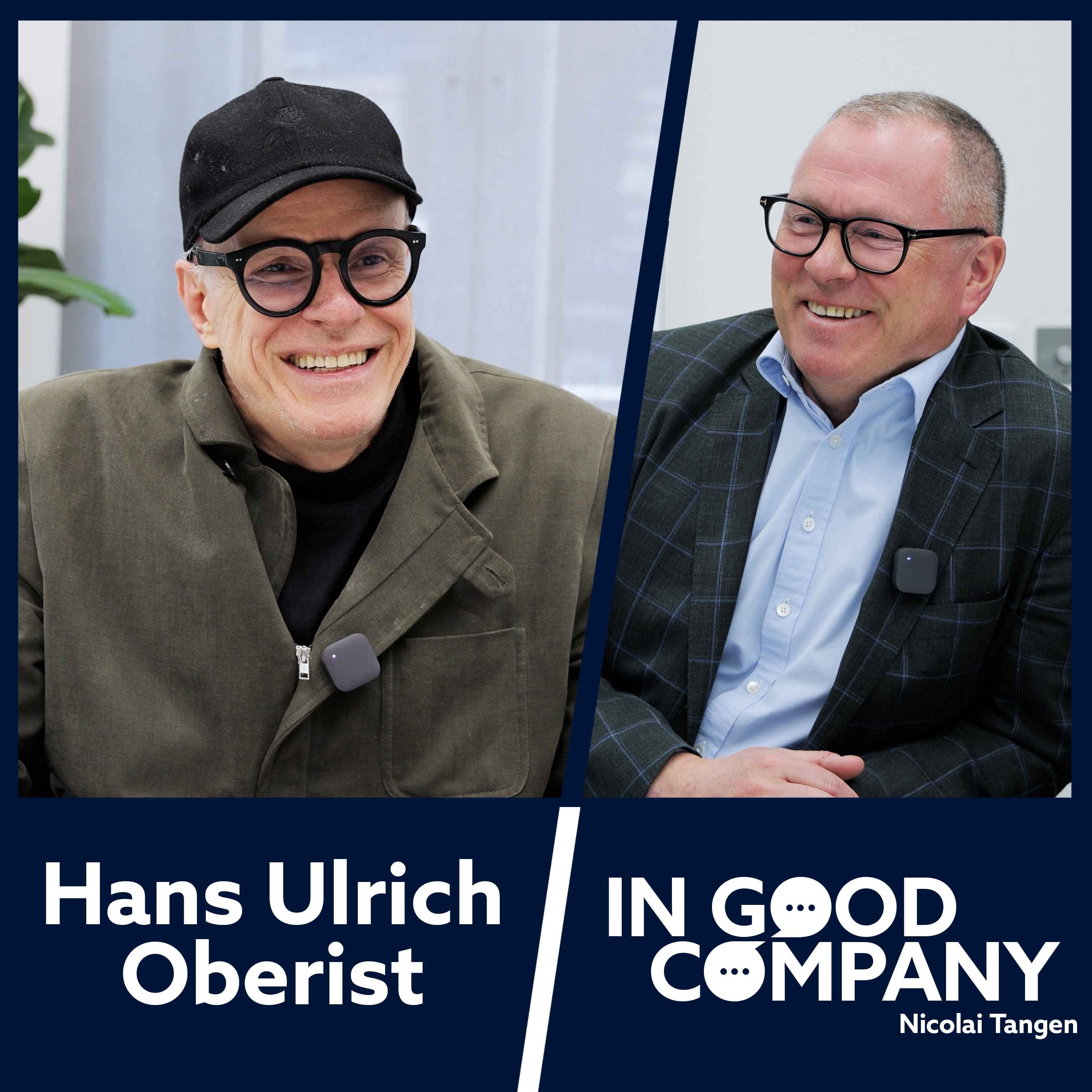
In Good Company with Nicolai Tangen
Hans Ulrich Obrist: What business can learn from the art world
00:58:15
Loading summary
Transcript136 lines
- [00:01]
A
Hi, everyone, and welcome to In Good Company. I'm Nicola Tangen and I am the CEO of the Norwegian Sovereign Wealth Fund. And today I'm joined by somebody who I think probably is the world's greatest connector of ideas, people and art. Hans Ulrich Obrist is the artistic director of the Serpentine Galleries in London and widely considered the best art curator in the world. You created unbelievable amounts of exhibitions, and today we're going to tease out the beast reasons behind your success. Creativity, how to connect with people, and what business can learn from all the kind of things you've done. So warm welcome.
- [00:41]
B
Thank you. Very nice to see you.
- [00:52]
A
What does an art curator actually do?
- [00:56]
B
Yeah, I've always followed this definition the writer JG Ballard gave me when he didn't really understand what was my profession. So I was describing it to him and he says, so basically what you're doing is you're a junction maker. You create unexpected connections. And I think that's kind of what is at the core of my practice. It's bringing artworks together, bringing people together, creating situations, and using also the exhibition as a kind of a medium to create experiences.
- [01:30]
A
What's the key to create interesting experiences?
- [01:33]
B
I mean, I think the first, probably most important step is to listen. The poet Etel Adnan said once that we sort of need to learn to listen again. And I think listening to artists is always the beginning. So I would go to studios. It's something I've been doing ever since I'm a teenager. When I was like 16, 17, I traveled on all over Europe by night train, and I went to see artists from Gerhard Richter to Rosemary Tockel to Louis Bourgeois, Message to Fish Levi. So artists kind of all over Europe initially and then also outside Europe and would just listen to them and of course also kind of find out what they would like to do. So rather than to somehow squeeze their practice into a kind of a framework, it's basically kind of listen what they've maybe not been able to do in the context of the art world. So how we can basically change the art world or shift it slightly to make this artist dream become a reality. So in a way to come back to your initial question, what is a curator? I think it's also about enabling, about making things possible.
- [02:46]
A
Now you put together things which weren't meant to be together. Often. What's the key to get kind of diverse things to play together?
- [02:56]
B
I mean, I think the key is to not stop the serendipity, because very often it's a chain reaction and it's not necessarily a master plan. I think very often an exhibition has a checklist early on and, you know, one would say that's what we're going to do. It's very limited. I think we go on a journey, we go into the unknowable. And on this path, you know, we have to be open for many different surprises. So one of my bigger projects of the last years has been my kind of handwriting project. And that is an example for that. You know, these two little books and this also my Instagram account. And we basically, I was with Umberto Eco, the writer and scholar, and he was very old and he said, basically we need to do something to save handwriting. And so kind of left his apartment with this task somehow. And I wasn't of course qualified to do that because I'm not the calligrapher, nor could I found a calligraphy school. Then, in a way, I was with the poet Etela Nan, whom I quoted earlier, who said that we have to learn to listen again. And she also told me that we shouldn't sort of forget that handwriting matters. And she started, whilst we were in a cafe to write a very beautiful poem in her notebook. And suddenly I realized I am with artists, with with poets, with writers, with architects every day. So I could just ask them to write something and make my social media give it a mission. Because in a way, I didn't really know what to do with Instagram and with social media. I knew that I didn't want it to be about selfies, I knew they didn't want it to be about food, I didn't want it to be about my travels. It needed to have a mission, a purpose. And then I thought, wow, so I could actually do what Umberto Eco told me. And so in a way, it's the serendipity which leads to project. I think it's to be open and to be curious and let things flow.
- [04:42]
A
Not many people actively believe in serendipity. I kind of love it because it brings out surprising things. What is your relationship to serendipity?
- [04:51]
B
I think in a way, the idea of an encounter with artists can lead us somewhere where we would never have thought or we would never think we could go. And I think that's what very often is the serendipity of such project. But it's also, I think, the idea of going beyond short termism. I think we live in a world which is very much sort of ruled by short termist deadlines, by deadlines, where for a certain moment or up to a Certain moment, something has to happen. And that's, of course, true in every field. It's also true in my field. The exhibition has to open. But I think very often it's interesting that we go on a journey and that an exhibition has a longer life than that. Some of my exhibitions have been evolving for more than 30 years. We started a project called do it, where I ask artists to write instructions and recipes. And basically, people, museums, people at home, people everywhere in the world can interpret and can basically do the artwork themselves. And so that project has been on the road for 33 years now. And it's never stopped. There has always been a new version. It keeps learning. It's. It keeps evolving. I think the idea also that exhibitions, in a way, don't start from this idea that they know everything, that we kind of set up vehicles or structures which can learn, is very important.
- [06:19]
A
What's the recipe for a great exhibition?
- [06:21]
B
I mean, I don't think that there is one recipe. I think that in a way, an exhibition needs to kind of come up with new rules of the game. It needs to kind of come up with new connections, new encounters, needs to create an experience we haven't had before. And very often it's also bringing disciplines together. I mean, for example, we've just had an exhibition at Serpentine of Peter Doig. And talking to the artists, we figured out that his desire is really to bring the world of art, painting and music together. And little by little, we realized that it also includes poetry, because he collaborated with poets. And so we created an exhibition. We invited him basically, to create an exhibition at Serpentine, where on the one hand, he presented new paintings. At the same time, he transformed the exhibition space into a listening space. People could sit down, they could have a chat, they could have a conversation. They could also lie down and just chill. And they could listen to his music. They could listen to the music he has basically in his studio. He plays in his studio. But they could also come for special events. There were these basically sessions every Sunday. So it means that people came actually not only once to see the exhibition, but all of a sudden you have people who came every Sunday, who came every day to listen to new music. And so, in a way, it created a completely new experience. And also, in a way, binds people to spend more time. Because on average, people spend very little time in front of an artwork in a museum. A few seconds, sometimes longer. But I think it's interesting when we create an exhibition.
- [07:56]
A
Are you fast when you go through exhibitions? Because I'm really fast.
- [08:00]
B
I'm fast until I'm not. If all of a sudden I'm fascinated, then I can spend a lot of time. So it's kind of both. But I think it's interesting that we create multi sensory experiences where actually visitors can spend more time as they did in Peter Dark's exhibition.
- [08:12]
A
What's your imprint on this? Where can we see obrist in your exhibitions?
- [08:17]
B
I mean, in terms of solo exhibitions. When we do solo exhibitions at Serpentine and we most of the time invite artists to take over the space and create their world and show their work as a kind of a world building, then I think it's an enabling. It's making that possible. It's, of course, very different with group shows. With group shows, the curator kind of defines, in dialogue with the artists, the rule of the game. And we are working right now with my colleague Ben Vickers and Sandrok Collective on the Vatican Pavilion, the Holy See Pavilion for the Venice Biennale, which is going to open next month. And there we basically came up with this idea of this interdisciplinary figure, this saint, Hildegard von Bingen, who lived in the 11th century. And so many musicians and artists today are inspired by her composing, by her music, by her writing, by the way she connected also to nature, by the way she kind of connected to healing. She was also a healer. So we decided to kind of in dialogue with artists, to sort of do a garden, a sound garden in Venice. It's a hidden garden near the railway station. And this garden is basically going to be accessible for the exhibition, and visitors will come there and listen to sound interpretations of 21st century artists, from Blood Orange to Paddy Smith to the Bong Nakanga. Many different artists will interpret Hildegard von Bingen's work for today. So here we kind of, you know, would define. Yeah. A rule of the game in which then the different artists can intervene. So it depends a lot if it's a solo show or a group show.
- [09:57]
A
Tell me about the importance of multi sensory exhibitions. What does it do to the visitor?
- [10:05]
B
You mean when an exhibition addresses multiple senses? Yeah, yeah. What happens?
- [10:10]
A
How do you think. How do you think about it? I mean, how many. How many senses do you want to engage? I mean, more senses. Better.
- [10:18]
B
I mean, I think we can never say an exhibition has to be this or that way because each time it's a different situation. But I think if you want to bind the viewer and if you want the viewer to spend more time in an exhibition, it's important to appeal to multiple senses. Definitely. And I think that's something I mean, the example of Peter Doug is the case in point. People spend hours, they kept coming back. And that's also what's happening, for example, with our experiments with technology. When I joined the sub, and then in 2006, we started to think about what could be new departments. And we started to basically introduce an ecological sort of department so as to say, where we looked at environmental aspects of what the museum does. But we also felt it would be important to kind of connect to technology, because around 2012, 2013, most of the museum work with technology happened, maybe on the website, but it wasn't really central it in museums. But it was clear that it would become a very important kind of dimension of art of the future. So we started kind of new experiments in art and technology. And many of these exhibitions are very multisensory. We created, for example, exhibitions with video games, because Today more than 3 billion people play video games. A niche medium has become one of the lead mediums of our time. Many visual artists are engaging with that medium. So we created kind of mixed reality installation, physical installations by artists with video game components. And that again exhibitions, for example, of Gabriel Massan and also Daniel Barai, Swecelli and others. These exhibitions really bind the view and visitors spend a lot of time. And it also brought in a completely new generation of kind of visitors who otherwise wouldn't visit the museum. So we also kind of think in relation to that, it's interesting to create new alliances, to kind of connect, because obviously museums always work with other museums, but we think it's interesting to create new alliances also with brands, with companies in technology. So, for example, for the cause exhibition, we partnered up with Fortnite. And that partnership meant that all of a sudden Serpentine was on the landing page of Fortnite. And we had in two weeks 150 million visitors on that space, which is more than any exhibition we've ever done. And that brought us a lot of visitors the physical space. The same exhibition basically happened in the virtual space on Fortnite. And in the physical space, the physical paintings were actually in the gallery. And all of a sudden teenagers brought their parents to the Serpentine, which in a way otherwise would be the other way around. Also, the same thing happened with K Pop. We did a whole collaboration with BTS and K Pop and the young artist Jako Knutzinsen. And all of a sudden the world of contemporary art and the world of K Pop came together.
- [13:09]
A
Yeah. Are the best artists also the most technically accomplished or using modern technology in a better way? Is there A correlation there.
- [13:19]
B
I think that.
- [13:20]
A
Because I remember I saw a Hackney exhibition where he had drawn on iPads. Right. You remember that? Probably from the Royal Academy.
- [13:28]
B
Yeah. At the moment, we actually show an exhibition of David Hockney at Serpentine, which just opened, and it's there until early September, late August. He's always gone beyond paintings. He's a painter who always had the curiosity to go into other fields. So he wrote Secret Knowledge, which is a book. At the same time, he worked with opera. He worked with opera sets and theater sets. And then he always came back to painting. And then I would say already in the 80s, he was very fascinated by technology, but it was too slow for him. Drawing was still faster. But then around 2006, 7, 8, 9, I don't remember exactly the year, but about approximately 20 years ago, 18 years ago, he started to, all of a sudden, really experiment more with technology. And then he started to make these extraordinary works on the iPad. And initially it was flowers and then landscapes. And it really intensified when, during the lockdown, he was in Normandy in France, and he created this amazing work, a year in Normandy. And it's, of course, a very physical, deeply embodied piece because it's printed, it fills the gallery. It's a panorama. It's, in a way, an homage to Bayeux. One can say it's inspired by the Tapestry of Bayeux. So it's interesting because later this year,
- [14:45]
A
which is now coming to the British Museum.
- [14:47]
B
Coming to the British Museum. So our show is basically ending when that starts. So it's kind of a segue almost. And for Hockney, it was very inspiring to visit the Tapestry of Bayeux. He created hundreds of works outdoors. A bit like Monet, the Impressionist would paint plein air. Hockney was plein air, but he wasn't there with the easel and the paint. He was there with his iPad, and he was basically painting. And then combined about a hundred of these works into one very long work, which is inspired by Bayeux and which is basically going around the corners of the space, so one has to walk in order to experience it. And then at the same time, you know, he would return again to painting, as he always did. And in the two powder rooms in Serpentine north, the two central spaces, there are two new paintings. So, yeah, that's definitely. It's a very physical experience, but it's being created using technology. And it took him a long time to basically learn how to use what's
- [15:53]
A
going to be the function of AI in art.
- [15:56]
B
I think it's interesting right now to see how many artists are working with AI. And we started, of course, when we, 12 years ago, began these experiments in art and technology at Serpentine. We quite early on, also focused on AI. Last year we had an exhibition of Holly Herndon and Matt Reihurst, and they worked with choirs all over the uk. They created a book of hymns. This is the book of hymns, basically, which then was interpreted by these different choirs. And the choirs kind of are forming, these recordings, are forming a data set. And visitors could actually experience this data set. Because normally one wouldn't see and understand how a data set actually works. It's.
- [16:48]
A
But does it matter for you whether art is created by AI or people?
- [16:52]
B
I think it's always both. I mean, the case of Holly Hunter and Matt Rehears, the artist worked with people and it was a collaborative situation with AI. And what was interesting is that, I mean, Park Clay once said that art makes invisible visible. And in a way, a lot of kind of AI functions we use, we don't really understand and don't really know. They are kind of opaque. We don't really understand how it works. And they really wanted to make the process of forming a data set visible or audible for the viewer. And then I think at the same time, quires are a very old coordination technology, and AI is a form of coordination technology. So they created that connection. And interestingly enough, it was for the viewer or for the visitor who came to Cypitan and experienced this AI work. The call of Holly Herndon and Matt Reihurst also a way to understand how actually artists can use a data set and AI ethically. And the same thing also happened with Rafi Ganadol. I mean, Rafi Ganadol created this very immersive installation in close collaborations, of course, also with Google. He's been collaborating with them for a long time with Nvidia, and he created very big data sets, but all ethically sourced. SMITHSONIAN from National Geographic. So I think it's interesting also how artists can set an example how AI datasets can be ethically sourced.
- [18:34]
A
Hans Urich let's talk about relationships. What is key to establishing good relationships with artists?
- [18:42]
B
I think relationship with artists are about liberating time. I think it's something which always begins with a studio visit. It begins with a long conversation. So I think it's something which has to do also with attention.
- [18:59]
A
And you visit them typically in the galleries.
- [19:02]
B
I would make studio visits. I mean, some artists don't have a physical studio, then we meet in a cafe, but that's also a studio. Visit? Yeah, I do that. I do that every day.
- [19:11]
A
How many artists have you visited?
- [19:14]
B
I mean, I've been doing it since 1986 because I started when I was a teenager. So it's been 40 years. So if you would think that on average I visit the studio a day, it's 40 times 365.
- [19:29]
A
It's a lot, huh? But you also record some of your conversations.
- [19:33]
B
Yeah, I started at a certain moment in the early 90s to record them. I mean, initially because I didn't really remember everything artists told me, but also because I started to think that maybe it could be interesting for the future as a document to have the voices recorded. I basically was very inspired by Vasari and how Vasari wrote the lives of the artists and wrote the lives of the architects. I was very inspired by the book of.
- [19:58]
A
So this was during the Renaissance?
- [19:59]
B
Yeah, the Renaissance. And then more recently, David Sylvester, who in the 20th century would talk again and again to artists like Philip Guston or Francis Bacon. As a matter of fact, he did a whole book of his conversations with Francis Bacon.
- [20:15]
A
It's incredibly incredible book.
- [20:16]
B
And it's an incredible book. And I read that book as a teenager and I started to think, you know, because I have this long. I started to have this long term relationship with artists that I could maybe do something similar. I could sort of record. And I mean, today I've. It's, it's. The archive is about 4,500 hours. So it is a data set.
- [20:35]
A
What are you, what are you going to. What are you going to do with it?
- [20:38]
B
I don't know yet. Completely. I mean, so far.
- [20:40]
A
So that's the most comprehensive collection of interviews in the world, right?
- [20:45]
B
Yeah, it's probably. I don't know, but it's definitely also not only very broad, but it's also deep in the sense of that I would talk to the same artists again and again. With certain artists, I have 20, 30, 40 interviews over the years because I would interview them every year a couple of times.
- [21:08]
A
Do you ask the same questions?
- [21:10]
B
Yeah, there is a couple of recurrent questions.
- [21:14]
A
What are they?
- [21:15]
B
So one question I always ask is the question about the unrealized projects Because I do think it's very interesting. I mean, I think we all, not only in the art world, we all do have unrealized projects. And it's interesting that it's only in very few professions that actually these unrealized projects are being published. I mean, architects do publish them because the competition culture, in a way, the architectural competition very often leads to them being published. But we know very little about poets, visual artists, filmmakers. But I suppose also in your field, we at the end of the day, don't know a lot about CEOs and unrealized projects. So I think it's interesting.
- [22:02]
A
What can we learn from them? So let's say now we interview a CEO. Hey, what is your unrealized project? What do you think we can learn from that concept?
- [22:10]
B
I think what we can learn is. It's an interesting question what we can learn from it. But I think in terms of artists, what we can definitely learn is maybe we need to kind of look at the range of the unrealized projects. I think there are many different types of unrealized projects. There are certain projects which are too big to be realized. There are certain projects which are too time intense to be realized. There are certain projects which are maybe unrealizable. There are utopias, there are dreams. There are certain projects which are censored that can be a reason for it not being realized. And then of course, there is also projects which are self censored. Doris Lessing, the writer, always said one category not to be underestimated is the self censorship projects we would like to do but don't dare to do. And I mean in terms of the art world, very often artists have projects outside their kind of daily routine because they are basically invited to be in biennials. Artists are invited to do gallery shows, they're invited to do museum shows, they're invited to participate in collection exhibitions. But very often they have projects outside these parameters. And these are very often the most interesting projects. And so then we need to think, how could we make them happen?
- [23:22]
A
Of course, the obvious follow up here is what is your unrealized project?
- [23:27]
B
Yeah, so my unrealized project, it's a long list because I think a lot of exhibitions I want to do early on fell through. And I still, one way or the other, would like to do some of them. The Hildegard von Bingham project we are doing now with Ben Vickers and the Soundwalk Collective and these different artists is one of these unrealized projects. We always wanted to do something about Hildegard von Bingen. So that's now happening. I always also felt having organized many exhibitions, worked in museums, being the artistic director of an institute at Serpentine, I've always been thinking, you know, what is missing in the art world? And I think what is really missing today is a kind of a new Black Mountain College. What is missing is what is that? The Black Mountain College was this extraordinary school in the US after the Second World War. Joseph Al was taught there. Cage, Buckminster Fuller. It was a very interdisciplinary moment where art, architecture, music, science, it all sort of came together. And I think today there is a real necessity for such a school. I think it's. And that's something we're starting to work on. The Rene Power jobs basically saved this building, the San Francisco Art Institute. When that ended, you know, there was a very big question what it would become in the future. And it has this Diego Rivera painting. And she decided to actually buy it and then guarantee that it would be a school for the future. And ask Abby Churchill and me to work with her together on ideas, how such a school could be. And so that's definitely a still unrealized project which now will be realized, which I think can be very exciting.
- [25:19]
A
Do you ever think about the fact that you have to sell tickets?
- [25:23]
B
Yeah, can I finish on the unrealized projects? Yes, because there's a couple of. No. And also, I haven't answered your question.
- [25:28]
A
You have a long list. You have a long list of unfinished projects.
- [25:30]
B
Yeah, I mean, I think another question. Because maybe the unrealized project, we did enough. But you asked me what questions I always ask. Yeah, my favorite question is about the unrealized project because I think it's interesting what people would like to do outside the box, outside their parameters in which they work. Because I think very often people have dreams, people have unrealized projects, which they would want to do, but they're somehow caught in a daily routine. Or maybe they're caught also by the parameters of their industry. And very often these projects could actually be very exciting. Then I think the second question which I always ask is, what's your advice to a young artist? What's your advice to a young curator? What's your advice to a young practitioner? The kind of Rainer Maria Rilke question. When he wrote this wonderful little book, which is an advice to a young poet, I would say. Another question I always ask is, who are your mentors? What was the most important message you received from a mentor? Another question I always ask is the way a practitioner connects to other practitioners. So have they been part of a group? Has this group had a manifesto? Are there individual practitioners outside the group? It's interesting because obviously, in my archive of more than 4,000 hours, a lot of the conversations connect to each other. And so it's interesting, you know, how artists connect to other artists.
- [26:59]
A
Do you connect to other curators?
- [27:01]
B
Yeah, definitely. I've always had conversations with colleagues from the Beginning, I mean, initially with people who are much older than me. I mean, I was very lucky to have these great mentors. And I think mentorship is super important. I think that we can mentor the next generation. And that's what happened when I began. I had, you know, a mentor in Caspar Koenig and Dinsan Pache, two great professionals who were like 20, 30 years older than me and taught me the profession in a way.
- [27:30]
A
You started to travel around and meeting artists when you were a teenager. What would you have told your young person then? Your young self,
- [27:42]
B
the advice? Yeah, it's interesting because I've just written a text about that. I need to find it of seven points, which.
- [27:51]
A
How much do you actually write? Because here I got six books and I think you all written them recently. And, you know, I did read your Life in Progress book over Christmas and I totally loved it.
- [28:03]
B
Thank you.
- [28:03]
A
But how much do you write?
- [28:05]
B
Yeah, about. I mean, a way I. I always write early in the morning when I kind of wake up. And then I try to liberate some time in the morning before going to the office. I do some spots and then I write. And so I try to write a little bit every, every day.
- [28:23]
A
And then of course, you publish a book how often?
- [28:26]
B
Maybe seven books a year.
- [28:28]
A
Seven books a year?
- [28:29]
B
Yeah. But lots of them are conversation books.
- [28:33]
A
So what did you write about?
- [28:34]
B
Yeah, so the advice to a young curator or creator is kind of a DIY idea, that the work can start anywhere, to be curious and learn constantly, I think to build long term relationships. You asked me before about relationships. I think it's important that these are lasting, evolving dialogues with artists and other practitioners. I think a protest against forgetting. That that's also why I record these conversations, because I think we live in an age where we have more and more information, but that doesn't necessarily mean that we have more memory. So the protest against forgetting. The protest against forgetting, to embrace collaboration, I think to facilitate and foster new alliances and to be global and local at the same time, I think is maybe another important aspect. And then I think to follow what excites you and meet it with enthusiasm. And probably most importantly, that generosity is at the core of everything. In a way. My advice would always be to someone to kind of be generous, to kind of have almost like generosity as a medium.
- [29:44]
A
Well, these are very powerful thoughts. Where is the art going now?
- [29:56]
B
I think the future, as Martha Rosalind says, always flies in under the radar. And we can't really predict the future of art. It would be preposterous. For me to do that. I learn from artists every day. But I think what we can see right now, we can talk about the extreme present, what's happening right now. And I think we can see that a lot of artists are interested in longer duration projects which go beyond event culture, which kind of. I mean, it's interesting right now that many artists are working with farms as kind of projects, with land, with farms. Otobong Nakanga in Kashonibari in Nigeria, Rojas in Argentina. It's many examples for that, artists who work with gardens, you know, we invited Alexander Daisy Ginsburg to do a project for the Serpentine and she proposed a pollinator garden. So we realized this project basically in collaboration again with AI. It was again enabled by AI. The artist created a garden not necessarily for humans, but foremost for pollinators. So was the biggest artwork, the biggest artwork we ever did in Kensington Gardens, and it attracted pollinators from all over London. It was a pollinator kind of meeting. And at the same time it could be enjoyed by humans as well. And so I would say that idea that artists want to work on more long durational projects is definitely a pattern we can see.
- [31:29]
A
Is the big difference between the various parts of the world or is art becoming more one global movement?
- [31:38]
B
Yeah, that is a very. That is kind of complex, I think, in a way, artists, I mean, we live in an age which has more and more homogenizing forces of globalization. And we kind of have a. A counter reaction to that. We can see, which are new localisms, which is a lack of tolerance, which are new nationalisms. So I think we've got these two extremes now. We've got the extreme globalization and the extreme counter reaction. And I think the most interesting practices right now do what the Martinician philosopher Edouard Glissant, who has always been a big inspiration for me, called Mondialite. They kind of negotiate. They negotiate ways of working, which are kind of enabling a global dialogue, but at the same time are deeply locally anchored in a way. So they resist the homogenizing forces of globalization, but they also don't fall into this trap that one goes from the local into the localist and no longer is open for a global dialogue. Glissant calls this Mondialite. So I think that's what you read
- [32:50]
A
him every morning, I gather.
- [32:52]
B
Yeah, exactly. That's a ritual. One of my rituals, because. Exactly. That's one of the reasons why. Because I want to think every morning how we can contribute to this idea of Montialite through what do you read
- [33:02]
A
the same Pages every day or you read different things?
- [33:04]
B
No, he's got a very big body of work. He's written poems, he's written novels. He's written a very beautiful novel called Sartorius, where about the people whose identity is really defined through relations. And at the same time, he's also written. He's written on art. It's a very, very big, big body of work. One can always find new texts.
- [33:27]
A
What can business people learn from the art world?
- [33:31]
B
I think there are many things. I think, of course, artists are really good at pivoting. And I think today we live in an environment where it's more difficult to predict the future. So I think in a way, the way artists work with the unknowable, the way artists work also with questions, often more than with answers, is something I think which can be very relevant today. And I think it's interesting. In the 60s there was this idea of John Latham and Barbara Stevini, where they had this idea of apg, they had this idea of an artist placement group where they thought that every governmental structure, but also every company and every corporation should have an artist in residence and maybe also an artist on the board. And I think the time has come that we should realize that. I think it would be very exciting.
- [34:19]
A
Do you ever think about the fact that you have to sell tickets?
- [34:23]
B
I mean, we are at the Serpentine, we have free admission, we are in a park, we are in Kensington Gardens. And we want the experience to be for everyone. So we've always had free admissions. But we of course think a lot about visitor figures. We want the experience to be there for as many people as possible.
- [34:44]
A
Does that influence how you, what shows you put on the fact that you need to have visitors?
- [34:48]
B
I think the program has to be a mix. I mean, for our CEO, for Bettina, Correct. For myself, for the teams. What is really important is that we have moments where we can show extremely well known artists like David Hockney, or last year Peter Dyck, or soon to come next year Lisa Bryce, alongside younger emerging practitioners. And I think sort of a good program in the museum is a mix of that. It's a mix of new, unexpected position, where visitors can basically discover artists they haven't seen before. And at the same time, they can see artists maybe they already know, but from a different, unexpected angle. So it's about finding the right balance, finding the right mix, but also the program. Because I think in your questions, I really like that question about what makes a good program. And I think what you just. Your question leads in A way to that it's the question of what makes a good program in an institution. I think it's about finding the right mix between very well known artists whom one shows from an unexpected angle, new artists whom visitors can discover. But then at the same time also, if you want to understand the forces which are effective in art, it's important to somehow also understand what's happening in other discipline. That's also why for us, for example, it's very important that we have this dimension with architecture. Because if we look at Vasari in the Renaissance, Lives of the Artists and Lives of the Architect, which is the book, which is somehow the reason why I became a curator, because as a teenager I would always read it and read it and I was thinking, I mean, Vasari's book kind of gave me the idea that that one could meet the artists of our time. Because that wasn't an obvious idea initially. But all of a sudden I kind of realized there are actually amazing artists out there of our time and I could go and meet them. And that prompted, when I was 16, 17, this idea of visiting studios quite feverishly all over Europe. Of course, also having been so inspired by this book, means that I always felt that we need in a program in a museum to kind of connect art and architecture. And that's what we do with our pavilion. We are now in a 26th year. And initially when the program started, when Julia Peyton Johns began it in 2000 with Zah Hadid, so the pavilion program began in the year 2000 with Zah Hadid. It was really about artists who haven't built in London before, who haven't built in the uk and that is still the rule of the game. But initially it was very well known artists because it's interesting that London is such a global city for many different things, for business, for many art forms. But it's interesting it has also produced. London has produced an extraordinary generation or several extraordinary generations of architects. If you think of Zah Hadid, if you think of Norman Foster, if you think of Richard Rogers, if you think of David Chipperfield, if you think of the Arche Ground Group, if you think of Mousavi, I think of Cedric Price and, and, and Right. So it's an amazing. It has an amazing architecture scene here, but it was always quite closed for architects from abroad to build. And that's really what the Serpentine Pavilion tried to do from the beginning. It's inviting international architects for the first time to build here and open the discourse. But then of course, at a certain moment, after about 12 years in 2012, I joined the gallery in 2006. And then around 2012, we realized that the scheme had become very well known and it would actually be a great opportunity now to open it up for a younger generation of architects. So we invited Su Fujimoto was the first younger architect we invited, who just last year, he's become very well known since and has done the Osaka, the famous ring, the biggest wood structure ever built. The year after, we invited the Chilean architects Milian Radic, who just was announced last months to have won the Pritzker Prize this year. And so that was 2012, 13, 14. And so over the last 12, 13, 14 years, we've continued in that direction. We've invited younger, emerging practitioners. And that means we could also, through that, make the architecture discourse more diverse, more open, invite more female architects. It's fascinating, for example, that architects like Frida Escobedo, Olina Gottmey, whom we invited now went on to build very big, to win very big competitions. Nina Gottme won the British Museum competition. Frida Escobedo is building a foreign ministry in Qatar. He's also building the new Metropolitan Wing. Sumaya Bali was the youngest architect we've invited. She was 29 when we invited her, is now involved in a very important bridge project.
- [39:43]
A
So you were basically part of making them famous.
- [39:46]
B
Yeah, and in a way, it allows us to bring art and architecture together in an institution. And now it allows us also sometimes to have artists who actually have a desire to work with architecture, to do the pavilion, for example. So you took Eliasson also. Theaster Gates were the artists who did the pavilion, or last year, Marina Tabasum from Bangladesh. And this year it's a very young office from Mexico at the Rananza. And that happens concurrently to what we do with visual art. And then we do the same thing with poetry. We connect a lot to poetry. We do the same thing also with music, as explained with Peter Dark. So in a way, we also believe that in a good program or in a museum program, we need to show the visual art in connection to the other art forms.
- [40:30]
A
Hans Ulich how has art changed?
- [40:34]
B
I mean, one of the things which has changed a lot, I think, over the last 30, 35 years that I've been in the art world is that we have very much a polyphony of centers now, and that that's also being recognized. I mean, there has always been a polyphony of centers, but when I entered the art world, it was very limited to a few centers where basically the focus Was, and I think today. And that happened through many new structures, that happened through the biennials, that happened through many new initiatives, through many curators, I think through many artists initiatives. I think today we have incredible art initiatives on all continents. And we do have really a polyphony of centers. And that also means that for artists, I mean, the idea was always, what's the center of the art world? And after the Second World War, Paris lost the center to New York eventually. But I think that question of where is the center is redundant today because I think artists can work anywhere today. I mean, and very often artists set up their own structures also, which I think is very important. The idea that artists create their own, you know, artist run spaces, their own initiatives, their own schools. So, yeah, we do have, I think, a very strong polyphony in the arts today. I think the other thing which certainly has changed a lot is that there has been an increased number, I would say, of private foundations, of private initiatives which have really created new possibilities and opportunities for artists. I think when I began in the 80s 90s, there were very few private museums, private foundations with exhibition spaces. And today Norway is a great example. There is an increased polyphony of spaces. And I think it has contributed a lot to the dynamics, I think, in the art world. And I've been involved quite from the beginning in the Luma project, which is the vision of Maya Hoffman in Arles. And I think that's a very interesting example for a very interdisciplinary art center where art is also connected to ecology, where art is also connected very much to. To a local bioregion, where art is connected to design and to architecture. And part of my archive is there in Arles, at Luma.
- [43:06]
A
Is that where your archive will end up, you think?
- [43:09]
B
I mean, for the moment, it's where the books are, obviously.
- [43:13]
A
How big is your archive?
- [43:15]
B
It's maybe about 40, 50,000 books. And it's a lot of papers and notes and things like that. But I think what is interesting is. What is interesting is that obviously the biggest part of the archive is on the cloud and is on hard drives, because that's the film conversations. I mean, I suppose, like the same with you. It's the archive of your podcast. It's digital. No. And I think the question, which I'm not yet sure and which I'm very interested in exploring more in the future is, of course, what's going to happen with these? What's going to happen with these more than 4,000 hours of conversations? Because it is definitely there is a great possibility that These conversations are more connected. And that because there is so many patterns which emerge from this, from this archive. And I think that's what I want
- [44:08]
A
to focus on, to run it through a proper AI model and bring out all the connections that we weren't aware of.
- [44:15]
B
And in terms of the. In terms of the archive, I think one thing which is also kind of interesting is that, of course, there are so many artists in the archive with whom I spoke again and again, so there can actually be exhibitions just on one specific person from my archive, which we started to do, because in a way, if I have like 30 or 40 conversations, it's the same artist. That is almost like a project in itself.
- [44:46]
A
Absolutely.
- [44:47]
B
But I wanted to ask you about that. Do you think about to do something with your data set of your podcast? Because that's also an amazing data set.
- [44:54]
A
Well, we have made a book out of it, and that's being translated now into German and English, so we'll see what comes out of that. But for me, it's more important, is what we have learned as an organization, and we have implemented many of the ideas and. And the findings into how we now work in the fund, and that's been important.
- [45:13]
B
Yeah. And do you have any unrealized conversations?
- [45:19]
A
I think we all have unrealized conversations, even though there are fewer than before.
- [45:23]
B
Yeah.
- [45:25]
A
But I think it also develops because you have new technologies, you have new sciences, you have people coming up in other parts of the world, which I wasn't aware of. And so there are always, always people to interview. And I think it needs to come from your. Your sincere wish to learn more, because you need to be interested in the person you meet. Otherwise it's not going to be a good podcast. Which is why I think this is so, so much fun, because I read about you, I read your books, I love what you do. And so that's such an incredible starting point.
- [45:56]
B
And that is, of course, the paradox of people who don't want to give interviews. I once had a conversation with the artist Stanley Brown, who never gave an interview, about why he doesn't give interviews. And these are my unrealized conversations on Cabara, who also never gave interviews. Whenever I went to interview him, he said, we are not doing an interview. We're playing chess. So in a way, very good.
- [46:19]
A
Well, at least it's been an interview and not chess, that's for sure. So you talked about time, some of the projects you've been working on, this been going on for 30 years. Your relationships go back very far. Art is Becoming more long term. Just what is the kind of the offsetting forces of, on the one hand, continuing to do what you do really well and at the same time reinventing yourself, because you need to do that as a gallery as well. Right?
- [46:49]
B
Yeah. No, it's a really interesting question about continuation and reinvention, I think.
- [46:57]
A
Repetition and variation.
- [46:59]
B
Yeah. Odd Deleuze wrote the book called Repetition and Difference. Yeah, I think it's a super interesting question. I think in a way, certain projects like the Pavilion, are also our solo exhibitions, where the artists take over the whole building and can create a kind of a Gesam Kunstverken, can kind of show their world. They remain very relevant, but we always need to add new layers. And that's the kind of thing which I sort of mentioned briefly before, which means to also kind of introduce new departments. I think, in a way, if you look at the organigram of museums, they're quite similar all over the world, and there are these different departments. And I think it's interesting that, given the fact that we live in a time of extreme change, how we can actually add new departments. And that's kind of what we did with technology. We added a whole department. We now have five curators who work with technology. And for our CEO within a cork for myself, it's super important and for our teams that we can actually, with this department, produce reality for artists, but also through the future Art Ecosystem reports, which one can download from the Serpentine website for free, hopefully make the work we do with art and technology accessible for the sector. And I mean, the same thing happened with ecology. We worked very closely with the artist Gustav Metzger, already around 2007, and he said it's extremely important that within an institution there's a kind of an environmental dimension to the work. And so we've invited artists to do projects for Earth, to create projects for Earth, and have done that also over the last years. And I'm sure there are going to be new dimensions to that. I mean, another thing we realized, particularly during the lockdown, is the even bigger importance of art in the park. So the idea that actually people can see sculptures outdoors because that was all people could visit during the lockdowns. The museums were closed, but one could see the art in the park. So that really encouraged us to do more of that. So it's kind of, yeah, there's always new dimensions added.
- [49:24]
A
How do you continue to reinvent yourself?
- [49:28]
B
In my own work, I mean, it's a permanent process, I think, of reinvention, because I think every conversation I mean, that's also the amazing thing of working with artists is that it's very transformative. When we do a project with an artist, we are no longer the same person afterwards. We have to allow to be changed by it. So I would say the reinvention happens each single time when there is a collaboration with an artist.
- [49:58]
A
And how should we go about learning and reinventing ourselves based on exhibitions and art and music and poetry? What is the key?
- [50:13]
B
As somebody who visits exhibitions or, like,
- [50:16]
A
just how should we think about. How should we think about our lives and our learning?
- [50:18]
B
Yeah, Yeah. I suppose the most important thing in terms of reinvention is openness. No, I suppose very often a lack of openness prevents us from that somehow.
- [50:34]
A
Are we less open than we were in the past?
- [50:39]
B
I think we always need to be more open. I think there is a tendency of. Yeah, I think particularly fear of taking risk is certainly something which. Because, of course, exhibitions which try to be new experiments can also fail. No, if an exhibition is a routine, I've always believed in. I mean, when I did my first exhibition in the kitchen, you were how old you were. Yeah, I was like, in my early 20s. I had already traveled and made all these studio visits and then invited artists to exhibit in my kitchen. And 29 people came over three months. And the exhibition happened also in the fridge. And it was obviously a risk, and it was also a very big excitement because it was the first time. And I always felt that with every exhibition, it has to be that way. It cannot be a routine, because if it becomes a routine, something gets lost.
- [51:47]
A
What was the biggest risk you took? What was the biggest disappointment you had ever with an exhibition that just surprised you on the downside,
- [51:57]
B
the biggest risk with an exhibition. I mean, we did an exhibition called Utopia Station, which was a truly utopic exhibition with recruiter monitor Molly Nesbitt at the Venice Biennale. And it was basically in itself an utopia. And we. I think that was the biggest risk we took. Yeah.
- [52:18]
A
And what's the exhibition that has surprised you the most? On the upside that you. That you liked.
- [52:23]
B
But, I mean, I did at the same time think that exactly that risk with Utopia Station continued to resonate for a long time. I think for me, in addition to Utopia Station, another exhibition which was very, you know, which was really an experiment with an uncertain outcome, but which continues to, I think, continues to be inspiring, was when we did Laboratorium, there was an exhibition about art and science. And we wanted to basically, look, what is the laboratory of a scientist and what is the Studio of an artist. We did that with Papa van den Linde in 99 in Antwerp. And we declared the labs of the scientists basically visible. So we organized visits in these scientific labs, we organized studio visits and we organized an exhibition where artists could basically work on this idea. What is a laboratorium? What is a lab? What is an experiment? And that's. Yeah, that continues to resonate somehow.
- [53:22]
A
How much do you sleep?
- [53:24]
B
More now than before. So basically I had different experiments with sleep. So initially when I began, I wanted to write many books. And so I was inspired by Balzac, because Balzac had this rhythm that he drank up to 50 coffees every day. And then. And I realized that that's not really sustainable. I did it for about six months and it was actually quite productive, but not sustainable. I mean, Balzac also died in his 50s, so it wasn't sustainable. Then I found out that there was the Da Vinci rhythm. And the Da Vinci rhythm is basically to sleep every three hours for 15 minutes. And that proved to be very productive and also not very stressful. I was quite somehow balanced whilst I did it. But it didn't work when I started to have an office, because obviously in an office we need to. We can't then after three hours, suddenly lie down for 15 minutes. It wouldn't work. Or we have meetings and then it wouldn't work. So then I stopped the Da Vinci rhythm. And then at a certain moment I realized that I needed. Because I think we all have an inner kind of rhythm. And I needed about six, six and a half hours sleep. So then I came up with this idea of having a night assistant, a night producer. So always after dinner in the evening, from sort of 10:30 to 11:30, I would work another hour with the night producer, who would then realize correspondence or transcriptions or editing overnight. And in the morning when I wake up, it's done. And so since I have this system in place, I can sleep.
- [55:04]
A
You have it still?
- [55:04]
B
Yeah.
- [55:05]
A
So you have somebody. You have like an assistant who works during the night for you?
- [55:09]
B
Yeah. So it's a 24 hour.
- [55:11]
A
So you are like a totally international business machine and a proper IBM.
- [55:17]
B
No, it's also. It's kind of. It's also quite creative and productive because in a way I get another hour work done in the evening. And when I wake up in the morning, a lot of things are done.
- [55:31]
A
Sounds pretty good. You also have something called Brutally Early Club.
- [55:34]
B
So the Brutally early club began in 2006, 2007, when I moved to London and we Kind of realized that it's become quite complicated to make meetings with friends because everybody is so busy. And so it always takes days and days to organize, and it has to be planned weeks in advance. And so we thought, how could we do meetings which are more improvised? And then we came up with this trick. We thought if we do it at six in the morning, nobody can say that they have prior schedule. So we basically convened coffee meetings at 6:30 in the morning, and astonishingly, almost 100 people showed up and it became a club.
- [56:11]
A
How do you relax?
- [56:13]
B
I would say to liberate time. For me, it's a very relaxing experience to be in a studio with an artist and switch off all the phones and disconnect completely and just focus on a conversation and forget time. So I think that's a way of slowing down. I also relax through reading a lot, and jogging is very important. Listening to podcasts, listening to your podcast,
- [56:45]
A
I was very surprised, actually, that you do listen to it, but thank you. What is driving you?
- [56:53]
B
I think what is driving me. I think that we live in a world. I mean, the departure point of what is driving me was and still is that I want to work with artists and realize their projects and enable their projects and support artists and their visions. So that's. And that's a driving force which never went away. But I think in addition to that, there is another driving force. I think we live in a world which is increasingly polarized and separated and people don't talk to each other. And I think it's super important that we have situations where we can bring people together. And I think that's what exhibitions can do. I think that's what we're trying to do with our program at Serpentine. That's what I try to do with all my exhibitions. And I think that idea of also breaking down silos and bringing different fields of knowledge together, going beyond the fear of pooling knowledge, I think that's very much a driving force.
- [57:59]
A
Well, you've broken down more silos than most people, and you also created more shows and created more pleasure in life than anybody else I know. So big thank you.
- [58:08]
B
Thank you very much.