← In Good Company with Nicolai Tangen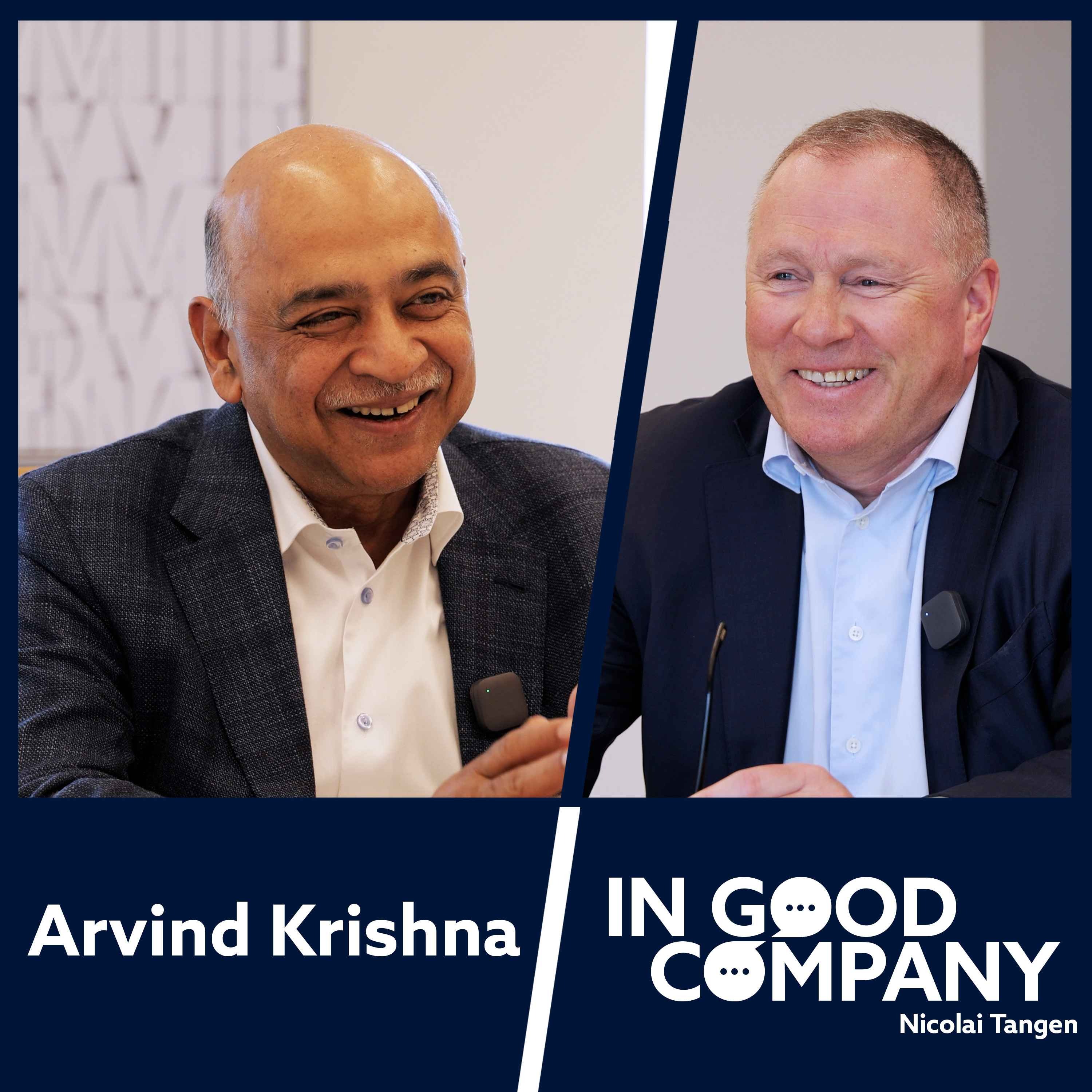
In Good Company with Nicolai Tangen
IBM CEO: Transforming a Tech Giant, AI Bets and Quantum Computing
00:58:53
Loading summary
Transcript180 lines
- [00:01]
A
Hi, everybody.
- [00:02]
B
I'm Nicola Tangen, the CEO of the Norwegian Sovereign Wealth Fund. And today I'm in particularly good company because I'm with Arvind Krishna in New York. And Arvind is the chairman and CEO of IBM, one of the most iconic technology companies in the world. Arvind has been with IBM for over 35 years and became the CEO in 2020 and have since orchestrated one of the most striking turnarounds in big tech. When he took over, IBM had been declining for years and today is growing faster than done for a long time. So, Arvin, a warm welcome.
- [00:35]
A
Thank you, Nikolai. It's always good to talk to you.
- [00:38]
B
Absolutely. Now, a lot of people still think that IBM is kind of company from another era, and you have changed that. So today what does IBM do?
- [00:56]
A
IBM is largely a hybrid cloud and AI software company. We have made the transition to. That's almost half our total revenue. We have another third that is in consulting. And we try to help our clients transform for the current era of digital and AI. And then we have about 20% that is hardware. I realize many people think that we are largely a hardware company, but that is just a fifth of the company. A very important piece, but a very small piece.
- [01:25]
B
When you took over as a CEO, the IBM had been declining for some time. What was your diagnosis?
- [01:31]
A
I always like to sit back and think, what are your strengths and what are your weaknesses? So as I talk to our own team and as I talk to clients, it comes out that we were trusted, but we were considered to be part of the past, not necessarily the future. So my diagnosis was you have to do things that are relevant for people's future. They're not always the biggest revenue in a month or in three months or in one year, but they become the big revenue over the next many years. So we began to say, what are we good at? And then can we double down? Can we double down on helping people transition towards a hybrid cloud? We were strong believers that sovereignty would remain important for many, many years to come. And so you double down on the portfolio that helps them do those things. And back in 2019, I was convinced that AI would be big. It took another three years for the world to wake up to that.
- [02:22]
B
What made you so convinced at the
- [02:23]
A
time data is going to overwhelm you and value is going to be derived from data. What can unlock the value from that much data? The only technology we knew was AI.
- [02:34]
B
You made some big acquisitions and a very large one, Red Hat, which has been tremendously successful. Just tell us about that.
- [02:42]
A
So in 2017, I came to the conclusion that public cloud is very important, but that IBM becoming a big investor in public cloud is probably not good for us. It was a pretty economic conclusion. When you are that far behind, you would have to spend multiple billions, 5 to 10 billion a year to try and catch up. And if you think at the end of five years, you're still going to be number five, that doesn't seem like a worthwhile investment. So instead, I wanted to partner with all the big cloud providers and Red Hat. There were only two or three companies I thought that could help give us a portfolio that makes us a great partner for all of them, that helps their business and helps our own. Hence Red Hat.
- [03:29]
B
What is the analysis that goes into such a decision?
- [03:33]
A
You got to see, because in some areas you can say I can compete because I can actually build something, and at the end of that time I can carve out our own niche or your own market share. I felt that the others were spending so much that they would remain ahead. That is not purely financial analysis. That's also analysis based on looking at the technology trends and at the strength of their technical teams in addition to the pure numbers. Then you say, okay, if it's going to take a lot of capital investment, then is that capital investment going to have its ROI or not? That is perhaps much more analytic than not. And then is there an alternate capital investment that pays off better? I felt that if we put our capital into doing software, M and A, that's probably a better return for IBM. Maybe I'm lucky, maybe I'm smart. That's what the last six years have shown.
- [04:27]
B
Yeah, well, I suspect you have been both. Well, we need. I mean, it was a very smart decision, and you've been proven right. Now. You also spun off the IT services business, which was like a huge part of your number of people. Right. A third of the workforce. What was the thinking behind that?
- [04:44]
A
So the negative always is that these are clients that are intertwined with everything else we do. So trying to separate it is painful. Let's acknowledge that for the employees and for the clients, I was clear. I mean, as you began, you said IBM was declining. I was clear that revenue growth is essential. If you say, and conclude revenue growth is essential, then something which is itself declining at 5% is something that should not be part of it. Otherwise your target for growth becomes that much harder. That means everything else would have to grow at 10, not at 5. So the revenue declined. And I felt that that was an area that didn't quite fit us well now though it did very well 30 years ago. I wanted to have a company that is based on innovation, that is based on high margins and that can grow. That is an area where people look for stability, not innovation. It's an area where it is not going to grow because I think it is fundamentally deflationary and it is not going to be high margin because it is by its nature it is going to be decent but not high margin. So that made it a decision to say such a company is probably much better served by being by itself and can unlock more value for its investors over time as opposed to being part of us.
- [06:06]
B
The latest you've done is confluent. What does that add to the business?
- [06:10]
A
You think so I think that back to why can you get more value from data? AI is one thing, but then you've got to be able to expose the data to all of AI. Confluent is the best infrastructure for beginning to move data and for exposing data for everything else. Also, there are so many companies that struggle with having real time data. Confluent with the Skafka backbone is the best in the world at taking data and making it real time for all the purposes that you might want to use it for. So those two things together make it like it's a wonderful acquisition. I believe time is going to show how great it is for us.
- [06:47]
B
It's for sure a great company and great product. But to which extent you integrate these acquisitions or your view on letting them do their own things and operate on
- [06:58]
A
their own, the only one that we have not fully integrated yet, and I'll emphasize the yet is red hat.
- [07:05]
B
Yeah.
- [07:06]
A
In all the rest, I always look for three things. It should be a great capability. So to the point you're making on integration or not, you should. You've got to make sure that even if you integrate, the engineering team who's building that great capability still has freedom to build it because they are the ones who really should be in charge of what they are building. We'll try to bring them more of how they're built. We'll bring them more AI, we'll bring them more tools, we'll bring them more global capability, but they should remain in charge of that on the go to market side. I really firmly believe in full integration because in order to unlock the value of many of these companies, we can take it to more clients. We generally have a presence in far more countries and geographies than anybody we acquire. But to do that, you've Got to integrate, otherwise you've got to grow a unique capability everywhere else. So we believe that bringing our digital capability, our geography footprint, our complete international go to market capability is a big plus for all of these entities. The third part, to operate you also need to worry about compliance, about contracts, about recruiting, about hr, about payroll, about taxes, about cash management. There is no value to me to have those as unintegrated functions. So those my love would be to do it on day minus one. But to be fair, it takes a few weeks or months to get it done.
- [08:36]
B
You said you haven't integrated it yet. What does yet mean?
- [08:41]
A
I believe that we are right now in the process, even in Red Hat, that what I call the third bucket around hr, legal contracts, cash management, treasury, all that we did over the last two years, so that's done now. Red Hat definitely had more scale, so they were not going to get an advantage by being integrated with IBM, let's say in the UK or Germany, unlike smaller ones like Confluent. So we let the go to market be independent. I think that we are now discovering that even on the go to market there are areas around digital that are outside the top few markets where integration is going to help more than be a detractor. Engineering in Red Hat, I actually believe given the open source nature of Red Hat is going to have to be its own function. So engineering I will likely not integrate because working at their scale of open source, maybe that is one where IBM learns from them. And things that are open source should belong much more in the Red Hat methodology than ours.
- [09:43]
B
What's the best thing you've done since you became CEO?
- [09:46]
A
Make the culture much more willing to take risk. I think that we had become a very risk averse culture. That is not the thing I would have told you if you'd asked me on the first week. But after a couple of years of observing and doing, I think that making the culture much more willing to take risk is the biggest thing I've done.
- [10:07]
B
How did you do?
- [10:10]
A
Becomes a question of. You have to first ask yourself that. If I don't like the culture taking risk, why is that? You've got to begin to understand that. And I think these lessons are drawn from whether it's biology or whether it's history. You said we were declining. When a culture begins to decline, the focus becomes inward. And I think it's a natural, I don't actually call it malicious. Human beings are very good at saying how do I survive? If the culture is in decline, then people begin to say I survived by not raising my head, by not looking like an outlier. And so it becomes the thing which becomes self reinforcing, not necessarily by design. So then you have to say, how do you unlock that capability to take risk? You've got to hold up examples, you've got to tell people, I want you to take risk. I tell people, don't give me a 90% confidence, give me a 50% confidence. And then you lean into it, recognizing they're probably not going to meet the timelines of the quality you want at 50. So you build a bit of a buffer. But cajoling them to go down that path is a big unlock. Then in total productivity and in how delighted clients feel, do you think?
- [11:19]
B
Also there is a factor of a fact that when you decline, a lot of the risk takers leave the company. And so you are in a way stuck with the most risk averse people.
- [11:30]
A
That is definitely a big piece of it. But then if you can unlock risk taking even amongst those that are left, of course you've got to get new people. I'll completely acknowledge that. I think a 10 to 15% refreshment rate per year is a great one. But you can actually unlock even that. Because my point being, if the ones who are risk averse, it's a learned behavior as opposed to inherent in them, then they can unlearn it. If it's truly inherent, then that's different.
- [11:57]
B
So that's the best thing you've done. What's the worst thing you've done?
- [12:01]
A
I think I've been slow so far in terms of client expansion. I think that we are very good at dealing with large clients and many of our people, and probably myself, turn that you're B2B into thinking that you're B to large B. You need to be good for B2B to everybody. And I think that those are things that we are yet to unlock.
- [12:22]
B
And how will you unlock that?
- [12:24]
A
A lot of focus on it. You got to say the longer tail is not going to necessarily want to buy everything that we sell. And we tend to have a habit right now of everybody should buy everything. So you got to then get more focused in what you do there. Those people also are not making large decisions. They're not viewing IBM as their partner. They're typically purchasing a capability. So you've got to be really good at saying, okay, if all you want to buy is that capability, I'm going to give it to you at a great price at a great quality. So you've got to begin to do those things, but those are changing some of the plumbing of the company in terms of how you sell, how you price, how you go to market, all of that.
- [13:09]
B
Moving to AI, which part of AI is a bubble?
- [13:15]
A
I think that some of the infrastructure buildout is probably a bit ahead of what the world can tolerate for the next few years. The way I would phrase it as, because I've been accused sometimes by saying that it's not a bubble, but I
- [13:32]
B
believe that, which is kind of why I posed the question a bit carefully.
- [13:36]
A
Yeah, some will disappoint, many will thrive, but not all will thrive is the way I would phrase it.
- [13:45]
B
So when you say the infrastructure bill out is a bit ahead, what does that mean?
- [13:51]
A
Look, by the math that I have done about a gigawatt of power you can debate, but it costs you 60 to 80 billion dollars worth of semiconductors to go populate it. So if you look at people have committed over 100 gigawatts of AI data center build out, that points to 6 to 8 trillion worth of a build out. If you say that that's got a five to seven year payback, you are going to need an extra one to two trillion a year of revenue. Because inside that one to two, even if it's high margin, that high margin will be 20 to 30%. So that much incremental revenue I don't believe is there. And so that's why I think it's a bit ahead. I also believe on a second one that many of the largest models are going to be commodity. Commodities can have a lot of value, but there is low switching cost, usually between commodities. If there is low switching cost, that means you can have a margin, but it's not going to be a margin with a massive moat around it. So those two make me believe that perhaps there aren't going to be a half dozen to a dozen companies who can build the largest models and survive. Maybe two or three. And that then tells you the second side of it is how much can be the total capital expense that goes into the data centers. If you had said it was half as much as today, I would have said that completely makes sense. I mean that aligns, but when it's double of that, then maybe some of those are not going to be able to get a great return.
- [15:25]
B
So who are going to be the losers?
- [15:28]
A
That is very hard to predict. I mean like having gone through a few technology cycles
- [15:35]
B
pretty different, who's going to be the winners generally from AI?
- [15:39]
A
I think, look, some of them that already have a very large consumer business. That means you have a natural distribution advantage on the consumer side. On the enterprise side, I think it's wide open to decide who's going to win. I don't think that that is predetermined on the consumer side. I think history has shown us if you have distribution and if the distribution is aligned to AI, there's a pretty good chance you will be one of the winners.
- [16:08]
B
Are you surprised that there is such a tech overhang that we are so slow in utilizing the full capability of this technology?
- [16:17]
A
No. There's a human timescale. Always. Technology can move at its rate and pace, but people take time to. Because you get into the questions always of is there a risk? Am I going to lose something? Always you get both sides of those voices. Whether you go back to the 1700s industrial revolution, or whether you look at the last one, which was the Internet era, or you look right now at the AI one, you get those voices that makes some people run and embrace. It makes many kind of watch cautiously on the sidelines, and it makes some dislike and hate it. So as you look across those three, each one, I'll just observe has gone faster. So if I look at computers and semiconductors from the 50s to the 70s, probably took 20 years to get fully embraced. If you look at PCs, that was circa 1980, probably took 10 years to get fully embraced. If you look at Internet, that probably took five years. 95 to 2000. So this one. But it's still years, it's not yet months.
- [17:24]
B
So how long will this take?
- [17:25]
A
I think we are right now. I used to say if I do a baseball analogy, and our global audience may not always love baseball and no
- [17:35]
B
baseball, but about innings and stuff.
- [17:37]
A
Innings, it has nine innings. I used to say AI was in its first innings. I would say maybe it's in its second innings now. So if we are in the second innings, it probably is going to take three, four years to get enough to embrace it. But probably definitely not 10. But it's not already done.
- [17:56]
B
But when you talked about these sort of technology shifts, how would you compare the AI advancements compared to those shifts?
- [18:05]
A
I think it's bigger than mobile and it's bigger than cloud. It's probably in the same category as Internet. If you go back to 1995, I use 95 because that's.
- [18:15]
B
You are much more. I mean, many clever people say it's like 10 times the Internet. But you don't think it's that.
- [18:21]
A
No.
- [18:22]
B
And you are very clever, by the way. I should mention that not that he needs explaining, but our mutual friend Malcolm Gladwell said that you were the cleverest person he had met.
- [18:33]
A
I don't know whether I'm the cleverest, but I'm older than many and I have been around a few of these. The Internet to me was fundamental, if you think about it, because many people don't realize the scale of global business that happens today is because of the Internet. The ability to move work in technology from country to country is because of the Internet. The fact that a small producer, be it in Europe or be it in Africa or in China, can sell and be part of the supply chain for a global corporation anywhere in the world is because of the Internet. If I look at that, the Internet has had a massive impact. The direct revenue, even to the technology providers is measured in the trillions today. The rise of all the social media companies could not have happened without the Internet. The rise of cloud could not happen without the Internet. If I include all those as the impact of the Internet, then AI is going to be in that category.
- [19:29]
B
But do you think you are biased in your assessment of AI, given that you have tried before and failed?
- [19:36]
A
The fact that we tried failed but remained committed and I made the bet on AI in 2019 again before the advent of ChatGPT says no, I don't think we are biased or jaded because you can imply that in your question. I actually think it's going to be very, very powerful, but it's in the same.
- [19:53]
B
But tell us about. I mean, you tried with Watson, right? Just tell us about Watson.
- [19:57]
A
I think that Watson was the right goal.
- [20:01]
B
What was it?
- [20:02]
A
So in 2011, we wanted to prove that AI can do and solve problems that were unimaginable at that time. People couldn't imagine that you could do natural language question and answers on kind of a gray area using AI winning the game Jeopardy, which had these questions in English but with all kinds of hidden puns and language. And that had to be interpreted, not just the black and white question. Prove that AI can do those things. Then you can say, but you failed. Why did you fail? The reason is we took that technology and we said we want to construct monolithic applications. And we unfortunately picked the vertical. That is the hardest health. That was the mistake. If we had taken it and said, let's use it to help corporations get better, let's use it to let their customers get better customer care, let's use it to digest all the documents that enterprises have, I think we would have been five years ahead of where we are today. On AI, but it would have been a long journey because the technology then was still what I call bespoke. What I call bespoke is yes, AI worked, but it worked when you had one use case with one corpus of data. Today's AI actually can do many use cases, so that's a big advantage. Two, you don't have to relearn. If some of the data changes, you can add the new data and add to it. Those two things make it much more industrial scale today than the one from 10 years ago. And that is why we didn't succeed then. But I do believe that we will succeed this time around.
- [21:42]
B
Are you basically building the infrastructure layer that the AI systems need?
- [21:47]
A
We are not. We rent the semiconductors from other people as appropriate. So you can imagine all the big cloud players, I won't name them on this call, but we tend to use many of them. We tend to not build frontier models. Those we will get from those. The point I had made earlier, I believe that there will be low switching costs. So this will be based much more on what are the T's and C's. How can you have a business relationship with our providers? We will build small domain models when necessary, but not because we necessarily want to, but because very few people are building the smaller models that can then augment the bigger models. So we will actually. We have a belief that most people are going to be multi model down the road and so we want to help enable that for our clients.
- [22:36]
B
Yeah, and you got like granite and so on, right?
- [22:38]
A
We have open weight models called the granite family, but in there I'll note we have not built a single model that's over 100 billion parameters and the biggest ones now are in the trillions. So we don't want to go there because we believe those are good enough. We don't have an advantage in coming there, but we build many because smaller models are going to be much more power effective to operate, much more cost effective to operate. Where people care deeply about where is the data. They could operate them on premise or at the edge, which is an advantage for some workloads and some clients.
- [23:12]
B
The Chinese seems to be agreeing with your thinking,
- [23:17]
A
or I think that the Chinese are very focused on enterprise deployment and they're very focused on sovereignty. We can ask ourselves how many people should care about those same two attributes.
- [23:31]
B
So if you just look at how you work with AI differently from the likes of Microsoft, Google, Amazon, how would you, what would you say it is?
- [23:39]
A
So many of them today are very focused on having A consumer approach to AI, which is I want to build a single thing which hopefully more and more of the billions of people in the world can begin to use, that's not us at all. We want to build great AI that our clients. Is it Nestle, Is it elevance? Is it Pepsi? Is it bank of America? Can they use this? And that's a very different goal. So I am not ever going to build one thing that everybody is going to use. We are very much focused on building that which our clients need and which is probably not the consumer side of their business. It is the enterprise side. Can I help them on procurement? Can I help them on accounts payable? Can I help them on how they are leveraging data for their own business decisions? And can we help them on all those things? Is where they will tend to use us for artificial intelligence.
- [24:39]
B
When you see things like the latest anthropic model, which is so powerful they can't even release it, what kind of reflections do you have?
- [24:48]
A
I have two at a very deep computer science level. This is not new. Let me observe. Really clever people with extremely sophisticated tools have been able to find vulnerabilities and have been able to exploit them for decades. I remember when I was in graduate school, this is 35 years ago, we had the Morris worm that came out of a really clever kid at Carnegie Mellon. Okay. But if AI can inherently use some of those capabilities and you can harness or harvest it into that, that means you're now letting a person with a high school education able to exploit these models to do what those really well trained, really clever people did. That opens up the speed aperture, unfortunately. So these models may well be able to exploit things in seconds that used to take really clever people months to get done. So the intensity and the speed is what we have to worry about. It's not the fact that it exists. It has always existed. But that means that you have to be able to have layered defenses and you need to pick your right partners to help protect the enterprise. Because I actually think that some of the smaller vendors may not have the capability to defend against these models.
- [26:19]
B
Do you think it'll be a requirement to pre release models to some kind of regulator or oversight function to make sure it's not too powerful before it's released to the public?
- [26:31]
A
I think that that sounds good on paper. So in practice, how do you do this globally? Because you can say that here. So do you stop the Koreans from doing it? Do you stop the Chinese from doing it? How do you get to being able to Control these things globally.
- [26:48]
B
Can AI be regulated?
- [26:49]
A
I am skeptical that the technology can be regulated. I believe the use cases can be
- [26:56]
B
because it's embedded in all the races
- [26:58]
A
and it's physical goods that are tangible are possible to regulate because you can put border conditions because there is a weight to them. You can control how much and where. A digital good that can cross a boundary I think is really hard to regulate. If you think about some countries in the world that some or the others don't always love the regime and that side tries to control Internet access, you tell me how effectively they can or cannot do it.
- [27:36]
B
Is software going to die, you think? I mean your Stock was down 13% when cloth code was released.
- [27:45]
A
No, I'll give you my reason for explaining why. So we didn't talk about demographics, but if the number of people in the world is going to decrease, then seat based software by definition has a smaller market 10 or 20 years down the road. I think investors are quite smart at recognizing long term trends. So I think one thing is how well will seat based software do? Let me fully acknowledge to you, I think AI and agents will replace some of the front end of much software. But if you replace the front end then by definition it has less total value. So you combine fewer seeds, less value for some things. That said, the system of record, the database that contains the business function, the business logic, that that is still important. But I do think that the value for some of the software where the front end was the prime value, that is going to decrease. Then to give full credit to the investor, they're saying, look, I can't decide today who falls into that camp, who are the few who might benefit. And then let's acknowledge maybe half are not going to have a help or a hurt. If I can't determine that, I'll take the sector down and then over time that will determine itself based on the numbers that you print. So I think that I could see that a fourth of people where the value was largely the front end could actually have a long term impact. That would kind of be where I would finish this. So I would look at you and say no, I actually think that we were hit in a way that was unfair. But look, the market, depending on who you talk to, is down from anywhere to 40 to 60% in software for many companies and we are down about 25. So in some sense we are taking a hit. But I think that means there are enough people who also think, wait a moment, you may not get that full hit. And so that's Kind of where we
- [29:51]
B
are talking about expected hit. Your mainframe business is thriving. Right. And a lot of people didn't think it would.
- [30:00]
A
The thing which Claude Code thought that it is going to replace is the thing that is thriving the most. That's interesting, isn't it?
- [30:05]
B
Yeah. So why is mainframe still thriving?
- [30:09]
A
Because the mainframe workloads tend to be workloads in critical industries. They're doing workloads like retail banking. They're doing workloads like credit card transaction authorizations. They're doing workloads like airline reservations. They're doing workloads like around warranty and maintenance. It's systems of record, it's places where that full six to nine nines of availability. I want to make sure that the transaction is not corrupt. I need to make sure I can get the batch workload done in 20 minutes. At five o' clock. Those workloads are only increasing.
- [30:46]
B
But should those workloads have been moved to cloud already?
- [30:49]
A
If you want to pay three times as much.
- [30:51]
B
Right.
- [30:52]
A
So economics would dictate that that's the more expensive answer.
- [30:55]
B
Did you think when you became CEO that mainframe would continue to grow?
- [30:58]
A
I was 100% convinced of it. Brilliant.
- [31:01]
B
Wow.
- [31:01]
A
So the 10 years before I became mainframe was declining. It's surprising, isn't it, that in the last six years mainframe has grown every single year.
- [31:08]
B
It's incredible what one person can do.
- [31:11]
A
It's not one person. It is unlocking back to risk taking. It's unlocking the enterprise. Many people there believed it could. And so you had to unlock them and give them the environment which allowed them to succeed and thrive. We have built AI into the mainframe that was not being done a decade ago. We built more and more capability. We built and encouraged our partners to build more software. Actually we built our own COBOL conversion code leveraging large language models three years ago. So it's harnessing innovation and putting it into the platform that then allows it to thrive.
- [31:50]
B
And you put AI on the platform before ChatGPT existed?
- [31:54]
A
That is correct. We put it on the platform in 2021, then we put more in 2024 and then we put even more this year.
- [32:03]
B
And you have tell us about this new version, the Z17.
- [32:08]
A
So in the Z17 we decided to do three things. One, we put a. It's a mini GPU is the best way to think about it right on the main processor. So you could actually do, I'll call it smaller models, not actually very large models, right in line. So if you're doing a credit card approval and you want to approve your transaction. Previously you would do sampling, you would take some transactions off the platform, see whether there's fraud, and then if there's a transaction like it, you would block it. Now you can run that model right in line. Then we said, if that's useful, should we put more? And then we added our, what we call the Spire card. That lets you, in a fully populated mainframe, do 450 billion inferences per day on the platform at zero latency and right in line. So no extra cost. That means you don't have to move all the data. You don't have to live with the seconds of latency of taking it off platform. And those are very powerful in terms of the capability. And the third one which people have begun to wake up to is we have post quantum cryptography built right into the platform. So you can, for the data you think could get attacked by quantum computers down the road, allow it to be pretty safe on the mainframe.
- [33:27]
B
Well, let's spend some time on quantum computing, which is one of your big bets, right? For somebody who listens to this program, who is not very technical in simple terms, what is quantum computing?
- [33:42]
A
So quantum computers at one level, and I'll just geek on the science for 10 seconds and get off, are trying to harness properties of quantum mechanics to do a new kind of math. That's the simplest way to explain it. So if I think about normal computers, they do arithmetic. Think of high school arithmetic and algebra, that's what they do. But they do it at incredible speed. So that looks remarkable. Then we can say, what do GPUs do? Because with the advent of AI, GPUs have come into the parlance, GPUs do matrix mathematics, let's just put it that simply. But matrix math unlocks a lot of problems that, that would be 10,000 times slower to do on normal computers. Such as, for example, if I want to do an LLM, to do an LLM on a CPU would probably be so slow, none of us would care. But you can do these large language models. You can recognize, is this a cat or is this a dog or is this a human being in a photograph is kind of what matrix math unlocks.
- [34:49]
B
So let's say now we fast forward. What do we think? When will we have them?
- [34:56]
A
20, 29, right?
- [34:59]
B
Okay.
- [34:59]
A
Quantum computers.
- [35:00]
B
So let's say to be safe, we're now five years from now, we have this big quantum computer in this room. Now what are you and I going to do? With it, what's the stuff we can do then?
- [35:11]
A
I think the first three use cases, the first one I think nobody debates, is going to be in the world of materials. So you look at me and say, materials. What do you mean by materials? Would I like a better coating so that things don't corrode? Example aircraft wings or rivets or pipes that carry oil? That's pretty important. Or could I design a better pharmaceutical drug because we can do things with molecules and be able to predict the properties as opposed to have to do a wet lab experiment? Or can I come up with a better fertilizer than the current very energy inefficient fertilizer that is there, or one that I'm getting excited by because our team just showed that you can predict magnetic properties of materials using quantum computers. Well, if I can do that, is there a possibility? And I'm calling it a possibility because we're still three, four years away to have a better magnet. And as we know, you need magnets for electrification, for EVs, for lots of things. So those are the first category. The second category I think is going to be around financial risk. How can we price something better knowing what we know? So the way we do it today, we kind of use data that's a week old or a day old, and then we try to guess during the day what it should be. But if a quantum computer could price some of those things in milliseconds, then that gives you an advantage in the financial world to be able to price complex instruments or derivatives or bonds, as some of our clients have begun to do during the day. The third is going to be in the area of optimization. And by optimization, I mean things like can we do a better route plan? Could we somehow attack the problem that 30% of all truck miles and containers are empty as opposed to used? And that's because we use very simple routes, because it's just too hard to do a complex route for all these things. So those are problems that I think quantum computers are going to unlock in the first few years.
- [37:32]
B
What's the relationship between quantum computers and AI?
- [37:36]
A
I think that that relationship is going to be more in the long term than in the short term. If I begin to look not at the first five, but the next five years. Quantum computers, to make it very simple, are great at finding hidden patterns in data. Okay, what is AI trying to do in the end? A large model is trying to find those patterns and in the data that it sees. So could quantum computers in the first instance be Used to help create these models in a much more energy efficient way than could be done otherwise. Is one example of how a quantum computer is going to help on AI. But for the first five years I believe the two will complement each other. You will do a problem on AI. You might discover that I need a property of a material that AI could not figure out. Quantum computer goes and does that. Then AI says, knowing everything else, here's the prediction it can make. Then it can say there's a gap in the knowledge. Maybe a quantum computer can help on that.
- [38:35]
B
Does AI help you develop the quantum computer?
- [38:37]
A
Absolutely. Today already it's a new form of programming. We call it circuits, but let's call it programming for the sake of being simple. How do you help people understand how to write these programs? AI is going to help you do that. How do you begin to make some of the normal electronics around a quantum computer? AI is going to do that. So AI is going to accelerate the development of quantum computers from 1 to 100.
- [39:01]
B
How confident are you that you'll have it by 2900? There is no such thing as 100% certainty.
- [39:09]
A
There is a certainty in we'll be able to have it. Now we can debate how useful will it be,
- [39:16]
B
when will it be properly in production and useful?
- [39:21]
A
Probably in the 28 to 30 range. So will we have it? The reason I have 100% confidence we have them at a scale of hundreds to low thousands today. So that's not a future statement. So we got to get up and scale by a factor of 10 and we got to improve error correction by a factor of 10. That's what has to happen between now and 2029 to make it just really very simple.
- [39:47]
B
Who do you compete with?
- [39:48]
A
There's a large number of companies who are making it. Some in similar ways to us, some in very dissimilar ways.
- [39:55]
B
Ion, how confident are you that your methodology is correct?
- [40:00]
A
We are very confident in it is correct for the next many years and we have to keep working on others if we have to have a much longer term horizon. So if I look at it today, but there's so many companies. Quantinium is there, IonQ is there. Pasquale is there.
- [40:16]
B
How do you where in the competitive field you put yourself?
- [40:21]
A
We put ourselves a couple of years ahead. I would never put ourselves more than that, but I do think that we're a couple of years ahead. But the next two, three years will demonstrate. Are we or are we not?
- [40:31]
B
How much could this be worth for IBM?
- [40:33]
A
Hundreds of billions.
- [40:41]
B
And how do you get to that number?
- [40:44]
A
So always when you come up with a brand new technology. The best analogy I can put is quantum computers today are by GPUs versus circa 2015. GPUs from 2015 took about seven years to reach. I'll call it takeoff velocity. Completely in 2022 you couldn't manufacture or supply enough to satisfy the demand, but it took that years. So if I go forward by five to seven years, if we are a few years ahead and we are better at making quantum computers than anybody else, once people realize what you can do, the demand will be insatiable for many.
- [41:23]
B
Where is China?
- [41:25]
A
It's hard to tell. We know that they're very heavily invested. We know that they are chasing the same use cases that we are. And we know that it's a top down initiative and extremely important to their government. We know that much. Then if you give them enough credit to say they have smart people, they have good scientists and they can go ahead and invest, then they are going to catch up or be in the race at some point. That is certain.
- [41:56]
B
And what does it mean for the geopolitical race for sovereignty, national security?
- [42:04]
A
So these things always have a number of different lenses. First, if it is going to unlock extreme economic value, let's stick to the main one that is extremely important for national security. Because if you are economically way superior to somebody else, the world has shown that that is a big national security advantage. Second, some of those problems have incredible applications to direct defense applications, better munitions, way to navigate without having to rely upon low earth orbit satellites. All those are examples of quantum applications. Then the third one, which we have not talked about, we know that quantum computers can do what is called Shor's Algorithm. What does it do? It helps you decrypt most of today's encryption. So the ability to be able to read somebody else's encrypted communications in the clear is an offensive military application. So for national security all those three are important, which makes it imperative that we work on these to be able to solve all of those applications.
- [43:20]
B
Arvind, let's move on to leadership and just how you lead. Now not many CEOs have a PhD and 15 patents to his or her name. And a kind of stupid question, of course, is it helpful to be so clever as a leader?
- [43:44]
A
I think it's really important to know where your strengths are, leverage your strengths, but also try to be very, very self aware or where you don't have strengths. I actually don't think about it in that lens at All I always think about it in terms of how does one empower the team to do their best. That really is the first job of every leader. The next is where can I help them. So for those who may not be very technical, it may be helpful for them to get a sense of where the world can go and as I call it, look around the corner a little bit. I think my depth of knowledge, more than cleverness is on the technology dimension. But there are so many other dimensions where others are going to bring much more of a skill set to me. And I think that actually my strength has been much more in trying to build around a team. I know far less about politics and the financial markets than many others. So I try to bring in people from both those dimensions into the team to give us that. I'm not ever going to know much about the law. So I got to have a great GC and a team around that for doing M and A. I bring in people who were ex investment bankers.
- [45:00]
B
What kind of credibility does it give you with your scientists that you have a scientific background?
- [45:04]
A
It gives me the ability to argue with them. I mostly lose the argument, but it allows them to have fun in their argument.
- [45:12]
B
What kind of scientist were you? Were you like an introvert person sitting there working on your own or just how did you work?
- [45:20]
A
I kind of put it this way. I was what I call a theory person. Theory people tend to be deep in mathematics and doing things. It tends to be small team efforts. But I was always very interested in being able to communicate my ideas. So I would say, I say scientists by nature are more introverted than extroverted. That's, I think is just given for 99% of them. There's a few we can imagine who are not, but 99% are. But I wanted to be able to communicate my ideas. That may have been my slight edge of why I was able to translate myself into the business world.
- [45:59]
B
But kind of the journey to go from that to running at 250,000 people, how has that been?
- [46:08]
A
I'm not sure it was a design path at the beginning. There are three or four probably transitional moments. Four or five years into IBM I was looking at building this was in the early 90s wireless networks. And I was finding that the business side was finding it very hard to understand that there could be a big market in the commercial world for wireless networks. And I was looking at them and saying, laptops are coming. You can see that people will want the ability to move around with them. And they just couldn't Understand well, because we are used to computers being plugged in. They're big, they're heavy, you're not going to move. Why do you need all this thing? So I realized that you have to gain the skills of what are markets, how do you distribute, what is that use case down the road? Otherwise it's going to be very hard to be able to talk the language that the other side, who were the decision makers were doing. That was one big moment that defined it for me. Another big moment that defined it for me came in the late 2010s where I was helping somebody do some business analysis around the impact of some other companies doing a lot of M and A in the application world. And understanding that actually probably unlocked a lot of thinking in my head around can I take what I know but then relay it into what became, for example, the red hat decision 10 years after that? So you got to learn from those moments. And then when I was looking in the late 2010s and thinking about how can IBM grow and where can it grow, that probably unlocked the ambition for me to be in my. In my current seat.
- [47:56]
B
After you took over, we had Covid coming in. Do you think that made the transformation easier or more difficult?
- [48:03]
A
Much easier.
- [48:04]
B
Why?
- [48:06]
A
So usually when you have to make a number of very tough decisions around things to divest around things to change in the company, there is a risk to the point you made. There is a risk that you actually will go through a trough before you can see again. Hopefully you see the gain, but there will be a trough when there is already a lot of disruption in the market. I actually believe it gives you a great ability to say, let's take all the pain as quickly as possible. And that allowed me to probably do in one year what may have taken three to four otherwise.
- [48:40]
B
So I completely agree with you because I experienced the same thing when I took over. We had Covid just afterwards. But I think there is another element, which is that there is less resistance to change because they are not together at the water cooler and protest against this new idiot coming in and thinking he can do whatever they want.
- [48:57]
A
I won't say so much. The protests, I actually think I was lucky. There were a lot of people who wanted change because you were a very successful fund already, but you made it better. In my case, we were not that, as you said, we were declining. So I think there wasn't that much resistance to the ambition. But when there is a lot of disruption, people are willing to take more change in stride, is the way I
- [49:21]
B
would Put it, are you a typical Indian leader?
- [49:27]
A
I don't even know what that means.
- [49:29]
B
Well, I would say after having interviewed a lot of them, they are more humble. They work for something which is bigger than themselves. Well, I mean, in India even the gods are supposed to be humble, right? So. So in my mind there is something there better with people more different type, just a different type of intellect, understanding, holistic way of looking at life and the world.
- [49:58]
A
I think some of that may be the self selection just because there's so many Indians. Well, one is there are so many Indians, but one is also the self selection you're looking at is those who probably grew up in India, migrated to the west and are now leading companies here. While I'll accept that some of what you're saying even applies to those who are leading companies in India. India is really a collection of cultures,
- [50:23]
B
you know, and that I feel pretty strong about. I was in India and I interviewed probably somewhere between 40 and 50 CEOs. It was true across the board.
- [50:31]
A
So India is a collection of cultures. So if you're not adaptive and understanding and empathetic to people is going to be very hard to survive in India itself. It really is a collection of what was originally 22 languages, which are probably more like 40 or 50. And the cultures are different within that. Two, the Indian culture is very quickly dismissive of people who are very arrogant and who are not humble. Three, at least where I went to college there were a lot of really smart people. So you get humbled really quickly and that you might think you're smart, but you're actually not that smart. And so I think all of those things play in. But the point is many of us came to the west on the basis of education and on the basis of trying to strive for a better life. It has to be for a bigger purpose. I don't think it should be ever about you. It has to be about harnessing and making a better organization and by letting people thrive. I think that if that's what you want to achieve, that's probably common to many Indians.
- [51:38]
B
Are you personally an international business machine?
- [51:43]
A
We are in 170 countries. I probably visit only 40 or 50 of them over the last few years. I actually love learning about business. I read a lot and I try to learn from everybody I meet. I'll say that.
- [52:02]
B
How would you define the corporate culture now?
- [52:05]
A
I think that we are half unlocked. I think half the people now embrace risk. I think the growth side has been embraced. Now people accept that we can grow. We will Grow. We have the right to grow. I think that people have accepted that we want to be very productive and very lean. So the amount of overhead is decreasing. And that seems to be a muscle memory that is there. I would say on the risk side, we're only halfway there. I think I would like to unlock people's ability to take risk a bit more.
- [52:36]
B
In the past, you did everything yourself. Now you partner with some of the other great companies. Just what kind of change in mentality did that take?
- [52:44]
A
So if you think that it's a fixed buy, then you're going to always fight for the largest slice for yourself. I think that's just natural. If you think that by partnering you change the shape and size of the pie, and so you've got to convince yourself of that. Then you say, well, I'll partner and I'll share, but I'm sharing from a bigger pie. That's kind of my mindset. I kind of put it this way. If you partner with somebody, are you going to increase your chances of winning? And the answer is like, usually yes. If that's the case, you're increasing the size of the pie.
- [53:17]
B
You have something called getting fired mentality. What does that mean?
- [53:22]
A
Fifteen years ago, I walked into the office of a mentor of mine at 6:30 in the morning and I was kind of frustrated. I said, like, look, you know, I really believe that I need to say these things, but I'm afraid that if I say them, somebody will want to try to fire me. And this person turned on and told me, arvind, you should live in the pleasure of being fired. And I looked at me, he said, that doesn't mean that you always pick a fight. It doesn't mean that you just make disruptive things for the sake of it. But if you are living in the pleasure of being fired, that means you're not afraid of being fired. That means you'll do the right thing. And if you have confidence in your abilities, why does it matter? And that was truly freeing. And I encourage people to think like that and to be like that. And I think it really has been very powerful.
- [54:08]
B
Have you been close to being fired?
- [54:10]
A
Couple of times.
- [54:12]
B
When?
- [54:13]
A
The last time was probably in 2015. 14.
- [54:18]
B
What happened?
- [54:19]
A
I was trying to make a decision that was popular with some people and was extremely unpopular with some others. So they decided that they were going to try and get me fired. They almost succeeded.
- [54:32]
B
Yeah. Not. Not quite.
- [54:34]
A
No, not quite.
- [54:36]
B
Now, you've been in one company for a long time, right? Why have you stayed for 35 years.
- [54:43]
A
I've done so many different things.
- [54:44]
B
Yeah. Has that been a deliberate policy from the company to move you around, or is it you yourself?
- [54:52]
A
I think it was. I always put it like this. If you put blinders on, you'll keep doing one thing for a long time. If you keep yourself open to opportunity, those opportunities come. I spent my first 10 years. I'll use probably more extreme. I was an introverted researcher for 10 years. Then somebody asked me, do you want to come run a business? You ask the average researcher, you want to come run a business? And they're like, I know nothing about it. I ran to it. I did that for five years. Then somebody came and said, you want to run the database business? And I said, I know many areas of software. The one area I know nothing about is database. So, yes. Then they said, do you want to run our semiconductor business? I said, yes. So I think that that allowed me to just do so many different things in some sense. I've had seven different careers, even though it's been in one company.
- [55:48]
B
Your father was a major general in the Indian army. Is that where you got your lack of hair from?
- [55:55]
A
A big part of it. He definitely was fearless in his personal approach to life, in how he lived his life. Part of it was. I mean, if you spend weeks in the jungles at 18,000ft, you tend to be like that. But part of it was probably his natural personality. But you observe that and then you observe him and his friends. They were very similar. It wasn't that dissimilar. And you get not so much a lack of fear, but there is also. Any military professional also prepares a lot. And so you say. The phrase that I think is common in business is luck favors the prepared. So you put the two together.
- [56:43]
B
How do you relax?
- [56:45]
A
I like to read. What do you read? Almost anything I was reading, I was reading a book on the technology trap, which is by Oxford economic historian, on how technology can evolve. I read books on how and what is happening on geopolitics. You love to read about why do different cultures behave in certain ways. I love to read biographies, whether it's of Alexander Hamilton, of Benjamin Franklin.
- [57:24]
B
Do you read poetry?
- [57:25]
A
I do not read poetry. I have read a little bit of poetry, but I do not read.
- [57:30]
B
What kind of music? What kind of music do you listen to?
- [57:32]
A
I mostly listen to the music I listen to in college, which is classic rock from the 70s and 80s, such as the Talking Heads was the last concert I went to. I love David Byrne. I've actually listened to him maybe a half dozen times live. Eric Clapton many times Queen, Jethrotal, Pink Floyd but that's a little bit you can. There's a few of the people around but not the whole group. They are just some recent examples.
- [58:05]
B
All my kind of music as well. And finally what is your advice to young people?
- [58:11]
A
Number one, do something you have a passion for and an interest in. It's really important to wake up and think about the day. Do it with people that you respect and can learn from. I don't say so that's not necessarily your friends and popular but do it with people that you like working with. Do not ever focus on the title or the compensation. I believe if you have the first two those will come. I'm not saying don't focus on that at all but don't make it your criteria for doing something.
- [58:42]
B
Good advice. Big thank you.
- [58:44]
A
Thank you Nikolai.
- [58:45]
B
It's been tremendous.