← In Good Company with Nicolai Tangen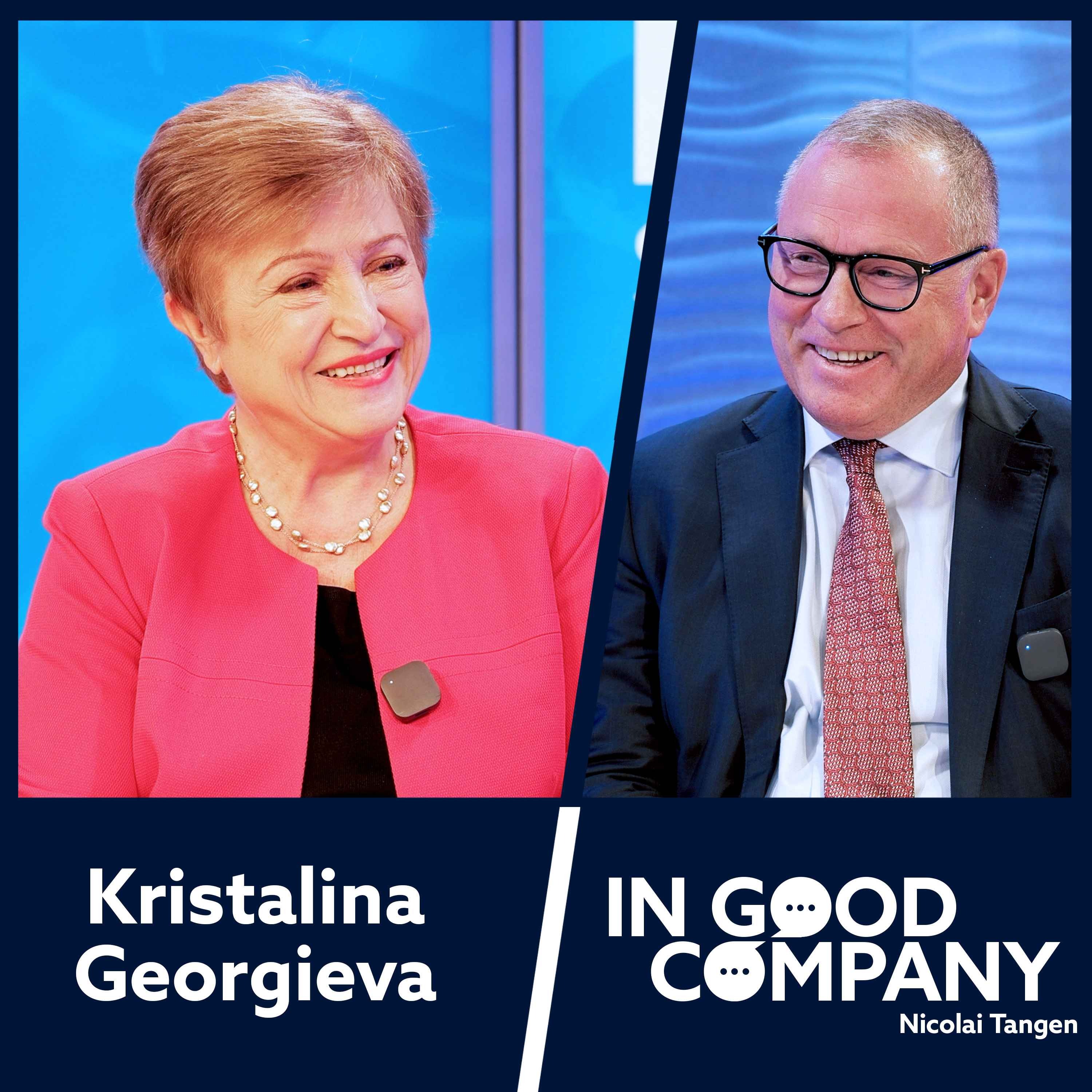
In Good Company with Nicolai Tangen
Kristalina Georgieva: Leading the IMF, Navigating Global Crises and Strengthening Cooperation
00:41:38
Loading summary
Transcript72 lines
- [00:01]
A
Hi everyone, I'm Nicola Tangen from the Norwegian Sovereign Wealth Fund. And today I put on a tie because I'm in really good company with Kristalina Georgieva.
- [00:10]
B
Wonderful to be with you.
- [00:21]
A
Now Kristalina is the Managing Director of imf, the International Monetary Fund. And you are known for your visionary leadership and the way you have been advocating for really important, bold long term reforms. So let's just start with the beginning here. Imf, what is it?
- [00:40]
B
The IMF was created towards the end of the Second World War together with the World bank to help countries recover after the war and to put in place institutions that can stabilize the financial system. Our mandate, macroeconomic and financial stability for growth and employment. We have a membership of 191 countries. In fact, over the last years we got two new members, small countries, Andorra and Lichtenstein.
- [01:21]
A
That's good. And how do you help these companies?
- [01:23]
B
What we do for our members is first help them to see the world economy. From one vantage point. We have this unique right to collect data from all countries and we do that regularly. So we can take the vital signs of economies, aggregate the picture and then see what are the trends in the world they should be mindful of. Secondly, when countries are in trouble and they need quickly financing to stabilize their economies, we come true. We have lending capacity of $1 trillion. We deploy it for countries in crisis. Some are middle income countries, some are poor, vulnerable countries. The third thing we do is we help countries build good institutions, especially monetary authorities, fiscal authorities, data, statistical capacity, so they can see their own economic development with more educated eye.
- [02:42]
A
How bad does the crisis need to be before they call you?
- [02:46]
B
Well, sometimes they call before a crisis hits. We have also a function to prevent crisis from happening. Sometimes they call when markets close on them. I'll tell you a story of my own country. I am Bulgarian. In the late 90s, Bulgaria was hit by hyperinflation, over 8,000% inflation. And it caught on the IMF. So what the IMF did for my country was to help us put in place a currency board which really stabilized the economy and put fiscal discipline. Bulgaria today has 24% debt to GDP, 3% deficit and as of January 1 would be a member of the Eurozone. Among the biggest clients of the Fund, Argentina has had a number of programs. So far, none of them got the country completely out of trouble. We are hopeful that our current program, supporting a president that is very reform minded, very determined, can bring Argentina to a point of not needing to borrow from the IMF anymore.
- [04:11]
A
Was it when IMF bailed out Bulgaria that you decided, you know what? I would love to be in charge of that one day.
- [04:19]
B
You know, at that time when the IMF bailed Bulgaria, I was actually at the World Bank. I was already in one of the two Bretton woods institutions. Never crossed my mind at that time that we would be sitting with you. And I will have been already six years at the helm of the imf.
- [04:40]
A
The World bank was founded at the same time as imf. How do you split the work between you?
- [04:45]
B
So what the World bank does is to look at sectors in the economy and fund investment projects. Predominantly education, roads, access to electricity. Right now, the bank is concentrated on creating conditions for more jobs in the developing world. In contrast, the IMF and the World bank is primarily about the emerging markets and developing economies. This is where the work primarily goes. The imf, in contrast, is about macroeconomic and financial stability. We don't fund investment projects. What we fund is balance of payment needs. So a country is about to crash. We come and we say, here is a cushion for you. Get your economy in order. The best value from the fund is to put in place good policies and responsible institutions so the country on its own can have a good trajectory of growth. The IMF works with all countries. All 91 countries go through what we call Article 4 consultation. It is a technical term of taking the vital sides of each economy. Big, small, rich, poor. They all need to disclose to the fund.
- [06:18]
A
But both where the economies are. Absolutely. Ajay Banga. He's from India. He runs the World Bank. You're from Bulgaria. You run the imf. Should we read anything into the fact that both these important institutions are run by people from emerging and developing markets?
- [06:34]
B
I think it is a very positive development because who does the World bank serve? The emerging markets, the developing economies. Who is the biggest demander of resources from the Fund? Emerging markets and developing economies. I actually think that the fact that both Ajay and I understand how tough it could be help us to navigate the institutions better. But above all, it brings this empathy for the impact reforms have on people. My message to my staff is policies are for people. They're not for the books. They're not for the parliaments. They are to improve lives of people. And that is, to my mind, the best I bring to the fund.
- [07:24]
A
Who owns IMF?
- [07:26]
B
The 191 members of the IMF. Very interesting. How are we funded? We are like a savings bank. Countries commit resources to the fund. Then we lend this money. We are paid back with interest and we Pay back those who fund us. In other words, we do not ask taxpayers for contributions. We ask countries to trust us with the management of their resources. And the beauty of it is that we can do a lot very quickly because we don't have to go knock on doors and say, please, can you, we need more money, can you please fund us?
- [08:18]
A
But we are, we are. We are today in Washington D.C. right, because this is where you are headquartered. So how US centric is the fund?
- [08:26]
B
Well, the US is our largest member. They hold over 17% of the quarters of the IMF. And in that sense, they are the only member that has v2 power we have. The most important decisions we take require over 85%, at least 85% voting. So if the US is not on board on important decisions, then they cannot happen. And in that sense, we engage a lot with us, of course, but we are an institution of 191 members. And for, for us, for the staff of the fund, what matters is are we making a meaningful contribution to a better working of the world economy through our analysis and by cushioning countries when they are in trouble.
- [09:31]
A
Let's touch on the world economy because, Kristalina, probably nobody in the world has got better statistics than you about the state of the world. So how do you read the state of the world just now?
- [09:43]
B
Better than we feared, Worse than it needs to be. We have a world economy that has proven to be remarkably resilient to the multiple shocks that have been hitting us. Starting with COVID we are projecting over 3% growth this year and next. Despite the transformational forces that are hitting us. Geopolitics, technology, demography, climate. We have a world that continues to grow. But first, this growth is too slow to meet the aspirations of people around the world for better lives. When we look back before COVID the average growth rate was 3.7%. Now it lingers around 3. Second, we have a world economy that has not been really fully tested for its resilience. What I mean is that we don't quite know how these multiple forces of transformation may test it in the future.
- [11:09]
A
But it's being tested now, right?
- [11:11]
B
Totally, it's being tested.
- [11:13]
A
Why is it more resilient than we thought?
- [11:15]
B
Three reasons, actually. Great question. I thought a lot about it. My colleagues and I have debated this first reason over the last decades. Because of the crisis that hit in the past, especially the global financial crisis, countries have built stronger institutions and they have put in place sound policies. And that applies to many countries in the emerging world, but also in advanced economies. We have independent central banks. We have in many countries fiscal rules. You cannot spend money you don't have. We have tax systems that are more or less delivering the public resource necessary reason number one. Reason number two. Over the last decades, we also have seen in many, many countries the state moving out of running the economy and letting private sector do the job. At a time of rapid changes, private sector is more agile, it is more resilient. What we saw when President Trump announced tariffs, what did the private sector do? They rushed. They bought goods before the tariffs hit so they can cushion their businesses against that particular shock. The third reason is in fact the latest shock. The trade shock has proven to be smaller than we feared it may be. On April 2, the total announced tariffs were around 23%. When we look at the level now 17, 18%. And when we look at what is being collected as tariffs, more like 8, 9%. Most importantly, what did we worry about? We worried that all countries would say, me too, so US puts tariffs, I'm going to put tariffs to the US, to others. And that tit for tat did not happen. I know there are people who are saying, oh, we should have gone aggressively and hit back. Truth is, if we were to have that tit for tat hitting back, we would have seen much more dramatic negative impact on global growth.
- [13:52]
A
One of the things you are quite vocal about is the debt levels. And you say that for instance, the US should deal with the deficit sooner rather than later. Why are you so concerned about the high debt level?
- [14:05]
B
Because servicing debt, especially when interest rates are no more zero or even negative, takes away money from other productive purposes. What is being spent to service debt is not spent for infrastructure, for getting ready for AI, for educating people for a much faster changing world. And because when you have very high level of debt, you really have no buffers. So when the next shock comes, what do you do? In the time of COVID I was out there telling governments and businesses, spent protect your people, protect your businesses, keep the receipts. But spent at that time there was fiscal space, there was monetary policy space that was possible. Today, not possible. Actually. One big problem we face and when I talk about the world is doing well but not perfectly, is that when countries put in place various programs to support people and businesses and they don't need them anymore, it's very difficult to take them back. So we are saying fiscal consolidation, do it slowly, gradually, but get your house in good order for the next shock to come. I don't know what it would be, I just know there would be Something for which we need to have the capacity to cope.
- [15:43]
A
When you write your speech and you tell the United States to get the House in order, do you think that perhaps I should be a bit careful? They own 17% of the bank.
- [15:52]
B
Well, fortunately the Treasury Secretary, Scott Besant, his on the same page. He thinks that they need to bring down the deficit to 3%. And you know, I. We are paid to speak truth to power.
- [16:11]
A
Absolutely. Do you think inflation is under control now?
- [16:15]
B
It has gone down, yes. We see the trend in disinflation continuing in the right direction. Of course tariffs are putting pressure on prices in the United States. So far that was mute. One, because there was pre positioning of goods. Two, because companies profitable they could eat up some of the tariffs. We don't know how this would continue in the next months, in the next year. And for this reason we are not quite yet ready to say victory. Inflation is gone. Everywhere is climate. In Europe it's okay. Europe has done a very good job in bringing inflation to target.
- [16:59]
A
Is climate risk a financial risk?
- [17:01]
B
Of course it is. Of course it is in two ways. First, if you accumulate in your portfolio assets that are vulnerable either to climate shocks or to change in policy, then you can see unexpected significant losses on your, on your assets. And the second is because we see already that some countries and some communities are more vulnerable. If you live in the Philippines or Vietnam these days, very likely you would be hit dramatically that hit on the economy and on communities, on people. It translates into financial risk. We have done quite a lot of work at the Fund to think through financial stability risks that are related to either the economy changing rapidly, which by the way seems to be now a slower process to decarbonization, or because of the high propensity of climate shocks that affect businesses and households and affect the.
- [18:20]
A
Financial system system Continuing on with the changes we're seeing AI now you can look at that through many different lenses. But if we look at it through the IMF lens, how is it impacting the world?
- [18:37]
B
Well, from an IMF lens we look at three things. First we look at are countries ready for AI? We created an index on AI preparedness that ranks 174 countries on four things. One, digital infrastructure. Can you quickly tap into AI? Two, labor market flexibility skills. Is the economy flexible enough to adapt quickly? Three, is innovation flowing? You have AI algorithms. Do they go into healthcare, into transportation, into the rest of the economy? Four and the fourth proved to be the most difficult. Regulation and ethics. When we rank countries, what do we see? Advanced economies do much Better. Actually, on the top of this list are three countries. Singapore, Denmark, United States. You can put them in different 1, 2, 3. But this is the top of the list. You look at the bottom. Developing economies in the vast majority, they're not ready. What does it mean, they're not ready? It means that they're not going to be able to capture the productivity enhancement that comes with AI. And this is the second thing we look at. How is AI affecting potentially growth, productivity and growth. You know that the views are very diverse, from the ultra optimist to the ultra pessimist. We are somewhere in the middle. We think that AI can lift up productivity and growth substantially. Somewhere between 0.1 and 0.8% of additional growth. Remember, growth is slow, growth is low, debt is high. If AI help us, that would be of tremendous benefit to humanity. But then we are looking also at how is this impact going to come through the labor market. And there it is, a very, to my mind, troubling story. Because what we assess is that over the next couple of years, in rich countries, 60% of jobs will be impacted by AI, either in hands, becoming more productive, changed or eliminated. In globally, on average, about 40%. In low income countries, 26%. You take any one of these percentages, this is like a tsunami hitting the labor market. And are we ready for that?
- [21:42]
A
But as an idealist, because you are in a way an idealist, I guess, and this will make the world more unequal. So what do you.
- [21:52]
B
So that is the problem that we see. What we worry about is that that both within countries and across countries we may see divergence because of AI. What can we do? The only thing we can do is to help countries prepare to move faster, take advantage of AI and also think about the distributional impact of AI because it is not given that AI should be dividing societies. Maybe AI can solve problems in societies, but only if we are ready. And I should say that I do believe in the best in people. I was for five years humanitarian commissioner for the European Union. I went to the most tragic locations on this planet. From the Haiti earthquake to Syria war to the triple disaster in Japan. Every place I would go. What would impress me the most is how people help other people. Majority of human race are really good, compassionate people. And there is a minority that is very angry and very loud. And I think that we need to find the that tune to listen to these voices of goodness. Because most people are genuinely good people. Yeah, that's why I'm idealist. I believe in humanity.
- [23:33]
A
I agree with that. But one of the things that surprised me a bit is that not more countries are making a concerted effort in lifting the whole AI level in the countries. Now Iceland has just launched such a project. There is something going on in Sweden which is a bit similar. But shouldn't more countries really put a lot of money and effort into this?
- [23:53]
B
I think that countries that have the comparative advantage, cheap energy, preferably renewable energy, high level of investment in research and development, they have responsibility to move the frontier and then, of course, share what they get with the rest of the world. And this is where it would be interesting to see what happens with cooperation on our planet. So here is an observation that may surprise you. Since we got into a more geopolitically confrontational world, I see in my work at the IMF more appetite to cooperate. Why? Because now people realize they cannot take that for granted. We used to take it for granted. Of course. We cooperate because we cannot take it anymore for granted. At least in the discussions at the imf, I see more maturity, more willingness to listen to each other. Would it last? Would it translate into strong cooperation? Globally is to be seen. But it's there.
- [25:19]
A
Well, I suspect IMF is one of the few places where we see it then, because it's not very common.
- [25:26]
B
I actually, you know, it's very interesting you're saying that one of our members made an interesting comment saying, well, the IMF is like an island of cooperation. And it is true. So why is that so? I have a theory on that one, because we actually make a huge effort, my colleagues, myself, our board of directors, to keep the world together. Actually, I had a simple message to the membership. They come for annual meetings, they come for spring meetings. My message is, you leave your trade war, your cold war, your hot war outside of this room. You come here, let's talk about the health of the world economy and what we can do to strengthen that health. So far, that works.
- [26:18]
A
Are we in the middle of an AI bubble?
- [26:21]
B
Well, I think we are worried a little bit that the massive investments in AI are hitting this segment of markets. But we have to recognize that companies are profitable. They are making money on AI. In other words, this increase in investment is justified by profitability. Would there be a correction? Most likely some, yes. Just because enthusiasm has pushed the valuations that are now so stretched, would that take us to a very bad place? I doubt it, again, because you see how AI is translating into marketable products that have consumers and are being sold for profit.
- [27:20]
A
So you're in the camp which I think is positive Bubble because it changes.
- [27:28]
B
I think it is an incredible, rapidly changing force of transformation. Incredible.
- [27:37]
A
Do you manage to use it in the fund?
- [27:39]
B
Oh, of course. We have multiple fund specific AI products. We have IDA that helps us do our work for our annual meetings. We have Sami. Sami guides our visitors. We of course use Copilot. I don't know whether you use it, but I find it super helpful. And we are asking our community of professionals to measure us vis a vis similar organizations. So far so good. The IMF is up there in a strong position of how we quickly adapt to a world of AI.
- [28:25]
A
Have you got a view on the energy transition?
- [28:28]
B
Well, I do. I think if there is one issue that AI creates, it's not so much the stretch evaluations. It is a departure from a path towards decarbonization. Would that be a massive shift? Let's see. I hope no. One thing that is very clear is that climate change is happening. It is real. We need to do two things. Try to reduce the impact as much as we can and adapt to it. And I think for us at the imf, there is one aspect of this conversation which is, and you brought it in your questions. When is climate a factor in macroeconomic and financial stability? And when it is, we have to take it into account. We cannot do our job well with a country like Jamaica if we are not integrating in their budget plans and in their economic objectives the risks of climate shocks. And actually, Jamaica is a good example where the Fund engaged on the policy side to help the country be more resilient to climate shocks now and in the future.
- [30:00]
A
Now the US is saying that IMF has drifted from its core mission of stability. How do you respond to that statement?
- [30:11]
B
One, it is true that we have to be always mindful where we put our resources. And I am very respectful when any of our members, of course, us included, tell us, be careful, you may be venturing into too many directions. We, we are a small institution, we are about 4,000 people. We are a fairly high performing institution. So everybody wants us to do more and different things for them. So we have to have the discipline to stay focused. And I would say when I look at the delivery from the fund, what we are doing for the world, that yeah, we are doing pretty well.
- [30:57]
A
Do you personally have to compromise when it comes to things that you believe in in order to keep keep the peace?
- [31:05]
B
We are a membership organization. I am here to help the members work together, collaborate in a world which is more complex these days. So what I believe, of course matters. But what matters even More is what my membership needs from us, and that is my guiding star.
- [31:32]
A
Is this a more stressful environment than Covid?
- [31:38]
B
I think Covid was pretty stressful. Imagine you are responsible for the health of the world economy and it comes to a screeching stop. I think what is different today is that getting cooperation takes more effort. When we had Covid, I remember vividly we called emergency meetings of our members to figure out what to do. And we came up with very strong response. I'm very proud of what the Fund has done. We deployed about a trillion dollars in lending and through the allocation of special drawing rights, 650 billion injection in reserves. That helped to put a floor under the feet of many, many, many countries. And we did it very quickly. When Covid was announced by the World Health Organization in one week, we disbursed our first emergency loan to the Kyrgyz Republic. But most importantly, we helped countries to see what is the policy path and at that point, what was the policy part? Monetary policy. Accommodation is the access to money. Fiscal policy is the flow of money from the state. And that was done in a coordinated manner. Makes a huge difference whether individual countries do their individual thing or the world comes together with a strong coordinated response.
- [33:29]
A
You're now entering your second term at imf. What are you the most proud of from your first term?
- [33:34]
B
Well, Covid I'm very proud of. But actually what I'm most proud of my first term is keeping the membership together despite of the many forces against it. Take Russia's invasion of Ukraine. The Fund came with a program for Ukraine that is supported by all our members, with the exception of Russia. And that ability to bring the collective for this purpose of strengthening the world economy, that I'm very proud of. I'm very proud of the State. These are fantastic people. You know how the Fund operates. We argue and we fight our individual positions and then we come to a decision. When we come to a decision, that's it. We all march in the same direction. It's like a little economic army that I'm in charge of.
- [34:42]
A
You grew up in Bulgaria in the 50s and the 60s and behind the Iron Curtain. And I was just kind of thinking about, you know, armies and things like that. Just how was your upbringing like?
- [34:54]
B
I was very fortunate to be a kid in a loving family, ordinary family. Materially, we had nothing, but we had each other.
- [35:04]
A
You say ordinary. You had quite clever parents, right?
- [35:07]
B
Well, they were clever, but my mother was worked in a shop as a shop assistant. My father was a road technician who was so Good that he got promoted to be in a position of an engineer, not party members. In other words, not part of the elite of these days. But I would be coming home and we lived on the first floor, and I would hear my father and my mother singing. We had so much nothing that we didn't have a radio until, I think I was in my 20s. So we sang, and that was wonderful. One thing that my parents gave me, that I am forever grateful to them, is the encouragement to kind of never give up. I had the ambition to study journalism. That didn't happen because my family was not a party family. But they kind of encouraged me to study political economy and sociology. Sociology was great fun. And they would always say, you know, you can be anything you want to be. So here I am, sure. Needless to say. Needless to say, my parents were very proud when I graduated from university, when I got my PhD, the first in our extended family with the PhD degree. And I have only these wonderful memories of growing up materially poor, but emotionally and in terms of education, rich.
- [36:50]
A
What have been the most important decisions and points from growing up without a radio to sitting here in this fantastic studio at the IMF and being one of the most powerful women in the world?
- [37:06]
B
I think the most important decisions were me deciding to conquer the world outside of where I grew up. I went to London School of Economics during Gorbachev's time. So Gorbachev comes to power. What did he start? Glasnuss and Perestroika. Glasnuss meant that in all former socialist countries, we were allowed to apply directly for scholarships to the West. So in seven months, I learned English enough to get a British Council scholarship and go to London School of Economics. Changed my life, because when I came back, that was 87, 88. When I came back to Bulgaria, boom. The system collapsed. And I wrote the first microeconomics, the first macroeconomics textbooks for Bulgarian students that put me in a high academic position. Then I went to be a professor in Fiji, which in these days, just imagine somebody from Bulgaria going all the way to Fiji. So that adventurous nature that I had that incredible appetite to see the world.
- [38:32]
A
But where did that come from? But I mean, not many people have, you know, conquer the world attitude.
- [38:40]
B
You know, my so interesting story, my father comes from a very prominent Bulgarian revolutionary family. So I can trace my origins to the 14th century, something very rare because of the Turkish dominance. And what it meant was that we had this revolutionary spirit in my. In our household. I think that helped me. And also I didn't tell you the most important think in my bringing positivity, I've never heard my mother or father to say, no, you can't do this.
- [39:28]
A
What about your energy? Because when I came in here, I asked a receptionist, hey, what should I ask your managing director? And he said, you know what, you should ask her about the energy. Because she's got such an energy and it's really, you know, kind of having an impact on us all. So where does your energy come from?
- [39:46]
B
Same place. Especially my mother. My mother lived to be 92. She had incredible sense of humor and never ever ending energy. It just radiated from her. So good genes.
- [40:05]
A
How do you relax?
- [40:08]
B
I relax with my grandchildren, with my granddaughter, with my grandson, with my daughter. They are my treasure place. I take from them, actually source of energy.
- [40:25]
A
And if you were to give them a piece of advice which they will listen to in 10 years time, what is your advice to them?
- [40:34]
B
So I want them above all to be kind. Kind to each other, kind to other people, to have compassion. I want them to be brave, I want them to be curious, to never be satisfied with what they know, but always think of what they can learn. And actually I was talking to my granddaughter and I decided to do the usual thing when you come with with three letters, you know, same letter, three words. I came up with three Cs and it is curiosity, courage, compassion. That's what I want them to be. She actually remembered it so.
- [41:22]
A
And you know what? I think they totally. They really sum you up as a. As a human and as a professional. So big thanks for being here today with us.
- [41:31]
B
Thank you, thank you.