← In Good Company with Nicolai Tangen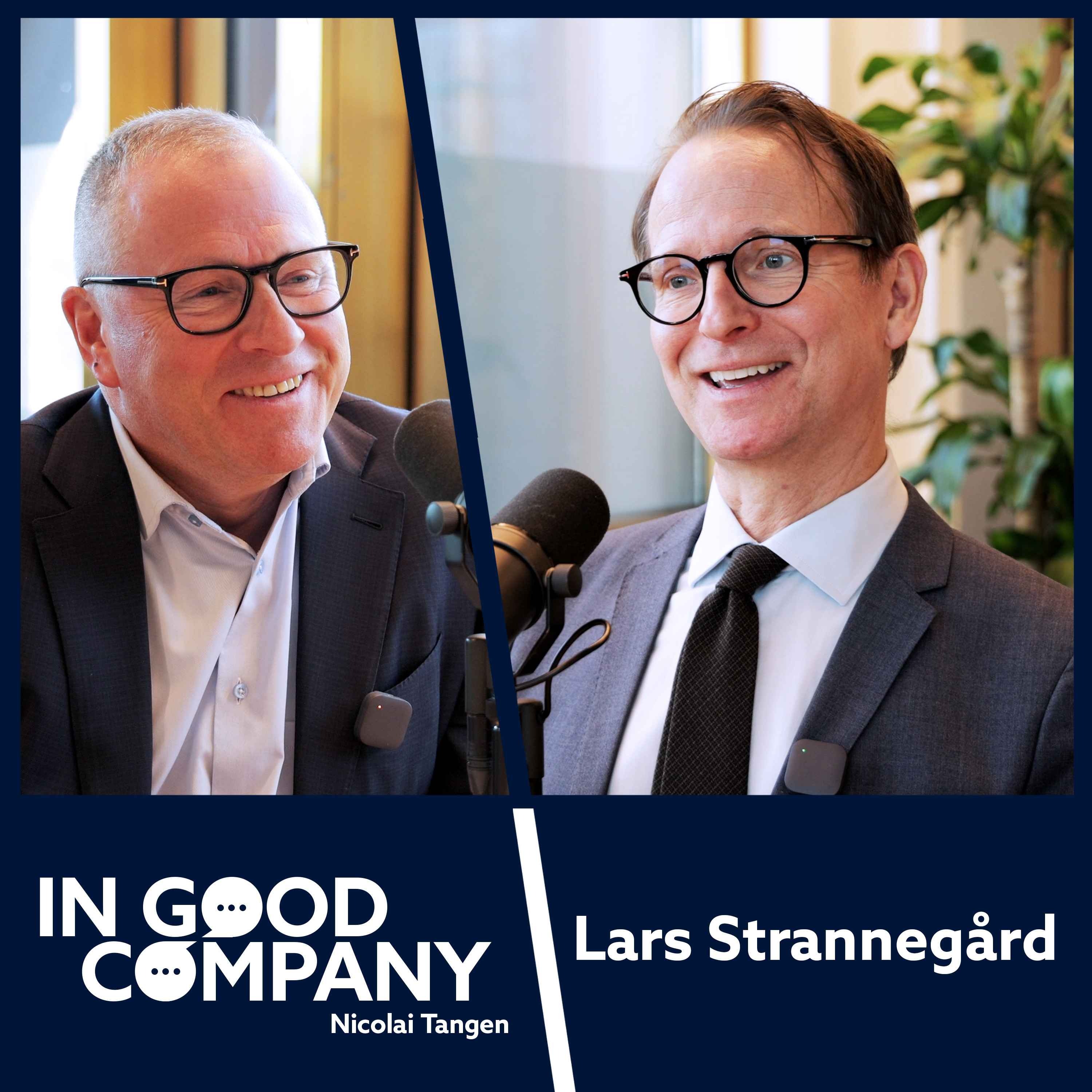
In Good Company with Nicolai Tangen
Lars Strannegård: Art in Business, Leadership, and the Skills AI Can’t Replace
00:42:15
Loading summary
Transcript127 lines
- [00:01]
A
Hi, everybody.
- [00:02]
B
I'm Nicola Tangen, the CEO of the Norwegian Sovereign Wealth Fund. And today we have a very, very special guest. Lars Strandegor is a dean of Stockholm School of Economics, which is one of the finest business schools in Europe. And Lars, you have revolutionized the Stockholm School of Economics and we are going to talk about that today. So warm welcome.
- [00:19]
A
Thanks so much. Great to be here.
- [00:30]
B
Now, one of the big things you have done is really to introduce culture and learnings about culture into the school. Why is culture important in business education?
- [00:40]
A
Because when we say culture, we mean arts, we mean literature and also music. But basically the idea behind that is to open up your senses, to contextualize, to make you see the world from new perspectives. And it's actually, you know, many business school students believe that they know how the world functions and how it operates.
- [01:04]
B
And you think they don't?
- [01:06]
A
Well, I think they're there to learn. Right? Yeah. So I think it's a good idea to expose them to things that they don't really understand, where they start asking themselves questions, where you actually sort of widen the blinders that we all have, not just students. And art can actually serve as a sort of intellectual and emotional itching powder to make you understand the world in another way and also increase your humbleness. You become more humble if you see things that you don't understand and learn to live with it.
- [01:36]
B
What are you seeing in people after they have been through this treatment?
- [01:42]
A
Well, after the treatment, I think they get a sort of fuller understanding of the world. Not always. Of course not. I mean, you can still go through our education program just knowing sort of the figures and the statistics and what happens only when the sort of demand and supply curves meet. But I do think that they are more open to the world. And I also think this idea of being humble is really, really key in the world that we're living in now.
- [02:13]
B
Why does culture lead to humbleness?
- [02:16]
A
Because it sort of makes you realize that you don't understand everything if you have that type of cultural expressions. It is what they, what it can do. It can also increase your empathy. So for instance, if you, if you watch a TV show like Mad Men, then you know what it's like to live in Manhattan in the 1960s, working in the ads agency business.
- [02:44]
B
And being treated badly if you're a woman, and.
- [02:46]
A
Being treated badly if you're a woman, even though you yourself have never been in that position or that situation. And that's sort of one of the greatnesses of high quality culture that can Move you to other times, to other spaces and to other sets of minds. So I mean, if you read Romeo and Juliet, you know what it's like to be in love with the wrong person, even though you yourself have perhaps never ever been in love, and, and definitely not been in love several hundred years ago in imaginary Italy. So that's sort of one of the great sort of capacities that high quality cultural expressions carry.
- [03:23]
B
Yeah, no, I've seen the research. And the more fiction you read, the more empathy you have.
- [03:28]
A
Yeah.
- [03:29]
B
And why is empathy important?
- [03:31]
A
Well, I guess the short answer to that is that because the machines don't have it. Right. So we are living in a highly digitalized world infused by artificial intelligence. And artificial intelligence is fantastic, as we know, and so impressive, but it lacks understanding of others. It cannot put itself into somebody else's clothes. It's got no feelings it can mimic very well. Also it's very good at it to mimic empathy, but it's got no real authentic empathy. And also it's got no sense making capability. It's artificial intelligence and especially generative AI is basically all about putting things together, assembling texts or videos or images in a way that seems plausible to the human mind, but, but it cannot really say that it's true. Right. Because it's still hallucinating. AI still has a lot of problems in hallucinations and thereby if you just practice your human skills, understanding others, your sense making capabilities, your feelings basically and the emotions, those are things that, that machines don't have. So of course you should sort of try to foster them and develop them.
- [05:03]
B
What does culture do to the learning environment and the ability to learn and absorb?
- [05:08]
A
Well, I think it sort of increases the knowledge intensity. If you, it's kind of simple. I mean, if you are in a, if you sit in a bunker, it's not inspiring. And if you are in an environment that sort of, sort of, it sort of awakens your feelings, also your perception and your attention, it makes it sort of interesting. And art can also, I mean, it communicates to you not just cognitively, but also emotionally. So thereby I think there are sort of more trajectories or sort of roads open to learning and creativity.
- [05:48]
B
What does it do? It's kind of a leading question because I agree with your view here, but what do you, just to spell it out, what do you think it does to creativity?
- [05:56]
A
I think it of course enhances your creativity.
- [06:00]
B
And why is that?
- [06:01]
A
Because creativity is basically all about combining things that are usually well known, but in new ways. So if you Sort of open the freeways that you have in your brain and in your connections to others. It's more probable that you come up with new things. If you just walk on the track that you've always been walking on, you won't come up with new ideas. But if you are exposed to and sort of urged to see the world in new ways, it creates something new.
- [06:36]
B
What does it do? Or have you seen examples of how it can improve cooperation and collaboration?
- [06:42]
A
Yeah, absolutely. I think it's. I mean, our entire environment is now packed with art. I mean, you can't walk one single foot or a meter without being exposed to an artwork. And also I think the development of our business lab, our incubator, it's now one of Europe's most successful ones. And I mean, being in that type of environment sort of just sparks your willingness to live, really. Right. I mean, it's sort of. It's a more interesting place. It also. I don't think we should underestimate the fact that it's, you know, conversation starters. It's also just something more pleasant and that it's fun. You know, it can actually be fun if you have a wall that's completely empty, or you have a wall where there's something, you know, a work of art of some kind, something human made, and if it can spark your imagination or sort of makes you tick somehow, you can get new types of conversations, you interact with people in a new way. So I think it's a perfect grease in human interaction.
- [08:00]
B
Lars, let's go into one or two of the classrooms. What are we. Where do you want to go first? Where should we go?
- [08:08]
A
Well, we can go into one, but.
- [08:11]
B
First you come through the big door of Stockholm School Economics, right? Yes. Pretty impressive stuff.
- [08:15]
A
Yes.
- [08:16]
B
Big building, wealth, history.
- [08:19]
A
It looks like a bank.
- [08:20]
B
It looks like a bank.
- [08:21]
A
Yeah, that's the idea too.
- [08:22]
B
But then it opens up and you see lots of funky stuff.
- [08:24]
A
Yeah, the first thing you see is a huge video screen where we have curated video exhibitions in collaboration with different art institutions like the. The Museum of Modern art in Stockholm, etc. Also with. With International.
- [08:38]
B
But then we go into classrooms.
- [08:39]
A
Then you go into classrooms.
- [08:41]
B
Which one? Where do you want to go?
- [08:42]
A
We can start in one that's designed by Jacob Dahlgren and he's one of Sweden's most well known artists. He's been at the Venice Biennale, et cetera. And what you see is that the walls are full of patterns. So basically looks, you know, it's stripes and squares and different types of curves. Then if you look closely, you see that they are made up of, first of all, school material, like pens and pencils. And also they are made up by measurement instruments, like rulers and. Yeah, different types of measurement instruments. And they just form a pattern. So it sort of makes you think, or. I mean, it's a clear comment on that. Everything we do at this academic institution is based on measuring the world, right? That's what researchers do, they quantify it. So basically, you can have conversations about quantification, the quantifiable world, and what numbers and figures actually do to you. Things like what that which is not counted, does not count, et cetera. These things that we have, our KPIs, et cetera, in order to prescribe action of different kind through numbers. And then also you see that the shape of the way that these measurement instruments are assembled is in an abstract form. It's basically an abstract pattern. So then you can speak about abstractions, you know, because all that higher education is about is actually abstractions. So if you have a profit and loss statement, that's surely an abstraction of something more, you know, real in a way. So using theories, using models, understanding the world from a. From another perspective is all about abstractions. And then you can speak about the connection between measuring and. And abstractions and then trying to understand what abstract thinking is all about. And just sort of thinking, reflecting on the very idea of the abstract is something that a higher education institution definitely should do, I think.
- [11:03]
B
Yeah, absolutely. Well, I mean, annual report is an abstraction of a company's finances, for instance.
- [11:08]
A
Yeah, exactly. So abstraction, I mean, it's basically about getting as much information as possible into some other shape and form. Right. So it should be, you know, if you take an annual report, the idea is to show so much as you can of a company in a few pages, in a few tables, in a few images.
- [11:29]
B
In German or in German language, you split between ausbildung and bildung. I'm not sure we have a good word for it in the Scandinavian language.
- [11:38]
A
Yeah, we do actually. In Scandinavian, we do. We have utbilding or. And bilduning, but English does not have it.
- [11:44]
B
Right. And you basically educate the leaders of tomorrow. Why is it important for future leaders to have bildung?
- [11:52]
A
Well, bildung. One definition of that, it's bildung is that which is left after you've forgotten what you've learned. So that means that what you've forgotten what you've learned, I mean, we all do that. We forget lots of things, right? What years, things happened Et cetera. But what's left is an approach to the world and a stance to the world and a way that you approach it. So it's sort of a position, more than a goal.
- [12:23]
B
And the stuff that you are doing, how does that make building better?
- [12:27]
A
Well, it does because what we do is to try to. We have an educational mission that we abbreviate as free F R, E, E. And the F stands for fact and science based approach. Completely key in this world. Right. Especially in the age of generative AI, when truths are not what they used to be because they can now be fabricated and you cannot believe your eyes or your ears anymore. So we're living in some kind of ontological crisis where you don't know that what you see actually exists. So practicing that your fact and science based mindset is key. And then the R stands for reflective and self aware. So sort of asking yourself, you know, where does this piece of data come from? Who benefits from this? And where do my attitudes, my opinions and even my feelings come from? Are they my own or are they produced by somebody else and then internalized by me? So I think they're my own important things to do. Right? And then the first D stands for empathetic and culturally literate. And that's sort of why we use the art in order to create this or enhance your empathy and your cultural literacy. And then the final E stands for entrepreneurial and responsible, which means that you actually do something, you have agency. So this abbreviation, free, that is our definition of bilnung. So if you have that approach, if you go into the world being fact based, reflective, empathetic and entrepreneurial, it's sort of a vaccination to getting stuck in mental models and theories that used to be true but perhaps no longer are. So thereby it's sort of an approach to ensure some kind of lifelong learning. And that's exactly what you need in this world that's changing so quickly. And everything you thought was true just a week or two ago has proven not to be. So you have to be able to shift your mindset to not sort of get stuck in the models that you used to operate by.
- [14:28]
B
What are the challenges with you, in a way educating a very elite group of people? I mean, this is in a way going to make them even more elite and even less in touch with the rest of the world. One could argue.
- [14:42]
A
One could argue that then you could say that's completely wrong because they're not going to be out of tune with the rest of the world. It's Actually a way of making them understand the world much better. For instance, empathy is one of those ideas. I mean, saying that future decision makers should not have that type of mindset. That's really to sort of give in. You know, if you're in to education and if you're educating the future leaders and decision makers, you of course, I mean, you have to be ambitious. You have to make them understand the world even more and turn them into much more of human beings. Because if you don't, they won't be able to actually do the job that they have to do because they have responsibility to make the world better, to sort of at least, you know, our ambition is that they should leave a better world behind than the ones that they found.
- [15:40]
B
Can you measure the results of this? I mean, it's not like you have a scale on empathy that you can measure people. It takes a long time to see whether they're more successful leaders and so on. Is there any way you can measure that? Do you have like a engagement survey? Survey?
- [15:56]
A
Yes, we do. I think it's really hard and also, especially when you're into cultural expressions because it's sort of hard to sort of measure how much empathy and how much learning did you get from going to the Louvre and see the Mona Lisa? How many kilos of empathy did you gain from that? Right. It's hard, but we can do it through different types of surveys. A lot of self appreciation on how much more free are you. Actually that's one way of doing it, but it doesn't really do the job. But we more use proxies in a way to say that, okay, so our school has never been more selective than it is now. Our students get the jobs that they want and they get it really, really quickly. The, the, you know, the faculty members who apply to our job openings are more than ever. The number of corporations that sponsor us has increased too. So Basically all our KPIs are increasing and thereby, I mean, I'm at an academic institution, so you shouldn't confuse correlation with causality. But we do know that it's a lot of correlation. Since we started with all this, all the KPIs are pointing in the right direction, but we can't really show and prove the causality.
- [17:20]
B
Well, I have to say, if I were young again, I would have applied.
- [17:24]
A
Great. But we have executive education.
- [17:26]
B
That's very good to hear. That's very good to hear. No, it's super appealing. You come in there and it's just so vibrant and beautiful and stimulating and Cool and fun.
- [17:37]
A
It's actually fun because we've been named in the Financial Times. I mean, they write about us as if we're an art institution. In the national press, we're considered to be one of the most, or actually the most interesting art institution in the country, which is, you know, it's a bit over the top, I guess, to.
- [17:56]
B
Say, is anybody any other school copying you?
- [17:59]
A
I think, I mean, lots of schools have art, but very few have integrated it to the extent that we have. I mean, very few have classrooms that are art installations in their own right.
- [18:11]
B
How can you afford it?
- [18:12]
A
We get donations. We constantly need that. And I think that's part of the model too. We want to engage people who believe in this, in the knowledge form actually, and who understand the importance of art. And what's also interesting, that basically all our big donations have always started with art. So we say for fun, sometimes it all starts with art.
- [18:44]
B
Changing tack a bit here. What are the qualities needed by tomorrow's leaders?
- [18:50]
A
I think they are exactly free, being fact based, being reflective, being self aware, being empathetic and culturally literate.
- [18:59]
B
And has this changed?
- [19:01]
A
Yes, I definitely think so. I mean, in the old days, I mean, you studied and then the type of knowledge that you had served, you know, what you wanted to do quite well, it doesn't anymore because you really have to be able to shift perspective, constantly, constantly seek for new facts, constantly reflect and constantly try to put yourself into somebody else's clothes. I think that's. It's always been important, but it's even more important now because it's. I mean, the situation in the world is changing so drastically and so quickly.
- [19:37]
B
Are there all the disciplines that you need to integrate into this? I mean, why don't they have to study psychology?
- [19:44]
A
I think that would be great too. And I mean, we do have that. I mean, a lot of our organizational theory courses are, you know, you got social psychology, et cetera into that. And then of course, I mean, you can't study everything either, right? So.
- [19:58]
B
Well, you say that, but.
- [20:00]
A
No, but I say that you have to try to make the years that you have at your disposal for a bachelor or a master's program, you have to work like crazy in order to make those years as knowledge intensive as possible. And I don't think all educational institutions actually, you know, try hard enough to make their environments knowledge intensive, but they sort of settle for the academic knowledge. They settle for what Aristotle called episteme, the type of knowledge that you can study and then have an exam on.
- [20:33]
B
Where do languages come into play here?
- [20:36]
A
We are now discussing to sort of reintroduce languages, especially if you're a European business school. We used to have much more focus. I mean, in the old days when the school started, it was German, then it was Russian, and then we have English and German and Spanish, et cetera. But now English or broken English has become the lingua franca of the world. And I think it's time actually to. I mean, if you're a European business school, if you speak other languages, and especially the European ones, it's really a way of understanding a particular culture or. One of the most prominent alumni from our school is Ola Seljanius. He's the CEO of Daimler Mercedes. And his German is absolutely perfect. He would never have gotten that job, I mean, in the German automotive industry if he didn't speak German. So it's a way of opening your career possibilities that for one thing. But even more than that, it's a way of understanding culture, understanding history, and sort of understanding why a particular culture and country looks the way it does and how it actually operates. There is no real sort of true understanding of a culture if you don't speak that language.
- [21:57]
B
Do you think this is also necessary for Europe to fight back against the rest of the world?
- [22:01]
A
I do think so, yes. I think it's a. I mean, fight back is one way of phrasing it, but also sort of collaborating even more within Europe, I think. And then.
- [22:13]
B
And why do we need more cooperation within Europe?
- [22:16]
A
Because, let's say, I mean, we are culturally and sort of historically, we are tightly knitted together and still we are in peace. And I think that's something we have to work really hard to keep. And if we sort of join forces even more, I think we of course will become much more powerful, really. So I also think it's. Right now, it's sort of. We don't have too much self confidence being European. We constantly hear about how Europe is lagging behind and Asia and the US and China especially are moving, especially in artificial intelligence and technology are moving so quickly and we're just being left behind. And I don't think it's a good idea to just sit back and sort of feel. Feel defeated, but instead try to see what we have, try to learn languages, each other's languages, see ourselves as more of an entity than we are, and then realize that there are lots of things that are pretty good here too. If you just take Sweden as an example, I mean, it's a highly innovative place. It's a country where the financial markets are working quite well. We have lots of, of private equity, 20 times more per capita than Germany and sort of, you know, to just boost the self confidence. Because I think many other countries like China, like the Americans are pretty good when it comes to self confidence, while Europeans aren't.
- [23:50]
B
What do you think are the traits that you are seeing in great leaders? Do you spend time observing?
- [23:58]
A
Oh, yeah, yeah, sure. I mean, absolutely.
- [24:00]
B
And when you abstract it down, what do they have in common? Why are the best ones very good?
- [24:04]
A
Well, I think it's. I mean, if you were really condensing it to a couple of terms, I would say authenticity. I mean, that you actually believe that what they're saying is what they think. And that's not the same thing as not lying nota bene, but actually being authentic in what you want to do. And that people feel that this is. That it matters to you, that you're not playing a game, that you're not sort of politically correct, whatever that means, but sort of, that it's your true self speaking and being there. I think that's absolutely key. I also think, I mean, being able to create a sense of meaning, you know, to make people understand and feel that they're part of something that's greater than themselves, that they're building something. You know that old anecdote where this man is sitting and banging on a stone and then somebody walks by and asks, what are you doing? Well, I'm banging on a stone. And then he asks another one doing the same thing, and then he says, well, I'm building a cathedral, right? So those, I mean, it's an old sort of saying, but I think it's a lot of truth in that, that you see what you're actually part of. And then I think energy too, right? I mean, to be in a place where things happen, where you feel that you're part of something that's moving, you know, people love being part of that because, I mean, I think we've all experienced workplaces or different types of places where you just feel that the energy level is low.
- [25:40]
B
Where does energy come from?
- [25:43]
A
Well, energy comes from inspiration, you know, so different leaders find their energy in different ways, of course, but I think if you do not feel energetic, that means that you don't. I mean, love is perhaps a strong word in this sense, but I think it's actually good if you don't love what you're doing. If you don't believe in what you're doing yourself, you will not get that type of energy.
- [26:08]
B
So I think it's interesting. We had Malcolm Gladwell on here and he said you get energy from doing what you love. So it ties into that. Now, is there such a thing as a Swedish leadership model or Scandinavian?
- [26:22]
A
Yes, I do think so. Even though it's hard to speak of those in terms of cultural specificities. But for sure, I mean, it's something in the ahierarchical idea that it is flat, that you actually listen to what others are saying, that you don't have the sort of traditional standing on a mountain and pointing in one direction, but being close to others. It's actually quite an academic model in the sense. In the old sense of the word, where Plato was walking together with his disciples. And what was important to him was that everybody, you know, every argument counts. It doesn't matter. Seniority doesn't matter. And it's only the argument in itself that matters. So that's what Plato said. That's sort of the true academic model. So seniority or titles and things like that shouldn't matter. And that's. I think that could be something that's quite visible in Swedish leadership. Flat hierarchies, listening to people, very informal, that it is possible for anybody to actually call anybody. And I think that sort of. We see it. Actually, a lot of German students especially come to our school because this is how they've perceived the Swedish model. It's highly attractive. I mean, if you want to start a company, for instance, it creates sort of an entrepreneurial spirit, I think.
- [27:53]
B
But tough for them to go back and work in a large German company, though, afterwards.
- [27:58]
A
Yes, that's true. And we want them to stay, of course.
- [28:00]
B
Course. Now, art, in a way, is storytelling, in a way, right. You abstract and express a story. And I, in a way, think that storytelling is just more and more key. And you see it when you go to conferences and so on. The people who own the room are the people who manage to translate something into a story that you remember. How are you working on that topic in your school?
- [28:32]
A
Well, I think in everything that we do, because stories are actually just a way of gathering and arranging meaning in a way. So, I mean, bringing together things that. Like in our case, ambition, right. Saying. I mean, you can do two things. You can either, say, come to our school, study and learn how to get a job where you can actually support yourself and perhaps be rich in the long run. That's one way of sort of speaking about what we're doing. The other way is to say, come to our school. Be inspired, learn to sort of change the world. Learn that this is a place where you can actually develop. It's where we have higher ambitions and of different kind. And it's also a place where you can really feel that the future can look very different. So I think it's basically everything is telling stories, right? I mean, everything that you're exposed to, every aesthetic expression is actually a story. I think it's also even more important in this very digital world to work with physical artifacts of different kind, that you can feel stuff and be part of something. So, I mean, the short answer is that I don't think any organization can be successful if it doesn't communicate what it does in a meaningful way.
- [30:07]
B
Now, you wrote a book called. And you there talk about the importance of hiring people who do not have a business background. And indeed, in my previous life I worked with historians and people who had studied theology and all these kind of things. And they were the best investors and the best financial brains I've seen. So should one actually study business?
- [30:32]
A
Well, I think in the book I say that you should study business, but that's not enough. You have to sort of open your mind as well. Right. I mean, I love the business school that I'm heading, of course, and I think the subjects we need are extremely important because they are ways of understanding the world. But it's all about, again, really sort of expanding the blinders that we have to. I mean, every type of education, it's specialized. Right. So it's a bit like watching the sky through a straw. And you need to have many straws nowadays in order to understand the world.
- [31:12]
B
That we're living in in America. They have many straws.
- [31:15]
A
Yeah, they do.
- [31:16]
B
When you study liberal art.
- [31:17]
A
Yes, but liberal arts education programs are not doing all that well. Right?
- [31:24]
B
Yeah. Okay. Now, another thing you talk about is sport. And you have some type of sport institute or what do you call it?
- [31:32]
A
Yeah, we have a center for sport and business.
- [31:34]
B
Exactly. With which we cooperate. You know, Norway's bank, investment management. We are doing some fantastic projects together with them. Very, very exciting in terms of sports psychology and how we build resilience and grit and the ability to cope with, you know, with tough times. Now, just where does sport come into education and business for you?
- [32:01]
A
Well, I think it's basically a good education program or institution recognizes that education is not just about the mind, but it's about mind, body and soul. So it's sort of three things going on at the same time. And also the fact that machines, they do not have any bodies, they're lousy at Sports. I mean, ChatGPT, you will beat it on the racetrack anytime.
- [32:27]
B
Right.
- [32:28]
A
So it says it doesn't have bodies, but humans do. And actually developing sort of, you know, your bodily functions, in a way is something that's really important. I mean, we know, you know, your cognitive skills develop quite a bit through physical exercise. Right. It's a connection. And of course, all these things that are about the human body that you were describing. Yeah. You know, the sports psychology, et cetera, all these things actually matter because human beings consist of flesh and blood and they have a mind, which is remarkable. And also sort of an interest in things that are beyond science too. And in a way, you know, poetry, art, religion, et cetera. Right. So these are things, just viewing the human being for everything that it is. I think that's what an educational institution should do. Great schools do that. I mean, you couldn't imagine Oxford or Cambridge without the rowing or.
- [33:40]
B
Some of.
- [33:41]
A
The US universities without their teams and their.
- [33:44]
B
And what can business leaders learn from great athletes?
- [33:47]
A
I think they can learn a lot, of course. I mean, it's the big. I mean, they can learn so much everything, you know, in, in terms of motivation and focus and. And sort of all the other things that sports psychology has got. There is a huge difference though. It's that it's more clear usually in sports, what the goal is, exactly what it is that you are to do. Right. I mean, if you, you know, that you are to jump, you know, over this bar that's right here. So it's very. The mission is very clear. It's not as clear being a business leader, because things can change quite a bit.
- [34:22]
B
Yeah. Talking about change AI, how will AI change education? Or already. How does it already change it?
- [34:30]
A
It already has. I mean, in every way, but fundamentally it. I mean, we know that cognitively, you know, the artificial intelligence actually outperforms us quite a bit, and so it really changes. And all over the world, university or educators are now trying to understand and think hard about how do we actually secure learning? Can we do the same type of tests that we used to do? Can we do. Take home exams? Do we need to pull out the plug and not let them use their computers? Should we only do handwriting, should we only do oral exams, et cetera. But it's kind of futile, all this, because fundamentally, I mean, generative AI and AI is here to stay. Our students don't even use Google anymore. Right. They use generative AI. And I think it poses much more fundamental questions that are about knowledge in itself. So what is the university to do when it's got a student for three years or sometimes even five years? You know, what should you learn? What's the purpose of it all and.
- [35:48]
B
What should you learn?
- [35:48]
A
I think fundamentally it's about the division of labor between machines and human beings. Because machines are great at being machines. We can't beat them in being machines, but they are not human. And they can't beat us in being human because they are. It's artificial intelligence, it's not human intelligence. So I think educational institutions should really help students to develop their human intelligence. And in that is of course included to understand how AI operates and be sort of able to interact with AI, but then also developing your human skills. So developing your empathy, developing your sense making, your understanding of the world, your contextualization capabilities, your language skills, all these things that AI is doing but not doing to the same extent. So it's basically trying to how do we become even better humans as the machines are becoming better at what they're doing?
- [37:07]
B
Do you think it's going to be more of an advantage to be an extrovert in the future? Do you think the nerds will be eaten by AI?
- [37:18]
A
I don't ever think that anything will eat anything else. First of all, I think that's sort of a view of the world where one thing sort of completely wipes out something else. I think it's always a matter of layering things are being put on top of each other. Having said that, yes, I think it's the way that you need to be a nerd in the future needs to.
- [37:41]
B
Change perhaps in more ways.
- [37:43]
A
Well, I suppose to be a little bit more sort of trying to understand the systems in themselves and not sort of operate within the systems. So being understanding how the general sort of ecosystem works.
- [38:04]
B
What's the future for PhDs?
- [38:06]
A
Well, I think the future for PhDs is bright, actually.
- [38:12]
B
Do you say that just because it's the most profitable part of your business.
- [38:15]
A
It'S actually the less or the least profitable because we have to educate them for so long? No, but I think it's not because that's. If you think that PhD is all about specializing in one particular subject, that's going to be gone. But it's not because a PhD education is actually about learning how to process large materials, big masses of data, analyzing things, putting them into new perspectives, also trying to express yourself both in writing and orally. So I think to have a researcher's mindset. Cause that's what you train PhD is not about a PhD dissertation, but it's about training an individual. And that individual will be needed even more, I think, in the future.
- [39:11]
B
Lars, rounding off with some personal things, what's the piece of art that's made the most impression on you?
- [39:19]
A
I think it's a Mark Rothko painting, which is. I think it's sort of. Magic is perhaps the wrong word. But I mean, it's just paint, just colors. It's a bit blurry at the edges. And somehow, you know, it just creates this emotion, which is absolutely impossible to explain why. And I think it's, you know, to be able to create that type of feeling. And I once actually just cried in front of those. Of one of those paintings.
- [39:54]
B
There's a book about people crying in front of you.
- [39:56]
A
Yeah, exactly. So there's a book on that. So I felt just like, you know, I'm just. I'm just. I'm just an ordinary guy. Right. Because this happens to everyone. It's interesting, you know that it's just. It's this emotional connection that's very hard to analyze and to give a rational explanation, too. So I think that's one of the powers of art, really. And I think it's. I mean, if you watch good films, I mean, just going into a cinema when the lights go down and you're just being pushed, or rather pulled into this world that you haven't been in or reading a book, what do you read? Well, right now, I'm actually. I've been reading a couple of classics, so I've been reading Joseph Conrad's Heart of Darkness. Absolutely terrible book. Or in that. It's scary. It's fantastically written. The language is amazing. And you're just being sort of pulled in to the Belgian Congo a long time ago.
- [40:56]
B
Into the river.
- [40:57]
A
Into the river, exactly. So you know the language. You just feel that you're there. It's just. That's what great cultural expressions can do again, move you into other times and other spaces and make you see the world in your perspective. It's something that we need so much of in the time that we're living in now.
- [41:13]
B
If you were not an educator, what would you do?
- [41:17]
A
I wouldn't mind running a cultural institution, actually.
- [41:20]
B
Right. Well, that's an educator as well. Right.
- [41:25]
A
That's true. That's true.
- [41:27]
B
Well, I'm sure you'll do well. Now, lastly, what advice do you have for young people?
- [41:34]
A
I think to really try to expose yourself to things that you don't understand, that you're not used to. And really try to push yourself into, you know, out of the box or out of your comfort zone or whatever you want to call it, but doing things that you wouldn't expect yourself to do.
- [41:59]
B
Great piece of advice. Big thanks for being here. And please look out for my application for your executive program.
- [42:07]
A
Thanks so much for having me. Great. Thank you.