← In Good Company with Nicolai Tangen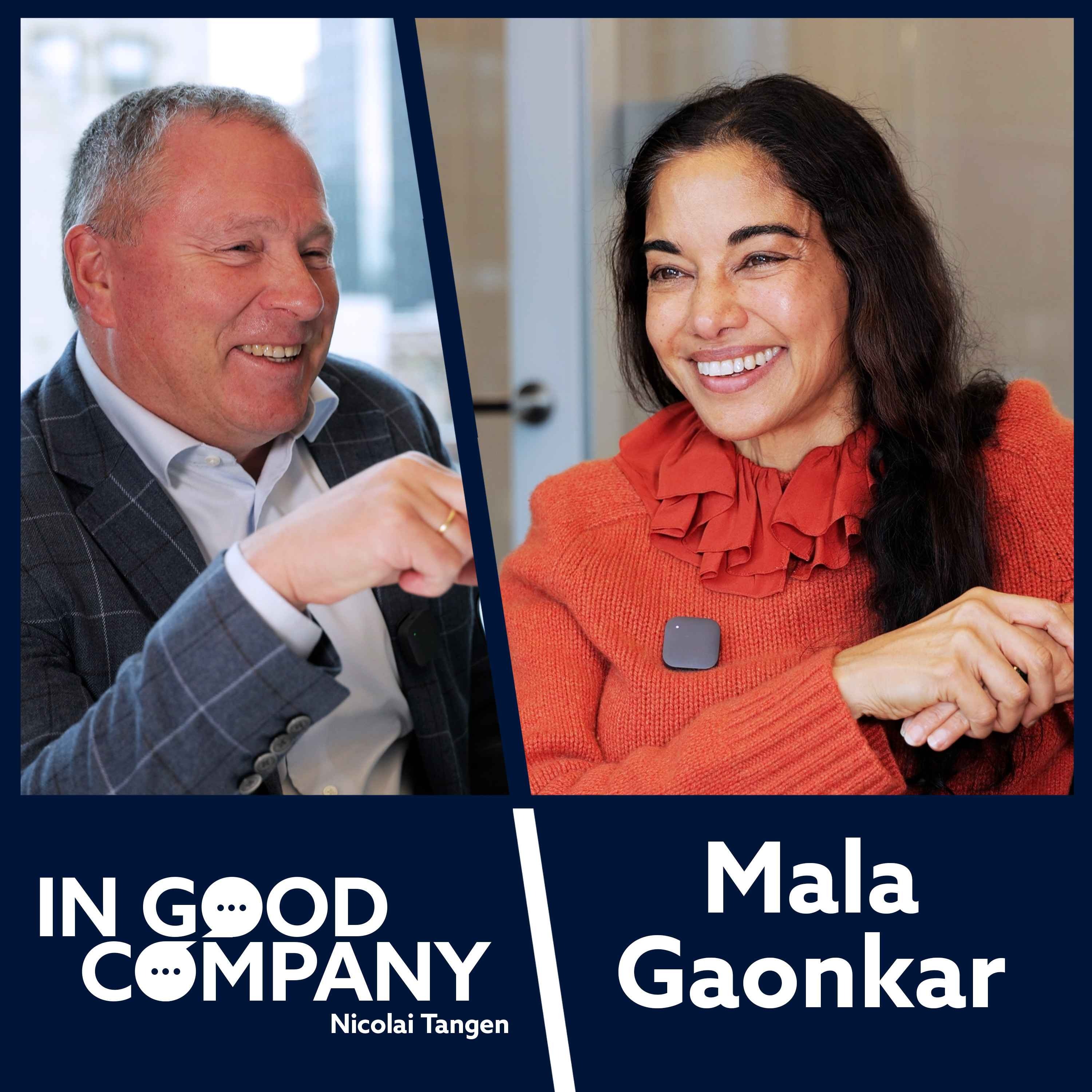
In Good Company with Nicolai Tangen
Mala Gaonkar: Building SurgoCap, Identifying Great Businesses and Learning from Mistakes
00:43:35
Loading summary
Transcript95 lines
- [00:01]
A
Hi everybody. I'm Nicola Tangen, the CEO of the Norwegian SO1 Wealth Fund. And today I'm really happy because I'm here with Mala Gaon Carr, who I've known for a long time. Actually, Mala founded SergoCap with $1.8 billion and now it's at $6 billion. And before that she spent 23 years as a founding partner of Lone Pine Capital, one of the most successful hedge funds of all times. Great to have you here.
- [00:27]
B
Great to be here, Nikolai. Thank you.
- [00:38]
A
Tell me about Sergio Cap Partners. You know your company?
- [00:42]
B
Yeah. Sergiocap tries to do what many investment firms try to do. It tries to beat the market over a three to five year cycle with less risk than the market. A risk defined as loss of capital, not volatility. And the way we try to achieve that is by by identifying this very small handful of truly great businesses that exist in the world. And we do that through a. Our product is really our process, a very transparent process of looking for very specific factors that really are distillation. As you pointed out earlier of my lessons I've learned the many mistakes and lessons I've learned From investing over 23 years with some of the best people in the business, my former colleagues at Lone Pineapple, that distillation has led to sergo. There are many different factors that lead to identification of a truly brilliant business. But the way I define a great business is a business with very long duration moats. And duration really is our true differentiation.
- [01:40]
A
So moat being that it's difficult to compete with them, it's difficult to compete them out. How many great companies are there in the world?
- [01:46]
B
As I said, a small handful. I don't think there are that many. We focus on really four verticals where I think there is a bit of an edge from one very specific factor is every business is a technology business, right. So if you're an aerospace company or a medtech business, or a financial data business, you are a technology company in your backbone. If you want to deliver at scale and with quality, you have to be a tech business. And I think understanding the tech stack map of businesses is something we spend a lot of time on, especially in non tech businesses, I think that's one. The second is how old technologies can disrupt in very new ways. So if you think about something like we've talked about this, but the auto industry, which employs far more people in the tech industry, but it's being disrupted right now by technology that was invented in 1976, the lithium ion batteries, I think that's always Interesting to me. Or when we started investing career, we were buying GPUs to make our video games look a little more fun. Then fast forward to now they're actually driving what's probably one of the more tough tectonic plate shifts in terms of social and demographic and technology shifts of our time, which is AI. So I think how old technologies disrupt in new ways and looking for that in non tech businesses is something we spend a lot of time on as well.
- [02:59]
A
And we'll come back to this. But just when you set up the fund, what kind of self imposed constraints did you put?
- [03:06]
B
Yes. So in order to distill to your question about how we identify these truly great businesses and keeping that discipline, there are a couple ways of doing that. One is focus. So we decided I wanted to keep the team small if there was consistent piece of advice I got from CEOs. Many have been on this podcast with you, whether they're running huge companies or small businesses or founders was to keep the team size small. So it's not just about aum. Obviously it's easier to multiply a dollar than it is to multiply a billion dollars, but team size and keeping team size small and making sure that collaborative and cross border thinking which is so fruitful for new idea generation, particularly creative idea generation, that was paramount in my brain.
- [03:45]
A
How small is mole?
- [03:47]
B
We have an investment team including the data science team and that we regularly meet table this size so that we can have a roundtable discussion. You know, Jeff Bezos has talked about sort of two, two pizza box teams. I think we'd like to stay at one pizza box in terms of our team size.
- [04:04]
A
One pizza box. So I think pizza per person, I have to say.
- [04:08]
B
Yeah, exactly. If we keep things lean.
- [04:10]
A
I'm saying that as a Norwegian, we are the biggest pizza eating country in the world. 11 kilo per person supposedly.
- [04:15]
B
Is that right?
- [04:15]
A
Yeah. Yeah.
- [04:16]
B
That's interesting. I've never predicted that.
- [04:19]
A
But when you look at your company relative to other tech investors, what would you say is the difference?
- [04:27]
B
We're looking at where technology is intersecting with non technology businesses and where, as I said, old technology is disrupting in new ways. So that's one angle. We look at the usual checklist of competitive and customer and other checks. I would say the other big lesson is really around biases and how you can use data science today in a way we couldn't when we started our investment careers. Given how fast and how open source now machine learning is, you can very cost effectively create very strong third party data Checks, including automated surveys, including automated tracking of various data points around markets and tech adoption that we could not. Very early on, in the late 90s, we were setting up our careers.
- [05:07]
A
Give me an example of the kind of thing you can do now that.
- [05:09]
B
You can do so very specifically if you want to track sort of product adoption. When we started out, when we started at lone pie 98, when I was looking at some of the early adoptions, even say around Adobe products back in the day when they were just transitioning to cloud, that was a very manual process. You went out, you called customers, you did surveys. Surveys were usually done by phone. Response rates were trickier to track. Now we actually can use survey bots to do these things. We can actually have a combination of both augmented human surveyors as well as looking at some of the deeper dives we can track through machine learning in a very automated way. A larger number of product SKUs we can scrape the web, which to be clear, wasn't at the scale and scope of what it is today to see product adoptions, to see who has open APIs to their suppliers, who doesn't. So there's a whole range of both tech stack mapping, product adoption, customer adoption, even outside the typical consumer adoption data that is tracked pretty religiously now, as you know, within the consumer world.
- [06:09]
A
Do you think investment organizations will be smaller in the future?
- [06:13]
B
I suspect they will be and they probably should be, because I do think there is something about human collaboration that works best at a smaller scale. I think some of the most interesting datas and simply mystery ideas come through looking across borders, across the borders of industries. So how AI is influencing medtech, how AI is influencing material science, innovation in aerospace? I think those are more interesting angles or just as interesting angles as purely looking at AI as AI within technology.
- [06:41]
A
Itself, what are some of the most counterintuitive benefits of AI that you are seeing in your companies?
- [06:49]
B
I think what is happening within medical technologies is, is not perhaps as well or broadly understood as it should. So to give you a very specific instance, if you look at the imaging space, so MRIs, CT scans and so on, the accuracy and the speed at which these images can be conducted are now improving at a pace of almost 70% versus what we would have even a few years ago that in an aging demographic globally has been incredibly helpful for not just therapeutic care, but, but preventive care. And in a way that makes obviously overall care much more cost effective. So I think that is one big area around imaging and really understanding earlier how some of these chronic diseases are Evolving and I think obviously nipping these in the bud earlier has been one big one. The other big area has been around how surgery is conducted. So I think the intersection people talk about AI and robotics in the manufacturing space. What I think people don't realize sometimes is There are about 300 million surgeries conducted globally and they're just beginning to be penetrated by what's happening with robotic surgery, specifically companies like Intuitive Surgical. So I think that is another big category where you're beginning to see real innovation happening where the combination of haptic feedback mapping software, better technologies around surgical conduct itself are really leading to a lower error, easier training for medical students and a overall better context for how these therapeutic cares can be conducted. As you know, there's a big discussion obviously around how healthcare costs can be contained and I have some hopes that AI applied intelligently can help with this. So yeah, I think broadly this idea of how technology is intersecting with non technology businesses and how you can use data to analyze that and debias the very human decision making process, something we spend a lot of time on.
- [08:54]
A
Very interesting. Now you believe in concentration. You have quite big. When you, when you go for something, you go pretty big, right?
- [09:01]
B
Correct.
- [09:02]
A
Tell me how you think about concentration.
- [09:04]
B
I very intentionally set on these four verticals happen to be enterprise data. So tech broadly, financial services and healthcare services as well as industrial technologies. Because I felt those were the areas where these themes of emerging technology disruption were most relevant and where you could see market leaders with very durable moats, where incremental returns and the capital you could put to work at those incremental returns had a clearer path given all the technology trends we're seeing today. So we purely just focus on those four areas. We also think about thematic exposure as well. And the reason for that I think is very simple. One, I think that allows you to play offense when at some point or the other due to the passive nature of the market structure. Now increasingly the odd factor rotation here or there could disrupt a portfolio that allows us to play offense during those periods. And we believe there is actually sufficiently interesting set of investment ideas across each of these four sectors where we're not compromising. And we have very different drivers of the long thesis of each of these names.
- [10:07]
A
Now you grew up in India and I heard you on a podcast once talking about food. So how do you spice up the portfolio?
- [10:15]
B
I think the spice for us is quality. So I think we have really moated long duration businesses and we have very de biased ways of tracking the data where it's not just based on my intuition or the team's intuition, but really based on systemic thinking and not siloed thinking. That's the spice that seems really exciting to me because then that's a really hard thing to think about and do well. And I think thinking. I think it's important for us to talk about this a little bit. And you're a real student of the investment process, Nikolai. But we both love the sort of Kahneman Tversky Thaler work, right? And I remember my father once giving me this great quote from Bertrand Russell which is, humans will do anything they can to not have to think. And it's very simple. Like Kahneman talks about System one and System two thinking. And system one thinking is that intuitive gut thinking that frankly is positive. It drives very quick, fluid reactions from humanity day to day, and it works perfectly fine. But system two thinking, which is really getting into the weeds and really thinking methodically and logically is really hard. And so I try to focus on making sure my team and our portfolio is driven by system two thinking here.
- [11:25]
A
I need to interject that I have actually interviewed you once before for my master's thesis.
- [11:30]
B
Oh, that's right.
- [11:32]
A
In decision making, which was exactly about that. You know, when do you use, you know, intuition and when do you, when do you use analysis? So how has your use of pattern recognition changed during your career?
- [11:48]
B
My pattern recognition has, I think, expanded from being less driven by individual analytical viewpoints and more to thinking about the context. I've probably over emphasized the person and the CEO or the leadership or kind of the hero model and under emphasized the very powerful social context in which companies, businesses were operating. And I learned this the hard way. I've had plenty of, plenty of failures. But my first job working in Russia and Mongolia as a junior analyst for the World Bank, I came in there, this is a particularly poignant example. I came in there thinking, okay, great, we're going to take these state owned enterprises, we're going to value them, we're going to distribute tickets through the various local bank branches, open up the stock market, boom, capitalism, liberal democracy, it's all going to be awesome. The end of history, done. What happened was a little bit different, right? We had instead a rise of very corrupt practices. We had the rise of autocracy across these countries. And we know the headlines today, still speak of these. You cannot take away or abstract away from 70 years of communist history and simply assume that people are going to just have a new framework of thinking. So I think the same is true today. You really have to think about the very powerful overall context as you're looking bottoms up at businesses. You have to have almost the right eye and the telescope and the left eye and the microscope to really think systemically and clearly about how businesses will evolve in the context in which they are in today. That's something I think a lot about is how do we address these very specific failures of our thinking.
- [13:32]
A
You can also invest in private companies.
- [13:35]
B
Yes.
- [13:36]
A
Why did you choose to be able to do that?
- [13:40]
B
I think some of the. We obviously know about the very large market caps that exist. The very large businesses exist in the private realm. And we know about the fact that there are fewer businesses that are out there in the public markets than have been for a while. So those trends aside, I think another reason to look at the private markets is because they're often the most disruptive. Change always happens at the edges, not at the core. Right. That's my fundamental view. And the edge is really the small company, the private company, the unsung founder who's just emerging. That's really where change at the margin will happen. So making sure that we have our networks and thought processes out there, not just in the U.S. but globally within these four areas that we focus on, these four big industry categories we focus on is something that I think is incumbent upon us. And talking to private companies as part of that process, it's as simple as that.
- [14:28]
A
How do you come up with ideas? So you wake up in the morning and then it's like bang, I want to look at that.
- [14:34]
B
It's not, I wake up in the morning and bang, I look at that. It's really a longer duration, there's a long incubation process. I think for me, of ideas I read a lot, I think I talk to my team, I talk to the broader networks that we all have access to out there. But then back to the point about change happening at the edge. It's really about going out in the field. It's about going to that obscure industry trade show that happens to feature automation of new robotic systems where you might get a new idea. It might happen to be this panel, this regular ongoing survey we've done since before our launch of AI developers and non tech industries to see what are they actually working on, what are they actually trying out. That's working, that's not working. So it's really, I would say from more obscure lenses that I get my best ideas versus what you would expect just talking to the existing power players, although that's obviously important as well.
- [15:29]
A
So then you have an idea, what do you do with it?
- [15:31]
B
The next step is to your point. Your question earlier About Intuition, System 1 versus System 2 thinking is then to put it through a very fine filter of the overall investment checklist. I very much believe in a checklist driven approach. We go through that. And then in addition to my point about biases, making sure we have a way to track the thesis and make sure that we can hold onto that rope. The reason for that is I think we are very subject to some very colorfully named biases. Whether it's confirmation bias or availability bias or sunk cost bias. When I look across my many investment mistakes, they've all been one or the other of these biases. They're very human and they're natural and there's some positive aspects, but for investing, maybe a bit less so. So I'd like to make sure that there's a data point that we can attach our investment thesis to that's unbiased so that the investment team and I can track this and make sure that we're not just assuming issues that might be headwinds to the thesis away. And I spend a lot of time on that. I spend a lot of time also making sure we're talking about errors of omission and commission, but I also want to make sure we don't get in to make mistakes. So a lot of my time is also thinking about what are the assumptions that are being made out there that could possibly be wrong, where could things go astray, where could market disruptions happen? And so that's something I spend just as much time on. And FOMO is probably the biggest, right? So I like to tell my team it's not let's move from FOMO to tomo, thoughtfully missing out, making sure that we're looking at whatever it happens to be crypto or quantum or whatever the flavor of the day might be. Maybe we can try and expand our circle of competence, but if we can't, making it clear what our circle of competence is, keep pushing it out, but be very clear about what those lines are, not overstepping them. So I think, I would say my ideas are as much about steering the team as they are about specific stocks.
- [17:28]
A
How do you use them? Do they make decisions or they support you in your decision making?
- [17:33]
B
I have a very experienced team. I'm very lucky to work with. A small handful of truly excellent people, have had a decade or so each of long and short stock picking experience. And I really use them as collaborators. I really think of them as people that are very important to my decision making process and I could not. This is very much a team sport in my view. And so you do need that strong team. And I view myself as much a coaching and mentoring role. And one of the big drivers of CircleCap, I hope is that I can attract and mentor the next generation of really great investment talent.
- [18:10]
A
Thoughtfully missing out what are the red flags that will keep you away from something?
- [18:16]
B
One is compromise. If you feel that you are only buying, investing in a business because of pure valuation, or you're investing in business because you think the founder is the next messiah, but there are other issues, but you're going to smooth those away, essentially being overly emotional in terms of the investment decision making. Whenever I see that, sometimes when I get too excited about something even I think that's a red flag to make sure that we're really thinking in a very balanced and thoughtful way about all the aspects of the business as opposed to just focusing on one. And I think that's where the bias is very inherent. As humans, we're very trained to look for that one big exciting moment or thing. That's how we evolved. We were looking for the predator that was about to pounce on us. But in reality, I think in the modern world it is not that simple. In fact, it's incredibly complex and there's a multiplicity of factors that could go right and could go wrong. And spending time in that full gamut is something I make sure we do and I make mistakes when I don't.
- [19:23]
A
It's not easy to leave emotions out of it.
- [19:28]
B
I do think you need to have a methodology and a process to bring that into your system, to thinking and creating tools so that you and your team can nudge that way. And then remember back to the nature of the markets themselves. Stocks move as much in narrative as they move on numbers. So you have to be respectful of that context and just be appreciative of the context. Back to my point about context in even the late dying days of the Soviet Union and how powerful that was. So I think that's something we need to balance as well.
- [20:01]
A
You mentioned long term moat as a definition of quality. What are the other type of quality signs you're looking at?
- [20:09]
B
Yeah, so when I say moat, what do I mean by that? I mean a business that has very high incremental ROICs, because ultimately the value of a business is going to be the return on incremental invested capital times the dollars you can put to work at those incremental returns. Right. So it's a balance of what is driving that ROIC and multiply multiple ways are really the best ways. So if it's just by driving a price, I don't love that. But if it's driving a price and there's feature innovation and there's market growth through new geographies or new products, that's great. So multiple levers on driving ROIC is one. The second is the capital you can put to work at those incremental returns. There are many businesses that have not many, but there's some great business have high incremental returns, but the capital they can put to work at those incremental returns are diminishing. The growth market isn't there. And so trying to understand what category of business that is. And then even if they do have a lot of capital they can put to work, and we're seeing this in the technology space today, execution risk is enormous. And so I think we need to make sure that we're getting the level of return for that level of capital being put to work versus the sales and size of the existing business today because that increases execution risk, which is a risk I very much need to think about. So I think that combination of incremental returns capital you can put to work in this incremental returns, having multiple levers to both manage the positives in one and the negatives of execution risk in the other is what we think about.
- [21:31]
A
So without talking about anything you own in the portfolio just now, but an example of great investments that you have had which would kind of tick some of these boxes.
- [21:42]
B
Yeah, I would say the broader. And we've had some of these investments in my prior role as well. This is the great aspect of these businesses. I think what's really interesting right now is what's happening with the chip stack. So we've been spending a lot of time on that. So you have businesses like TSM that are well known that have really kind of. There's a Taiwan in Taiwan kind of the process engineering aspects of that. So it's not really just about one thing. It's all about multiple things. So I love that sort of system, systemic moats where there isn't just one little simple. It's not you just own the only gold mine in town. It's that you own the process around how the gold mine is extracted. So I think I like businesses that have those dynamics to them. I also think there's something really interesting happening now in the chip layer in AI where there's been a lot of talk about training, but I think training is a little spiky, but inference is the annuity stream. Ultimately this is what we're going to be calling on the models to do day in, day out and those are going to be within specific LLMs. Google will have its own inference stack, OpenAI, Anthropic and others. I think what is happening around Google's TPU is really interesting in terms of reducing that. So I think ASICS or ASIC chips, application specific chips that are designed for specific types of workloads and what's happening around that creates very long duration moats. And so we've been focusing a lot in that kind of thematic. We talked about medical technologies earlier but I do think the combination of go to market moats combined with process innovation that just keeps compounding embedded in a large pool of global doctors, nurse practitioners out there actually executing creates a lot of stickiness as well. I think that's another area where great businesses are really emerging and forming and have formed. Those are probably two big buckets. And what's happening around the chip stack layer which have really. And the medtech layer which playoff last 20 years. So these are not new. I think there's another interesting category as well where there's a view that AI is maybe disrupting a little bit more than it actually is. And so I think within sort of real time data and data analytics there's some proprietary data providers I think are really interesting and are really terrific businesses where they have both the system of record and the system of workflow from combined and that combined with a very basic innovation engine. Those three combined often create very durable.
- [24:08]
A
What type of companies would that be?
- [24:09]
B
So those would be businesses that provide for example financial data. So think about even for your portfolio, all of the real time pricing that's needed for FX clearance or for fixed income or for the equity markets. I think those are real time data, very hard for LLM, for example to ever disrupt because of the real time nature of that. But that's embedded in real workflows around trading and compliance that I think are very hard to disrupt as well. So I think there's a perception that those can be scraped away by the AI models. But I think that's almost very hard for me to see or understand.
- [24:43]
A
What kind of time horizons do you have when you invest or when you.
- [24:46]
B
Think about investments for as long as possible? On the long side, obviously shorts are obviously different. They're more catalyst driven and usually tend to have sort of, you know, sub nine month kind of catalyst periods. But on the long side As I said, I trust our process to look at duration. So we're really looking, as I said, for that combination of factors driving incremental returns and capital that can be put to work at those incremental returns that really are playing out certainly over three to five year cycle in terms of our valuation horizon. But ideally we see levers beyond that.
- [25:17]
A
How does shorting compare with long investing? Can the same person do both?
- [25:23]
B
It's a great question because it's really the opposite muscle of the long side as you know, it's really thinking about. So sometimes you will see clear the shorts that are the broken mirror images of the longs. X is winning, Y is losing. I find those are very rare and few and far between. And that's not enough. Usually. I think in addition to that you have to have the timing correct as to when exactly those win or loser dynamics will play out. Usually if it plays out through some combination of clear price competitive pressures, clear share competitive pressures leading to those pricing pressures, and then that combined with other factors such as just misexecution by management, you have a pretty good short. The problem though is that combination of factors occurring within the time frame you need is a tricky one. And then add to that all of the sort of factor rotations and the passive nature of the markets today, often driven by quant and ETF and other funds. You have other dynamics that are driving trading. You need to think about, do you short? We do short.
- [26:29]
A
It's just so, so stressful because you are wrong for such a low period of time. And when you're right, it's just like in these bursts, you know, and they don't last very long. You may be like super right for one week and then you're kind of wrong again for two years. Right.
- [26:47]
B
It's hard. It is day in, day out. We still look for absolute profit dollar shorts.
- [26:51]
A
Do you care about valuations?
- [26:53]
B
I do. I think valuation matters a lot. We look at free cash flow multiples, we expense stock based comp, we do all the unfashionable things and look at things pretty conservatively. And the reason for that is what I said earlier about wanting to manage risk. So. So I think about risk adjusted returns and I think valuation and what you pay up front is very much a part of that. And particularly thinking about valuation and the information asymmetries in the market even more so.
- [27:26]
A
Let's go back to your time at Lone Pine and you set it up with Steve Mandela. What did you. What was the most important learnings from your time At Lone Pine.
- [27:38]
B
Yeah, I think there were several. I mean, I think and I was really lucky to work with the brilliant group of people there, including Steve. I would say one of the big lessons I distilled was really what we discussed around biases. Let me give you a very specific example. I'll give me a couple of examples. And you talked about shorts. We can start with shorts. One of my biggest mistakes at Lone Pine was shorting Nokia. I shorted Nokia for went down at the end. So this is what's interesting. Thought I was absolutely right. And then obviously 2014 Microsoft comes out and buys the thing for $7 billion. It was a very painful day for me and for my firm. Then 18 months later Microsoft writes it off, it's gone. So you can be right and you can be completely, utterly wrong to your earlier point on the short side. So what was the lesson? The lesson is if you think about the business as a standalone business, yes, you were right, great. However, you didn't really think about all of the other strategic value of the business broadly over time. So thinking about a business not in isolation but thinking more systemically but not in silos is something I have to learn over and over again and something I teach my team. So, so systemic, not silo thinking, that's number one. And the Nokia example is one. The other is avoiding balance sheet leverage like public LBOs I've learned the hard way are probably not my thing. I've made mistakes where I have invested in decent businesses that were pretty decent business. They were over levered but as a result they had much less maneuvering capacity when times of inevitable macro tensions arose. So that's another big lesson and I made mistakes there. Businesses like Altice for example, the third is I think maybe the most interesting one. Going back to discussions of the AI chip stack and of how old technologies can disrupt in new ways, which is Nvidia. So Nvidia saw it very much as a GPU business what it was. But then 2015 we had the deep reinforcement, learned the DeepMind papers come out and it was incredibly interesting and exciting. You began to see how parallel compute would be necessary, how GPUs would be helpful for that parallel in fact essential for that parallel compute to work to drive this interesting new engine of machine learning. I didn't know what generative AI was going to happen, but you definitely saw what was happening with machine learning in early stages of what would then become generative AI. The fact that was back then, apart from just GPUs for video games, there was A big crypto component as well. So it was gaming and crypto that was driving Nvidia at the time. I said, well, yeah, but there's going to be this AI thing and that's going to be big. Turns out they missed significantly because of a concrete crash in crypto and game permitting delays in China, which were driving a big portion of demand for the video gaming part of the business. So I sold, which I shouldn't have. But here's the bigger, that was a mistake. But the bigger mistake was not that. The bigger mistake was then not revisiting Nvidia later. So this sunk cost bias I find is a very powerful one. And that's why I spend so much time now at Sergo to make sure that we keep a strong kind of survey of the available idea sets out there and make sure we continually revise including the names that we missed. So errors of omission as well, to make sure we don't bump into this issue repeatedly.
- [31:13]
A
It's so difficult to buy back things you sold lower down.
- [31:17]
B
Yes, but that's, in my opinion, that's not an excuse. And I think precisely because that is so hard, it's a really important and interesting opportunity set for new ideas when you are wrong, which happens a lot. And so at least to me. So I think those are probably three concrete examples with clear lessons. One around systemic, not siloed thinking, the other around wariness, around financial leverage versus the other drivers of leverage that we all are happy about. And the third being around these biases that we talked about earlier, including the sunk cost bias.
- [31:49]
A
Mano, I'd love to ask you a couple of questions just on slightly more personal nature. Do you think, I mean, you grew up partly in the US Partly in India. Do you think that multicultural background is impacting the way you view the world and investments?
- [32:07]
B
Very much so. I would say growing up in India, growing up in a Bangalore that was not the Bangalore it is today, a very sleepy town, it was actually considered a retirement town at that point. My parents are both. My mother's a doctor, my father's an academic and they worked there in that capacity and is a very quiet, very academic, very cerebral upbringing in many ways. But it was not without exposure to the very stark realities of India at the time. An India that was suffering in many ways from the walls that were put up. It was a closed off economy at the time, the License Raj, as it was called. And it was very apparent that that was leading to real issues for the economy overall. Even as a young girl growing up. But I think also seeing the level of income inequality, something that is striking, not just India, but the world at large, and the perils of that became very clear to me. And the resulting loss in trust in institutions, the resulting corruption that that often results in, was something I grew up with and was all around me. And I think it's something that led in me, at least to a very fierce sense of I need to give back and be of service. And I think that's partly also my family, my great grandmother was in jail working because of her work with the independence movement under Gandhi. And I think that idea of social service and how you give back was very much that became all the more reinforced by the social realities of growing up in India. Now, all of that said, it was also wonderful in some ways, partly also because of the barrier. You have very strong local culture and local dynamic and a very rich literature and sense of history and self that came about as well from some of the fact that India was more closed off at that point in time. And so I think as a result of all of that, I also came away with a sense of great pride in what India stands for and what it has become today and what will become in the future.
- [34:07]
A
You are a role model for many women, and I think when you launched, it was the biggest hedge fund launch of any woman ever. Right? That's pretty amazing. Any reflections around being a woman in the investment world?
- [34:23]
B
I would say, look, first of all, I hope that's a record that's broken very quickly, and I'm sure it will be. There's some really amazing, talented women out there. Look, I hope I'm not just a role model for women, but the broader investment community and hopefully over time, the philanthropic community as well. That's a very important part of my. My work and my ethos and my identity. I would say I'm a little. I really think the investment business, broadly, whether you're an outsider in any way, shape or form, is a great one. It's about as meritocratic a business as I can think of. I could be a green Martian with two horns in my head, but if I produce investment returns, there'll be a line out the door wanting to get money. So I think it's a very meritocratic industry. And I just hope that places like Sergo, places like the platform you're running here, are just ways for more people to add value in this industry, because I really think it's a terrific one for people who are intellectually curious of all stripes and shapes. And sizes to come in and be of use to the world at large.
- [35:29]
A
Well, you have indeed many stripes because you are interested in so many different things. You've written. You've written a book, you've been involved with a play. How does all this play into your kind of creativity and curiosity?
- [35:45]
B
I think.
- [35:47]
A
Well, tell me about some of the stuff you do first, because you do a lot of funky stuff.
- [35:50]
B
I do two main things apart from my professional works. One is the philanthropy, which we can talk about. And you asked about the creative works. I can talk about that first. The creative. Well, let's talk about the philanthropy. So on the philanthropic front, I started very early. So from year one at Lone Pine, I felt it was very important to start giving back. And just as I do as an investor, it was really about backing really great social entrepreneurs and making sure we could seed them, seed them early. So I was very lucky to meet Paul Farmer, who was early in building Partners in Health at the time. He sadly passed away, but was a great mentor to me. And he always said public health is more like armed robbery than it is helping the old lady cross the road. You have to break things to build things. And it truly is. There's a lot that needs to be done in terms of breaking siloed thinking to really get solutions to people in a rural maternity clinic in India, for example, that I learned through people like him, through people like Atul Gawande and others that I've worked with. That all led to who was working at Gates foundation at the time and I to set up Zurgo Health. And this really going back now over a decade. Our view was very much how do we take healthcare service delivery and really help with data sets that are targeted, not just data and the set of data, but behavioral data. So I think one of the most interesting things happening potentially in AI is adding the why to AI. AI is very good at solving what questions. What ad will Nikolaj click on next, but not why. And I think adding this large scale behavioral data, which you can do with some pretty basic Bayesian networking math, to say this is why a woman is not going to the maternity clinic to deliver. This is why XYZ is not using contraception in this community. It's something that we've been spending a lot of time on data as a public good and data science as a public good is something that we spend a lot of time on. So that's a big part of the philanthropic effort. And we work with groups like the Belinda Melinda Gates foundation and others as well as Local governments to help. So, for example, one thing that was interesting is the maternal mortality work where we did a lot of this work in India to help target the state of Uttar Pradesh, spending a billion bucks a year on just maternity clinic adoption and driving that up. And then we're getting calls from people in the US saying maternal mortality is rising here. It's a real problem. How can we use those same techniques here in the US and then that then led to a really program with Uber with Dara. Actually, I reached out to, I think you've interviewed here to do rides for moms. The problem was having a maternity plan and making sure women actually went to the clinic, in which case transportation was actually an interesting thing. It was transport, not hospital care. So understanding the why is really important. So I'll wrap up there. But I think that's a really important side where both the technology side and the philanthropic side overlap really interestingly on the creative work look, I think we're happiest as people, not when we're obsessing over ourselves, but when we forget ourselves, whether it's our professional work or philanthropic work or creative work. And so I very much do it out of joy. Have since college writing short stories, that is. And I think at the end of the day, everything is a narrative, Right. We had dinner recently with a group of very diverse range of very successful people. And you asked them to do predictions.
- [39:10]
A
You do fun dinners and we asked.
- [39:12]
B
Them to do predictions. They all came up with pretty pessimistic ones. So there's this conflict between the narrative self and what I see, how I see myself versus the social self, social context. And so I think that conflict is something I like to write about and think about. And it's been really fun.
- [39:27]
A
What about the theater project?
- [39:29]
B
Yeah, so the theater project, Theater of the Mind, it was based actually in a series of neuroscience experiments. I had was very interested in what was happening around some of these economic games. We talked about Kahneman, Thaler and Tversky's work. There's one called the Dictator's Game, for example, where even though an individual in a group playing this game could take all of the coins on the table, they do not they want to share. So that's hopeful. And I was interested in that. And I wanted to take that to the basement of the Science Museum in London, one of the great museums of the world. And my friend Brian Eno said, no, no, no, there's something more to this introduced me to David Byrne, who was thinking about experiment in a very different context, which was more sensory. Playing with proprioception and how you can inhabit the body of a doll is actually a Swedish lab called Erson Labs that did this work. And when we met, we thought, okay, this is actually something else completely different, which is a theater piece. It has a narrative. It's the story of a life, of a man living his life backwards, dealing with memories with these experimental aspects woven in. It played very successfully in Denver, and it's now moving to the Goodman Theater in Chicago. So. So that's been really fun as well. So it's really about thinking in new and fresh ways and making sure that that feeds into a more creative, less siloed thinking.
- [40:43]
A
How do you bring all this back into investing?
- [40:46]
B
I think all of this goes back to this idea of how everything is narrative in some ways and really thinking about the context and how powerful that is versus the individual characters of the play and how they all work together to really thinking about a systemic whole. I think that is the common point across each of these. The other is curiosity. I think curiosity is key to pretty much everything we do in each of these, whether it's solving a problem philanthropically, finding a great investment and understanding it as well as you can, or producing a good piece of creative work. I think the other is openness. So I think with the writing, it's a great exercise in humility. Unlike the other two spheres of my work, no one really cares if I write another short story or not. The world has plenty of those. But to really make sure that people do care, you have to keep revising and revising. And what is revision to make it as good as possible? And what is revision is just openness to possibility and openness to something better. And I think be aware of certainty. I think that's probably another commonality across all of these. The person who's 100% sure that X or Y or Z is happening is something that always raises a red flag with me. It never is that certain.
- [41:55]
A
What's the key to staying curious and humble?
- [42:01]
B
I think it is very. It's a virtuous circle, right? Because if you're curious and humble to begin with, you learn and you see how much more there is to learn. And that keeps you humble. And then you. But you also are excited by the possibilities out there. So I think it's just very much a virtuous circle of getting on that wheel to begin with. And I think plus and more fun, right? What's more fun than learning?
- [42:24]
A
When do you wake up?
- [42:26]
B
I wake up about six in the morning. Every day.
- [42:28]
A
What do you read?
- [42:30]
B
I typically read the papers. I usually just spend time thinking, and then I, you know, I like to sometimes go for a bit of a walk, and then I. Then I read all the papers, the usual stuff, and then dive right into it.
- [42:41]
A
How do you think? Did you sit in a chair and think?
- [42:43]
B
I usually walk. Go for a walk, you know, pace around.
- [42:48]
A
Do you structure your thinking or are you just, like, looking at dogs and trees?
- [42:52]
B
I don't believe in. I have plenty of structure thinking in the rest of my day. So that point of the day, I just let my mind roam and see what comes up.
- [43:01]
A
How do you relax?
- [43:03]
B
I relax with spending time with the people I love. My friends, my family, reading, going for long hikes. So the. So the usual ways, I think many of us have, of disconnecting being with nature and being with friends and family.
- [43:19]
A
Fantastic. Well, it's been great talking to you. You are curious, humble, and an incredible professional. It's great.
- [43:27]
B
Thank you, Nicolai.
- [43:28]
A
Thank you.