← In Good Company with Nicolai Tangen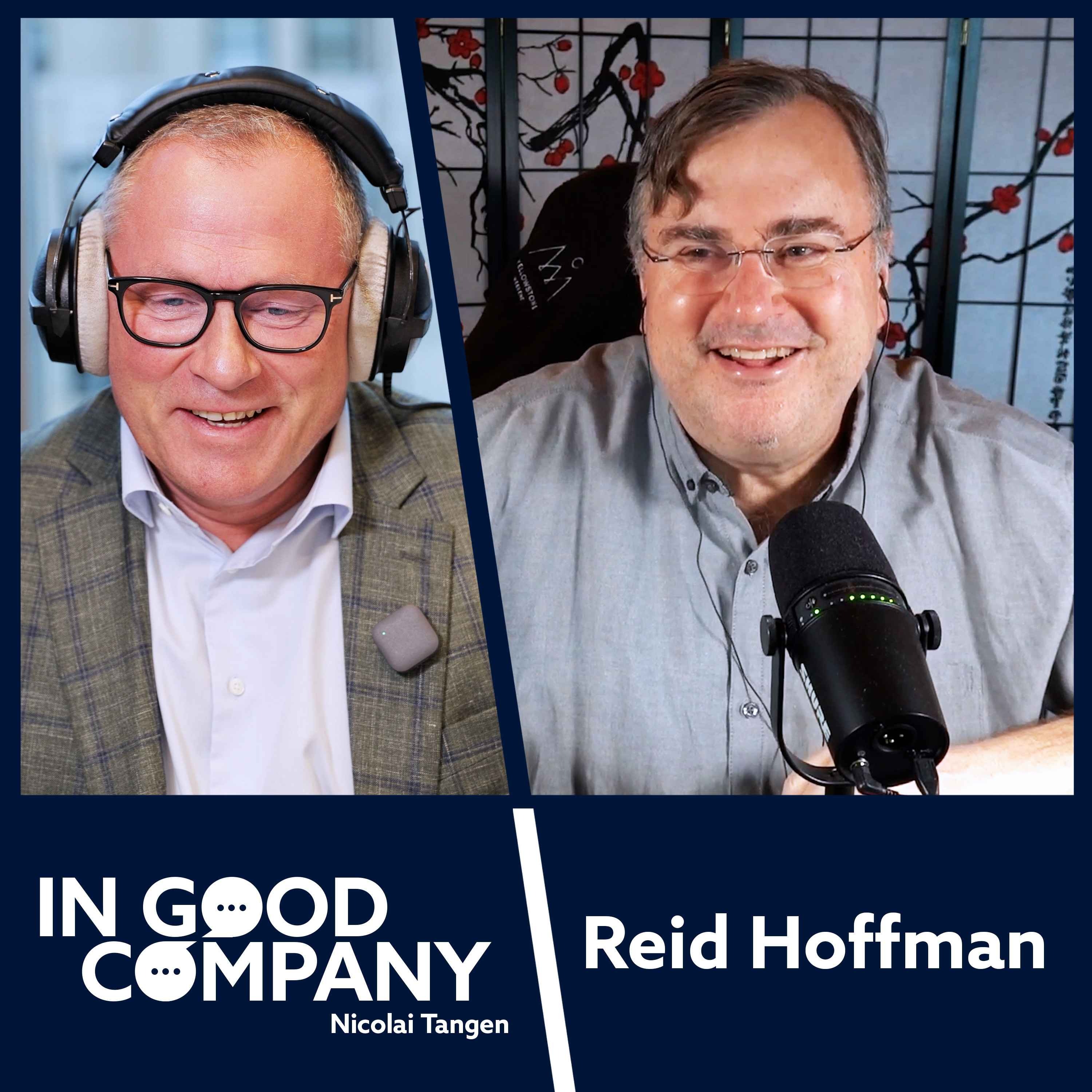
In Good Company with Nicolai Tangen
Reid Hoffman: Shaping the AI Era, Investing in Transformation and Calling on Europe
00:55:54
Loading summary
Transcript58 lines
- [00:01]
A
Hi everyone, I'm Nicolai Tangen, the CEO of the Norwegian sovereign wealth fund. And I'm here today with Reid Hoffman, who is the co founder of LinkedIn, partner at Greylock, board member at Microsoft, and one of Silicon Valley's most influential thinkers. And today we are basically going to talk about everything that's going on. AI, human potential, all the things you've been up to. Reid, so wonderful to have you here.
- [00:26]
B
It's great to be here. And you know, one of these awesome things about the modern world is, you know, here I am in Seattle, there you are in Oslo, and we can have a fully robust conversation that is not quite spanning the globe, but maybe in topic.
- [00:49]
A
Now. Reid, you've seen multiple tech cycles from web 10 to the current AI boom. Just how does it stack up compared to what you've seen before?
- [01:01]
B
Well, look, each new tech cycle and even if you do a bit of history and you kind of go back to printing press and other kinds of things as, as early versions of this is new and impressive and builds upon the old and part of the current, you know, AI just, you know, massive acceleration, much bigger than, much quicker, much larger, more impact than anything else is because it's builds on the Internet, it builds on the cloud, it builds on, you know, kind of the massive amount of data we have and the mass amount of commute we have, which then makes it possible to build these amazing learning machines. And so I think it's obviously the largest now in all large things, you know. You know, like in your industry, the discussion of, you know, is it, is it a bubble? I don't think it is. If anything, like, I don't think it's a bubble in the usual discussion of, you know, could it get to a collapse. But the impact upon all of society is probably going to be the biggest of our lifetimes. And that's presuming that you and I have at least a number of decades ahead of us. And I think that's stunning because in industry and in life and in society, I think the fact that we've now made learning machines as part of our firmament of the humanist world, the society, is landmark.
- [02:30]
A
Now you see this from both sides. Given that you're on the Microsoft board, which is like the incumbent, and then you also invest in some of the new, more disruptive companies, how does that shape your way of thinking?
- [02:44]
B
Well, the frequent way that people put this kind of conversation, is it going to more benefit startups, more benefit large companies, et cetera, et cetera. And the answer is massively all. And which one more, I don't know, but I think it's important on the, you know, in kind of the AI, you know, kind of the revolution that we're doing that we support both startups and large companies. Both of them have a, have a substantive role in their contribution to industry and society. So for example, startups can't be doing the kind of things that the frontier models are doing without at least the support of the frontier model companies. So you know, like, for example, OpenAI could only got to its position because Microsoft supported it with Compute and you know, similarly, you know, that's what's happening with Anthropic and others as it requires these, the hyperscalers and the massive cloud companies, not only in the work they're doing themselves, but in the work they're doing to support the startups. On the other hand, the kind of risk and innovation in the startups is the thing that will drive a lot. So like, for example, there's another, you know, not, you know, relatively common meme that is, you know, like, well, enterprises are trying to deploy it and they're not deploying it that well, you know, is that, does that mean that it's overhyped? And the answer is, well, if you look at small startups and the way they're deploying AI, it's magical. I mean, the speed at which you can move with a smaller number, with an initial number of employees, the way that you can empower all aspects from team meetings to productivity and all the rest is already massively emotion. And it's just the question of, well, those companies will grow and then the large companies will need to either adapt to that probably with some speed in the next few years, or run the risk of being, you know, kind of horse and buggy companies once the automobile industry starts going. And so, so I think it's a, it's a kind of an, it's a, all of it. The benefit of being on the Microsoft board is you see, you know, both what Microsoft's doing and, and OpenAI and, and you know, a whole bunch of, of the different companies that partner with Microsoft, you know, Anthropic and Code and, and all these others. And you know, by doing startups myself and through Greylock and other places, we, we can also see a number of that kind of that bold edge innovation.
- [05:15]
A
Where, where are you seeing the most kind of genuine massive transformation now as opposed to experiments?
- [05:25]
B
Well, so, so one of the things I tell people, it's probably useful here too is if you're not finding the current frontier models to be useful in some substantive way to do that, like, for example, useful in your work, not just create a sonnet for your kid's birthday or take a picture of what's in your fridge and ask for what a recipe could be, which are great, but in some substantive way that involves information analysis, research, decision support, et cetera, then you're not trying hard enough. And in fact, you know, one of the things that I think for the frontier models is if you're engaging in a substantive medical decision and you're not using, you or your doctor are not using, you know, ChatGPT, Copilot, Gemini, you know, et cetera, for a second opinion, then you're also making a mistake. And so there's all a whole bunch of substantive individual uses. I myself, you know, probably use, you know, kind of serious AI, not simple queries, not like, oh, you know, when was, you know, when did, you know, the fall, like, chart all the different. When all the different cryptos started and so forth. But like, you know, research, like light research things, but like, deep ones, like, you know, like, if I'm working on a book, like my book Super Agency, you know, what would a historian of technology give me a serious critique on what I'm doing? Or if I'm thinking about kind of the different kinds of molecules for therapeutics in Manas AI company I co founded the beginning of the year with Siddhartha Mukherjee, you know, what are the different, you know, attributes of the different kind of therapeutic molecules, you know, between the, you know, different kinds of small molecules that you use as drugs and pharmaceuticals, and what's the history of them been. And so then you can actually get pretty deep research. Now, that being said, I'd say the. The probably leading adopters are a whole bunch of stuff in coding because coding gives you a, A, engineers understand this, international adopters, B, it gives you a. It's a precision in information work that, by the way, is a. Is a kind of a foreshadowing drum to what's going to really happen in legal and medical and a bunch of other things because, you know, other areas of precision. You know, here is coding precision. Both coding precision will be used for legal, medical, educational, et cetera, but also will be the pattern by which the similar kind of precision in those areas will also be flowering and developed. So I think that's kind of where you see, you know, the kind of. The most, you know, put into work and workflow so far. But, you know, part of the reason, of course, I invested in Manas and co founded it with Siddhartha Mukherjee was because it's like, well, but there's these other areas that people aren't thinking about yet, like drug discovery. What does an AI native drug discovery company look like? That are part of the thing that I think we will also see simply amazing, stunning magic on.
- [08:43]
A
Are you surprised that we are not seeing productivity gains yet? We're not really seeing it in the productivity numbers.
- [08:49]
B
I'm not surprised yet. I mean although, you know, of course, what is that old line? I see computers everywhere but not in the numbers. You know, it's kind of like the, you know, kind of a, like there's a bunch of different things within the, within the kind of GDP side where it's a kind of an odd measurement. Now that being said, I definitely see it in all the startups and I think what's in part happening is companies figuring out what to do. Because most of the things like the classic way a company experiments with and builds technology is they go, okay, this, this group of, you know, three, five, ten people are all going to go do a little proof of concept and we're going to see what comes of that. Well, AI can work in some of those areas but you have to be selective of what the project is. So for example, if your project is, and this is one of the things I think, you know, call it within, you know, 2ish years it could be 4 to 5, but it could already happen. Now is any like basically every organization should be saying we're recording all of our meetings and we're running an AI on the, on the recording of the meeting, not just for the transcript but also to do all of the suggested follow ups. It's like, hey, did you, you, you mentioned this. You should probably, you should probably let Nikolai know and make sure that that's the case or you know, you should make sure that you get approval from Satya on the following thing or this other group is doing this. Like all of that kind of thing is a already like the technology is there to go. You should already be doing it. I'm doing it, you know, you know, work groups should be doing this and yet most companies aren't doing that. There isn't a massive acceleration in terms of speed, information, risk analysis, you know, updating communication functions, you know, and a whole stack of things which would then begin to get into the numbers in any industry. And that's the kind of thing that I think we, you know, like as opposed to a proof of concept, just start doing all the Meeting stuff or both.
- [10:56]
A
What do you think are the biggest hurdles that you see for large organizations trying to integrate AI effectively?
- [11:04]
B
Well, typically most large organizations for, with a rational basis kind of start with a like risk first, you know, avoid downside first, gain upside second. And part of the reason is because a large organization usually has a whole bunch of assets, not just brand market position and capital, the way that's developed over the years and decades to be efficient and have a market position and so forth. And so it has a position to say, hey, don't take risks on these things or choose these risks very selectively. But that leads to a general. And that's part of the reason why you tend to do a proof of concept as a little thing on the side that leads to a, like, don't introduce anything until you've run all the risk to zero. And one of the things that with AI is it will say, well, hey, there's a bunch of unknown risks here. Like for example, we're doing the meeting thing that I'm talking, that I'm talking about, well, what happened if we have all these transcript meetings? Is that going to increase legal liability? Is that going to increase information bleed and flow and you know, might some of this information get outside of the enterprise in a way that's concerning. And we worry about these probabilistic machines, like do the probabilistic machines misconstrue something and then that, that, that causes an error and you, you can list all the different errors and you go, oh, we should make sure all the errors are brought to zero before we do anything. And you're like, well, that's a little bit like saying, you know, I'm going to, you know, drive from Oslo to Trondheim and I'm gonna, I'm gonna, I'm going to get all of the, I'm gonna eliminate every risk before I get on the road. And you're like, yeah, it's not going to work. You'll never, never going to get on the road. And so I have to say I'm
- [12:57]
A
pretty, I have to say I'm pretty impressed by your local knowledge here. Have you actually, have you actually driven there?
- [13:02]
B
I have not. But it is on my bucket list to come to Norway not just because of northern lights, but the fjords and all the rest. So I know a little bit about Norway's geography. A friend of mine is, is a Norwegian born and has been talking to me about sailing in the fjords for at least two decades.
- [13:22]
A
Very good. Now I do think it's interesting because it's the first time I've seen the potential for compliance officers to kill the companies, you know.
- [13:30]
B
Yeah, no, exactly. And it's one of the things where you gotta go, look, is this really a risk? Not could there be something or would there be a bad press article or something else? But it's like, is it really a risk? Because if it's not really a risk, like deploy, iterate and learn, right? And so like, I actually think like it's literally the real question is just when do we get to where it's considered to be weird? When you're not having an AI in the meeting, helping you with the various aspects of the meeting. Because like, you know, part of what we find in the venture community at, in Silicon Valley and in Klock is that we record these meetings all the times now because it gives us a set of notes, it gives us easy follow ups, it gives us something that we can run through AI to say, hey, can you do research on these questions, right, that we, that we came up with? You know, because you know, part of what, like, like if people, if this is news to people, you're not using AI enough, which is one of the things we do right now, is you can trade off, call it minutes of compute to instant research, like very, very different than what you get from a Google search and so forth. And so you go, okay, you know, I'm really interested in, you know, what is the pattern of data centers going to evolve and you know, kind of energy ecosystem and green energy. You can very easily set, you know, the AI deep research queries on this and get some really good answers. Not perfect, not necessarily errors, but really good answers, like beginnings of answers in like 10 minutes. Because it does like 10 minutes, 15 minutes of compute and does that. And by the way, part of what the frontier models are developing is they're developing the capability for this to work coherently in compute for hours to get to result. And so like, for example, you know, some of what my team does, like for example, where I have a podcast called Possible, and we've released Possible in French because we basically had AI kind of do all the translation and compute and he sets it on the evening, goes to bed, he sets it going in the morning and in the evening, goes to bed, gets up in the morning, checks it, sees which things need to be fixed, et cetera, et cetera, this is going to become part of a work process. And so having compute, the amplifying of our labor is like it's here now, it's one of My favorite science fiction authors, William Gibson wrote Neuromancer and others. One of his quotes that I really like is the future is already here. It's just unevenly distributed.
- [16:17]
A
Well, you have a lot of the future where you know where you live. And also in Silicon Valley. Do you think that dominance is under threat, for instance, from immigration policies and so on?
- [16:31]
B
Well, for sure. I mean, look, one of the things that is. There's multiple things that are crazy about the current administration's global relations. You know, one is, you know, the US Is a country for every decade, built on being the best superpower for immigration in the entire world. It's part of what's gotten the U.S. to where it is. And Silicon Valley is a microcosm of that. I mean, how much of Silicon Valley has been built by, you know, immigrants from all over the world, including both Western and Eastern Europe? Like a lot of very smart people coming to Silicon valley in the US from there. Also India, you know, also China, etc. So the immigration is one. But the next, of course, is that part of our ability to have global industry is because we have very good global relationship or have had good global relationships that has been, you know, kind of most catastrophically damaged in the entire history since World War II by this administration. Right. I mean, they, they going out and saying, you know, give us your lunch money or we're going to tariff you as kind of a bully tactic on this kind of stuff is, is. Is terrible ways to deal with partners, trading allies and other things. And so that's another area of, of, of significant damage. And so, yes, I think there's some of the areas that we've had as historic strengths are under extreme challenge. Now, that being said, part of what I want Europe to do more of is to get more into the technology game. Like, one of the things I've told various, you know, you know, I, I take trips through the UK and France and Italy and other places, and I say, look, getting in the AI game directly is important. Let me give you a European metaphor, which is, I'm using the word football in the European sense, not in the American sense, which is if you think of a AI as a football game, World cup match between the US And China, and what Europe tries to be as the referee, there's two problems. One is the referee never wins, and two, no one really likes the referee. So you gotta get on the pitch, right? You gotta be doing stuff, and it's really important. And they say, well, we're behind and we don't have the Hyperscalers and computers, like, well, do deals with the hyperscalers in order to get compute.
- [18:58]
A
And there's Sarid. What would you do specifically? So now I give you. So now I'm, let's say now I don't know who I am, but I am somebody with a lot of power. And I say, hey, can you fix Europe and AI? What do you do?
- [19:11]
B
Well, it's work. It's not easy. One is I'd say go do deals with the various companies at hyperscalers that can build a bunch of compute. Those deals don't necessarily require money. They could just be here. Like we have facilitated a bunch of energy, data center permits, ability to build stuff, to be able to build your business here and build these data centers. In return for this facilitation, we want to make sure that you are enabling kind of European companies to be able to access that compute either in building new applications or inference for deploying them. And in return for that, we also want you to make sure that some of your AI technology that if you happen to be building it is also deployable in a kind of a good way within the European sector. And you say, well, but that's still a bunch of US technology. Of course you're going to have a bunch of US technology, not just the least of which is like the semiconductors, the chip infrastructure, because Nvidia obviously, but then TPUs and other kinds of things as ways of doing this. But there's a tremendous amount of value in the applications. There's a tremendous amount of value in like, where do we bring our kind of areas of competitive advantage? Like, for example, if I was being a European entrepreneur, I'd say, well, one of the benefits we have of centralized medical systems is we can use that centralized medical system to build a whole bunch of different unique medical applications. And we should do that and we should dominate that not just within Europe, but globally. I mean, one of the things that, you know, most often is the mistake in how European governments say, well, we just need to have a European one. You know, just we, we just need to have an Austrian one. And it's like, no, no, no, no. Technology industry is strongest when it's global. So you want to say which are the ones that we can build that are global, which are the things that are like Spotify, like Aden, like, you know, et cetera. And how do we get those kinds of things? Because, you know, here are some. And how do we have a, like kind of global competitiveness with the edges that we have here? And I Think that's the kind of thing that I, you know, basically every, every, every you know, European leader who reaches out, I try to help you.
- [21:33]
A
Continuing on the, the topic of ramping and scaling, you, you wrote the book on, on blitzscaling, right? And does that playbook work for, for AI where the scarce resources are GPUs and, and electricity and not users?
- [21:51]
B
Well, it is actually centrally like I think if anything the AI. So first backup. So for those who don't know, the reason I wrote this book, Blitzscaling, it was kind of like what is the lessons I learned from how Silicon Valley builds the technology companies of the future? And if you take the greater Silicon Valley area, like the entire Metropolis area, it's seven plus million people. And that's not all in the tech industry. That's just, you know, in like everything in the Bay Area, which is, you know, a little over twice the size of Ireland. And why does more than half of the global NASDAQ come out of Silicon Valley? And there's a whole set of different things, immigration we mentioned before, but one of them is it's this learning about how to build the technology companies to create the platforms, the networks, the, that the kind of the global technologies of the future through these companies. And the answer is blitzscaling. And the two places in the world that I see demonstrate blitzscaling in really robust general ways are Silicon Valley and China, which is part of the reason why the two technology hubs. And so it's like, look, the more that we have, especially in Europe, but like in the rest of call it Western democracy world of, of ability to build places like Silicon Valley and to have tech center innovations, I think the better off the world is, the better off even Silicon Valley is. So that's the reason why I wrote it. Now if you look at what's happening with and the precise definition of blitzscaling is taking the risk of going big in an environment of uncertainty. Right? That is exactly what's happening with AI. Like if you look at, you know, the discussion around AI bubbles and like, well, we have such conviction that large scale training is going to build such interesting learning machines that we're investing like, I think it's roughly like $60 billion to get a gigawatt of compute to do and you know, we're trying to get from multiple gigawatts in multiple companies to, to be able to build this stuff in a way that we can then deploy it through other gigawatts of compute in inference because this will have such a elevating effect to everything that we're doing in. Think of it as, you know, work, life and society. And so. But yet, you know, it's like, well, you know, we see OpenAI making some money and we see Anthropic making some money, but, like, is there any of the rest of it? And that's exactly what Blitzscaling is. So that's what we're doing now. There are, you know, there's limited numbers of GPUs that are growing as fast as they can, there's limited data centers growing as fast as they can, and there's limited energy. And, you know, interestingly, energy may end up being the weird once again, almost back to the days of oil, the geopolitical issue that really, you know, kind of puts all this stuff together. But by the way, of course you also need data and you need talent and critically, you need a loop of adoption. And all of those things are part of what, you know, kind of makes the AI revolution. So I think the Blitzscaling is frankly, I'm thinking about writing some of this up in the next couple months is Blitzscaling is. There's specifically like, all of the rules in the Blitzscaling book are being applied and there's more that are being developed and added.
- [25:23]
A
Another thing you talked about is the kind of the splinter net, the fragmentation of the Internet. How are we seeing the same type of developments happening now in the AI world, that is the race between the US and China, mainly?
- [25:38]
B
Well, there's this whole question around. Generally speaking, it's good to have kind of just like a global trading system and a global communication system, a global telecom system and a global transport system. There's good to have a lot of stuff that's global. And of course, you need to balance it out with various issues of national culture, control, sovereignty, et cetera, as ways of doing it. And the natural instinct that most people have given how important the Internet and digital is, is like. And very few do it other than China, is to kind of say, well, I have my own, and it's kind of federated. And so I think that that the kind of splinter net, there's still a lot of tensions heading in that direction. It's again, I think among the problems that the current administration is creating for the American people, American industry, because, you know, I think they're, if anything, they're accelerating that. You know, like, you know, the tariff policy is a good way to try to incent other people to trade with China versus the U.S. i think that's a. That's a deep danger and, and then similar on the kind of the Internet side. So I think that's important. Now that being said, roughly speaking, the things that are successful within global platforms are the things that get the broadest possible base. So one of the reasons why, you know, AI tends to be most naturally trained out of English versus call it any of the other Western languages is because the vast majority of the content that's in the data, everything else allows that to happen. And matter of fact, when I was on the OpenAI board and got early access to GPT4, one of the things I did as kind of an experiment is I had GPT4 write some poems in English, then write some poems in Hindi and then write some poems in English and translate them into Hindi. And then I went to some of my poetically minded Indian friends and said, okay, without a kind of blind taste test, which of these poems are better? And all of the poems, literally the top half, were the one that written in English and translated to Hindi because of the ability to have that language generous there. And so that's going to be one of the things that as we get to the Splinternet is going to say, well actually in fact, we're going to have to rely upon the languages for the inference engine. Everything else that have the vast majority of the data for the training of these things doesn't mean that we can't ultimately get to a Norwegian system, a Swedish system, et cetera, et cetera, but it's going to be to get the high quality system, you're going to start with some of the inferences. Now in a classic European thing you say, well, you don't have to just do English, you can do English and Chinese and a few others and we can be pluralistic in how to do it in case there's any latent, you know, kind of cultural biases and so forth, to try to be kind of a little bit more of a pluralist understanding, which is one of the things that I love about what Europe's been doing in, you know, kind of the post World War II era. And that could be something that is, that is a feature rather than a challenge for what's going on. But you know, you have to kind of navigate those things. And so I think the tendency is the splinter net will still be there, but need to be resisted substantially in at least some vectors.
- [29:05]
A
When you look at the amount of capital flowing into data centers and chips and energy and the circularity and the new kind of debt issuance and so on, what are your Reflections when it comes to the speed of the development here.
- [29:22]
B
Yeah, so it's a natural worry to say something like Nvidia invests in a company, puts a bunch of money in the company, the company then buys more Nvidia chips. And then Nvidia invests in other countries that buy more Nvidia chips. And this would be a classic bubble if the only use of those Nvidia chips was doing things that didn't have kind of call it were separate economic productivity. Like if you didn't have this view where like part of what I think is coming with AI is we're going to get intelligence with the scale and 24 by 7 availability of electricity. So intelligence is going to be as available as electricity. Well, that's from these compute centers. And so the fact that they're building all this compute isn't like its own little isolated bubble, it's going to collapse. It actually is creating the compute infrastructure that we already see even in these very early days, a tremendous amount of demand for. Because like at a company like Microsoft, you know, each GPU is kind of being allocated between like inference where customers want it because basically it could sell everything to customers. Two is in internal groups that want to do R and D themselves in building it. And three, you know, it's kind of like groups that want to do, you know, like deploy things in terms of their products. So you, you've got, you've got, you've got all, all these computing competing for it. And so even if you suddenly ramped down the training speed a great deal, there would still be a lot of economic demand for the commute. Now a little bit of how I think about this is it's kind of, I don't think the AI bubble as getting to a collapse is you know, is actually in fact a real worry. The AI bubble leading to potential pricing corrections is definitely of course possible because you go, well, but look, look at the astronomical prices. And, and so when you say well, but actually, in fact, you know, like if you created a data center for call it $60 billion, you know, you're still going to run the data center and you can run it profitably, but you may not run it profitably from a cost basis of $60 billion. If all of a sudden, you know, like, like the, the, the level of demand takes the premium off it. Right. There could be that as a, as a risk, but that's not a bubble correction. That doesn't create the kind of contagion and debt and banking and other kinds of things that People most worry about with bubbles. And that's the reason why I'm, I'm, I'm, I'm not that concerned with the current worries about you know, is it circular round trips or other kinds of things? Because what I actually see it as kind of a evolution takeoff to getting a compute infrastructure there that we have intelligence available essentially with the same scale and an always on availability that electricity
- [32:32]
A
has related to this. What do you think the primary computing device will look like in the future?
- [32:43]
B
I'm not sure.
- [32:45]
A
I mean the kind of stuff that Johnny I obviously working on.
- [32:49]
B
Yeah.
- [32:50]
A
Is working on some things. Have you, have you had a look at it?
- [32:53]
B
I haven't. The Johnny I've got purchased in the company after I was on the board. The like it's a little bit of kind of like classically with technology is like will there be something that surprises you? The answer is absolutely yes. Can you predict the surprise? Much harder and an easy way to look foolish. I do think that there's a real value in all the scale compute that's going on. So the fact that there is a tremendous amount happening through massively centralized data servers is I think a continuing trend. Now that being said, you know, like for example, take a little bit of what the electric vehicle revolution is. Electrical vehicle revolution is not just electric and you know, the green, all the rest, but it's also putting a data center with sensors on wheels. And that data center with data center with sensors means all kinds of things. That doesn't mean autonomous vehicles, but also means a much more real time map for mobility, emergency management, a bunch of other things that are all there. I mean imagine for example, you have a whole bunch of autonomous vehicles and you need to get the emergency vehicle through. Currently if it's got gridlock on a highway, you just kind of hose drive on the side, the side of the road, side streets, et cetera, et cetera. You literally could go AVs, you know, clear the way and they all kind of go okay. And they clear a channel and the fire trucks can get through, the ambulances can get through, you know, et cetera, et cetera. And so you know, this is all part of all of that part of revolution. And of course that will have a lot of local compute and local compute areas. Now I guess what I would say is I think it's too early for the whole glasses revolution being the next social thing. I mean variety of companies are doing some pretty interesting work there. I don't know about these pins and other things. I mean the classic thing tends to be is, hey, if it works pretty well with your phone, we're all pretty acculturated to the phone, right? So, so what does that mean exactly is kind of an interesting question. I do think that the notion of like an always on AI assistant for all of us is just a question of when and how then, then if. Because you know, the kind of like, for example, I don't know if, if your listeners track the fact that, you know, I'm one of these people who made a digital version of myself read AI and demoed it in various ways. And part of what I was doing that is because normally when people talk about deep fake, they, they tend to say, oh, that's just bad. It's like it's imitation. It's gonna be used for like cyber hacking and phishing and, and political misinformation, by the way. Those are all legitimate issues, serious ones. But I was like, okay, let's play with it. Because there's always something we can steer towards that's good. And one of the things I realized by creating read AI is that it's a small number of years where like voicemail goes away. Because what happens when, when, when someone calls Nikolai, Nikolai, AI answers and says, hey, you know, and then it says, oh, it's read. And oh, this is really important. Let me see if I can interrupt him. Hold on, let me get, I'll get like, hold on a second. Let me say. Oh, actually he's in a board meeting right now. Can I take a message? He'll probably be able to call you back. I don't know, seven o', clock, eight o'. Clock. Would that work for you? You know, that's what it's going to become, right? As part of it. And by the way, part of the kind of the, the digital avatar version is it's the representation of you in terms of how you're doing it. And so that's part of what I think is saying. And that will also be edge compute. And so you're asking what are the AI devices of the future? And it's kind of like every single device that has anything of compute capability will start adding AI to it. And some devices that don't currently have compute capability will have compute capability added into them in order to do it. Like, for example, you can imagine, you know, pretty easily like washing machines as part of being green and saving electricity. You kind of say, hey, just set it up to run when the grid has already got a, you know, has already got a surplus of energy. And so I'm being green about, you know, using energy that that is otherwise unused and not creating the spikes that cause the whole expense of the. And then you'll have, you know, simple compute in your washing machine and dryer, you know, as, as instances of doing this. So anyway, so like I think perhaps the answer is actually everywhere as I think about your question.
- [37:26]
A
I think it's just so much fun to be alive.
- [37:28]
B
Yes.
- [37:29]
A
So exciting.
- [37:30]
B
No, yes. No, no, it's, it's. Look, we're, we've created the most amazing technology in human history. More better learning device than the book. So now of course it builds on them, but it's just, it's you know, like for example, people like to talk about, and I think this is mostly just people who misunderstand, like, oh, is there's going to be a huge spike in energy because of use of AI electricity and is that going to be a climate impact? And the answer is, well, if you're using intelligence, you can use intelligence to, to, to mitigate climate impact. And, and so as long as you're using some of this electricity, AI electricity for, for being smart about the climate, you're going to be a net benefit. And as a tangible example, Google, which runs some of the best data centers in the world, when they applied their AI technology, figured out how to get savings of 40% in their data center. And that's not going to, you know, these old inefficient grids and all the rest of this stuff, which would be a very natural way to really get a lot more energy efficient using intelligence.
- [38:37]
A
Reid, let's change tax area a bit and we'll put a little jingle here so that people understand that actually we are moving slightly turn on the side here. Now you are, you've seen so many entrepreneurs in your life. What are the common characteristics of growth? Great entrepreneurs.
- [39:02]
B
One good thing for many entrepreneurs is there isn't just one archetype, right? Since you know, again we're talking European, you know, there may be multiple Jungian archetypes for this and, but you know, important characteristics are to be super ambitious, right? If because you don't shoot for the stars, you don't even get to, you can't get to the moon as a way of doing it to be both like, like kind of believe in, you know, that kind of huge outside capability, but also learning and adjusting. It isn't believe against any data and belief, but it's like it's a, hey, I think I can do this. Because you know, one of the definitions of entrepreneurship is your Plans outstrip your current resources because almost by definition, that's true for all entrepreneurs. Every stage along their entrepreneurial journey, they have to be able to take risks smartly, frequently. You know, the issue is like, oh, just take risk. Like, no, no, no. Like, like risk blow you up all the time. But there is no entrepreneurship without risk. It's one of the challenges with a general European framework because they say, well, we want to minimize risk because we really like the stability of what we have. And you're like, well, but there is no innovation without risk and there is no innovation without making errors. And so you have to allow errors and risk and you correct for them. Right? You don't, you know, it doesn't mean you allow them forever, but you kind of, you, you go out and you play it. So that has to be another thing they're capable of. Another one is you have to be able to learn the journey. And the learning the journey is lots of things. It's like, it's, you have a, you have a product or service idea, can you assemble talent? Can you assemble capital? Can you do the initial things to get your business together? Can you then be growing and scaling your company, which means scaling the executives and scaling yourself, you know, and doing all of that? And, and that kind of, we have this, this phrase in American English, multi tooled athlete is really important. Now part of that for an entrepreneur, whether she or he is doing this, is to be kind of like, okay, that's not my tool, but I can hire someone who has that tool. Because you're assembling like, part of it is entrepreneurial companies and entrepreneurs launched through networks. It's one of the reasons why, like, I helped set up, you know, kind of this program called Silicon Valley comes to UK because it was like, you know, bring the Silicon Valley network and learnings into the uk and we've done that occasionally in other places to Japan, France, other, other places. And it's the, because we want more of this kind of understanding. But you need that kind of, not just with the founders, but you also need it with the executives and early employees and much of other things in order to play that out. And the, the, the founder needs to be, you know, kind of knowing that that's what they're looking for, that they're always trying to assemble the strongest possible network to realize this vision that is evolving and changing as the market changes and as scale changes. And so that's the set of attributes you want. But sometimes, by the way, like, and then you get to, where are the Places you must have a complete edge. Well, some industries, like, you've got to be a really good salesperson, Some industries you gotta be a real good finance person. Some industries you have to be a really good engineer, Some industries have to be a really good product person. And one of the things I look at when different, you know, companies is, is this person a fit to this problem now and as it scales. And so, like, for example, one of the kind of aphorisms that tends to circulate around Silicon Valley is, oh, you want to invest in people who started coding before they were 12 years old. And by the way, that's a good sign for they're deeply immersed in software, they have reflexes, software, tech. They understand it, they understand kind of what the different patterns are and how they're evolving. But like, for example, Brian Chesky, the CEO and co founder of Airbnb, is not that he's a design person, but so, you know, classic, that's a classic aphorism. There's a lot that's good to it. But I look at Brian, I go, he's perfect for Airbnb because he's approaching the marketplace, the experience of travel, the experience of staying somewhere, the experience of hosting somewhere as a design thing, where he comes from risd. And the design attribute is actually, in fact, the right attribute. So it's kind of different sets. And that's part of the reason why not just different fitness functions, but different kinds of ways of entrepreneurs are, are better at different kinds of businesses. Some are very good at enterprise and others suck at enterprise. Some are very good at consumer and many suck at consumer. So it's kind of a different set of configurations.
- [43:45]
A
So now you sit in your Greylock office and in I come. How long time does it take for you to decide whether I'm worth packing or not?
- [43:54]
B
Well, it depends a little bit. Ideally, like I did with the Airbnb folks, I had reference checked them before I met with them. So I interrupted them, I think it was a few minutes into the pitch and I said, I'm going to make you an offer to invest. Let's take the rest of this pitching session as a work session and let's, let's work together on this stuff. So you get to see me, I get to see you. We can see if this is a good match. And it's one of the reasons why, you know, they, they declined a financing offer that was twice my valuation in order to work with me, because they said, hey, this is like, he is actually helping us solve these problems. That's actually, in fact, really valuable. So that, you know, can happen. Airbnb is an example. You know, Zynga, Facebook, you know, these are other companies that I, you know, basically made an investment decision in the first minutes in. Sometimes it takes days. Because sometimes you've got a sense of, okay, I need to reference check afterwards. Sometimes it's, okay, I wonder what the competitive landscape looks like here, or are there other people developing technology like this? Or do I think that this technology will bear fruit at the right sequence? Because usually the, like, the ideal thing in a venture investment is for my kind of style is at day zero, it looks crazy. Like, some of my partners thought Airbnb was crazy. At year two and three, it looks feasible. And year five, it looks five to seven. Looks obvious, right? Is kind of the. Is kind of. And so you go, okay, well, that's your time frame for the evolution. Now, occasionally it's longer. Like, one of the Greylock investments is Roblox, and that took longer. You know, it does happen, but it's like that's kind of a classic time frame. And AI is obviously compressing this in some ways. So this is a pre AI kind of heuristics and timeframe.
- [45:51]
A
Now, you said that it's more damaging to pass on a great investment than to back a poor one. And I guess in the old day, it was about protecting your downside. Then in the venture capital world, it was about not missing out on the big thing. But it seems like the whole world is now moving into the VC way of thinking. We must not miss out on the next great thing. But instead of the tickets being a million dollars, they're like $500 million, right?
- [46:14]
B
Yeah, exactly. Well, it's still true that on the venture world and generally speaking, investing in tech, if you can get into some of the great ones, that's all that matters. And missing one of those matters a lot more. Now, that doesn't mean if you're presented with 20 investments and none of them are the great ones and you put all your money into that, then it's not going to be horrific for you, right? You have to get some of the great ones. Like, the corollary to that statement is if you're not getting some of the great ones, better not to play at all, right? And so, and that's one of the reasons why people tend to, you know, a lot of capital goes towards open AI, goes towards anthropic, you know, goes towards, you know, the ones that they go, well, these ones, I think, are very, very likely to work, you know, kind of as a direction. And so, but I think, so I think it's still the case that it's, you know, like, if I think this could be one of the great ones, then I tend to have to talk my way out of investing, then talk my way into investing. But the, but the challenge of that is that, you know, you have to have a pretty good sharp edge about. Is it really possibly one of the great ones? I mean, like, more or less, like, you see all kinds of silly stuff where people talk themselves into things where you're like, no, like the universe in which that's one of these great tech investments is kind of the universe in which like, you know, 30 volcanoes in the, in the world go off at the same time. It's not impossible that that happens. Oh my God, it's a totally different world. And so, and so you have to have a good sense of is it actually, in fact realistically possible? And if so, then with some energy on it, because the vast majority of companies obviously fail and the vast majority of companies do not become industry defining, transforming companies.
- [48:13]
A
And the vast majority of venture capital companies don't make particularly much money. But a few at the very top make a heck of a lot of it.
- [48:21]
B
Right? Exactly.
- [48:22]
A
Because they get the first pick. I guess the main issue, or what
- [48:26]
B
is the main issue? So McKinsey did a study couple decades ago, and they found that what happened is the top tier Silicon Valley venture firms, they didn't deliberately, they don't directly collaborate with each other, but they tend to signal and draft off each other. And that's one of the things we're identifying the really top companies and top teams. It's again, one of the ways to analyze Silicon Valley investing is through networks, networks entrepreneurs, networks of executive talent, but also networks of angel investors and networks of venture capitalists. And it's a network.
- [48:58]
A
Tell us about your PayPal network.
- [49:01]
B
Oh, right. Well, so I. Thank you. I usually refer to as PayPal network, as, you know, most people refer to as PayPal mafia. It's like, it's not criminal. It's a network. The. So one of the things that made the PayPal network so noteworthy is PayPal sold to eBay in 2002, which was kind of the, you know, the kind of the. At the kind of the, you know, kind of the mid to kind of two thirds of the way through the Internet winner, maybe Midway. And so you ended up with all these people who had some money and believed in the Internet and would go and create new companies. LinkedIn, my own, also YouTube, you know, Yelp, whole number of different companies got created in this time and then the ability to do angel investing in a variety of these, in a variety of these companies. And that was part of the reason why it was viewed to be such an awesome network. Because what we would do in, you know, 2003 is we'd be calling each other saying, hey, did you see this? You see this company? This project? This looks really good. It could be one of the things that's really good. You know, that's part of how, you know, I reconnected with Chad and Steve at YouTube, you know, and other things. And that's part of what made, you know, kind of so many good companies coming out of that initial group of founders and investors from the PayPal network. And I think they, you know, the, you know, it's one of the things that has now been, because these get learned in Silicon Valley is that part of what happens is, you know, venture capital firms go and look at and they say, hey, you know, will this company X, you know, say roblox be a generative thing of a bunch of new people coming out? And which I should, I should go see which of the people who are going to come out of that and be the next generation of founders and so forth, and, and I should go research them. And that's another of the learning loops in Silicon valley. So anyway, PayPal was one of the early icon ones.
- [51:03]
A
If you were to look at your most successful investments, PayPal, Facebook, Airbnb and so on, what was it that you saw that other people didn't see? Is there a general theme?
- [51:16]
B
Well, I'd say broadly, including LinkedIn, of course, in this entrepreneur is I saw why a number of smart people would think it was a dumb investment, and I saw why I thought I was right. So it's the contrarian and right thing. So, you know, in the case of LinkedIn, everyone thought there was no such thing as a professional network. People wouldn't put their, you know, their CVs online. There wouldn't be a utility of collaborating with people other than currently in your company, et cetera, et cetera. And so that, you know, that was a LinkedIn thing and you could never get the network to scale to do it. In the Facebook case, people said, oh yeah, there's a lot of activity, but it's all college students and they'll never be money. And college students. And sure, they'll the, you know, the amount of pure raw generation of time is important, but for college students who's going to pay for it? The advertising market's not very good. College students aren't going to pay. Business model is bad for Airbnb. It's, oh, it's really strange that, you know, that you're going to rent a room or apartment or, you know, or a house from a stranger. And what is the trust? How do you build the trust and how does that happen? And you know, part of the theory there is actually, in fact there's such demand for better, more unique experiences than hotels and at different price points and different locations. And it enables a network of entrepreneurship in the hosts for doing it that that will actually evolve to a kind of product that then becomes a brand name like Xerox or Kleenex or that kind of stuff in terms of how it operates because people now refer to as an Airbnb as a, as a way of doing it. Zynga is like people actually want to play casual games with each other. Gaming is not just a, not just a hardcore, like people say, well, no, no, this is a halo and a, you know, in the hardcore gaming. No, no, there's this new category of games that social networks enable for, for, for how it is. And you basically go through, you know, almost all of my investments and it's that, oh no, no, here's why a bunch of smart people think it doesn't work. And here's what I betting on that does work. Now, by the way, some of my failures are in that too, because my bet was wrong. Right, but, but that's the, but that's the thing that leads to the, you know, industry transforming successes.
- [53:35]
A
Given all that and given all your experience, what is your advice to young people?
- [53:40]
B
Well, the longer version of it is my very first book is called the Starred Review, which came out of a commencement speech I gave to my high school. So it's precisely, it's take all the entrepreneurial lessons that I learned from Silicon Valley because by the way, I think we're all becoming need to be much more entrepreneurial in times of disruption. Doesn't mean you need to start a company if it's right for you, great. But only a small number of people should start companies. But you have to lead your career in a much more entrepreneurial way as opposed to the, oh, I go apprentice at IBM, then I work my way up career ladder of Type X within the company and then we get a job at another company and so forth. And that's. But it's like industries are changing, job tracks are changing. You know, what is a marketer going to look like in five and 10 years versus what a marketer looks like today. Given AI, it's going to be totally different. So you have to be entrepreneurial and learning and using the tools. And so that's part of the, the kind of the startup view and entrepreneurship of which there's a lot more depth in the startup view. But the central thing, of course, is the like, one of the things for the next X years that young people should pitch firms on is I'm a native AI user. You need to be AI transformed. Here's the way that my experience with AI can come help you and your organization. Right. And I think that's a very important thing to do because all of these companies are going to be looking at these going, shit, we need this transformation. Who is AI native? And one of the things I gave this talk in Bologna a couple years back is, you know, you guys are generation AI. That's the thing you should be leaning into and deploying for your path to work and life success.
- [55:21]
A
Good advice to generation AI.
- [55:23]
B
Yes.
- [55:25]
A
Reid, you kind of feels like part of generation AI as well. So it's been just tremendous to talk to you. Wow, what a story. What an experience.
- [55:33]
B
Just I think we can, you can opt to join it, which I'm trying to. I try to, you know, I try to use AI in new ways every week.
- [55:41]
A
Absolutely. Well, I have, I finished my name with AI, so I'm kind of part of it.
- [55:45]
B
Yes. But big thanks.