← In Good Company with Nicolai Tangen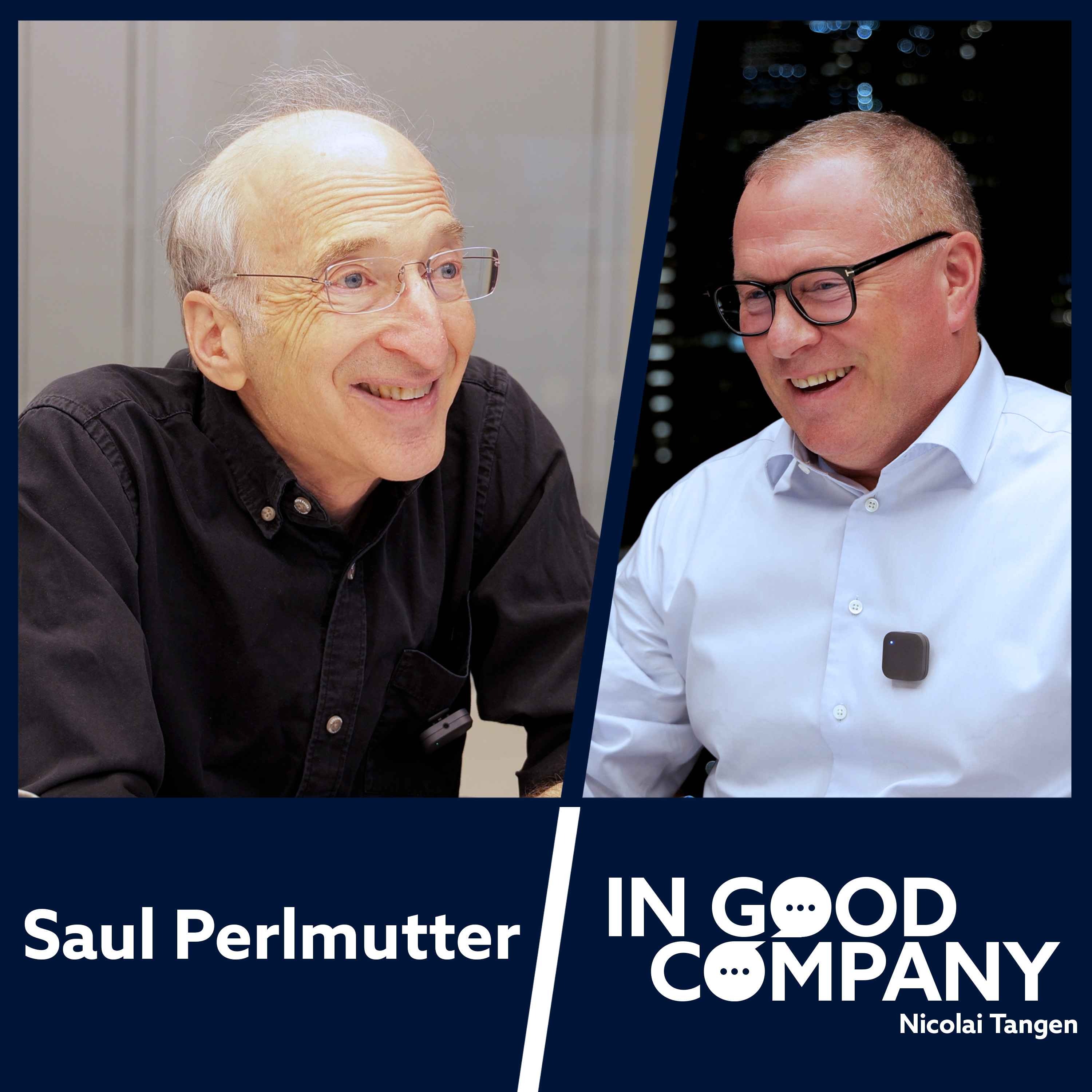
In Good Company with Nicolai Tangen
Saul Perlmutter: The Accelerating Universe, Doubt as a Superpower and the Science of Collaboration
01:00:32
Loading summary
Transcript158 lines
- [00:01]
A
Hi, everybody, and welcome to In Good Company. I'm Nicola Tangen, the CEO of the Norwegian Sol and Wealth Fund. And today I'm in particularly good company with Saul Perlmutter, who I would argue easily is the cleverest person we ever had on a podcast because Saul won the Nobel Prize in physics for discovering that the universe expands at an increasingly rapid pace. Now, you also written a book called Third Millennium Thinking, which teaches us how to use scientific method in order to navigate this increasingly uncertain world. So, Sal Big, welcome to this podcast.
- [00:34]
B
Thank you. It's good to be here.
- [00:44]
A
I thought we could start with the book and kind of the scientific thinking. So what is Third Millennium Thinking?
- [00:50]
B
Well, it's a bit of an odd name because what we really want to capture is the direction in which we think. The best of our scientific style of thinking has been helping our whole society be able to do better in working through problems together. And we want to try to capture what does that really look like so that people can realize that there's so many elements of it that they could all be using in their day to life and also they could be using when they're talking to other people and working out problems together. And in some sense, I'd say that we've learned by now how to solve really dramatic problems and difficult problems and interesting problems in the world. The one that I feel is the leftover problem that we can make a huge difference if we can solve is just how to talk to each other, how to work problems out together so that we can actually use all these other techniques that we've learned.
- [01:38]
A
Because the first time I met, when we spoke, you said, you know, Nikolaj, we can now solve all the problems in the world, you know, climate, how to feed people. But we don't manage to because we don't talk to each other.
- [01:49]
B
I mean, it's remarkable. I think we actually live at incredible moment in history and prehistory and in fact, maybe even cosmic history, where we are the first generations on this planet who have the ability to solve planetary sized problems. I think the idea that there could be a pandemic and we actually know what to do about a pandemic. We have billions of people living on the planet, many more than when we were children. And at the time when we were children, most of the world was going to bed hungry. Today, that's a very small percentage. And we now know how it's possible to feed a planet. We could even handle things like climate. Changes that have happened throughout history have wiped out civilizations at different points in different ways. Today, for the very first time ever, we know how you could stabilize a climate and that we can actually manage that we could even manage the, you know, the thing that killed the dinosaurs. The possibility of a comet or asteroid hitting the earth and that one wiped out most of the families of species on the planet. That's something even that we have the possibility of being able to solve that problem.
- [03:05]
A
That's a pretty, pretty, pretty incredible starting point. Right?
- [03:08]
B
So it seems like the one thing that we should all be enjoying today. If we had had a moment to just breathe and ask each other what is the world that we want to live in? This would be the moment where we could all be saying, turn to each other and saying, okay, now finally we can build a planet that we just all be proud to live in. And at that very moment we're having a hard time interacting with each other and communicating well enough in a productive way so that we can do this work.
- [03:33]
A
So what is a scientific method?
- [03:37]
B
So when I say scientific method, I mean often many of us have been taught something called the scientific method in school, which was just this hypothesis testing concept. But that's just one piece of this whole culture of grab bag of a whole bunch of different ideas that together make an approach to thinking about the world. It includes things like thinking of the world probabilistically that we don't tend to know. We very rarely know anything absolutely true or absolutely false. Generally we have a fairly strong sense that this is very likely to be true. Something else we would bet our lives on being true, something else we're not sure is true. And that's actually a very useful differentiation. It's not black and white, yes or no. It's this one I'm going to bet 90% on, but this one I'm only going to give, you know, 70% bet on. And that makes us very powerful. It turns out we actually can do a lot more that way than in just saying absolutely known or absolutely unknown.
- [04:32]
A
How do you think about your life in probabilistic terms?
- [04:35]
B
Well, in our day to day lives it comes up all the time. We are having to make, well, some of them we just, we're very used to. We make a bet on whether it's safe to cross the street and we are pretty good at that. Some of them we occasionally are forced to think very hard about when we have to make a health care decision. So should you take this medicine? People have to decide whether to get a certain operation. Those you actually have to think through very carefully what the Odds are and what the, and how much you should risk. But those are things that we, I think, would so recognize that we do. But it's hidden in many, many of the other just day to day activities that we do. And when we make decisions as a group, we don't usually remember that. And we don't remember that actually we should be using this as a way of not getting overly attached to any part of the, of the argument, but being willing to consider, well, I could be wrong. I mean, I'm 75%, 80% sure I'm right, but there's 25% odds that I'm wrong in this one. In which case maybe your point might be the right point in this particular discussion. And it makes it a much more of a fluid discussion, much more possible for groups to think through problems without being attached to their position.
- [05:46]
A
You talk about something called individual humility and collective arrogance. What do you mean by that?
- [05:50]
B
So these parts of the story where you need to be able to understand that most of what we did as scientists that has made successful is to consider the possibility that we're making a mistake and that we're getting something wrong. And that is probably 95% of an experimental scientist's life is looking for where are the mistakes this time in the experiment they're running in the theory that they're working with? If they're day to day, most measurements have some error to them. You have to figure out what the amount of error is that is permissible for the particular measurement you're making. And that's part of the mistakes that are there in front of you. What you're really looking for is you're really hoping you find mistakes in the fundamental theories that you're working with. So when you found out there's something wrong with our understanding of gravity, that was really exciting. And that was what made Einstein one of the things that made him famous. And most scientists, they're constantly trying to figure out and push the edges of what, what is it that we are fairly sure about, but what things would be amazing if it turned out that the world was a little different than we thought. And that is actually where our strength comes from. That ability to be constantly questioning. And it sounds like a weakness to always be doubting, but it turns out that I think that's really where our superpower lies.
- [07:06]
A
Now that's easier if you work in a team, right? So what's so special about teams?
- [07:11]
B
There's a couple aspects to this. One is that I think it's very easy, very Hard to think outside of your own head when you're by yourself. And as soon as you start talking to other people, it opens up the range of possibilities even more difficult. But even more important is talking to people that you think that you disagree with. And so science has built a whole tradition of taking your work and putting it in front of people who are going to give it a hard time and are going to show all the flaws in it. And that's actually one of the most successful ways to figure out where you may be going wrong. Our society as a larger society seems to have lost a lot of that skill or that memory of why it is that you talk to people that you disagree with and where the usefulness comes in.
- [07:53]
A
Why has society lost this?
- [07:55]
B
I think we happen to go through different waves in our communication with each other. And some of them tend to be, oh, they tend to corner people into groups where they are only talking to people who already agree with them. And then they find that the other groups sound scary and the other groups that from the outside, it's very easy for a group that's talking among themselves and you're talking with a different group for the other group to look like they're just bad in some way evil, or out to do something that you don't trust. But when people actually communicate with each other and think through problems together, almost invariably they start discovering that the actual people themselves that may be in these separate bubbles of communication turn out to really share almost all of the same big goals. And the differences are much more just the question of what do they think the answer is to some factual question, rather than really their priorities being completely different.
- [08:56]
A
But if you work with somebody whose job is to shoot down your arguments, is there less room for ego in science than in other parts of society?
- [09:07]
B
Well, I always describe the aspirational aspects of science as opposed to what actually happens day to day. Day to day people do things wrong day to day. They don't follow the prescriptions of, I think what this best idea of what science and this third millennium thinking that I'm describing has offered us as a whole, though that's the aspirational goal, to be open to being, to listening when somebody gives you criticism. And it's very difficult to do. Not every scientist does it every time. But in the big picture, eventually people listen to the referees comments on papers, they listen to the objections raised in a conference when they're giving a talk, and it ends up actually making a big difference. It means that they may not want to hear it the first three or four times. But eventually they think, you know, I've got to answer that question. And that sharpens up their thinking.
- [09:56]
A
So it's kind of tied into the whole confident humility concept.
- [10:00]
B
Absolutely. And you know, I don't think of the typical image of a scientist as being a humble person. But are you humble in this particular respect? I think I aspire to being as humble as I can. Right. Because I know that I've done things wrong and I figured things. I've made mistakes and I've caught them sometimes myself, but other times I've only caught them because somebody else was there.
- [10:25]
A
And which parts of you are less humble?
- [10:27]
B
So I think the part that's less humble is actually sort of an interesting one. There's another side of the culture of science which I think has to be arrogant in a very interesting way, which is that I think science has benefited by having a culture that allows you to believe or maybe even fool yourself into thinking that you can solve difficult problems long enough to solve them. And the problem is that most of us, I don't think, are built to stick to a problem as long as it really takes. And so I think we tend to think, well, I tried very hard on that problem, I spent at least a day on it, maybe I spent a week on it. And then you give up. Whereas the culture of science has, I think, led people to think we can solve that problem. And if we didn't figure it out that week, we'll keep working on it and we see some progress. Maybe by a month or so from now we'll try something different and then another month and eventually people figure out these problems. And it takes a certain kind of confidence, a certain kind of, and you can call it arrogance, I think, to manage to stay with a problem long enough to do these problems that are worth our solving, well, you have to.
- [11:39]
A
Come out of that, you have to be a bit of a die hard believer in your own brilliance. Right. To keep going.
- [11:44]
B
Exactly. And it's a very strange thing because you want, what you really want is this funny balance between being very humble and very willing to be wrong and yet very can do that. We're going to be able to figure this thing out so that you, if it doesn't work, you think there's got to be a different way we can do this. And that is, I think, one of the real secrets of this, of how sciences work in some sense it's the breaks of making mistakes that so many of the things that science involves is the skepticisms and the doubts that keep you from falling into certain kinds of mental traps. But you can't drive a car with just brakes. You need an accelerator pedal. And I think that accelerator pedal is this can do sense that we can figure this out. It's a hard problem, but once you identify the problem, we have a reasonable chance of figuring out how to solve it.
- [12:30]
A
What makes a good team, what I've.
- [12:33]
B
Seen that for me at least the thing that's made a huge difference is that combination of people who come in with a wide variety of skills but who aren't so ego driven that they can't just join a group together and bounce ideas with each other and listen to each other. And that combination of people who are very capable but are also able to enjoy the team nature and thinking together. That's the thing that I usually am looking for in a group a little bit with that you always want the person to be very skilled and capable and. But you also want them that can do spirit that they think that it's worth staying in the room with the group of people and worrying the problem for that extra time that most people wouldn't.
- [13:22]
A
Increasingly, Nobel Prizes are won by teams.
- [13:26]
B
So in general, science has become less and less of a single person activity. With the image of the lone scientist putting on their lab coat and going down to the lab and disappearing. That's not been my experience at all. And even rather small groups are still often groups of people doing projects. And a lot of science just requires enough different expertise and different parts and the scales have gotten big enough that they often are fairly big teams. The projects I was doing were smallish in the sense of maybe 30 people all working together on something. But the very next stage of those same projects in more recent years are now hundreds of people in those projects.
- [14:13]
A
What are the challenges in terms of splitting the work and managing that whole process?
- [14:18]
B
It's very tricky because you have all sorts of balancing acts to do. So there's the fact that you want groups of people to share a lot of their approaches and other resources. They might share their software with each other to work on it. But there's a danger then that if they've shared too much, then you don't get the independent comparisons that you can often find the errors with. So you in some sense need to encourage splinter groups to be working on things while the whole group is coming to a consensus at the same time. And these balancing acts actually go throughout the whole third millennium thinking story in that book is that most things you're doing, you're having to get that right balance between several different things you're trying to achieve that aren't necessarily obvious that you would do them at the same time.
- [15:06]
A
How does chamber music come into this? Because that's one of your teams.
- [15:10]
B
So I was thinking about this from the point of view of who've been. Some of them were influential teachers in my life, and some of them, it's obvious my research advisor was very influential when I was going my PhD in physics and. And others are in that category of teachers. In certain courses that you've taken that I still remember, but perhaps one of the more interesting ones is for those people who've studied an instrument in their lives, your teacher of that instrument has stayed with you for. Usually had stayed with you for many, many years while you were growing up. And so in my case, my violin teacher was a very influential person. Her name was Frances Duffy, and she was able to teach a certain degree of this mix of extreme care and precision, but with a spirit and a goal of making music, not of just doing something right.
- [16:09]
A
Do you still play?
- [16:10]
B
And I do still play. And the thing that I was always interested in when I was playing was not solo music. I was interested in playing string quartets and other kinds of chamber music. And I think the pleasures in that are very much some of the same pleasures as in group efforts for solving a scientific problem. That you have a group of people who are all contributing something, but they have to listen to each other. And the degree of paying attention back and forth, I think, is what makes that so enlivening. And it's also, I think, one of the things that makes a group science project fun.
- [16:45]
A
What is blind analysis?
- [16:48]
B
One of the classic problems that we've become aware of actually in the larger world, we see it in a single confirmation bias where it's very easy when you're, let's say, trying to see what some news story is telling you to fall into the danger of only reading the news stories that already tell you something that you believe and not reading the ones that are giving you information that would disagree with something you believe. And when you do happen to read an article that says something that disagrees with something that you. That you think is right, you would. You look for all the things, all the mistakes it's making. Whereas when you see an article that's saying, oh, somebody did a study and it. And it agrees with something that you like, you don't look for its flaws in the same way. And this happens actually not only in, like, politics and when you read the newspaper, but in a science project. So when you're measuring some graph points for a graph, and it's going to agree with a theory or disagree with a theory, and you're very excited to see what the results are, there's a real danger that. And you see it has happened now in history. You can go back and look through the graphs of the past, and you see that there's a danger that people accept the graph when they think it's showing you what they were expecting to see, either because it confirmed the theory or disagreed with theory, whichever it was, that they were kind of expecting it to show. And they're more likely to look for the errors in that graph if it's showing something that they don't expect. So that means that there's a real bias towards having graphs come out in papers that are just what the scientist was expecting to get, because those are the ones that they don't go hunting for the errors. In recent years, that was. That's become something where the physicists started to become aware that this was a trap that people were falling into. And one of the whole ideas of science is to recognize these traps and then to figure out how to solve them. So the way that the physics community has started to solve this particular trap is they've started using this technique called blind analysis, where you don't let yourself see the results, the final graphs with the real values on the graph, until everybody has agreed that you've looked for all the errors in the measurement. And then when you've checked for all the errors, then you open the envelope and you see what the numbers correspond to. And you see whether the answer is what you were expecting or what you wanted, or if it goes against what you wanted or what you were expecting. And it's a kind of dramatic moment. So we've been in the group meetings where we were sitting there, it was the end of the day, and one of our students was about to unblind their data. They'd been working for the last year and a half, and if they came out a certain way, they would have a wonderful PhD thesis. If it didn't, it would be a disappointing result. And it was all going to depend on what happened when they opened this blinded result. I remember one time particularly, it was like late at night, we had gone for a long, long meeting, and it was past dinner time, and we were trying to decide, okay, are we going to open it now or should we wait in the morning and do it when we're fresh? Because if it comes out wrong. It's going to be really devastating at the end of the day, maybe we should wait until we're well rested, et cetera. And we all looked at each other and said, nah, let's look at it. And so we decided that was the time that we were going to unblind and we were going to have to accept whatever we got.
- [20:09]
A
And was it good that time?
- [20:10]
B
It was good. Not every time, but that time it was.
- [20:13]
A
The whole concept of confirmation bias is interesting, right? I mean, you've got one political view and then you only watch Fox News. You got another point of view, you only watch something else.
- [20:22]
B
Exactly.
- [20:22]
A
You know, this is, I guess, what creates more of the polarization in society.
- [20:26]
B
No, it's a real problem. And also we tend to, you know, if you are a Fox News watcher, when you see a New York Times article, you assume that it was, you're very skeptical about it. And if you're a New York Times reader and you watch a Fox News story, you assume that there's something got something wrong in it and you tend to look for all the errors in the other, but not in your own reporters.
- [20:50]
A
And confirmation bias is very, very problematic also for investors because you made an investment and the only piece of news you read is the stuff that's confirming your already existing view.
- [21:01]
B
I mean, I think it's clear that it's one of these deep problems that for all of us, for almost anything we're doing, we can fall into that trap. I mean, I've been describing it also, you know, like when you're trying to decide, let me use the medical example again. You're trying to decide whether or not something is a good idea or bad idea for medical treatment. And there's a real temptation to hunt on the websites until you find one that says what you want to hear. And I think that really what you need to do is you need to first, without looking at what it says about your particular case, look for which websites do you trust more about everything else besides that one. So that you choose your website blinded without knowing what it would say for your particular case, and then you read what it recommends.
- [21:42]
A
So let's say now I have bought a million dollars worth of Apple stock.
- [21:46]
B
Yes.
- [21:47]
A
Okay. And we have four people around in the room here. What's the best way to analyze and question and research whether we should own Apple or not?
- [21:58]
B
So to begin with, the fact that you have four people in the room could be a real asset, right? Because they could have different sources of information and be Able to bring different.
- [22:08]
A
Well, I'm sorry, should we have four people in the room first? Well, let's start from total scratch. Okay, so I want a million dollars of Apple stock. How should we decide whether that's a good investment?
- [22:18]
B
All right, so obviously part of the story is where is the information out in the world that would give you the most chance at doing good predictions in this period case and in this story, of course, you have to decide where do you expect the most information to lie? Is it going to be with people who are doing the technology development? Is it going to be with the people who are doing the consumer research? Will it be actual consumers themselves that are missed by the consumer research? Depending on where you think the most information sits, you might want to bring different people to the table. My guess would be that in many of these topics you want a fairly broad range of sources of information, some that you would not have even thought of, and that actually requires reaching more people than you might typically do. If you're trying to bring information in, you cannot have them all get together and start walking around the room with the first person saying all the best reasons for why it is that they would recommend the investment or not or what form to do it in, and then have the next person talk and the next person talk because they will be so influenced by what the previous person says that the. That there's a real danger that you just get heard thinking that people lock in on what sounded like a very good argument and they don't want to embarrass themselves by bringing in some other information that they have from a different source. Nor do they want to sound like they're arguing. They don't want to sound like they're conflicting necessarily with the other people or the previous person in the room. So it's much better to get all the information written down independently so people provide it separately and then aggregate it. Then people look at it together and try to figure out, okay, now how do we work with all this information at the same time? So the number of tools that people have used for playing these games and different kinds of organizational activities that get the best of that when you can. I particularly like some decisions that need both some values in play as well as the factual issues. Some of those seem to be done very well with using random samples of the population, which of course is a little bit different from probably what you'd be doing in the investment case. But even there, you never know. It could be that having a broader random reach would reach source of information that it never would have occurred to you if you were just stepping back and trying to choose your 10 people.
- [24:45]
A
I think one of the. One of the really bad examples of this bias is, you know, in the Norwegian Supreme Court, the oldest and most experienced member of the court speaks first.
- [25:00]
B
Ah, yes.
- [25:02]
A
And you have the lowest supposedly disagreement of any court because of that.
- [25:07]
B
Now it sounds like the exact opposite of this concept. Yeah. Because now you're.
- [25:12]
A
And was in Sweden just around the corner.
- [25:14]
B
Yep.
- [25:15]
A
It's the youngest person who speaks first.
- [25:16]
B
Is that right? Yeah.
- [25:17]
A
And you have much more disagreement.
- [25:18]
B
That's fascinating.
- [25:19]
A
It's unbelievable.
- [25:20]
B
No, that's really interesting. That's really very interesting.
- [25:23]
A
But how can this last for years and years and years?
- [25:26]
B
I mean, you hear about all of these kinds of stories where you realize those biases people should be jumping on and asking, how do we fix that? I mean, the other one I remember reading about was. I forget where it was where they compared the. I think the sentencing after lunch and before lunch.
- [25:44]
A
Yeah, absolutely right. And it was totally different. If you're hungry, bang, you are guilty. In prison, you go, yeah.
- [25:49]
B
Which is also crazy that that would be allowed to go on for a long time.
- [25:54]
A
Incredible. Okay, so now we have. We have this investment case potential. We have people from all over the place. They've written down what they think. Okay. So nobody's biased by anybody. So what do you do then? How do you get some productivity disagreement going here?
- [26:10]
B
So I do think that now this is the time where I think bringing people into a room and encouraging them to actually bounce ideas off each other and to be thinking very hard about the possible ways in which the world could be different than they think. So here is a technique that might have been developed actually originally for business purposes was this technique called scenario planning. This is something that I've been. Peter Schwartz was somebody who I came across who was teaching this and he has a book on this, actually. But the goal was to try to identify driving forces that could change the future in some topic area. I mean, in this case, I guess if we're talking about Apple stock, it's presumably consumer computing. And then trying to just have a group of people that come from a wide set of backgrounds. Just begin by just writing down all of the things that could drive the future with respect to it. Is it going to be resource availability? Is it going to be economic growth? Is it going to be economic disparity of different levels of income? Will it be odd things like climate change? How could that possibly affect the consumer computing? Will it be AI coming to fruition in some new way. You write down a whole group of these and you choose a few of them, even sometimes just two that look like they'd be completely unrelated to each other. And then consider the extremes of those two in all four possibilities. So let's say a stagnant economy where there is not much growth versus a very rapidly growing economy. And then in the other direction, maybe you might have chosen climate large climate change and climate stasis where things stay roughly the same. And look at all four of those combinations and ask what would be our best in this case investment in each of those situations. Because it forces you to think through the logic of what things are robust and what things aren't robust, whether or not those particular futures are the right answer. It's a very useful way of being able to consider a wider variety than you typically will do. If you're just stuck thinking about the future that everybody else is talking about, that you all are reading in the same newspapers.
- [28:42]
A
How do you incentivize people to disagree and to find mistakes and, and flaws?
- [28:49]
B
Well, there's one of the reasons why I think intentionally allowing for different groups competing as opposed to trying to get everybody to be in one collaborative group does make a difference, because then you naturally get teams and the teams naturally have the incentive to look for the things that the others may have gotten wrong. And I think that's actually been one of the very interesting ways in which team science has progressed that I think you've seen that people have some real pleasure in being able to find something that nobody else found. And one ways that shows up is they find the flaws in the earlier thinking. And I think that if you can manage to do that in any organization where you encourage there to be a bit of friendly competition going on where people are trying out ideas and that they're encouraged to be disagreeing with each other, that that's not seen as unfriendly thing to do. But it's just. That's part of the process. I think it's a culture that really helps.
- [29:52]
A
In investments. The best investments are typically the cases where you are right. And nobody agrees with you. Right. So really counterintuitive findings, is that also the case in science?
- [30:04]
B
Absolutely.
- [30:05]
A
So what are some of the most counterintuitive findings that you know of?
- [30:09]
B
Well, I mean the. Well, the only reason.
- [30:11]
A
But we're coming back to yours in astrophysics. Right, so.
- [30:14]
B
Right. The only reason I wanted Nobel Prize was not because we had done what was really fun, great experiment. It was because it came up with a real surprising result.
- [30:20]
A
Yeah. And it is very surprising. And you know, that's, that's like a cliffhanger because you have to, you have to continue to listen to get to that one.
- [30:26]
B
Yes, yes.
- [30:27]
A
Okay, we'll leave that, we'll leave that in the meantime.
- [30:30]
B
But I will say that, you know, in general, the, the people who do well in the sciences usually are doing well because they come up with something that nobody else has seen and that, that excites everybody. They all say, wow, we didn't realize that the world was working that particular way. And that's really important to know. And that's where the excitement is. Not somebody, usually it's not somebody who was just showing more of the same of what people already thought.
- [30:57]
A
Why do we find uncertainty so hard?
- [31:00]
B
I think that we have a very love hate relationship with uncertainty because in some sense it's what people love about so many games and so many things that they're going to do for fun. They love that sense that it could go this way, could go that way. Nobody would really want to play sports where every single time you knew exactly how it was all going to come out that you. Everybody enjoys that sense that something a little bit surprising could happen here and they look for that surprising thing to occur. But we also are very easily scared. I mean, it's very easy, I think, for us to feel like if we don't know that we're going to, you know, get to the next stage exactly the way everything is, who knows, it could be bad. It could be that we wouldn't have enough to eat. It could be that we don't, you know, have a place to sleep. And I think that that is probably an evolutionary deep down advantage that if you are always being careful that you're not going to lose the fundamentals that you need to live, then probably you'll look out to do your hunting and your farming early enough so you'll have food for the next season. I can imagine that that could have been a very useful cultural and maybe even psychological thing to evolve. But it has to be balanced. You need to be not driven by fear to the point that you don't step out of your cave and out of your house and you don't try out ideas because if you just use the old ideas, the world changes. And the old ideas don't necessarily track what the world's doing. And they're not even the best ideas. Often they're. They were good enough models of what was going on at the moment when Somebody came up with them. But there could be much better ways of understanding the world, and that is really what you want. You don't want to miss those, and sometimes you need them.
- [32:56]
A
I did a degree in social psychology, and I did my dissertation on gut feel in investing. Well, I mean, gut feel. Nobody believes in gut feeling, but we call it pattern recognition. They all believe in it. Is there a room for pattern recognition in science or gut feel?
- [33:10]
B
Absolutely, because we know that our brains are doing a very interesting combination of work when they're trying to understand what's going on out in the world. Some of it is the logical stuff that we're very conscious of, that we're very aware that, okay, I've just seen this, and I've seen that. So I'm putting them together, and I'm betting that probably that means that this aspect of the world must be the case. But some of it, you're really puzzled. You don't see, how is it possible that. That this thing and this thing turned into this thing, and people work on it and work on it and work on it, and then some days they go to sleep and they wake up in the morning and they think, hey, I think I know how that works. And we think, and this is some evidence that the unconscious mind also has partly it gives us other ways of solving problems. Maybe a little bit more like the way these neural networks do, where you don't. You can't really track down exactly which thing was the source of the pattern recognition. But in fact, it does a very good job of figuring out patterns that we otherwise wouldn't catch. I often think that it's really good to try to play these two against each other, because some of the pattern recognition is wrong, that we recognize things, that we think we see a pattern. It's not really true. So we use our very thoughtful, rational mind to go back and analyze them and use things like statistics to tell whether that pattern could have appeared just from random noise and that the randomness looked to us like a pattern. So that's very useful to apply your rational mind to your logical, rational mind, to the pattern recognition inside the mind to weed out the good from the bad parts of what you've come up with. But also the other way around. Sometimes you need to feed the. The pattern recognition mind by focusing the rational mind for a long time on a problem, and eventually that seems to force the pattern finder to go working while you're sleeping.
- [35:11]
A
Yeah. Interesting. We did a podcast with Magnus Carlsson, the chess player.
- [35:16]
B
Yes.
- [35:16]
A
And so he Uses his kind of gut feel to choose, for instance, three different potential moves, and then he then analyzed them properly.
- [35:25]
B
Ah, that's very similar in that way.
- [35:27]
A
Absolutely, absolutely. Now he thinks that, you know, spending more than 10 minutes on analyzing is more than that doesn't really add a lot, which is interesting. Then he's very quick.
- [35:38]
B
Right. I was going to say, it probably gives you a sense of exactly where his depth level is for his analysis, that at that point he realizes he's no longer adding enough information.
- [35:48]
A
How do you teach this? How do you teach critical thinking?
- [35:52]
B
We were not really sure how teachable it was when we began all this. So there was a group of, well, three faculty. There was a social psychologist in the public policy school, so it was Rob McCune, and then there was a philosopher, John Campbell. And the three of us started meeting. We put a little sign up saying, are you embarrassed watching our society make decisions? Come help invent a course. Come help save the world. And about 30 students, graduate students, postdocs, started showing up every week at the end of a Friday. And we.
- [36:23]
A
So this was how you spent Friday.
- [36:24]
B
Nights, practically for how long? It was Friday afternoons and often went past dinner. And this went over, like, nine months that we were meeting. And what we were doing is we were walking through what would be like a whole collection of ideas where if you had all those ideas clearly enough, it would help you think about problems in the world. And then for each of them, we started asking, how could you teach that idea? Is there a way that you could get it across so that it wasn't just for one topic that you taught it? But anytime you read a newspaper article or anytime you walked down the street and you had to make a choice, you would find yourself using the ideas. And often that meant that we came up with activities and games and sometimes just good discussion questions. And that mixture is actually the way we end up teaching the course. And I think it ended up being both fun, but I think also a little bit effective.
- [37:17]
A
They copied that course in other universities as well, Right?
- [37:20]
B
Exactly. So now it's starting to spread to other universities. We began it at Berkeley. It's now been taught at Harvard and University of Chicago and Irvine, and I think now Columbia is picking it up.
- [37:29]
A
Should it be mandatory across the world?
- [37:31]
B
I think that it's one of the things that people have. It's one of the secret ingredients of what science really consists of that I think could help everybody.
- [37:39]
A
Because the world is more uncertain than it's ever been. Right. So you need more structure and vigor.
- [37:43]
B
Exactly. And I think that we've known for a long time that thinking tools are really important. That's, I think, one of the reasons we teach expository writing to students everywhere. They're not all planning to be writers, but I think the focus of how you think about a problem when you write is a very important thinking tool. But these are a whole set of other thinking tools that feel like they're very important in this technological, scientific world, and even a world where you just have to make probabilistic decisions with other people. And that so much of this has to do with how you can think together with people in a productive way, that you want that vocabulary of ideas to be shared by everybody. So I would love it to be as a standard basic course in every university.
- [38:27]
A
Now, your mother was a professor in social work, your father was a professor in engineering, and you are married to an anthropologist. So it doesn't get more cross domain ish than that. I mean, what do discussions look like at your family dinners?
- [38:46]
B
Well, I remember at one point somebody was asking me how much influence was there of having parents in these areas. And I was thinking, well, my father was obviously a very big influence, just because as a scientist and he would be doing calculations and I'd be seeing the graphs and the calculator and just slide rules back in those days. And I think I was attracted to the fact that you can learn things about the world that are very precise and organized. And I think I always enjoyed watching, and I was attracted to that. But at the same time I realized that I think probably just as influential was watching my mother, who was a social professor. She studied public policy and public administration. And then in her case, the work was often done in larger collaborations. And just watching how she would work with collaborators, I think was a whole different education. And it was a real pleasure to see groups of people who really enjoyed figuring out problems together and thinking together. And I think that was one of the things that was as important for me growing up as watching my father as a scientist.
- [39:54]
A
How does AI inhibit critical thinking or does it.
- [39:57]
B
I think of it as two edged. I mean that it can do both. And I mean, much like I think we might have felt that way about calculators originally, that we weren't sure, should every student be using calculators? Because shouldn't they know how to do multiplication and division? And in fact, we still teach how to do addition, subtraction, multiplication, division first, but then we send them loose with the calculators. The tricky thing about AI is that it can give the impression that you've actually learned the basics before you really have, and that there's a little danger, I think, that students may find themselves just relying on it a little bit too soon before they know how to do the work themselves, the intellectual work themselves. So I think that's the danger. Now, the positive is that when you know all these different tools and approaches to how to think about a problem, AI can often help you find the bit of information that you need to use these techniques that we're teaching. And so I think ideally what I'm. What I've been asking in this round, as we're teaching this set of 24 concepts that we're trying to teach in this critical thinking course, that for each one of them, I'm asking the students to think very hard about how would you use AI to make it easier to actually operationalize this concept, to really use it in your day to day life? But also how would you use this concept to tell whether or not AI was fooling you and whether the AI was sending you in the right direction or the wrong direction? Because many of them are just tools for thinking about where are we getting fooled? And we can be fooling ourselves. The AI could be fooling itself and then could fool us. As we know, at least the current generation of AI is very good at being overly confident about what it's telling you. And then you believe, oh, well, it's typed there right on the screen, it must be right. And yet you need to have that same sense of gauge of how much do you trust this result as you would when you're trying to figure out how much do I trust a statement I'm making or a statement somebody else is making? And I think that's the game that you have to play, at least with the current version of AI. Now, of course, AI will be changing and we'll have to keep. We are constantly having to keep asking ourselves, is it helping us or are we getting fooled more often, are we letting ourselves get fooled?
- [42:29]
A
So should we move out into space?
- [42:31]
B
Glad to.
- [42:32]
A
Is that where you enjoy living?
- [42:34]
B
So I've been really liking the fact that as a cosmologist, you get to be in this really interesting place because you're using our understanding of the very smallest elementary particles and forces to understand the biggest, largest structures in the universe. And so you get to be sort of nestled right in the middle of scale while you look out at things that are tremendously larger than us and look down into things that are tremendously smaller than us. And we're in that nice sort of middle place that we get to look at both.
- [43:10]
A
Stupid question. What's the difference between a cosmopolitan and an astrophysicist?
- [43:15]
B
So the astrophysicists are generally studying the physics of almost anything that you see in the sky, whereas the cosmologists are specifically asking the question of what was the evolutionary order? How did things come about in this order, from here to here to here, that led to where we are today?
- [43:36]
A
And you study both?
- [43:37]
B
I do both.
- [43:40]
A
When you think about space, how do you visualize it? If you close your eyes, just what does it look like?
- [43:48]
B
I think that for me, I've been very interested in this, the fact that Einstein's theory of relativity allows for a, for three dimensional space to possibly have a weird curvature to it. And this isn't saying that our brains, you know, are evolved to, to picture at all. And so you constantly are having to sort of force yourself to imagine that there's what looks like infinite space. You're traveling as far as you want in some direction, but it's possible that there's curvature in it. You'll find yourself back somewhere where you were before if you just keep going in that direction. And I think I always have loved boggling my own brain. I like that feeling of not quite getting something but almost being able to picture it. And I think that for me, that's a bit of an odd pleasure, you know.
- [44:40]
A
So when you picture it, is it like black with the planets being, you know, lights and suns, or just how does it look like?
- [44:48]
B
I mean, in some sense the current universe to me seems like it's almost entirely empty. And every now and then in this huge empty void, you see a little dot. And if you go close up to it, you realize that that dot is actually a whole pinwheel of a galaxy with 100 billion little points of light of stars in them. And then you go whooshing by it and you. And it disappears into the background and goes back to being a little dot. And then eventually you see another dot showing up way out there in the future in the horizon. And you, and you get closer and closer and you start realizing, oh, it's another galaxy. And I think that's my picture of the current universe. Now, if you go way, way back in time, the universe we think was the space was sucked out between all these galaxies, and they were closer and closer and closer until everything was on top of each other. And then eventually all the material was on top of each other. And eventually you get to the point where it was this possibly infinite soup of elementary particles that are hot and dense. And during that period it's like a very thick, almost like a pea soup because it has little clumps of where the galaxies someday eventually form and slightly emptier spots. But it's basically a non stop plasma of these elementary particles. So those are two different extremes of time.
- [46:16]
A
But of course a naive kind of question is how can something which is already infinite expand further happen?
- [46:22]
B
I mean, that's one of the biggest standard, mind boggling questions that everybody comes to. And I certainly have come to it over and over again. When you hear the words the universe expands, that's the first thing that comes to mind. Wait, the universe is everything, how could it expand? And the only answer that seems to make any sense is you have to picture even an infinite universe. And you ask yourself, okay, today, as I said, there's galaxy and then there's a lot of space and there's another galaxy and there's a lot of space and another galaxy. And in an infinite universe a that's expanding, all those distances just get a little bit further apart. So it's not expanding into anything else. It's that we're adding extra space between all points. So it's almost like inflating it from the inside that we're just putting more and more space between any two, between me and you and between this galaxy and the next galaxy and the further galaxies everywhere. We're just adding a little bit extra space and slightly bigger because of that. And it's still infinite. It's just now there's more space between all the points.
- [47:27]
A
If Elon Musk asked you to go to Mars, would you go?
- [47:30]
B
I'm somebody who loves the fact that there are people who would like to go to Mars, but I would never go.
- [47:37]
A
Why not?
- [47:38]
B
Because there's so many things I enjoy doing and I enjoy coming across and getting to explore with people that I would hate to give all that up just for this one thing, the one exploration of just going to Mars. Especially because you don't get to know that you get to go back. I mean, if they promise, you have.
- [47:59]
A
To assume there is a drone ticket there, right?
- [48:01]
B
If you promise that you could certainly get back and you'd be happy and healthy and you get to do all the other explorations, then absolutely I would go to Mars.
- [48:09]
A
Given the Big bang happened so long ago, why does it accelerate now?
- [48:14]
B
So the original picture that we had started with when we were doing the measurements that we were talking about that led to our current understanding the original picture had it that the universe begins with a very rapid expansion that we can explain where we think it comes from, but then has been slowing down ever since because gravity will attract everything else. And then if that were the case, then the only thing that we really needed to know about to figure out the future is to measure how much it's slowing down, because that tells us how dense the universe is. That's gravitationally slowing the expansion. So that's what we thought we were setting up to measure back when we started that project, oh, 25, no, 30 some odd years ago. And then when we actually finally got to the point that we could make the measurement, we found the surprise that actually the universe is not slowing down, it's speeding up. So what that led to is a expectation that there's some property perhaps of empty space itself. But right at the moment, we're thinking it could be a new substance, new field that's spread throughout space that actually powers a more rapid expansion and acceleration. And that's what we're calling dark energy.
- [49:25]
A
And what is that?
- [49:26]
B
And that's the mystery of the past 20 years. So we've seen that this acceleration is happening. And so what we've been starting to do for the past 20 years is try to measure properties of that acceleration to see if we can figure out what is what that dark energy could be there. There's a huge number of theories. I think there was a, I think I was estimating that in the last 20 years, 25 years, there's been a, on average, a new theoretical paper about the dark energy written every 24 hours, published for, you know, in the last 25 years. And so there's way more theories than there is, than there are constraints and measurements. And it's taken us 20 years or so of developing these projects to the point that we're just now about to be entering the next five years or 10 years. We'll be making all the measurements that we were hoping to make for 20 years ago that we're intending to start telling apart what could be the stark energy.
- [50:26]
A
We talked earlier about the importance of believing in yourself. Now you spent three years without any breakthroughs researching these kind of things before you published in 98. How do you keep a team motivated to just kind of go on and on and on?
- [50:39]
B
Yeah, no, it was worse than that. In fact, we started the project. So the 98 result started in 87 was when we first proposed the measurement. And we thought it was going to be a hard project. We thought that was going to take three years, because we were going to need 30 of these exploding star supernovae to make the measurement with. At the end of three years, we had zero supernovae, not 30. And it was only after five years that we had really excellent first one that was well measured. But by then we'd learned how to make batches of these measurements. And so for the next three years, we collected a dozen or more a year until we finally had the numbers that we needed to get the answer.
- [51:21]
A
And when you have one of these, how long time do you have to measure it and to.
- [51:24]
B
Oh, well, these exploding stars, the supernova, they're. They're amazing tools because you can see them across the universe. And they. And the kind that we're using is all the same brightness. And they make a great measuring tool, but they're a terrible thing to work with because they don't let no warning about when they're going to explode in any galaxy around. They only explode every few hundred years in any given galaxy that you're looking at. And they rise in just a couple of weeks, and they fade away within month or so. And you have to catch them during that rise so you can measure them at their peak brightness. And so they're the most annoying research tool that you can imagine. And that's why it took so long for us to get to the point of knowing how to work with them as a very standard tool where we could churn out many of them all the time and study them.
- [52:14]
A
Because we talked about. Because we briefly talked about this when we discussed the importance of having a backup for these podcasts. And you said, well, when you, when you look at these, you know, these explosions, you better have film in your camera. Right, because.
- [52:26]
B
Exactly. And we used to do all sorts of things to make sure that we were. That we would be that on those rare nights that we happened to be there at the telescope and there was a supernova, that everything was going to work. And we had teams of people flying out from one part of the world to another, because that's where the telescopes were at that time that we had to fly to. And we had teams of people back at the lab who were collecting the data from the parts that. Different parts of the world and giving instructions for what they were seeing and what they recommended. So it was a bit of a show during that period, talking about show.
- [52:56]
A
And you raced against another team, right?
- [52:58]
B
That's right.
- [52:59]
A
How did that impact the process?
- [53:01]
B
Well, at the beginning, it was funny because in the early days, we were trying to say this is a great project. Everybody should be doing this. And then pretty soon another team was doing it. And that meant that now we were in a bit of a race because there were only a few telescopes in the world that had the capabilities of doing what we wanted. And we were now both applying to use the same telescopes. In fact, we would sometimes pass each other in the airports going to these telescopes. And so it was a very toughly fought race.
- [53:32]
A
Were you friendly with them? I mean, did you say hi when you passed them at the airport?
- [53:35]
B
Well, yes, but there was some parts of it that were very conflictual and very. People give each other a really hard time at the conferences. And. But, for example, the other leader of the other team and myself, we would commiserate with each other about how difficult it was to keep our whole teams working effectively independently. And we did at least on two occasions where we all depend on the weather when we're doing astronomy from the ground. And so one time they had terrible weather, and that meant they were going to lose everything they've been working for for that particular sequence of searching and then following. And so we took some observations for them so they could keep going. And then there's another time where we got bad weather, and we traded times, we traded nights with my counterpart, the leader of the other team, so they could help us be able to stay on our trajectory of how many nights we had to keep observing.
- [54:31]
A
And then you share the price.
- [54:33]
B
And then at the end, the two teams came up with the same result and announced it within weeks of each other. And so in the end, it was accepted as a joint discovery. And so the two teams shared the prize.
- [54:46]
A
It's kind of beautiful.
- [54:47]
B
No? I mean, in some sense, at the time, everybody was saying to me, oh, you've got to get yours out first, because otherwise you're going to have to share the prize, et cetera. And I was thinking. But in the end, it was a relatively small community of people who were doing this kind of work, and we were all dependent on each other in some sense for different things that we were contributing. And so it was the right. It was a very warm outcome in the end, because it felt like it honored. A big fraction of the community got honored by these two teams.
- [55:16]
A
Saul, is there an objective truth?
- [55:19]
B
I think that the way science has been able to make all of its progress is by taking very seriously the idea that there is a world out there that is the thing that we're trying to figure out and that we don't get direct access to it. We get to see what we can see through our eyes, through our instruments and through our tools and our measurements. And we built up our models of what that objective truth is of the world out there. But it's going to do its thing whether we get it or not. And our models are going to be not quite right. They'll almost never capture everything. And for one thing, they've got to be simplifications just for our brains to understand some aspect of the world that's out there. We probably can't get it, take it all in all at one time. So we're always using little windows, little models of what's going on out there. But at the same time, I think we make progress because we all believe that it's there no matter what we think, and that we can't just go to our separate corners of the room and say, okay, you believe what you want to believe and I'll believe what I want to believe. And our science doesn't have to agree. In the science, there's a real need for us to agree because we have to, because that's where we figure out where we're making our mistakes. And it improves our picture of our model of what the reality is out there in the world. And so the objective truth of the world is actually, I think, what provides the link between our different projects that gives us the chance to figure out things that are more right and more likely to be wrong.
- [56:51]
A
Is the world more uncertain than before?
- [56:53]
B
Oh, I think it's always been uncertain in some sense. I think that's the human condition that we grow up. We don't know what's going to happen, and we don't know what's going to happen to us. We don't know what's going to happen around us. In some ways, what we've been doing through civilization is making more and more little pieces of it manageable so that we can be pretty sure that those we can control. But you know, it's always going to throw us curves that where we don't know what's going to happen. And our job, of course, is to be able to be nimble enough to manage what all the uncertainties are and not to have them throw us, not make them scare us, but make us feel like that's where we thrive. That's what we live on. We live on playing, managing the uncertainty.
- [57:40]
A
What's the benefit of being of youth in science?
- [57:44]
B
I think that you get so much advantage of having bringing in new generations year after year, decade after decade, into any field Any topic, because there's at least a half chance that they won't get stuck in the mistakes that the previous understanding made. And they also are acting a little bit like when I said that it's very important to go find the people you disagree with and so they can give you a hard time. It's also true that there's a pleasure in, usually in the young trying to show the older that they've made a mistake.
- [58:19]
A
And do you never think, hey, who are you to teach me? I've got a Nobel Prize, I'm a superstar, and you're just a youngster straight out of university all the time.
- [58:27]
B
Of course, what happens is that anytime somebody gives you a hard time, your first reaction is to say, oh, come on. First of all, that other team, they don't know what they're talking about. They're claiming, I made a mistake. You know, I'm sure they made a mistake. And then some of the time you have to actually look at and you go, you know, I think maybe they're right. Same thing with the fresh young Turk that come into the thing. And they say, okay, it's our turn. We're going to take over and do this thing. And you say, oh, come on, you don't know how to do that. And of course, in the end, some of the time, they're the right ingredient that you need at that moment.
- [59:05]
A
And given that, what is your advice to young people?
- [59:08]
B
Oh, well, I mean, my sense is that if you can at all put aside all of the scary aspects of the news that is often presented to you, because the news is designed to be scary, because I think that's how they get you to watch. And if instead you can say, we have always lived in a complicated, uncertain world, and we are just getting better and better at learning how to ride on it and work with it, and we have this opportunity and this option to work with other people to make a world that we want to live in, I think this is your moment. I mean, as a young person coming in this generation, you should not get turned off by all the doom and gloom that you might be hearing from the elders. You should be saying, those are the challenges that we can deal with. We now know how to do all sorts of things that are on the scale of these fears and these goals. Those are things we can manage. And so you should jump in and join and try to bring the elders with you and try and get them to be a little less worried but a little bit more constructively engaged in trying to think of how are we going to make the world the world we would like to live in?
- [60:20]
A
Well, that's the perfect place to end. So it's been a privilege to be allowed to interview you. Big thanks.
- [60:25]
B
I'm a pleasure.