← In Good Company with Nicolai Tangen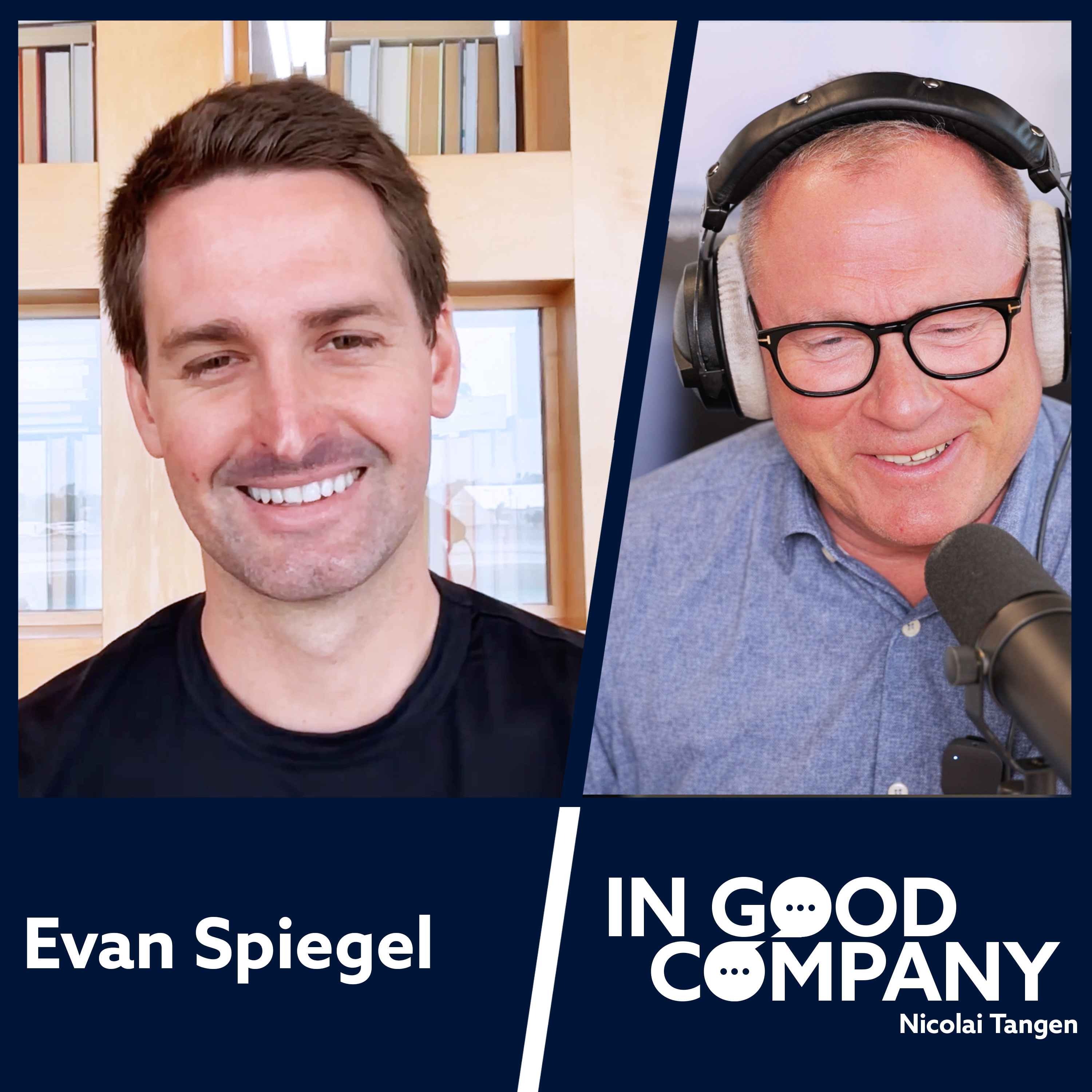
In Good Company with Nicolai Tangen
Snap CEO: Building Snapchat, AR Glasses and the Future of Communication
00:27:40
Loading summary
Transcript78 lines
- [00:01]
A
Hi, everybody.
- [00:02]
B
I'm Nicolas Tangen, the CEO of the Norwegian Sovereign Month Fund. And today I'm really thrilled. I'm here with Evan Spiegel, the co founder and CEO of Snap, the company behind the very popular Snapchat. Now it's used by nearly a billion people every day. He was 22 years old, turned down a $3 billion offer from Mark Zuckerberg, and has continued to build the company, which, by the way, in Norway, of all places, was one of your first really, really big markets. So fantastic to have you here.
- [00:31]
A
Thanks so much, Nicol, on the. On the show. And yeah, we now reach more than 3 million Norwegians. So very proud to serve the Norwegian people. Now.
- [00:49]
B
It started as an idea that most people were thought was, like, totally ridiculous. A photo that disappears just after you look at it. So where the heck did that idea come from?
- [01:00]
A
Well, Bobby and I had grown up with social media, and on social media, everything was saved forever. It was public. It was like a big competition to see how many friends you had or likes you could get on your photos. And so it meant that people were only posting pretty and perfect moments, not the full set of emotions or full set of experiences they had that are really important to relationships. So I think the most important thing Snapchat did was create a new way of communicating with visual messaging that was really the foundation of the service. Now today, it's diversified across a map that lets you see what your friends are up to, or augmented reality lenses, of course, content with stories and spotlight. But the core of the service is really visual messaging between friends and family.
- [01:41]
B
So where do you go? You're like 22 years old, no money, no app, no nothing. I mean, how do you start?
- [01:48]
A
Well, I was in school at the time, and Bobby and I actually lived across the hall from each other. And so we started working on some projects together, one of which was called Future Freshmen, which was a service designed to help people get into college. College that was a total failure. Only my mom signed up for our service, despite both of our siblings applying for college at the time. So we got some strong customer feedback in the early days. We ended up shutting down Future Freshmen, trying a few other things, and ultimately creating Picaboo, as Snapchat was called at the time, which I presented to my class in junior year.
- [02:22]
B
When did you understand that you were onto something big?
- [02:27]
A
Oh, gosh. I mean, it probably wasn't until about a year after we launched the service when there were enough folks using it and continuing to use it in a way that we thought Maybe we could build a business. But I think the most important thing for us is that we loved using it together with our friends. And so that really gave us the conviction to stick with it, continue evolving Snapchat. Because we were having so much fun using Snapchat to message with our friends.
- [02:53]
B
Now in the beginning, people kind of thought it was a bit secretive, right? Stuff is disappearing, there is no record of anything. So how did you think about the kind of reputation side of it?
- [03:03]
A
You're right. Back then, people didn't really think about or prioritize privacy the way they do now. I mean, if you remember at the time, everyone was talking about the world being open and connected and everyone was going to share everything permanently. And I don't think people had yet realized the downside, you know, of saving everything forever or allowing companies to access and store such large amounts of data. And so it was unusual for Snapchat, I guess now, 15 years ago, to say privacy is really important to us. And you know, we think that privacy is actually the foundation of self expression. Right. Unless you feel like you can express yourself with your friends and family without fear of that being recorded and, you know, broadcast publicly, it's very hard to feel comfortable expressing yourself. So I think we were early to explain the connection between privacy and self expression, which I think now is obviously very well understood and widely accepted.
- [03:55]
B
You had a pretty healthy offer to sell the company early on. Now in Europe, we typically take the money and run. You thought differently? How come?
- [04:06]
A
Well, we really loved what we were doing. We saw a huge long term opportunity. I mean, now the service reaches nearly a billion people around the world. Back then it was still very small. And so we believed that we had a vision that was unique and different than traditional social media, that was much more focused on close friends and family, on messaging and self expression. And so we decided to pursue our own vision. And I think the thing that really helped us make the decision was just how much we love what we do.
- [04:37]
B
Now you've been at the forefront of a lot of innovations, right? Disappearing messages, stories, augmented reality filters and so on. How do you, how do you build a company that comes up with these kind of ideas?
- [04:49]
A
Well, I think what's so important is to continue to create a culture where great ideas can come from anywhere, where people put good ideas in, you know, before hierarchy. One of the challenges with companies as they grow is they become much larger organizations. People become more fixated on promotions or making more money rather than taking risks. And so one of the things that we've Done is kept a very, very small design team. It's about nine people. It's a totally flat structure, so there's no fancy titles or anything like that. And the entire idea is to iterate really quickly to try new things. We look at hundreds of ideas on a weekly basis, and every now and then we have a good idea. But I think the most important thing is to create a culture that rewards creativity and risk taking, rather than a culture that rewards promotion.
- [05:36]
B
For example, what's the craziest idea you looked at lately?
- [05:40]
A
Oh, my goodness. The craziest idea I've looked at lately. We had all sorts of wild ideas for April Fool's jokes on Snapchat, most of which actually. All of which, which I think we discarded, except for we briefly renamed Spotlight reels R E A L S because we're so focused on the authenticity of videos made on Snapchat.
- [06:00]
B
So when you sit around the table, how does it work? Do you have a screen? You put things on a screen. You have a whiteboard. Just what do you do?
- [06:06]
A
Yeah, we've got a screen. Sometimes we draw stuff, sometimes we use a whiteboard. Most of the time we're just debating stuff and laughing. I mean, I think one of the things that's so important is creating a culture where everyone can speak up and share their point of view. And part of the things that, you know, part of what makes that, you know, enjoyable is to make sure that it's fun. Right. I think fundamentally, unless you can have fun with design, it's very hard to be creative. So I think the levity of those design meetings is something that I always really enjoy and something that brings out the best in people and creates a space where everyone can share their perspective.
- [06:36]
B
How did you guys come up with stories?
- [06:39]
A
Well, that was actually, you know, an outgrowth of people asking for a send to all buttons. And so in the early days of Snapchat, people said, oh, gosh, it's such a pain to go select each one of my friends when I want to send them a snap. I'd rather just have a send all button so I can blast snaps to everyone who's my friend on Snapchat. And we were really concerned that that would end up with people spamming each other all day long rather than intentionally communicating. But we did understand that people wanted to share snaps with all their friends. So we asked them a lot about how they were using social media at the time, and they complained that the feed was in reverse chronological order. They complained about likes and comments and feeling the pressure when they're posting. And they of course were frustrated that their feed or ultimately or their profile, when they went back and looked at it, felt like it didn't reflect who they were currently because it had all these old images and photos of them. And so for us, we took a lot of those learnings and what we heard and we created a product that disappears after 24 hours. You can start fresh the next day that doesn't have public likes and comments, that's in chronological order so people can follow you through your day instead of experiencing your day in reverse. And we release stories. And the early uptake was minimal. I mean, people were just discovering the feature and there wasn't a lot of growth early on. But as people figured it out and started using stories to share with their friends, it became a very large success for us.
- [08:01]
B
How many stories do you put out?
- [08:04]
A
Do I personally put out? Oh, I put a couple snaps on my story a week, I would say for my friends and family.
- [08:11]
B
Now people just copy what you do, right? So Instagram copied stories. TikTok took the short term kind of short form video, WhatsApp, disappearing messages. I mean, is it depressing that people take your ideas or do you think it's kind of flattering or how do you look at it?
- [08:29]
A
Well, it's a heck of a lot better than coming up with ideas that nobody wants to take. Right. So I think certainly prefer it to the alternative. But it means we have to be really thoughtful about how we build our business for the long term, how we continue to build a moat and make Snapchat very resilient. Right. And it's what's helped us think a lot about our future looking investments like in augmented reality, where we have, you know, I think the largest augmented reality platform today and advanced developer tools and really this ecosystem we've developed because we found that, you know, as you build an ecosystem that's much harder to copy than an app feature, for example.
- [09:05]
B
Now the biggest bet now for you seems to be the augmented reality glasses. And I believe you are on generation five. Do you think the world is ready for this now?
- [09:17]
A
I think the world is so ready. I think that technology has been trying to catch up to where the world is. I think folks are exhausted by what their computers and their phones demand of them. I mean, people are spending seven or eight hours a day hunched over a screen. They feel like it distracts them from the real world, takes them away from their friends and family. But yet this technology is so useful and so powerful, right, that we don't want to just put our laptops away. We need to fundamentally change what a computer is. And that's really what specs do. They take computing and they actually integrate it in the world around you. They make it something you can share together with your friends so you and your friends can participate in the same computing experience in the same place at the same time. That's really, really powerful and it represents a whole new direction for computing that I think the world has wanted for a long time. But the technology hasn't been ready.
- [10:06]
B
Some pretty big players have tried already and they failed. So why should you succeed here?
- [10:12]
A
Well, I do think we have unique customer insight that we've been able to translate into very innovative products in the past. And I think staying close to our customers, what they really want and building products that really delight them is core to who we are. And I think that's been combined with the ability to really invest consistently over the long term. I think a lot of companies that have tried and experimented in this place, in this space have turned their initiatives on and off abruptly, which is really damaging for long term research and development. They've sort of chased different market opportunities, pivoting back and forth between consumer and enterprise. And so these pivots and these sort of starts and stops are really, really harmful to long term research and development. And I think that's where we're very different because now I think for what, more than 12 years, we've invested very consistently and very deliberately against this vision, starting with just normal camera glasses, adding a second camera, adding a display, building out our own proprietary operating system and the developer ecosystem, and now launching a bit later this year, full fledged consumer grade specs that fit all of that capability into a normal pair of glasses. So I think it's really that focus and long term consistency that's, that's going to differentiate us in this space.
- [11:29]
B
How far into the future do you think you can see? So I mean, what I mean is that I have a question. Where do you see snap in 10 years time? And then I thought, you know, 10 years time, I mean my, that's like, that's like a hundred years for these guys. So, but I mean, can you see like, well, two to three or just what is your time frame when you plan and when you look at your visions?
- [11:57]
A
Well, the hardware time horizon is obviously far longer than the software time horizon. So in the hardware space we plan through, I'd say now we plan through 2030, right. So we have a general idea of the tech tracks and product capability and what we need to land over that time frame and what the consumer value proposition needs to be and the price point. So I think one of the great things about hardware actually is that we get to benefit from our long term vision because by the time we've released a product, we're already years ahead in terms of the next generation of the product and our investment cycle. So it makes it harder for our competitors to catch up because they're only seeing what we worked on several years ago when we launch a new hardware product. On the software side, I'd say the cycles are a lot faster and we can pivot and make changes much more quickly. And of course, the software on Specs, for example, even after we launch, the hardware continues to develop at a really rapid clip. So it depends, hardware versus software. But I think taking a step back, big picture looking out, over the next three to five years, Snapchat will reach more than a billion people. It'll have a diversified set of revenue streams across subscriptions and direct revenue, as well as our advertising business. And then we'll be layering in the development of this specs ecosystem and the SPECS hardware product, starting first with early adopters and enthusiasts, but by the end of the decade, I think really having a mass market Glasses product out there,
- [13:21]
B
in terms of augmented reality, is it the hardware which is the slowest now or is it software or just if you look at what could make it move faster?
- [13:33]
A
Well, hardware is always harder than software. That's why it's one of the most compelling places to invest. I think it's so important if you want to create long term value to do really difficult things and to solve really difficult problems. And certainly the hardware space for glasses is difficult because you have to combine so much capability into a very, very lightweight and wearable product. So I think looking at the history of our augmented reality development, we already have an AR platform that's used by hundreds of millions of people inside Snapchat. And the question will be how that evolves as the Glasses hardware ultimately is released later this year. And we've seen a lot of promising signs from the 2024 edition of Specs, which was developer focused. People have built hundreds of lenses for that device and I'm really excited to see what the developer community builds on this next generation.
- [14:24]
B
Moving on to culture, what are the non negotiable part of your copaculture?
- [14:29]
A
We've got three values, very simple, kind, smart and creative. All non negotiable. And the most important thing I think actually is the relationship between kindness and creativity. And what we really learned over the years is that unless you have a culture where people feel supported, feel like they can bring their full selves to work and experiment with crazy ideas, it's very, very hard to develop a consistently creative culture. So the relationship between kindness and creativity is very important to us.
- [14:54]
B
How kind are you?
- [14:57]
A
I try to be as kind as I can. Certainly I'm more kind after a cup of coffee.
- [15:05]
B
Hierarchy.
- [15:06]
A
What about it?
- [15:07]
B
Have you got it?
- [15:09]
A
Hierarchy. Well, I think hierarchy is a function of a larger organization. One of the things that's exciting, I think, about the way that AI is changing the workplace is that I would expect there to be less and less hierarchy, much larger spans of control. Most of the management process, I think will be largely automated by AI and it will free up leaders to spend more time leading. But hierarchy does end up being a function of larger companies. I think the question is how fast does bad news travel within that hierarchy? Are people lifted up for highlighting things that aren't working, that are broken so that the organization can fix it quickly? Or are people more focused on managing up and more self interested in their own promotion and appearing like they're making progress rather than delivering real results for the business? And I think snap's culture, especially at our sort of startup scale, is a very high impact culture and very much focused on finding the best ideas wherever they may be, rather than trying to enforce some hierarchy.
- [16:09]
B
Why will AI reduce hierarchy in an organization?
- [16:13]
A
I think ultimately AI creates a huge amount of leverage for managers to take on a lot of the managerial work that they used to have to do in the past. So for example, in the past as a manager you had to spend a lot of time staying very close to what your team members were doing, working to provide very actionable feedback, gathering all that feedback from their peers. Today I can use our systems at SNAP to see everything they're actually doing without them having to report anything. I can just understand based on the work product they've actually contributed, whether or not they're meeting their goals. I can easily gather peer feedback right from their interactions with their peers and feedback from their peers and ultimately turn that into very, very actionable feedback without having to do much managerial work to get that outcome. So I think if you look at a lot of the things like career planning, career conversations, feedback, a lot of the day to day work required of management, most of that I think is going to be automated in the not too distant future and that's going to free up managers to lead.
- [17:16]
B
What do you think is going to happen to the number of reports that a manager have,
- [17:22]
A
I think it could very meaningfully increase. And I think that's certainly a benefit that rather than maybe a more traditional 7 to 10 directs or something like that, you could even see that number double over time as more of that managerial work is automated.
- [17:39]
B
Now you went through a restructuring in 2022, took down the number of people by some 20%. What did that do to the culture? Did you see any significant impact?
- [17:51]
A
Well, I think it's always difficult to manage through change like that, mostly because our colleagues are our friends. There are people we really enjoy spending time with. The folks here are incredibly high impact. And so those decisions are always incredibly difficult and painful. And it does take time for the culture to recover. There's a real sadness that comes along with saying goodbye to colleagues who we really love and admire working with. And so I think understanding that and empathizing with that and also recognizing that we do have to adapt as a business and make changes so that we can continue to work towards our long term goals.
- [18:26]
B
You also say that the firm, that as a firm you need to work faster and leaner. What are the type of things that you have changed to achieve that?
- [18:34]
A
Well, I think the thing making the most profound impact is AI. We're a software company. And so the entire way that software is written now has changed profoundly. It's mostly written by agents. I would be stunned if humans are writing any code at all by next year. You know, whether it's bug fixes or testing, I mean, all of these processes now that required a huge amount of human engineering work are being automated very quickly. And so for a company like ours that's predominantly in the business of software, that's hugely impactful. It'll let us move way faster to serve our customers. It'll help us resolve issues much more quickly. And that's a really inspiring change that's happening right now in software.
- [19:14]
B
Now you got more data on how young people communicate than most of the firms. When you look at the data, what are the kind of things that surprise you?
- [19:27]
A
I wouldn't say it's surprising so much as it's reassuring. What we see over and over again is the reason why people love using Snapchat is to talk with their close friends and their family and to do so in a way that's really authentic. So I think at a moment when everyone's preoccupied with social media and public performance and these sorts of things, Snapchat represents something very different. And what we continue to see and hear from young people is just that desire for real relationships and connection and, you know, what a positive impact those close relationships have on their lives. I mean, our friends and our family are the most important thing in our lives. And so making it easy to stay in touch with them in a really authentic and fast way is just so important.
- [20:03]
B
Do men and women use it differently?
- [20:06]
A
That's a great question. In the early days, a lot of the early adoption was women communicating with other women. And over time, the user base has become more diversified, more balanced in terms of user engagement.
- [20:23]
B
How do you make sure that young people stay on the platform when they grow up?
- [20:29]
A
I think it really comes down to providing utility around those close friends and family. Friend and family relationships. One of the things that's fascinating, when we get older, our friend groups actually get smaller. And so Snapchat's really well positioned for that because it's built around this close friends and family dynamic. And so as you go from caring about staying in touch with maybe hundreds of people when you're in college to staying just close to your few best friends or your family or the grandparents, I think Snapchat's a really, really useful tool as we all grow older and ultimately choose to stay in touch with that small group of close friends that really matter.
- [21:04]
B
And what's the trade off between keeping it small and authentic versus becoming very big in Instagram and TikTok?
- [21:12]
A
I think there are lots of trade offs. I mean, the first thing is that communication services just grow slower than social media because social media is broadcast based and Snapchat is based on communication. And so that does mean there are some trade offs. And we've seen historically in terms of our rate of growth, because it's dependent on people communicating with a smaller group of friends rather than blasting out content to thousands of folks or people they may not know. And so I do think that ultimately that trade off is balanced with the resilience of building a communication service, because the durability of communication services and the importance of that in people's lives is something that's helped us build long term value.
- [21:51]
B
Talking of which, how long do you think these podcasts should be for the audience to continue to hang in there?
- [21:59]
A
Well, I guess it's a function of how interesting it is. Right? You probably have.
- [22:03]
B
I think it's super interesting. But you know, you know your audience better than I do.
- [22:07]
A
Well, I think the more important thing is to have a great clipping team. Right. And to cut it up into awesome 15 to 30 second moments.
- [22:15]
B
We'll work on that. Now you've been CEO since you were 21. It's pretty amazing. And now you are 30, what is it, 34?
- [22:23]
A
35.
- [22:25]
B
Wow. How have you changed as a leader?
- [22:29]
A
You know, it's so interesting in the early days, right, I had to wear so many different hats. Whether it was, you know, answering customer support emails or, you know, getting the legal work done, the financing. So much of, you know, my growth has been about leading people and the evolution necessary to, you know, primarily focus on making sure we have the right folks in the right roles and that I'm helping them grow and develop and that being much more important than, you know, any individual task or function we have here at our company. So I think so much of the job really becomes, you know, about people and that is certainly the most important thing to me. I think the one thing that's been really helpful through all of this is because we started the company when we were so young, we've been able to really think long term. I'm sure you're aware the tenure of public company CEOs is incredibly short today. And it's very hard to do anything of real significance in such a short period of time. If that's four years or seven years. Anything that requires real technical development and research and development happens over very, very long periods of time. And so I think, you know, as I've gotten older, I've been able to better appreciate what a strategic advantage that is to really be able to invest consistently over a long period of time.
- [23:41]
B
How do you communicate with the rest of the firm? What are the methods you use?
- [23:46]
A
I typically do company wide Q&As pretty frequently every other week, I'd say. And then we also have team wide meetings where we have folks present on what's going on in the company. A lot of what we've been doing lately is highlighting all the amazing AI adoption and work that's happening across snap because that's just so critical to the way that we're working today. But yeah, I think my favorite format is just open Q and A because I learn a lot, right, based on what people are asking, what people care about. I'm constantly hearing what's top of mind for our team and that helps me stay close to issues across the company.
- [24:19]
B
What are the most interesting ways you're using AI now, which you didn't, let's say three, four months ago?
- [24:27]
A
Well, I think the most profound shift is really in software development. I think that's where the capability has increased so dramatically. Even, you know, as I reflect on the end of last year to today, you know, the notion of, you know, of really evolving, right from AI being a tool that engineers use to now, you know, really agentic development and developers overseeing agents who are completing this work, that that change has happened in basically six months. And that's a really big deal for us. And it also means that as a smaller company, sometimes we haven't had the capacity or the resources to invest in new tooling. So for example, we have all these amazing creators on Snapchat. They're constantly creating content about brands or new snaps that companies might want to use to promote their services. But historically we didn't have a tool that made it easy to find those creators and collaborate with those creators. We were having a hard time resourcing and funding that work. And now, you know, in just a matter of weeks, we've created an awesome tool. It's already out in the market. We're getting great feedback from our partners and advertisers. And so for a company like us that's resource constrained, AI is letting us accelerate in such meaningful ways that just weren't possible before.
- [25:39]
B
Even just some personal things at the end there. What do you, what do you do when you don't work?
- [25:44]
A
Well, we've got four boys at home, 15, an eight year old, a six year old and a two year old. So that consumes virtually all my free time. We were just at Legoland for our eight year old's birthday. That was pretty fun. But yeah, that's what I enjoy doing.
- [26:01]
B
What is your screen time policy for your boys?
- [26:05]
A
It really depends on their ages. So the 15 year old, I don't think he's allowed to use it after. I think the latest rule is 10pm so we like him to put his device away at 10pm, but otherwise it's so important for him to stay in touch with friends and get work done and all that kind of thing now that he's in high school. For the little ones, we really minimize screen time. Obviously they can watch a movie every now and then and then. For the two year old, it's virtually never, you know, except for when he's getting his hair cut because he has a hard time sitting still for that.
- [26:36]
B
Sounds good. We've got lots of young listeners, as you can imagine, and in particular for this episode. What is your advice to young people?
- [26:46]
A
You know, I think what's so important, especially when you're younger, is to take risks by trying lots of new things. You know, I think there's sort of this narrative that, you know, find your passion. Right. Or whatever you're passionate about, chase after it. It's hard to know what that is unless you try a bunch of different things. And so I would really encourage folks to. To try different things to see what really resonates if they're not enjoying something, to stop doing it and find something else. Because there's. There's never sort of a lower risk time to experiment with finding your interest than when you're young and when the switching costs are very low. So that would really be my advice to young people.
- [27:23]
B
Fantastic. Very good. It's been great talking to you. All the best of luck and keep up the good work.
- [27:30]
A
Thanks so much. I really appreciate it. Thanks for having me on.
- [27:33]
B
Thank you.