← In Good Company with Nicolai Tangen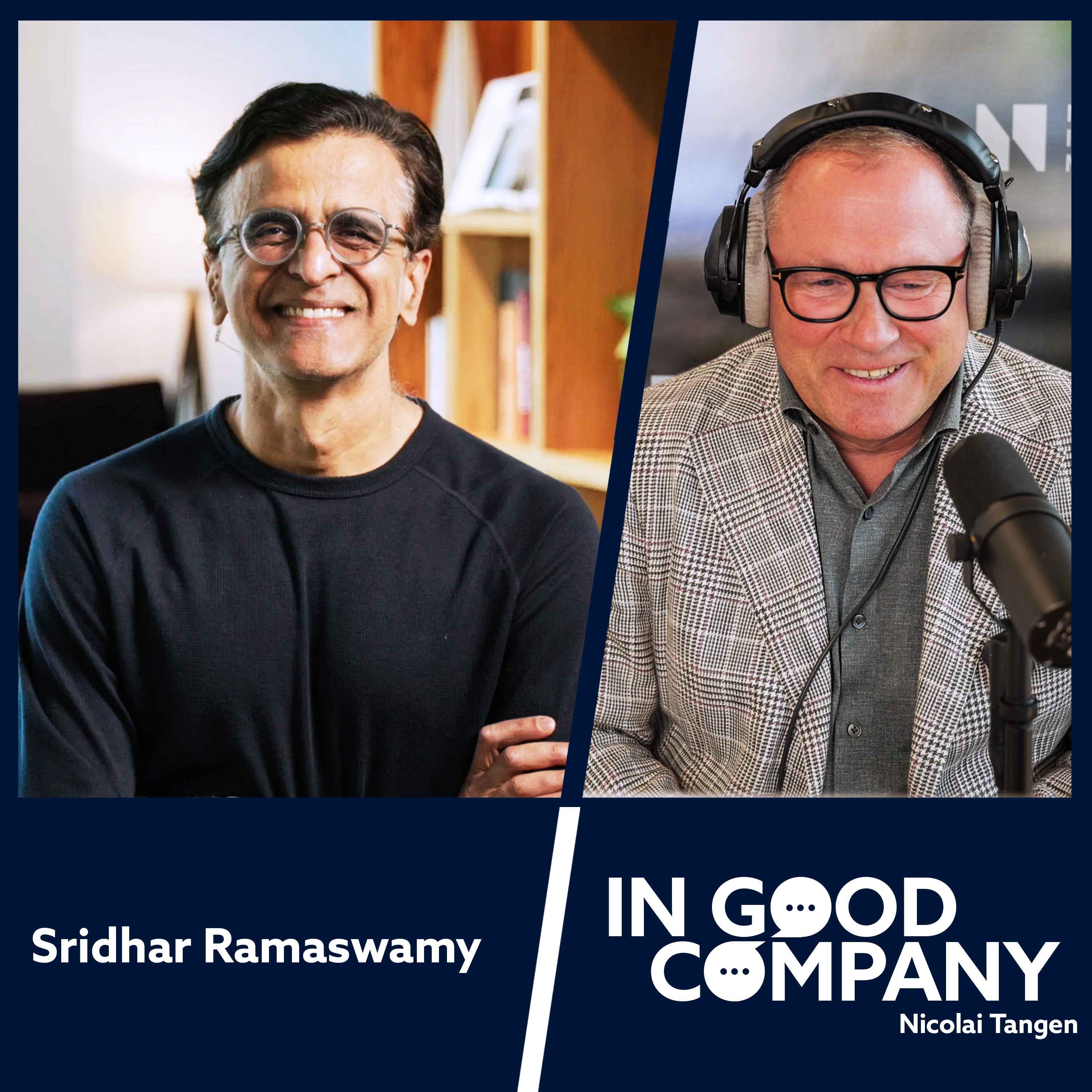
In Good Company with Nicolai Tangen
Snowflake CEO: Scaling Data, AI Agents and the New Software Era
00:30:52
Loading summary
Transcript56 lines
- [00:01]
A
Hi, everyone. I'm Nicola Tangen, the CEO of the Norwegian sovereign wealth fund. And today I'm joined by Sridhar Ramaswamy, the CEO of Snowflake. Snowflake is basically the data platform that many of the world's biggest companies run on. So when your bank approves a loan or when a hospital pulls together patient data, Snowflake is often the engine underneath. Sridhar spent 15 years at Google, where he built the advertising business from 1.5 billion to over $100 billion. Then he walked away to start his own company, and two years later, he became the CEO of Snowflake. Now here at mbim, we are investors in Snowflake and we are also big users of the products. We have two petabytes of data in Snowflake, which is the equivalent of 2 million gigabytes. And we have roughly 3 million queries into the database every day. So big. Welcome, Sridhar.
- [00:55]
B
Thank you, Nikolai. Happy to be here. Excited for the conversation.
- [01:07]
A
First of all, how would you describe Snowflake to somebody who's never heard of it? In brief?
- [01:13]
B
Yeah, we are a data platform. We are like a cloud computing platform, like in aws, but with a strong focus on data. We help you do everything from bring in data from various different systems, analyze it, get insights from it, and then take it to the systems where you take action. So we are an analytic data platform.
- [01:35]
A
Who are your clients?
- [01:38]
B
Gosh, half the global 2000 companies that are addressable, that is non China companies are our customers. Hundreds and hundreds of customers in financial services, healthcare, advertising industries. The list goes on and on. And we operate out of more than 25 countries and have customers in way more than those.
- [02:06]
A
When the company was founded in 2012, to separate storage from compute was pretty radical, right? Just tell us about it.
- [02:14]
B
Yeah. The simplest way to internalize that really important concept is to think about how you and I have always bought or used computers. I tell people for the past 50 years, whenever you and I wanted computing at our company, we would go buy a box, and that box would have a fixed amount of storage, a fixed amount of compute, and a fixed amount of memory. And you're generally stuck with that box for, I don't know, five years. So if you decided that you wanted more memory, well, too bad. You wait. If you decided that you bought too much compute, too much CPU power, well, that's too bad. You already bought the machine. And so that's the essence of it. By the way, your phone is another box, just a little box. And it was also really hard to move Data from one box to another. That was an integration project. Snowflake radicalized things by sitting on top of cloud computing, which effectively are infinitely large databases with amazing amounts of compute that can be shared between different customers that operate there. And we separated out compute and storage. So we said you can use exactly the amount of storage that you want and the compute that you want if you want to do like a deep analytic job. Because one of the people within NBIM came up with like this brilliant idea for investing that required you to go through every piece of historical information. You can spin up a thousand computers over one weekend, do the analysis, shut them down, and then figure out how to implement that in practice. That's the magic of Snowflake's model.
- [03:48]
A
Most software companies charge per seat, but you charge for what people actually consume. Why is that better?
- [03:57]
B
Because it is aligned value creation. Part of the benefit that we have is we are very good at predicting demand because we have over 13,000 customers. And so we are able to amortize spiky demand ourselves and offer you a more stable model that does not require you to make a commitment that you're going to use a certain amount of storage or a certain number of CPUs on an ongoing basis. And this in turn means that you spin up things as you need them. Most analytic jobs tend to be bursty. And as you know, the day night variations, even in transactional jobs is very high. People just are not doing as many banking transactions in the night. And so there are all of these well known patterns. What we are able to do with the consumption model is offer an incredibly effective price because we are able to amortize that. And it also makes the company super value aligned. You pay first. We recognize revenue. When you and your team use Snowflake. And we'll come to this. In the world of AI, that's a big deal because you only pay for what you use.
- [05:06]
A
Absolutely. Trina, why do you now consider the likes of Entropic and so on your competitors?
- [05:13]
B
Because they're changing software as we know it. I think what is very, very clear to many of us working deeply in the software industry is that the caustic economics of software are dramatically changing. And I would separate that out clearly from near term concerns about costs of AI models and things like that. The reality is that software has always been a little bit of a craft. For the past 50 years, special people that are doing incredible amounts of work in order to produce software, hard to build, hard to integrate. You should think of these like the best programmers are like concert pianists. There's no way to mint them. It's you spend the 10,000 hours and you have that special genius in your head and that's how you become an amazing musician. Software engineers have been like that. But what these models represent with software is the industrialization of software at a scale that we have not seen before. And that is the primary reason why I consider the model companies, things like the coding agents that they are creating, to be our biggest competition. This is the reason why we have a coding agent. They represent the front door to computing, the front door to all information. More and more for everybody starts with software engineers, but it goes to more.
- [06:35]
A
Absolutely. What about the likes of Amazon and Microsoft who also have competing products?
- [06:40]
B
Yeah, well, you know, with all due respect to them, when it comes to pure data platforms, we have always been top of the charts when it comes to that. Companies that operate at that scale should never be underestimated because they are able to bring on just incredible resources to solve problems. But from what I see, I think of coding agents as the biggest threat to all software. And figuring out a path for Snowflake that is going to survive and thrive in this world is my number one challenge.
- [07:20]
A
Continuing on AI in what ways are you benefiting from from this revolution?
- [07:28]
B
I take a reductive approach when it comes to AI and a software company like Snowflake. At our core, we do two things. We create and run great software. This is what my engineering team does. We sell and help customers like you implement our software. So a lot of our energy is focused very much on how do we make this go faster. On the sales side, our sellers now have tools that give them instant access to information. It's a sales agent that sits in their phone. Our solution engineers can do a custom demo for Nicola in 30 minutes that has data that will look like it came from your bank. Their ability to use these tools drive outcomes for you is incredible. And then on the software engineering side, coding is being revolutionized. I just came from a meeting where we are talking about how we need to get more people into spec driven coding development, which is you write an English language spec for what it is that you want to produce and then you automate the entire rest of the process of writing the first version of the code and testing it and deploying it and so on. Software engineering is nothing like what it was two years ago. How to get every engineer in your team to act like that, to internalize these great possibilities is the biggest challenge that we have. But we have the superstars people that are 50, 100 times more productive than the average software engineer.
- [08:54]
A
How do large enterprises now change the data estates on the back of AI?
- [09:01]
B
That's right. So two things. First of all, AI makes the data that you have a lot more accessible. This is what products like Snowflake Intelligence do. It is roughly an agentic interface to your data where you can say, how are my biggest investments doing? This investment seems to have gone down a little bit. Break it down for me. Is it because of the sector? Is it some other problem? All of those questions that required analysts to perform on your behalf right now at your fingertips. And what this also means that how work should be done in the future is also going to get dramatically changed because of this fast programmable access almost to the data. The second way in which a lot of our customers are benefiting is because of things like native coding agents. It's not often that I go to my customer and say, I can make something that you have to do every day go 10 times or 20 times faster. That's what we are doing with internal teams and that's the value that we take to them. So both the builders and the consumers of data within a company have massive benefits thanks to AI.
- [10:07]
A
Now we have something called an MCP which connects us to you guys. Could you just explain, in short to the listeners, what an MCP is?
- [10:18]
B
Yeah, you should roughly think of that as it stands for Model Control Protocol. It is just a way for a language model or a coding agent to be able to talk to a data source. And what we like our customers to do is use our products like Snowflake Intelligence that natively expose the data. But we are also all about being interoperable, working with the things that you folks have. So every agent that is created in Snowflake can be called remotely from some front door that you have. And that's what MCP is. It is an interoperability layer.
- [10:56]
A
How will agents change the way you work?
- [11:02]
B
This is a big question and the word agents itself is a little bit misunderstood. The way you should think about agents is it is a model and a piece of code that has access to different kinds of tools underneath. And it knows how to call them smartly. So, for example, if you ask it a question and say, write a little program for me, it knows how to create a file, write some code into it, and then call something locally to execute that piece of code. But exactly the same thing can be used if you say, I want to know how my portfolio is doing. It knows how to call the portfolio tool, analyze it and give you back the result. And so agents are changing work at every level. Even though you tend to hear most about things like coding agents, but the general concept is very powerful. These coding agents are effectively abstraction agents. So even somebody that never wants to write a line of code and is going to benefit enormously from having their basic functionality, access to all of your documents, access to the structured data that is in Snowflake. If I give you, for example, Snowflake intelligence, access to all of it, practically any question that you would want to ask of the data, the agent can come up with a plan and help you execute. That's why there's so much excitement about things like the work concept, cloud, cowork or snow work, because they're changing how people think about work. Everything is programmable and also everything is interconnected. If you want to send an email based on an analysis you did, you don't have to cut and paste. You can just tell your agent, please send this email to Stefan and out goes the email.
- [12:44]
A
Absolutely. Now I'll tell you one thing. We spent years cleaning up our data and it's not a fun job. Now when you look at data, it's messy duplicates, gaps, decades of legacy systems stitched together. Just what kind of barrier is that to the usage of AI and to the usage of your product?
- [13:04]
B
Used to be a bigger, a huge barrier to getting value from data. I think it is getting simpler by the day. That's the magic of coding agents applied to the data problem itself. Used to be that changing a pipeline for just adding one additional column of information in a complex data set, that would easily be a week long job for some poor programmer that had to toil through all of the details. We now have things like skills which you can think of as English language programs that automate that entire process from start to finish so that they can start it and they can come back in an hour and just ensure that everything has been taken care of. We are working on things like agent driven migrations where you can move data from legacy systems onto Snowflake in a matter of days and small number of weeks, as opposed to the multiple quarters in the multiple years that it used to take. And AI can be very, very powerful in the data modernization journey overall. And it's an area that we are very heavily invested into.
- [14:12]
A
I wish we had it five years ago, but hey, what about gdpr? How is that holding back usage, that is the Personal Data Protection laws.
- [14:25]
B
Well, part of Snowflake's benefit is that we offer excellent governance features. It is a burden for companies to make sure that they comply. You know, I'm American and everyone criticizes gdpr and it has had some unintended consequences. But there are also many aspects of GDPR that were genuinely forward looking.
- [14:54]
A
Is GDPR good or bad for Europe?
- [14:58]
B
I think it's a very mixed bag. I think it had a lot of unintended consequences and it also tells you how regulation needs to be very surgical about what it does and people really need to think very hard.
- [15:12]
A
What are the unintended NATO consequences?
- [15:14]
B
Yeah, I'll tell you the positive things. First, the fact that you as a consumer can go to a company and say, you need to delete everything that you know about me that came as a result of gdpr. That is a huge positive. It forced every company, it forced my Google Ads team to make sure that we were actually able to track down everything that we knew about Nikola. I think that's a huge positive. On the other hand, those walls of prompts that you have to, at this point, you just give up and say, yes, I think that's an unintended consequence. I think it has raised the cost of doing business for every European company. And the people that ultimately benefited from GDPR were the giants who are able to spend the money, follow all the rules and be compliant, while every new company that comes up in Europe has to struggle to follow all of these rules right out of the gate. That's what I mean by unintended consequences.
- [16:06]
A
Unrelated question, will we have data centers in space?
- [16:12]
B
I'm simply not qualified to answer that. The math looks really, really formidable.
- [16:21]
A
What will quantum computing unlock for Snowflake?
- [16:27]
B
This is a great question. I think being things like, first of all, quantum computing, computing similar to great AI models is a great security risk. And making sure that your data is safe is a high priority for us. It promises to bring very new and different approaches about how you think about things like optimization and searching. And we are confident about being able to use those things. I think core infrastructure will still continue to be super relevant in the world of quantum computing.
- [17:03]
A
Can we spend a bit of time on your earlier years? You know, you're still a very young man, but when you were even younger, you, after Google started up niva,
- [17:16]
B
what.
- [17:17]
A
What did you learn from that failure?
- [17:21]
B
There's a. There is a part of me that is deeply idealistic and deeply romantic about the world that I would like to see. I consider that a positive. And NIVA was started out of this sincere belief that creating a better search Engine was going to be a great business. Among the tough lessons that you learn is consumer products especially do not get adopted without an experience that is dramatically better. At one level, I knew that search could be better, but I did not have a concrete plan for how my view of search and information could be ten times hundred times better. Ultimately, that's what led to its failure because we came up with a search engine that was marginally better, that had better privacy. Of course, you learned the hard way that privacy, like exercise, is a quality that we like subscribing to rather than actually practicing. And, you know, those were tough lessons, but we had amazing folks in the team, we built amazing technology and it eventually ended up being the underpinnings of what AI became at Snowflake. So something great came out of it.
- [18:38]
A
Yeah, I love the way that these type of things are learning experiences in the us, in Europe, that's not the way they are considered, you know, so good. But now, then you went into Snowflake, you were named CEO. The share price didn't particularly like it. Just how did you tell me about the first period in Snowflake?
- [19:05]
B
Yeah, I think I became CEO at a pretty critical juncture for Snowflake when growth was actually slowing down. The day I became CEO, in fact, we guided five full percentage points below consensus for the year, for the upcoming year. That was the real reason for the dramatic drop. Of course, it does not help that an unknown person that has never been CEO before was taking over from the legendary Frank Slave Lutman. Dealing with adversity in my mind is the true mark of greatness. And we just set about going to work. I believed in the company. It helped that I had been in the company for six months and we focused back on creating great products. That ultimately is what makes the difference. Everybody talks about everything else, but. But at the end of the day, if you are in software, life is fundamentally about are you creating products that people love? And that singular focus on creating value is what has propelled us and this is how we have created products like Cortex code. You can do a little bit of a search and you will see how much excitement and love there is about the product. This is what all software engineers live and dream for, and that's what creates value for the company.
- [20:38]
A
What do software engineers have in common?
- [20:46]
B
I would say previously, in the pre AI era, software engineering combines the ability to think at a high level about how you want to solve a problem combined with almost this fanatical ability to drive the details. You need to be able to do Both at the same time. It is a remarkably unforgiving discipline. You miss one comma somewhere, the compiler would not tell you, hey, that's just a comma, I'll add it for you. It's like that's an error that you had to deal with. I think AI is making things very different. I think the modern AI driven software engineer is much more conceptual. They are actually managing a team of agents. They are exercising taste and judgment about what problems to solve and how solving these problems makes sense in the context of the company and the product that you're creating. These are the people that are quickly figuring out how to use the latest and greatest tools in order to solve a problem. And that discipline is dramatically changing by the day, by the week, and it's going to be completely different a year from now. I'll give you a specific example. My younger son is 24 years old. He graduated three, four years ago as a software engineer from a really good university. And he was very proud of being a systems programmer that really knew the details. Designing streaming systems with 3, 4, 5 millisecond latencies, that was his specialty. And now he works for one of the AI labs. And he told me recently, dad, everything I learned in school and after that is completely useless. To succeed in my current job, I've had to learn basically new things that tells you how much things are changing.
- [22:43]
A
It's incredible. It's incredible. At Snowflake you have something called the weekly war room. What is that?
- [22:50]
B
Yeah, this is the concept that we put into place. Early on. Snowflake had specialized a lot. What I mean by that is every function in between when a product is created to, when you, the customer can actually use it, had evolved into its own specialized discipline. So you have product manager, you have software engineers, you have product managers, you have designers, you have product marketing managers, you have technical program managers. This stack keeps going up and up and up. All of this works fine when you have a perfect product and all you're trying is optimizing scale at every level of delivering that software to you. It does not work when things are changing dramatically. When you want to create a new product, you basically want to have a much tighter feedback loop between who is creating and who is using. We need to talk to your team every day, every week. We need to be on Slack channels because we need to figure things out honestly. That's what the war rooms did. They brought everybody that was responsible for a new area together into one place. I would participate in them and we would talk about how we Made progress this week is a way to short circuit communication. As you know, in management, you can either organize horizontally or horizontally, or you can organize vertically. And there are pros and cons of each of these things. This was an example of reorganizing virtually, but vertically to drive outcomes. I do these even today. I have a number of war rooms where we plan on Monday, and in the world of AI, I want to see results on Friday. And that's the rapid speed at which we ourselves are evolving and changing even today.
- [24:33]
A
You call yourself an email machine.
- [24:38]
B
I process email for a living. But it's all about information. You know, I look at management as I like, generally life. I like working hard. I like both being in the detail, but also being able to articulate the higher principles or help teams reach critical decisions. So I consume a lot of information. All of this is towards building context, is about building intuition so that you can make the one or two or three decisions per year that are going to have a profound influence on your company. And so I think of a CEO's role as getting that breadth and depth in what is going on and helping drive those outcomes. By the way, I don't think I'm the one that needs to be driving the new ideas or coming up with new ideas or deciding. It is about making sure that you set up an environment in which the best ideas come up and you are the facilitator, you are the face of the team. When you say, yes, we should go in that direction, we should actually launch Cortex code, a coding agent, because that is going to ensure our future. It's all about supporting the team.
- [25:52]
A
What are the most important part of the COPA culture?
- [25:54]
B
I think among the most important things that you need is, first of all, let me start with baselines, Things like civility, things like respect for each other, things like equality of opportunity. Those are things that are a baseline in any company, definitely any company that I am a part of. I do not accept any behavior whatsoever that does not conform to these. There's never any yelling that I will tolerate from literally anyone within the company. And I think setting that culture is very important. But beyond that, the thing that I stress is an open culture in which things are evaluated on their merit, where people do not have to worry about contradicting me or contradicting anyone else. Where we debate things openly, where we come together, where we also decisively reach decisions that dictate where we want to go and we're able to execute together as a team. But that open, honest communication and teamwork Is something that I think is very, very critical. Too many people and you see this all over in the world are afraid to say what they see.
- [27:21]
A
You grew up in Tamil Nadu. How did that shape you?
- [27:29]
B
I grew up in Tamil Nadu. I was also in Bengaluru, which is in a nearby state, until I went to college. I grew up in a lower middle class neighborhood Most of the time when I was growing up, you know, there was one living room and one bedroom for a family of four. But this was a family that profoundly believed in education as a way forward, that was intellectually curious about things. Neither of my parents went to college, they only finished high school. But they stressed education, and there was nothing that they would not do to help me and my sister reach for a better life and educate ourselves. So the virtues are very much that of being knowledgeable, being smart is important, that it is helpful, and that working hard can create a better future for all of us. And these are qualities that I keep to this day. And I'll also tell you that my parents were also remarkably malleable. I went to a college that they did not want me to go to because the idea of sending a young son to a college that was 300 miles away was something that they were very hesitant about. But they supported me in doing that or in who I choose as my life partner. I think that kind of malleability is also important. If I had to crystallize all of these back, I would say it's all about the value of education, the value of hard work, and the value of being malleable to a changing world. These are all things that I take very much to my heart. And these are very much the qualities that I talk to my children about.
- [29:17]
A
If you were to do another degree now, what would it be? What are you curious about?
- [29:22]
B
You know, when I was growing up, I was really interested in things like cell biology and how the body worked. I think it is just. It's the kind of topic that interests me because it is infinitely complicated, but also infinitely profound. I think that would be enormously satisfying.
- [29:46]
A
Last question. What is your advice to young people?
- [29:51]
B
It's the things that I said. And I would add on one more, which is. I mean, I'll start with. As I said, hard work matters. Being good at what you do matters. Having the ability to change your mind and learning and adapting is important. The third thing that I would say is being resilient to failure is really, really important. It's really important that you try new things. But you have to accept that you're going to fail in many of them, and that is okay. You're a lot more than any particular victory or any particular failure in what you do. Having that grounded sense of self, I think is very important. So three things. Hard work, malleability, resilience.
- [30:38]
A
Sridhar I think that's a really, really great place to end. Big thank you for taking the time and, you know, keep up the good work. Thank you.
- [30:45]
B
Thank you so much, Nikolai.