← In Good Company with Nicolai Tangen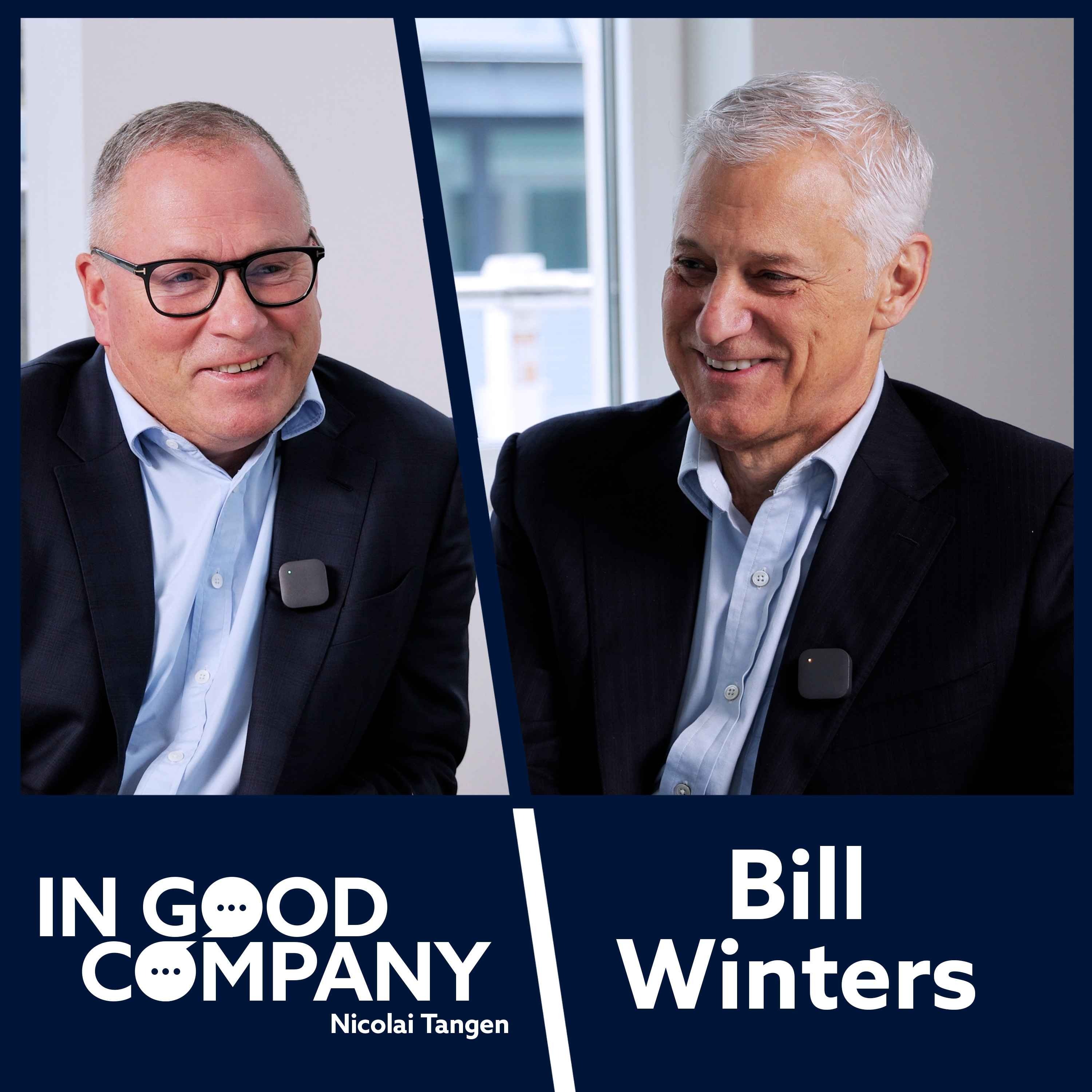
In Good Company with Nicolai Tangen
Standard Chartered CEO: Global Banking, Geopolitical Shifts and the Future of Blockchain
00:46:14
Loading summary
Transcript133 lines
- [00:02]
A
Hi everyone.
- [00:02]
B
I'm Nicolai Tangen, the CEO of the Norwegian Sovereign wealth fund. And today I'm joined by Bill Winters, the group CEO of Standard charterbank, one of the world's most distinctive banks. Headquartered in London. You have most of your activities in Asia, Africa and the Middle East. And we own more than 2% of the company, worth a billion dollars. We are really proud sharehold. So Bill, the bank opened its first offices far away in Mumbai, Kolkata and Shanghai in 1853. Long time ago. And you've been CEO for 10 years, which is only 5% of the duration of the bank. So tell us, what is it that makes Standard Charter so special?
- [00:50]
A
First, it's great to be here. Thanks for having me. So you're right, Standard Charter actually started as a Standard bank of Africa, which started in Port Elizabeth in South Africa, today's South Africa. And the Charter bank of India, China and Australia, first branch in Calcutta. And obviously at the outset it was two banks. It only came together in 1969, still a long time ago. But to finance the empire, it was to finance trade within the empire. And those are still our roots. People sometimes refer to us as an emerging markets bank. That's not quite right because we have big operations in the US and Europe. And I'm not sure that places like Hong Kong and Singapore are emerging markets anymore in any case. Or they refer to us as a trade bank, which is true. We are a trade bank and the second largest trade bank in Asia, of course, which is the biggest trading center of the world. But really we're a connector bank. We just connect markets to markets and people to people because we have multiple home markets. And what attracted me to Standard Chartered was this unique culture of being a connector with no single home market. Of course, the UK is our home market in many ways, is where we started and where we're headquartered. Hong Kong is our biggest single market. Hong Kong. China, which is increasingly a single market, is by far our biggest profit source. Singapore is our major operational hub. India is our operations center. And then we're big bank in India as well.
- [02:09]
B
But who are your clients then?
- [02:11]
A
Our clients. So roughly two thirds of our businesses are corporate and institutional clients, including governments. They're almost all multinational. If they're not multinational, they don't really need us. And of course we can deal with some local clients as well. But for the most part they're multinational. They have some cross border nexus. One third is retail. All of the retailization in at least in Africa. But the corporate is truly global and the clients use US to connect them to markets and investments.
- [02:38]
B
Why are you still headquartered here when you've got all your activities so far away?
- [02:42]
A
Yeah, it's a good question.
- [02:44]
B
It's not the first time you've got it.
- [02:46]
A
No, not the first time. Do you know what, when we reflect on this from time to time we say, first of all, we're quite a complex bank, difficult to regulate, and the UK regulators are extremely sophisticated. They've been managing global banks for a long time. Especially for us, we deal actively in financial markets, derivatives and things like that that are quite difficult to regulate. The PRA bank of England is extremely sophisticated. Second, it's. The UK has always been a fantastic financial center. So it's got the underlying infrastructure. It obviously could time zone because we're active throughout Africa and in the West Europe and Americas where the UK is fine, but, you know, our name is on the banknotes in Hong Kong. Our largest shareholder is Temasek in Singapore. We don't ever want to have to choose between the two of them. So that's. And you can think about some other location. Today Singapore and Hong Kong could regulate us because they've become extremely sophisticated regulators as well. Twenty years ago, I'm not sure they could, but in the meantime we're firmly entrenched here.
- [03:52]
B
So now I'm an international company and I've got businesses in all these places. What do you do for me?
- [03:58]
A
We take care of your local operations, financing for your local operations in countries where in some cases will be the only bank that you could deal with. In others will be one of the few international banks that's truly local. So we're going to take care of your business in those local markets. We're also going to connect you to local players who may be part of your supply chain or they may be your distributors or they may be your partners or one day they may buy you or buy part of you. So that's for the multinational companies. We're offering them access to these local markets.
- [04:34]
B
When you took over the bank 10 years ago, the state of affairs were very different. What did things look like back then?
- [04:42]
A
I had left banking at that point. I'd worked at J.P. morgan. I had set up what today we would call a private credit fund. Then we just called it an asset manager. It was fine. It was a good life, you know, the asset management life. It's a good life.
- [04:54]
B
Not always, but some.
- [04:56]
A
I'm going to say it's a good life. That's how I remember it. And then I got this call from Sandra Chartered. I knew the bank pretty well from my time at JP Morgan because Sandra Chartered was a client and a partner that were still clients and partners. And the chairman said, we've got a problem. I said, I'm aware that there are some problems. But he said, I think we've got a really good underlying franchise and we just need to clean it up. And the problems that were very clear at that point were compliance problems, largely with the us, but also with the UK and elsewhere. But it was also clear that there were some credit problems. I don't think anybody was aware how substantial the problems were and I wasn't when I arrived. I have to confess, despite my due diligence.
- [05:34]
B
How bad were they?
- [05:35]
A
We wrote off a quarter of the book equity of the bank and had to fill that up with the rights offering, which took the share price down. It had peaked at almost double the price that it was at when I was announced, but it dropped by another half again, so that's now 75% down. Peaked at trough. But the bet I made, which I questioned at a few points, but fundamentally I'm sure today was right, was that there was a really good underlying franchise with a really interesting. And thank you for calling us distinct at the outset. It's a neutral term. It could be distinctively positive or negative, but it is, in fact distinct and.
- [06:08]
B
I think positive now.
- [06:09]
A
It is a positive now. And people have wondered at times whether it is a positive because sometimes it's expensive to be distinct or it's tough to get to scale when you're distinct. But I took the view that we were distinctive and that that distinction was a strength and that we could leverage that strength and that we just had some problems that we had to clean up.
- [06:26]
B
So we did. So first day in the office, you come in there and it says, hi, guys, Bill Winter, I'm coming to save you, and let's have a look at the books. Wow, not so good. Write off a quarter of that. Have to take in some new capital. Just how do you go about fixing something which is so big and complex?
- [06:45]
A
We took a little bit of time. I had the luxury, first of all, of having three months between the time that I was announced and the time that I started. So I was just an observer. I was also selling, as it happens, my previous business. I was on the board of some other companies that I had to step off. So it took a little bit of time to transition, which gave me a chance to understand without having to make decisions. So by the time I started, three months after announcement, I was pretty familiar with the bank and we could get right down to business. The first order was to pick the team actually even before we dealt with the problems. And there was one person that had been on the previous executive team that we carried over. About half the people that formed the core team at the outset came from inside, but we bumped them up an organizational level or two and the other half came from outside. Took a little bit of time.
- [07:35]
B
During those three months, how many people did you meet with?
- [07:38]
A
Oh, hundreds.
- [07:39]
B
Hundreds of the bank and meeting people?
- [07:41]
A
Yeah, no, I was in almost every day and I took weeks on the road to go visit the key centers in Hong Kong, Singapore, Dubai, Seoul.
- [07:52]
B
And how do you. And how do you pick the people? How do you see who is fit?
- [07:56]
A
When I reflect back on that period, I didn't have 100% success rate. But I'm surprised that the initial instincts were as correct as they seemed.
- [08:07]
B
What were you looking for?
- [08:08]
A
First and foremost I was looking for integrity. There had been, I would say very substantial control lapses in the company. It wasn't completely clear whether all those control lapses were completely honest. And I don't have a lot of evidence that there was a lot of dishonesty, but there were some bad examples of self serving behavior I thought. And that had got, I think that contributed a lot to the state of the company at the time. And I wanted to make sure that we had a team that was completely focused on the team and not focused on themselves.
- [08:35]
B
How many people did you bring in from the outside?
- [08:38]
A
The first hire from the outside was a chief risk officer which was a really natural place to start. It brought in the head of our corporate bank, came from outside, whereas the head of our retail bank I promoted from within the bank actually had just hired a new CFO before I arrived who had a very experienced CFO from Vodafone who obviously stayed. And they had just hired a general counsel to basically to clean up some of the mess with the US authorities in particular who was also very strong. So we had some good endowments at the outset. And in fact the bank had just hired a head of technology and operations who started the same day I did. But what I found was that the talent in the bank was actually very, very good and much of it long serving and they understood what was really good about Senator Chartered and what was not. But I also realized that that group of people was, they were shell shocked because a little bit of the History center charter was just three years earlier. They were the darling of the city, trading at A multiple of their book value and had subsequently dropped down to something around book value. Subsequently it fell down to 30% of book value. But that in 2012 they were heroes and told that they were great and very big investors came in and put a lot of money with the company at a very high price, saying, you guys are great and you're including us. I don't think so. I think you were much, much, much more astute at the time. But no Nordisk was involved. But I don't think outsized at the time.
- [10:05]
B
When you come in there and the bank is in trouble and you're like a fallen star and you're a new person, how do you communicate with shareholders? What are the key things and key messages?
- [10:15]
A
You know, the very first and most important communicators were with regulators because the bank had lost the confidence of regulators. And so my first interactions were just to be very clear that the regulators actually were the very single, number one priority, even at the expense of shareholders, not because that can sustain for any period of time, but because that was necessary for existence at that point.
- [10:38]
B
Stupid question. Why is it important to be friends with the regulators?
- [10:41]
A
Because regulators give you your license to operate and without the support of the regulator, you can't operate. There were questions back in 2012 when Standard Chartered was first identified as having violated some of the financial crime rules in the U.S. there was a question whether the U.S. would remove our banking license. I don't know how close that ever came, but it was certainly considered.
- [11:04]
B
And a bank without a banking license, that's not a good place to be.
- [11:07]
A
It doesn't exist. It doesn't exist, not necessarily in every country, but if that country is the United States and you're one of the largest clearers of US dollars and that means you can no longer clear US dollars, it's existential.
- [11:19]
B
But how do you communicate with shareholders when just what do you tell them? Do you tell them your dreams or your plans or your specific targets? Just how do you.
- [11:29]
A
So I gave shareholders my assessment of why I took the job. And it was pretty clear, I think, to anybody I was speaking to that I didn't have to take that job. I wasn't an internal person that was brough, you know, to carry on. I was. I dropped a really nice, comfortable life outside to go do something new. And I explained why. And I explained that I thought that the underlying franchise was a super franchise, that we had some problems that we could fix them. I had been at JP Morgan at the time that JP Morgan sold itself to Chase. That bank, JP Morgan Chase, which is hard to imagine today given how powerful that bank is, had a really difficult time in 2001 on the back of the bankruptcy of Enron and WorldCom and other associated failures during that, the dot com bust and other things. And we as a team pulled together and fixed that bank. Jamie then came in four years later I guess and then continued to fix the bank and obviously has taken it on to what it is today. So I had some experience with really bad situations, with really bad relationships with regulators that had worked out really well for shareholders and I tried to play on that history.
- [12:35]
B
When did you first start to think that everything, hey, now things are going well. We sorted it well.
- [12:41]
A
Interesting. When I thought things were going well, it was a little bit different than when the market thought things were going well. So we took really severe medicine in 2015 and 16, both management and financial, I think 17 and 18 were definitely rebuilding years. We also had a big technical deficit, technology gaps, obsolescence that needed to be closed. I was feeling very good about things in 2019 and we had set at the outset three year performance targets as we all do and performance plans were linked to that. So it was all public. The big delivery year was going to be 2019. As it happens, we fell a little bit short of the targets in 2019 largely because interest rates had fallen relative to what we expected. But we were on track. So 2020 was going to be the delivery year. That was not reflected in the market at all for us at that point. Not long enough to be too frustrated. We know what happened in 2020 with COVID and interest rates going to zero, which is very bad for any bank. It was particularly bad for our bank at that point. So for two years we had to kind of tread water with continued to progress, but it was not very visible. So I felt things were in good nick in 2019, but I don't think the market finally came around to that view until probably 2022 or 23.
- [14:00]
B
What took you so long?
- [14:01]
A
Covid was two years. We had a credibility gap, which I think was the credibility gap that came from the problems in 2014. 15, 16 were relatively small, so that not every investor has to spend a lot of time understanding a relatively complex bank like Standard Chartered. And so I think there's a very wise shareholder, actually non shareholder, but a portfolio manager at a very large asset manager who said, Bill, the way this is going to is you're going to have to outperform for two or three years before anybody really pays attention. And Then people will crowd in. And he probably said that to me in 2018. I thought that was a little bit histrionic at the time. It turns out I think he was exactly correct, which I don't think it would necessarily be the same if it was a much bigger bank. Even a bank like hsbc, much bigger than us, similar kind of business profile, but they're in the indices, they're in all the indices. You can't not own hsbc. Or if you don't own hsbc, you have to be very aware that you don't. You cannot own a Standard Chartered and it's not going to fundamentally change your portfolio.
- [15:09]
B
If you were to take over a bank in the same situation again, what would you do differently?
- [15:13]
A
The biggest mistake I made, and it was a big one, was to not realize that the risk appetite inside the bank had already collapsed before I arrived. So I showed up on day one. I saw many indicators of loose controls on the compliance side, on the conduct side, and then on the financial side, so credit losses. And I hit the brakes hard. And that was. I overdid it. And I overdid it because I acted before I, before I investigated. So the indicators were very negative. And so I said, you're out of control, basically. You can't do anything without my approval for a little while.
- [15:48]
B
And they were already scared to death.
- [15:49]
A
But they were already scared to death. And they had been scared to death for six months. So the balance sheet shrunk by the better part of a third in my first year. Probably half of that was unnecessary. I may be a little bit harsh on myself on that one, but I think I overindulged on the risk messaging. Maybe even more harmful than the damage that did in the short term was that it meant it was that much harder to get out of that risk averse position.
- [16:19]
B
What were the most important things that you took from your time at J.P. morgan to bring into this bank?
- [16:24]
A
J.P. morgan was several different banks in my time there. I started there in 1983. It was a US commercial bank, but a very preeminent US commercial bank, but a commercial bank. And then Morgan Stanley and Goldman Sachs were these other things that we just heard about. Shortly after I arrived, Lou Preston, legendary leader of JP Morgan, who went on to run the World bank bank, said, we've got to make a decision. Do we follow our clients into the products that they're pursuing or do we follow our products into a new group of clients? And that was because our clients were going to capital markets which we as a US Commercial bank were unable to access because of the Glass Steagall Act. And Preston said, prophetically, we will follow our clients. Therefore, we need a new set of products. So we developed some conventional investment banking products like debt and equity capital markets. First debt, then equity, but then also gave ourselves license to get into some new areas, like the very early days of the derivative markets. So the first big lesson was ask yourself the question, why are you there? Are you there to serve your clients, or are you there to push products? The right answer is almost always serve your clients, but perhaps in some cases it's not. Second was. And the huge lesson for me was I just got very lucky and got put into this derivative area, or swaps, as we called it in 1987, when it was just getting started. And I rode that wave for the next 25 years. And it gave me an opportunity in the outset in sort of the back room, in the dark room that nobody paid too much attention to, to innovate and create, and then later to industrialize. Something that started from an innovative process. The most fabulous learning experience of my life. I was just, you know how things happen. Just a confluence of things and events that allowed me to glom onto that at that point and just ride that wave. But we did some really interesting things at J.P. morgan, and maybe we then sold the company to Chase. That cleanup was absolutely fascinating. I can blame us for having done very bad due diligence at the time that we sold the company, because we sold the company at a huge premium to a company whose stock was hugely overvalued as it turned out. It's okay. As we see today, today with JP Morgan Chase, it worked out, but it was a very bumpy road. But that cleanup process was fascinating. And then Jamie came, and I learned as much from Jamie as I learned from anybody in my working life. He's just a highly disciplined, very focused manager. And we didn't always get along for sure. And it didn't end well, my relationship with Jamie at JP Morgan. But it's carried on very well. I mean, I was put him in the category of good friends to this day, despite the bumps we had along the road, he's a fabulous manager.
- [19:01]
B
How would you define your leadership style?
- [19:05]
A
I would define my leadership style as very collaborative. I'm not particularly directive. I can get deeply into the details if I need to, but I would prefer not to. I'd prefer that the people that are working for me are really taking care of the details themselves. I try to push accountability down at every opportunity. I try to create a team that is a team rather than a team that has a series of bilateral relationships with me. Some would say that I over index optionality so that I carry too many options at too high a carry cost. Some would say that. Others would say the fact that you're prepared to back non sure things is what has changed the organizations for the better that you work for over the years. I would accept that I probably over index optionality, unbiased, unbalanced. I think that's a good thing. But that's probably the most controversial of the things that are attributed to my leadership style. Some people say I just can't make a decision sometimes.
- [20:05]
B
And what would you say?
- [20:06]
A
I say I love optionality and I'll make a decision when it's the right time to either exercise, sell or shut down that optional them.
- [20:12]
B
Yeah, optionality is often underpriced and worth a lot sometimes. Sometimes Here I think we'll put in a little jingle so that people can top up the coffee and then we move on to geopolitics. How do you read today's world?
- [20:37]
A
It's obviously super tense today and I wake up each morning wondering what happened overnight in China or in Asia or depending on where I'm sitting. And I go to bed each night wondering what's going to happen when I sleep. And what we find between dawn and dusk is things are going pretty well. I happened to be in Vietnam on April 2nd and I had met with the Prime Minister on the evening of the first and then evening of second acting, then woke up to find this. Vietnam was at 46% on the tariff chart. We all remember the tariff chart.
- [21:14]
B
So this was a liberation day where they introduced.
- [21:17]
A
That was the day that tariffs were introduced. And I had said to the Prime Minister the night before, I don't know what's going to come today in this press conference, but I don't think you need to worry because at the end of the day, I don't think the President of the United States States is really keen to trash his economy. And then the 46% number came out and I met with him and the Finance Minister the next morning and he said what kind of advice was that you gave me last night? Because we're worried here today. I said, I'm just. Well, I'm a little bit more worried than I was yesterday because it was quite dramatic, this whole thing. But I still don't think you need to worry because I really don't think that the United States wants to destroy its own economy through inflation. Or throughout the suppress economic activity. So what I would suggest is that you identify those things that are really sensitive to the US the obvious one for you in Vietnam is transshipments. You're a very large transshipment point, or at least allegedly for Chinese goods that are basically stamped Made in Vietnam on the way through. I don't think you make a lot of money at that. I don't think it's a big employer of your people. It's just a thing that you do. I think you could probably focus on that and cut a pretty good deal with the US on the way back anyway, we had the view that tariffs would end up at 10% for the world, 25% for China. And I will still maintain that. I never change that view. I would still maintain that's where we're going to be once we've factored in all the exemptions and India has to cut the deal, et cetera. But if you take the view that the US doesn't want to engage in self harm and China doesn't want to engage in self harm, but they're intense competition that's going to persist for my entire lifetime and beyond, I suspect, then you just have to ride with that tension. And what I reflect on more broadly is that in the history of the world, we've never been at a time where there was less major conflict than right now. So of course you don't feel that way if you're in Gaza or southern Lebanon or Ukraine. But broadly this is a really peaceful time in the world and I'm hopeful that we can sustain that. And I'm hopeful that it's fundamentally, it's the self interest of the United States, China, even Russia, Europe as the major military powers in the world that that continue.
- [23:30]
B
So when you, when you talk about resetting globalization, what do you mean by that?
- [23:34]
A
We mean extracting the benefits of globalization without leaving key parts of the population behind as we did last time. So we all know that globalization was a tremendous enricher and generator of prosperity for billions of people around the world. We also know that there are extremely important chunks of the electorate in democracies that were left behind as their markets deindustrialized or partially deindustrialized. And hence we get the populist backlash. So resetting globalization, and that's just one example of people that were disenfranchised. I think there were also incidents of human rights or indigenous people abuses that came with globalization. There was a lack of focus on sustainability and managing greenhouse gas emissions that came with globalization. So resetting globalization is getting as much of the benefit that we have always recognized from globalization, while taking maybe a slightly slower step from time to time to, to bring those other populations along.
- [24:37]
B
Are we moving towards a world world with, with separate financial systems?
- [24:42]
A
I hear that we are, although I think there will be a big chunk of the world that operates in both. So for the time being, the dollar is the dollar and the Bretton woods system is still preeminent. China is steadily building up a financial infrastructure that is an alternative to the US dollar. I don't think their objective is to displace the US dollar, certainly not as a reserve currency, but I don't even think as a currency of trade. But they do want to have a facility to continue trading if their access to US dollars is shut down. And so whether it's the. And we play very actively in both, call it financial systems, they're completely interoperable today. But of course we could imagine a time when they're disintegrated as Russia was disintegrated from the global financial system after they implemented invaded Ukraine. So I fear we're heading that direction bit by bit. I fear we're heading the same direction in technology and underlying technical infrastructure. But we've also seen that very important countries in the world, starting with India, Brazil, South Africa, the Middle east, aren't going to choose sides. And I don't think they can be compelled to choose sides. So they'll be operating in both financial systems and as long as you have somebody in the middle, then you've got the bridge between the two which will render them interoperable even if they're technically not interoperable.
- [25:58]
B
Let's spend a minute on the big regions where you operate and let's start with China. How do you see the longer term outlook for China?
- [26:05]
A
Longer term, I'm very optimistic about China. I think they've clearly have some huge technical and technology advantages. Now they're coming from behind in some of the cutting edge technologies we know. But we've also seen how quickly they can catch up, even in things like chips design, where the gap was enormous even two years ago. So I think technically and technologically China's in a good place. China is going through a major transition right now and I've lived through major transitions in economies as they develop. And they're quite ugly. They're usually associated with things like real estate crises or bubbles bursting, which is often associated with stock market crashes, recessions or depressions in some case. And these are extremely destabilizing things when they happen in the United States or the United Kingdom or Norway or anywhere else. China, I think is desperately keen to avoid the adverse consequences of the deflation of in their case, a property bubble, which was also a little bit of an equity market bubble, but really it was a property bubble. And so far so good in the sense that they've not had a financial crisis following from the property crisis. The I say so far so good because it's not over. The property market hasn't yet begun to recover. The financial system is intact, but it's completely sapped consumer confidence and investor confidence. It's tough to reignite the consumer confidence in China. So as we sit here today at 4.8 or so percent growth, which is below potential for China, it's still just a middle income country. 4.8% is not the appropriate long term growth rate for a country of that size. They've got a real challenge and as the property market stabilizes, the equity market has begun to stabilize. I think they can expect, I think then they'll inject some of the stimulus that's lacking today in particular into the consumer economy and get a little bit of lift. But that could be another three or four years. In the meantime, the technical base looks quite good. The other obvious challenge is they've got an export led economy and they're so strong on the export side that they're being shut out of key markets almost entirely shut out of the discretionary markets in the US and now I think increasingly in Europe.
- [28:15]
B
How do you read India?
- [28:17]
A
India is a powerhouse and I think the reforms that Prime Minister Modi initiated 10 years ago and is carrying on have been extremely effective. It's still a poor country. So there's, you know, there's a ton more to go. 8% GDP growth figure in the most recent quarter is very encouraging. Getting closer to what we would think is its real potential. The there's still much more structural reform to do. There's much more infrastructure that needs to be built and I think there's ongoing cultural adjustments that will be necessary to make it easier for foreign investors to operate in the country. But, but the wheels are in motion. I think India will carry on for some time.
- [28:53]
B
Middle east major hub for you.
- [28:54]
A
Middle east has been booming on the back of obviously oil prices helped, but that's less of a talent and a.
- [29:02]
B
Lot of English people moving there.
- [29:04]
A
Well, Dubai in particular is certainly picking up. Actually the bulk of the wealth that's moving into Dubai is Indian or South Asian. It started during COVID because it turned out it was a really nice place to seek refuge. And they've been very welcoming to people with money in the uae, but that chunks of the asset management industry are moving. And with that, a few tax exiles from Britain, I'm sorry to say, but I think the region is the most interesting thing about the Middle east is that it's transforming from being an oil and creditor economy to being a developing, diversified economy. It's actually hugely capital consumptive. And it's interesting to see at the annual jamboree that they have in Riyadh that people used to go thinking they would walk away with money for their business, and now the people who go are people who are coming with money in their pocket to invest in the exciting projects there. It's a big change in just five years.
- [30:04]
B
Talking about money, you've been an industry leader in digital assets. What role will this play in the future of bank.
- [30:13]
A
I think it will be absolutely central. Our view is, well, it's probably quite controversial a few years ago, less so today, but we have an underlying view which is that eventually all things will settle on blockchains. And all things certainly means securities, but also means money, so payments. And then eventually we'll mean real world assets like property and art and wine or whatever else people might want to admit. And why do we think that? Because blockchain based settlement is cheaper. It's easier, it's more transparent, it's more traceable, and it's real time. So when you've got all those advantages, it's hard to see why that wouldn't ultimately prevail. The obstacle the obstacles have been technical. There are no longer technical obstacles. We've piloted everything. The real obstacles are regulation. Regulators are understandably quite nervous about a whole new financial infrastructure.
- [31:05]
B
And why are they particularly nervous about this?
- [31:07]
A
So I think they're nervous for different reasons. Number one, the blockchain technology, the only place that's been deployed at scale is cryptocurrencies. And cryptocurrencies which have nothing to do with real money other than the fact that you can convert them from one to the other. But cryptocurrencies became a domain for the criminal and it was wonderful for money laundering or for disposal of illicit gains or whatever, that already makes law enforcement and regulators nervous. But second is as you think about moving that blockchain technology moving into payments so using things that aren't cryptocurrencies but are digital assets, per your question, as a medium of exchange for payments. And it's quite A natural medium of exchange for payments. It means that the deposits are no longer sitting in banks, the deposits are sitting in, in stablecoins which today the big stable coins are invested in government bonds. And as a bank regulator and Andrew Bailey, head of the bank of England but also chairman of the FSB has been very clear and not him, not just him, many of the bank regulators have been very clear that a system that, that drains deposits out of the banking system basically to fund government deficits is an unstable system. Now it doesn't mean it won't happen or it doesn't mean that, that that bad things can happen anyway. But I think the benefits of a payment system that's based on stablecoins which would include also tokenized bank deposits, I.e. you keep the money in the banking system or central bank digital currencies which the central bank gets the money but they've always said we'll keep it quite small. So it's not to drain too much by way of deposits from the banking system. But the benefits of a stablecoin based payment platform are inexorable in our opinion and therefore we've been investing in that area for seven years and have the leading institutional grade platforms for those mechanisms.
- [32:57]
B
Talking about changes, AI, how will that change your bank?
- [33:01]
A
I think AI is going to be a huge game changer. I think we've all been using.
- [33:05]
B
Is it already or is it just.
- [33:08]
A
It is in some areas. So in areas like fraud detection, anti money laundering compliance, so where we've always been trolling big data for patterns or incidents, it has already drastically improved our ability to fight financial crime. P.S. we still only capture 3% of the financial crime that we think is committed in the world. So it's like we've hardly broken the back of the criminal but it's a huge improvement. I think pretty much anybody that builds large scale systems is using AI for co generation, so programming but that's productivity. I think the productivity investments will be meaningful and will allow companies to grow with improved profitability. The big changes will come with product development, with customer service, when we were deploying agents in scale to improve the customer outcomes and advice and I think we're very early stage in those applications.
- [34:10]
B
Let's move on to corporate culture. You talked a bit about your leadership style but how would you describe the corporate culture in the bank?
- [34:17]
A
I think our culture is highly collaborative and I'd say that would be the big positive and based on diverse inputs. So we're structurally diverse as a company and by that I mean we offered in 55 markets physically, in other words, 120 via fly in, fly out and contact. And we have people from all those countries.
- [34:38]
B
What are the parts of the culture which you are trying to change?
- [34:41]
A
The negatives of the collaborative culture are the slowness of decision making and getting things done. Some of that will come from the risk aversion that I mentioned earlier, and there are some legacy hangovers from that. But I think the bigger issue is in a very diverse organization where people don't always, always connect, you don't have the eye contact that means I know exactly what you're saying and what you're saying that you're not saying, or something like that. It's a little bit too hard to get things done in our bank. So some of that is simplifying process, but a lot of that is culture.
- [35:13]
B
And how do you go about changing that?
- [35:16]
A
So we're tackling the relative complexity of our bank by streamlining our processes mechanically. And that's the hard work. The software is better feedback systems so that the people who go beyond collaboration into actual execution and getting things done and helping their partners are recognized as such. And that flows through to prospects for promotion or pay or whatever else is good in one's life. But we've got to have an equal focus on hardware and software to really shift the culture of the place.
- [35:47]
B
How do you benchmark speed?
- [35:50]
A
That's a really good question. How do we benchmark speed?
- [35:52]
B
Because we also work on getting speed up. Speed is an obsession of mine. I think organizations which make fast decisions generally make better decisions.
- [36:03]
A
Yep. One of the measures that we look at carefully is what our colleagues tell us about their census feed. We measure in terms of processes. We measure turnaround times. Just how many minutes or hours or days does it take to get from where we start to point B? So when it comes to onboarding a new asset manager, we want to know that we can get that time down from 60 days to six and then down to six hours and eventually to six minutes. Probably never happened, but given the screening, that needs to be done. But benchmarking speed generally in one sort of universal metric. You've given me a good challenge.
- [36:41]
B
You mentioned the risk aversion. Just how do you handle mistakes in that environment?
- [36:48]
A
I think I'm quite tolerant of errors of judgment and I'm completely intolerant of errors of principle. So when we find an error of principle, it's an instant out. And when there's an error of judgment, unless it's material or very frequently repeated, it's Indulged. I insist on understanding what the root cause of the. The problem was and understanding wherever the mistake came from, how you're going to deal with it to make sure it doesn't come again or to take best steps for it not to come again. But yeah, that's. I wouldn't say we embrace failure. That's cliche, but we have plenty of it. So, for example, we set up a venture lab. The venture lab has been extremely successful. We've created the best digital banks in Hong Kong and Singapore. We've monetized ventures in India and. And in the uk We've got a good return on invested capital on our venture lab. At the top of the funnel is 2,000 investments or 2,300 investments that we've looked at. At the bottom end of the Funnel, we've got 40 that we've materially commercialized and we've got five that we've completely commercialized. So there's a lot of failure in that1960. Not all failures. Some of them we just decided to discontinue. So perfectly happy to try and then not succeed. Sometimes it's failure. And that actually has helped to change, I think, the tone within the company that better to try and fail than to not have tried at all.
- [38:14]
B
So, Bill, everybody in the bank would look at you. You are the role model. How do you use that role model to breathe and live the corporate culture that you want other people to replicate?
- [38:27]
A
This role model question is interesting because one, I'm not keen to be a role model. The role. I'm not keen to be the role model, especially in a bank that's as diverse as ours. Because what am I? I'm an American guy who's lived in the UK for 32 years and spent a lot of time around the world. But what I would like the role model to be is the aggregation of the senior managers. Who's the person from Hong Kong who's been in the bank for 25 years, the person from Europe who's been in the bank for two years, the person from India, the person from Africa, et cetera. And collectively we're a role model. And we're really collectively a role model. If we work together as a seamless team, despite the fact that we come from very different backgrounds, both culturally, linguistically and organizationally. What I would like people to see for me is that it's okay to take risk. It's okay to. You've got to be curious. I'm super curious. Curious. And I want the people that work with me to be extremely curious themselves and I want them to be extremely empathetic. Those, to me are the two defining terms for leadership are curiosity and empathy.
- [39:30]
B
What is it that drives you now?
- [39:32]
A
Curiosity and empathy. I'm extremely curious. I love learning. That's also very cliche, but it just happens to be true.
- [39:40]
B
What are the kind of things you try to learn now?
- [39:43]
A
So I learn in lots of different realms. I, of course, the environment that we're operating in is changing every day and I'm learning a lot about geopolitics at the moment. I'm learning a lot about innovation and I've always been curious whether innovation can be taught or it's a character trait.
- [39:58]
B
What do you think?
- [39:59]
A
I don't know. I think some people are innately curious and I think other people can adopt. Sorry. Innately innovative, and I think other people can adopt innovative characteristics through training.
- [40:10]
B
Why are some people more curious than others?
- [40:13]
A
More curious. Probably starts in the womb, more or less, But I grew up in an extremely curious household and we didn't have a lot of money to travel around, but when we scraped a little bit together, we tried to see the world because it was something new and something different. And now I'm getting paid to do the same thing. It's fantastic.
- [40:34]
B
Do you think ambition and curiosity go together?
- [40:37]
A
I do. I do. Ambition is a bit of a curse.
- [40:41]
B
Tell me.
- [40:41]
A
Well, I think ambition leads to perpetual dissatisfaction unless you lose the ambition at some point. So I think it's a bit of a curse. So sometimes I wish I wasn't ambitious. Sometimes I wish I was.
- [40:53]
B
Are you, like, perpetually dissatisfied?
- [40:56]
A
I always want to keep on going. Yeah.
- [40:59]
B
How long do you think you keep going for?
- [41:01]
A
As long as you let me.
- [41:05]
B
When do you wake up in the morning?
- [41:06]
A
I usually wake up about 5:30.
- [41:08]
B
And what do you do then?
- [41:09]
A
I read. I read in bed for a bit and so I kind of clear all my emails and the research and news that comes in overnight.
- [41:17]
B
Still in bed?
- [41:18]
A
Still in bed, yeah. And maybe you're on one of these.
- [41:21]
B
Kind of tables that sits over your bed so you can.
- [41:24]
A
I have this iPhone thing that's pretty good for that. My wife also gets up about the same time, if I'm lucky. We get up together, have a cup of coffee before I head off to work. And then, of course, I travel a lot, so a lot of times I'm alone in that bed, in which case I can hang out a little bit longer.
- [41:40]
B
What do you read?
- [41:42]
A
Well, for work, it's whatever comes in overnight which is a lot of research and news and emails in my free time. And I do try to get a little bit of free time every day. I typically read fiction, and typically fiction that's kind of hard to get through. I want to be challenged. I don't know why, but I did.
- [42:03]
B
Give me an example of a hard fiction book.
- [42:05]
A
All right, so what am I right now? It's actually not fiction. So I'm reading George Saunders. He's a fabulous American short story author, but he's also written some novels, he's won Pulitzer Prizes, things like that. And I actually attended a lecture of his in upstate New York about 15 years ago. He's fabulous. So he's written a book on the Russian short story, which he considers to be the perfect form. So it's six Russian short stories, Chekhov, Turganov and others. And then he analyzes them, and it's actually a university lecture and analyzes it page by page. So it's kind of fiction, because the story is fiction, but the rest is a lecture. Why do I read that? Because it's just really interesting.
- [42:45]
B
Now, you and your wife are very into theater, and your wife runs the Coronet Theatre in Notting Hill, where they, by the way, sometimes put on Norwegian plays. In Norwegian. Can you imagine? And they are sell out.
- [42:56]
A
They are. They are.
- [42:58]
B
Why? Why is theatre so important for you guys?
- [43:01]
A
Well, this is my wife's theatre. I'm moral support. But I love it because obviously it's an alternative. It's an alternative life for me, actually, when I go into the Cornet Theatre in Notting Hill in London, I'm Anda's husband and period, full stop. And if I'm wearing a business suit, they say, like, why are you the only guy here in a gray suit? So don't worry about that. There's my wife. But I think it's extremely important for all of us to give back to our communities in our own ways. And that can come in lots of different forms. This is a theater that focuses on international work. It features prominently Norwegian work. I think we had. I think we were the first theater to put on Jan Fosse, the famous Norwegian playwright, after he won the Nobel Prize, and which, if I'm not mistaken, you may have helped with. And that's a. It's very special to. To have that kind of a position in. In. In a local community.
- [43:55]
B
What's the play that everybody should see?
- [43:58]
A
Oh, there's so many plays that everybody should see. The. Well, everybody should see Hamlet. I think most people have seen Hamlet, but if you haven't, it's because it is just the classic story of the tragedy of life and death and power and empathy and curiosity and insecurity, et cetera, et cetera. But not very modern, although maybe you could say timeless, maybe. Ibsen is frequently referred to as the European Shakespeare or the.
- [44:31]
B
Well, I think he's the number two played playwright after Shakespeare.
- [44:36]
A
Yep. And for good reason. And whether it's the Dallas house would be a pretty good one or I'd probably stop there.
- [44:47]
B
Yeah. So, Bill, in addition to seeing this plays, what is your advice for young people?
- [44:53]
A
My advice to young people is stay on the path, but not for very long, and find a way. There was a famous American called Yogi Berra who said, when you get to a fork in the road, take it. Which you have to think about a little bit to realize how ridiculous that is. But the gist of it is when you do come to a turning point from time to time, go the reckless route. And if you go the reckless route early, you can recover very easily. Don't go the reckless route right at the end of your working life, but in the beginning. And then you ask about young people, take a risk. And I can say I only made two or three decisions my whole working life. One of them was to come to Standard Chartered. One of them was to go into that derivative business that I talked about earlier, which was 40 years earlier, 30 years earlier. And those are two of the best decisions I took. Because they were reckless. Actually, it was reckless for me to give up my cozy life in asset management and go work for this struggling emerging markets trade bank. But it's worked out really well for me and I did it because I thought it would be a great challenge and I quite enjoy risk and same thing back in my earlier days.
- [46:00]
B
Yeah, well, I would say they have worked out very well indeed. And it's been really, really great talking to you. Speak. Thanks.
- [46:06]
A
My great pleasure.
- [46:07]
B
All the best.
- [46:07]
A
Thank you.