← In Good Company with Nicolai Tangen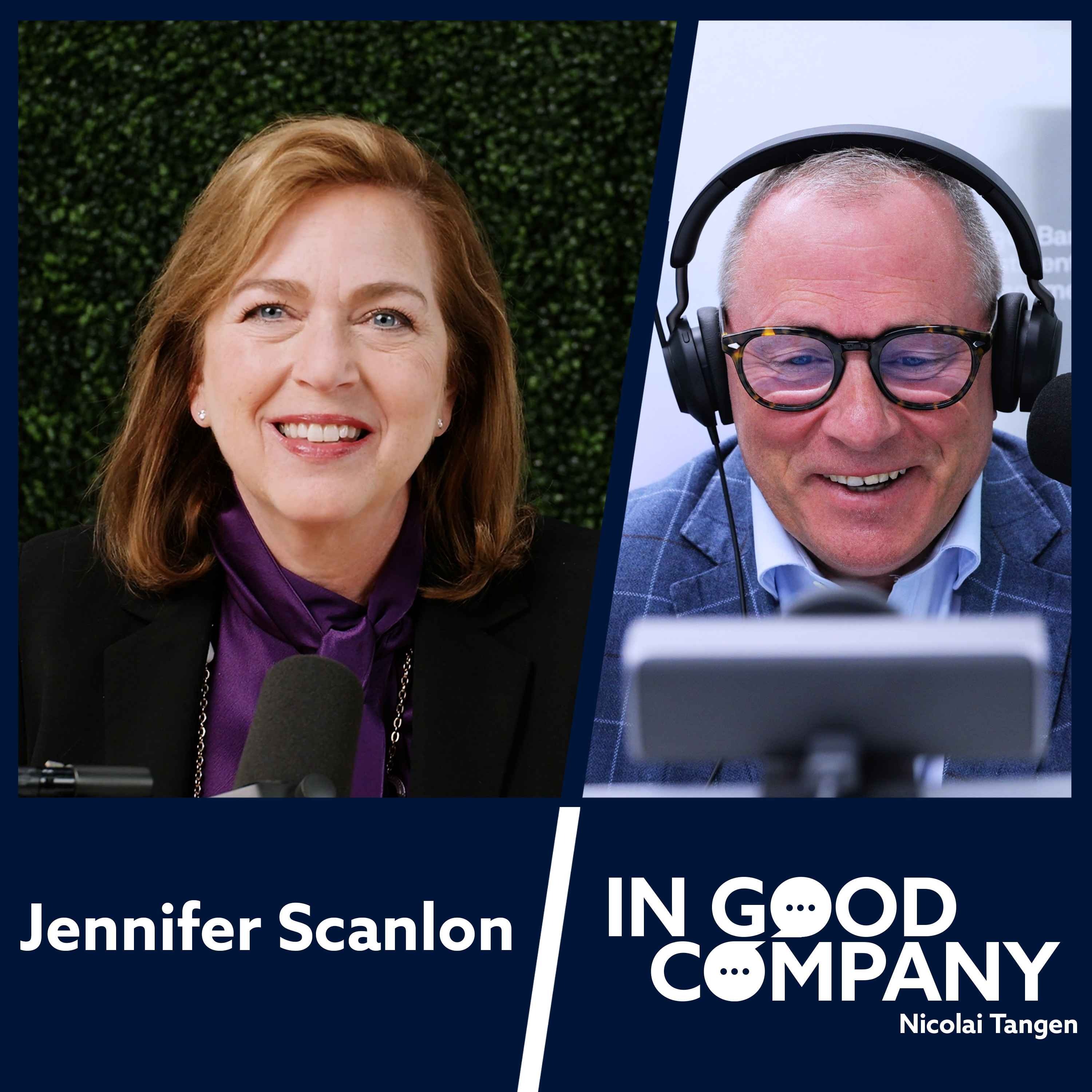
In Good Company with Nicolai Tangen
UL Solutions CEO: Evolving Safety Testing, AI, and Consumer Protection
00:42:40
Loading summary
Transcript85 lines
- [00:01]
A
Hi, everybody. I'm Nicola Tangen and the CEO of the Norwegian sovereign wealth fund. And today I'm in properly good company with Jennifer Scanlan, president and CEO of the remarkable UL Solutions. Now, UL Solutions specializes in safety testing across a wide range of areas, from household appliances, industrial equipment, building materials, medical devices. Lots of interesting things we're going to talk about. And we own 1.6% of the company, equivalent to $160 million. Jennifer, huge pleasure to have you on today.
- [00:30]
B
Oh, it's such a pleasure to be here. Nikol, thrilled to be part of your portfolio as a newly public company.
- [00:36]
A
Absolutely. So let's just kick off with the basics. What exactly do you guys test?
- [00:51]
B
So we test products, and we test products in the industrial space where our customers are in the B2B environment, and we test products in the consumer space where our customers are really in the B2C environment. And then we have have a whole set of offerings of software and advisory services that help those customers have better usage of the data and some of the advisory services that they need to get their products to market.
- [01:18]
A
Now, how do you test? What kind of things do you do with the products?
- [01:23]
B
Visiting our labs is always such a crowd pleaser. We do things like we drop things from six feet high, see if they break, we break things. We may try to put an anvil on top of, let's say, a helmet for personal protective gear. We try to blow things up. Our fire labs here at Northbreak, at our headquarters, we're constantly lighting things on fire. And then all over the world, we're trying to ensure that the way that products are used over and over again meets a set of standards. We may stick a boot in a pool of water for 48 hours with sensors inside to see if there's any leakage, anything you could possibly think of to test a product. We probably do.
- [02:11]
A
And why is the testing market growing?
- [02:14]
B
The testing market's growing for a number of reasons, and it's really driven by, I would say, the amount of transparency that consumers now have. We all want to keep ourselves safe, our family safe, our children in particular, safe. And there's a lot of information that's available. So you think about 50 years ago, nobody was paying attention to things like volatile organic compounds, VOCs, and how much of you know that new car smell or new carpet smell, what that was actually doing to our lungs or our bodies? And so as consumers have more information about products and they want better assurance that those products are safe, secure, sustainable, you know, additionally, as the confluence of technology comes Together you have second order effects of safety. So a component in and of itself might be safe, but when you weave it together into a larger system and then add software to that system, lots of things can go wrong. So it's, you know, this exponential explosion of the things that you have to think about when you're testing product safety.
- [03:27]
A
So give some more examples of the stuff that we're testing today, which we didn't test, let's say 10, 20 years.
- [03:32]
B
Ago, you know, to start with, I mean, let's just start with the confluence of now AI and the way that that's being embedded in products. I was at one of our largest retail customers a year ago and launching our Retail center of Excellence in Arkansas. And they said to us, hey, there's AI embedded in this kid's toy. How do we think about this? And you know, on one hand, you know, an individual toy with a, you know, couple pieces of algorithm in there may or may not present a safety hazard. But when you start thinking about the ways in which AI can power industrial controls or change the ways in which decisions are made about the use of software in a complex vehicle, now you have to start thinking about how do we validate that those algorithms were using the right data, how do we consider the functional safety, the second order effects of the way that those products are connected, and how do we just think differently about this entire kind of integration and confluence of technologies. So that's our most state of the art extreme. But even on the other extreme, something as simple as wire and cable, we'll test the efficacy of wiring cable. And I had a customer call me a little over a year ago and say, hey, the standards and the way that we're testing, that worked back in the 1950s and 60s when contractors installing that cable used these types of tools. Well, fast forward, technology has changed in the ways in which buildings are built, the ways in which contractors work. And so you should change your test methods, you should think about changing the standards and advocating on our behalf for that. And we did that. And that recently just got published as an update. So there's just a constant evolution because of technology in the ways in which you need to test things and the types of testing we do.
- [05:42]
A
Is there much difference between the various geographical areas? So do we test more in Europe, for instance, than you do in the.
- [05:49]
B
US The US is certainly the most highly regulated market. In fact, the US in many cases requires third party testing. Not every market requires third party testing of distinct products. But the US has a much greater amount of third Party testing requirements. And that's from regulations, but it's also from the way our insurance industry works. And it's also, quite frankly, our tort system here. And so that third party testing can really protect manufacturers in addition to protecting consumers. So that's, you know, that's kind of how we think about it all over the world. As a manufacturer, you're trying to get products into multiple markets. So you're looking for what's the common denominator of tests that can get your product all over the world and then what's distinct for each market. And we help our customers maneuver through all of those regulations.
- [06:48]
A
So if I test for something in America, I can sell it in Europe, let's say I have a toy.
- [06:53]
B
If you test for it in America, it's highly likely it will pass all of the European standards, but not necessarily, and I'll give some great examples Even in the U.S. minnesota a couple years ago changed some regulations around use of, I want to say, cadmium and lithium in products. And so all of a sudden, you know, if you wanted to sell your product in Minnesota, you had to meet these extra tests. Well, no manufacturer is only selling into Minnesota. They're selling across the United States and then thinking about Europe. And so they start testing maybe a broader array than they otherwise would have needed. So again, we help our customers think about what's the full set of markets you want to get your product into. What's that set of tests that meets those criteria? How do we do that? Most expeditiously, so that when that product lands in customs and the customs agent is looking for the certification, they know that it's passed that test for that market.
- [07:54]
A
What's the weirdest thing you test?
- [07:56]
B
What's the weirdest thing we test? I'll tell you the most. One of the most fun things we've tested. Two years ago, we stacked up 2 million soda pop cans in our large scale testing lab. And you know, our team probably worked, you know, a good portion of a week just to get those stacked. And then what happens is somebody walks through the middle and drops a lighted piece of paper and walks away. And we've got all these sensors and we're behind glass and they waited to see what would happen. And, and in that particular test, and I don't even know whether they were testing labels or aluminum or the warehouse itself. I don't, I don't even know exactly who they were testing on behalf of, but what they thought was gonna happen was that those aluminum cans would collapse upon themselves from the heat. Instead they exploded outwards, failed test. But a lot of information for that customer in determining how they needed to either, you know, again, manufacture that container or build out that warehouse to hold those types of products.
- [09:02]
A
Now, one of the reasons we think testing is a good industry is because it's relatively cheap thing to do and it has huge implications for the product. Right? So these kind of things, what do they cost? What does it cost to test something?
- [09:17]
B
It can range, you know, if you're, if I'm rubbing, you know, my sweater 10,000 times, that has to be in and out in the lab in about three days. And it's a pretty low cost test. If you're testing, let's say, a product that's going to 26 markets around the world and it has a big life or health safety risk, you know, that can cross into, you know, a much greater part of new product development, you know, into the hundreds of thousands of dollars range.
- [09:52]
A
If you sell something that you have imported from some emerging market, do you have to test it in the U.S. do you have to have local testing?
- [10:02]
B
No, you have to have passed the US Tests. And this is why we have labs all over the world. So we try to be close to our customer because in a lot of cases, if a test fails, they're going to want to go back to their research and development organization, their new product development team, and make the right adjustments. So we have labs all over the world to be close to our customer and those labs know how to test to the US Standards, to the EU standards, to local market standards in every country around the world.
- [10:35]
A
How many people do you have?
- [10:37]
B
15,000 in, yes. And that launches us into 110 markets around the world.
- [10:46]
A
Any new regulatory requirements that you are particularly excited about?
- [10:52]
B
I think the one that we're most excited about right now is we were named the lead administrator on the US Cyber Trust. Mark and I view this as probably version one of the type of product cyber safety that consumers are looking for today. As a consumer, you really don't have good evidence that that product has been tested. So, you know, you always hear the horror stories of like the baby monitors and being hacked into, but more broadly, giving consumers a view a lens into the fact that the products that they're purchasing have passed a certain set of, you know, validation and standards to make them safe. So, so we're excited about that. That's something new that the FCC has chosen us as the lead administrator. I think the other testing, when you move to the other extreme, lithium ion batteries, the electrification of everything is such an important topic. And we saw in New York City alone over a dozen deaths a couple years ago from lithium ion batteries and E bikes spontaneously combusting. And that can be prevented, and it can be prevented by following some UL standards around the battery enclosure, around the connector. And we worked with the City of New York to turn those standards into law. And as we've seen some recent data, it's evident that the number of deaths have reduced pretty significantly as a result of those standards being put into law. So those are the things that I think are the most fulfilling for our 15,000 employees is really seeing the evidence that we are working for a safer world.
- [12:44]
A
The fact that global trade seems to be going a bit in the wrong direction now. What are the implications for you?
- [12:50]
B
Yeah, for us, it's really the implications for our customers. And I like to say our customers are really smart and they've been worrying about this for almost a decade. When the first set of tariffs started shifting under the first Trump administration, customers started making different decisions. They make different decisions about their raw materials. They make different decisions about their suppliers and their supply chain. They may value engineer their products and swap out components. They may move the location of their factory. In many of those cases, it does require that product to be retested to a new standard based on those new designs or those new manufacturing parameters. So we just stay by our customer side to help them maneuver through the decisions that they're making in response to the shifting tariff climate.
- [13:48]
A
Who do you compete with?
- [13:51]
B
Our competitors. It's a fascinating industry. Just in product testing, we estimate that there are tens of thousands of companies. You can be getting a PhD at a university and come up with a testing protocol for the specific product or use of what you're studying. And you could be a competitor to us, or you could be a large European publicly traded company that has similar longevity to what we have. We've been in business 130 years and some of our competitors have as well. This is a long standing industry. Again connected to insurance and shipping originally, but moving into, as the industrial environment evolved and then consumer awareness evolved and global trade evolved has really opened it up. So we've got competitors all over the world.
- [14:51]
A
And why do they choose you? Is this reputation or price or how does it work?
- [14:56]
B
I think our customers, first and foremost, they want to know that they can get their product to market quickly and safely. And UL has the longest reputation and I believe the most recognizable brand in the North American markets. So the first and foremost question we get from customers is really, you know, they call do you have the technical expertise for this, you know, new product or all new and improved the next generation of product? The next question they ask is can you get it done quickly? And then they want to know how much does it cost us? But getting that product to market, you know, I spent almost 20 years in manufacturing. When you're investing in new product development and you want to get a product to market and there's a delay because of testing, that's really frustrating. That's when the CEO picks up the phone and is really pushing that new product development team on where the heck is it? Why aren't those trucks shipping? So we need to be right there by our sides and making sure that we're the facilitator, not the bottleneck in our customers processes.
- [16:08]
A
You mentioned you'd been in business for 130 years now you came in, I believe in 2019. What have you done with the company since you took over?
- [16:18]
B
When I joined in 2019, UL was for profit, but we were privately held by a single shareholder who was a not for profit. So it was a little unusual structure and one of the reasons.
- [16:30]
A
So was it like a sleepy, Was it like a sleepy company?
- [16:33]
B
It was a company that actually prided ourselves in being under the radar. So there was this opportunity to introduce the UL story to a broader population. One of the things we did was we rebranded. So we were UL Inc. When I joined. And in the process of thinking about becoming public and in continuing that consistency and continuity of brand with our not for profit affiliates, we rebranded as UL Solutions and created the Fun Mobius logo and launched that at the beginning of 2022. So that was exciting. But where I had to start was really taking a company that had been for profit for about seven years and having them start to think about what would be the same and what would be different if we had more than one shareholder. Because I knew that that was the likely outcome and that our singular shareholder was looking to monetize part of their position so that they could build an endowment and focus on their primary safety science research in the areas that they're really focused. So bringing our employees along without a strategic decision having been made about which direction the parent company was going to go in was an interesting exercise. We had to start talking about shareholders or the shareholder and start thinking about how do we aim for best in class return, start thinking about how do we tell this story in a way that is understandable and exciting to investors. And that was fun for me as a new CEO to join and to have that opportunity.
- [18:21]
A
What do you think being a listed company has done to the culture? Has it changed much?
- [18:28]
B
It's absolutely changed. And I think even the process of getting to that changed us. But one of the greatest things that being listed has done for us is it really has taken us above the radar and it's helped us attract talent. I think it's helped extend our brand and our value with our customers. And certainly it positions us with the capital markets for growth in the future in an industry that's, that's large and fragmented and growing now.
- [18:58]
A
I believe you are also a big user of data analytics. And just how is more data and data analytics changing the way you test and go about your business?
- [19:13]
B
There's a couple different ways we think about data and analytics. Almost 10% of our revenue is from software. Software is a service that we sell to our customers. And a great example of that is one of my favorite pieces of software is focused on having ingested all of the chemical information from material safety data sheets into a system, using that data to help retailers understand how they live up to regulations around the transport, the sale or the disposal of products containing chemicals in their environment. But what our retailers have discovered and where we help them is there's lots of derivative uses of that data for their environment. We're constantly thinking about how do we help those large retailers better use that data? And that's just one slice of the data we have. We have 80,000 customers. We've got information on billions of products. Helping our customers better use that data to stay ahead of regulatory requirements or think about other derivative uses, both in sustainability reporting or scope 2 scope 3. How it traces back through their component manufacturers or their raw material suppliers is an exciting opportunity. The other way we're thinking about data and analytics is when you look at the future. We have some customers we were just talking with a couple of weeks ago, some of the, you know, leading technologists in the world and their focus on the industrial metaverse. And you start looking at the opportunities for the way in which digital twin and simulation and other uses of data can help them work through that new product development process faster with better results is an area we're really focused on.
- [21:13]
A
So when you look at AI, you mentioned that you are testing for the use of AI in some products. Could you elaborate a bit on that? How do you do that?
- [21:24]
B
Well, with regard to AI, we launched a verified mark, as we call it, last fall, focused on AI PCs and AI servers. And we put together a list of let's just call it 10 categories that we work with our customers to walk through to, to achieve that mark that can go onto a product. Additionally, those customers as well as many others have come to us and asked us to think about, given that there aren't any standards or real regulations around this today, what should they be thinking about? So we've been convening different groups of customers to work with our AI scientists around. How should we be better thinking about what they should be building into their products as well as how we can help them advocate for regulation that's sensible and meets the needs of a pretty rapidly changing, ever evolving technology. It is something I still believe we're in. You know, we're in early stages of AI and we're barely even on the roadmap on quantum. We can go there too. But all of these technologies really do change the ways in which humans are going to interact with products, but also the way products are going to interact with each other and that second order effect of functional safety and the way that AI is powering or directing or concluding how that product is going to work. It's an exciting opportunity, but it's also daunting. There's a lot that we don't yet know.
- [23:05]
A
How do you use it in your company to simplify and automate?
- [23:10]
B
There's a number of different ways back to, you know, that software I was talking about on the the view for the retailers of chemicals. One of our largest retailers came to us and has asked us to help them with, you know, what I would call, you know, the metadata about every product that they could possibly sell through their portals and then could possibly be returned to, well pre AI. That would take a team of people an extraordinary number of hours, let's say, to put in 500 attributes about a product with AI you can reduce the time to do that dramatically. And so that's one just particular use case of how we're working with one customer. We're also really focused on the use of AI in thinking about the ways in which we can help our customers reach faster conclusions about whether or not their product is safe. So a really good use case that we're focused on right now is plastics. Plastics that are, you know, on printed circuit boards or surrounding, you know, consumer technology. That plastic has to sit in a long term thermal aging oven. It could sit in there for 12 months, 18 months before it's passed all those tests. And so thinking about how do we get data sooner about how it's performing in this kind of static environment to help draw those conclusions faster. So we're applying AI across the board in all of our areas.
- [24:48]
A
Do you think it will replace actual testing? The fact that you have a digital twin and can can show the results? I mean, for instance, now you can crash cars digitally, right?
- [25:05]
B
Yeah. I think over time there's always opportunities for the digital to replace the physical. I also think that there will continue to be these connection points that will be difficult to simulate in really high risk situations. I think for a while there will continue to be the need to do both. But it's something that we all have to stay ahead of and make sure that what we're doing meets regulators needs as well as customers needs.
- [25:46]
A
Jenny, moving on to leadership. You have been running both manufacturing company and, and now a global safety organization. How has your leadership style changed?
- [25:56]
B
It definitely evolves. There's a big difference between becoming CEO at a company where you had worked for 14 years and being a new CEO to a new company in a new industry, quite frankly. And I frequently say to my team, kind of what got us here doesn't get you to there. When I was named CEO at USG Corporation, which was publicly traded at the time, you know, I knew the team, I knew the business, I had visited every plant in the world. I knew our customers, I knew the relationships. But we still had the opportunity to sharpen and hone our strategy. And I had the opportunity to spend time with our largest shareholders and hear what they thought about coming into a private company as CEO. It gave me the latitude to learn the industry, to learn the team, to learn the company, to get out there and visit. And we had one shareholder. So spending the time to think about what types of shareholders would be most attracted to our business model and how did we get out there in front of them to have them support our ipo, that was an interesting kind of leadership assessment, an interesting way to shape my leadership team into thinking about our next stage of growth. So the leadership has definitely my leadership, my style has definitely evolved over time. And it is different depending on the circumstances that you're in. I think the longer you're in this chair, the less patient you become.
- [27:35]
A
Why is that?
- [27:36]
B
I think you see patterns and I'm a pretty decisive person. And when you start to see a pattern of something that is familiar, that you've already decided three years ago or five years ago, you've seen this before, you just become less patient about getting to that conclusion and having it executed.
- [27:59]
A
Is that about people?
- [28:02]
B
I think it's people, but it's more than that. It's relationships with the board, it's relationships with shareholders, it's relationships with customers. I think being decisive and having a bias toward action and moving with speed is extremely important. And it's probably why I've become less patient over time.
- [28:27]
A
I kind of thought that age brought some patience.
- [28:34]
B
I had a stone on my desk for years that somebody gave me with the word patience written on it to remind me that I needed it. So I'm not sure I ever had it. So aging may have helped with some perspective there, but it's not something that I've ever been known to have.
- [28:55]
A
Are you a better leader now than you were?
- [28:57]
B
Absolutely. Absolutely.
- [28:59]
A
In what ways?
- [29:01]
B
I've learned one of the challenges of leadership, particularly when you're named CEO, is how your voice carries and learning the lesson that you can say something and it's interpreted in a really unintentional fashion. And, yeah, I've told this story a number of times, and it really hit home for me early in being a CEO. So I was at my former company. I got in the elevator, and I was with one of our engineers who was from a plant, and he was wearing a really nice Carhartt jacket, and it was embroidered on the sleeve. They had won best employer for the region. And I said, wow, that is a nice jacket. That is so great. You guys won that award. And, wow, what a nice jacket. Carhartt jackets are really nice. And he said, thank you. 45 minutes later, I got an email from the plant manager that said, hey, Jenny, what size are you? And I thought, well, I wasn't trolling to get a free jacket. But then I realized that my voice carried. My voice carried, that that engineer felt seen and heard, that he called his boss to say, hey, Jenny complimented us in the elevator and that that mattered. And it really taught me this lesson that you can say things and people interpret it different ways, and you want to make sure that they're, as much as possible, interpreting it in the way that you intended, and so to be very careful about your voice, that it can't be used in an unintended fashion. And that's something I've become more deliberate about as a CEO than I was in my early days.
- [30:51]
A
What are some of the ways you use it in an intended fashion?
- [30:57]
B
It's funny. My father was a high school football coach, and he had colorful expressions and great language, but he was a pretty tempered guy. And I remember the story. I tell the story. I remember a time at a big game, and he threw his jacket in the air and he was, you know, yelling at the ref, and the next morning, we won the game. And the next morning I said to him, like, wow, dad, you were really mad. And he said, no. He said, but sometimes you got to throw the jacket. They need to know that, you know, that they got it wrong. And I think that using your leadership voice effectively to, you know, respectfully and honestly point out where there's opportunities for improvement. Sometimes you gotta throw that jacket. Most of the time you don't. And if you throw it too often, people will stop paying attention to it. And so it's just. It's. I think about my father often, and I think about that story, and it's, you know, every once in a blue moon, I think it's time to throw a jacket. But most of the time, you find another way to communicate appropriately.
- [32:13]
A
What about using the voice in the opposite way? So compliments and praise. I think that's one of the most incredible things by having. Being a leadership position is just how you can use it to really see people, lift them up. A compliment from you means more than from some other people. It's a wonderful thing, right?
- [32:35]
B
It is, it is. And I'm going to give two different examples of times where I've. I really felt this and agree that it's very important. One was long before I was CEO, I was CIO at my former company, and we were doing awards for employees across the organization. And a woman that received an award, who I had spoken about afterwards, wrote me a note. And the note said, jenny, I knew I was getting the award. I knew that you were going to announce it, and I knew you were going to say a few words about me. What I didn't know was how good it was going to make me feel and how long I continue to feel that way. And I've always kept that note because I think it's a great example of people never forget the way you make them feel. One of the things that I continued to do when I joined UL that my predecessor had done was send a blog once a week to all employees. And I'm insistent that, you know, it's just. It's whatever's on my mind, it can tie to what's happening in the company. But one of the things I really like to do, if I've been out traveling or if I've been in a meeting and somebody's presented something interesting, I really like to showcase and highlight our employees just through my blog. And I get some great notes back from people of, wow, thank you for noticing or oh, our team was so proud that you mentioned them and that positive reinforcement. I mean, we've got 15,000 employees. I always say everybody rolls out of bed every day wanting to do a good job and they want to feel like their work matters and they matter. And the more that I can highlight and showcase that, I think just the better the culture is and the organization is.
- [34:28]
A
Do you think people tell you the truth?
- [34:32]
B
I think the more senior you get in a company, the more deliberate you have to be about finding people who are willing to tell you the truth. I think having people around you, the ones who come in and tell you what you need to hear, whether or not you want to hear it, is extremely important. And knowing who those people are and ensuring that you provide the opportunity for them to provide that input is extremely important. There's a lot of people who only want to tell you what you want to hear, and that is a recipe for disaster.
- [35:06]
A
So we are introducing a new award in our company. It's an ice hockey puck and it's called the straight puck award. And it's basically, it's basically for people who are telling me things. I, you know, the real truth. And I think it's quite fun. We are kicking it off now so you can actually physically give them a puck. You know, it's just like, hey, thanks for the straight puck or here is a straight puck. And so we see how that goes. I think it's quite fun, actually.
- [35:32]
B
Oh, I think that's excellent.
- [35:39]
A
How would you describe the corporate culture?
- [35:41]
B
Our corporate culture is 130 years old. So there's a lot of longstanding traditions as well as habits. We have some employees, they've been here 45 years. 40 years, 35 years. And these are thought leaders and they understand the science and the engineering and the business and they're just really fun and interesting to be around. And at the same time, our culture, grounded, founded by the Underwriters Electrical Bureau, can be risk averse. One of the things and that's good for our customers, our customers always say, like, you know, somebody's gotta tell us the bad news that our product, you know, isn't safe or isn't working. Glad you're here to do that. But balancing out, evolving our culture into, you know, risk appropriate at the right speed is really important. But one of the greatest things about our culture is how connected our employees are to our mission. In our employee engagement survey, over 80, I think 85% of our employees said that our mission matters to them personally. Working for a safer world matters to Them. And I think that creates this unification of no matter what country you're in, what lab you're working in, what customer you're working with, you feel that same sense of purpose.
- [37:05]
A
Now you work for a safer world. And I think you were a lifeguard for seven years. So are you, like, totally paranoid about safety? Are you just, like, one of these people who are afraid of everything or.
- [37:19]
B
I'm not afraid of everything, but I am. My. I have two daughters. They're in their 20s. And when I was named to this job, they said the headline should be, mom, Safety freak runs safety company. And I have always been attuned to managing risk appropriately. Risk management is important. And working in a manufacturing environment, a heavy industrial environment, we mined. We had paper mills, we had wallboard flying off lines at 600ft a minute. Dangerous environments. We had a plant managed, couple people who were missing a hand. And other terrible things can happen to people in these environments. So I've always been attuned to focusing on how do you eliminate unnecessary risks. You know, life is full of risks, but, you know, it's. It's, you know, better to wear a bike helmet than not. It's, you know.
- [38:17]
A
Why do you think your daughters think you are a safety freak?
- [38:20]
B
Because I made them wear bike helmets when they were, like, 6 years old riding their tricycles. But. But I think they also. They know that I've always. And it's probably the project manager in me as well, that you just constantly have to think about, you know, expect the best plan for the worst.
- [38:40]
A
Do you, like, hold the handrail when you go down the stairs?
- [38:43]
B
Three points of contact. Absolutely. And in fact, we do safety moments at the beginning of all of our meetings, and we pick different topics and we leave it up to the leaders. But if you are walking down a hallway with me and I see you on a stair rail and you're not holding staircase, and you're not holding the rail, you're going to hear me say, hey, three points of contact. It will save your teeth. Maybe a concussion.
- [39:13]
A
What is it that drives you?
- [39:16]
B
The thing that drives me. I've always. I've always been a leader. When I was a little kid, I organized the neighborhood into, you know, teams or games or put on the show. I've always wanted to feel like I was making a difference. And every job I've ever had, you know, I wanted to feel like there was a connection into a way that was making the world a little bit of a better place. You know, I'm driven by being a Mother. I look at my daughters and I hope that, you know, they have even greater opportunities than I have had. And I hope that as I'm paying it forward for others in the work environment, that others are doing the same for the next generation, for all of our kids.
- [40:09]
A
What's the first thing you do in the morning?
- [40:11]
B
First thing I do in the morning is drink a cup of coffee. I am a non functioning human being without that caffeine.
- [40:20]
A
When do you wake up?
- [40:22]
B
About five o' clock every day. I was not naturally a morning person, but being in the construction industry for almost two decades turned me into that. And then once I became head of international, having teams all over the world, I've just learned you got to be up that early and check email and make sure that everything is staying afloat everywhere.
- [40:43]
A
What are some important pieces of advice that you have got during the years from people you respect?
- [40:52]
B
One of the biggest pieces of advice is take the time to listen. If you take that time back to do people tell you the truth? If you take the time, you will learn what matters and you will learn what motivates and drives people. So taking the time to listen. Early in my career, I had someone point out to me that I was always in a rush, you know, back to that lack of patience and that sitting down and starting a meeting and, and saying, you know, just taking the, the 30 seconds, you know, hey, how was your weekend? How was your daughter's school play? How was, you know, how's your birthday? What are your plans? And just listening because you can learn so much. And the next great piece of advice that I give to every, you know, kind of post college newly employed is become a really good project manager.
- [41:44]
A
What does that mean?
- [41:45]
B
It's figure out first and foremost what problem are you trying to solve and then how much time does that take? What resources do you need? Do you need money? What issues are going to arise? What risks are out there? What communication is needed with others to get it done, to get that problem solved. And then always come back to did you solve that problem? Was it the right problem to solve? And then how do you close that loop and do it again? Because so many times people solve the wrong problem.
- [42:17]
A
Absolutely. Well, Jennifer, you have solved lots of very important problems over the year. Big thank you for making the world a safer place and a big thanks for being on here today.
- [42:29]
B
Thank you so much, Nikolai. It was such a pleasure to be here.
- [42:32]
A
Likewise, great big thanks.