← Leaders with Francine Lacqua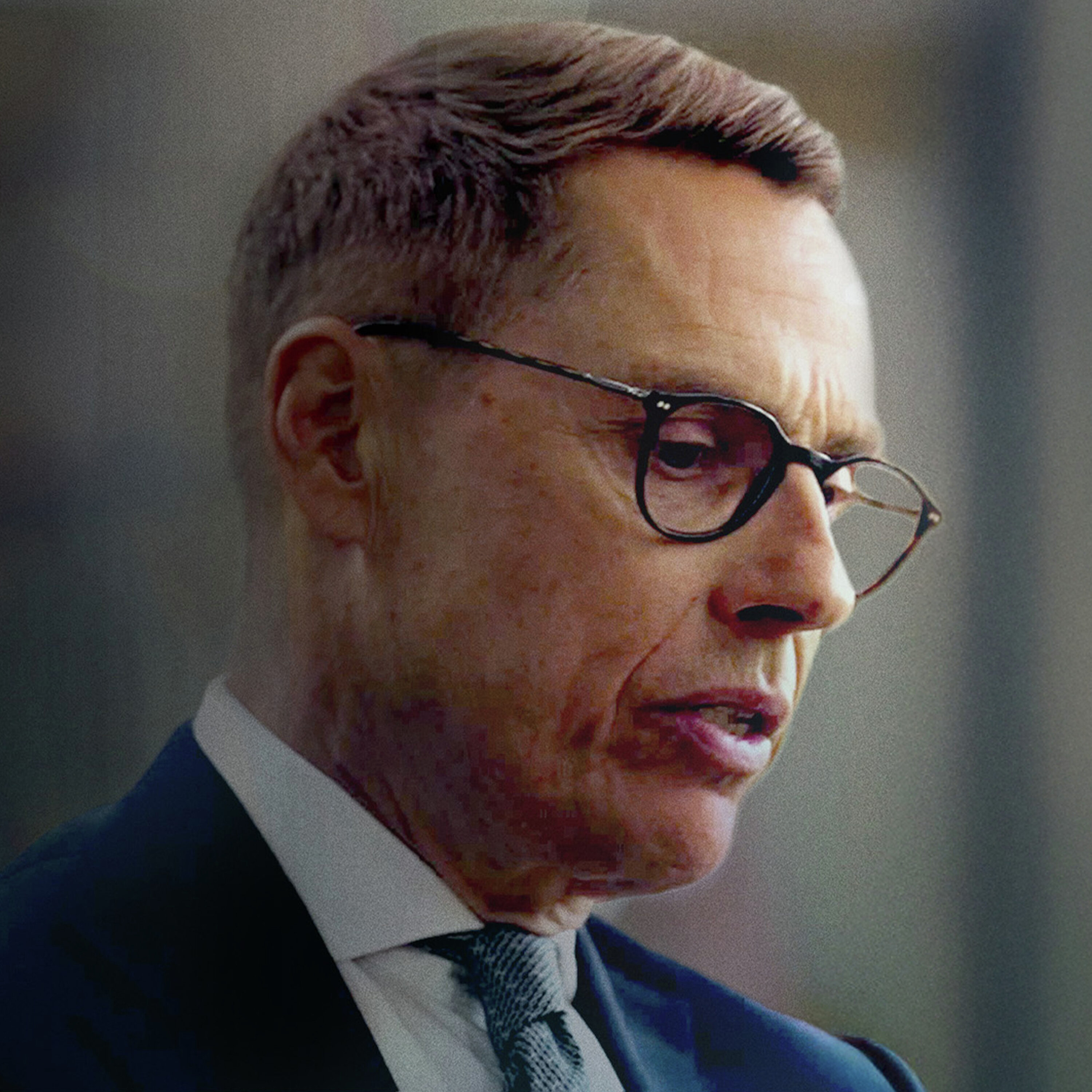
Leaders with Francine Lacqua
Finnish President Alexander Stubb on How to be Resilient in Russia's Shadow
00:38:26
Loading summary
Transcript111 lines
- [00:04]
Alexander Stubb
Every small business owner has that one moment that could have broken them. But remarkably, it didn't. Hi, I'm Ben Walter, CEO of Chase for Business and on season three of the Unshakeables, my co host Kathleen Griffith and I are bringing you more incredible stories of overcoming the impossible. We're really proud to share that the Unshakeables is nominated for Best Branded podcast at the 2026 iHeart Podcast Awards. Listen to the Unshakeables wherever you get your podcasts and learn more@chase.com podcast JPMorgan Chase bank and a member FDIC Copyright 20 and 26 JP Morgan Chase Co.
- [00:40]
IBM Representative
The thing about AI for business, it may not automatically fit the way your business works. At IBM we've seen this firsthand, but by embedding AI across hr, IT and procurement processes, we've reduced cost by millions, slash repetitive tasks, and freed thousands of hours for strategic work. Now we're helping companies get smarter by putting AI where it actually pays off, deep in the work that moves the business. Let's create smarter business IBM from Coast
- [01:10]
Sonesta Hotels Announcer
to Coast Unlock Adventure at Red Lion Hotels by Sonesta where restful, sleep, friendly service and trusted local knowledge are part of every stay, Red lion makes it easy to feel welcomed, comfortable and connected wherever the road takes you. Whether you're traveling for business or pleasure, you can spend less and make more of every trip. When you sign up for Sonesta TravelPass, you'll get their best rates instantly. Go to sonesta.com to book your stay and unlock the best rates with Sonesta Travel Pass here today, Rome tomorrow. Join now@sinesta.com terms and conditions apply.
- [01:47]
Francine Lacqua
Bloomberg Audio Studios Podcasts Radio News hi everyone, it's Francine. At the end of our final in the City episode, I promised I'd be back. So here I am with a taste of a project of mine that launched this this week. It's a new program for Bloomberg Originals Leaders with Francine Lacqua. Now the show is centered around in depth conversations with frankly just interesting and influential people from business, politics, sports, wherever. They just need to be leaders in their industry. They need to be interesting to us and they just need to be honest about their journey to the top. So for the first episode, I spoke to the President of Finland, Alexander Stubbing. He's recently become a very pivotal figure in the negotiations on Ukraine taking on a new importance after he bonded with President Donald Trump over their mutual love of golf. Yes, golf as diplomacy. And according to Trump, Stubb is a very good player they competed against each other in a tournament at one of Trump's golf courses back in March. According to the Wall Street Journal, Trump asked Dobu for lunch if he could trust Putin and stubbed in his frank and honest way, told him, you cannot. Later, Trump then publicly criticized Putin for the first time over his refusal to agree to a ceasefire with Ukraine. So I traveled to Helsinki in May to speak to President Stubb, and we had the conversation in the Presidential palace in the middle of Helsinki in a beautiful ballroom. It's very grandiose and simple. At the same time. You really get a feeling of what it's like to be president there. I tried to learn more about his motivations, and we talked about his life before becoming president. Ultimately, I just want to know how he'll measure his success at such a critical moment. I hope you Enjoy the conversation. Mr. President, thank you so much for joining us.
- [03:48]
Alexander Stubb
My pleasure. Thanks for the invitation.
- [03:50]
Francine Lacqua
Talk to me about resilience.
- [03:52]
Alexander Stubb
It's something I think we in Finland know something about. Actually. It's one of our key words. It's sisu, which is resilience, perseverance, grit, stamina. So you basically, you never give up. You just have to keep on pushing and grinding through the tough stuff. And I think a lot of Finns have that ingrained into the system, because, remember, we're a poor country. First we are under Sweden for 700 years, then under Russia for a little bit over 100. And when we gained independence in 1917, we were basically a poor, developing country. And I think then this sort of idea of resilience let's try to overcome, let's work hard, became very much a part of Finnish DNA. And I think I'm still part of that generation.
- [04:37]
Francine Lacqua
What was your hardest time?
- [04:39]
Alexander Stubb
There were times at school or in university that I found it quite tough, especially probably the first three months of my university years in 1989 at Furman, because, remember that I came from, you know, an essentially liberal Nordic country and went straight into the Bible Belt in South Carolina. And that was a bit of a culture shock, but probably the toughest, toughest time in my life, and it's only my own doing, was, was from 2014 to 2016, when I was prime minister, finance minister, and chairman of the party. Probably not in my comfort zone because domestic politics was never my thing, but I, you know, grinded it out for two years, and when I lost an election, I. I left politics, but I. I left sort of, you know, with a high morale to a certain extent. Lessons learned, and. And my Whole idea was, okay, the time was tough. I learned something from it, and I'll never come back to politics.
- [05:34]
Francine Lacqua
And here I am saying, then, seven years later, here we are. What made you go back to politics?
- [05:40]
Alexander Stubb
Putin. I'll be very frank with you. Had not Russia attacked Ukraine, I would not have run for. For president of Finland. My mission had always been to bring Finland into NATO. And to a certain extent, I felt I failed because I was in a very small minority during the time I was in government, and there wasn't this sort of natural push for membership. But then I realized that, wow, you know, things might happen. And I felt that, you know, I mean, it's almost a little bit corny to say, you know, sense of duty. But we talked about it at home. My wife, because we had decided that we're not going to do politics, and she said, well, perhaps because we might become members of Natum, because the security political situation is what it is, you should reconsider. And then we started reconsidering, and, you know, less than a year before the actual elections, I announced. And then one thing led to another, and here I am.
- [06:36]
Francine Lacqua
I want to ask about your network, because you have an incredible network internationally because you've been around, but also people warm to you, people like you. How do you do it?
- [06:45]
Alexander Stubb
I've kind of had three different careers, and I've gone back and forth. So first I was an academic, then I was a civil servant, then I was in politics, and then I went back into academia. So during those times, you sort of acquire a network. And for me, it's been a global, international network, and I really enjoy it. So I try to go into every situation without, you know, pretext or without the, you know, presumption of someone. And then I'm just myself. And the nice thing is also I come from a small country, you know, and I don't come from an imperialist country. Right. So Finland is kind of inoffensive. You know, people like us, you know, we're okay. And I've been fortunate. For instance, when I was a civil servant, most of the civil servants I work with in Brussels, for instance, they are now ambassadors all around the world from different countries. So it's lovely. You know, I go to a state visit, say in Kenya and Tanzania, and suddenly I find people who'd work with me in Brussels. So that's the kind of a network that you end up doing.
- [07:44]
Francine Lacqua
But are you a people's person?
- [07:45]
Alexander Stubb
Yeah, definitely.
- [07:46]
Francine Lacqua
So it's difficult to be a politician if you're not A people's person.
- [07:48]
Alexander Stubb
Yeah. I think you have to be quite open. And I have to admit, at home, Suzanne and I would discuss about this. I'm very much an extrovert, where Suzanne is more of an introvert. So we complement each other in a good kind of a way, and I do enjoy that part. I think it's an advantage in politics to be an extrovert like I am. And I know that most Finns are not considered to be extroverts, but actually we are. Once you scratch the surface.
- [08:14]
Francine Lacqua
How has that helped with President Trump, President Xi?
- [08:17]
Alexander Stubb
Well, I mean, it helps with everyone to a certain extent. You know, of course, I have a set of people who are in powerful positions or political positions from the past. So Jonas Garstor, the Prime Minister of Norway, he was foreign minister when I was foreign minister. Radek Sikorsky, the foreign minister of Poland, was foreign minister then, when I was foreign minister. So there are a lot of connections. And then, of course, it does come. I think diplomacy is really about two things. It's about state relations, and then it's about personal relations and connections. And then I think it's my job to try to connect with people, and I hope I succeed sometimes. You know, when I was with President Xi, I felt we had a very good and respectful conversation. When I was playing golf with President Trump, we had a really good time. And, you know, I think that's what diplomacy is about. You sort of. You scratch the surface, you're able to have conversations. You don't need to be so formal. You're not in the public eye. And then it's about social connections.
- [09:18]
Francine Lacqua
What was President Trump like on the golf course?
- [09:21]
Alexander Stubb
Very pleasant, you know, very. Yeah, very talkative. You know, we had a good group of five players there. Gary Player was there, Lindsey Graham and President Trump and Trey Gowdy. And, you know, golf is a nice social setting. And again, going back to my dad, I remember my dad being very encouraging and saying, you know, Alex, even if you don't become a golf professional, golf will be useful for you one day. And I was going, yeah, sure, dad. And sure enough, there I was on the first team with President Trump. And, you know, I had a good time. And the fact that you have a good time with someone doesn't mean they agree with him. So, you know, especially coming from a small country, what you want to do is, is you want to, you know, nudge things in the right direction. And that means that you have conversations which sometimes can be difficult and awkward. Sometimes they can be good and then, you know, the rest of it is about getting results. And I hope I get results with my diplomacy.
- [10:18]
Francine Lacqua
But if you have a good time, does it mean that they listen to your arguments more?
- [10:22]
Alexander Stubb
I don't know. You have to ask them. So, you know, certainly I found, you know, if I'm in a context, in a diplomatic concept where someone is arrogant, where someone is aggressive, you know, I sort of switch off. I don't like that. I'm not going to tell you when it happened, but when I was foreign minister, you know, I had a few conversations where I thought, you know, where's this guy coming from? And it's like any human connection, you very rarely achieve anything by being arrogant, by pushing someone too hard. You achieve it by having a nice and cordial discussion. I mean, same thing at home. I even wrote a column once comparing child mining to diplomacy that goes through the similar phases.
- [11:05]
Francine Lacqua
Who's a better golfer, you or President Trump?
- [11:07]
Alexander Stubb
I think we're pretty much equal. But to be honest, he's one of the few players that I've seen playing under his own age. So I was certainly very impressed. And this is not diplomatic nicety. This is what I say behind his back as well.
- [11:21]
Francine Lacqua
What did you learn about him? I mean, is he different?
- [11:23]
Alexander Stubb
Actually, you know, this is the thing, and I've always said this, that funnily enough, and I hadn't really played golf for 35 years. I mean, when I quit, I quit. So. But I've always said it, you learn about the personality of a human being on the first hole of a golf course. You see if they're edgy, if they are impatient, if they're frustrated, if they're fun, if they're relaxed. And I have to say, I had no uncomfortable moments during that round. And we hit good shots and bad shots. So, you know, people are quite different on a golf course sometimes.
- [11:55]
Francine Lacqua
What did you talk about?
- [11:56]
Alexander Stubb
Oh, we talked about a lot of stuff. We talked about golf. You know, we talked about Finnish, US Relations, we talked about Ukraine, we talked about Russia, we talked about different personalities, but in a social context, you know. Yes. You spend seven hours with the President of the United States, it's not going to be a seven hour shop because no one wants that.
- [12:15]
Francine Lacqua
Did your dad call to say I told you you had to continue with golf?
- [12:20]
Alexander Stubb
No, but there was a little bit of a fun episode there because I mentioned when we had breakfast before the golf round to President Trump about my dad. Oh, let's call your dad. But then something came in between that we didn't call him. But there you go.
- [12:32]
IBM Representative
The thing about AI for business, it may not automatically fit the way your business works. At IBM, we've seen this firsthand. But by embedding AI across hr, IT and procurement processes, we've reduced costs by millions, slashed repetitive tasks, and freed thousands of hours for strategic work. Now we're helping companies get smarter by putting AI where it actually pays off, deep in the work that moves the business. Let's create smarter business.
- [13:01]
Public Investing Announcer
IBM Support for the show comes from Public Lately it feels like there are two types of investing platforms. Some are traditional brokerages that haven't changed much in decades, and others feel less like investing and more like a game. Public is positioned differently. It's an investing platform for people who are serious about building their wealth on public. You can build a portfolio of stocks, options, bonds, crypto without all the bugs or the confetti. Retirement accounts? Yep. High yield cash? Yes again. They even have direct indexing. Public has modern design, powerful tools and customer support that actually helps go to public.com market and earn an uncapped 1% bonus when you transfer your portfolio. That's public.com market and paid for by
- [13:46]
Alexander Stubb
Public Holdings Brokerage Services by Public Investing Member FINRA SIPC Advisory Services by Public Advisors SEC Registered Advisor Crypto Services by
- [13:55]
Public Investing Announcer
0/ all investing involves risk of loss.
- [13:57]
Alexander Stubb
See complete disclosures at public.com Disclosures Sonesta
- [14:01]
Sonesta Hotels Announcer
Travel Pass makes traveling more rewarding Designed to help you get more out of every stay. Sign up@sonesta.com to enjoy instant savings, bonus points and valuable perks like early check in, late checkout, room upgrades and free stays over time. With Sonesta TravelPass, every stay brings you closer to your next reward. Choose from more than 1100 hotels across 13 distinctive brands and unlock the best available rates. When you book direct with Sonesta Travel Pass. Here today, Rome tomorrow. Join now@sonesta.com Terms and conditions apply.
- [14:36]
Francine Lacqua
I want to ask about your father. He was someone that had a huge influence on your life. What was he like?
- [14:43]
Alexander Stubb
Yeah, definitely still is. He's 90 years old. He was the chief talent scout of the National Hockey League in Europe. So very much an ice hockey family, if you will. My dad was a big influence in the sense that he taught me a lot of things. He's tried to teach me patience. I don't know if that good. He's always taught me curiosity. He's a very relaxed guy. He's a lot of fun to be with and he's full of life. Still at a tender age of 90.
- [15:11]
Francine Lacqua
So you're naturally curious, but not naturally patient.
- [15:14]
Alexander Stubb
Yeah, I think that's what my wife would probably say. Always curious and with an open mind and trying to understand things and learn something new every day. And I think that's something that my, my dad certainly taught me.
- [15:26]
Francine Lacqua
Well, you have two children. What do you think about parenthood?
- [15:30]
Alexander Stubb
Well, parenthood is really cool, especially now the kids are 21 and 23 and studying in the UK. But I mean, obviously with Suzanne, we sort of split the job. But I've always said that it's 75% her and 25% me, basically because of my job. But we've tried to install certain set of values to the kids and make them good citizens, if you will. But most of all, it's a lot of fun to be with them. And we're very proud of what they do. We're very proud of what they've achieved in life so far. And we used to have these four things that we told them. You know, dream, believe, work hard and succeed. And dreaming meant, you know, dream big, don't worry about it. Believe, believe in yourself, work hard, always. But success for me and to the kids is about meaning. Not about societal status, about money or titles. It's about leading a meaningful life. And if the kids come out of this life with that set of values, I think they'll be good.
- [16:30]
Francine Lacqua
What's a meaningful life to you?
- [16:31]
Alexander Stubb
For me, it's about helping others, I think, of course, we all strive towards happiness. That's kind of an Aristotelian thing to do. But happiness comes with meaning, and meaning comes usually from being kind to someone else. And I found that in my life, perhaps not so much in politics, but in other lives, that I find myself getting meaning if I see that someone has, you know, changed their behavior or, or gotten something from something I've said, and. And for me, that's a meaningful life.
- [17:06]
Francine Lacqua
Were you always like that? A sense of duty?
- [17:08]
Alexander Stubb
No, no, not at all. I was very much into sports when I was a kid. You know, first I wanted to become a professional ice hockey player, but my dad probably saw that it's not going to work with that one. Then I wanted to become a professional golfer. That's why I actually went to study in the States. And my sort of mission or academic life or, or meaning, purpose only started pretty much at the age of 21. I mean, before that, I lived in, you know, teenage abyss, I guess, in. In many ways. And, and if you had asked my friends in high school or elsewhere that, you know, will Alex go into politics or will he become president? They would have probably laughed.
- [17:44]
Francine Lacqua
What changed?
- [17:45]
Alexander Stubb
I don't know. It was probably just this sort of idea of learning. And, you know, I was okay in school, you know, in the lower grades. But then when I went to Furman University in Greenville, South Carolina, you know, I had professors that inspired me. They became mentors, you know, Brent Nelson, RST Tessitor, Don Gordon and many others. And they sort of nudged me in the right direction. And I must admit that when I get excited about something, I get sometimes a little bit over excited. But it was good because from 1989 to 1993 at university, I was over excited about studying. And that sort of, you know, Furman changed my life.
- [18:28]
Francine Lacqua
How has the US Changed since you were at Furman?
- [18:31]
Alexander Stubb
Yeah, it has definitely changed. I mean, for me, of course, as an avid pro American, the US Was always the guarantee of security and peace in Europe and the world. And of course, there was a isolationist moment of the US before World War I, and we saw where that led. There was an isolationist moment before World War II, and we saw where that led. But then after World War II, it was America essentially that created the current structure of global institutions that we have. And it's been a world police, for better and for worse. You don't have to agree with everything that America does, but it has led the world and it certainly led the Western world. And now it's a question of is it going to sustain that position. And usually these are long range things. These are not, you know, four years or eight years or 12 years. And I also think that there's always a president in the United States that changes future presidents, you know, Franklin D. Roosevelt, the New Deal, you know, that led to an American policy which lasted for decades. Reagan and Reaganomics, that led to an American policy which lasted for decades. And remember that Reagan was talked down when he started, and at the end of the day, he became the savior of the free world and free markets. And I actually think that Trump already in 2016, changed American policy to America first. And then it just, you know, we have to look at where America first leads. I, of course, hope that it's at least Europe second.
- [20:07]
Francine Lacqua
But where do, when do we know where America goes?
- [20:11]
Alexander Stubb
You know, we don't. We can't. You know, we can't. Years, decades, it'll take a while to know. Exactly. And you know, we Finns are very pragmatic. So what we try to do is to influence the things that we can influence. You know, we cannot change the mind of the President of the United States or the administration. That administration has been chosen in democratic elections by the American public. And this is a policy line that they have chosen. It has some good elements which we like. It has some elements which we like less. But we try to influence the elements which for us are important, important, like finding peace and ceasefire in Ukraine, you know, like keeping America engaged in Europe and in, in NATO and making sure that America has a strong voice in the world.
- [20:58]
Francine Lacqua
So to Kissinger's very good question, if I need to speak to Europe, who do I call? What's your answer?
- [21:03]
Alexander Stubb
Today? There are quite a few numbers for,
- [21:06]
Francine Lacqua
for France, press one for two.
- [21:08]
Alexander Stubb
Yeah, exactly. But I do think that, you know, we are seeing strong European leadership, you know, from the uk, from France, from Germany, and also from the EU institutions. I think the president of the European Commission is very strong. Remember that the EU has exclusive competence on trade, on competition, on monetary policy. So we don't have like one European leader, but we have a triumvirate, at least that is leading Europe.
- [21:37]
IBM Representative
So there's a lot of noise about AI, but time's too tight for more promises. So let's talk about results. At IBM, we work with our employees to integrate technology right into the systems they need. Now a Global workforce of 300,000 can use AI to fill their HR questions. Resolving 94% of common questions, not noise. Proof of how we can help companies get smarter by putting AI where it actually pays off, deep in the work that moves the business. Let's create smarter business.
- [22:06]
Public Investing Announcer
IBM Support for the show comes from Public. Lately it feels like there are two types of investing platforms. Some are traditional brokerages that haven't changed much in decades. And others feel less like investing and more like a game. Public is positioned differently. It's an investing platform for people who are serious about building their wealth on public. You can build a portfolio of stocks, options, bonds, crypto without all the bugs or the confetti. Retirement accounts. Yep. High yield cash. Yes again. They even have direct indexing. Public has modern design, powerful tools and customer support that actually helps go to public.com market and earn an uncapped 1% bonus when you transfer your portfolio. That's public.com market and paid for by Public Holdings.
- [22:52]
Alexander Stubb
Brokerage services by Public Investing member finra. SIPC Advisory services by Public Advisors SEC Registered Advisor. Crypto services by zerohash.
- [23:01]
Public Investing Announcer
All investing involves risk of loss.
- [23:03]
Alexander Stubb
See complete disclosures@public.com Disclosures from coast to coast.
- [23:07]
Sonesta Hotels Announcer
Unlock adventure at Red Lion Hotels by Sonesta Where Restful sleep, friendly service and trusted local knowledge are part of every stay. Red lion makes it easy to feel welcomed, comfortable and connected. Wherever the road takes you, whether you're traveling for business or pleasure, you can spend less and make more of every trip. When you sign up for Sonesta Travel Pass, you'll get their best rates instantly. Go to sonesta.com to book your stay and unlock the best rates with Sonesta Travel Pass. Here today, Rome tomorrow. Join now@sinesta.com Terms and conditions apply.
- [23:40]
Francine Lacqua
You feel like a true European at heart. Is that fair?
- [23:44]
Alexander Stubb
Yeah, very much so. I mean, of course, in the heart of my heart, I'm Finnish, then I'm Nordic, and then I'm European. So I always say that I kind of, you know, have my roots in Finland. My sort of tree trunk or stub, I guess tree stub is European. And then I hope that my sort of branches are global. So I think very internationally about things, but I'm very adamant about my Finnish roots. And it's probably different for someone who. Well, it's not different, but I come from a country where there are two minority languages, Finnish and Swedish. And when you have those languages, they're very, very strong part of your identity. And that sort of, you know, brings it home in a different kind of a way.
- [24:28]
Francine Lacqua
But do you worry about society splintering, the rise of populism? Yeah, definitely not being able to talk to each other.
- [24:34]
Alexander Stubb
Yeah. I mean, one of the things I keep on talking about here in Finland as well, and I did in my New Year's speech as well, is to say that, you know, what we have to avoid is the polarization of society. We have now the technological instruments to polarize as much as we can, because we can kind of start living in not only alternative realities, but in alternative truths. And that's very dangerous for democracy because if you don't have basic agreement of what facts are, say on science or otherwise, then you cannot have a democratic discourse. And we have to try to avoid that. We're seeing some of it, obviously, in the United States, but it's not only the United States. United States. We're seeing it in many other liberal democracies. Finland is a small country. We can't have, you know, we can't have that. And that's why I try to say that, you know, try to tone down the language a little bit, try to avoid polarization, communicate, have dialogue rather than judge.
- [25:30]
Francine Lacqua
But what's the solution, especially for politicians that want to make a difference, that want to, I Guess, bring people together.
- [25:36]
Alexander Stubb
Well, I mean, for politicians, I think, to be honest, it's politicians and media, because media has a lot of power today and media freedom is the foundation of any democracy and freedom of speech. But politicians, they have to think about how they express themselves. What kind of a role model do they show? Because, say, if the president of Finland would start cussing on Bloomberg and condemning and pointing fingers at people, then that kind of gives a carte blanche for other people to do it as well. And probably easy for me to say as the president of Finland, but in parliamentary debate, it's okay to clash a little bit. But think about how you clash. What kind of an example do you set? What is the behavioral pattern that you're trying to communicate? And it goes to social media as well.
- [26:29]
Francine Lacqua
But it's changed completely.
- [26:31]
Alexander Stubb
It has.
- [26:32]
Francine Lacqua
You grew up in an era where globalization was an opportunity and now people are looking more inwards.
- [26:39]
Alexander Stubb
True, but you could say that I was born into a world, the Cold War, where there was a clear ideological split between the east and the west, between hypothetically or really communism and capitalism, authoritarian regimes and freedom. So the world was very polarized on a global kind of a set. And then we sort of had this holiday from history, and I'm a big fan of Fukuyama and the end of history thesis. And remember, I started studying in 1989 when the Berlin Wall fell in November, and then the Soviet union collapsed in 1991, and there was this sort of basic assumption that, hey, the whole world is going to be a combination of liberal democracy, social market economy and globalization. Then, of course, at some stage, we sort of woke up and smelt the coffee and realized that actually the world was not going to be all about green fields and rainbows and peace signs. And for me, of course, the sort of turning point was not only 911 or the financial crisis 2008, but probably Russia's attack on Ukraine in 2022. And we're now starting to see the change of a world order.
- [27:54]
Francine Lacqua
But you say in 2008 you saw Russia change.
- [27:57]
Alexander Stubb
Yeah, I mean, so for those of you who didn't follow world politics very closely at the time, I was foreign minister, chairman of the oversea and mediating part one of the peace mediators or ceasefire negotiators in Russia, Ukraine, the war. And I gave a speech right after the war. We had gotten a ceasefire in five days where I said, you know, we should wake up and have a look. Power politics is back, spheres of interest is back. Russian imperialism is not gone. So start Adjusting. And of course, you know, it wasn't a very kosher thing to say at the time, but, but. And I, I'm. I'm, you know, I'm not happy that I was right, but that's what happened.
- [28:38]
Francine Lacqua
But no one listened.
- [28:39]
Alexander Stubb
Well, I mean, some people listen, some didn't. You know, I think kind of a lot of Eastern European countries were right about Russia at that time, but I think we were all sort of in this wave of, yeah, you know, Russia is going to become a democracy. We were thinking, China is going to become a democracy. And, you know, if there is technological advancement, if there is freedom, people are going to use it. There was Arab Spring, et cetera, et cetera. But my argument, big argument, is that right now we're living in a 1918, 1945 or 1989 moment in world history. In 1918, after World War I, the leaders at the time created the League of Nations. It was a good idea. You know, Wilson's 14 points, et cetera, Woodrow Wilson. But it didn't work out. We ended up in World War II. Then in 1945, there was the creation of the UN and the current international structure that we have with the wto, with the imf, with the World bank, and of course, a bipolar world with Soviet Union and the US and that sort of contained power. We didn't end up in World War Three. And then in 1989, we just said, okay, that's it. The US won the Cold War. Unipolar moment. Everyone's going to become a democracy. And now we're in a similar situation. We just don't know where the world is going to go. And my argument is it's going to take about five to 10 years for things to settle. I would prefer to see the rejuvenation of the international system, but that means that we need to give agency to, for instance, the global South.
- [30:11]
Francine Lacqua
But where do you see Russia going?
- [30:13]
Alexander Stubb
Oh, it's not looking good. You know, very honest with you. Of course, I believe in change, but with the current regime and with President Putin, I don't see big change. You know, nations that don't have a capacity to deal with their past, they have a very difficult time to look into the future. So in many ways, you know, there is this, you know, imperialist DNA and undertone in Russia, which doesn't seem to go away. You know, Russia is built on empire. That's why Putin talks about the Ruskimir Great Russia borders to the 1800s, which has, you know, one language, one Russia, one religion, and one leader himself. So I'm not very hopeful about the future of Russia right now. I was at some stage, you know, I thought we saw a lot of progress, but until it sort of quenches its imperialist thirst, I don't see Russia advancing. Remember that Russia's economy, it's the biggest country in the world, right? Its economy is smaller than Italy and just a little bit bigger than Spain. It had the chance to modernize. In 1990, the size of the Chinese economy and the Russian economy was the same. Now China is over 10 times bigger. So it hasn't been able to modernize. So. So in that sense, and of course, having 1,340 kilometer border with Russia, I want to see a rich and prosperous and democratic Russia, but I just don't see that in the cards in the near future.
- [31:42]
Francine Lacqua
But you've also said that Europeans live in La la land that they actually don't want to see, I guess, what they have in front of them. Why is it so difficult to see?
- [31:50]
Alexander Stubb
Yeah, it's. It's one of these things. I think sometimes it's very, very human. You know, we want to deal with a world that we want to see and we are not dealing in a world which it actually exists and what it's like. And I think the La La land thesis is pretty much the idea that, you know, we thought that Russia and many other countries in this world would just automatically revert to some form of liberal democracy, but it didn't happen. And now we try to find convincing ways of doing it. My big thesis, though is that in this new world order, you know, you have kind of. You have the Global west, which is us. We sort of want to preserve it. Us, you know, in and out. We don't know yet. Then you have the Global east, which is about 25 countries led by China, followed by Russia. They kind of want to change the current system. The one that's going to decide is the Global South. You know, the likes of India, Saudi Arabia, South Africa, Nigeria, Kenya, you know, Indonesia, Brazil, Argentina, Mexico. So these are the sort of swing states or future big powers. And my humble advice to my Western friends and colleagues is that, you know, we need to work with the Global South. If we want to have global institutions, we need to give agency to the Global South. They cannot be created in the image of the global West.
- [33:18]
Francine Lacqua
Are they listening?
- [33:20]
Alexander Stubb
Some of them are, some of them are not. Remember that diplomacy and foreign policy is never static. There's no end state. You know, we're not going to end up with the fantastic world government, it's always diplomacy and trying to work in different directions. Right now the pendulum is going towards transaction, towards nationalism, towards bilateral relations, and at some stage it'll start swinging back. But when it starts, we have to make sure that everyone feels that they're part of it.
- [33:49]
Francine Lacqua
I mean, many are saying this is actually China's moment. That President Xi could benefit from this chaos or splintering also of Western alliances
- [33:56]
Alexander Stubb
could be, you know, if the 20th century was the American century, is the 21st century going to be the Chinese century? We don't know. But my point is that we can't be spectators in this. We have to try to influence. And the best way to influence is by showing example. So I think open societies, free societies, liberal democracy, market economy is the best model of society. I mean, we seem to be doing well. If you look at all the rankings around the world, about not only the happiness country in the world, but about development, about environment, about no corruption, about openness, about press freedom, they're all top democracies that are there, you know, a lot of the Nordic countries. So we must be doing something right. But my point is also that we can't go and preach about this. You know, we can't go to. You have to be like us to be happy. No, you know, people find their own
- [34:51]
Francine Lacqua
morals, but that means a lot of flux until you find one that fits. You can be unhappy for many years,
- [34:56]
Alexander Stubb
you can be unhappy for many years, but. But usually, fortunately, at the end of the day, countries do develop. And for me, the best solution is democracy. But if I said that only democracies develop, I'd be lying. I mean, look at the uae, look at Saudi Arabia, look at Qatar. You might not like their model of society, but to say that they are not advanced, rich countries would be wrong. They are. So, you know, you have to find a good balance always in this. Some models work better than others.
- [35:32]
Francine Lacqua
We're talking about the fact that actually Finland's very resilient and it feels like the population has been prepared for potential war for the last decades. Is Europe prepared to go to war?
- [35:44]
Alexander Stubb
Well, I mean, our mentality is that the better you prepare, the less likely your going to end up in a war. And in my mind, you kind of, you fight wars on a battlefield, but you win them at home. So that's why we look at this concept of comprehensive security. So, you know, we have one of the largest militaries in Europe, right? We have obligatory military service. 900,000 men and women have done it. My son just Finished his. I did mine in 1988 and 89. We have 280,000 that we can put put out a wartime from reserves. We have 62 F18s. We have long range missiles, land, sea and air. We just bought 64 F35s. We have the biggest artillery together with Poland. And as I always say, we don't have them because we're worried about Stockholm. So it's a question of preparedness. So you want to kind of have a deterrent to show that guys don't come here. And the other side is the civilian part and that is as important. So we have this huge network of civilian shelters. We can house 4.5 million people underground out of 5.6. And of course, you know, in peace times we use them for parking and for sports facilities and recreational things. Then we have this security of supply agency which is very prepared and flexible. So basically deals with crisis ranging from weather catastrophes to war. So their contracts with energy companies that they have to have this and this much in stock or with farmers, they have to have this and this much in stock. And then the icing of the cake for our general preparedness are these sort of, you know, defense courses that you have four times a year for the general population. And it builds a glue of kind of being prepared. And our argument is that the better you're prepared, the less likely you end up.
- [37:39]
Francine Lacqua
But the rest of Europe is not prepared.
- [37:41]
Alexander Stubb
Well, I think many of them are, Many of them are waking up. So of course you have big militaries in Turkey, in Ukraine, in Poland, in Finland. You have a lot of pressure now to increase defense expenditure in the rest of Europe. And you know, again, you have to give credit to the U.S. they're pushing Europeans to increase their defense expenditure, but not only that, to increase preparedness. If you go to these civilian shelters, I talked to our guys there. In the past two years they've had 500 visitors coming from abroad. So basically every king and prime minister and president, the minister that comes to Finland, we take them to these shelters to show. So, you know, we are increasing our preparedness in order to avoid the worst.
- [38:25]
Francine Lacqua
Do you think every European country should have compulsory military service service?
- [38:29]
Alexander Stubb
No, I can't. You know, I can't say. First of all, I can't give advice on that. But put it this way, the security situation, say in a country like Portugal or Luxembourg is a little bit different from the security situation of a country like Finland and Poland. So there are different degrees of preparedness. But what we need to do is to have synergies so that we can sort of compare and combine these things. And, and that's the way that's the best way to do it.
- [38:53]
Francine Lacqua
I mean, there's so much. You know, we're so connected, the modern life. Is it more difficult to go to war in 20, 25, 26, 27 than it was 50 years ago?
- [39:02]
Alexander Stubb
Well, I mean, again, one of the big problems, I guess, is that the line between war and peace has been blurred. So you have conventional warfare, which we're seeing now in different formats in Ukraine, but then you have hybrid warfare. And, you know, so the things that were supposed to bring us together, like trade or like information or energy or even currency, they are now being suddenly used as instruments of war or even migrants. I mean, the reason we've closed our border with Russia is they're using human beings as weapons. So, you know, we are sort of in this age of unpeace right now that we're trying to grapple with. And I think preparedness is a key here. And of course, what we're all trying to do in diplomacy is to try to calm things down. Number one, we try to get a ceasefire in Ukraine. Number two, we try to get a peace agreement. And number three, we try to make sure that Russia doesn't attack again.
- [39:58]
Francine Lacqua
In all of your working life, have you ever thought of quitting? Have you ever just had enough?
- [40:03]
Alexander Stubb
Probably the only time was when I was prime minister and finance minister. I mean, at other times, never. Not really quitting. That wasn't part of it. Otherwise I wouldn't have, you know, continued to, to. To run as party chairman and other. So I never kind of quit. But I'm also really good at losing. So, you know, if I lose, I, I sort of take it in stride and, and, and, and move on and, and. But no, there haven't been those moments. And I must say that as. As tragic as the world situation is right now, I have never felt more empowered about the situation in which. Which I am. And I feel that every day is a challenge. But at the same time, I sleep very well at night. You know, I feel I'm very well prepared. And I have to also add that as the President of the Republic, I'm probably the best informed person in the country in terms of our military planning, in terms of our civilian preparedness, in terms of our societal resilience in general. And there's a reason I sleep well. I look at the way in which our authorities work, and I feel very calm. Just give you one example. There was A ship called the Eagle S on Christmas Day that was tearing its anchor and cables in the Baltic Sea. Our authorities dealt with it like this. And this is what gives me sort of courage and strength to continue. A president's job is not that lonely. You have a pretty good team dealing
- [41:26]
Francine Lacqua
with it, but it's lonely at the top because at the end of the day, the buck stops with you.
- [41:29]
Alexander Stubb
Yeah, I mean, my leadership philosophy is very simple. I try to give as much sort of power and responsibility to the people I work with. If they screw up, I take the responsibility. If they succeed, I give them credit. And I think in a small country, also with foreign policy, it's very much about teamwork. And this is where I come back to my sort of ice hockey thinking that we're Team Finland. And that's why I, as president, want to work very closely with the government to make sure that we speak the same language and we play the puck into the same zone and that we have a strategy. And I've always had that philosophy in my life, which I know is counterintuitive sometimes for people in politics, because for them it's a very Hobbesian struggle. Life is nasty, brutish and short, but in my mind, it's completely the opposite. I think you have to work together to try to find the solutions. And I also have to say that for some people who don't know the Finnish model, the president runs foreign policy together with the government. And I'm the only living person who has been in Finland who's been both prime minister and president and foreign minister. So I understand the reality. So I feel very strongly that no matter what the color of the the government is, it's my job as president to help the government to succeed as well, regardless of their ideological take.
- [42:56]
Francine Lacqua
So you feel you make a difference?
- [42:58]
Alexander Stubb
I hope so. But, you know, I'm very bad at judging it myself. I just try to do my best every day. And for me, you know, remember, again, we come from a small country. You know, the difference was when I was prime minister, and this is to all prime ministers, a lot of people want you to fail for ideological reasons. Right. That's what democracy is about. But when you're president and dealing with foreign policy, and foreign policy for a country like Finland is existential. Everyone wants the president to succeed. So you can imagine, you know, when I wake up in the morning and I get messages and encouragements and well wishes, you know, you're all on fire, you know, doing your job, and it gives you a lot of energy and also humility to deal with the task ahead.
- [43:43]
Francine Lacqua
Present Stubb thank you so much.
- [43:44]
Alexander Stubb
Thank you.
- [43:52]
Francine Lacqua
Thanks for listening to my Leaders interview with President Alexander Stub. Be sure to check out the full originals show and you can see the palace, the palace of Mirrors. It's beautiful and simple at the same time. It was a scene out of Frozen. If you enjoyed the episode also please share it with friends. We'll have more leaders interviews soon.
- [44:17]
Sonesta Hotels Announcer
If you follow markets, you know the
- [44:19]
Francine Lacqua
value of long term thinking. You plan, you diversify, you prepare for volatility.
- [44:25]
Sonesta Hotels Announcer
But even the best strategies can't prevent every bad day.
- [44:29]
Francine Lacqua
For more than 75 years, Cincinnati Insurance has helped individuals and businesses navigate tough moments.
- [44:36]
Sonesta Hotels Announcer
With expertise, personal attention and independent agents who focus on relationships, not transactions, the
- [44:44]
Alexander Stubb
Cincinnati Insurance companies let them make your bad day better.
- [44:49]
Sonesta Hotels Announcer
Find an agent@cinfin.com Sonesta TravelPass makes traveling more Rewarding Designed to help you get more out of every stay. Sign up@sonesta.com to enjoy instant savings, bonus points and valuable perks like early check in, late checkout, room upgrades and free stays. Over time. With Sonesta Travel Pass, every stay brings you closer to your next reward. Choose from more than 1100 hotels across 13 distinctive brands and unlock the best available rates. When you book direct with Sonesta TravelPass here today, roam tomorrow. Join now@sonesta.com terms and conditions apply. These days it seems like AI agents are just about everywhere you turn every field and every function. But without identity, you can't trust they'll serve your business instead of jeopardizing it. Fortunately, Okta helps you get identity right by securing your AI agents identities, giving you a single layer of control, a single standard of trust. So whether an AI agent supports a single user or your entire enterprise, with Okta you'll turn risk into opportunity. Secure every agent. Secure any agent. Okta secures AI.