Loading summary
Transcript40 lines
- [00:00]
Rabbi Ami Hirsch
Rabbi.
- [00:01]
Dr. Barry White
I'm Rabbi Ami Hirsch of the Stephen Wise Free Synagogue in New York. And you're listening to in these Times.
- [00:12]
Dr. Joanna Sleva
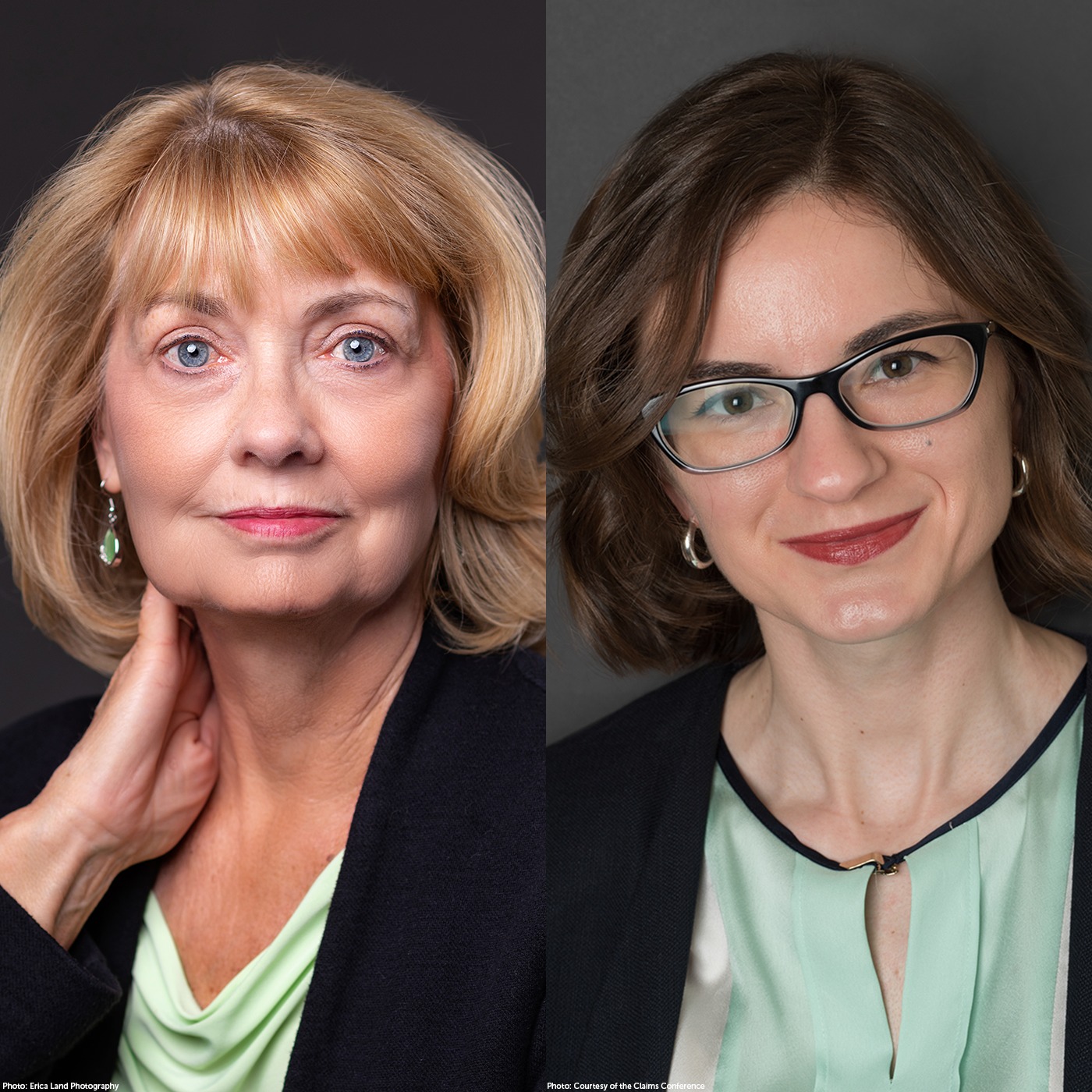
The Countess Janina Sukadolska saved as many as 10,000 prisoners from the Majdanek concentration camp in Nazi occupied Poland. Fluent in German, this self assured aristocratic woman negotiated with the Nazi and SS officials in Lublin to secure the release of thousands of Poles at Majdanek and save thousands more through deliveries of food and medicine. Countess Sukadolska was stubborn and persistent. She never accepted no for an answer, and when she got a yes, she considered it an invitation to ask for more. It might not be so surprising that this noble and elegant woman was secretly a member of the Polish resistance. But her comrades in the underground Polish Home army had no idea that Countess Janina Sukhadowska was in actuality a Jew and not a countess at all, and that her real name was Janina Mahlberg. Janina died in Chicago in 1969 and her story was almost lost to history. Eventually, Dr. Barry White, a Holocaust historian and Department of Justice Nazi hunter, received Janina's incomplete memoir, A new mother with a busy job. Barry had neither the time nor the Polish language skills to verify the incredible account. But haunted by a sense of responsibility to history, Barry eventually connected with Dr. Joanna Slieva, an expert on the Holocaust in Poland, and the two set about researching Janina's story. Published in January of this year, their book, the Counterfeit Countess, brings Janina's story to light in stunning detail. Dr. White and Dr. Sleva, welcome to in these Times.
- [02:08]
Rabbi Ami Hirsch
Thank you so much for having us. This is a great opportunity for which we are very grateful.
- [02:15]
Dr. Barry White
I was very taken by the fantastic story that came to light by virtue of your research.
- [02:24]
Dr. Joanna Sleva
Before we even get into the story itself, there's a background story to how you discovered all the details of Janina's life.
- [02:30]
Dr. Barry White
So can you tell us about that? It took quite a few years to uncover her story and verify it.
- [02:37]
Rabbi Ami Hirsch
Yes. Well, this goes all the way back to 1989, when I gave an academic conference paper on Maidanic concentration camp, which was located in German occupied Lublin, Poland during World War II. After the panel, a historian I didn't know handed me a package containing a carbon copy manuscript. He said it was the memoir of Janina Melberg, a Polish Jewish mathematician who had aided prisoners at Majdanek while pretending to be a Polish Christian aristocrat. Maelberg had died in Chicago in 1969. She didn't have any children and there had been efforts to publish the memoir, but they hadn't succeeded. So this historian was going to give it to a couple of archives, including at the United States Holocaust Memorial Museum. But he really wanted me to take this copy because I was writing about Majdanek, and so he hoped that I could make the story known. So I read this story with just increasing astonishment, because Janina Mailbert claimed that she survived the Holocaust in German occupied Poland by posing as the Countess Sukhodowska. And she used this aristocratic guise to become an official of a Polish relief organization that the Germans allowed to operate in Poland, but only to help non Jewish Poles. Her job included negotiating with Nazi and SS officials in Lublin because she had flawless German. And so she was, according to her memoir, extraordinarily persistent in her negotiations. And a particular focus of her efforts was at Majdanek, where she continually badgered the SS for permission for her organization to bring in ever increasing quantities of supplies for the prisoners, to the point that she was bringing in food and other supplies for thousands of prisoners five days a week. And she brought these deliveries herself inside the camp, a place where 63,000 Jews were murdered in gas chambers and shooting pits. And she not only brought these deliveries, but she also used them as cover to smuggle messages and supplies from members of the resistance imprisoned in the camp. So I found this story so incredible that I really had to question whether it was true. I could imagine writing something about the memoir and then having the real countess of her descendants come forward and accuse me of fraud. So I couldn't use the memoir without verifying it, and I didn't have any way to do so then, particularly because I don't know Polish. So I figured another historian would come across it in the archives and do what was necessary to bring it to light. But that didn't happen for years. Decades. And I never forgot this incredible story. And so then in 2017, I really started digging into who Nina Naelberg was. And I found just enough to make me think that she probably was the countess. And that's when I reached out to Joanna, whom I only knew by reputation as an expert on the Holocaust in Poland. And when she read the memoir, she was all in for investigating Janina's life and bringing her memoir to light.
- [06:14]
Dr. Barry White
Joanna, did you, when you heard the story, you heard it first from Barry, then you read the documents, did you. Did you immediately think this had to be true?
- [06:25]
Countess Janina Sukadolska
Well, the way that Barry and I were connected, we did not know each other. We were connected through my former doctoral advisor. She was a fellow at The Holocaust Museum where Barry worked. And Professor Dork reached out to me and said, I met with the historian Elizabeth Barry White. She's working on this fascinating project. Would you be interested to meet with her and to discuss this? And I thought, wow, what a fascinating story. I've never heard anything like that. And I was immediately drawn to the topic. Then Barry shared with me the manuscript, and I read it. And of course, similarly to Barry's first reactions, it was great astonishment. Could this be true? But Barry already had, as she mentioned, some details that made her think that this story could be true. And so we are professional historians. We read many memoirs, diaries, listen to oral histories of survivors, and we know that they had sometimes incredible stories of survival during the Holocaust. And as historians, of course, we have to approach it with caution and try to corroborate the information, but we cannot dismiss it offhand as something that didn't happen because of our background, because of our expertise of what we know about the history of the Holocaust and the Jewish experience during the Holocaust. And so we immediately started looking for information, for historical records, genealogical records, to corroborate what Janina wrote in her memoir. And we were successful.
- [08:13]
Dr. Barry White
And Janina was. The whole thrust of the story is that she was a con artist, albeit for all the right reasons. But she managed to fool so many people, monsters, really, with unbelievable courage. You think about it, just walking into Majdanek, if she would. And you write this in the book, if she was discovered, or if she faltered in some way to raise suspicions, she herself would have been tortured and eventually killed. But she was a con artist. So did you have any doubt that maybe her memoirs were either not true at all or, you know, they. They were exaggerated?
- [08:56]
Rabbi Ami Hirsch
Well, I. I don't know that I doubted it exactly. She had details about Majdanek that were consistent with somebody who really had been there, things that most people wouldn't know about it. She also got some things wrong, but those were the kinds of things that she wouldn't have understood that because she didn't see that part of the camp, for example. So there were things about it that made me think that it was true, but I couldn't just accept it on face value as a historian. I had to verify it, and not just that she was the countess, but also verify a lot of her claims in the memoir. Again, we found out that her memoir doesn't even do justice to what she accomplished during the war.
- [09:52]
Dr. Barry White
Why do you think. I mean, it's an exceptional story, really sheds light on so many human attributes that you talk about in the book, as well as it adds breadth to our historical understanding of the Holocaust, and of course, from my perspective, about human nature itself. But why do you think such an unusual, exceptional story never came to light until now? Your book was published in 2024. Why didn't she speak about it? Or did she? Or why didn't it catch some kind of wave that would have brought it to public attention?
- [10:29]
Countess Janina Sukadolska
So part of the reason was that Janina continued to live under her wartime false identity even after the war. She worked for a Polish social welfare organization which was run by the Polish Communist government at the time. And she felt too dangerous to reveal her identity because the. That would elicit questions. How did you get that identity? Who helped you? Also, she was protecting the people, the Polish people, non Jews, who helped her survive during the Holocaust and who are part of the resistance, Polish resistance with her. So Janina escaped from Poland in 1950. She reached Canada at first, where her husband already was there holding a fellowship. And in 1956, Henry, her husband, and Janina Melberg emigrated to the United States. They settled in Chicago. And Janina did not speak publicly about her experiences. And if we think about it, that makes sense, because many survivors did not speak about their experiences. We did not have this kind of Holocaust education that we have today. Holocaust survivors did not go into the classrooms. They were not interviewed to the extent that they have been since the 80s, 90s, even going into today. And perhaps also Janina knew that her story seemed so incredible. Who would believe her at the time? But at the same time, she thought it was important to put that on paper, which she did. And we believe it was in the 1960s. She passed away in 1969 that she wrote her memoir. Toward the end of her life, and also in a particular historical, political, social context, in the 1960s, there was a lot of state sponsored antisemitism that was cloaked as anti Zionism in Poland. And the culmination of that was 1968, when about 30,000 Polish Jews were forced out of Poland and many of them immigrated to Israel, but also to Denmark, Sweden, the United States. And at that time, in the 1960s, there was also this narrative that the Polish Communist government was promoting about how the Polish people were courageous, they were rescuers of Jews, they were not collaborators, and that the Jews were ungrateful to the Polish people who saved them, that the Jews were promoting this anti Polish narrative abroad. And Janina's memoir is a response to that. And the memoir was written in Polish. It was only translated by Janina's husband Henry, later on, which also indicates to us that the intended readers were Polish speakers, Poles who knew this history. Because if you read Janina's memoir without any context, a reader today would have difficulty understanding what is it exactly that that she's talking about. What was it like with Majdanek and the German policies toward Poles? You need that historical context to understand fully Janina's activities, her decisions, and how exceptional she was and how exceptional it was what she did.
- [14:18]
Dr. Barry White
So can we get to her? How does a Jewish mathematician that you described as a brilliant mathematician and to assume the identity of a Polish countess?
- [14:32]
Rabbi Ami Hirsch
Well, she had a life of very unusual privilege growing up. She was from what was then called Eastern Galicia, which was then a multi ethnic, multilingual, multi religious area under the control of Austria, Hungary before World War I, then Poland between the wars, and today is Ukraine. And her father was actually a wealthy estate owner. So she grew up mixing in the society of the local Polish nobility, learning their manners and customs, also absorbing their Polish nationalism. And so that really helped her to carry off her role as the countess to be very, very convincing as this countess, Janina Sikodolska. And it was also through her connections that she was able to become the countess, because she and her husband, Henry Maileberg, were living in the city of Lvov then. Today it's Lviv, Ukraine, before the war. And in 1941, they were about to be forced by the Nazi occupiers to move into a tiny ghetto with 100,000 other Jews in Lvov. And they knew that death awaited them there. But at the last moment, Janina's old family friend, Count Andrzej Skinski, showed up. He was a member of the resistance, and he said, if you can get to Lublin, I can get you false papers. And so that's how they became Count and Countess Sikadolski. And it's also through Skrinsky that Janina joined the Polish resistance and became an official of the Polish relief organization that was known by its initials, the rgo.
- [16:22]
Dr. Barry White
So. And Majdanek is literally right outside of Lublin. So that's how she ended up doing work in Majdanek, is that right?
- [16:30]
Rabbi Ami Hirsch
Yes, it was right on the edge of Lublin. It was fascinating because I could talk for a long time about it, but it was the first concentration camp and the only major one that the SS established outside the borders of what, during World War II was the Third Reich. So Auschwitz, for example, was in annexed Polish territory. So Majdanek was established in the midst of this hostile population. And part of its function was to terrorize the local population into obedience. So the SS didn't go to much effort to try to keep what was happening there secret. There were no walls around it. It was right on a major road. People in Lublin could look down on it from the hill above it. Neighboring village people could actually see into one of the prisoner compounds. So what was going on there was pretty much an open secret.
- [17:26]
Dr. Barry White
So what is Janina? So how does she get going in Majdanek? What brings her the first time to Majdanek? Who sent her? Why was she there? And how did she win the trust of the Nazi officials there?
- [17:43]
Rabbi Ami Hirsch
So she was working for this organization, the rgo, in a part of Poland that was called the General Government. And her organization was allowed to provide for non Jewish Poles. The Germans had no interests in taking care of their Polish subjects, so they were fine with letting this volunteer organization help all of them. The hundreds of thousands of Poles who were being displaced from their homes or the families of those were left behind when Poles were taken off for forced labor and the Reich and so forth. And in 19, the early 1943, thousands of non Jewish Poles were sent to Majdanek. And this is what gave the RGO standing to ask for permission to provide food for those Poles, because the RGO was able to do that for prisons within the General Government. And so when the RGO got that permission, Janina was put in charge of the whole operation. So that's how she got going at Maidana as a countess? As the countess. As the countess.
- [18:57]
Dr. Barry White
Everybody thought she was a countess, including the people from the resistance. Nobody knew her real identity. Is that right?
- [19:06]
Rabbi Ami Hirsch
Nobody but Shpinsky. Yeah.
- [19:09]
Dr. Barry White
And what do you think resides in the heart of somebody like that, too? I don't know if she was fearless. I don't. You know, it's hard to say what courage really is. What was part of her makeup that drove her to do these kinds of acts of unbelievable courage and daring and sustained her for a long time. She was doing this for. It was close to two years, I think. Just kept on going back and forth and back and forth and saving all these. What eventually ended up to be thousands of people. What exists in the heart of that kind of person that doesn't exist in other people.
- [19:53]
Countess Janina Sukadolska
Janina very quickly understood, as a witness, but also as a victim, that her chances of survival as a Jew when she was still in Lvov were small. She also understood, even though she was trying to survive under the false identity of a of a Catholic, Paul, and someone from the higher social class, a countess, that still she was slated for destruction, as were other Poles, through Nazi policy that was aimed against the Polish people as well, in a different way than against the Jews. So she understood that her life and survival would not mean much if she didn't use it to help other people. And I think this realization drove her actions, but on other factors as well. Janina grew up in this kind of Polish environment filled with patriotism. And Janina felt very much as a Pole. She understood that she was not in a position to help Jews. And so Janina focused on the people whom she thought she could save, the Polish people, the non Jews. And Rabbi Hirsch, you asked earlier, you know, how did she just kind of walk in and talk with these. With these Germans and manage to get what she wanted? She was, as we understand, a charismatic woman who, as Barry mentioned earlier, did not take no for an answer. And she continued to press and press, and she framed her requests as something that was so obvious to the Germans that of course they would agree to it because it was in their best interest to feed the Poles, because how else would these Polish people work for the Germans if they didn't get fed? So she had these skills, these social skills, people skills, fluency in the language, this cultural acumen that all combined together allowed her to do what she did. And I think this also contributed to her motivation that she recognized that this works, that she can persuade this official and that official. And she continued doing it on and on. And she believed in her Persona. She assumed her false Persona, as if the Jewish side of her had to be dissociated in order for her to become fully a Polish Catholic countess, focused on negotiating with the German and Nazi officials and helping the Polish people, because only then would Poland hopefully emerge and survive.
- [22:58]
Rabbi Ami Hirsch
Yeah, and I would just add that she was not fearless. And she admits that she was very much afraid at many times, which I think is what makes. That's real courage, when you're afraid and yet you still go forward. And when she. There's a point in the book where there's a raid on their street, the Germans are taking men off, probably for forced labor. She's convinced Henry is going to be seized. And once he undergoes a physical examination, the fact that they're Jews will be revealed because only Jewish men were circumcised in Poland. And at that point, it suddenly becomes clear to her, okay, so I gotta stop worrying about how to survive and start worrying about how to spend what's left of my life and how do I die a meaningful death? And the answer then was obvious to her. That was be by resisting the Germans and saving as many of their victims as she possibly.
- [24:05]
Dr. Barry White
Can I ask you what your sense is of her Jewish identity? You said that there were people who, when she died, didn't even know she was Jewish. I've met a lot of children of survivors who tell me stories about how their parents consciously suppressed their Jewishness for whatever reason, including some lingering fear that it's not a safe thing to reveal Jewishness, and a feeling that was intensified after the war. What was her Jewish identity? Did she have a strong Jewish identity?
- [24:42]
Countess Janina Sukadolska
We understand from the sources that we have that Janina came from an assimilated background. She was exposed to a variety of languages, a variety of people. She received secular education. She obtained her PhD in 1928 in Mathematics from the Yan Kazimov University, a prestigious university in Lviv. And she had a religious wedding, Jewish religious wedding. At the time, there were no civil marriages. So in order for her to get married, she had to have a religious wedding. But the question of her, you know, how Jewish was she in terms of her identity? I think it's very hard to say because she does not engage with that question in her memoir. She just does not discuss her Jewish identity. And yes, even after the war, that may have something to do with the continued anti Semitism that persisted in Poland after the war. The violence that Holocaust survivors faced when they were returning to their hometowns, when they were trying to reclaim their property, when they were coming out of hiding, when they were returning to their Jewish identities, Jewish names after the war. So I think that had something to do with that. But I think she was just. The background that she came from was highly secular, and that's how she continued to live after the war.
- [26:10]
Dr. Barry White
So there's no record of her when she gets to Canada or America, engaging the Jewish community in any way, or some kind of involvement in a synagogue or even observing some kind of ritual at home.
- [26:24]
Countess Janina Sukadolska
We have some information that when Janina arrived in Canada, that she and Henry may have been to some extent involved in the Jewish community there, but probably more for social reasons rather than religious. However, I would say that what she did, her. Her decisions, her actions, to a large extent, guided by Jewish values, if we think about it. Right. So of course, we have this idea of, you know, Judaism, of Tzedek, right? This justice that would pursue justice. But what does justice mean? And I think for when we consider Janina's story, it's this care for other people, pursuing justice for other people, for those who are oppressed, those who are in more difficult circumstances than she was. As you know, we talk a lot about, in the Jewish world about tikkun olam and what does that mean? And I think we can also talk about tikkun olam in the context of Janina's story, about in what way was she trying to repair the world, and was it through her connection and her commitment, her dedication to the survival of Poland and the Polish people, through building bridges between the Jews and the Poles, through her actions? Right. She was just one person doing this. And we talked about courage. We talked a lot about courage. All met. Right. And so she had a lot of courage to know a Jewish woman trying to survive the Holocaust as a Jew and confidently walking into a German office, including to one Nazi official who was the manager of Operation Reinhard, the mass killing of 2 million Polish Jews. She spoke with him in person, she negotiated with him, and he was very accommodating to her requests. So I think there is much in this story, in the story of Janina Malberg, to talk about how Jewish values shaped her actions.
- [28:51]
Dr. Barry White
I was fascinated by passages in your book that bring forth the dichotomy of the human character. You point out that she pointed out that when she looked at this, just this terrible laboratory of how human beings behave, that you could have heroes who behaved evilly and evil people who had some positive attributes. Could you expand on that a little bit and explain more of the way she saw the world?
- [29:26]
Rabbi Ami Hirsch
Yes. She writes about people who were her enemies. That Ukrainian janitor she'd been friendly with, just, you know, she would chat him up, and at one point she helped one of his children when. When the child was sick, but he was in a Ukrainian militia that was dragging Jews off to. To mass shootings. And she saw him do that to the former landlord at the building where he had worked that was right across the street from where they live. And then the next day, the Ukrainians came to their building, and Yanina told Henry to hide. And she answered the door, planning to pretend that she was just visiting the male birds and they weren't there. And then she's face to face with this janitor amongst the other Ukrainian militiamen when she goes through with her story, and the janitor says, oh, that's right. I saw the Mailburgs leave a little earlier. And so then they moved on, and he saved both their lives. And she writes about other instances of people who were involved in terrible crimes, and yet who took risks to help her, occasionally even, like the janitor, save her. And she was also very well aware that some of the Poles who risked their lives alongside of her, who she rescued, who lit candles and said prayers for the safety of Countess Sukodolska, would have despised her and maybe done worse if they had known that she was a Jew. And her specialty as a mathematician was probability. So she was continually calculating the odds for success on her actions and trying to figure out whether the risks outweighed the chances of success. And she found that she could never predict whether a particular person would help her or harm her in a given situation based just on that person's ideology or religion or ethnicity. And she also came to see that none of this is completely defined by either the worst or the best that we do. And so she decided for herself. She believed in justice, she believed in accountability, but for herself, she would not pass judgment on others. She recognized the terrible choices, and she writes very movingly about the terrible choices that the occupation forced people to make. And so she approached each person simply as a fellow member of what she described as the vast suffering human family. And if they were suffering, she thought it was her human duty to help them.
- [32:15]
Dr. Barry White
I'm reading from the very end of your book where you write Janina's memoir as a call to tolerance and her belief in the fundamental value and dignity of every human life. Then you point out that from her memoir she provides examples of Ukrainian, Poles and Germans who demonstrated both the capacity for what she termed goodness, for kindness, courage and self sacrifice, and the capacity to be evil, to be dishonest, vicious, and even murderers. She recognized that both capacities are inherent elements of human nature. Did she include in that description Nazis that she met in occupied Poland and especially in Majdanek?
- [32:57]
Rabbi Ami Hirsch
Yes, I would say she did. Certainly some of the SS at Majdanek helter 1 at very considerable risk to his own life. When the late spring of 1944, a new commandant came in and prohibited the RGO from sending any supplies to the camp, this particular SSNCO would actually go to her office and pick up packages for the prisoners and take them into the camp.
- [33:28]
Dr. Barry White
You write here that her beliefs included grounds for both cynicism and hope, while heroes are naturally flawed. By the way, Joanna, this is another of that very Jewish personality that you were talking about. Judaism spends reams of documents and centuries of thought about how heroes are naturally flawed. In fact, there is no hero in Jewish tradition that is not flawed. What makes them heroes is that they're flawed and they overcome their flaws. But you write so while heroes are by nature flawed, villains may have the capacity to prove heroic too. It's a provocative way of describing it. I. I understand what you meant and what you understood her to mean. When we think of villains, you know, our natural assumption, our initial assumption is irredeemable. Villains, you know, and we think of Nazis. But it is part of the Jewish hope and Jewish teaching and we see this throughout the way the Jewish calendar is set up as well. That the road to redemption is open to every person. That we need not be defined exclusively or even primarily by the worst of what we do, that we can rectify, make atonement, ask for forgiveness, and embark on a different path. So I wonder if either of you, or both of you maybe you want to give us a final word and summary of what you learned and what you think the readers should be taking away.
- [35:12]
Countess Janina Sukadolska
I think there is much to take away from this book. I think we covered so many topics today, you know, in terms of values and motivations, what makes people make certain decisions in particular contexts. And another thing I think that is really important. It was really important for us when researching and writing this book was to present a fuller picture of the history of World War II and the Holocaust in Poland and to bring to attention, especially to English language readers, the oppression and the persecution that non Jewish Poles faced during World War II. There is a lot of misunderstanding about what the Polish people went through. There is a lot of this politically driven narratives about who suffered more. And there is no such thing. Competitive suffering is such a useless concept. We can't talk about it in this way. I think it's better to understand what different groups went through based on the racial hierarchy that was assigned to them by the Nazi rulers. And so we hope that with this book our readers will gain a better understanding of the complexities of World War II and Nazi rule in Poland. That they would also gain a better understanding of Majdanek, which was a major camp of persecution for both Jews and for Poles and for prisoners of other nationalities. But I think I would just like to make this highlight this point is that one person can and does make a difference. And Count Andrzej Skzchinski, the non Jewish Pole who hopped on the first civilian train from Lublin to Lviv, he made the conscious decision to risk his life too and smuggle the Melbournes help the Melbournes by bringing them to Lublin. One person makes a difference. Janina, she could have assumed this kind of a low profile and understandably so, to try to survive under false identity, but she did not. She used her position, her newly acquired identity to help others. And she was successful, although she did not believe that she was fully successful in her efforts. But she did manage to save close to 10,000 Polish people.
- [38:01]
Rabbi Ami Hirsch
Yeah. Or more. We don't really know how many more people survived because of the relief that she was able to provide, particularly at Majdanek. And I just want to add also that the book really shines, as does her memoir, shines a light on the amazing efforts that Poles made to resist the Germans and to help each other survive. So the Poles were subjected to basically starvation rations, and yet much of those supplies that I mean was bringing in to the prisoners at Majdanek was donated by the local population, despite the terrible conditions that they were in.
- [38:43]
Countess Janina Sukadolska
We started our conversation with the question, how did Barry learn about the story? And we talked about these feelings of astonishment and the need to corroborate and so on. And I think now we understand the importance of individual stories, of not dismissing an account just because it's challenging for us intellectually, because we can learn a lot from it.
- [39:15]
Dr. Barry White
I want to thank both of you, Barry and Joanna, for the diligence of your research, for writing this fabulous biography of a person basically none of us would have known about, had you not researched it and brought it to light. And it's a fantastic read. I urge everybody to go out, buy the book, it's called the Counterfeit Countess, and learn some important history, and from my perspective as important, learn about the character and the nature of the human condition and the human creature. So thank you very, very much for what you've done. I wish you much success and keep delivering the message to as many audiences as you can.
- [40:02]
Countess Janina Sukadolska
Thank you very much for having us. Thank you.
- [40:09]
Dr. Joanna Sleva
What an incredible story. There are probably thousands of such acts of surpassing heroism from the Holocaust period that have not yet come to light or perhaps never will. Dr. White and Dr. Sleva have done a tremendous service first to Janina Mehlberg herself. They have forever sealed her place in the annals of our people's heroes. And they have shed more light on and deepened our understanding of the Holocaust. I especially appreciated that through this detailed account of one person's exceptional courage, we learn more about human nature itself. As Doctors White and Sleva wrote, Janina's memoir is a meditation on human nature. She witnessed both the worst and the best of human capabilities. She saw that people who engaged in murderous cruelty could still commit acts of surprising kindness and even self sacrifice, and that people who routinely risked their lives to Save others could be self serving or hateful. This reflects ancient Jewish wisdom. The prophet Jeremiah wrote, most devious is the heart. It is perverse. Who can fathom it? Human beings are such a piece of work. We are merciful, we practice friendship, we give and receive love, yet often darkness eclipses our splendor. We are capable of admiration and envy. At the same time. We can express compassion and ego in the same act. We may be charitable and uncharitable in one fell swoop. For every noble impulse in us, it seems that an equal and opposite impulse pulls us down. Plato equated the human condition to that of a charioteer whose horses pull in different directions. We try to ride the right road of life, but these wild stallions of our personality keep pulling us in opposite directions. A fierce struggle rages inside each of us, an unrelenting civil war between our competing inclinations. Such a twisted thing cannot be made straight. Ecclesiastes wrote. The rabbis termed our propensity for virtue yetser hatov, the good impulse, and our inclination for corruption, yetzer hara, the bad impulse. Jewish tradition never sought to deny our problematic side. The sages taught that this too is part of the human condition hardwired into our system. But they insisted that we can master our impulses and overcome. They asserted that even our negative drives can be good. Ambition, competitiveness, ego, profit. These are what push us to achieve, excel and propel human progress. The sages were skeptical that altruism alone would be a powerful enough motive for hard work, success and invention. Our tradition believes that for practically all of us, there's no such thing as pure and utter selflessness. Human beings were not designed that way. Therefore, the rabbis taught that our goal is not to eliminate our problematic inclination. To deny our negative side is to deny ourselves on its face. This side of our personality is not even negative. It is neutral simply who we are. It becomes undesirable through excess by our inability to control ourselves. The sage Ben Zoma asked, who is strong? He responded, one who masters himself. Judaism teaches that we can increasingly master our problematic impulses through fortitude, self control and self discipline. If one desires to turn himself to the path of good and be righteous, the choice is his. Maimonides wrote, should he desire to turn to the path of evil and be wicked, the choice is his. The devil made me do it as no excuse. In Jewish tradition, if we are unable to restrain ambition, ego, envy, lust, attraction, hunger for power, they will grow stronger and eventually destroy us. It is a constant daily struggle. Rabbi Isaac said, a person's Evil desire renews itself daily against him. It grows stronger within him from day to day. At first, the sages taught, it's like a thread of a spider, but ultimately becomes like cart ropes. According to Jewish sages, only when we have mastered ourselves can we say that we are truly free. The rabbis insisted that we can prevail against ourselves. They explained, one day the Holy One will bring the evil inclination before the righteous and the wicked. To the righteous it will have the appearance of a towering hill, and to the wicked it will have the appearance of a strand of hair. Both the righteous and the wicked will weep. The righteous will weep saying, how were we able to overcome such a towering hill? The wicked will weep saying, how is it that we were unable to overcome this strand of hair? The rabbis do not simply describe the problem, they offer a solution. The Talmud states, the Holy One spoke unto my children. I created the evil impulse, but I also created the Torah as its antidote. If you occupy yourselves with Torah, you will not be delivered into the hands of the evil impulse. The school of Rabbi Ishmael taught, if this repulsive wretch meets you, drag him to the house of study. It's a classic Jewish approach. What is the method to deal with our daily struggle to control ourselves? Study and reflection. We converse with and gain access to the greatest minds of history. We come to understand that we are not alone. All human beings struggle with the same impulses. We can overcome. We can master our straying hearts and our self absorbed minds. We can learn to do it by learning how others have done it. We do not seek to eliminate the joy of food, but to control our appetite. We do not seek to eliminate the joy of wine, but to control our sobriety. We do not seek to eliminate our acquisition of material resources. Poverty is not a virtue in Judaism, but to find balance between consuming and sharing. Enjoy food, but don't be a glutton. Enjoy wine, but don't be a drunk. Be ambitious, but don't be an egomaniac. Influence others, but don't be authoritarian. Lead, but don't be a tyrant. The sages advise avoiding even the first step on the wrong path because it may be impossible to resist the next step. It is the first wrong steps that count, wrote Mark Twain. Odysseus orders his men to tie him to the mast as their ship passed the island of the Sirens. Even he, the commander of men, could not command himself to resist the temptation of the siren song. He knew that even one alluring note could lead to his downfall. The more one yields to one's passions, the more mastery they gain over him. Rabbi Yisrael Kagan, better known as the Chafetz Chaim, lived to the ripe age of 95, when he was already very old. He was asked how he managed still to get up so early every day. He responded, when I wake up, I tell myself that my yetzer, my negative impulses, are also very old, as old as I am. And he has already arisen, and so must I. Until next time. This is in these times.