← Independent Americans with Paul Rieckhoff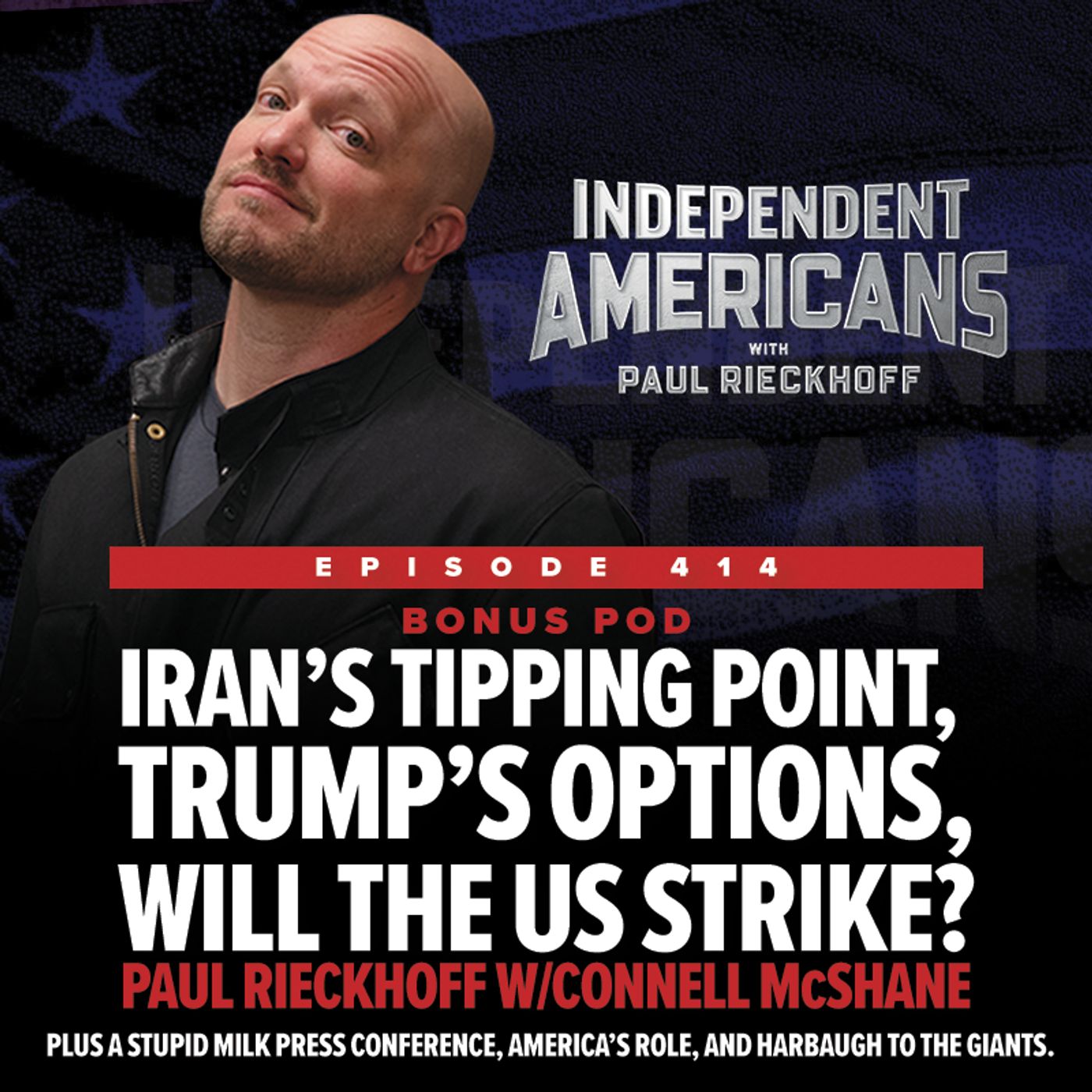
Independent Americans with Paul Rieckhoff
BONUS: Iran’s Tipping Point, Trump’s Options, Will The US Strike?
00:14:08
What’s really happening on the streets of Iran? Is the regime conducting executions or not? Reports say yes. Trump says no. During a crazy press conference at the White House about changing the rules for milk in schools. Will Trump hit Iran again? Will Congress do anything?? What does it mean for America and the world? Rieckhoff explains why the protests feel like a potential tipping point, why organic, grassroots uprisings matter, and why the best move for President Trump may be to avoid military escalation while supporting those risking their lives for freedom. From reports of snipers on rooftops and internet blackouts to questions about executions, regime brutality, and U.S. intelligence, Rieckhoff and retired General Richard Newton dig into the realities on the ground and the risks of miscalculation. They explore how regime change in Tehran could ripple across Russia, North Korea, and beyond—and what true American leadership should look like in 2026.
Loading summary
Transcript32 lines
- [00:00]
Paul Rykoff
Power by righteous media.
- [00:19]
Connell McShane
Independent Americans, hello from New York City, usa, where it is cold. And I have a special bonus episode of Independent Americans for you coming up in just a second. But first, it is cold here in New York City. This is going to be a cold and hard winter, literally. Politically, horns are blasting socially and across America, across Ukraine, across Iran, across the world. It's going to be a hard winter. And I'm going to continue to try to bring you information, inspiration, impact, independence, all of it, to keep you motivated, to push you through it, to bring you light, to keep you warm and these cold times. So first off, there is big news here in New York City. We might have a new head coach of my giants, John Harbaugh maybe announced today. We'll have more on that in the episode later today. And the unrest continues in Iran. I want to go deeper and share with you a quick interview that I did yesterday on News Nation with Connell McShane, as I do. Here comes some helicopters. Those are, those are Pablo's big Navy helicopters. Those usually come through New York City on days before Trump comes through. So I don't know if he's coming to town today, but if he is, those helicopters usually come overhead. And that's the sound that too many are fearing in Iran right now. Too many are fearing in Ukraine. And too many fear will be happening in places like Minneapolis and Chicago soon, too, maybe here in New York. If you didn't hear my or see my episode yesterday with Lindsey Church, super inspiring independent veteran that's now running for Congress in Chicago and pushing back against ICE authoritarianism and all the attacks on our democracy. Go check that out. Check out my recent episode with Ruth and Gayat. And later today, I'm gonna have a brand new full episode with Sheriff Chris Swanson. He's a cop from Michigan, a real cop who's now running for governor. So I'm gonna talk to him about all of it. We're gonna stay on top of all the latest breaking news and whatever crazy shit did, including yesterday he did a press conference on milk with yes, milk, like the stuff you drink. I'm gonna comment on that. I'm gonna comment on Iran and much more in my weekly segment. A bonus episode for you right here now on Independent Americans. Here I am with Connell McShane. I'll have a new episode for you later today. We're gonna keep it coming. Daily Football Friday tomorrow. Have a great day, folks, wherever you are. And most of all, stay Vi.
- [02:58]
Interviewer/Host
So I want to spend a few minutes talking about that. It's been our big story. What's going to happen next in Iran? How do these comments change what might be happening next in Iran? I'm sitting next to Paul Rykoff, host of the Independent Americans podcast, is here with me in New York. So quick reaction to that before we go back to hear the president, I'm.
- [03:13]
Paul Rykoff
Sure, take questions on this to the Iran part.
- [03:15]
General Richard Newton
Yeah.
- [03:16]
Paul Rykoff
Not the milk.
- [03:16]
Interviewer/Host
Not necessarily the milk part, although I'm fine with whole milk.
- [03:19]
Paul Rykoff
Yeah. I mean, my kids aren't going to drink any of it unless it's got chocolate.
- [03:22]
Connell McShane
Right.
- [03:23]
Paul Rykoff
But nevertheless, I mean, obviously, the biggest story is Iran, and I think what he's saying doesn't check out with what we're seeing on the ground. I mean, it looks like people are being executed by the thousand. Reports are starting to come out. We know the lights are out, the Internet is out, but this regime has been brutal, and it's killed people before, and they've said they're gonna kill people again. So I think we need to get the reporting on the ground to find out what's really happening.
- [03:42]
Interviewer/Host
Well, he says he has it on good authority. So there's a possibility, right? I mean, we don't know there's a possibility that the threat of action from the United States in Iran has changed the regime's approach here.
- [03:55]
Connell McShane
I mean, I think he'd like to.
- [03:56]
Paul Rykoff
Think that, but I think what we're seeing from limited reporting in the news that's leaking out is that people are being slaughtered. There are snipers, rooftop, they're communicating, they're gonna do executions, and thousands of young people and people of all kinds are bravely standing up. This feels like a tipping point in Iran. And the best thing for Trump might be to just let it go and let it happen and definitely not put American lives at risk. And if he does something, he should be consulting with Congress, he should be talking to the American people, laying out the costs and the strategy. This is another critical step he keeps skipping. If he's gonna engage with Iran again, he has a responsibility to go to Congress, and Congress has a responsibility to flex their authority and ensure that he doesn't do it alone.
- [04:29]
Interviewer/Host
Well, go back to that earlier point that the best move here for Trump might be. You think?
- [04:34]
Connell McShane
Yeah.
- [04:35]
Paul Rykoff
I mean, it looks like this has more momentum than any uprising we've seen in Iran. I mean, there are ways that they can help with intelligence, there are ways they can help on the ground to support the protesters. But him involving our military in some way or something along the likes of what we saw in Venezuela might make the situation worse and might not undermine some of the validity of what these protests are doing. This is a democratic uprising. This is people fighting and dying for their freedom. And we should all be cheering for them right now.
- [05:01]
Connell McShane
And if we can help them do it, we.
- [05:02]
Paul Rykoff
But it might not be military solutions.
- [05:04]
Interviewer/Host
Well, because the talk, as you know, throughout the week had been that if we could, maybe now's the opportunity, if they are weakening, if this protest is at a point where it is close to this tipping point you described, now's the chance, now's the chance to go. And that's the case from the more hawkish people in the Congress. I know, you know, in the Senate, like a Lindsey Graham has been saying things like this and probably would say it anyway, but that's what we're hearing more of. And you're saying, hold on a second here.
- [05:28]
Paul Rykoff
Yeah, I mean, it looks like the Iranian people are doing it on their own. And I think the best kind of uprising is an organic one, is one that it comes from the grassroots. It doesn't have an outside force putting their finger on the scale. And we've meddled in so many different uprisings before, but we do want to see the regime topple. I mean, this will put tremendous pressure on Russia, It'll put tremendous pressure on North Korea. This can create a groundswell that sweeps all across the world. And that's the potential here. But this is coming from the people, and I think that's important that Trump doesn't get involved and make it a Trump thing.
- [05:56]
Interviewer/Host
There was one guy in particular, a guy in his 20s, who's apparently part of the protests. And there'd been reports in recent days that this person, and he was 26 years old, was going to be executed today. The president, in a CBS interview was asked about that, said he didn't know about it, but if something happened, there'd be hell to pay, essentially. And now today comes out and says, no, no, no, there's no plans for that. So you do wonder what happened between then, which was last night and now this afternoon.
- [06:22]
Paul Rykoff
I mean, you can't trust the regime, I mean, any more than you can trust Putin or any other authoritarian. So if Trump's getting some back channel information from someone in Iran, he shouldn't trust it either. The reality is the regime has been brutal. They murdered people, they've executed people. That has been their method for decades. And I think right now they, that they're teetering on the edge of disaster for themselves and they're gonna pull out every stop. They're gonna kill people. They're gonna put this down like they have in 2009 in the past and try to squash this before it gets any further.
- [06:47]
Interviewer/Host
All right, stand by for a moment, Paul. I wanna bring General Richard Newton into this conversation, who had been set to join us in a few minutes. Anyway, so, General Newton, we were listening to the President at one of his daily events on an unrelated subject, Milk, as the case would be. But he came out right at the beginning, and he says that the killing in Iran is stopping. He has that information, as he described it, on good authority. And there are executions, as Paul and I were talking about. You know, there've been these reports that, you know, this one person in particular would be executed as early as today. What do you take away from that in terms of, you know, again, he says he has it on good authority, but in terms of what it means now in the conversations we've been having about what might be next in Iran?
- [07:29]
General Richard Newton
Well, let me backstop what Paul just said. I'm just coming into the conversation. But this is a brutal regime after 45 years plus of really tyranny against not only the Iranian people, but the largest export of terrorism that has really decimated also American soldiers lives and so forth. And so I think it's still within US national security interest to really take a hard look at where we are right now in 2026 and determine if it's within US national security interest to not necessarily just strike back against Iranian capabilities like we did back in June 22nd. But are we really going to be now focused as a tipping point now for US national security to conduct what would be leading up to a regime change in support of the opposition, with thousands killed and imprisoned and so forth? Okay, I got that off my chest. But we have to trust the President to some point here. I'm sure he's getting the latest intelligence not only from the United States, but partners in the region, specifically Israel, specifically Mossad, and is really trying to determine what is the situation in Iran. Is it indeed, you know, what's the numbers of killings and so forth? President, however, said yesterday on the flight line at Andrews Air Force Base that the number he hearing, regardless of what media is coming forward, is too many and so forth. And does that serve as really now the tipping point for us to go beyond just 25% tariffs and perhaps increase sanctions and other things that we could possibly do to really now go to get into the Target folders that U.S. central Command has provided the president? That would really provide for, I think making change, significant change in Iran. And by the way, that change, and I believe ending the regime of Iran at some point would also be in the best interest of US national security.
- [09:13]
Interviewer/Host
Okay. Let me ask you this, General Newton. Paul's point earlier was that, you know, the protesters on their own, even without the help of the United States might be able to make tremendous progress, maybe even lead to the regime change that you talked about in Iran in terms of whether we should push them. Don't you think that if President Trump made a point again at a completely unrelated event today to start his comments with the fact that the killing is stopping and there are no plans for executions, that he does not have plans to get involved in terms of the military, of course, he could be trying to throw people off, I suppose as well. So what's your perspective on that?
- [09:47]
General Richard Newton
Well, first, the public statements by the president. I think what he's probably trying to do here is trying to stave off as long as you possibly can, you know, if there could be reached some type of solution short of kinetic strikes by the United States. That's all well and good and I think that's an appropriate playbook for, you know, the very short term, foreseeable future. However, back to what's happening in the streets of Iran. This is my opinion. I don't think it's going to be thousands and thousands of protesters that are really going to create a what I've referred to as a tipping point to really create regime change and to have the ayatollah and his henchmen step aside. I think what however, on that note, I believe what's changed since December 28, which was initially led by the middle class in terms of those protests, fast forward to today. What's changed is they're no longer looking for transformation or for perhaps the regime to change their ways. They're looking to topple the regime and that's what's moved also. Second point, however, I don't think it's going to be, as I mentioned, the protesters alone, I think really what I'm looking for and Paul, I your comment on this is really what's happening within the Islamic Revolutionary Guard Corps, what's happening with the IRGC and also what's happening with the 2 to 3 million of militia, the bungee, that are really the strong arm pipe throwers, as we say in the streets that have been suppressing for internal security of the regime for years within Iran. So I'm looking for those two key ingredients and when that influence perhaps begins to separate itself from supporting the regime, the ayatollah, and then maybe slightly switching over to the the Iranian people. To me, that's going to be the tipping point. That's when the United States should act in support of.
- [11:29]
Interviewer/Host
Okay, Paul, I want you to pick up on that. So just for our viewers, the president's this event is about whole milk and schools and what have. But he started it, as I said to General Newton, with comments on Iran that we thought were very, very newsworthy, that the killing is stopping. He has it on good authority that there'd be no plans for executions as early as today, as had been reported. So pick up, Paul, on what the general was saying there.
- [11:52]
Paul Rykoff
I think there's a bigger context of all this. I mean, we are no longer trusted to lead the world, Right? There was a time when America could really quarterback this and we would have NATO by our side and we'd have Israel locked up and there'd be a united front against the regime in Iran. We don't have that right now. So we've also moved assets away from places like the Middle east down to Venezuela. Carriers that might have been ready and staged off the Middle east are now in somewhere else. And there's also other factors that we can't control, like Israel. Israel may coordinate with us, but they don't have to anymore. And there's a number of folks in the world who might want to put their finger on the scale in support of regime change independent of the US So it's a real defining moment for American leadership and I think reflects also how we're not calling the shots as we once were years ago and in decades.
- [12:32]
Interviewer/Host
Okay, I hope both of you.
- [12:36]
Connell McShane
All right, folks, there it is, a bonus episode with Connell McShane. You can tune in every Wednesday to News Nation in the 3 o' clock hour to hear more from me and Connell on the latest on political, national security and foreign policy news. I'll also be hitting my weekly visit to Ms. Now in the 3 o' clock hour today, Thursday with Katie Tur. Check that out. Might have other media to come. I'm gonna keep bringing. If you like what you hear here, if you like what you learn, if you like what you see, please hit subscribe rate us on Apple Podcasts and share it. Go over to YouTube too. If you don't watch us on YouTube. I'm also recording this on video right now. You can see where I'm at in lower Manhattan, New York City today and you can hear and see all our episodes. So go to YouTube subscribe. Go to Apple Podcasts. Subscribe. Go to Spotify. Subscribe and spread the word. Our movement continues to grow, and we're gonna continue to bring light to contrast the heat people over politics. You know the deal. That's what we do here at Independent Americans, and you're a part of it. So spread the word. I got a new episode coming up for you later. I hope you enjoyed this bonus episode of me with Connell McShane. I'll see you again soon, or I'll hear you again soon. Until next time, stay vigilant, America.
- [13:47]
Interviewer/Host
Just.
- [14:05]
Paul Rykoff
Powered by Righteous Media.