← Independent Americans with Paul Rieckhoff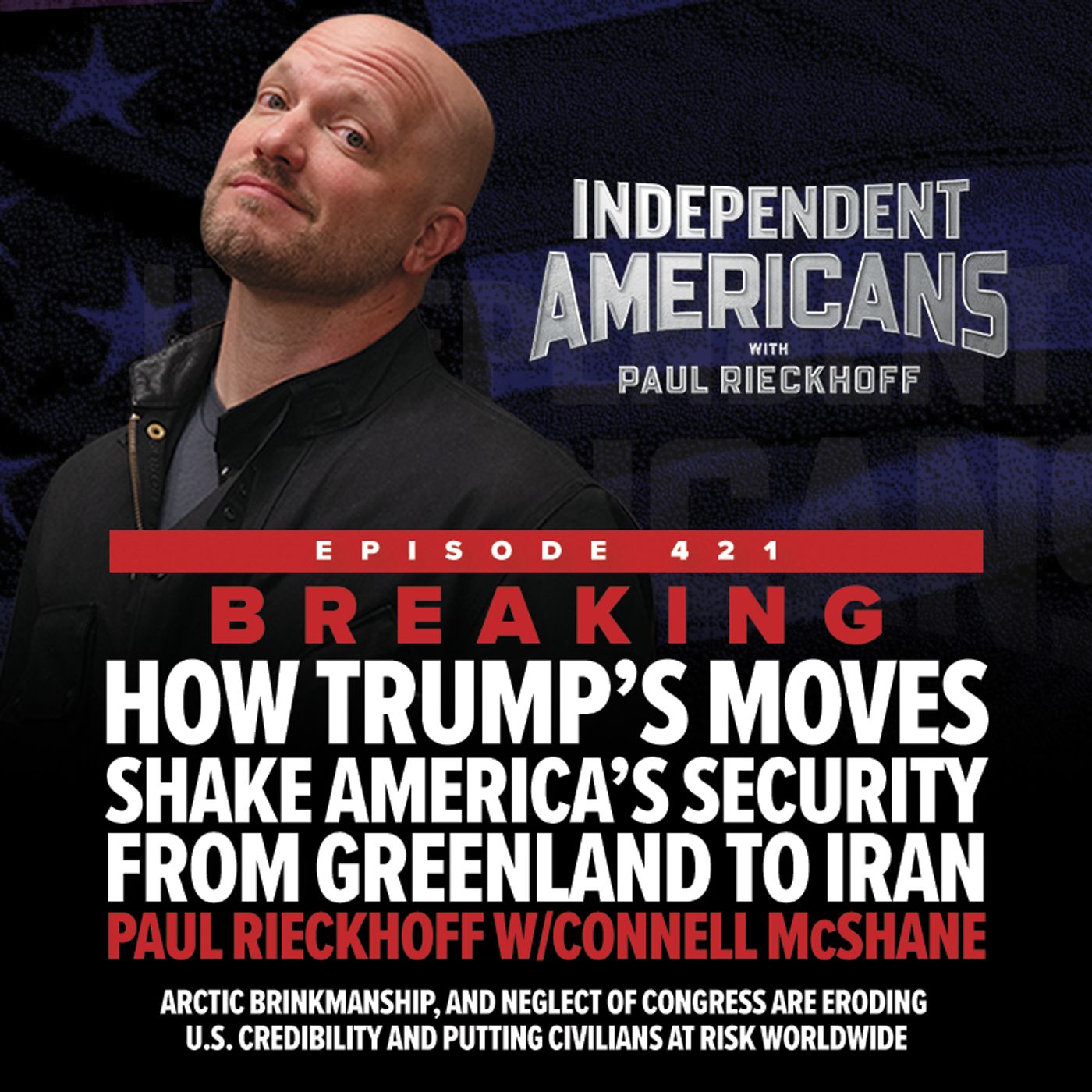
Independent Americans with Paul Rieckhoff
BREAKING: How Trump’s Moves Shake America’s Security From Greenland to Iran - Paul Rieckhoff w/ Connell McShane.
00:09:13
Independent Americans host and Army veteran Paul Rieckhoff joins Connell McShane on NewsNation Now for a rapid-fire breakdown of Trump’s shocking threats to “blow up” Iran, his escalation over Greenland, and what it all means for America’s security and standing in the world. From NATO nearly considering Article 5 over a possible U.S. attack on Greenland, to protests in Greenland against America, to civilians literally freezing in the dark in Kyiv, this special bonus episode pulls back the curtain on the real costs of Trump’s foreign policy chaos.
Loading summary
Transcript36 lines
- [00:00]
LifeLock Advertiser
The new year brings new health goals and wealth goals. Protecting your identity is an important step. Your info is in endless places that could expose you to identity theft, leading to lost funds. LifeLock monitors millions of data points per second. If your identity is stolen, our restoration specialists will fix it, guaranteed or your money back. Resolve to make identity, health and wealth part of your New year's goals. With LifeLock, save up to 40% your first year. Visit LifeLock.com SpecialOffer terms apply.
- [00:30]
Kalshi Advertiser
The second round is this weekend and now you can trade on football legally and nationwide on kalshi. Right now, LA is trading at 42% to beat Seattle. That means a $100 trade pays out 289 with a win. On Kalshi, you are trading against peers in a live market, meaning there's no house. And as the odds change, you can buy in and out of your position all game long. For a limited time, download the Kalshi app and use code iheart to get $20 when you trade 100k a l AGI kalsi trade on anything.
- [01:01]
Paul Rykoff
I think the bigger issue was we already had military access to Greenland. We already had cooperation from NATO, we already had access to the Arctic. So Trump can spin this into a win and maybe he'll get some some gains out of it, but at what cost?
- [01:29]
Independent Americans Podcast Host
Hey guys, here is some bonus content for all of our independent Americans, all of our vigilant, very vigilant and most vigilant. This is a TV interview that I recently did that I hope continues to expand all the conversations we're having on this show. Be sure to subscribe on Apple Podcast and follow us on YouTube where you can find this conversation and every regular TV and media interview I do. It's another way I hope I can help you stay vigilant.
- [02:01]
Ivan Davos
Ivan Davos, Switzerland. Paul Rykoff is here with me in New York. He's the host of the Independent Americans podcast, joins us every week. And you agree this has been kind of a distraction, maybe with now military action off the table in the speech tariffs as of this afternoon off the table, we move on and figure something out. I wonder what this agreement the President is alluding to with Greenland really is about.
- [02:22]
Paul Rykoff
I think it's even worse than a distraction. I think this has been deeply damaging to the world's trust in America. I mean, Naito is considering invoking Article 5 against the United States. If we attack Greenland, if we attack Denmark, there are Danish combat troops in Greenland. The entire continent of Europe was preparing for a military incursion by the Americans. You know, the only other time they invoked Article 5 was in our support after 9, 11.
- [02:47]
Ivan Davos
Well, that was the idea of Trump saying, well, has NATO ever been there for us? They were then.
- [02:51]
Paul Rykoff
Yeah, they've been there for us in Afghanistan. They've been there for us in. In Iraq. They fought alongside guys like me and bled and died. So I think it's been deeply, deeply damaging. Our closest allies have been afraid of us. And when he was over there today in Davos, he insulted everybody from Switzerland to Canada to Greenland, you know, the entire spectrum. So I think it's made us much more isolated, and it made us much less safe. Our allies don't trust. Now, he may walk this back with a deal.
- [03:14]
Independent Americans Podcast Host
Right.
- [03:14]
Ivan Davos
But that's what I mean by distraction is that it's not necessarily that. It's not important. But, you know, Robert's talking about Ukraine. There's so many things that we could be talking about. And I wonder if, you know, whether military action in Greenland was ever really on the table to begin with or it was just something to kind of throw out there. You know what I mean? The world's talking about it for whatever reason.
- [03:32]
Paul Rykoff
Yeah. I think the world has come to trust that Trump will do what he says. I mean, he said he was going to do Venezuela, and he did. He said that he'll strike, you know, boats in the Caribbean, and he did it. So when he says he might put troops in Greenland, they believe him, and I think they should. But I think the bigger issue was we already had military access to Greenland, we already had cooperation from NATO, we already had access to the Arctic. So Trump can spin this into a win, and maybe he'll get. Get some. Some gains out of it. But at what cost? We've really driven a rift in between NATO and the US And Europe, and the biggest winner here has been Putin, not only because of our destruction, but because of the damage it's done to our closest alliance.
- [04:07]
Ivan Davos
I want to talk about that for a moment first. Trump earlier today on. On Greenland, speaking at this speech in Davos at the World Economic Forum, where he took military action off the table. He's since added to all of this. But here's part of what he said.
- [04:21]
Donald Trump
It's the United States alone that can protect this giant mass of land, this giant piece of ice, develop it and improve it, and make it so that it's good for Europe and safe for Europe and good for us. And that's the reason I'm seeking immediate negotiations to once again discuss the acquisition of Greenland by the United States, this would greatly enhance the security of the entire alliance, the NATO alliance.
- [04:48]
Ivan Davos
Now, he says there is some sort of a, quote, unquote, future deal in place. Now, we don't know that that's the acquisition of Greenland. It could be something far less, it could be something much different. It's possible, against speculation that it's something we could have gotten all along, as many military experts have said coming in.
- [05:02]
Paul Rykoff
Yeah, we could have done that without pissing off all of Greenland and Denmark and most of Europe. I mean, there were protests in Greenland against America.
- [05:09]
Ivan Davos
So your concern is the lasting impact of that?
- [05:10]
Paul Rykoff
Absolutely. I mean, they've lost their trust in America. They don't feel like Trump is a reliable partner. And that's deeply down. He can play a switcheroo here, and he may get what he wants, but at what. And those deep divisions are going to last. The popularity of America is dropping by the minute, and we've got to really reflect on how isolated we've become. Yeah, we might be able to go into the Arctic alone, but we shouldn't. We should go with NATO, we should go with all our allies and should be a true coalition, because the Arctic is a space I would have expected us to be fighting for at some point in my lifetime. It's accelerated. But because of the resources in Venezuela and Arctic, those have always been on the military chessboard for any plan.
- [05:46]
Ivan Davos
Yeah. So just to be clear about this, and I think this is important because you've been critical of the president on this and many other issues, see the value strategically of what Greenland has, you know, because of its location, because of its resources. You just don't agree with the way that he's been going about it. Now, you think there's. There's value in Greenland strategically for the United States?
- [06:06]
Paul Rykoff
Absolutely. That's why we've had military bases there for decades.
- [06:09]
Ivan Davos
Should we have more?
- [06:10]
Paul Rykoff
There's a difference between planting the American flag, calling it the 51st state. Right.
- [06:14]
Ivan Davos
But we could add to those military bases.
- [06:16]
Paul Rykoff
We could. We could do that without threatening to invade Greenland. Right. We could have done that anyway here. So I think Trump is coming off as a bully, and I think that's really, really deeply damaging. We do need to be aligned against Putin to defend against any incursion in the Arctic. But the best way to beat Putin is beat him in Ukraine.
- [06:31]
Independent Americans Podcast Host
Right.
- [06:31]
Paul Rykoff
Right now they are losing tens of thousands of soldiers every single week in Ukraine. And if we want to push back Putin, we don't need to do it in Greenland, we need to do it right because that's where the fight, well.
- [06:40]
Ivan Davos
That'S where the focus tomorrow is going to turn to Trump, Zelensky and Wyckoff in Moscow. I mean, they've got a, you know, Trump said earlier, since they would be stupid, meaning Zelensky and Putin if they don't cut. So I guess we'll see what happens.
- [06:52]
Paul Rykoff
I mean, we've been here so many times before. The reality is that the lights are off in Kyiv. 600,000 civilians have had to leave Kyiv because there's no power and no heat. It's 5 degrees Fahrenheit there. People are literally freezing to death. So the thing that they should come away with is a stoppage of the bombings on infrastructure, on civilian sites and on Kyiv and other cities across Ukraine. That would be progress. If Trump wants to come back with a win show you can stop Putin from doing anything, then he would really look like a tough guy.
- [07:18]
Ivan Davos
No, these are interesting conversations. You should get away from all kind of the headlines. You know, that's kind of what we try to do here. Anyway, I will toot our own horn for a moment and say that, you know, we have your perspective on this, followed immediately by the Pentagon press secretary is on in our next section of the show. So we'll talk to her about what the Trump administration is saying and even tonight in primetime. And I want to play a clip from this interview because part of it aired last night. We have the president, part two in the Katie Pavlich's show. And then, you know, to show the balance and how I think we're the only ones having these, all the discussions Cuomo is having, Jacob Fry on the mayor of Minneapolis. So it's a lot of a larger conversation all happening at once. The topic I wanted to bring up with you, the president that came up in the interview was Iran and what he said to her in the part of the interview that aired last night about Iran. Here's the president with Katie Pavlich.
- [08:05]
Donald Trump
Well, they shouldn't be doing it, but I've left notification. Anything ever happens, we're going to blow the hell. The whole country is going to get blown up.
- [08:13]
Ivan Davos
So we forget about Iran. Now Trump says if anything ever happens to him, he's going to, he's left instructions to blow the entire country up.
- [08:21]
Paul Rykoff
I mean, just that kind of language is unnecessary, right? I mean, everybody knows how powerful America is. You don't have to threaten to blow up an entire country. The reality is that the Iranian regime has now squashed the protests. They've killed potentially tens of thousands of people. And Iran is always been a legitimate threat. But how do you approach that threat? Not by threatening to destroy the entire country, because we have protesters there, freedom fighters who are on our side who want to see an overthrow and they can do that without blowing up the entire country.
- [08:48]
Ivan Davos
How?
- [08:49]
Paul Rykoff
What would you have supported? We can support the rebellion. We can support, you know, an outside government like we're doing in Venezuela. We don't have to threaten to nuke the whole place, which is what it sounds like when Trump talks like that. And it scares the world. And I don't think it's entirely necessary. Bigger issue, he's not going by Congress on any of this, whether it's Greenland or Iran. I hope everybody from both parties should agree that our Congress should have a say on any kind of combat and especially long term incursions like he's potentially threatening to do. He should go to Congress, he should go to the American people, because both of them are very unpopular with both.
- [09:20]
Independent Americans Podcast Host
Those group all right, folks, I hope you enjoyed this extra bonus content. Be sure to subscribe and share and rate on Apple podcasts and on YouTube and spread the word about what we're building here at Independent Americans. I will continue to bring you regular episodes, I will continue to bring you quick response pods and every time I'm on TV and I think it's worth watching or seeing, I will share it with you here. It's another way to unite our community. Continue to bring light to contrast to heat and another way to help you stay vigilant. America.
- [10:11]
Paul Rykoff
Powered by Righteous Media.
- [10:15]
LifeLock Advertiser
The new year brings new health goals and wealth goals. Protecting your identity is an important step. Your info is in endless places that could expose you to identity theft leading to lost funds. LifeLock monitors millions of data points per second. If your identity is stolen, our restoration specialists will fix it, guaranteed or your money back. Resolve to make identity, health and wealth part of your New year's goals with LifeLock. Save up to 40% your first year. Visit LifeLock.com SpecialOffer terms apply.