← Independent Americans with Paul Rieckhoff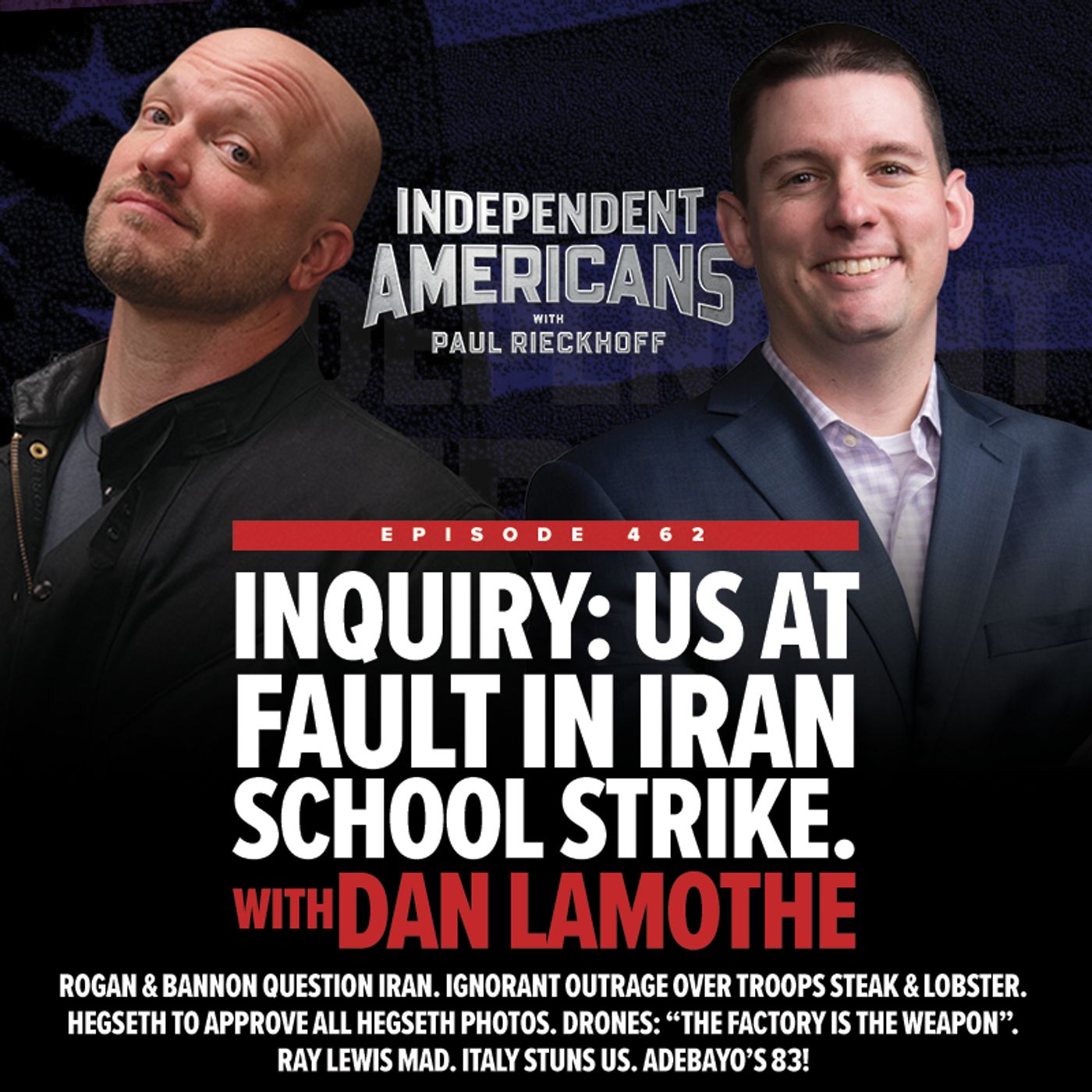
Independent Americans with Paul Rieckhoff
Inquiry: US at Fault in Iran School Strike. Dan Lamothe.
01:07:33
On this Wartime Wednesday episode of Independent Americans, host Paul Rieckhoff takes you inside the rapidly escalating war in Iran, what it really means for troops and families, and why 76% of Americans now oppose it. From a deadly U.S. strike on an Iranian school and new Pentagon revelations, to drone warfare, Cyber Command leadership, the Strait of Hormuz, and the viral Heath “lobster and steak” for Troops outrage, Paul breaks down the stories everyone should be tracking—but most news and politics shows are missing. Because we didn’t just start covering national security and war when the war with Iran started. We focus on it always. And this is one of the few shows out there hosted by a combat veteran who gets it.
Loading summary
Transcript71 lines
- [00:00]
Paul Rykoff
Avoiding your unfinished home projects because you're not sure where to start. Thumbtack knows homes so you don't have
- [00:06]
Dan Lamoth
to don't know the difference between matte paint, finish and satin or what that clunking sound from your dryer is. With Thumbtack, you don't have to be
- [00:13]
Paul Rykoff
a home pro, you just have to hire one. You can hire top rated pros, see price estimates and read reviews all on the app. Download today.
- [00:20]
Commercial/Advertisement Voice
When you manage procurement for multiple facilities, every order matters. But when it's for a hospital system, they matter even more. Grainger gets it and knows there's no time for managing multiple suppliers and no room for shipping delays. That's why Grainger offers millions of products in fast, dependable delivery so you can keep your facility stocked, safe and running smoothly. Call 1-800-GRAINGER, click grainger.com or just stop by Grainger for the ones who get it done.
- [00:50]
Paul Rykoff
He knows politics and he knows that this is bad politics, especially if gas prices go up and stay up. But Trump really doesn't care about Newt Gingrich. He doesn't care about the Republican Party. I know they're all concerned because they know one day Trump will be gone and they'll all be left with the wreckage, especially politically. The Republican Party may never recover, but just like on everything else, Trump doesn't give a shit. Foreign. Welcome to Independent Americans. Welcome to episode four 62, man. We're at 462 already. I'm your host, Paul Rykoff, and It is Wednesday, March 11th. Happy hump day. And maybe we're gonna have to start calling it Wartime Wednesday, probably every Wednesday until further notice. But I'm coming to you from New York City, usa, where the weather is still warm and sunny. It's shocking. It hit 80 degrees yesterday here in New York, the earliest in the year it has ever hit 80 degrees, which was nice, but not normal and a bit alarming. But it's an alarming time and I'm going to help you weave through the alarms and the sirens happening across our world. And today's artist, I give you an artist every day for the new folks is Jesse Wells. Yes, Jesse Wells. If you don't know, he's had four albums out this year. He was nominated for four Grammys. You might have seen him recently on the Colbert Report. I actually told Stephen he should check him out. I'm probably one of a couple folks that did. But Jesse Wells is a sensation. He is brilliant and he may have been my artist of the day before, but he just keeps bringing it. And his song join Ice I think should be song of the year. But he's at it again because he releases songs like daily and they're all amazing. Another one today, follow him on Instagram where you'll get new songs almost daily. And he has a song today that's just called song where he has a line. He says, I don't love it, I don't hate it. I don't even know it's real. Yeah. The more I understand, the more misunderstood I feel. He's just capturing this time and how so many of us feel daily, especially as this war in the Middle east continues to unfold. Because Jesse Wells continues to meet the moment like no one else and his legend continues to grow. He's capturing this time and how so many of us feel. And he's there for all of us. So I want to shout him out. I want to celebrate him, I want to share him and I want to do the same with this show. Try to be there for you and for all of us and bring the five eyes in every single show. I also hope Jesse Wells will join me on this show. But the five eyes, if you don't know, independence, integrity, information, inspiration and impact. And our guest today coming up is going to bring all that. He is a 10 time returning champion. This will be his 10th time on the show. Coincidentally, John Lithgow was on the Colbert Report with me. Sorry, check that. The Late show with Stephen Colbert earlier this week and it was his 10th time on Stephen Colbert. And I know that Stephen Colbert loves John Lithgow and I love Dan Lamoth because he brings exactly what you need in times of war and crisis and adversity. He is the military affairs analyst at the Washington Post and he's been on a ton because he helps us navigate all of this. And we're going to get into everything from the latest reporting around casualties in Iran to whether or not there could be a draft to Pete Hegseth doesn't like people taking his photos that don't work for him. But he will help us get through all of this and he will help us all on this wartime Wednesday. Stay vigilant. I'm working with some tea and lemon and honey, which actually I hope is helping my voice. And there's a ton to get through today that you have to track on before we get to Dan Lamoth. And there's one top topic until further notice, and especially on wartime Wednesday, it is the unfolding war in Iran and beyond. All right. And there's breaking news now from the Washington Post and others that finds that the US Was at fault in the strike on the Iranian school. There is a preliminary inquiry that has come out from in the Pentagon saying that outdated targeting data may have resulted in the mistaken missile strike. And this is after Trump said it was the Iranians Hegseth said he was investigating. Well, now it looks like a school full of children is dead because of the American military. We should apologize, we should investigate, we should ensure it never happens. And we should do our best to ensure that Trump doesn't lie about it. But this will be a focal point until further notice. And it's something that the world, I think, is much more focused on than America is. And we can't lose sight of that. America is watching. Our enemies are watching, our allies are watching. And how we handle and our president handles incidents like this in particular will determine not just this war, but whether we make new enemies for the next war. All right, also In Iran, the US says it struck 16 Iranian mine laying vessels near the Strait of Hormuz. The US Is trying to keep the Strait of Hormuz open. The Iranians are trying to disrupt it. It's one of the most important leverage points they have. There's now reporting that the war in Iran could lead to food shortages in the region. If the bombings continue and the carnage continues, it should be expected that there will be humanitarian issues to include potential food shortages because oil isn't the only thing that goes through the Strait of Hormuz. There will be food shipments to the region, and that is something to watch. Now, we know Trump continues to sidestep any blame for civilian deaths in Iran. And the popularity of this war continues to be very, very low, historically low. As I covered yesterday, 76% of Americans now oppose the war in Iran. That's more in any war in recent history, much higher than Iraq, which was only about 46%. We're at over 75%. 3/4 of America does not support this war. And more and more Americans are speaking out about it every single day, including Trump supporters and significantly, of note, Joe Rogan. Check this out. Neither thing made any sense to me. The Venezuela thing, at least that one
- [07:26]
Dan Lamoth
was at least clean.
- [07:28]
Paul Rykoff
They go in, kidnap him, get him out.
- [07:31]
Dan Lamoth
This one's nuts. Like if they had supposedly dismantled their
- [07:35]
Paul Rykoff
chances of making a nuclear bomb. Whether or not that's true or. I mean, it's so hard to know, just seems so insane based on what he ran on. I mean, this is why a lot of people feel betrayed, right? He ran on no more wars and these stupid senseless wars. And then we have one that we can't even really clearly define why we did it. Well, but he said he's against endless wars. Well, they're endless. Listen, man, they're all endless. So Joe Rogan has issues with the Iran war. And he's not the only Trump supporter. Steve Bannon, longtime Trump strategist, spoke directly to the President saying that he needed to get this under control. And now guess who has reemerged. It's going to be like the re emergence of chicken hawks from ghosts in times past. Newt Gingrich is back. Check this out. I look, there are three huge challenges that this administration has tackled. The first is that and they should have frankly moved on this on day one. They have to keep the Strait of Hormuz open. Yes. I don't care what it costs. If they can't keep it open, this war will in fact be an American defeat before very long because the entire world, he understandably is focused on the Strait of Hormuz. He says if they can't keep it open, this war will in fact be an American defeat before very long. Newt Gingrich saying the D word that you won't hear from most folks, but there's a name you probably didn't expect or want to hear again, but Newt Gingrich is alive. One more thing about Newtown. He knows politics and he knows that this is bad politics, especially if gas prices go up and stay up. But Trump really doesn't care about Newt Gingrich. He doesn't care about the Republican Party. I know they're all concerned because they know one day Trump will be gone and they'll all be left with the wreckage, especially politically. The Republican Party may never recover. But just like on everything else, Trump doesn't give a shit. He's always and only out for self. His power, his glory, his legacy. And he cares no more about the GOP than he does about troops in war zones or doing sit ups or exercising. He is the ultimate not team player. As I've said before, he's all gas, no breaks. He wants it all. He's grew. He wants the moon. He wants to put it in his pocket. He doesn't give a shit about anybody else, not even Newt Gingrich, not even his base. And that is becoming more and more apparent to more and more Americans of all political backgrounds. And here's some other related news that our enemies are watching. It's being reported from the Washington Post. Reminder, we've got Dan Lamoth Coming up, Ellen Nakashima is reporting that General Joshua Rudd has been confirmed by the Senate as the next NSA Cyber Command head. We had one year of leadership limbo at Cyber Command, the nation's largest spy agency and the military's offensive cyber organization, and did not have a leader. Now they do. And about damn time. Because you know, it would be good to have a head of Cyber Command right now. Right. Especially in an election year when the Chinese and Russians are going to want to continue to probe and disrupt and as Trump unleashes a whole new regional war in the Middle east, be good to have a head of Cyber Command, right? This is the political stuff that is often below the radar, that matters for our national security. And when it gets delayed and it gets mucked up, it's bigger than politics. It's about our national security. And our enemies are celebrating. All right, our enemies might be celebrating my loss of voice, but I got bad news for you bad guys. It's coming back and so is some of the stupid. When wartime happens, people run to their political corners. And I think sometimes liberals and conservatives jump to their partisan corners and want to run with things. And I think there's an incident in particular where liberals especially need to take a breath and remember that everything is not a scandal. There's a lot of hubbub around released information about what the Department of Defense is spending money on. And Molly Jung fast. I've been on with with her before on msnbc. She is a podcaster. She is a liberal voice. She posted something on X yesterday that got a lot of response, especially from military members. And we'll get a response from me and folks from across the veterans community. I'll read it to you. Some of the frivolous September purchases made on Secretary Pete Hegset's stewardship include a $98,329 Steinway Sons grand piano for the Air Force chief of staff's home $5.3 million for Apple devices such as the new iPad an astronomical amount of shellfish, including $2 million worth of Alaskan king crab, $6.9 million worth of lobster tail, she adds lobster tails, apparently a favorite of Hegset's Pentagon department, spent more than 7.4 million total on the luxury item in March, May, June and October. Other pricey food purchases, the government decided to drop $15.1 million for ribeye steak again just in September, $124,000 for ice machines and $133,224 on 272 orders of donuts. Now look, you all know, everybody knows I'm no fan of Hegseth, and there is plenty to hit him on. He's disgraceful. The worst Secretary of Defense in human history. But paying for lobster and steak for our troops is actually not some frivolous DoD expense. Same with ice cream and donuts. It's a pretty standard way of taking care of our troops and giving them a nice meal to boost morale, especially during a long deployment like the USS Ford, which is going to be gone for 11 months. Or for submariners who've been underwater. And let's just use this as an example so you understand the context. There are 4,500 people just on the USS4. So how far do you think a couple hundred thousand dollars of ice cream goes? And there are many ships deployed now, and they have been for much of the last year. And a good meal is one of the few and nice and celebratory things for them to look forward to when they're missing countless birthdays, weddings, funerals. Deployments are hard and food is often a rare highlight. And it is not frivolous. And folks are pushing back, including Ryan Evans, who wrote I don't know who needs to hear this? Well, actually I do. But the Department of Defense spending money on shellfish, ice cream and steak for service members at war, many of whom have been at sea for a long time, is not a scandal. This is just basic taking care of the troops. Craig Jaffe, who covered these issues for a long time, wrote, the lobster is a scandal. They freeze it, thaw it, and then refreeze it until it has the consistency of an old tire, totally not edible. And Tom Shugard wrote, yes, when I was in the submarine force on Sundays underway, we had surf and turf. Why was that? Because once a week we got to have a somewhat nicer meal as a reward for caps. Spending years of our lives underwater so that people can make stupid points about non news like this. This is really, really what it's all about. Few recent issues have exposed a civil military divide in America like this one, and especially in the political media, more vividly than ice cream, donuts, lobster and steak story. And this is a pretty easy one if you dig below the hood. If you talk to people who know, this is an easy one. But it does reveal how we're going to have to explain a lot of basic stuff about the military to a lot of people. Wait, we have to explain and re explain disability benefits, traumatic brain injuries and toxin exposures? That's gonna be really hard. Stay vigilant, folks. All right. Speaking of wounded troops, some of them are home now from the Middle east and they are sharing their stories. Play this one, Chris.
- [15:25]
Commercial/Advertisement Voice
Sergeant First Class Corey Hicks says he's
- [15:28]
Paul Rykoff
lucky to be alive.
- [15:29]
Commercial/Advertisement Voice
The Minnesota native is recovering from injuries suffered in an Iranian drone attack in Kuwait that killed six U.S. service members.
- [15:36]
Paul Rykoff
I remember turning my head to the left and I seen the nose of that drone pop through. And as soon as it did, I knew what it was. It was either a missile or a drone. So I turned to my right and that's when it blew up and just blew the whole building apart. Life is precious. Precious life is short. You never know when you're going to be putting in a situation like we were in. All right. That's Sergeant First Class Corey Hicks describing a terrible moment where a drone struck his command center, confirming what we've talked about a lot on this show, that drones are the biggest threats to our troops and the Ukrainians have been warning us for years. NPR has a great story today about an eastern Ukrainian town of Izum where the entire city, the entire town is covered in, in nets. They have nets, all anti drone nets that cover the streets and the sidewalks and the highways because as Ukrainian officials have disclosed, drones now account for 80% of frontline casualties. Izium has spent six months under the occupation during the first year of the war. Some good reporting by Eleanor Bedsley at npr. But this is what we've been telling you. Drones and IEDs are the VBI sorry. Drones are the IEDs, improvised explosive devices and VBIDs, vehicle borne improvised explosive devices of this war. And they're going to kill and wound more American troops and potentially civilians than anything else. And as we've talked about on this show a lot, the Department of Defense, our troops and our homeland where you live, are not ready enough. They're not. We went deep in our recent episode with Nolan Peterson and we'll continue to focus on drones daily and as often as possible. Go back and check out my episode with Nolan. Nolan, it's one of our favorites and one of our best from the last couple of months. And there is also some reporting from Axios that the Pentagon is pushing the defense industry to saying that, quote, factory is the weapon when it comes to drones. There's a bunch of meetings kicking off at Fort Bragg this week and the trials run through early March, putting small, inexpensive drones and their makers through the ringer as the US Is trying to learn lessons of the war in Ukraine and crank up our drone production because we know that we are behind. And Redcat CEO Jeff Thompson told Axios they're very blunt about it at drone dominance. If you can't produce them and deliver them on time, if you're two weeks late, you're out. Well, the factory is the weapon. Our ability to make these things is going to be a weapon. And making weapons, of course, is big business, very big business. War is a racket. That's what General Smudley Butler famously said. And it's never been more profitable than now. Never forget that war makes people rich, very rich. We talked about the billionaires list last week and how Elon Musk is at the top of it. But as war continues, so does the profit for many. And it's another reason we all need to stay vigilant. All right. We need to stay vigilant because so much other stuff continues to happen. ICE continues to run rampant across America. Don't lose sight of that. Trump continues to wage war on the free press. Don't lose sight of that. We're going to talk to Dan Lamoth about that. Coming up. Ukraine continues to fight on Today is day 1448, Russia's full scale invasion of Ukraine. Veterans issues continue to be important and below the radar. I want to remind everyone that Senator Ron Johnson, Republican from Wisconsin, sucks. If you didn't hear my episode yesterday, go back and check that out where I highlighted how he is blocking the Major Richard Starr bill for veterans because he says it's too expensive. Yeah, there's a lot of bad politics that continues to happen even in a time of war. All right. And there's some other political news of note. There was a primary yesterday where again, many independents were blocked out in a couple of states in Georgia and Mississippi. And in March, Marjorie Taylor Greene's district, a Trump backed candidate has advanced. Clayton Fuller will face off against Sean Harris, a Democrat, in an April runoff. Mr. Fuller's win over a flashier Republican showed the power of the president Trump support. The New York Times has that. And Sean Harris is of note. He is a retired general and he was a guest on this show. If you didn't hear my episode with Sean earlier this year, the end of last year, check it out. We'll link to it in the show. Notes. He's an impressive guy. He won 37% of the vote. Clayton Fuller got 35% of the vote. And there will now be a runoff in this critical race to succeed Marjorie Taylor Greene, who has also become a critic of Trump and is not too high on Iran. But I hope General Harris will come back soon. And I've said this before, I still hope General Harris will declare his independence. I think if he was an independent, he'd actually do better in that district, as we've seen with so many other veterans. But there is no independent in that race and Harris is the only military veteran and he will have my support and he will have an opportunity to come back on this show. Remember, we talk about it all the time. I think the Republicans are morally bankrupt and mean and the Democrats suck and will not save you and are weak. If you're new to this show, you're going to find out more in the days to come because we believe that independents are the people's champion. We're not just moving the needle, we are the needle, and we're going to continue to keep a focus on independent politics even and
- [21:12]
Commercial/Advertisement Voice
nobody does Selling Better than Shopify Shopify is the home of the number one checkout on the planet and the not so secret secret with Shop Pay that boosts conversions up to 50%, meaning way less carts go abandoned and way more sales going through. So if you're into growing your business, your commerce platform better be ready to sell wherever your customers are scrolling or strolling on the web, in your store, in their feed, and everywhere in between. Businesses that sell more sell on Shopify. Upgrade your business and get the same checkout that Skims uses. Sign up for your $1 per month trial period for three months at shopify.com Westwood One all lowercase go to shopify.com Westwood One to upgrade your selling today. Shopify.com Westwood One
- [22:09]
Dan Lamoth
with its two juicy
- [22:10]
Paul Rykoff
beef patties and three slices of melted cheese topped with tangy Big Arch sauce.
- [22:15]
Dan Lamoth
The Big Arch is what happens when
- [22:16]
Paul Rykoff
you start making a McDonald's burger and never stop. The Big Arch the most McDonald's McDonald's burger yet for a limited time.
- [22:24]
Dan Lamoth
It's tax season, and at Lifelock, we know you're tired of numbers, but here's a big one you need to hear. Billions. That's the amount of money and refunds the IRS has flagged for possible identity fraud. Now here's another big number. 100 million. That's how many data points LifeLock monitors every second. If your identity is stolen, we'll fix it. Guaranteed. One last big number. Save up to 40% your first year. Visit lifelock.com specialoffer for the threats you can't control.
- [22:54]
Commercial/Advertisement Voice
When you manage procurement for multiple facilities, every order matters. But when it's for a hospital system, they matter even more. Grainger gets it and knows there's no time for managing multiple suppliers and no room for shipping delays. That's why Grainger offers millions of products in fast, dependable delivery so you can keep your facility stocked, safe, and running smoothly. Call 1-800-GRAINGER Click grainger.com or just stop by Granger for the ones who get it done,
- [23:24]
Paul Rykoff
especially as the wars continue. All right, rounding the bend Culture There's a culture story I want to shout out. Looks like Miley Cyrus will be performing as Hannah Montana for the first time in 15 years. In this special, never before seen footage, they will have recreations of the show and Cyrus will sit down with Call Her Daddy star Alex Cooper. I share this because I like Miley Cyrus. I'm a big fan of her. I've been a big fan of her music and her attitude to and her stances for a long time, and I'd be interested to hear what she has to say about this moment. I think she's probably an independent, but I can't confirm it and I want to invite Miley Cyrus to come on this show and join us. Alex Cooper, you're welcome to join us, too. I've seen her podcast Dominance, and I think we could have a very good conversation. But that's what's going on in culture. Let's move quickly over to sports, where there is a lot going on, especially around the intersection of sports and and politics. Now, there are some sports legends you don't want to piss off. Ed Reed, the Ravens great is definitely one of them, near the top of the list. I told you earlier this week about how he objected to the White House using a clip of him as a part of one of their absurd and shameful hype war videos. War videos. Well, there's one of few people, there are very few people higher on the list of you don't want to piss them off than Ed Reid, but there's one that's higher on the you don't want to piss them off list, and it's NFL hall of Famer and certified madman Ray Lewis. Yes, Ray Lewis, the great Ravens linebacker, Hall of Famer, super bowl champion. But now following Ed Reed, Ray Lewis is also speaking out. After this video, Ray Lewis, through a representative, has made his objections known, saying, quote, this is something we do not agree with and we would like and would like Ray to be removed. Ray Lewis is pissed at you. You know you're fucking up when Ray Lewis is pissed at you. Ed Reid is pissed at you, and more and more Americans are pissed at you. Ray Lewis is not a dude you want to piss off. I welcome him and Ed Reed to come on this show anytime because they have a right to be pissed off. If you're not angry, you're not paying attention. And all across the U.S. in baseball world, the U.S. is pissed because we lost last night to Italy in the World Baseball Classic. Yes, we lost to Italy in a stunner. Italy got the biggest baseball win in their history, beating the USA 8 to 6. Last night, Italy was 20 coming in. And they're toasting espressos all over the boot today. It is still the opening round and both teams may advance. We'll find out today. But this was a stunner because it's not guaranteed the US could be out. I think this is underscoring how it's been a pretty bad year for America and it's only March. But here's what we need to root for today. Now we need to root for Italy to beat Mexico. If Italy beats Mexico, then the US Is in. If Mexico wins, it depends on how much they win by. But this is a stunner and not a great look for America. This team doesn't seem focused. Apparently they went out drinking, celebrating the last game because they didn't know they needed to win this game in order to advance. This sounds like the shit we hear coming out of the Pentagon. All right, speaking of stunners, there was one from the NBA last night that was amazing if you didn't see it. Miami Heat star bam Adebayo scored 83 points. 83 points, the second most ever, only behind Wilt Chamberlain, who once scored 100. He was two points ahead of Kobe. Now, they did foul him a lot and he scored like 40 points from the line, but it was inspiring. It's one of those moments that we need as a break. Sports can be a break. It can be a bit of joy, because joy is still a form of resistance, but so is vigilance. And our guest coming up is going to bring you that vigilance, especially in wartime. It is wartime Wednesday in America, and it is now especially a time to stay vigilant. Okay, folks, as the war in Iran continues to overflow throughout the region, Trump is talking about a draft pressure on our military as it is at an all time high. I'm always gonna bring you guests that are at the middle of all of it. Guests you can trust, guests who have integrity, independence and all the other of our five eyes. And there's no better person to talk to this week and in this moment than A returning champion, one of our favorite guests, one of our most trusted guests. And for those of you that are new here after the Colbert hit, welcome. This is the kind of guest I think you can expect to have on this show. I'm going to read you his X bio. Military affairs at Washington Post. A state school alum at UMass Journalism and Merrill College, straight out of Chicopee, Massachusetts. Grateful American. And also he has his signal address, which is Dan Lamont, 30, up there. Because he is trusted as a reporter who sources can trust. And that will be true much more in the days to come, I am sure. The great and powerful Dan Lamoth is back on Independent Americans. Welcome back, sir.
- [28:27]
Dan Lamoth
Thank you. Paul.
- [28:29]
Paul Rykoff
Man, this is like what you were built for. I feel like this is a moment we're really going to need you, right?
- [28:35]
Dan Lamoth
Yeah. I mean, me and my team, you know, our whole team, we've been, we've been grinding and, you know, it's, it's been a real team effort. 5, 6, 8 of us through the weekends, through, through the evenings. And it's been really uplifting to see kind of the group all chip in various pieces, you know, and just do. Doing whatever we can to kind of expand understanding.
- [29:04]
Paul Rykoff
Yeah, you guys are meeting the moment. And when we saw the, When I saw the destruction at Washington Post, I was saying, man, please don't hit Lamoth and that national security team. And the wreckage has been pretty significant, but you guys are still standing and doing tremendous public service. I can't skip over without asking you, where in the world are you and how are you in this chaotic time?
- [29:25]
Dan Lamoth
Yeah, we're doing the recording home from my house in Virginia today. Hanging in there, working hard, can't complain.
- [29:37]
Paul Rykoff
Can I ask you, because we've been covering this on this show for now, years. The Pentagon press corps is not in the Pentagon. We are now fully engaged in war, arguably around the world, at least eight countries and counting. You are reporting from home. Hegseth went from not doing press briefings at all, kicking out the press corps, not doing briefings, even with the propaganda press corps, to now doing almost daily briefings. Can you give us an update on what it's like now and maybe, maybe take us inside these rooms, you know, he's now doing these almost daily briefings with Cain, which is kind of what the norm used to be. But take us below the surface to what folks can't see off camera. Who is in that room and what are your thoughts on how those things are taking place?
- [30:23]
Dan Lamoth
Yeah, it's a different feel. You Know, I haven't been shy about how little they've been willing to kind of speak on the record and speak on camera over the months. I kind of, you know, every once a week, basically had been reminding people on social media, hey, it's been X weeks, X months since they've kind of done what had been considered the bare basics. This has changed the dynamic there. They very abruptly shifted to doing at least a few a week. Usually it's Secretary Hegseth and General Kane. We've also seen Secretary Hegseth and Admiral COOPER down at U.S. central Command, which then turned into a Saturday Night Live skit. You know, it was kind of wild seeing an Admiral Cooper look alike on Saturday Night Live. I didn't have that on my bingo card and I was in the room for one last week. We've been kind of rotating that through our Pentagon reporters at the Post. But. But it's a. It's a different vibe, for sure. They assign seating. That's enough. That's not something we ever saw. Their accredited press corps usually in the front. I was in the second to last row last time. I don't say that as a complaint, more just an observation. You know, that's just the way they're kind of shaping it now. The questions mostly, and I would say even from the accredited press corps, which had been a concern for some readers and some online, are these people asking reasonable questions? I would say a lot of the questions they're asking are similar to the questions I would have, but it's still a bit more managed. And we have Washington Post reporting today noting the fact that after the very first one over the weekend, they've actually decided to greatly reduce the number of independent news photographers in the room because they weren't happy with the look of some of those images.
- [32:14]
Paul Rykoff
Yeah, I want to come back to that. Hegseth doesn't like the photos and he's doing a very Hegseth approach to that. But take us a bit. So. So you're second to last row, right? That means the MyPillow TV guy and Newsmax and Laura Loomer and Matt Gaetz are in the front row. Is that kind of how it's. How it's shaping up?
- [32:34]
Dan Lamoth
Generally speaking, yes. The first row was. Oan some of. Some of the others like that. Some of the questions they're asking are solid. Whether or not you're getting the same follow up. And I think it does create a dynamic. Words less likely. Can't say impossible, but less likely that we're going to Be able to interject from 50 feedback or 30 feedback in that kind of environment and get a question you might not otherwise hear.
- [33:03]
Paul Rykoff
And like in defense of our democracy here, I remember for a long time, I think it was at the White House press corps, was it Helen Thomas was often the first question or one of the first questions. Right. The venerable Helen Thomas that was understood. All presidents went to Helen Thomas among the first. And was there a first place the Pentagon used to go? I mean, maybe you can share some of that because now that's important here too. They only have a little bit of time. So they can kind of run out the clock by starting with OAN Newsmax, you know, and those kinds of folks, and then not give the Washington Post or CNN or AP a question till the end, if at all. But how did, how did it used to go in Pentagon briefings?
- [33:43]
Dan Lamoth
The longtime tradition at the Pentagon briefings with the Associated Press had the first question. I think it also made sense from the perspective at the time, at least as I came into it. You had Bob Burns who had been in the building for decades, and Lita Baldor who didn't, you know, was basically right behind him in terms of experience. So regardless of who's in the seat, it was a seasoned journalist who knew how to kind of, I guess, level set at the front of the briefing on what the likely questions of the day that should be answered would be.
- [34:13]
Paul Rykoff
So it's hard to pick one top topic here with you for today, but I'm going to start with kind of the overflowing mess and make that our top target, top topic and maybe tick through a couple of it. The breaking news now that I'm sure you're gonna cover is the internal inquiry has found that the US Was at fault in the school strike on Iran that killed over 140 kids. Trump said it was Iran. Hegseth said they were investigating. Now at least preliminary internal reports are saying it was a U.S. mistake. Do you have any additional color or reporting on that, Dan?
- [34:46]
Dan Lamoth
Yeah, I mean, I've seen the New York Times reporting. We have been and will be chasing that story. You know, we have to firm it up to our standards. You know, they just got there faster. I do think that reporting probably bears out as true, you know, so I think it's the how of it, right? It's how did you go about assigning a value to this building as a military target when it's not at least anymore? And I think that's probably where it went wrong. Here is if this used to be a military building and it became a school. Where did the United States as an entity lose that plot? Where did we lose understanding of what that building was and who was inside? So I think you're going to start seeing an assessment of how we target, what kind of intelligence is available, how are we processing it? And those are questions that I think are going to come especially as we see an increasing use of artificial intelligence in some of that processing. I don't know if that's a factor yet. It's certainly a question I have. And we're used to seeing these long term wars in Iraq and Afghanistan and so on, where we had slow flying drones and other aircraft overhead for hours and days on end, providing soak, they would call it. You know, basically just eyes on target for a very long period of time. That's going to be a much more difficult proposition in an area where they're shooting down drones and where you're seeing just a lot more incoming fire of all kinds.
- [36:18]
Paul Rykoff
Yeah, My follow up question was going to be about the AI component. We covered it with Nolan Peterson, we covered it with Joe Serencione and there's been the anthropic fallout. So no one knows definitively if there was AI in the decision making process before this strike was made. Right. We don't know either way. Right.
- [36:36]
Dan Lamoth
I'm not clear on whether it's a factor. Would probably be a good way to put it. Central Command has been on the record talking about how artificial intelligence is helping them process targeting here. So I think whether, whether A and B are tied here, I think that bears more reporting.
- [36:53]
Paul Rykoff
Yeah, this is a really, really important question, you know, as the kind of moral fabric of how the kill chain decision making is unfolding. Also, you know, there's so many points of this that are deja vu all over again for me. And this is a strange tangent, but I was in the movie Green Zone back in the day with Matt Damon and there's a scene where I'm briefing Matt Damon and these teams that are looking for weapons of mass destroyers. And Matt Damon and I get into like an argument because he keeps saying the intel's bad, the intel's bad. You know, we just hit a toilet factory and I have to, I play a guy named Major Gonzalez and I say, no, the intel's good, it's solid. You know, this is, this is that. But on steroids now. I mean much quicker, much faster, much more lethal with higher grade technology on board. We're not just sending, you know, search teams and eod teams, we're sending drones, we're sending strikes that are following up. And if the intel is bad, I think that the cost is even more catastrophic. Do we have any sense of reporting on the ground around this strike and other strikes? I mean, how are you guys getting at that when basically the Internet shut down, so much is shut down in Iran? How are reporters working this story from the Iranian side?
- [38:04]
Dan Lamoth
It's challenging. It's especially challenging now when the situation on the ground is so dynamic and so violent. I think as time goes by, you'll see an increasing reliance on Iranian journalists on the ground. Some freelancers. We've seen CNN have a limited presence on the ground for a period of time. I think each news organization is going to have to make judgment calls on what's safe for them, what makes sense for them, what kind of ground rules are attached. And none of those decisions are easy in the short term. A second piece of this, and I think this goes to some of the reporting over the last week, particularly the Tomahawk missile was likely used. It's the question of what can you see through other means? Video that's out there, social media posts that are out there that you can verify as real, you know, visual forensics is the team at the Washington Post that does that. You know, and that was our. Our, Our version of that story was basically crunching as a group what kind of munitions were hitting which buildings. Can we verify it? You know, there's additional questions. Which destroyer that Tomahawk probably came off of. I think those are things that we're still having to sort through. But the fact that it looked like Tomahawks hitting that particular city block at that particular time, that's how we got to where we are and how we got to that strange conversation with President Trump saying that Iran had Tomahawk missiles, which simply isn't true.
- [39:34]
Paul Rykoff
Yeah. So that's a good focal point, because what we're ultimately getting at here is the truth. And the truth is always the first casualty of war. You help us get at the truth, and you also, as we often do on this show, you help us understand not just what's happening now, but what's happening next. I wanna talk about some of your recent reporting where you broke the story that the 82nd Airborne had some training canceled. You know, 82nd Airborne is America's 911. You know, our paratroopers are usually among the first to go in. They're also usually among the first to potentially get out. Americans. Right. If they have to do something around an embassy. But what does your reporting tell us about the significance of the 82nd Airborne having training cancel? As Trump has said, he wants to put boots on the ground. He's open to put boots on the ground. Many of his surrogates are saying the same. He's even teasing the idea of a draft now. But what does it mean for folks that aren't tracking on this like you are that the 82nd Airborne has some training cancer?
- [40:30]
Dan Lamoth
Yeah, I mean, I think the, the, the noteworthy piece and the piece that, you know, actual sources tied in with this discussion pointed to was this was an abrupt cancel cancellation of the headquarters element of the 82nd Airborne Division participating in this training exercise at Fort Polk in Louisiana. Some of the rank and file, like the brigade level, still went forth with that training Louisiana, but they made sure everyone else stayed back at Fort Bragg. And there's a lot of reasons that could happen. But I think a reasonable assumption here, and what a lot of people I talk to anticipate here is they're having to crunch through what the next steps would be. Certainly a concern a lot of Americans would have would be, is the 82nd Airborne all or in part going to be in Iran proper? And I don't have a good answer on that right now, but it's certainly a concern. But the 80 seconds also had a lot of other missions in the region. When things get dicey in the past, it wouldn't be a surprise to me, as a for instance, to see the 82nd involved in any kind of evacuation effort. It wouldn't be a surprise to see them be added as basically additional guns at some of the US Embassies. If they're worried about any kind of attack on embassies in the region, which is something we've seen out of Iran's playbook in the past. So, you know, there's a lot of things that could be short of, you know, putting a brigade or more on a specific target of, on Iranian soil. I'm not saying that's where we are right now, but the fact that the 82nd headquarters, including the general and otherwise, needed to think about this, I think kind of tells you that we're kind of in some uncertain territory on what the next 30, 60, 90 days could look like.
- [42:15]
Paul Rykoff
It also feels like the 80 second is high visibility enough that it's something that Trump would like to use, like the idea of paratroopers in his mind. And he often thinks of things in kind of a World War II framework, or like his idea of, you know, death from above, the 82nd Airborne dropping in in parachute regiments, like on D Day. I mean, I could see him wanting to do that, if only for the demonstration effect of it. Right. Even if they pick an abandoned airfield somewhere, which the 82nd Airborne could do, no problem. Right. Dropping in a bunch of paratroopers in the 82nd Airborne would kind of be like a flex in the same way they hit a ship with a submarine torpedo, which we haven't seen since something like World War II. Let me ask you a kind of related question. Do you know what's going on with the 11th Airborne Corps? The 11th Airborne Corps was put on standby to potentially deploy to Minnesota. That was, I think, well reported. You know, now things have simmered down in Minnesota, but ice friction continues. Do we know if they're keeping the 11th Airborne Corps or any other unit at the ready for anything domestic, to include the Insurrection act, which they put out there? The Freedom Caucus has endorsed their using. But any idea if the 11th Airborne Corps or anybody else is still on standby for domestic dependency employment?
- [43:33]
Dan Lamoth
I don't. Some of those details emerge, you know, through concerned sources. Some of those, I think, emerge sometimes as a signaling mechanism. You know, hey, we want to show that the, you know, that particular unit is available and ready if the president needs it. Like so. Like, I think how it emerges in the public square. You know, the reasons vary for that. So I don't have a good read at the moment. Will keep thinking
- [44:01]
Paul Rykoff
so. Reporting from CBS that now is kind of cascading around that the Iranian drone attack in Kuwait in the early hours of the war was more severe than previously known. Jennifer Jacobs from CBS is reporting on this. That now there might be over 100 medical personnel were sent to Landstuhl to assist. You know, there are 12 at Walter Reed, 25 at Landstuhl, 20 got to a Landstuhl on a C17 with military injuries designated as urgent. Bottom line here, it looks like that first strike was more damaging. Not deadly necessarily, but it hurt a lot more people than originally disclosed. I'm gonna say this. You know, CBS continues to get exclusives. That is noteworthy, given the changes at cbs. I don't think you could probably comment on that. I welcome our old friend James Laporta, who's also reporting on this, to come back. But it would not be outside of this framework to assume that folks inside the administration are giving stuff to what they might perceive as friendly first. But putting that aside, any reporting or thoughts on the extent of the casualties, a lot of folks are saying you can't believe Trump on anything, are a lot more people dying and getting wounded than they're reporting.
- [45:16]
Dan Lamoth
I have no reporting that would suggest that there's more dead than we know about. But, but I do think, and I think the question was there right along, how much are we showing of injuries? You know, it's one thing to, you know, you may know, the number of fatalities. You know, I think we have a read. I kind of would agree that at the moment, it sure looks like it's seven American dead in combat situations here with an additional in a medical situation. But anytime you have blast injuries like that, if you have that many dead, you wonder immediately how many more are hurt, how many more could die. So we're in that situation now where like, that's 7, 8, 9 additional that were, you know, seemingly quite severe. I don't know what exactly the extent of those injuries are, but I would wonder and be concerned about what their, you know, the medical outcomes are for each of those individuals. And then we've seen it in the past. You know, we saw it during the first Trump administration when we had ballistic missile attacks on Iraq that injured in excess of 100American U.S. service members. You know, the range of those injuries was pretty wide. You know, they cast them as, as mild TBIs in a lot of cases, and in some cases, that was the case. But I've also interviewed people in the past that, you know, a year later were still really struggling with the head injuries they had and the headaches and the nausea and all those sort of things. So it wasn't all mild injuries. So I think some of this is in the category for me of like, what are we not fully sharing? Just, you know, skeptical, you know, reporter job, reporter hat. What are you not telling me that, you know, perhaps should be out there? The second piece of it is, I think there is also understanding that grows over days, particularly with head injuries of, you know, maybe you didn't feel, you know, maybe on day one you thought, ah, you know, that they rang my bell and I'll be okay. But if you still feel that way a week later or two weeks later, that's a higher echelon of care. And I think we're sorting through that at the moment.
- [47:23]
Paul Rykoff
Or maybe you're in a remote place and you haven't been checked out by a doctor yet. I mean, this is, I think this is really important because there's so much lack of trust and there's so much politicization of everything that especially I've seen a lot of folks on the left, they're jumping to conclusions, saying there are so many more dead, there's misinformation happening. I want to ask you to address two related points of that one, which is the medical situation. One, an NYPD officer and a reservist died and it was a medical issue. Now, I know that this could be a heart attack, could be he's a diabetic. It could be any medical issue. That happens when you have thousands of people in one place. There are also accidents, car crashes, people fall off trucks. Those are not necessarily hidden casualties. But what was interesting to me was that it was first reported by the NYPD. It wasn't reported by the DOD, it wasn't reported by Centcom. Then you saw Mamdani respond, then you saw Governor Hochul respond. And I think it was like 11, I think that was around 8 o' clock, and it was like 11:30 or so before we heard from anybody in the Department of Defense that acknowledged this. So can you address, you know, number one, the frequency of these kind of medical issues and just how that information did get out, which I think, which I think was suspect?
- [48:36]
Dan Lamoth
Yeah, it was a surprise to see it reported formally by the NYPD before dod. But, but I, I think one thing that I would want to know more on before I'm casting any aspersions, they don't have the same policies necessarily on that. And dod's hands are tied to some extent for a lot of good reasons that they won't release the name until 24 hours after all next of kin on a list designated as Mexican that need to be, you know, reached out to and discussed and visited basically until those folks are all, you know, box checked on all of them. All of them have been talked to. So I don't know where the next Akin notifications stood in that process. I've seen in past cases where, you know, it seems like a, you know, you know, about an anonymous death on a Tuesday and on Friday, you don't yet have a name. In past cases, Afghanistan and other places I've covered, you know, sometimes it's, it's the why, how did this happen? What are we missing? Sometimes it's, there's like a random outlying family member who's on vacation and not easily reachable or, you know, they're trying and they haven't yet. You know, family dynamics get in the way. That's not always easy. Sometimes that challenges it. You know, estranged family members, all of those sorts of things. So I don't know what the case is here. It did strike me as Unusual and kind of sad.
- [50:08]
Commercial/Advertisement Voice
Nobody does Selling better than Shopify. Shopify is the home of the number one checkout on the planet and the not so also secret secret with Shop Pay that boosts conversions up to 50%, meaning way less carts go abandoned and way more sales going through. So if you're into growing your business, your commerce platform better be ready to sell wherever your customers are scrolling or strolling on the web, in your store, in their feed, and everywhere in between. Businesses that sell more sell on Shopify. Upgrade your business and get the same checkout that Skims uses. Sign up for your $1 per month trial period for 3 months at shopify.com westwood1 all lowercase go to shopify.com westwoodone to upgrade your selling today shopify.com westwoodone. Day or night VRBoCare is here 247 to help make every part of your stay seamless. If anything comes up or you simply need a little guidance, support is ready whenever you reach out. From the moment you book to the moment you head home. We're here to help things run smoothly because a great trip starts with the right support. And hey, a good playlist doesn't hurt
- [51:32]
Dan Lamoth
either, with its two juicy beef patties
- [51:38]
Paul Rykoff
and three slices of melted cheese topped with tangy Big Arch sauce. The Big Arch is what happens when you start making a McDonald's burger and never stop. The Big Arch, the most McDonald's McDonald's
- [51:49]
Dan Lamoth
burger yet for a limited time regardless. But, but I didn't have a good read on, on whether anything odd was going on there.
- [51:56]
Paul Rykoff
Yeah, and I also think it's, it's important to emphasize this is a time for discipline and vigilance. And, you know, the NYPD maybe should have waited. It could have been a social media manager or a press person or even the commissioner who said, you know, we're okay to release this data and maybe they're coordinating with Hegseth. If not, they should be. I mean, coordinating with Hegseth in this administration has been hard for a lot of folks. But I think it's a good time to emphasize to everyone, you know, measure twice and cut once. And especially when you're retweeting something, when you're sharing something, check the source, make sure it's reliable because there are processes in place that are in place to protect the families. Right. And deal with it. Let me ask you another kind of sensational one, but also where I feel like the civil military divide is being exposed. The story about the spending on lobsters and steak and ice cream and donuts I posted about this. I said, look, you know, and I'm going to cover it in my intro. You know, this, this happens. They do this. They give steak and lobster to people on submarines who've been underwater for months or been deployed for 11 months. I think there's a lot about Hegset that is scandalous and unacceptable. People are drilling down on the piano. But overall, steak and lobster, it's not like they're feasting on steak and lobster. It's pretty shitty steak and lobster. I think I had it on Christmas once in Baghdad myself. But can you talk about, you know, maybe just the reporting on that and how you would pull it apart?
- [53:14]
Dan Lamoth
Yeah, I mean, step one, I've had steak at Camp Leatherneck. You know, it's happened for a lot of years. You know, it's a treat for people that are in some, you know, pretty challenging circumstances and away from home, you know, would be my first thought. For me, this was something that I would teach in a journalism class. You had a story that went out with some pretty eye popping numbers, contexts missing, important context missing, you know, that goes out onto social media where a lot of people already predisposed to dislike anything Hegseth does kind of jumped to, you know, the worst case conclusion. And then you kind of reel it back and it's like, well, the past spending on this is X and it's not all that different than this year. You know, I think there are a lot of things where it sometimes makes it. It makes sense to kind of tap the brakes and say, what do I not know about this number? In this case, it went out. You know, it was kind of the classic Internet sensation of here's this thing you should be mad about. Oh, wait, here's the piece I was missing. Then you move to the civil military discussion. Then you move to the think pieces about how Americans don't know what they should know. And then you drive on to the next thing. And for me, if I was teaching journalism classes, it would be like, hey, here's why. You really need to really drill down on why a number may be sexier than you think it is.
- [54:42]
Paul Rykoff
Yeah, I mean, Molly Jean Fast, who's a political commentator on the left and I've been on with her on Embassy, she posted something about it, you know, and she said lobster tail is apparently a favorite of Hegstad's Pentagon. You know that The Pentagon spent $7.4 million on the luxury item over four months. And then, you know, she says $2 million on Alaskan king crab, $6 million on lobster tail, you know, $139,000 on donuts. As I reminded her, there are 45,000 people on the USS Ford alone. Right. Like when you put this over the side. Worse, right? Like, that's not, that's not like you're handing out lobsters to everybody.
- [55:23]
Dan Lamoth
I mean, DOD as an enterprise is a couple million people. Just as a starting point. Like the number. The budget is going to look huge. It is. But like, how has it trended over years is important here. And if it's within the trend line, then you want to have a discussion, you can, but it's not necessarily based.
- [55:43]
Paul Rykoff
$139,000 on donuts for a force of a million people. It's not a lot of donuts to go around. Right. And you know, if you might be off to war and think you might die, I think having a decent donut is not, is not too much to give our troops. All right, let me ask you go a little bit below the radar here. I mean, you cover so much good stuff. Your team covers so much good stuff. This is an emerging story now, but your colleague Scott Nover is reporting that the Pentagon press corps. The Pentagon press photographers. Sorry, the Pentagon has banned press photographers from briefing the ongoing US Israeli military conflict with Iran after they published photos of Hegset that his staff deemed unflattering. This seems on brand. What should we know?
- [56:31]
Dan Lamoth
There's a history in the Pentagon of both staff and independent news photographers being in the room for a big press conference event, which I would argue all of the ones in recent days happen. Usually you're going to see, you know, some army sergeant who's a very good photographer in his own right taking photographs that the Pentagon is going to scrub and decide what to publish and what not to. And then you're going to see somebody from the Associated Press or whoever else who's also in the room who doesn't have to get his photographs approved. Once he is approved to be in the room, he's free to photograph as a photographer would be without being employed by the government. You know, but they don't have control of what those images look like. And it appears here the concern is they didn't like whatever the images look like. I don't know which images were the problem. I don't know where they appeared and where, how they saw them. But the reporting at least is that, you know, they have dressed the scoped back. How many independent photographers are going to be in the building at least for the foreseeable future during these events?
- [57:43]
Paul Rykoff
I Mean, and this is consistent in my view of an operation that wants to control the message. They want to. They're not doing as many briefings. You know, even the shot that Hegseth has with the dramatic cinematic effect, I mean, he's got the cinematic setting on his phone when he's shooting videos, right. They want it to look good, the music that they've got behind it. But picking photos is important too, because anybody who's been around these events knows it. That means, like, not letting them put a photo out with you looking stupid, where, like, your mouth is open and it's kind of frozen, then it makes you look strong and makes you look good. So in my view, this is also a part of their, like, evolving Pentagon propaganda machine where they want to make sure they look good all the time. And I think it is part of a more larger strategic plan to try to control the message and control the look and control the tone. Let me ask you for one last story you guys have been reporting on that I think is important. According to the Post, you know, the Pentagon has burned through $5.6 billion worth of munitions in the first couple of days, alarming some folks on Capitol Hill about depleted supplies. There was a meeting that Trump admitted he was gonna rally of defense contractors. Look, I mean, we all know you can't just endlessly shoot without needing to replenish the supply. We focused a lot on drones, where I think we're way behind related to this issue. You know, again, scaremongers have said we're running out of bullets, we're running out of ammo, which is actually something Trump used to say. We're running out of bullets when Biden was president, which was untrue. What do you think is the truth here that folks need to understand about this story, Dan?
- [59:13]
Dan Lamoth
Yeah, I mean, that was some good reporting by my colleague Noah Robertson, off the Hill. And I mean, I think where we are with this is you're going to see a discussion of what kind of munitions are used, have been used, will be used, and those are not necessarily going to be the same over time. One of the concerns, and there was reporting by numerous organizations, including the Post, prior to the conflict starting, was that there was a finite number of missile interceptors, Tomahawk missiles, some of the high end, kind of exquisite weapons that the US Military has, and that they would likely burn through them quickly. That was a concern that the chairman apparently raised in planning. We went forward anyway. You know, there's a discussion to be had about whether or not that made sense. But Here we are. Where we are now is they burned through a lot of those. And I have no clear sense at the moment for how many interceptors they are left. They have left, you know, Patriot missiles and Thaad and some of these other systems that you basically use to shoot a missile down with a missile. That's expensive. There's a finite number of them. It's a challenging thing to do. It requires radar and a lot of other things to get right. What they're trying to do now, and they've been open about this, is now that they have taken out a number of Iran's air defenses, they're flying over Iran itself a lot. And they're using the B52 and the B2 fighter jets and all kinds of other things to drop basically an extraordinary amount of ordinance over the last few days, you know, right up, right up, including the last day or so, you know, the number of bombs being dropped is going up, not down. And they're kind of, for me, in a race. The more Iranian targets they can take out, particularly missile launchers and missile, you know, and ammunition depots that would carry munitions for those launchers, the more they can ratchet down the threats they're going to face as their own missile interceptors are also down. So they kind of need to do this as quickly as they can to protect their own force, US Interests in the region and embassies in the region and otherwise. So Secretary Hegseth and others are not wrong to say they have a lot of munitions left. They do. They have an extraordinary amount of JDAMs and other bombs they can drop off the wing of an aircraft. They have much fewer when it comes to the interceptors. And we're kind of in that mode right now. They're worried. They're going to try to do as much as they can as quickly as they can. And it's going to really come down to how well Iran can hide these launchers. How many of them do they have left? How well can they protect them? And I think that even, even if President Trump were to declare victory in a week or whatever and say, you know, we have the required end state here, Iran's probably still going to have some straggler launchers that we just didn't see because they were hidden well or underground or whatever, and then the second step, second six months out or whatever, is how many more can they build? Did we take out all the factories that are building these things? So it's a dynamic time, and it's really hard to predict what's going to be coming over the next year.
- [62:34]
Paul Rykoff
I think that framework is really important. Of course, there is the threat that is, I think, going to emerge more and more, which is the low cost, cheap threat of drones that we talked about on the show extensively. That production can happen. It can come from. From Russia, can come from North Korea. They can get a lot of cheap drones that can cause a lot of trouble. Can I ask you one final question, if I can? You're always good at what's next. We're not talking about the Arctic. We're not talking a lot about Venezuela. What do you think is below the radar that our folks need to track on? It might be next, Dan.
- [63:07]
Dan Lamoth
I mean, I don't think it's an imminent threat today, but. But it wasn't lost on me that there's some reporting about Chinese ships in the region that moved in closer. It would not be a reach to think they're learning all they can about the way the American military operates in this moment and how that looks different than the way the American military operated 10 years ago. A lot of change all at once. A lot of things that we didn't use five years ago. Any potential adversary would want to know everything they can. So Russia, China and others are no doubt paying attention to what we are doing and how we are doing it.
- [63:46]
Paul Rykoff
Very smart, very important. China, in my view, is just waiting, waiting, waiting, letting us punch ourselves out. Our enemies, in many ways, are celebrating what I think is becoming a sucking chest wound in the Middle East. But your reporting continues to be exceptional and intrepid. I'm going to go to something good real quick and come to you.
- [64:06]
Dan Lamoth
Something good, Something sweet.
- [64:10]
Paul Rykoff
Feel the fire. Because in all this time, there are still good things out there that we've got to focus on. Number one, your reporting and your team has been exceptional. You are performing a tremendous public service. I think many of us were worried when the cuts happened at Washington Post, you guys were going to get cut. And the fact that you're still there doing the most vital reporting now underscores why it's so important to everyone. And I would underscore, too, to the military families and to our troops. Stars and Stripes is under attack. There's a lot happening in the space. Much of it has been decimated. But you guys are continuing to carry the flag forward for truth and journalistic integrity, and I want to commend you on that. And then totally shifting gears, I don't think the World Baseball Classic is something good right now after the loss to Italy last night. And frankly, the way they've been carrying themselves, and Cal Raleigh not shaking the hand of his teammate, I think on some levels, they've been embarrassing the U.S. but our Paralympic team is not. And I want to specifically shout out the nine military veterans for Team USA who are competing. They are 13% of the overall delegation. Daniel Knossen of the Navy is a Nordic skier. Travis Dodson of the Marines is a sled hockey player. Stephen Ernt of the army, army veteran wheelchair curling. Jen Lee, army sled hockey. John Misowitz, Marine sled hockey. Daniel Rose, army wheelchair curling. Josh Sweeney, Marines Nordic skiing. Katie Vertiber, army wheelchair curling. And David Williams, Navy Alpine skiing. These folks are incredible. They're showing how you can overcome adversity and keep fighting. They represent the best of what our country is all about. They are the true Team usa And I encourage everyone to follow them, watch them, and root for them because they are definitely something good. All right, Dan, over to you. What do you got? What's something good?
- [66:03]
Dan Lamoth
First of all, here, here on the Paralympics, and I've done wheelchair basketball with the troops before, and I gained a real appreciation as somebody who grew up playing basketball of just how exhausting getting up and down the court is in a wheelchair like that, what they're, what they're able to do. I mean, it's not like a less than game. It's very difficult to play. So I think that's probably a good spot to start. Beyond that, March Madness is here very soon. For me, it's one of the handful of events we have left that people will sometimes put down their sword and shield and just watch the damn games. It's a spot where we always find some sort of inspiring story. We always find some underdogs, you know, and we crown a champion usually early in April. So both the men's and women's teams, I mean, I feel like we watch these games in a way that kind of feels old timey in a way, and I hope we don't lose that.
- [67:05]
Paul Rykoff
Hear, hear. That's something good. You and I both grew up in. I went to school in the Pioneer valley and watched UMass make a couple of good runs. I'm rooting for any of the underdog teams that'll come out of Massachusetts. Your Celtics are looking pretty good, too, especially with Jayson Tatum back and your Red Sox, you know, who knows? But it is an exciting time, but an important time. I think you're right to bring people together. It is unifying, and people do put their swords down. And I want to Encourage folks to look for those moments and look for all of Dan Lamott's reporting. Follow him on X. He's one of the few good reasons to stay on X and everywhere else. He's a reason to pay for the Washington Post they're reporting. I don't love going through a paywall. Dan knows that and most of you know that. But this reporting is worth it and you're doing a tremendous public service, especially in a time of war. So Dan, our thanks to you and your colleagues for all you do. Keep after it, man, and I hope you'll join us again soon.
- [68:00]
Dan Lamoth
Thank you.
- [68:02]
Paul Rykoff
All right, My thank you to Dan Lamoth, 10 time returning champion. I think it's a record. If you haven't heard Dan's shows in the past, check them in the show notes. Go back and watch us on YouTube. He is one of the best in all of media and so is his team. Speaking of media, it's Wednesday. So today I'll be on News Nation at 3 o' clock with Connell McShane. At 5 o' clock I'll be on Ms. Now with Nicole Wallace. And at 5:30 I will be on defiance.org for their daily podcast with Miles Taylor and my friend Xander Schultz. Check that out. If you get this late, you can go back and check it out. We've got a new project that we will be announcing that I'll share more with you in the days to come. Coming up, we got some big guests. I talked about it yesterday. Admiral James Stravides will be here next week and Ken Casey from Dropkick Murphy's working on a lot of other big guests. A lot of folks saw me on Colbert and have been reaching out. My thanks again to Stephen. I want to get him back soon as well. If you haven't seen our back episodes with Stephen Colbert, those will also be linked in the show notes. They're on our YouTube page. You should check it out. We are daily now and we hit number 36 on the podcast charts. That was before Colbert. So if you like what I'm cooking, please spread it far and wide. Share it with your friends. Follow us everywhere, especially on YouTube. Instagram is blowing up and you can get IA merch. If you're new here, if you didn't know, you can go to IndependentAmericans US and get IA merch. We got some cool stuff there, including a multicam green independence hat. It kind of actually looks like the Italy World Baseball Classic hat, but better. And I want to give a shout out to Timothy Vandershroff in East Peoria, Illinois. He picked up one of those hats. I hope you can wear it proudly and root for Italy today, because we need Italy to win so the US can advance. All right. America is divided, but the war in Iran is bringing us together just as ICE did. And I think there is an opportunity. And here at Independent Americans, we, we want to push that unity. We're working to bring people together, adding light to contrast the heat. So if you're among the now 45% of Americans who are independent, maybe a few more today because of the Iran war, maybe a few more today because of Colbert, maybe a few more today because you've got a son or daughter serving in Iran or around Iran. Who knows if they're in Iran, we'll find out. But this is your show. Independents are the hope for the future, and so is our movement. Country over party, people over politics, light over heat, challenging the status quo and building a new movement. And that movement is the hope that is the oxygen of our democracy. If you're an independent veteran that wants to be a part of that, that wants to run for office, check out independentveteransofamerica.org I talked about it on Colbert. I talk about it on this show often. And if you enjoyed this episode with Dan Lamont. Spread the independence. Share it far and wide and invite others to declare their independence from the parties, from the corporate media, from all of it. We must, we must maintain our independence. George Washington was our last and first independent president, and he warned us to beware of the parties. So stay vigilant, my friends, because eternal vigilance is the price of freedom. And it's a price we got to pay, especially in wartime. But know you're not alone in your vigilance. We're all vigilant and we're all in this together. I think people feel that now as the threats gather and continue. So there is an opportunity for unity if we push it, if we make it happen. I'm your host, Paul Rykoff. Thank you for tuning in to Independent Americans, Whether you're listening or watching, I will see you tomorrow. Happy hump day. Happy wartime Wednesday. Go Italy and go USA to our Paralympians especially, you are a light for this country and we are rooting for you, especially now. Until next time, stay vigilant, America. Stay vigilant tells me the left and right are dreams for those without a clue and when you wait it's time to grow and it's not cool to believe in school but if I can
- [71:59]
Dan Lamoth
say one thing I've seen the children
- [72:00]
Paul Rykoff
of the revolution and the good trouble they can bring he says the red and blue I get an independent is
- [72:06]
Dan Lamoth
an attitude an island in the sea
- [72:10]
Paul Rykoff
of rhetoric and I can probably go he tells me the left and right Our dreams for those without a clue and when you wait it's time to grow power by righteous media.