← Independent Americans with Paul Rieckhoff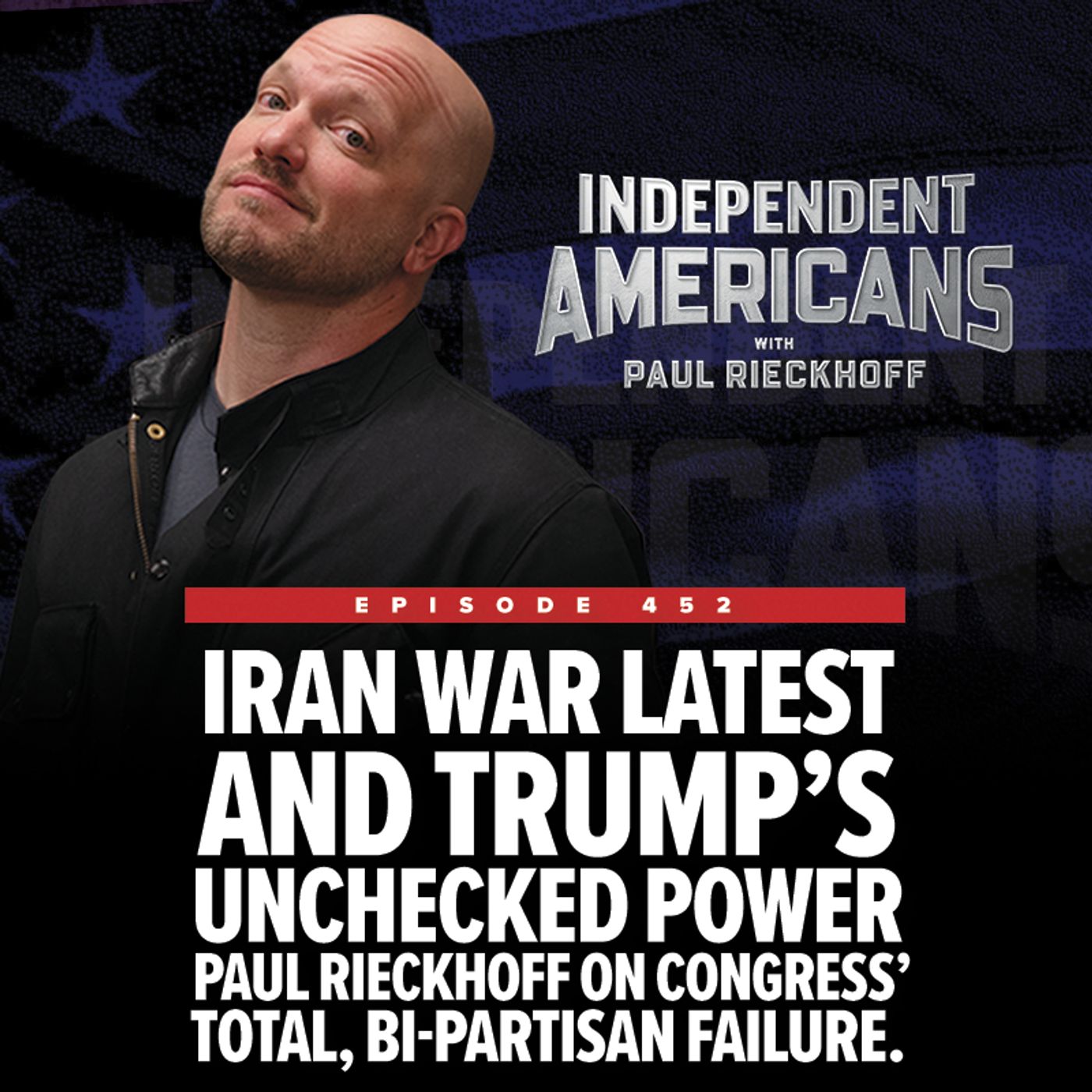
Independent Americans with Paul Rieckhoff
Iran War Latest and Trump’s Unchecked Power: Paul Rieckhoff on Congress’ Total, Bi-Partisan Failure.
00:11:13
Trump launched an unauthorized, unpopular war with Iran, and Independent Americans host and national security expert Paul Rieckhoff joins MSNOW’s “The Weekend” to break down what it means for our troops, our Congress, and our future.
Loading summary
Transcript32 lines
- [00:01]
Host
If you're an H Vac technician and a call comes in, Grainger knows that you need a partner that helps you find the right product fast and hassle free. And you know that when the first problem of the day is a clanking blower motor, there's no need to break a sweat. With Grainger's easy to use website and product details, you're confident you'll soon have everything humming right along. Call 1-800-GRAINGER clickgrainger.com or just stop by Granger for the ones who get it done.
- [00:30]
Paul Rykoff
The real question is, is Congress going to do anything right? At least the UN Security Council had an emergency session this weekend. Our Congress can't even be bothered to come back on the weekend when three Americans are dead. They haven't even called an emergency session of Congress in Iraq. At least they voted. They haven't even voted on this. So I think the bigger question is, is there anything in the American government that can slow him down on this end? If he wants to hit Cuba, if he wants to hit Mexico? Because this is not just about Iran. This is about a new phase of global fore where Trump is totally unencumbered and doing whatever he wants.
- [01:17]
Host
Welcome to a special episode of Independent Americans. As I cautioned on Friday, Trump could launch a war any minute now. Yep, he did it this weekend. An unauthorized unpopular war that most of the American people don't support has been launched and it's unfolding before our eyes. A lot of what we talked about in my episode with Joe Cirrencione on Friday has come to pass. Go back and check that out if you haven't already. We talk about the real threat of nukes. We talk about how to defend against Iranian missiles. We talk about what can happen next. A lot of information that was ahead of the curve. If you want to know about not what's just happening now, but what's happening next, check out our episode from Friday. And until I get you a full episode later today, here's a quick hit from a media interview I just did on NBC to break down the latest of what's happening in Iran to include three American casualties. Tragically, there are now three American casualties, with likely more to come. I will continue to try to get you information that keeps you ahead of the curve. It helps you anticipate what's next and helps you stay vigilant. Until then, stay informed. Look out for each other. Question everything, especially coming out of this government. And most of all, always, especially now. Stay vigilant, America,
- [02:37]
Veterans affairs and Political Analyst Paul Rykoff, and he is founder of Independent Veterans of America and host of the Independent Americans podcast. Also with us, Mississippi, now, political analyst Basil Smichel. He's a professor of practice, School of Professional Studies at Columbia University. So, Paul, I want to play for you Trump's post on Truth Social about avenging the fallen soldiers. Take a listen.
- [03:02]
Trump (quoted)
America will avenge their deaths and deliver the most punishing blow to the terrorists who have waged war against basically civilization. They have waged war against civilization itself. Our resolve, and likewise that of Israel has never been stronger.
- [03:24]
Host
What do you make of those comments?
- [03:27]
Paul Rykoff
Trump is doing whatever he wants and nothing's stopping him or even slowing him down. I've been saying for months the most important story in the world is that Donald Trump can do anything he wants with the most powerful military the world has ever seen, and nothing is stopping him. And this last week especially is the latest manifestation that he's hit eight countries in the last year. He's thrown middle fingers up to Congress. And I think a really important question now is Trump's not going to change. Trump's awesome gas, no brakes. We know that this is the worst case scenario so far of what a Trump presidency could look like. The real question is if Congress is gonna do anything right. At least the UN Security Council had an emergency session this weekend. Our Congress can't even be bothered to come back on the weekend when three Americans are dead. They haven't even called an emergency session of Congress in Iraq. At least they voted. They haven't even voted on this. So I think the bigger question is, is there anything in the American government that can slow him down on this end? If he wants to hit Cuba, if he wants to hit Mexico. Because this is not just about Iran. This is about phase of global foreign policy where Trump is totally unencumbered and doing whatever he wants.
- [04:26]
Interviewer/Host
Well, it doesn't feel like he's accountable to the American public. Even his CENTCOM commander not standing and doing a briefing and going through play by play what we've done so far in this war. So, Basil, I want to ask you, Democrats here, to Paul's point, have let him go unchecked. It's not like there was a sustained push after eight months ago, the first time that Trump launched a war with Iran and bombed the nuclear sites. There was no big push for the War Powers Resolution. And now maybe they're gonna vote this week. It doesn't seem likely to pass because of Democrats. What do you make of the lack of Democratic response to opposing Trump's unchecked power here.
- [05:08]
Basil Smichel
All right, listen, I actually think there's been a strong Democratic response. There could be more. There's no question about it. But I think it's strong. But it's important to remember that Republicans hold the key to the House. They literally hold the keys to the chamber. So it's the Republicans need to come to the table, as you've talked about, and say, look, we may agree with you, I don't. But they could say, we agree with you, Mr. President, but we at least have to look like we're doing our jobs. And I think to Paul's point, you know, I just remember I was in college during Desert Storm. I think I was in college during Desert Storm. And I remember being concerned then because I was of an age where I hey, man, this is the first time I'm even thinking that I might be able to get, have to get drafted into something. I may not love what my country does all the time, but the, but most of my friends and colleagues are really nervous right now because of exactly what was just discussed. This is a president that has the ability to do anything he wants and he is largely being unchecked. It could be partly a Democratic problem. It is mostly a Republican problem. But there is real concern that our, and we were talking about this earlier, our institutions are not strong enough to push him back. And when Tulsi Gabbard is focused on votes in Fulton county and doesn't seem to be at least in standing with the president, talking about why this is a, quote, righteous act, it should give everyone, we should be really scared and nervous because what's stopping him?
- [06:39]
Interviewer/Host
To what extent do you think the American people care about what is happening? I think like we've, and maybe this is part of the reason why they're not briefing and maybe the reason why he's not addressing the country right is like it doesn't, he doesn't make it, you know, front page news. It's not on, I mean, you know, we cover it, certainly. But I'm not sure how much everyday Americans around this country are following what is happening with Iran to the degree that they think, I mean, they'll notice
- [07:04]
Host
gas prices get marked.
- [07:05]
Interviewer/Host
Well, no, that's what I was going to say. Like once the effects of that kick in, then they'll start asking those questions. But I'm not sure that the administration is keen on explaining to the American people what is happening because I'm not sure they want the American people.
- [07:17]
Paul Rykoff
That's exactly, they're on plan. This is the plan, the Pentagon press corps is gone. They haven't done a press briefing, even to the propaganda press corps in months. They're not putting out casualty figures. They're not doing regular Friday briefings. You know, I remember going to Iraq and seeing Congress debating the war, seeing Americans protesting the war. I think the Republicans and Democrats, the entire congressional institution has completely failed us. And the only thing that seems to be somewhat of a bulwark is the courts at times. But nothing is stopping him right now. And your question is the right one. Where are the American people? There are no protests in the streets he wants to miss.
- [07:51]
Trump (quoted)
There are some.
- [07:51]
Host
There are some. I mean, right outside our office, there were some.
- [07:54]
Paul Rykoff
Yeah, but none that are noticeable and none that are moving the needle. I mean, the ICE protests have been significant. We've seen a groundswell, bipartisan, maybe we'll start to see some of that, but not if they hide the casualty figures. And we can't trust them on that either. We can't trust them on American casualty figures any more than we can count on them to give us candid information about ice. So this is by design. And I'm going to continue to emphasize Trump is on plan. And imagine how much farther he would have been if Hegseth wasn't screwing up all the time. I mean, they are on plan and picking up steam.
- [08:21]
Interviewer/Host
How important is it that our men and women in uniform who are based in the region right now and are on ready alert, that they know what their mission actually is? How important is that? You commanded a. You know what it's like to have young soldiers under your command.
- [08:40]
Paul Rykoff
It's critical, but we haven't done that in a couple decades. I mean, this has become acceptable in America. I mean, it's patriotism light. And this is the danger of having decades of an all volunteer military where most Americans don't have any skin in the game. I mean, this is the real danger of what Trump can do. He can create a forever war. I've said this many times. 2025 was about conquering and ruling America and the American institutions. Now he's expanding to the Western hemisphere. And he has very, very grand aspirations. He has no failure of imagination. But the American people seem to have a failure of imagination. I wonder if it will take terrorist strikes on US Soil if we see a drone hit an American city, if there is actual casualties here at home, if that will move the American people or if they'll continue to keep their head in the sand. I don't.
- [09:23]
Basil Smichel
Oh, no. You know, I do think that you've seen some protests. And I just coming out of 2024, I know that a lot of voters do care about what's happening abroad. Right. But I do, I think it'll happen. I think it'll happen because I do. There are two sort of important changes going on in our politics, particularly on the left. There's the partisan politics because obviously I think Democrats largely against this, Republicans are going to be largely supportive of this. Right. But there's also a generational shift on the left and I think that generational shift to me is what will likely drive whatever turnout you end up seeing and mobilization because of what we're seeing right now. Because that large anti war effort was largely a youth driven effort in 2024. I think you will that sort of manifest in what's happening now or pivot into what's happening now and manifest in protests as we get closer and closer to our election. So I do think it's coming, but I also think it has a sort of electoral outcome at the end of it.
- [10:28]
Paul Rykoff
That's what I'm not sure about. I mean he'll label those protesters anti patriotic like he just did with anthropic. I mean, you know, the question is really central to Congress. Are you okay with him doing whatever he wants? Because the Constitution will not work. America is broken right now. If we can let him continue to wage never ending war on a different country every couple months when his voters don't want it.
- [10:49]
Interviewer/Host
And the American public overwhelmingly doesn't want either.
- [10:52]
But Pete Hexif is launching war against Columbia University and the Ivy Leagues for indoctrinating students.
- [10:56]
Trump (quoted)
So.
- [10:57]
Paul Rykoff
So also part of the plan. The culture war is a part of the plan. Oh, I know.
- [11:02]
Interviewer/Host
We'll leave it at that for now. Paul Rykoff, Basil Smichel, thank you to
- [11:05]
Trump (quoted)
the both of you.
- [11:05]
Interviewer/Host
Greatly appreciate it
- [11:08]
Trump (quoted)
tells me the left and right are dreams for those without a clue and when you wait it's
- [11:15]
Paul Rykoff
to grow and it's not cool to
- [11:17]
Trump (quoted)
believe in school but if I can say one thing I've seen the children of the revolution and the good trouble they can bring he says the red and blue are dead and independent is an attitude an island in the sea of rhetoric and not the rap without a clue and when you wait it's time to grow power by righteous media you
- [11:44]
Shopify Advertiser
when it's time to scale your business it's time for Shopify get everything you need to grow the way you want like all the way Stack more sales with the best converting checkout on the planet track your cha chings from every channel right in one spot and turn real time reporting into big time opportunities. Take your business to a whole new level. Switch to Shopify. Start your free trial today.
- [12:13]
Grainger Advertiser
If you're the purchasing manager at a manufacturing plant, you know having a trusted partner makes all the difference. That's why, hands down, you count on Grainger for auto reordering. With on time restocks, your team will have the cut resistant gloves they need at the start of their shift and you can end your day knowing they've got safety well in hand. Call 1-800-GRAINGER click granger.com or just stop by Granger for the ones who get it done.