← Independent Americans with Paul Rieckhoff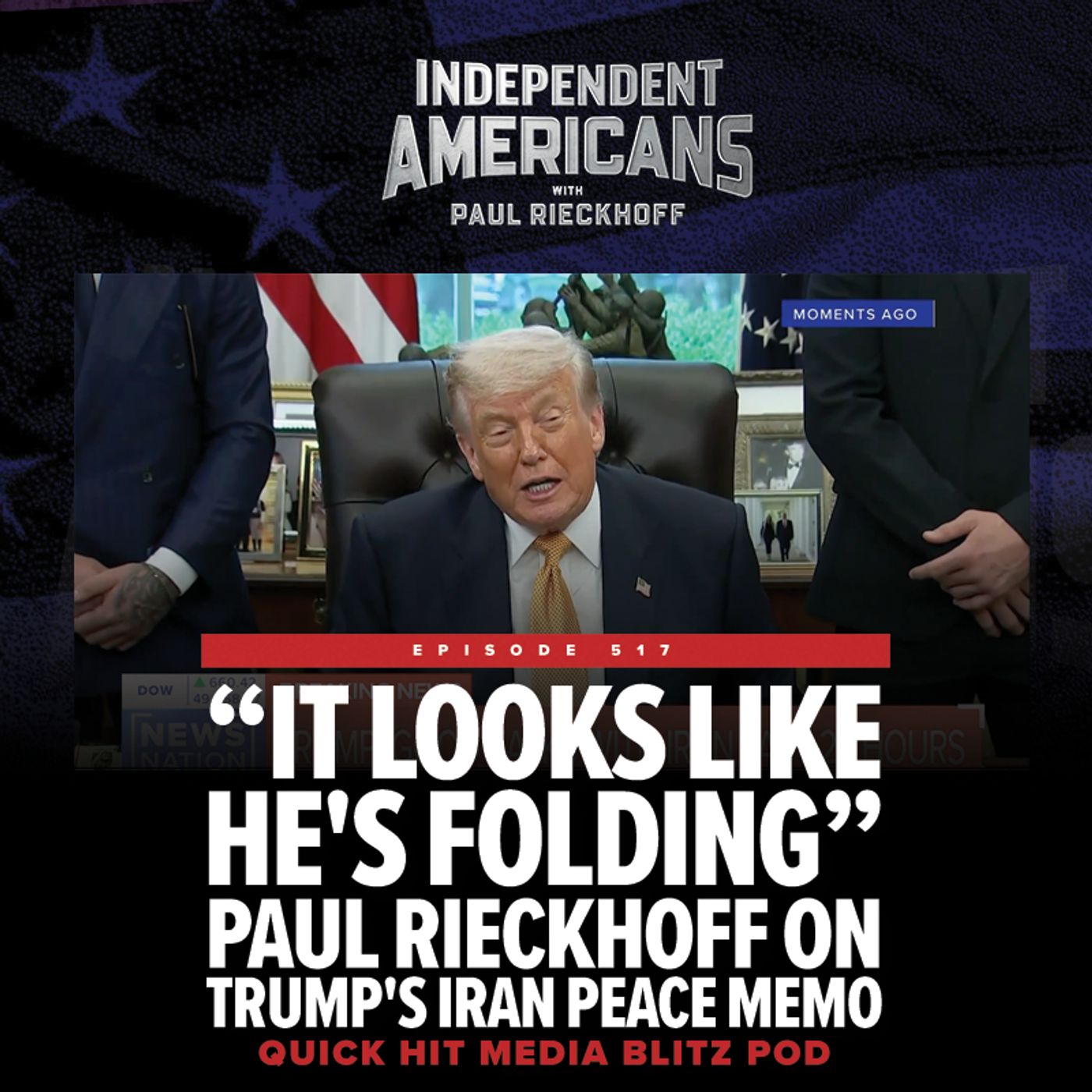
Independent Americans with Paul Rieckhoff
"It Looks Like He's Folding" — Paul Rieckhoff on Trump's Iran Peace Memo
00:08:17
The White House wants you to believe the Iran war is winding down. A one-page memo. A ceasefire. A market bump. But missiles are still flying on both sides, an Apache just lit up six speedboats, and the regime that murdered tens of thousands of its own people — and 13 Americans — is still very much in charge. Paul Rieckhoff sits down for a no-BS solo briefing on Trump's Iran framework, the four goals the administration set on day one, and why only one of them — eliminating Iran's Navy — looks anything like accomplished.
Loading summary
Transcript32 lines
- [00:00]
Paul Rykoff
It's like a split screen. It's what he's saying and it's what we continue to see out of the Middle East. Meanwhile, gas prices are still up, oil still up, fertilizer still up, and the American people are still feeling it. So I think they're trying to spike the ball here, but. But the other side gets a vote and it looks like the game's not.
- [00:30]
Interviewer
With Iran versus what we heard maybe last night or earlier. Paul Rykoff is sitting here listening with me, the host of the Independent Americans podcast who appears with us just about every Wednesday. And the news today, you're seeing that the President added to it, I don't really think he did. Is this idea that we might be headed towards some sort of peace in Iran slowly but surely like a one page memorandum they're talking about that would have a framework for peace. So what's your view of this? Like where do you think things actually stand right now? Reading between all these lines.
- [01:02]
Paul Rykoff
Lines different every day?
- [01:04]
Interviewer
Yeah, sometimes multiple times.
- [01:05]
Paul Rykoff
Yeah, I mean it changes almost by the hour. I mean they say they have a cease fire, they say they're close to a deal, but missiles are still flying on both sides here. And I think we blew up six speedboats with an Apache in the last few days. So.
- [01:17]
Interviewer
Right.
- [01:18]
Paul Rykoff
It doesn't look like it's like a split screen. It's what he's saying and it's what we continue to see out of the Middle East. Meanwhile, gas prices are still up, oil still up, fertilizer is still up and the American people are still feeling it. So I think they're trying to spike the ball here. But, but the other side gets a vote and it looks like the game's not over. Yeah.
- [01:33]
Interviewer
The markets that trade on a day to day basis, like oil is down today. Right. So you have, and the President even emphasized it, the stock market up today. So you know, maybe you buy yourself some time. Here on the Telestrator we have this one page memorandum what might be in it if it happens. So the reports, we've confirmed them, it started with Axios, we've confirmed them, is that Iran would commit to a moratorium on nuclear enrichment for a set amount of time. US would then agree to gradually lift sanctions, both sides would lift restrictions in the Strait of Hormuz. You know, nothing on nuclear though. So you say, well, how does that get us in any of a better position than we were say with the Obama deal and all the rest before, before the war?
- [02:14]
Paul Rykoff
I don't think it does. I mean, I think it gives him some political relief. I think it'll give the markets some relief. But it looks like you're kicking the can down the road. So sometime in the future they're going to give up their moratorium on enrich uranium again and then we're going to have to do this all over again, which is what it feels like we've been doing for 20 years. And I think, you know, I think the President and the White House are hoping that folks forgot the goal. The goal was supposed to be to remove the regime, to get rid of the uranium, to keep the strait open, to destroy their military. And I don't think they've accomplished any of those four goals which have been many moving targets. Well, if you look at the President,
- [02:43]
Interviewer
explain it away, said on day one all of his goals, the only one you could say that maybe was accomplished or has been accomplished is eliminating their navy. Right? Yeah, because he went through a whole list. The others, to your point, work in progress at best. Right.
- [02:56]
Paul Rykoff
And bad guys are still in charge. Right. I think that's the problem here. Normalize, you know, negotiations with people who just shot tens of thousands of their own people in the streets. So, you know, a couple weeks ago they were our enemies and they killed 13Americans. Now we're going to sit down and negotiate with them. It just seems inconsistent. And I think what most of the world wants to see and especially the Iranian people that I talk to, is they want to see the regime out. So is he giving up on that goal entirely? And if he is, what's going to happen in the future? Because until the regime is removed, they're going to continue to be a bad actor that we can't trust that will manipulate the Strait of Hormuz and has enriched uranium. So the important question is we're going to where is the enriched uranium is even secure?
- [03:32]
Interviewer
Are we going to go in and get it?
- [03:33]
Paul Rykoff
Are we going to.
- [03:33]
Interviewer
Yeah, I mean there's leave it there
- [03:35]
Paul Rykoff
on the table to send boots on the ground that he's apparently considering in the past couple of weeks. What happened to that? That's a really important question because that's the threat that they named and we have to know the status of that threat every day.
- [03:45]
Interviewer
You think Iran at the end of the day ends up with not a military win, but a strategic win out of this. How would you describe it? Like here I'm looking at some of Iran's, you know, request they supposedly put out a 14 point peace plan, withdraw all the US forces, release their frozen assets, lift the sanctions Reparations, I think it's fair to say they're probably not getting this. They're probably not getting a bunch of this. But even if they got some of this, that could Iran be the one that ends up coming away from this with a strategic victory or at least a wash? And if so, that's not that. That wouldn't be a good situation, would it, for the US this is a
- [04:22]
Paul Rykoff
really good deal for Iran, when you look at that.
- [04:24]
Interviewer
Well, if they get it, they probably won't get all that.
- [04:26]
Paul Rykoff
If they get any of it, really, it's still a pretty good deal for Iran. I mean, the idea that we'd even consider removing US Forces, we'd give them all their money back, and then you're just feeding the regime again, and then you're kicking the can down the road to a year from now, five years from now, 10 years from now, they continue to say that they are a nuke threat to the region and to the United States. Until that threat is removed, it's still on the table and it's incomplete and I would argue a failure by their own measurement, because that's why they said they were. They had to go in now. There was an imminent threat. And that imminent threat doesn't seem to have been eliminated because the regime hasn't been eliminated. As long as the bad guys are in place, we're still going to have a problem.
- [05:03]
Interviewer
The sense here we ask this of my military guests over the last few days about this. It's interesting. It's split some, and I always wonder whether it's what people think is going to happen or what they want to happen when you ask questions like this. But is the sense here that the fighting is over, that Trump wants out, you know, pretty much at all costs, he'll cut some sort of a deal. But the idea of offensive military operations in Iran, from the US Point of view, that, that that's done. Do you think?
- [05:26]
Paul Rykoff
I mean, he always says he doesn't leave anything off the table.
- [05:29]
Interviewer
I know.
- [05:29]
Paul Rykoff
So I hope in this case especially, he doesn't leave anything off the table, because right now it looks like he's folding. I mean, if you look at the Iranians, what they are taking is the approach that many have taken, that if you just wait out, the Americans, public support will fall, they'll quit, and they'll pull out. Right. Vietnam, Afghanistan, Iraq. And they've said that to the world that we know Trump's going to qu. So they're calling his bluff. And if he gives them any of these concessions or anything like it, I think they can reasonably declare a victory if only because they're still there. Right. If you're still negotiating with a group of people who are controlling that place and repressing their people and removing civil rights from people and human rights from people, that's a win for them because they live to fight another day.
- [06:08]
Interviewer
Well, let's think about what most people were saying before this began. A couple of months ago, there were the list of objectives on the US Side, which, as I pointed out a few moments ago, maybe one, the elimination of the Navy has been accomplished. But a lot of people came on at the beginning of the war and said the only objective for Iran was to survive. And it looks like survival is likely now.
- [06:29]
Paul Rykoff
I think there's a really important barometer here. The Iranian people, I think the Iranian people will tell us when all the leaders are dead. When you see the Iranian people taking back their society, when you see them coming out in the streets, when you see them communicating to the world, because think about how they've almost been entirely on a media lockdown. When we start to hear from leaders from within Iran that there is a change and that the leadership has been removed, then we can start to believe it. But until then, you know, we've got to trust but verify. We've got to see what's actually happening on the ground. There very few voices coming out of Iran right now.
- [06:56]
Interviewer
There are. And the idea of, you know, the public rising up against the supreme leader or anybody else, that seems, you know, far fetched at this point, do you
- [07:05]
Paul Rykoff
think, or it doesn't look likely. I mean, if I'm an Iranian civilian who wants democracy, I'm going to keep my head down because it doesn't look like the folks who just killed tens of thousands of people a couple months ago are gone. And I think that's ultimately what we want to see, is a democratic Iran. You want to see the people taking charge and America not having to decide their and having a peaceful leader that we can negotiate with. But we're nowhere near that right now. And again, if I'm Iran, I'm celebrating the ability to wait Trump out, let gas prices go up, let the public opinions fall, know that a midterm election is coming out and just wait him out.
- [07:36]
Interviewer
All right, Paul, as always, thank you. We'll talk to you next week. Paul Rykoff
- [07:42]
Poet/Guest
tells me the left and right are dreams for those without a clue. And when you wait, it's time to
- [07:49]
Paul Rykoff
grow and it's not cool to believe
- [07:52]
Poet/Guest
in school but if I can say one thing I've seen the children of the revolution and the good trouble they can bring he says the red and blue are dead and independent is an attitude an island in the sea of rhetoric and right Our dreams without a clue and when you wait, it's time
- [08:12]
Paul Rykoff
to grow power by righteous media.