← Independent Americans with Paul Rieckhoff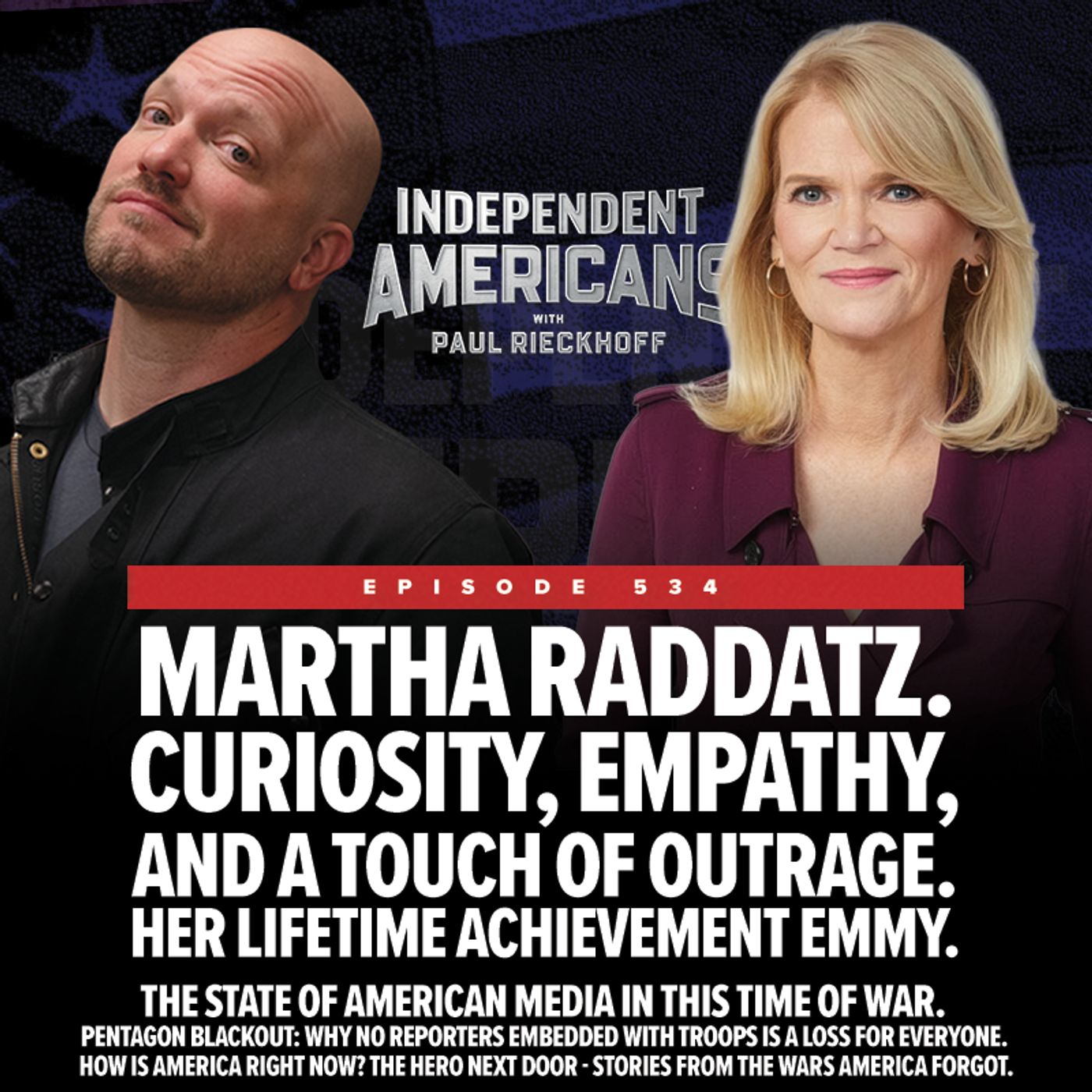
Independent Americans with Paul Rieckhoff
Martha Raddatz. Curiosity, Empathy, and a Touch of Outrage. Her Lifetime Achievement Emmy.
00:31:34
Martha Raddatz has spent decades doing the work most of Washington can't or won't — getting on the ground, walking with troops, sitting across from presidents, and refusing to look away. And she’s known Paul for two decades. The morning after she received the Lifetime Achievement Emmy, ABC News' Chief Global Affairs Correspondent returns (previous appearance on episode 61) to the show to talk about the state of journalism, the blackout on military coverage, and her new book The Hero Next Door. This is the conversation that doesn't happen on cable news anymore, because the access has been cut, the embeds are gone, and the briefing room has been handed to the MAGA machine.
Loading summary
Transcript40 lines
- [00:00]
A
Jake I'm Jake Stauch, co founder and CEO of Cervel. We built Servl to automate the IT work that slows companies down. Onboarding password resets, access to applications. My laptop stopped working. While employees wait for help, their real work is put on hold. IT desperately wants to automate this work and that's why they need Serval. You just tell Serval what you want to automate in plain English and it's built. No drag and drop workflows, no expense of consultants. Employees get unblocked and IT teams go from drowning in tickets to building what actually matters. With Cerval, it becomes the AI engine powering the entire company. This is a new way to run it. We guarantee you'll automate 50% of all tickets and we'll prove it to you in a free four week pilot. Go to serval.com tickets that's S-E-R-V-A L.com tickets. You're listening to this podcast, so I know you've got a curious mind. Here's a helpful fact you might not know yet. Drivers who switch and save with Progressive save over $900 on average. They make it super simple. Pop over to progressive.com, answer some questions and you'll get a quick quote with coverage options tailored to your choices. Plus you'll see which discounts you may qualify for, like the online quote discount or or savings for paying in full. In fact, 99% of Progressive Auto customers earn at least one discount. See if you could save when you switch to Progressive. You'll feel good about making a savvy choice. Visit progressive.com and see if you can enjoy a little extra cash back. Progressive Casualty Insurance Company and affiliates national average 12 month savings of $946 by new customers surveyed who saved with Progressive between June 2024 and May 2025. Potential savings will vary.
- [01:50]
B
Power by Righteous Media. Ladies and gentlemen, independent Americans around the country and around the world. Welcome to episode 534. I am your host, Paul Rykoff, coming to you from New York City, usa, where the weather is beautiful. People are feeling really good about the Knicks. But news and politics continues to remain front and center. And we have a guest who can help us navigate all of it. A true conscience for our country. A true hero. A person who I think has been meeting the moment for decades and will help us all stay vigilant. She is the chief Global affairs correspondent at ABC News. She's one of the most respected journalists in the country and in the world. Her new Book is called the Hero Next Door, which came out right around Memorial Day. Go check it out. It's linked in the show notes. And last night, after appearing with me on Deadline White House, which was a tremendous honor for me, she received the lifetime achievement award last night at the Emmys. She is a true patriot. I am honored to call her a friend and I consider her a great mentor. The great and powerful Martha Raddatz is back on Independent Americans. Welcome back, my friend.
- [03:21]
C
Thank you so much, Paul. And I am humbled by that introduction, as I was last night at the Emmys. It was quite a night. It was amazing.
- [03:30]
B
Congratulations, like, so well deserved.
- [03:33]
C
Thank you, thank you, thank you. I was kind of blown away. It was a bigger deal than I imagined. It was beautiful. It really was. The whole night was beautiful.
- [03:42]
B
Well, you are a big deal. We're going to get to the book, we're going to get to your work. But talk about that, I mean, you know, the White House press corps dinner obviously didn't go as planned. When you and I saw each other at Deadline White House, you know, you were in a very nice dress and you said, yeah, I'm going to get, you know, going to this thing tonight, and I think, you know, a lifetime achievement award. You were very humble about it. But what was that like to walk the red carpet and be recognized, especially in a time like this when journalism is under attack?
- [04:13]
C
I think, you know, I, I, the award came at about two hours into, into things, and I, I had these kind of prepared remarks and, and just listening to everyone, I threw them away. And I, I, I think, you know, I, I sat there and I listened to our, our business is changing so much, you know, that, you know, we're going towards your business and, and podcasting and everything else. But I, I really do think the fundamentals of journalism hopefully remain the same. And I think, you know, looking at all the magnificent work of my colleagues all across the networks, all across independent television, New York Times, everything, it was powerful to sit there and watch that. I mean, to hear people say in their speeches how worried they are about the business, and yet to see all the magnificent work that has been done and in the last year somehow left me optimistic. So I know things that are, things are scary in the business, but we have such a great group of journalists trying every day to do the best they can and fight the good fight. I think I described it as, keep it up, do your work with curiosity and empathy and just touch of outrage. That's how I've always looked at it.
- [05:38]
B
I said this yesterday on the air with, with Nicole, but I want to reiterate, I mean, you've always been so trusted in the military and veterans community for your integrity, for your righteous outrage, for your professionalism, for your discipline. But you've been through such a winding road of a career. You've been in combat zones. You know, a lot of young people are trying to navigate their way, especially in media and in politics and trying to meet this moment. If you. This is kind of a podcasty kind of question, but if you could go back 30 years and tell yourself something, give yourself some advice, what would you say to yourself not knowing this trajectory you'd be on and receiving a lifetime achievement award at the Emmys?
- [06:21]
C
That's a hard question, Paul. You'd think I'd kind of been asked that before. What would I tell myself long ago? I think I would. Maybe what I would do is say, just remember, everything you do, everything you do is, is a mark on your career. Like, you can't have a day where you're, where you're not doing the best you can. You can't have a day where you're like, oh, I'll just do this and move on. You. You really have to make sure your integrity is there every single day. I'm not saying mine wasn't. I tried, but I, I didn't realize that, that how serious it was, I guess. And that, and that what we do has such an impact. I do. You know, there was a young reporter there last night who got a regional Emmy. And that's, that's one of the things when I was sitting there and I watched this, this young woman named Lauren and she, she, she's at a television station in St. Louis. And she got up there and she said, I'm so nervous. And I'm sitting here and I'm just this local journalist in front of all these, you know, network and greet people. And so I shouted her out because I think that was me, right? I mean, that was me many, many, many decades ago. And I think, you know, I said to her, what you do, and all the old cliche, but all news is local. I mean, what you do impacts people in your local community. You can ruin lives if you get things wrong. You really can. And I think we just have to try our best and sort of seeing her, Lauren Trager, and I didn't know her name, by the way, and she came up to me afterwards, I was so pleased, and I said, that's, that's what we got to keep doing. And she just, she's one of those moments where it just gave me hope for the business, but it was also made me remember and help me answer your question, which is just remember what you do is, is not only vital, but, but it, it can change people's lives in good and bad ways.
- [08:23]
B
So if you're, well, it's so important because I think those of us who know you, I consider you a mentor, if even by example, just being around you and seeing your discipline and your professionalism and how you approach your work every day. And when we were getting, I think in between the commercials, you and Nicole and I were talking, and I think she brought up one of the debates you hosted. And I remember that moment when you were hosting the debate because the veterans community was frustrated. We felt like Afghanistan was off the radar. Nobody cared about veterans issues anymore. And I think I may have even posted we can count on Martha. Martha is going to make sure we talk about military issues and war and foreign policy. And you did, because in some of those debates, it didn't come up till like the second hour. Right. But we knew that when you were there, it was going to be front and center. Can you talk about, you know, that wasn't always easy, right. People want to talk about gas prices and they want to talk about inflation, and sometimes it can feel far away, but you've always kept a focus on that. Can you talk about that and why it's so important?
- [09:25]
C
I think it's important. She was Talking about the 2012 debate between Joe, Joe Biden and Paul Ryan. And I had just been covering the wars, and I wasn't really covering politics at the time at all. I was a random pick by the Presidential Commission for debates. I studied my butt off to do that. And I'm just gonna say, like, with Nicole, Nicole was working at ABC as a contributor, and I was just getting inundated with people at abc. Well, you gotta do this and you gotta do that, and you should start with the economy. You should start with this. And, and I said to Nicole, sort of privately, I don't even know what to start with. I mean, I, I cover foreign policy and more. She said, of course you have to start with that. And, and, you know, it's in my heart, I, I, that's never gonna go away, Paul. I mean, I have been with you. I've been in theater. I know that issue. And it's important to me not only for the humanity, for people to understand that it's not G.I. joe and G.I. jane. They're people who were in minivans a week before taking their kids to school. And they're just like you and me, but they're better. And the other thing is, that's so important is that people understand why we go to war. If you know nothing about what's going on, if you know nothing about force, foreign policy, and you know nothing about the military, you can't make a good decision. You really can't. And it's. It's important. And that's. That's really been at the center of what I have tried to do for. For decades. And I, I, you know, I remember, I think it was the last one of the last interviews President Bush did, and he was. And he did it with me and Crawford, and he, you know, he's easy to talk to. And I said at the end of the interview, like, president Bush, why for so long did you tell people that things were fine, that things were going okay? And he said, because I needed to keep troop morale up. Like, they knew it wasn't going well. Okay? They are the first line of people who are going to know it wasn't going well. I mean, I think he meant well, but it was that it's important for people to know, and you can criticize us for whatever you want and the buildup to the war and all that, but I think the press did its job during Iraq, especially of saying things aren't going well. And you should know this because these are your young men and women in the fight, and these are your tax dollars. And same with Afghanistan. I mean, I kept going back and back and back and back to sort of see the progress. And then you realize you're sort of this, this funnel of history that, that, okay, I was there in the beginning when Donald Rumsfeld, you know, was standing with the Iraqi security forces saying, look at them. Aren't they great? I'm like, what? You've gotta be kidding me at that point. And it's all those little moments like, that's. He's not telling the truth right now. Because these guys had no idea what they were doing. And then know, years later in Afghanistan, somebody said, you know, they can't shoot, they can't drive, they can't read. And I thought, great. That's. That's a great start for, For a security force. So I, I think, I think that's what I've tried to do, and I keep trying to do it. It's important to me. And I. And part of that is experience. I mean, it's, it's. I. I Know the history. I've seen it. I've smelled it. I've, I've felt it. I know so many people who are in the fight and are in the fight today, so.
- [13:04]
B
And you've succeeded. Let's dig into what I think is our top topic that spans over all this. On this show in particular, we've had so many thoughtful, experienced voices. Barbara Starr, Tom Bowman, you know, so many people, you and so many others who've been on the ground and seen and shaped that funnel of history. Right. But we're in this new world where that funnel is cut off, where you're no longer allowed in the Pentagon. The access is so restricted. Now. There's what I've called the propaganda Pentagon press corps. You've got the MyPillow guy and Matt Gaetz, and, you know, you touched on this yesterday on Deadline with me. There are no embeds. We got 50,000 troops in the, in the region around Iran, but we're not seeing any embeds. And we were the generation that walked. I had a 60 Minutes crew out on patrol with me. We all knew that that was part of it because it was important in showing the truth and telling the story. But this has been a deliberate strategy to cut that funnel off. Can you talk about, given your experience, your reaction to that, and maybe the pieces of it that the public might
- [14:16]
C
not fully comprehend, I think it's a shame we're not out there. I think we need to see it. And when I say we, I mean all of you. I mean, we do this for the public. And just what I was saying, you know, we do it for the public because they get to make decisions about how things run in this country. They vote, they do what, you know, they get involved, they do whatever it is in a civic duty way or as a human being that you, that you care about the people you're sending into war. So not being able to see that. And even short of embedding, I mean, embedding, as you know, you're walking the streets with the guys or you're out there, or you're. You're sleeping in a tent or you're doing whatever you can there, but I haven't seen any coverage of any of the military bases that have been hit or any of the ships. Again, I will say I completely understand that it is very difficult in the middle of an operation to get people out there, but during a ceasefire, maybe would have been a pretty good time to do that, to get people on the ships, to get people at the military bases to do something to show what our men and women are doing out there and to get a sense of how it's going, besides those very occasional press briefings that sometimes just elicit anger from, and we don't get answers to a lot of questions.
- [15:37]
B
So it is, I think, unprecedented, at least in the last 25 years. We're in a place where we have no coverage from inside Iran, Right. Like, Iran is basically dark and we're not hearing from the Iranian people, and we have no coverage from the American troops. We've been blacked out, too. And so now we're in this place where the public can't trust the regime in Iran and can't trust the Trump administration. So in this type of an environment, where do you advise people to go for the truth? How do you find the truth? And how do you get to the truth when you can't get that kind of access?
- [16:09]
C
Well, I think one of the things you do, and I mean, the New York Times has been amazing with this, with these investigations of the military bases that have been hit and others who are in the region who can see what's going on there. But I'll tell you, it's hard. I mean, I certainly still know people who I can talk to. Iran is really difficult, but we have people who can get through to people there. I've actually traveled there numerous times over the, over the past couple of decades. So I have a sense of that, which is really, it's. So it's, when I first went there was very restrictive, and I, they took my passport away. They actually detained us, so they wouldn't. I don't want to make this more dramatic than it was. They took our passports away, but it was three days before we got out of there finally. And, but during those three days, you didn't really know whether you'd get out of there or not. But, but over the years, it's, it got better for the people. You know, they weren't, there's obviously a requirement. You can't go in the country as a woman unless you have a headscarf on. But the, but the young woman who didn't want to wear it, it was getting further and further back on the head in the last few years. It's, it's, it's, it's down here again. And I'm saying if, respectfully, if you want it there, great. But if you don't want it there and they're forcing you to do that, that's not so great. So, but it's so strange because in the last, you know, couple of years, it is just cut off. I think we had somebody there about a year and a half ago. I think I was in some other country at the time, so couldn't go. But, you know, we hope to get in there, too. But on the American side, you just try to find people who are in theater who you can talk to. But there's a sense of fear among them, too, that if they talk and if they're found out that they're in trouble. So it is much harder for us to get the story, to get the truth. But we keep trying.
- [18:04]
B
You never stop trying your vigilance.
- [18:06]
C
No, I don't. I don't.
- [18:07]
B
That's part of your trade. I mean, I can hear that there's an alert going off on your computer because you're probably getting updates in the field right now.
- [18:14]
C
I realized I need to show.
- [18:16]
B
I think that that shows people that Martha never stops working. I'm going to pause for a second, take a quick break, and we're going to come back on the other side and go below the radar. Okay, we're back. And now we're going to go below the radar with Martha Raditz. Martha, your book is doing something really important. The Hero Next Door. You're telling the stories that I feel like are out of the mainstream. I feel like, you know, our troops, veterans, we get a quick blip on Memorial day every year, 9, 11 feels a little smaller. This year's, you know, 25. So maybe it'll feel different Veterans Day similarly. But our troops are in Iran. And let me ask you, you know, what can we learn from your book about the need to remember the humanity of war at a time when it seems so far away? Right now we're in, I don't know what number war with a professional military where there's no draft, there's no conscription. And Iran is really far away. I mean, it feels even further than Iraq and Afghanistan were, especially because I think they're playing games with calling it a war, not calling it a war. What can we learn from your book about what we need to know about the people that are involved in all this?
- [19:31]
C
Well, the main reason I wrote this book is because it seems to be getting further and further away from people's minds. I mean, we remember, you know, thank you for your service during Iraq and during Afghanistan at the height of the war and even then, I don't know how connected people were to the war, especially in Afghanistan. There were years that it was just totally forgotten. But I Think showing the humanity of people and what they have done since that. And there are guys who were in battles that changed their lives and affected them so deeply. Well, that effect on them, as you well know, Paul, is still there. That never goes away. They try their best each day to be motivated and to find purpose. There's, there's. There are other people. And I had a wonderful night the other night with a few of the guys who, who came to New York and talked to some people at abc. And that was important to me, to not just talk to me about the book, but. But to talk to them. A guy named Derek Carrera who was a captain in the Marine Corps, Marine Raider. You know that he'll tell you it's the equivalent of the closest thing to Navy SEALs or special op or special operations forces you can get or, you know, whatever. Green Berets. And Derek in 2012. And how many people were even thinking about the war in Afghanistan in 2012? And Derek was a fantastic Marine Corps leader. And he was shot in the shoulder and it lodged in his spine, and he's paralyzed from the chest down, and he still is. And I think that's what people forget and the courage that Derek has shown to find an incredible purpose in his life. I just want everybody to know about it. He has built a company that is doing for people who are paralyzed things that he didn't see being done. It involves the urinary tract. And Derek will tell you in two minutes, it's now not as painful for people or it's not as uncomfortable or humiliating. And he thought like a Marine, right? What am I going to do? How am I going to do it? What am I going to do? And Derek, when he was paralyzed, I mean, when he was first paralyzed, said, what can I bring to find purpose and do something for people that is good to make their lives better that I'm uniquely qualified for? He thought, I am paralyzed. I am a wheelchair. I have a problem urinating, and I have problem with these tests. And there are a whole bunch of people out there with the same problem, and I'm going to find a solution. And he did. I mean, it's like he has 11 or 12 employees now. It is. The company has grown. I mean, they have to keep putting money into it, but it has grown so far, and I'm just so proud of him. Ruck Ormanda, who was the. Who was the doctor who saved my friend Bob Woodruff's life? If you know Bob well, he founded a foundation, the Bob Woodruff Organization Foundation. And he. The guy who helped save his life. Rocco Armando, a neurosurgeon army doc who experienced in Iraq and Afghanistan, changed medicine for treating traumatic brain injury. And now Rocco goes to Ukraine a couple of times a year to operate on the wounded. I saw him do that in Dnipro, which is the closest major hospital to the front lines. And it's just remarkable what he's doing with those Ukrainian doctors. And his family's like, dad, you're going back to war. Do you really need to do that? They totally understand him. Of course he needs to do that because. Cause that's the purpose he has found. That's his service. That's his way. And so when I am around them and the mothers caring for their sons who were injured, all these amazing people, I just feel like any challenging day isn't so bad. And it is. They are a gift to me. They are a gift to me for some of them. For more than 20 years I have known them, and I just want to share that gift and I want to share them. And it's beyond the military, Paul. It is really the story of humanity. I mean, we can all learn from them. It may not be in a military environment, but, boy, what they do next, refining purpose and patriotism is really awe inspiring. And I'm going to tell you, there are parts of this book that will make you cry because you'll be so proud and so amazed that they went from this terrible battle or this, you know, dangling from a pararescue rope and, and, or hoist and under gunfire and RPG fire and came back up and saved lives, that it will just make you proud, especially a guy like you.
- [24:12]
B
Well, this is why we honored you when I was the CEO of IVA. We honored you in D.C. because you've been telling our stories sometimes in ways that we can't. And I think it's so important for you to underscore the human cost of war. I was talking to a young man the other day who was thinking about the military, and he was with his mom, and he's like, you know, he had that kind of cavalier attitude. I said, listen, buddy, the worst case scenario is not that you get killed, it's that you get severely injured. And this mother right here is wiping your butt for the next 25 years. Like that is a scenario. They don't think about the true human cost of war. Being paralyzed, being really burned badly. And. And that cost is paid forever. And you're giving voice and renewal for those voices and showing how they can be stronger at the broken places is the great line from Hemingway that Max Cleland always taught me. Let me ask you just a question that's kind of building on that one.
- [25:02]
C
Okay, yeah.
- [25:04]
B
You know America, you know America inside and out. You study America. It's your craft. You're traveling America now. What are you feeling? What are you seeing? Where is America right now?
- [25:17]
C
I think America is a little bit tuned out right now. And I think they're so inundated with trouble. Right? I mean, we're at war with the gas, prices are higher. What are we doing here? What are we doing there? And I'll get in these things with them. They're like, oh, I don't know that much about that thing or that thing. I'm like, well, let's talk about that thing. And it is again, that kind of frustration sometimes. It's like, please pay attention. Please pay attention to everything. I stay as non political as possible, but I think the electorate, Americans, have to stay engaged. And you're trying your best there, too. It is just so important that we learn and stay curious and learn about your neighbors, learn about your politicians, learn about anything you can. But I feel like they're a little tuned out. And it's getting smaller. I mean, that's the problem with divided America. You get smaller. And it's one of the things, I hope in this kind of book with this bridging, that you get bigger again, that you can join together in some way, that you can bridge that divide and we can all be that again. Because right now I think you're going in your own group or you're just disengaging. I have more people come up to me and say, you know, I really like, I see you every night, but I don't watch anymore. I'm like, well, apparently you do, but. Apparently you do. But I get it. I mean, I get it. It's like, it's just every single day, there's so much news from around the globe and from everything. It's hard. And that's something I'm aware of. I mean, I don't want to shove things down people's throat. I mean, like Iraq and Afghanistan as it started fading. And, you know, our younger correspondents would say, I can't get on the air. Then you have to think of a different way to tell that story. Stay with the truth, but find a way to engage people. And that's challenging.
- [27:18]
B
Bill, you've never been shy about meeting a challenge. I think what you're saying is so important. I think your book can open it up. I always kind of hope Memorial Day can, but it really doesn't. And maybe the World cup, maybe July 4th and this America 250, frankly, if Trump isn't too much in it. The pizza that don't have politics, I think might be an opportunity for us to kind of reconnect and celebrate and open each other up. But I think you're putting your finger on something really important. And leadership is ultimately, I think, the challenge and the solution always. And your leadership is going to be key in creating these places where people can have these conversations. Let's go to the final segment, which we call Something Good.
- [27:56]
C
Something Good.
- [28:01]
B
And I'll go first, Martha, then I'll throw it over to you. I want to thank Nicole Wallace said that you and I should have a podcast. And I said, well, she's not a podcast tomorrow, which is the next best thing. But I'm always so grateful for you. I mean, I want to celebrate the Knicks, which are still something good. I'm hoping that politics doesn't invade that and the Mamdani Trump Collective doesn't totally contaminate what's going to be an amazing run for the Knicks. But I really want to focus on something else, and it's you, Martha. Like, something good for me in this episode is you. Because of your example and the fact that you're a role model to so many people, especially young people and especially young women who want to work in national security and defense and journalism. You have become an icon. You've become an inspiration. And the lifetime achievement award is so warranted. And I know just another part of the next chapter for you. But in every society, you need elders. And I say that respectfully because of your witness.
- [28:54]
C
It's fine. I'm proud of it.
- [28:56]
B
You are an elder for this country now. You're helping us understand and make sense of it and figuring out the path forward. And that is so vital. And it's definitely something very good. So that's my something Good. Over to you, Martha Raditz. What do you got? What's something Good?
- [29:11]
C
Something Good. You know, I kind of gave it away last night or just a short time ago with, with the young reporter, but I just got back to work and, you know, took the acela down from, from New York and just to be on your theme there, just to know how much that meant and last night meant to my young colleagues and the young women and messages I got from them that meant more to me than the award. But just them saying thank you to me is the Best thank you. I could possibly get. I also just. I have a brilliant daughter who we spent a long time on the phone and she was. We were both just sort of teary eyed about. But. But she understands it because she's now in a position, too. She's a partner in a law firm, and she understands her position. And what I also loved IS she has two daughters, 11 and almost 13. And I said, and they've been exposed to my world, and my world being the military and my world, you know, meeting people who are in the book. And those girls will now have that to think about. And my daughter Greta just said, mom, I love that they. I love that they've been exposed to this. I love that they know more probably than the other kids at their school about the military and the importance of that. So that's my happy place this week. I just kept thinking of it. I was proud of the girls. I was proud of my daughter. Proud of my son, too, and his little boys. They're just too little to really know anything at this point. But, you know, he too was raised around this. And they've been the same kind of bridge I try to build, which is civilians in the military. And I hope everyone in the military knows that they have to help bridge that gap, too. I don't just say it's civilians who have to learn more about the military. The military has to keep that open. I often, my friends will say, oh, nobody understands. And how many civilian friends do you have besides me? Because keep it up, guys. You got to get out there, too. And my advice to everybody, please listen to veterans. You know, please open up. Please, please know that they are. Do not ask them if they've killed anybody. Please. Never, ever ask them that. Your audience certainly knows that. It makes me crazy. But know their story if they want to tell it. And just. They're just regular folks. They really are, with extraordinary histories.
- [31:40]
B
Well, you are extraordinary. Somebody said to me, my old friend Todd Bowers, who I know you knew, used to say, they always ask us how many people we've killed. They never ask how many we've saved.
- [31:50]
C
Exactly.
- [31:50]
B
And I know that you've been saving many lives, more than you'll ever know. And a testament to your power and your integrity. I said this last night is I have never heard Trump or Hegseth mention your name, which is because, frankly, they know not to mess with you. They know not to mess with you. And I hope they will continue to not mess with you because your work is so vital and your voice is so important. I wish you would run for office. But in the meantime, keep writing books. Keep writing books. Thank you for your leadership and all the work you do for the Woodruff foundation and so many other charities in this space. You do without a lot of fanfare. You're always there for the community and you're always working as that translator. But you've always had our back, and we're all very grateful for it. And congratulations on the book, everybody. Go get it. It's linked in the bio. The hero next door, the great and powerful Martha Raditz. It's been an honor, my friend.
- [32:42]
C
Thank you so much, Paul. It's been an honor to be with you again. Thanks, guys.
- [32:48]
B
He tells me the left and right are dreams for those without a clue and when you wait it's time to grow and it's not cool to believe in school but if I can say
- [32:59]
C
one thing I've seen the children I
- [33:01]
B
the revolution and the good trouble they
- [33:02]
C
can bring he says the red and blue I get an independent is an attitude an island in the sea of rhetoric and I can write our dreams
- [33:14]
B
for those without a clue and when you wait, it's time to grow Power by Righteous media.