← Independent Americans with Paul Rieckhoff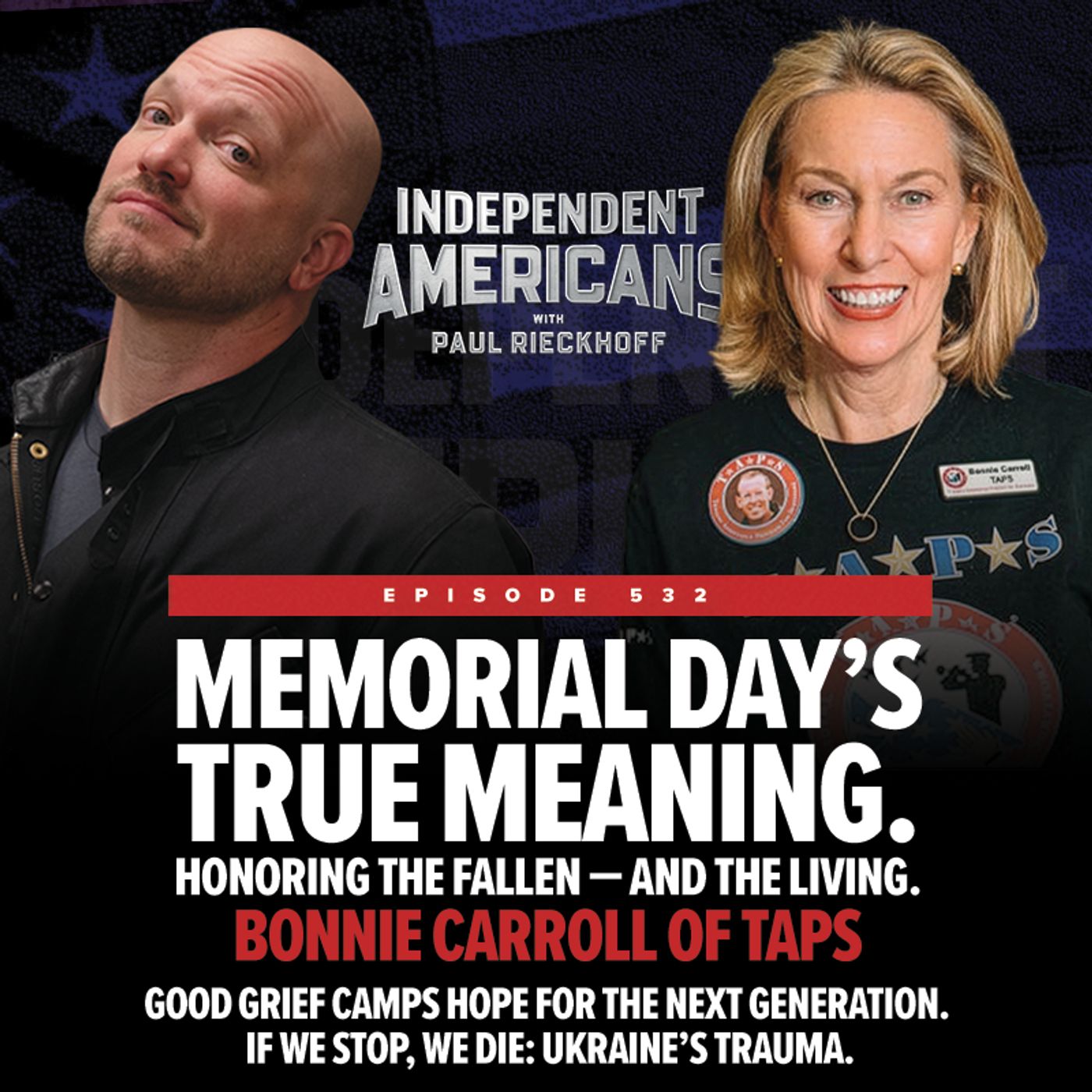
Independent Americans with Paul Rieckhoff
Memorial Day’s True Meaning with Bonnie Carroll of TAPS. Honoring the Fallen — And the Living.
00:24:33
Memorial Day is not a sale. It's not a barbecue. It's a debt. In this special episode, Paul sits down with Bonnie Carroll — Medal of Freedom recipient, veteran, and founder of TAPS (Tragedy Assistance Program for Survivors) — for the 31st annual National Military Survivors Seminar and Good Grief Camp in Arlington. Bonnie has spent three decades building the community that catches Gold Star families when the country looks away, and she brings the kind of clear-eyed, hope-forward leadership the Angry Middle is starving for.
Loading summary
Transcript46 lines
- [00:00]
Narrator
Foreign.
- [00:05]
Paul
Welcome to a special independent Americans. Welcome to episode 5 32. Memorial Day was yesterday, and let's be honest, most Americans didn't really observe and think about the holiday. Whether you did or you didn't, it's an important time to reflect on the sacrifices, the service, the patriotism, the unity, the community of generations of Americans who came before us and gave their lives in defense of freedom. So I have been working a bit this weekend, but mostly reflecting, honoring my friends and spending time with family because I've always remembered that memorial day, after 15 years of working in the veterans space, is also about celebrating life, celebrating the life we have that those young men and women no longer have. They gave up their tomorrows for our todays and I was taking advantage of it, and I hope you were, too. But now it's back to work and I want to give you a special episode with one of the most heroic guests we've ever had, somebody who was working all weekend to remind people about the true power and meaning of Memorial Day. She is a Medal of Freedom recipient. She's a true American hero. She's a veteran herself, the great Bonnie Carroll of taps. This weekend, like every Memorial Day weekend, she had thousands of surviving families together in Arlington and around Washington, D.C. for incredibly empowering, important, inspiring community and programs to help them move forward in life and honor the memories of those they've lost, mourn their passing and celebrate their lives.
- [01:52]
Interviewer
That's what it's about.
- [01:53]
Paul
And it's about coming together. Memorial Day is a time when we do come together. I'm up in the woods in Pennsylvania, which has been great and a nice break, but I'm back to the city. Tonight I'll be on cnn and tomorrow I'll be on News Nation. Mississippi now and maybe some other stuff. We got a lot of stuff going on with Iran, the economy, primaries in Texas and much more. I'll bring you more guests. But as we officially start summer, which is what I think happens after Memorial Day, I'll bring you one of my favorite episodes, one of the most powerful, one of the most inspiring guest we've ever had, the great, great Bonnie Carroll for a very special episode that I hope will help you as we go into summer. And we continue to try to recognize the power of Memorial, to help you stay vigilant. Now some more, this beautiful brook
- [02:40]
Interviewer
in the woods.
- [02:43]
Paul
Check out this treehouse.
- [02:44]
Bonnie Carroll
What?
- [02:54]
Interviewer
Ladies and gentlemen, independent Americans around the country and around the world, Happy Fleet Week in New York City. We don't say happy Memorial Day, but we are here to recognize and remember and talk about and learn from Memorial Day, a time where most of the country is at the beach, but many of our friends are at the cemetery remembering those they've lost. So I'm very honored and privileged and humbled to have back on the program again for our Memorial Day special. The great and powerful Bonnie Carroll is back on Independent Americans. Welcome back, my friend.
- [03:30]
Bonnie Carroll
Hey, Paul, it's so good to see you. Thank you very much. And thank you for always carrying the true meaning of Memorial Day through to your listeners.
- [03:39]
Interviewer
I adore you. You are a mentor and an inspiration, and I think like a true north for this country always. And every chance I get to talk to you, I just want you to know that how much I appreciate you and your team, especially this time of year, but also because I know that every day is kind of like this time of year for you. Last night you were with Denzel at Othello in New York. Then you took a 6am train back to D.C. so let's start with the question I ask of everyone, my friend. Where are you and how are you?
- [04:12]
Bonnie Carroll
I am in Arlington, Virginia. We are welcoming thousands of family members who are pouring in to the Crystal Gateway Marriott, where for the 31st year, we will host them for the National Military Survivor Seminar and the Good Grief Camp.
- [04:28]
Interviewer
Can I ask you to talk again about what the Good Grief Camps are? And I have to pause to say, you know, people don't know how to feel about Memorial Day. And one of the things I'm always struck by is the joy you have and the positivity you have. And I think it gives other people permission. But can you talk in that context specifically? The Good Grief Camps are just one of the most miraculous things of many miraculous things that you do. Can you talk about what that is and what will happen this weekend?
- [04:57]
Bonnie Carroll
Absolutely. And let's start with the kids because, you know, for many of these children, they're the only kid in their school who's lost a parent or even a big brother or big sister. And so to come together with. With other kids who get it, who understand, who are living that same life where they can just kind of shed that little body armor they wear and pull down that mask and just be real and authentic and talk about their amazing, awesome person. And, you know, we wear photo buttons of our loved ones. We talk about, you know, their lives lived. It's not just about the fact that they died. It's the fact that they served this country and, and we honor and we remember them. So for the kids you know, they get to come together. We bring in members of the military who volunteer to spend four days as individual mentors. We train them, you know, how to. How to help kids at different age groups. And then they get to spend time learning coping skills, hanging out with the kids, being that friend who listens. I mean, how important is it in your life to have just someone who's, you know, going to be there for you? So it's amazing.
- [06:08]
Interviewer
And someone who understands. I mean, it's so. It's so important. And I've talked to so many families over the years and sent so many families your way. And there's a family at my son's school, and the young girl, you know, lost her dad to suicide. And, you know, I spoke to her mother, and her kid felt like the only person. She felt like the only one. And I said to them, I remember the conversation was, I know people you can talk to who will be the only people who understand. If you're in New York City or Kansas City or LA or somewhere else and you feel isolated, these are people who can understand. Can you talk about Bonnie? Some of these kids are adults now, right? I mean, they're in their 20s and they have their own kids. Can you talk about the evolution of memorial day since 911 and since Iraq and Afghanistan?
- [07:01]
Bonnie Carroll
You know, Nathaniel Lee is a great example. He came to TAPS when he was 8 years old, and, you know, his dad was Army Aviator of the Year. I mean, big deal. He had his little matching leather flight jacket. Six months later, his dad died in a helicopter crash. So for the Nathaniel journey of really creating a whole new identity, learning, you know, to transition from being a dependent to the living legacy of service and sacrifice, he actually got his degree and went into the Air Force as an officer, transitioned to the Space Force, and now he's up on Capitol Hill as a fellow Congressional Fellow, as a major in the Space Force. I mean, doing extraordinary things, but honoring his dad's legacy every step of the way. I mean, these kids at TAPS now have grown up. We have legacy mentors, kids that are adults that come back to mentor the little ones, because that's such a unique relationship, but it's just incredibly powerful. Garrett Schmidt. I gotta tell you, Paul, Garrett was the son of my husband's aide. Great guy, young sergeant, two tiny little boys. He was killed on the aircraft with my husband. Garrett Schmidt was just on a panel with the Secretary of Veterans Affairs. He's worked for pension and Fiduciary at the va, and he's risen in the Rank. So I'm so proud of Garrett and the man that he's become. It's extraordinary. Kids.
- [08:30]
Interviewer
Bonnie, one of the things you've taught me is that you, you honor, you know, you mourn the loss, but you honor their memory.
- [08:38]
Bonnie Carroll
Right.
- [08:38]
Interviewer
And you honor their life. And yet now you have what I think is the most powerful memorial of all, which is these living examples. Right. The children and the grandchildren and so many people in their orbits that are impacted. I feel like I'm close to it, right. Because of the work and because I'm so close to you. But I feel like this Memorial Day and every Memorial Day, you know, in the last couple of years feels further away from it all. Can you talk about your thoughts on that? Because, you know, I need a break. You know, I did it for 20 years. You've done it for over 30 years. Right. But America seems to be tuning out. I feel like we're less connected than we were after nine, eleven, or a couple years ago. Can you talk about your thoughts on that and how people, in their own way, if they can't go to Arlington, they don't know somebody who's died or served, how they can recognize and be a part of this important day?
- [09:35]
Bonnie Carroll
Absolutely. And our heroes live on and the stories we tell and the values we uphold. Paul, you and I are veterans, and we both served in Iraq. And it was different in the past 20 years that our service members, if injured, if in an ied, blah, positive, you know, inhaling since whatever happened to them over there, they probably made it back in, you know, maybe in pieces, but made it back. And with miracles of medicine today, and all the surgeries and all the therapies that they can do may have survived the past 20 years, but now we're seeing our military veterans dying at a rate that is, for us, with our families, three times what we saw at the height of the war. And that is so counterintuitive for the
- [10:23]
Interviewer
public, you know, and they're dying by suicide. Is it suicide?
- [10:27]
Bonnie Carroll
Toxic exposures?
- [10:29]
Interviewer
Sorry I stepped over you there, but explain to folks, because there aren't as many people dying in combat or in. In training. It still happens, and I'm always trying to highlight that. But talk about where the bulk of these people are coming from.
- [10:42]
Bonnie Carroll
You know, it's suicides as a result of post traumatic stress, undiagnosed traumatic brain injury, and then it is illnesses and cancers as a result of toxic exposures. And now we're just learning about, you know, a lot of the undiagnosed traumatic brain Injury as a result of concussive blast. Frank Larkin was just on 60 minutes a couple weeks ago talking about his son's death. Now, Frank was a Navy seal. His son followed in his footsteps, a Navy seal. That autopsy of the brain after his death found massive lesions undiagnosed prior, but contributed, his dad feels, to his suicide.
- [11:25]
Interviewer
Bonnie, a part that's baked into all of this is the moral injury. And you're an expert on this, right? I mean, I've called you Saint Bonnie. I mean, we have a new American Pope, but we've had an American saint in you for decades, and you received the Medal of Freedom. You work with people on all political backgrounds, but this issue of moral injury, right, that so many folks feel. And now we've got this, this discussion around Afghanistan right now. Pete Exit says he's going to reinvestigate Afghanistan. But I feel like, you know, in the midst of all the politics, they're failing to recognize the moral injury where now Afghans are being denied TPS protections. You know, Kirsten Noem said Afghanistan is safe. Can you talk about moral injury and how that is a part of all of the work that you do?
- [12:17]
Bonnie Carroll
Paul for those who serve, we go in knowing that we are doing the right thing, that we are meeting a just mission, that we are making the world ultimately safer, and we are defending democracy. So when things happen right after the fall of Afghanistan, we immediately gather together, leading veteran voices, yourself included, with experts, with others, with Afghans to talk about in panel forms. You know, just the feelings that we had, how difficult this was to walk away from a mission. When I left Baghdad in 2004 and we shut down the Coalition Provisional Authority, it was tough. It took me a while to just adjust to leaving that mission and maybe not fulfilling some of the promises that we had made. You know, we go into this business defending democracy to raise our right hand to protect and defend the Constitution, to serve, to make this world a safer place and for all Americans. And we have to believe that we're doing the right thing.
- [13:27]
Interviewer
It's hard for folks right now. And I think you've always been really careful about navigating the political world and effective as a result. But we've also got, I had Fleet Week is happening right behind me right now. The ships just came up, pulled the boys out of school, and we watched the USS New York come in, which has, I think, seven tons of steel from the World Trade Center. We saw the Calhoun. It was a little, you know, it's a military parade, right? It's a Naval parade. Trump's going to do a big parade next month. It's on the Army's birthday, but it's also on his birthday. This is very controversial. Can you talk about your view on this and just how you all deal with controversy on which seems to surround our community all the time, and I think, I would imagine makes your work harder when they feel like political chew toys. But what are your thoughts on that and how that's happening, you know, for our families?
- [14:25]
Bonnie Carroll
We have families with all political backgrounds and views and opinions, and we wrap our arms around them and we give them so much love and understanding and support, and that really, really do not give. Get involved politically. We're very apolitical. We advocate in Congress for the benefits for the surviving families. But as far as political, you know, views, we have been honored at every White House since TAPS has been in existence. We have been present for every ceremony. We have been grateful for the support that we have received as an organization and the respect that has been given to the Gold Star families of this country. I think our, our community is universally honored by this nation and we appreciate the support and that, that respect that
- [15:15]
Interviewer
we're given and you still deserve and need more. So are there any advocacy priorities or the things you need to get through Congress? You know, in a Congress doesn't seem to be able to get anything done. I'd hope that your stuff would be the stuff they're able to get through. But is there anything you're advocating for and have the federal cuts that have come down impacted your programs or your people in any way?
- [15:37]
Bonnie Carroll
Yeah, we're very fortunate. We have not had any impact from that. TAPS is entirely privately funded. It's made possible by caring Americans who understand the sacrifices made by our men and women in uniform. We have a couple of legislative initiatives. One of those is called the Love Lives on act. And that is really personal for our families. And it's just changing the law so that benefits for surviving spouses don't stop if they remarry. You know, we had even, even widows, but more importantly, their kids up on Capitol Hill last fall talking about this and to hear kids say, hey, I, I would like, you know, it's not my dad, but I would, I'd like to have, you know, a guy who cares about me come to my baseball game and, you know, it's not that they can't remarry, but it's a significant financial impact and it makes it very, very difficult.
- [16:35]
Interviewer
Does it impact the GI Bill benefits too, if you remarry? Do you keep the GI Bill benefits or not?
- [16:42]
Bonnie Carroll
That's a good question. I can check on that. I should know that.
- [16:46]
Interviewer
But I think that's a great example of the nuance of where you all are focused, that you would only know if you're connected to that community. Bonnie, a great part of your work is international as well. I've been honored to start American Veterans for Ukraine with you. We launched this big campaign this week to encourage members of Congress to step forward now and support Ukraine. It feels like the last couple of months especially has been hard. It's been topsy turvy, right? Trump came out, you know, really hard on Ukraine. We had the terrible meeting with Zelensky. Now we have the minerals deal. There's all these starts and stops with a potential conversation with Putin. But can you talk about the work you're doing on the ground? Like, you. You're at. You're at. You're where the rubber meets the road. You're serving families in Ukraine. Can you talk about that?
- [17:30]
Bonnie Carroll
It is, you know, it is all about honoring those who have sacrificed for the freedom of their country. Back in 2014, that first invasion by Russia of Ukraine was horrific, losses, horrendous. And the U.S. state Department actually came to us and asked if we would mentor the creation of an organization in Ukraine to care for their families, to help them learn how to do that. So. So we did. It was launched in 2017. They wanted to call it TAPS Ukraine as a nod to our partnership, but also, you know, recognizing the alliance between America and Ukraine. They have a wonderful facility over there now and taking care of the families on the front lines.
- [18:15]
Interviewer
I mean, you and I talk about this a lot, but philanthropy seems to have diminished in support of Ukraine as it's become more politicized. Do you see that impact on the ground for the families over there that are trying to navigate this? And do you even. I mean, we know 19,000 kids have been abducted. Do you have a sense of how many families have been impacted by loss in that society? Is it like one in three? One in, you know, one in two? Do you have a sense of the scope? Because I think we are removed from the human cost of our own wars. Were definitely removed from the human cost in Ukraine.
- [18:50]
Bonnie Carroll
Yeah, the numbers are tragically high. And, you know, for our families, we also have a medical training team, and they're now actually in the. Not only on the front lines at the casualty collection points, helping save lives, but they're also in the schools now working with teachers. And what a sad statement. That now it's the schools and the kids that are being affected with these most recent attacks. And whether purposeful or not, it's absolutely tragic. And to live for now, for three years in that kind of environment, with that anxiety, not knowing when the next rocket is going to hit, incredibly difficult.
- [19:37]
Interviewer
Last year, we did an event at the Ukraine House around Memorial Day. You brought families and soldiers from Ukraine that I was honored to spend so much time with. And we all collaborated on ways to support each other. And again, coming back to maybe where we started, Bonnie, you're always positive, you're always looking forward. You're always giving people hope and strength. There's a lot of people who are looking for hope and strength right now and looking for leadership with integrity where it seems to be lacking. You know, you've been supportive of so many different veteran leaders, and you're respected by so many of them. Can I ask you, just as a leader yourself, you motivate teams, you train teams. How do you keep going? You know, what is it that keeps you going, and how do you encourage other people to keep going? And what's your message for folks that maybe feel tired and worn out and feel like the hits just keep on coming?
- [20:22]
Bonnie Carroll
Yeah, because it matters. Because we have to. You know, I asked Julia that, and she just. I'm going to start crying saying this, but she just looked at me and she said, you know, we can't stop. If we stop, we die. I mean, that's.
- [20:36]
Interviewer
Tell folks who Yulia is, please, Bonnie.
- [20:37]
Bonnie Carroll
Oh. Yulia Dimitrova is the director of TAPS Ukraine. She is absolute warrior on the front. She, you know, comforts families. She's run morgues. She has managed funeral operations. She is a lieutenant in the reserves there, and she manages with such joy the programs for the families and the children, whether it's giving out gifts at Christmas or taking the kids to camp or, you know, however they are wrapping their arms around these families who have sacrificed so much for the freedom of their homeland.
- [21:09]
Interviewer
And, Bonnie, you. You give people perspective, too. And I, I. My kids are, you know, around it all the time, and we always put things in perspective versus what kids in Ukraine are facing or what kids around the world are facing. You know, the resiliency that comes out of these traumatic experiences creates a new generation that can rise to this moment. These people that you have trained as children that are now adults that are meeting this moment. Can I ask you. You know, a lot of folks feel confused about America, especially internationally. They don't know who we are anymore. Maybe Feels like we perhaps have lost our way. You're an ambassador for America around the world in a positive way, kind of like the Pope will be, I think. You know, what is it that you want the world to know about America, especially on Memorial Day weekend when we remember some of our greatest folks?
- [21:59]
Bonnie Carroll
For many of us, Memorial Day is a mix of tears, of pride, of grief, but it's reflecting on why we serve. And we serve in defense of democracy. We serve in defense of this nation. We serve for each other to protect and defend. My mom served during World War II, and she was a pilot. And, you know, for her, she had an amazing life, did extraordinary things, but that really was the standout because she said it was an opportunity to step forward and make a difference. And we all, you know, all of us who've worn the uniform, whether it was in a very small way or in a, you know, in a big way, we did our part. And I'm. I'm so proud of that, and I'm so proud of every one of our families. And it taps, regardless of how or where that death occurred, we honor the life lived in service to this country, and we wrap our arms around those families this weekend and always.
- [23:01]
Interviewer
Bonnie, you are awesome. I'm going to say it every time you're on the show. I wish you would run for Senate from Alaska, your home state of Alaska. Run for governor of Alaska. We need you now more than ever. You are an example for everyone. I think you're such a voice of reason and character and integrity, and you're a touchstone. Like, when folks are struggling, I. I tell people, go, look at Bonnie. Like, she can lift you up and her work can lift you up, and that's what the work does. So I encourage everybody, especially this weekend, to check out the work of TAPS and support taps. But also, Bonnie, thank you for all you're doing. You're going to stick around for a couple extra questions from our Patreon members where we'll talk about a little bit more of your background, which is fascinating, but thank you for all you're doing. Keep giving them all that hope and inspiration and know we're. We're rooting for you always.
- [23:52]
Bonnie Carroll
Thank you.
- [23:53]
Interviewer
Thank you. Bonnie.
- [23:59]
Narrator
Tells me the left and right are dreams for those without a clue and when you wake it's time to grow and it's not cool to believe in school but if I can say one thing I've seen the children of the revolution and the good trouble they can can bring he says the red and blue identity dependent is an attitude, an island in the sea of rhetoric. Without a clue. And when you wait, it's time to
- [24:28]
Interviewer
grow Power by Righteous Media. If you like the show, please take a moment to rate, review and subscribe. It really does help the show to grow. Thank you for listening.