← Independent Americans with Paul Rieckhoff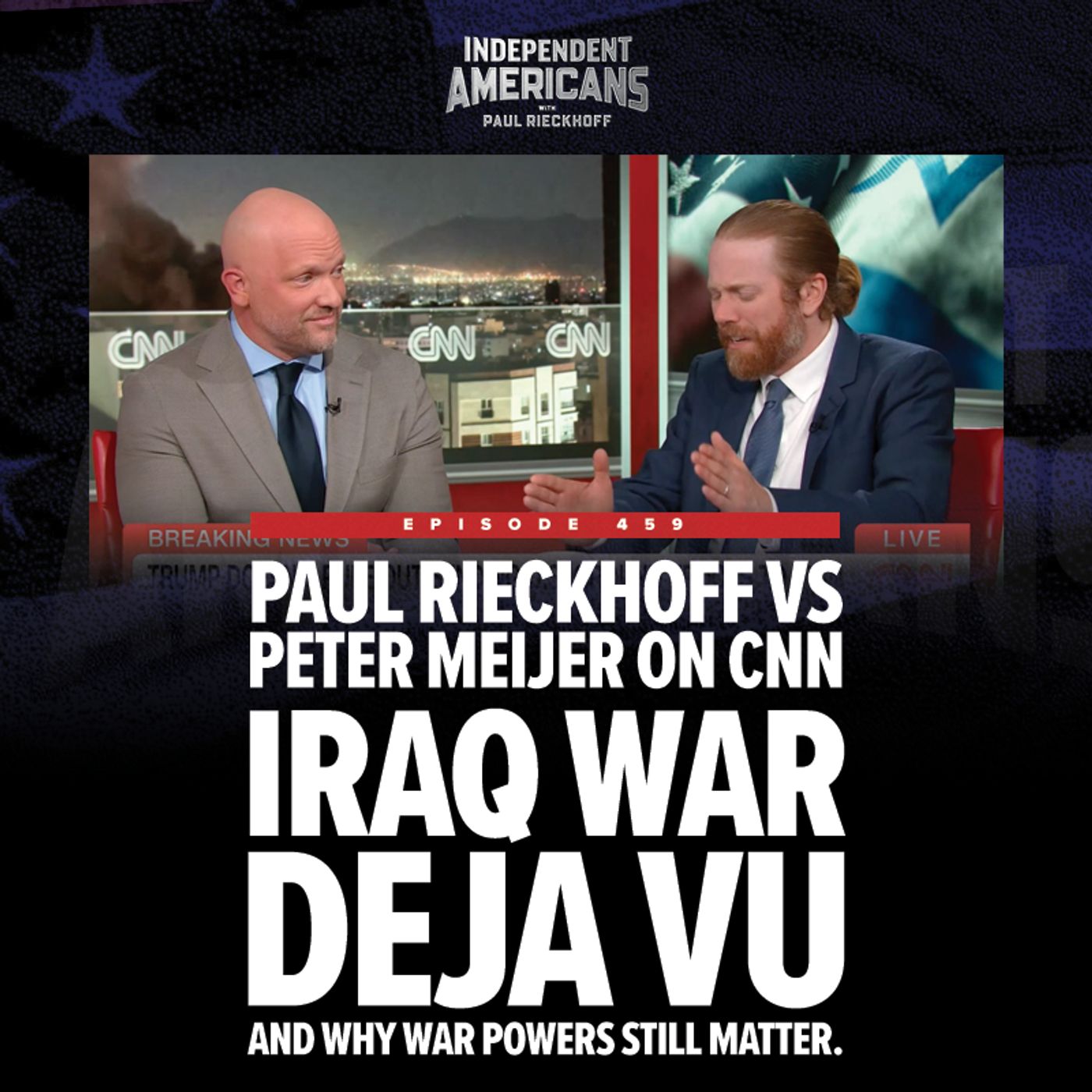
Independent Americans with Paul Rieckhoff
Paul Rieckhoff vs Peter Meijer on CNN - Iraq War Deja Vu and Why War Powers Still Matter - War, Trump, Iran and Congress Failing to Act.
00:17:09
Independent Americans host and Iraq War veteran Paul Rieckhoff takes you behind the scenes of his fiery CNN Newsroom clash with former Congressman and fellow Iraq vet Peter Meijer over President Trump’s escalating Iran strategy and the deadly strike on an Iranian school that killed scores of children and teachers. In this raw, real-time debrief, Rieckhoff explains why Trump’s rush to blame Iran despite independent analysis suggesting U.S. responsibility shreds American credibility, feels like “deja vu all over again” for veterans of Iraq and Afghanistan, and risks dragging America into another open-ended Middle East war most Americans do not want.
Loading summary
Transcript78 lines
- [00:00]
Thumbtack Narrator
Avoiding your unfinished home projects because you're not sure where to start. Thumbtack knows homes, so you don't have to don't know the difference between matte paint, finish and satin or what that clunking sound from your dryer is. With Thumbtack, you don't have to be a home pro, you just have to hire one. You can hire top rated pros, see price estimates and read reviews all on the app. Download today.
- [00:20]
Grainger Narrator
If you're a maintenance supervisor at a manufacturing facility and your machinery isn't working right, Grainger knows you need to understand what's wrong as soon as possible. So so when a conveyor motor falters, Grainger offers diagnostic tools like calibration kits and multimeters to help you identify and fix the problem. With Grainger, you can be confident you have everything you need to keep your facility running smoothly. Call 1-800-GRAINGER, click grainger.com or just stop by Granger for the ones who get it done,
- [00:50]
Paul Rykoff
intentions are different than outcomes, and taking out the regime is a good thing, but what does it produce and what happens next? We got to Iraq and saw what happens when you don't have a plan for afterward. And if you want to win over the Iranian people and get them to stand with you, you can't kill kids and lie about it, right?
- [01:20]
Host/Anchor
So I just got off the air at CNN and maybe ironically, the Intrepid is right behind me, but I am leaving cnn. And that was another weird one. It was another weird one at cnn. And I think it's gonna get weirder because I don't think this war is gonna end, or at least the chaos won't end anytime soon and the media coverage is gonna be sustained. And apparently it is so deja vu all over again because when I went in the green room, I saw Alex Petas, who was on, and I saw Kim Dozier, who I haven't seen in 10 years, who I used to see around the Iraq war, and Peter Meyer, who's an Iraq vet. So it was like Iraq War reunion. And maybe that's fitting because it felt like 2024 where I was on TV arguing with a guy who was another veteran who was taking all the positions of the president, arguing in favor of the unpopular war, saying it was going to be over easy and everything was great, people. Peter Meyer, I think, is a good dude. I've known him a long time, I have respect for him. But he is all in on Trump and he is carrying all the talking points. And as I've told you before. I am not going to abide by that. I'm not just going to stand there and let people go unchallenged. So as I go down the west side highway on my way home, this is deja vu all over again. I think, unfortunately, on cable news, you're going to see too many veterans arguing with each other put in little boxes. But as we knew then and we know now, this is an incredibly complex situation that will get even more complex. I'm going to do my best to try to add honest perspective and also, as you've seen before, challenge both sides, because I am not in the bag for the Democrats, the Republicans, or any politicians. And I don't think you should be either. So I'm going to go for a walk. Peter and I did end on a hug, which was nice. Maybe we will continue the discussion on my show sometime soon. But it is deja vu all over again in so many ways. And just like in 2024 in Iraq and after Afghanistan and especially now, it's most definitely a time for us all to question everything and, of course, stay vigilant.
- [03:45]
Interviewer
So on Air Force One tonight, President Trump blamed the deadly strike on an Iranian school that killed at least 168 children and 14 teachers. One on Iran. That is despite reports and some independent analysis that points the finger at the United States. I want you to listen to this exchange.
- [04:03]
Paul Rykoff
Did the United States bomb a girl's
- [04:05]
Peter Meyer
elementary school in southern Iran on the first day of the war and kill 175 people?
- [04:10]
Podcast Host
Based on what I've seen, that was done by Iran.
- [04:14]
Paul Rykoff
Is that correct? Yeah, but only the only side that targets civilians is Iran.
- [04:24]
Podcast Host
We figure is that we think it was done by Iran. Very inaccurate, as you know, with their munitions, they have no accuracy whatsoever. Was done by Iraq.
- [04:36]
Interviewer
With me now are two Iraq war veterans, Paul Rykoff and former Congressman Peter Meyer. I want to point out that Secretary of Defense Pete Hexithology, he'd back President Trump up on almost anything. Right. He did not 100% agree with President Trump there that, yeah, it was Iran who bombed the Iranian school. He said we're investigating there. So, Paul, what did you think of that?
- [04:58]
Paul Rykoff
Doesn't look like they're on the same page. And I think it's very important that they get on the same page. I think Hegseth's response is actually more appropriate that they're investigating the situation. They're going to get to the bottom of it. They need to find out, because truth is always the first casualty of war. And if Trump gets ahead of his skis and is not telling the truth, the world's going to find out. Especially if we want to contra with the brutal regime that can't be trusted. America's commander in chief needs to be trusted, especially if it comes to casualties on the American side and civilian casualties, especially when they're kids.
- [05:26]
Interviewer
What do you think of the president's initial response there?
- [05:29]
Peter Meyer
I think the president was reacting to what we had seen on social media. And you get this back and forth where you have the initial blush and then you have a follow on. In a lot of ways reflected a similar pattern with what we saw in some of the early days of Israel's invasion into Gaza and their attacks post October 7th where there were actually strikes that were not Israeli, they were fallen missiles, they were inadvertent. On the Hamas side of the House, there was a lot of speculation on social media that could have been the case. I think what we've seen in terms of the initial analysis and both from the independent side and where leaks are suggesting the US Military investigation is going is that was not the case in this. It was a tragic. But what we see in conflict, an inadvertent strike, whether or not that was a database that should have been updated or is just a signature.
- [06:17]
Interviewer
Unusual to see Secretary Hexit there, though, not immediately jump and say, you know, rah, rah the president, and kudos to
- [06:23]
Peter Meyer
him for saying like, hey, you know
- [06:24]
Paul Rykoff
what got Kristi Noem fired a couple days ago.
- [06:27]
Interviewer
All right, let me ask you both. And you guys were both on the ground in Iraq. Iraq, obviously, when the president today once again refused to rule out ground troops inside Iran. What's your reaction to that?
- [06:40]
Peter Meyer
I think we are looking far too often at this conflict right now in Iran with the reflections of what Iraq looked like. Right. You obviously had the Mission Accomplished speech. You had a relatively quick fall of Saddam Hussein's reg regime, followed by years, years of devastating insurgency. And so when we talk about nation building, it's are we trying to do the same thing? Are we going to repeat the de Ba'? Atification? And on the democratic side, that's twinned with frustrations that, you know, oh, you're call. You're not calling, you're either calling for regime change, you're not calling for regime change. If you're not calling for regime change, although the regime is undemocratic and we should be pushing for that. You know, there's a lot of mixed signals and mixed messaging. But the reality with this conflict is we will probably need troops on the ground in some limited capac.
- [07:24]
Interviewer
Okay with that.
- [07:25]
Peter Meyer
I'm not okay with an invasion. I'm not okay with an occupation. I'm not okay with anything that is focusing on a massive continuing force. But the reality of what we may be trying to do with neutralizing some of the nuclear stockpile in terms of uranium that's already been enriched there, there are things you cannot do from the air. But it's very different from a targeted specific in and out special operations mission versus what we saw in Iraq and Afghanistan, where you're there to stay, hold and build.
- [07:54]
Paul Rykoff
Here's the bottom line. Most everybody's not okay with this, except for Trump and a small group of his loyalists. The American public does not want boots on the ground. The American public is not behind this operation or war in Iran. They're not behind a lot of what he's doing lately. But he's all gas and no brakes and not slowing down. I think it's important to underscore Congress only voted on this about five days after it happened. So he continues to be going all out, and there are no circuit breakers, there are no guardrails. He's doing whatever he wants with the most powerful military the world has ever seen, and nothing is stopping him. So if he wants boots on the ground, he's going to it, even if 80% of the American public doesn't want.
- [08:28]
Interviewer
The congressman has a point here in the sense that it may be that to dismantle the Iranian nuclear program, which does have, I think, broader support than a lot of other aspects of this, you probably do need. Oh, yeah, you can't do it from
- [08:39]
Paul Rykoff
the air, but does that mean we should do it right? I mean, intentions are different than outcomes, and taking out the regime is a good thing, but what does it produce and what happens next? We got to Iraq and saw what happens when you don't have a plan for afterward. And if you want to win over the Iranian people and get them to stand with you, you can't kill kids and lie about it. Right? That's very, very important that they get the Iran people on their side. And that's going to be a tough sell right now if there's no security. And who's going to do this security? Is it going to be just American boots on the ground? Are they going to be Israeli troops, NATO troops, the Kurds was an idea a couple days ago. It doesn't seem like they have a clear plan that they can articulate to the American people to include the cost, which is what the American public is most concerned about.
- [09:15]
Peter Meyer
But this is also the strategy on the US Side. It is the decapitate and delegate approach that we saw in Venezuela. Now, obviously Venezuela, their boots on the ground for approximately two hours. That was it. Now we're reopening and reestablishing diplomatic relations. Venezuela very different from Iran in a number of contexts. But that is obviously where this administration, I think is trying to be very diligent in responding to the reality. How the regime being diligent, how the regime reacts.
- [09:40]
Paul Rykoff
I do not think they're being react
- [09:42]
Peter Meyer
entirely operative on what their next cards to play.
- [09:44]
Paul Rykoff
I think they're being everything but diligent. They're not being precise in articulating their goals and their outcomes. And yes, that is the challenge. That's why maybe you should have thought about not doing it. And if you did, I'm sorry, it's
- [09:58]
Peter Meyer
the OODA loop all over again. You are trying to say like we, we, yes, we have a general thrust,
- [10:03]
Paul Rykoff
we have a general, sorry, let's do this, but how long can boots go on?
- [10:06]
Peter Meyer
What? No, I think we both agree that we do not want to see a continuing or enduring presence of American forces within Iran 100%. And I think this administration also is very contingent. They do not want to see that. Now Donald Trump will take nothing off the table at any point. If you read the art of the deal, all of this was foreseen years ago. He has been incredibly, incredibly detailed on his negotiating strateg. We're seeing that in Iran, we saw it in Venezuela. But the reality is a lot of it's going to be dictated by what we see on the ground. Not in terms of truth, I will say, but in terms of the reality.
- [10:38]
Interviewer
There's one difference between everything that was written in the art of deal and this is, this is war. I mean, you're dealing with American lives here. And there is, there is a human cost to this for sure. And when you're talking about something like
- [10:49]
Peter Meyer
that and a cost to non action as well.
- [10:51]
Interviewer
Absolutely.
- [10:53]
Paul Rykoff
But the cost is now overflowing throughout the region and hitting over a dozen countries. Venezuela wasn't firing rockets and Shahid drones to their neighbors. So the lid is blown off here. And the question is, do we even have the capacity to rein this in?
- [11:05]
Interviewer
Can we just all agree that regime change is now a stated goal of the US Administration?
- [11:09]
Paul Rykoff
It's one of many stated goals they've had. They've had a bouncing ball of stated goals over the last couple of days.
- [11:13]
Peter Meyer
The regime was the Ayatollah the ayatollah is gone. Obviously, there are still echelons and institutions below him. I mean, the man is dead.
- [11:20]
Paul Rykoff
The man is gone, but the institution remains.
- [11:22]
Peter Meyer
And the question is, can you reorient that institution? It is not about, you know, now we're going and doing a 180. It's about a game of degrees day by day.
- [11:31]
Paul Rykoff
This is what, this is all what we heard 20 years ago ago, you and I. This is like a reunion here at CNN, because all of us were here 20 years ago when we heard the same thing around Afghanistan, the same thing around Iraq. And that ended up dragging on for 20 years. And that is what the American people are most concerned about. The financial cost of a billion dollars that's secondary to 20 years of American caskets coming home, which is what we saw last.
- [11:50]
Interviewer
What's to keep? What's to keep? You know, one of the things we've heard, General Kaine has done a good job, I think, briefing the American people on the military right. Metrics of this war, a 90% decrease in missiles shot from Iran since day one, an 80% decrease in drones launching from. What's to stop tomorrow, Monday, Tuesday, Wednesday, President Trump saying, we did it or we did enough, and the regime has changed. Right. Whether it's the full regime change you wanted, it may not be it. But what's to stop from saying, mission accomplished.
- [12:20]
Peter Meyer
And that's the whole point of the calibration is what are the intelligence assessments saying could be accomplished if we continue on the path that we're on versus is this potentially the best we're going to get in terms of shifting and neutering the threat that they were posing to the region? And again, that is where I think it's very difficult because they can have rhetoric, rhetoric that's out there that, you know, is all nice to try to hold them to. But if the reality on the ground is shifting and changing, and frankly, this was the problem with Iraq is we had rhetoric that was stated of, oh, it's going to be. We're going to implement democracy. We have all these wonderful human rights ambitions that we want to throw out there. And all of a sudden we baked ourselves into being there for years to oversee things that, frankly, we never truly believed in because it was all about might makes right. And now we have an administration who recognizes reality.
- [13:05]
Interviewer
Let's talk about the memes, shall we? What do you think of the video videos that the White House has. Has really?
- [13:11]
Peter Meyer
Why?
- [13:13]
Paul Rykoff
I'll tell you what I think. Yeah. I think they're Ridiculous. I think they're juvenile. I think they are inappropriate. I think they, they have a casual and, and, and almost celebratory approach to the cost of combat, to the fact that men and women are in harm's way. I think it's created by a demographic of people in the White House who are trying to reach that same group of demographic people who are playing video games and watching ufc. But the problem here is the rest of the world is watching and we don't look serious. This should not be coming from to the world.
- [13:41]
Interviewer
Is there a risk to US Troops in this? Does it put people in hard sweat?
- [13:43]
Peter Meyer
I don't think so. I mean, I, you dig the videos,
- [13:46]
Paul Rykoff
you think they're good. You feel proud about that.
- [13:49]
Peter Meyer
Not to divulge things that may have been discussed off camera, but like, man, I'm, like, I, I. There were far lower resolution versions of this that I downloaded on Kazan limewire in like 2003. I mean, this is typical hype video. It is showing what we can do. You know, if I'm there, Iranians, I don't see that and say, oh, these guys aren't serious. I say that and say, oh, boy, I do not want to give them more footage. There are additional soundtracks. They could lo in the background and, and now with all of the AI, Add spongebob.
- [14:16]
Paul Rykoff
They're adding spongebob. They're adding Mortal Kombat, you know, videos. I mean, this is ridiculous.
- [14:21]
Peter Meyer
Painted on the T walls outside of American bases in Iraq.
- [14:24]
Paul Rykoff
And that wasn't appropriate either. And the videos that we had in Iraq weren't appropriate either. And you wouldn't show the humor, you wouldn't show them to your mom, and you wouldn't show them to your kids, and you certainly wouldn't broadcast them from the White House. But these guys are doing.
- [14:34]
Interviewer
All right. Let's. One more subject here, if I can get it in here. Congressman, you, you know, you, you did serve and you have run for office several times. Let's talk about gas prices, right? How do you like to be running for office right now with G prices going up the way they are?
- [14:46]
Peter Meyer
We're still below where we were in the post Russia invasion of Ukraine.
- [14:50]
Interviewer
Got to $5 in June of 2020. No question about that. But it's higher than it's ever been than at any point in either Trump presidency. Yeah, higher than when he took office.
- [14:59]
Peter Meyer
I know. I mean, I think this is showing the perils of. If you have an administration that believes in the green New Deal, this is exactly where they want to see things going right. Higher gas prices 100%. I think that the Trump administration has a very serious challenge which is a lot of their foreign policy object objectives are not going to be immediate short term payoffs. Venezuela being the exception. And the crazy thing about Venezuela is the approval for the operation of venezuela in the US it's about 20 points lower than the approval for that operation in Venezuela. The Venezuelans 75%. The country's on the right track. Fantastic. The challenge that the Trump administration has is a lot of the things that they're implementing are solutions to long term problems where you will see the payoffs in the medium to the long term, but there may be short term consequences. You see this on tariffs and trying to re industrialize and trying to bring manufacturing back. It hurts in the short term. Great in the long term term. And that's also the challenge here. If we can have Iran not be within the Russia China axis now that Venezuela's out of that, that is a massive weakening that is forestalling a great power conflict in the next three, five, ten years.
- [16:00]
Interviewer
How well has the President sold that to the American people? Has the President made the case? Has you ever heard the President make the case you just made?
- [16:05]
Paul Rykoff
No. Really, it's a good thing you're not running for Congress because that wouldn't do very well with most of the American people. No, I think the reality is that the gas prices hurt. Right. And I think there's another reality here. He has now conducted military operations in eight different countries just in the last. There hasn't been congressional approval on any of them. There hasn't been populist support.
- [16:23]
Interviewer
There won't be congressional approval the next day.
- [16:25]
Paul Rykoff
But it really, if I, it's really important. He also conducted operations in Ecuador this week. Right. And the American public didn't approve that. Congress didn't approve that. Hold on. And before they even voted on Iran, he was already in. And now he's talking about going into Cuba. So are they going to have a war powers act on Cuba before or after he hits Cuba? He is all gas, no brakes and nothing is stopping him. And that should alarm all Americans.
- [16:46]
Peter Meyer
Not talk about going into Cuba. Talking about.
- [16:48]
Paul Rykoff
He literally said he's going to putting
- [16:50]
Peter Meyer
pressure on the regime, focusing on Cuba. Cuba's next, Cuba's the next to fall. And honestly somebody would get paid off and that regime will shift. But the Ecuador operation, that was not unilateral. That was with Ecuadorian special operations. That's something we've been doing for the past two decades.
- [17:03]
Paul Rykoff
And a lot of Americans didn't even know it happened until we just mentioned it.
- [17:06]
Closing Narrator
All right, good.
- [17:06]
Peter Meyer
They should be more aware.
- [17:07]
Paul Rykoff
They shouldn't know.
- [17:08]
Peter Meyer
No, they should be aware. I'm glad we're mentioning it. This is wonderful to have partnered operations against cartels.
- [17:13]
Interviewer
Peter Meyer, Paul Rykoff, great to see you both. You have a lot to talk about. I suggest heading out to the bar. You guys can finish.
- [17:18]
Paul Rykoff
We're old friends.
- [17:19]
Interviewer
Over a drink there. Glad to spend tonight with you. Appreciate it.
- [17:22]
Closing Narrator
Thank you. AR tells me the left and right are dreams for those without a clue and when you wake it's time to
- [17:31]
Paul Rykoff
grow and it's not cool to believe
- [17:34]
Closing Narrator
in school but if I can say one thing I've seen the children of the revolution and the good trouble they can bring he says the red and blue are dead and independent is an attitude an island in the sea of rhetoric and left and right Our dreams for those without a clue and when you wait it's time to grow Power
- [17:57]
Paul Rykoff
by Righteous Media
- [18:00]
Grainger Narrator
if you're a maintenance supervisor at a manufacturing facility and your machinery isn't working right, Grainger knows you need to understand what's wrong as soon as possible. So when a conveyor motor falters, Grainger offers diagnostic tools like calibration kits and multimeters to help you identify and fix the problem. With Grainger, you can be confident you have everything you need to keep your facility running smoothly. Call 1-800-GRAINGER Click grainger.com or just stop by Grainger for the ones who get it done.
- [18:31]
Podcast Host
If you like the show, please take a moment to rate, review and subscribe. It really does help the show to grow. Thank you for listening.