← Independent Americans with Paul Rieckhoff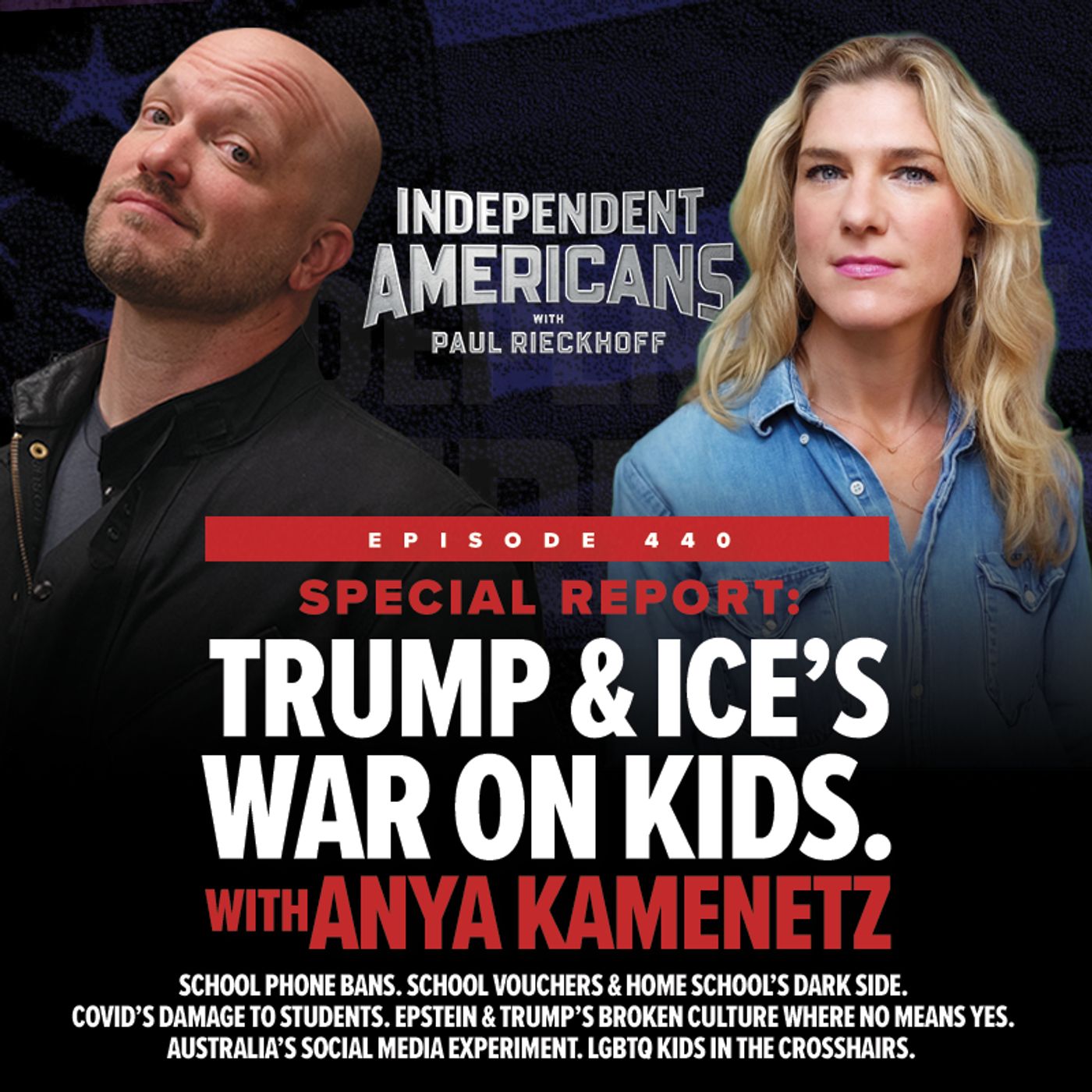
Independent Americans with Paul Rieckhoff
Special Report: Trump & ICE’s War on Kids w/ Anya Kamenetz.
00:48:41
In the midst of chaos and political turmoil, our children are facing unprecedented challenges—from ICE enforcement creating fear in schools to the dismantling of public education and lingering COVID trauma. Award-winning journalist Anya Kamenetz joins Paul Rieckhoff to expose the secret war being waged on America's kids and offer pathways to hope, resilience, and collective action.
Loading summary
Transcript90 lines
- [00:00]
Anya Kamenetz
Try Angel Soft for your tushy. It's made by Angels Soft and strong. Budget friendly. The choice is simple. Pick up a pack today. Angel Soft. Soft and strong.
- [00:14]
Paul Reichoff
Simple.
- [00:16]
Anya Kamenetz
So what we're seeing is that, first of all, I think people need to understand that one in four children under 18 in this country have a parent who's an immigrant. Right. So that's 18 to 19 million children. Yeah. Because this is the future of America. Right. Like, this is we. This is who we are. We are a nation of immigrants. And that is true in our public schools. And so those kids are afraid to go to school, and they're right to be afraid.
- [00:55]
Paul Reichoff
Foreign. Welcome to Independent Americans. I'm your host, Paul Reichoff with a very special episode. In the midst of all the chaos in this country and in this world, often forgotten are the kids. Think about it. They've been through Covid, they've been through ice, They've been through multiple administrations. They've been through a lot. And this is a generation that has been surrounded by adversity, controversy, and politics. And I wanted to focus a special episode on how our kids are doing now and how they can be a source of hope. But Trump has been at war with our media. Trump has been at war with the Pentagon. Trump has obviously been at war with the Democrats and much of the world. But there's also been a secret war on our children. Trump's been waging war against the Department of Education. Secretary of education Linda McMahon hasn't gotten a lot of attention, and there's been a lot happening, from kids being detained by ICE to kids being scared by ice, to kids being scarred by ice. But this is a really, really important story that I don't think has gotten enough attention. So I brought in one of my favorite guests, Anya Kamenetz, who's an expert on child development. She's a true thought leader on how everything is impacting our kids, but not just affecting our kids, but impacting all of us. It's also a really hard time to parent. It's a hard time for anyone just to be. And Anya is a voice of reason and clarity and information that will help prepare you and those around you to navigate these times. It's an important conversation that I've wanted to bring you for a while. So here it is, my important conversation with Anya Kamenens about the kids, about all of us, and about the future and how we can all stay vigilant. Okay, folks. Helping us stay vigilant during a time when vigilance is especially required around children's and children and families. A guest I've had on the show before that many of you told have told me is one of your favorites. I know that this guest is one of my wife's favorites, especially a person I think brings tremendous wisdom and really important information and perspective about our children, about our culture, about our families. She is a writer. She is a thought leader. She has a great substack called the Golden Hour. She has been at npr. She's had books called the Stolen How Covid Changed Children's Lives and Where We Are Now. She's been an advisor to the Aspen Institute and the Climate Mental Health Network. She has been at npr. She is a really, truly thought leader. She's a thought leader who helps us understand and navigate these times. I look at her like a secret Dakota ring or maybe like a compass at times when we need it, especially the great and powerful Anya Kamenetz is back on Independent Americans. Welcome back, my friend.
- [03:59]
Anya Kamenetz
I feel the same way about you, Paul. I gotta say that. I mean, the time that we've known each other, you've just consistently held down this position of such integrity and informing people. And, you know, the, the mom, like, the being independent in these times is not an easy task, but you do it.
- [04:16]
Paul Reichoff
You know, I think there's also a similarity because I feel like I have to always remind people about national security.
- [04:22]
Anya Kamenetz
Yes.
- [04:23]
Paul Reichoff
I have to always remind people about domestic security and veterans issues. And I feel like you have to always remind people about our kids.
- [04:30]
Anya Kamenetz
That's right. That is so right. And it is so frustrating, I have to tell you. But, yes, here we are. And, you know, if we, if we put these things front and center, I feel like our, all of our politics would be better. You know, there's nothing partisan about security. There's nothing partisan about kids.
- [04:45]
Paul Reichoff
It shouldn't be right. But it feels like everything has become contaminated by bipartisanship now. And I've been really excited to have this conversation with you. And I want to get into what you've been covering in your substack, what you're covering in your next book. I want to talk about our kids. I want to talk about parenting. I want to talk about kids around the world. But let me start with a question I ask everyone. Where are you in the world and how are you?
- [05:09]
Anya Kamenetz
I'm in New York City and I'm doing great because our vacation starts tomorrow and I'm going down to New Orleans to be with my family. And we're going to have a really fun time, the whole family.
- [05:21]
Paul Reichoff
It's about to be winter break for public schools in New York City, Right?
- [05:25]
Anya Kamenetz
That's right, yeah.
- [05:27]
Paul Reichoff
Which is really cool. But it also creates this, like, this dysphoria of New York kids and families flying around all. And driving around to all these warm places, right?
- [05:37]
Anya Kamenetz
Yes, definitely. And we are part of that. I mean, it's, as you know, it's been a brutal stretch of winter. So as much as we like to embrace the cold and we stayed in driving distance for the winter break, for Christmas, we're really, really happy to be flying down south. I gotta tell you, the other thing.
- [05:52]
Paul Reichoff
That'S weird about New York, and I know this is true in other, other cities as well, is we get in public school two breaks. Right. We get a winter break and then we get kind of like an Easter time Passover, like early spring break.
- [06:03]
Anya Kamenetz
Yeah.
- [06:03]
Paul Reichoff
And then private schools get like a mega break at a different time. Right. Can I ask you, and I wanna go deeper on a lot of this stuff. What do you think about that? Like, like what's better for our kids? Is there any data on this? I mean, I feel like we all really need a break right now with the cold, especially in the east and in the Midwest. But, but what are your thoughts on, on that and how our education system does winter and spring break?
- [06:25]
Anya Kamenetz
It's a really interesting question. I will say that, like, different school schedules have been tried at different times and there's no silver bullet like the year round schedule, you know, extended days. And then different countries do it really differently too. So for me, I don't actually think it's hard and fast. I think that there's, I mean, here's what I'll say. Like, bottom line, like, kids need outdoor time. They need time to play. The indoor recess that we've been having is like, not great for kids. And so I've been really happy that my younger kids enrolled in a lot of activities that gets them moving. But yeah, in terms of vacation, it's really, it doesn't have to be that rigid. I think that it could work in a variety of different ways. I don't think there's any optimal schedule for that.
- [07:08]
Paul Reichoff
I'm glad you mentioned the outdoor time because my boys are, you know, wild with great energy and they do a lot of sports and do a lot of activities. But my six year old reminded me that they haven't been out outside for recess in weeks.
- [07:22]
Anya Kamenetz
Yeah, yeah, right.
- [07:23]
Paul Reichoff
And like in New York City and some other cities, if it gets below a certain temperature, they can't go outside. There's like A rule. Right. And. And this is a really challenging time for our kids, most of all, for a number of reasons, for parents as well, but for, like, everybody who's locked inside. Right.
- [07:39]
Anya Kamenetz
Yeah.
- [07:40]
Paul Reichoff
I mean, can I ask you to just tackle that from a policy standpoint? I've actually had conversations with the principal, with the school board members. You know, they have ice on the. On the recess yard. So I'm like, all right, can we bring in a bunch of parents to shovel the ice out? But this seems to be a really urgent thing where kids are kind of locked in a box for a long time, especially when it's winter time. What can be done to change that?
- [08:02]
Anya Kamenetz
You know, I have so many thoughts about this, honestly, Paul, because I'm working on a project right now about kids with special needs. And, you know, they have all kinds of accommodations, but there's so many basic things we could do to make small school more. A more friendly and flexible environment for kids. And there's so many decisions that we make that are really based on convenience for the adults and control of bodies and not on what kids really need, you know, and even what adults really need. And, you know, we've learned that, like, even if you work out in the morning, it's not good to stay immobilized at your desk for eight hours, you know, much less for kids who are growing. Right. So, yeah, I think for me, like, if I were making that case, and I have been, I should probably be talking to my school administration about this, because I have the same issue is, like, we need to talk about the science of it. All right? And, like, we know that our kids have trouble listening and trouble behaving if they are not allowed to move their bodies. And so whatever needs to happen, we have to make it happen. And, you know, the regulation is part of it, but it's also just, like, getting schools to see that it's in their best interests to let our kids move.
- [09:05]
Paul Reichoff
Yeah. I mean, and it's at a time where, like, I feel like sometimes it reminds me of the military, where they're more concerned about mitigating risk and the danger of someone who might slip and fall or someone might get too cold or might lose a kid. Whatever it is, there's always a worry that kind of drives the reluctance and, like, the holding close of everything rather than, you know, the bigger worry, which is their mental health. Right. And how they need fresh air and they need sunlight and they need to move. And especially we're going to get into the issues that are also compounding that.
- [09:38]
Anya Kamenetz
Yeah.
- [09:39]
Paul Reichoff
But I feel like education and the wellness of our children is maybe like the one policy issue and political issue above all that I feel like nobody's talking about. I feel like we never. Right. Like Linda McMahon has got no accountability and oversight. Trump doesn't talk about education. I don't hear the Democrats talking about it much either. I feel like education and our children have been a casualty of these chaotic and violent times.
- [10:03]
Anya Kamenetz
I could not agree more. And I find it terrifying, um, because I, I, everybody knows that if you're going to take over a government and be authoritarian, the first thing you do is you take over the schools. And, you know, there has been some efforts to push propaganda into the schools, but the bigger thing is just this neglect. Right. And not just neglect. I mean, destructive destruction, basically. Trump is moving forward with plans to dismantle the Department of Education, the federal Department of Education. You know, it's been in place since 1981. 1980. And other administrations, Republican administrations, have tried to make this move, but this is the first time that we're thinking it might actually succeed.
- [10:42]
Paul Reichoff
Yeah. Can I wanna ask you to build on that? And I'm gonna come to our top topics and then go below the radar. But I do feel like this is underappreciated and underreported in terms of the cultural impact I've long talked about on this show, especially about how the Pentagon is the place that Trump has started, strategically, effectively. He's moving very fast. And one of the things he's been doing is pushing radical change in military schools. It's the first place he banned schools. Right. Because there's no pushback, there's no school boards. The Secretary of Defense can say, this book is out, and then it's out. And we saw protests. The first protests were from kids on military bases who were pushing back. Right. But can you talk about the attack on education as a priority in Trump's agenda?
- [11:27]
Anya Kamenetz
Yes, absolutely. So, gosh, it's so nefarious. Right. So on the one hand, we have an attack on science, culture, universities and higher education at that level. Right. So attacking them from, from a political perspective, extorting them for money and then just destroying funding for science and technology, which is really the biggest self own. I mean, other authoritarian takeovers. They actually tried to expand science and engineering. So this is, like, really an unusual move and one you see in, like, kind of only the scariest takeovers. So that's happening at that level, on the local level, in terms of our individual schools, Trump included in the one big, beautiful Bill act, the first federal voucher program. And what they're trying to do is push school choice to the limits that we're seeing only in certain states, Arizona, Florida, New Hampshire now has one of the biggest vouchers programs there. And you know, there are many different interests that for this, for which this is a vehicle. One is sort of like a right wing Christian perspective of we put our school, you know, kids into schools that don't allow anyone to be gay, don't allow anyone to, you know, say gay or you know, have any gender, non conforming anything. They're not required to ex, you know, to include people even of all races in their schools. I mean, that's private school, is private school and they don't have to take in kids with disabilities. So that is the growing share of what we're going to see. And then of course, there's the homeschooling. Now, I'm not against school choice. I think that families have to make the decision that's best for them. And there is like. But that's where you get a government role to make sure everybody is safe, everybody is included, everyone has a place to go. And that there's a minimum standard of learning. And what these groups are pushing for is at the margins is basically no oversight. Right? And homeschooling, this is something where on the one hand you have kids have amazing experiences, do unschooling, learn what they really love. On the other hand, you have a screen for abuse and a screen for really, really scary things because nobody's coming to the door and nobody notices when those kids go missing. So in an unregulated environment, that is what you get. That is what school choice actually means when it comes down to it.
- [13:43]
Paul Reichoff
I really want to stay on this because I think that like the strategic policy and political pieces are among the most important because they drive everything. And I don't know if there's a single member of the cabinet, in my view, who's gotten a bigger pass than Linda McMahon. Right. She's never been a teacher. You know, we know most folks probably know her from getting body slammed by Vince McMahon in the WWE. We had Jesse Ventura on last week. I wish I could have asked him about that. But Linda McMahon, I don't see her getting the same kind of oversight that Kristi Noem does, that Pete Hegseth does, even the media attention that those folks do. But she is almost more of a known entity as a radical right, a political extremist. Not even right of center, like far right of center, right an ideologue who has been on a mission to destroy the Department of Education. State Stack says it going to burn it all down. Can you talk about what she's doing and maybe why she's not held accountable? Why we don't, I don't feel like, I don't feel like the, any party is, is holding her accountable and the public even isn't really holding her accountable.
- [14:49]
Anya Kamenetz
I mean I think the, the answer to that is we're living in a constant stream of distractions and there's so much violence and mayhem and destruction happening at the very forefront of our eyes that it's very hard to focus on these long term things. And education is the ultimate long term policy play. Right. We're talking about our future generations. It's decades in the future. And so that's the lack of scrutiny is a symptom of our raggedly shortened attention spans where we're not really able to have the energy to effectively hold our systems to account in terms of what the, the, the mode is. You know again I'm going to say like there's multiple constituencies for the destruction of public education. The Christian anti secularists, you know, they really want, they want to promote like traditional, ultra traditional. What does that actually mean? Women don't read. Right. Like the less educated you are, the less power you hold in society. So not everybody goes to school. Not everybody goes to school as much. And who holds the power when the average person's level of literacy goes down? It's the demagogues, right? We already saw this in the last election. The people who followed mainstream news sources voted Democrat and the people who were not following the news at all went for Trump. That's what he wants to see. He wants people that.
- [16:07]
Shopify Advertiser
Nobody does selling better than Shopify. Shopify is the home of the number one checkout on the planet and the not so secret secret with shop pay that boosts conversions up to 50% meaning way less carts go abandoned and way more sales going through. So if you're into growing your business, your commerce platform better be ready to sell wherever your customers are scrolling or strolling on the web, in your store, in their feed and everywhere in between. Businesses that sell more sell on Shopify. Upgrade your business and get the same checkout that Skims uses. Sign up for your $1 per month trial period for three months at shopify.com/westwood1 all lowercase go to shopify.com westwood1 to upgrade your selling today. Shopify.com Westwood1.
- [17:04]
Anya Kamenetz
Can'T read the newspaper. That is what Advantages. A regime like this.
- [17:10]
Paul Reichoff
I think that's really important because I've talked a lot on this show about how Trump is like gru. He want from Despicable me. Right. For all the parents. He wants the moon. He wants it all. He wants to put it in his pocket. Right. Or I've said he's like Augustus Gloop. He keeps eating. He keeps eating. And I've also put out something provocative recently. I said he's like a rapist. He doesn't know that no means no.
- [17:30]
Anya Kamenetz
He's not like. He's not like Paul.
- [17:32]
Paul Reichoff
He is. Thank you.
- [17:32]
Anya Kamenetz
He's an adjudicated rapist in a court of law. Yeah.
- [17:35]
Paul Reichoff
Thank you. Thank you. But he behaves like one, right?
- [17:37]
Anya Kamenetz
Yes, he does. Yeah.
- [17:38]
Paul Reichoff
Where no does not mean no to him. Whether. Whether it's Greenland or, you know, what's his involvement in Epstein or. Or anything else he wants to do to include education. No does not mean no to this guy. He just keeps coming. But I think it's important for folks to understand that he wants to dominate America. And in my view, that's what 2025 was about. And 2026 is about dominating the Western Hemisphere, the rampage on education and the kind of the conflagration of the media machine and the education and the culture where, you know, J.D. vance says this week, you know, Olympians should just shut up and play. Right. And Pete Hegseth is now at war with Harvard. Right. He doesn't want to send military people to Harvard anymore. Right. It's the anti intellectualism that is a really effective, consistent, strategic part of their plan, to your point, to get him watching Newsmax and to get him to stop listening to npr. And I would. I would argue, and I really want to know your view. I think they're ahead of plan. I keep saying about Hegseth, imagine how far they'd be on the Department of Defense if Hegseth wasn't fucking up all the time. It feels like Project 2025, or whatever we want to label the agenda, it feels like on education, they're ahead of plan, too.
- [18:51]
Anya Kamenetz
So it's. It's an interesting question, and I think I would push back on a little bit just to say that the beauty and the terribleness of our public education system, it is so decentralized, right? There's like 13 to 14,000 individual districts, and behind the doors of classrooms, teachers have an incredible amount of freedom. I mean, people talked about the Common Core, they talked about tyranny and, you know, and standardized tests. There's lots of ways to hem in teachers autonomy. But at the end of the day, there is a lot of autonomy in individual schools and there's a lot of power in individual public schools. So I would also like ask that we look at public schools as a place of resistance. And you can see that in Minnesota, right, where individual schools are becoming places that teachers are enacting protection, parents are patrolling outside the school. I mean, it's horrific that they have to do that. But the point is, in every single community in this country, there is a public school. And most of the people in that community have positive feelings about that public school. So this, this is how we start to look at the resistance.
- [19:53]
Paul Reichoff
Yeah, no, I think, you know, I should adjust. I think that's, I think that's right and I think that's important. Right. I mean, the battlegrounds for the soul of America, in my view right now, are in our schools. They're in our school board. And there are a lot of great examples of folks that are, that are pushing back and fighting back and maybe that'll help me transition into what I think is our top topic. And you are the perfect guest to talk about this. I've been really looking forward to, to having you about this. Anya. I'm going to start with this. These times are fucking up our kids. Ice Trump, Covid is still an issue, all of it. And in your substack, you know, you pulled out a couple of examples that I just want to highlight. There's five year old Leon Ramos that we talk about with the blue bunny hat. Right. There was 6 year old Zwajin Chen, who was deported with his father from New York City. Six year old Anabella Rodriguez found wandering the streets. I talked about this on my show asking, where's my Poppy? Where's Poppy? There's the six year old son of Renee Good, who had just been dropped off at school when Renee Goode was murdered. Those are the, you write this. Those are the names we know. You know, we are not. Are not only the child victims of what the Trump administration is calling immigration enforcement, nor are the reported 3,800 children taken into immigration detention between January and October 2025, including kids as old as 2 years old. And you say what's happening is hurting a startling percentage of the nation's school children in ways that will be measurably felt for decades. Yeah, can you please expand on all of that?
- [21:36]
Anya Kamenetz
Yeah, obviously, I mean, and thank you for just, you know, enumerating those examples. So what we're seeing is that first of all, I think people need to understand that one in four children under 18 in this country have a parent who's an immigrant. Right. So that's 18 to 19 million children. Yeah. Because this is the future of America. Right. Like this is we. This is who we are. We are a nation of immigrants. And that is true in our public schools. And so those kids are afraid to go to school. And they're right to be afraid. Right. So we saw that. There's surveys done. One national survey of high school principals, almost 2 and 3 said that their immigrant families are showing reduced attendance. Right. And in California, we saw, you know, Ms. Days coming up around the crackdowns in the Central Valley in Education, education week. Overall, 1 in 4 said reduced attendance. 15% said reduced enrollment. Los Angeles, specifically Los Angeles USD, saw an 8% enrollment drop. Just among the families of Newcomers. Right. This is really important. Right. Because this is denying our kids, our kids. I'm gonna say they're our kids. A constitutional right. Kids in this country have a constitutional right to go to school, no matter where they were born. And we're taking that away through fear.
- [23:03]
Paul Reichoff
Yeah. You know, I think I was talking to Chuck Todd about this when he was on my podcast, or I was on his. You know, there's some folks that are on the sideline, and if you view this, you know, think of what the Ukrainian children are facing right now. No Ukrainian child is safe. I know Ukrainian family is safe. And I think there are some in America that still think they're safe. They think that it can't touch them.
- [23:25]
Anya Kamenetz
Right.
- [23:26]
Paul Reichoff
And maybe it hasn't touched them yet. But I think that statistic that you highlight, one in four kids in public school, and I would say, you know, generalize. You say they're fearful, and I think they are and they should be. Right. But. But the concentric circles of their friends, of their classroom, of their teachers, Right. We have an entire generation of children that are now uniquely under threat. I talk to these children. There are children in my life. There's a 10 year old boy that I know that says, you know, I don't want to go to school because I'm worried they might take my mom when I'm gone. We have a. They just. This is a group of kids, a lot of them who are, you know, 10, 12, 14, who just got out of COVID Right. And the looming fear of that. They were in kindergarten, preschool when Covid happened. Now they've got a new fear that's. That's impacting them and everyone. And I've said That, you know, we're scaring our children and we're also scarring our children. Can you talk about other ways we can assess the damage that it's having on all of our children?
- [24:19]
Anya Kamenetz
Yeah, I mean, I think that that manifests in lots of ways that unfortunately we are familiar with from COVID which is the ambient anxiety. Right. The bad dreams, having more of a hair trigger emotional response to things, worries. Right. Just, just coming to, to us with worries. And I wrote it, I wrote a second companion piece about parenting through these times because you see, we can all see that this is our, you know, our kids are experiencing and absorbing our anxiety. I was on a call with some local moms talking about what can we do, you know, to, to organize and to protect families in our community. And, and one, one mom had a, was putting a three year old to bed and the three year old had a whistle that they'd gotten, you know, at a church that was giving, giving out the whistles. And I just, I was like, this is so heartwarming and so beautiful because they're part of the local like resistance. But also it's so terrifying and so sad because, you know, this has become this child's comfort object and it's representing protection against something that no child should ever have to deal with.
- [25:20]
Paul Reichoff
Yeah. I think on a recent show I highlighted nami, put out the National Mental Health association, right. They put out guidelines for how to talk to your kids about ice. And one of the things that stuck out to me was like, don't tell them everything's going to be okay if they're of a certain age.
- [25:35]
Anya Kamenetz
That's right.
- [25:35]
Paul Reichoff
Because it's not reality. Right. Like they're growing up in a reality where the danger is constant and the fear is real. Let me ask you if there are any bright spots in policy. I want to pull out one in particular because I think this might be one here in New York, they've banned cell phones in schools. This is a parallel track that's happening where we're trying to protect our kids from everything. Right. And you can't do that, but on a very basic level, you can protect them from the most harmful stuff. And this feels like to me, especially in New York, it's like the smoking ban. Like when I came back from Iraq, Mike Bloomberg finally got through. No smoking in public places. Nobody said it would ever happen, it would be impossible. And then after it happened, everybody said, wow, life's a whole lot better. Right. We could have been here. And I feel like it's similar with Cell phones. You know, kids now are not allowed to have cell phones in New York and other schools. There's this national conversation about when to give kids phones. Can you talk specifically about the cell phone ban policy implementation, where it is in America and what we can find out so far?
- [26:37]
Anya Kamenetz
Yeah, absolutely. So I wrote about this, actually interviewed high school students in New York. In New York. And it's really interesting because, Paul, you know, I have a nuanced perspective on kids and technology. I believe that our job does not start and end with keeping them off the screens. Right. We need to be coaching them and being alongside them to model what is healthy information diet. What is it? How do you verify information that you get online? Right. So if we just span it, that's not the end of our responsibility. However, creating that free, free space inside school is having all kinds of great effects. Just like both, anecdotally, a little bit in the research. It's not going to be a silver bullet, but you have kids that are just interacting more, they're talking more, they're playing board games, they're getting more involved in school activities. They're even like, playing poker. One school had, like a big poker ring going on. Hopefully they're not betting too much, but it's just like relearning how to interact. And I think we all kind of need that little social push sometimes to get off our phones. And whether that's family dinner, whether that's a party where everybody agrees to put their phones away, um, it's just that little. I think you're totally right. It's just like the smoking ban. Within a couple of years, we're going to be like, how do we ever let these distraction machines inside our classrooms?
- [27:49]
Paul Reichoff
Yeah. Can I ask you another big policy change that I don't think has gotten enough attention is, I believe it's Australia that has now created a minimum age for social media access. Right. A national program. Right. And this is, I think, one example of at least an acknowledgement that policy and politics have failed to. To keep up with technology. Right. It's maybe the most unregulated industry we've seen since, I don't know, the oil companies in the early 1900s. I mean, it's. They're rampaging across our culture and politics is catching up. And it seems like Australia, you know, set a new standard and said, okay, we're going to ban social media access, I think, up to 18 or 16. I'm not sure what the age is, but can you talk about that as a policy move? And if we're learning anything, are other countries copying it?
- [28:33]
Anya Kamenetz
Um, I actually think it's really wrong headed and I'll tell you why. Um, if you would compare it to streets, light streets and traffic, let's say you had a, a city or country where every, every road was a six lane highway and the speed limit was 80 miles per hour. And now you say, you know what, a lot of our kids are getting mowed down by trucks so nobody can go outside unless they're over 16. Now the alternative is traffic calming, right? Signals, speed bumps, roundabouts, narrower streets and lower speed limits. You can see the analogy here. We need to build safe public spaces. The answer is not to ban people of a certain age for public spaces because you know what happens. So Australia figured out that they actually didn't know what social media was and there was a big debate about is YouTube social media or is it not social media? There's a recommendation algorithm, there's. And so what they decided to do was ban kids or kick off all under 18 accounts off of YouTube. You know what happens now? Children watch adult YouTube unrestricted and not logged in. So all the parental controls and all of the content filters that they tried to create to make YouTube safer are basically gone now because there's no such thing as under 18s on YouTube. So you see the unintended consequences. I'm so in favor of regulating the tech industry and making it safer for everybody and more accessible for everybody. I don't think, I don't think this is the right way to do it.
- [29:57]
Paul Reichoff
I love this conversation. I mean this, this is, I feel like this needs to be a weekly conversation. I want you to come back more often so we can dig into it. Let me ask you if I can. I want to go below the radar. We have talked about a lot of this and I want to ask you. It's going to be a two part question. The first one is you were expert on understanding the impact of COVID on our kids. You were kind of a clarion voice during all that. You were on this show. Folks, if you haven't heard that, go back and listen to Anya because I think you were prophetic. Can I ask you as we sit Here now in 2026, what is the long term impact of COVID on a generation of our kids? My oldest boy was in kindergarten at the time, right? Masks, temperature checks. I never went in his school the entire kindergarten year. And now as he's a fourth grader, you know, I see kids who maybe did better in Covid than others. Right. And especially what I see is the kids who spent Covid on a device and the kids who didn't. I feel like there's a cleavage there almost in their mental and social development. Those are just my anecdotal assessments. But what is the long term impact now on what Covid has done and that experience has done to our kids?
- [31:10]
Anya Kamenetz
Yeah, absolutely. So I think we really have to start by pointing out that Covid was a mass orphaning event. It orphaned hundreds of thousands of children, including those who lost a grandparent caregiver who might have already had a transition point in their lives. Right. If they're being cared for by a grandparent. So that's the most traumatic thing that can happen to a child. And so we're going to see that moving through society when it comes to the mental health impacts, not only missing the school that they did and being home, but the absenteeism which has continued after Covid as an outcome of a different attitude towards school attendance. And this is on the part of both school administrations as well as families. School administration saying, we'll just pivot to remote, you know, when this or that thing happens and families saying, well, I'll just keep them home. Right. This is really dangerous. And I talked about this, you know, in my piece about immigration enforcement, because if you miss 10% of the days in a school year, that's 18 days in a school year, two days a month, that is considered chronic absenteeism. And that is something that is detrimental on your ability to learn to read, your ability to graduate high school. So we can measure those impacts. So that's the generational like real shift in terms of individual kids that maybe are the kids of people who are listening to this, you know, I don't know everybody's family situation, but if you're able to really pour that love and those resources into our kids, we are finding that they're quite resilient. Right. So we're finding that there is a rebound in youth mental health that is just discernible in the 2023, 2024 kind of research that from the low point of the pandemic, it's coming back up. Is it going to return to previous decades? We don't know because there's so many different factors. And I would start with the adults and their lives. Right. What is the impact of the adults, what are they going through and the general violence in our society. But I do see reasons for hope. And what I really see reasons for is celebrating our kids strengths and their resilience. Because they are tough, man. They went, they went through some stuff that we did not go through at their age.
- [33:20]
Paul Reichoff
Yeah, they, they really did. I mean, I almost have to remind my son sometimes because he's just kept on trucking. I mean, you know, his little kindergarten ass was my hero. I mean, watching him go into that was like watching them go into what felt like a war zone or you know, a toxic exposure every day. And it was really, really heroic. I think what so many of these kids went through, and I do think it toughened them and it sealed them and it clarified them and it united them on some levels. And they probably haven't even processed it because they're just, you know, chugging along. But let me ask you if I can, to address a related maybe issue, the suicide challenge that's facing our society. I talk a lot about how it's impacting veterans. We just found the latest numbers there continue to go up as a percentage of the population for men and women. Over 17 veterans a day die by suicide. But we talk a lot on this show about young men and how they've specifically been prone to extremism, prone to isolation, and often are very vulnerable to the risks of suicide. Women as well, young women. Can you talk about where we are on suicide in particular as a, as a, as a function of all of this?
- [34:32]
Anya Kamenetz
So youth suicides again are showing a tiny hint of an uptick of a reduction in suicides since the pandemic. It's still too high and it's too high for the subgroups, especially black teenagers, especially very young women, young children, and especially kids who are trans. Right. Because they have been really in the crosshairs of this administration unlike any other group except for immigrants. Right. So I think that we are, we are the awareness, we've done a lot to raise awareness. And whenever you bring it up, it's so, so important because we still find that so many people don't talk to anyone about their suicidal feelings. And the more that we can kind of raise our collective awareness and ability to talk about it, the better I think it's going to be. So I think there's, there's a lot of positivity to that. Some people have speculated that some of the changes in the numbers around suicidal ideation have partly becoming an over overcoming of stigma of people being able to say, yes, I do, I do feel this way. I can talk about this. And while it looks bad, it's almost like we're finally hearing something we might not.
- [35:44]
Shopify Advertiser
Nobody does Selling better than Shopify Shopify is the home of the number one checkout on the planet. And the not so secret secret with shop pay that boosts conversions up to 50%, meaning way less carts go abandoned and way more sales going through. So if you're into growing your business, your commerce platform better be ready to sell wherever your customers are scrolling or strolling on the web, in your store, in their feed, and everywhere in between between businesses that sell more, sell on Shopify, upgrade your business and get the same checkout that Skims uses. Sign up for your $1 per month trial period for 3 months at shopify.com Westwood1 all lowercase go to shopify.com Westwood1 to upgrade your selling today. Shopify.com Westwood1.
- [36:42]
Anya Kamenetz
I've heard it all before.
- [36:45]
Paul Reichoff
Just as a, as a, as a, as a public service announcement. I will link to the veterans to the crisis text line. I'll link to some other mental health resources. Are there others that you want to recommend? Anya Just to put out there in the universe. And I want to tell folks, if you're struggling, reach out for help. Especially, you know, I've talked about this a lot with the veterans community. It is a sign of strength. We need you. There is connection, there is hope. I've been there, many folks have been there. And I just want to encourage folks to reach out and connect and I'll link some resources for you or anybody in your life that is impacted. But anything you want to recommend.
- [37:19]
Anya Kamenetz
Anya I'm really big fan of this program called Mental Health First Aid. It's a short course. You know this program, right. I went to a high school where everybody in the school took it. All the 10th graders, all of the teachers, all of the administration, even the custodians and the bus drivers in this district are taking this course. And it's just these simple things right about like, what does mental illness look like? How do you reach out? What do you say? And it's a beautiful thing to see a community coming together and more and more people feeling empowered. Not only did people say, you know, not only does it improve mental health, but people say it improves their friendships. Kids say, I know how to support my friends. I feel like a better friend myself.
- [37:56]
Paul Reichoff
Thank you for that. Yes. When I was at iaba, we trained thousands of veterans across the country on mental health first aid. And I think it was the early days. I mean, we were, we were at the forefront of a lot of mental health innovation. I mean, everything from mental health first aid to using text to service dogs and equine therapy, you know, there's an old saying that the only victor in war is medicine. I think some of what we learned, especially in the veterans community, can now transfer, you know, be transferred to others. Let me ask you to kind of bring it all back to what I think is the topic of your next book, how to cope with the world right now.
- [38:30]
Anya Kamenetz
Yeah.
- [38:31]
Paul Reichoff
What is the impact of all of this on parents especially, but also on all of us? My wife told me to make sure I said thank you to you because your substack has helped her so much and helped me so much and helped so many people so much. It's really been a source of comfort and understanding and wisdom. But can you just talk about how are we all dealing with this right now? And how can we cope with these crazy, dangerous, violent times?
- [39:00]
Anya Kamenetz
That is so sweet. Thank you so much. And please tell your wife I said thank you. And, you know, I think it actually goes so closely with what I was just saying, because the challenges of our time are collective, you know, and we have a mental health paradigm that is individualistic. It's you and your thoughts and your brain and your experiences and your family story and maybe one other person who's your therapist. But we are facing shit that is completely collective. Like, climate change affects every single person on this planet. Authoritarianism affects way too many people on this planet. Right? And so the emotional responses that we have to these things are so common, they're overwhelmingly universal, but we don't talk about them because they don't belong to any one person. Right. And I. I can draw an analogy. And there's so much wisdom, you know, that comes from your work with veterans. Because I really think that, you know, the way that a society teaches, treats its soldiers and the people that keep us safe is such an. So emblematic of what our values are. Right. And what we understand from TRA about trauma comes from veterans so much. Right? And so much of what people say is like, well, I had. I didn't have it as bad as other people, right? Other people had it worse than me. I gotta be tough. And with collective challenges and collective traumas, we really have to flip that around and say, I'm taking part in something that is impacting everyone, and it impacts me, too, because I am not just a brain in a jar. I'm a node in a network. Right? And the more we start to see ourselves as connected to other people through our responses to these challenges, the more powerful it can be. Because just like with mental health, first aid, everybody can be the person that turns things around and Everybody can be the person that changes from fear to courage, changes from grief to love, changes from despair to faith. Yeah. So that's. That's what I'm focusing on.
- [40:54]
Paul Reichoff
I love that because, you know, there is. There is a silver lining, if you will, of these times is where so many people are finding their voice and finding their power. And on a very basic level, like leaving their house and connecting with other people. Right. And like, oh, shit, like, this is what we can do. You know, at least for me, I think it's also important to kind of ground ourselves in reality and. And recognize. I use the combat analogy a lot. Like, we are in the equivalent of a social, political combat zone in this country right now. And part of it is like recognizing once you leave the wire, that's what you're in. And, like, you know, there's no magic sunrise. It's going to come up tomorrow. Like, we're in this.
- [41:33]
Anya Kamenetz
Yes.
- [41:33]
Paul Reichoff
And we bond in the suck. And it's going to suck. It's going to be hard. It's going to be worth it in the end if we stick together and get to that better place. But also recognizing the reality of this moment where you can't be a pedestrian, you know, you are. You are either, you know, you are either either serving the dinner or you're on the plate. I mean, we have to understand that this. This administration especially wants people to be on the sideline or be run over, and we have this collective opportunity to come together and meet that moment. But also recognize, like, this does suck. This really sucks. And, you know, yes, it doesn't suck as much as being in Dresden during World War II or being in Ukraine, but there is a very, very real problem we're all facing together. And I think we also can recognize that we can meet it together. We're stronger together. Right. And that's a big part of your work. And what I think we need to echo, especially now, and folks are feeling isolated, they're feeling lost. This is our new normal on some levels, until we change it. Right?
- [42:30]
Anya Kamenetz
That is so right. And, you know, I got to tell you, you know, we talked about this before, but I had a chance to be in Ukraine right after the invasion for a month with npr, and they had that solidarity. They had that sense of mission. I know that they're exhausted now, and it's been, you know, a really, really, really hard time. But the sense of mission and the sense of efficacy that every single person had, that I do have a part to play, whether I'm organizing donations or Whether I'm, you know, going to the front or whether I'm like doing new software stuff to, you know, innovate, the way that they're counterattacking, that feeling that everybody has a part to play and a place in this and a place to keep together is something that is the biggest source of hope. I think in these times. If we, if we seize it, if we allow ourselves to, if we don't just sit back on Netflix and like change a channel away from the authoritarian takeover to whatever's on tv, then there's something really powerful that's possible here.
- [43:23]
Paul Reichoff
It's, it's really true. And the energy is contagious, the activism and community is contagious. I, I say on the show all the time, hope is the oxygen of democracy and we're, I hope, spreading some of that today. Your work spreads it. Let's spread it a little more and end with something good.
- [43:39]
Anya Kamenetz
Something good.
- [43:44]
Paul Reichoff
I'm going to go first, then I'll go over to you. I think in this spirit. There's a story that I found. I'm going to ask Chris to play the clip and then I will react to it and I'll give you the highlights on you. It comes via police body cam footage from Louisville last month. A missing police three year old child. More than a half dozen officers on the search. They sent up a helicopter but had no luck until this happened. Oh, what's up dude? There's a dog. Where's he at?
- [44:16]
Anya Kamenetz
Let's go.
- [44:18]
Paul Reichoff
That's officer Josh Thompson responding to a dog that seemed to have something important to say. It led me all the way back to the backyard. At that point I, I'm thinking, okay, there's kids in this backyard. And sure enough, the dog went right to the back bumper. Check the rear. Here goes the back bumper. Just sat there. Yeah, he's right here. After a quick lesson in car lot. Grab and pull it. There we go. I don't think I ever seen a happier kid in my life. He jumped out of the car, bear hugged my neck and wouldn't let go. Good job, buddy. The dog had cracked the case last. He found him, man. I don't know where the dog came from, but it was a blessing from God that day. But there was a missing 3 year old boy that folks were looking for in Louisville. They're desperately searching for a three year old boy and a dog comes out of nowhere jumping and barking and eventually leads them to the location where the little boy is found safe. I just think it's an amazing story about I say look for the helpers. Our dogs are in this, too. We're all in this together. And when your antenna is up and understanding your responsibility and the fact that we need everybody, you will see these people who continue and not people, dogs who continue to reach the moment and provide something good. So, you know, this is a country full of good people and good dogs and good community. And I'm going to try to highlight those things. And that's my something good for today. Anya, what have you got that is so beautiful?
- [45:44]
Anya Kamenetz
I really love it. Mine is a little bit more nerdy, but let me just say so the Healthy Mind study comes out of UCLA. They have 84,000 students participate, undergraduates. And they found that for three, the last three years in a row, students, mental health has been improving. So in the most recent survey, those experiencing severe depression dropped by a quarter. Those experiencing suicidal thoughts dropped also by a quarter. And so this is a narrative that we need to pull onto because as much as we are focusing on youth, mental health and all of our mental health, we need to be able to recognize when things are turning around because what you pay attention to is going to grow.
- [46:27]
Paul Reichoff
I love that. I love that. And we've talked a lot in the veterans community about understanding that mental health is total health. Right. You know, you wouldn't leave your knee injury to just fester. You can't leave a mental health injury to fester as well. We have to look at it comprehensively. And I think there's some progress on stigma in how athletes are addressing this. Right. And that's helping crack that seal and veterans and kids and so many others. Anya, for you, you know, I pulled out the boys stuffies because I think we need, like, comfort in these times too. And I've got Mr. Foxy and Boo Boo are behind us kind of looking in on behalf of my boys. They've been a touchstone for our kids and our family. But so is your work. Can I ask you where can folks find out more and as much as you're able, can you preview your next book?
- [47:10]
Anya Kamenetz
Yeah, sure. So I'm on the golden hour on Substack. You can come join me there. I do lives. I've got a live five session course coming up and it's previewing my new book. So it's called Falling in Love with the World Again. And that's the name of my, of my book as well. So it's really like practical tools. It comes from neuroscience, from Buddhism, from lots of different wisdom traditions, psychology, about how we actually move through These emotions instead of moving away from them to really turn into them. Because I care a lot about youth well being, but you know, youth are in, hopefully they're in a system. Right. They've got families that are taking care of them. And so this is really a two generation approach. But I'm really looking at the adults because we have to be able to deal with our own stuff. Get through the distraction, the numb, the overwhelm, the despair, the grief and find your, your, your hope and your joy and your ability to keep climbing. You know, I think that's really. We're not trying to get back to a stable place because I think you're so right to say, like we're in the suck. Right. And we got to get through it. And just like they say, like buffalo run through the storm, they don't run. Have you ever heard that?
- [48:13]
Paul Reichoff
Yep, yep. They face the storm and they go through it. Yep.
- [48:16]
Anya Kamenetz
Yeah, that's, that's where we're at.
- [48:18]
Paul Reichoff
I love that you are an American Buffalo for our democracy and for our. I say that in the best possible terms. And you've just been a really courageous leader and I just want to thank you for your leadership is also about sacrifice and you've been very personally vulnerable. Sharing your stories, sharing your family stories and it's been tremendous dedication and tenacity. I mean, you keep climbing and you keep running and into whatever storms come up. And I hope you understand how valuable you are to this country and to so many people around the world. You're a true leader and a patriot and a helper. You're running in when a lot of other folks are running out. So I thank you for your leadership and for your work. I hope everyone will check it out and I hope you'll come back again soon.
- [48:59]
Anya Kamenetz
Absolutely. Paul, thank you so, so much for your work and yeah, thanks for having me back on and have a really.
- [49:05]
Paul Reichoff
Good time in New Orleans.
- [49:06]
Anya Kamenetz
I will.
- [49:07]
Paul Reichoff
I'm gonna kill it. I know you. We both love New Orleans, right? Like, we need a little more New Orleans in our lives and that's a place of Jo joy and positivity and community and music. So I'm gonna find a way this spring to spread more New Orleans and enjoy yourself and have a great winter break.
- [49:22]
Anya Kamenetz
Thank you. Okay, you too, Paul. Take care.
- [49:24]
Paul Reichoff
Folks. The great Amya Kamenetz. She is amazing. Check out more about all her great work in the show links. She will help you definitely, in these times and whatever comes next, stay vigilant. All right, folks, if you enjoyed this episode, please be sure to subscribe wherever you're listening to my voice or wherever you see my pretty face. And be sure to spread the word. Because we are divided in this country. But this is the kind of information that people need to be united. Country over party, people over politics, light over heat. And getting you information to prepare you for not just what's happening now, but what's happening next. If you enjoyed this episode, share it far and wide. Invite others to declare their independence and stay vigilant, my friends, because eternal vigilance is the price of freedom. Especially a price that our kids have been paying for too long. And no, you're not alone in your vigilance. We're all in this together. And I'm your host, Paul Rykoff. Thank you for tuning in. To independent Americans. I'll see you again soon. Until next time. Especially to our kids. Stay vigilant, America. And when you wait it's time to grow and it's not cool to believe in school but if I can say.
- [50:32]
Anya Kamenetz
One thing I've seen the children of.
- [50:34]
Paul Reichoff
The revolution and the good trouble they can bring he says the red and blue are dead and independent is an attitude an island in the sea of rhetoric. And when you wait, it's time to grow Power by righteous media.