← Independent Americans with Paul Rieckhoff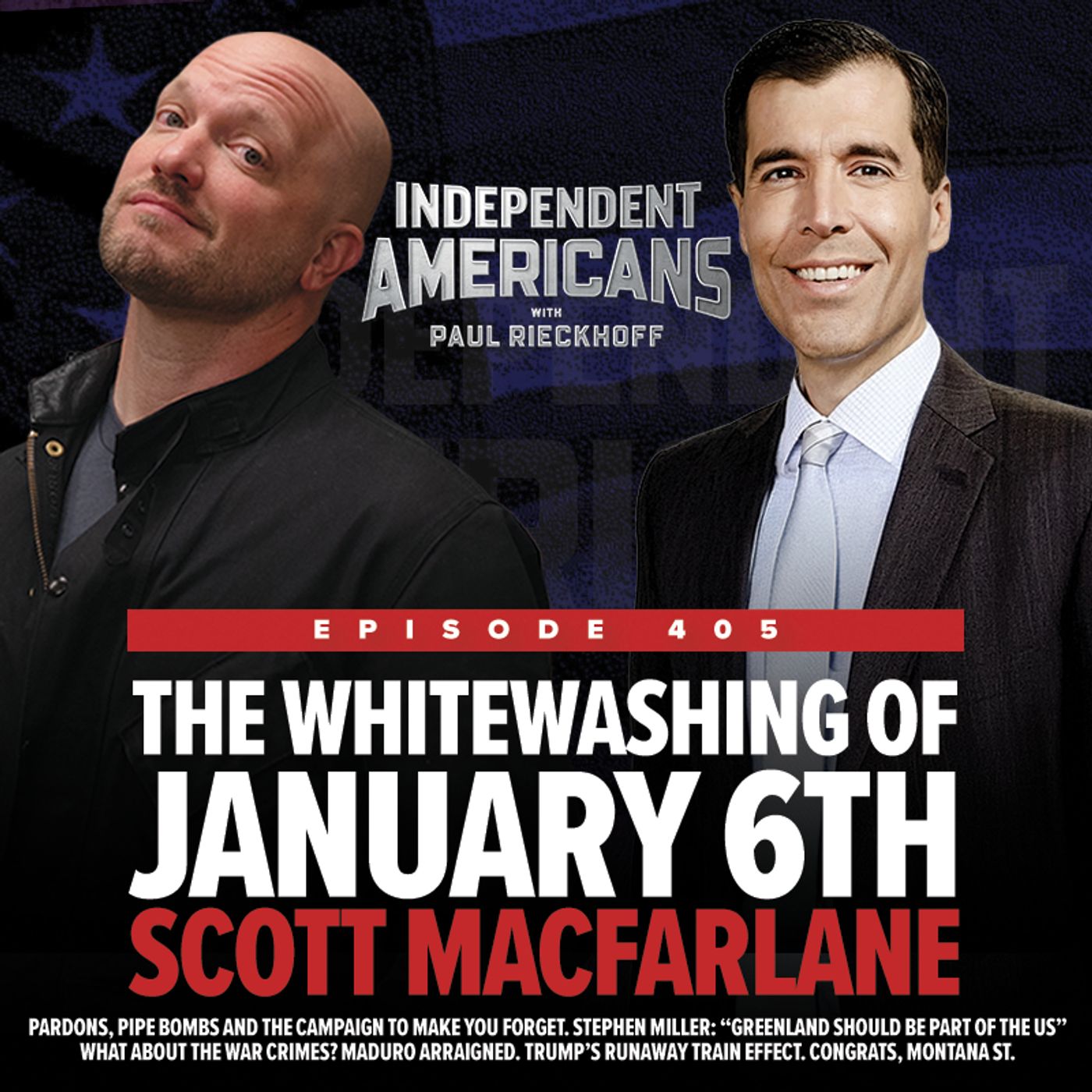
Loading summary
Transcript36 lines
- [00:01]
Grainger Narrator
This is the story of the 1. As the purchasing manager at a manufacturing plant, she knows the only thing more important than having the right safety gear is having it there when you need it. That's why she partners with Grainger for auto reordering, so her team members can count on her to have cut resistant gloves on hand and each shift can run safely and efficiently. Call 1-800-GRAINGER click granger.com or just stop by Grainger for the ones who get it done.
- [00:30]
Scott McFarlane
One of the police officers who was injured said, five years ago, I thought there'd never be a day where somebody denied this happened because we all watched it happen on television. Yet here we are. So that January 6, which was immediately denounced far and wide, has become something no longer denounced far and wide. That's unexpected and maybe that's without precedent or without historical connection.
- [00:58]
Paul Rykoff
Foreign. Welcome to Independent Americans. Welcome to episode 405. I'm your host, Paul Rykoff. It is Tuesday, January 6th. January 6th. I used to love January 6th because it was my grandfather's birthday. My grandfather who immigrated here without being able to speak English and served for three years in the South Pacific and was my hero growing up. But Trump and his insurrection fucked all that up. And so now and forever, January 6th will be January 6th. And that's what today is. And I'm coming to you from New York City, usa, where the weather is dark and gloomy like it was on January 6th. We're gonna try to warm it up, we're gonna try to lighten it up with some critical independent information with the perfect guest coming up, Scott McFarlane. Scott McFarlane is back on the show. He's gonna come to us from Capitol Hill and he is the best reporter on January 6th there is. He's the justice correspondent for CBS. And if you listen to this show, you know how I feel about the recent changes at cbs. And he's so good that I'm having him on. Anyway, he's done 20 years of reporting in Washington. He's won 20 Emmys and Edward R. Murrow Awards. His reporting has led directly to the passage of five state laws in Virginia, Maryland and D.C. to protect kids in public schools. And he's secured the Anna Quindlen Award for excellence in journalism from the Child Welfare League of America. He's a guy who has America's back and, and he's coming up in just a second with a really great and quick conversation about what you need to know on this important day. But first, on this important day, on January 6, there is a ton happening. Trump, of course, is still trying to take over the Western Hemisphere. That is the lead story, and I think will be until further notice. I've been saying it for months, and now everybody finally understands that the most important story in the world is that Donald Trump can do anything he wants with the most powerful military the world has ever seen, and nothing is stopping him. But some folks are sort of trying. So there may be a War Powers act vote again in the Senate this week. Senator Tim Kaine, Democrat from Virginia, continues to push forward a war powers resolution that might get a vote on Thursday. Kaine is saying he won't stop with Venezuela, as lawmakers are now taking Trump's threats seriously. On other nations that we've talked about here, Cuba could be next. Colombia could be next. Greenland could be next. But I'm going to underscore, even if they pass a War Powers act, that might not stop Trump either, because he is all gas, no brakes, as I've continued to say on this show for months. And I want to underscore something else, because Trump is going so fast that people are forgotten what he hit most recently. He's like a runaway train, and they're trying to stop the train, and they can't even stop to clean up what the train is crushed. So whatever happened to the allegations of war crimes? A couple weeks ago, the world was awash in discussions about whether or not the American boat strikes were war crimes. Whatever happened to that? Can Congress not walk and chew gum at the same time? Have they all just completely abdicated their responsibility? And also to my friends in the media, whether it's conventional media or independent media, what about the fucking war crimes? We can't just blow past that because they're doing new crazy things. Did Trump and Hegseth just effectively run out the clock like they did on Signalgate? Because remember that we had a very comprehensive internal report from the Pentagon that chastised Pete Hegseth for using Signal to disclose confidential information. So the same guy who put out classified information on Signal Gate just organized a strike on Venezuela and might organize a strike on Cuba and Colombia. And can we really trust him not to be talking about it on Signal? I want to underscore an important point that I've talked about, I think for months. Going to war is not just about the countries we hit. It's about the American men and women we put in jeopardy. Even if you have an incredible operation like we saw in Caracas, American troops still could get killed and American troops do get hurt. We still have no information from the Pentagon about how many troops were wounded in that operation, how severely or. Or even who they are. So here's a question. How shitty is Congress that they keep just letting all this go? I'm going to stay on top of it. I'm going to continue to have folks on this show. I'm going to continue to ask hard questions, and so should you, not just on Venezuela, but all of it. Because it looks like maybe they've stopped hitting drug boats now. I don't know. Now they've moved on to seizing oil tankers. That might be what we have to track on. But there's still been, as of December 22nd or so, at least 100 people killed and almost 30 strikes. And don't forget, they have not released the September 2nd boat strike video or the videos on all the strikes. And Congress is still failing to keep up with this flood of information and attacks and a blizzard from Trump. So this is still not supported by the American people. This is still not authorized by Congress, and it is still happening. And I don't think it's easy to get distracted by everything else anymore. I think people have finally understood that this is the thing. And it was underscored yesterday by an interview with Stephen Miller, who was on with Jake Tapper. Stephen Miller is a top aide to Trump who said that basically Greenland belongs to the United States. That's what he said overtly. And the Trump administration could just take it from Denmark anytime they wanted. Chris, please play this infuriating clip.
- [06:55]
Stephen Miller
Say that military action against Greenland is off the table. It would be military action against Greenland. The. The Greenland has a population of 30,000 people. Jake, the real question is by what right does Denmark assert control over Greenland? What is the basis of their territorial claim? What is their basis of having Greenland as a colony of Denmark? The United States is the power of NATO for the United States to secure the Arctic region to protect and defend NATO and NATO interests, obviously, Greenland should be part of the United States. And so that's a conversation that we're going to have as a country. That's a process we're going to have as a community of nations.
- [07:33]
Paul Rykoff
So you can't take it off the table that the US Would use military force to seize Greenland. You can't take it off the table.
- [07:39]
Stephen Miller
I can't. Jake, I understand you're trying very hard to. Which again, is your job.
- [07:45]
Paul Rykoff
I respect it.
- [07:45]
Stephen Miller
It's great to get exactly the headline right. That catchy headline, trying to get an answer that says, that says Miller refuses to rule out the United States should have Greenland as part of the United States. There's no need to even think or talk about this in the context that you're asking of a military operation. Nobody's going to fight the United States militarily over the future of Greenland.
- [08:10]
Paul Rykoff
So I don't know what Stephen Miller was like growing up, but I can't imagine he was popular. He's just got an obnoxious tone about him and an aggressive nature that I've never seen from a government official. I mean, he makes Donald Rumsfeld seem humble. This guy is so radical and so aggressive in the way he speaks about American foreign policy and American power and the American military. I've never seen anything like it. And he is just the most detestable dude that I've seen stand in front of the White House and claim to speak for America. So what? I've warned you that Venezuela is not the end and that they telegraph their punches. The punches are usually telegraphed most consistently, most clearly by Stephen Miller. He says it. His wife tweeted a photo of Greenland covered in the American flag. That is not just a joke. That is a prediction of what they want to do. Steve Bannon does the same thing. They tell you what they're going to do and then Trump does it. So when he says they want to take Greenland, have no doubt they might try to do it by the weekend. And we have to especially stay vigilant. Now, one other thing. I don't think I'm going to have Stephen Miller on my show. I don't know if I want to invite him on my show. What do you think? Do you platform a guy like that and amplify his voice by having him on a show like Jake Tapper did? I don't want more people to hear from this guy because he is so radical and so extreme and in my view, has no place in government and definitely not in the proximity of the President. When the President gave his update on Venezuela this weekend, the Secretary of Defense was standing next to him. The Chairman of the Joint Chiefs is standing next to him, and Stephen Miller was standing next to him. And I don't want to give him any more airspace to than he's already got. I mean, Laura Loomer could be next. Maybe at the next press conference, radical conspiracy theorist and hate monger, Laura Loomer will be standing next to Trump too. That is the world we're living in, and I am going to try to stay on top of it. I will try to bring light to contrast to heat. And I'LL try to help us all stay vigilant. All right. Staying vigilant also means tracking on other parts of the world and not getting so navel gazing in our own stuff that we forget that there's still a full scale invasion of Ukraine by Russia. Today is day 1413 of Russia's full scale invasion of Ukraine. And we're going to continue to stay on top of it. On Thursday, we've got the great Tim Mack, American veteran reporter, who is going to join us exclusively on Thursday to talk about the latest from Ukraine. And I want to underscore something else that I think gets forgotten. The Russians continue to attack civilian targets inside of Ukraine every single day. Zelensky posted something last night that the Russian army hit another hospital in Kyiv with a highly functioning inpatient unit. Patients had to be evacuated. There are casualties. One person has been killed. And he said, of course Ukrainians will restore the hospital. This is the kind of people we are. Ukrainians rebuild what has been destroyed, but Russians continue to hit civilian apartment buildings. Putin continues to hit hospitals indiscriminately. This is why the allegations of war crimes should stick. Representative Don Bacon, the intrepid Republican who I wish was an independent from Nebraska, tweeted yesterday that Russia has conducted over 2,000 attacks on Ukrainian hospitals and medical facilities. War crimes. That's what Don Bacon wrote. I think he's right. And we have to keep our eye on this ball. We have to continue to support Ukraine. And I hope Representative Don Bacon will rejoin us on the show soon. All right, shifting into politics, Hegseth is of course still coming after Senator Mark Kelly from Arizona, who I actually ran into last night in the green room at Ms. Now and Times Square before we both went on Rachel Maddow show. Mark Kelly continues to push back and I think very creatively with regard to his media appearances. He was on the Daily Show. He's been on the morning shows. He appeared alongside his heroic wife, Gabby Giffords, and he's punching. And the speculation about Mark Kelly running for president I think should be valid. I don't know if he's going to or not, but I hope that he will. If you go back to last year, I recommended that Kamala Harris choose Senator Mark Kelly as her running mate if she wanted to appeal to independent Americans, because I know the kind of guy Mark Kelly is. I've seen it and I think we're all seeing it now. So we're going to continue to track on this and I know Mark Kelly will come back on this show. I also hope his brother, Scott Kelly, will come back on this show. He is another true American hero who's been a bit quiet lately. I know he wants to let his brother go out in front, but if you want to go deep and be impressed about America, read the bios of not just Mark Kelly, but also his twin brother, Scott Kelly. They represent the best of what we're all about. Now, speaking of some of the best that has been under attack, the Corporation for Public Broadcasting has been dissolved officially yesterday, ending 58 years as the primary funder for PBS, NPR, and local TV and radio stations. And I just want to say that it's terrible. And this is another part of Trump's total assault on the American government, on American culture, and on American media. This is another win for Trump. This is how he is consolidating his power by removing arguably some of the most effective, trusted, important free information and news across NPR and PBS stations all across the country. If you're like me, I didn't grow up with cable. We didn't have the money for cable, and we depended on PBS for information and for news. And when I finally found NPR as a young man, I was hooked because I just learned so much, and it's a terrible loss for America. That reminds us all why we need to continue to support independent media like this. And I would tell you also support your local NPR stations because they are more important now than ever. Now, while they're defunding the Corporation for Public Broadcasting, it looks like there might be a government shutdown at the end of this month that's looming over Congress again in all their dysfunction. There's a possibility that we actually could shut down the government again at the end of January. So keep an eye on that. Also related to January 6th and legislation at the local level, there is new legislation being introduced by Senator John Lew in New York State. Here he is a Queens Democrat who's introduced a bill that would educate New York school kids about January 6th. He wrote that in state education law, we try not to prescribe what curriculum or syllabus has to be, but there are small number of events that have such historical importance that we feel it's necessary to ensure that all public school kids in New York are taught about these events. I think he's absolutely right. And I've said before there is no formal curriculum, at least in New York City for 9, 11 either. So I would support this legislation to educate our children in New York and nationally about the importance of January 6th. And for the states and cities that don't have it also September 11th. Because on both of those days, part of never forgetting is ensuring that our kids understand the truth of what happened. Because already, only five years later, January 6th is being whitewashed. We'll talk to Scott McFarlane about that in a second. In the world of independent candidates, I want to give a shout out to our friend Ty Pinkins, who's running for Senate in the state of Mississippi, an inspiring guy who's been on the show and will be back soon to show you how inspiring he is on January 6th. Sorry, January 1st he posted something that I want to share with you. He said, Today, January 1st, I laced up for my annual 1 mile New Year's Day run. For nearly two decades, I've started the year this way in places like Junction City, Kansas, Friedberg, Giston and Weissbaden, Germany, Tikrit in Baghdad, Iraq, Okinawa, Japan, Bowie, Maryland, Rolling Fork, Pittsburgh, Mississippi and so many others. Different roads, different seasons of life, but the same tradition. 11 mile to set my mind, reset my spirit and move forward with purpose. Today that mile was in Odessa, Texas and he said, if you're starting something new this year, I'm with you. If you're rebuilding, I'm with you. If you're trying to make it to the next mile, keep going. And he said, I'm claiming next year, January 1, 2027, I'm going to do the same New Year's run for one mile in Washington, D.C. as the incoming United States Senator for the great state of Mississippi. One mile at a time, all the way there. And he said, join me in this journey. Volunteer, donate and learn more@ty pickens.com I'll link to it in the show. Notes Ty Pickens is putting up a good fight folks. He is the kind of independent veteran that I want to support. That we should support. It's why we created Independent Veterans of America. So if you're new to the show, especially after some of our recent media.
- [17:12]
Grainger Narrator
Hits, check this is the story of the 1. As the purchasing manager at a manufacturing plant, she knows the only thing more important than having the right safety gear is having it there when you need it. That's why she partners with Grainger for auto reordering, so her team members can count on her to have cut resistant gloves on hand and each shift can run safely and efficiently. Call 1-800-GRAINGER clickgrainger.com or just stop by Ranger for the ones who get it done.
- [17:44]
Paul Rykoff
Independentveteransofamerica.org we are looking for and supporting leaders like Ty Pickens all Right. Rounding out the bend here, going over to culture, here's a little bit of inspiring news. The X Men are officially back in live action, and we're going to need the X Men right now to save the world. The third teaser for Avengers Doomsday has been playing in front of Avatar, Fire and Ash, which I haven't seen yet, but I want to. And it's been released online.
- [18:09]
Scott McFarlane
And.
- [18:09]
Paul Rykoff
And it marks the return of X Men characters Professor Xavier with Patrick Stewart, Magneto with Ian McClellan and Cyclops James Marsden. The teaser reunites Professor Xavier and Magneto and shows Cyclops blasting a huge I beam. We're going to need those guys and gals in the next couple years to defend America from all that's going on. But watch this space. I grew up a huge X Men fan, and if you need another little bit of inspiration, watch. Watch the X Men. All right. Finally, in sports, the opposite of inspiration. My Knicks got clobbered last night, losing four in a row to the Pit. Now to the Pistons. And maybe a bit of inspiration, or hope, at least, for those who fell to the bottom of the barrel. The NFL draft order is now set. Here's the order of the top 10 picks. The Raiders, the Jets, Arizona Cardinals, Titans, New York Giants. My Giants are at five, where I think we honestly need a really stud offensive lineman. The Browns, the Commanders, the Saints, the Chiefs, and the Bengals. Looks like quarterback Fernando Mandoza from Indiana or Dante Moore of Oregon will go one and two at quarterback. And they're both going to be playing this weekend, squaring off against each other in what will be an electrifying game. I'm sure if I'm picking number one, I'm taking Mendoza. I think Dante Moore could be great, but I think Mendoza can handle the pressure and is a really special kind of leader. So if you haven't seen these two young men, check them out, because it's bigger than football. Speaking of why, football is bigger than just football, last night was an incredible game. If you're like me, you were covering Trump's new war and you probably missed it. But Montana State won their first FCS title in 41 years, winning 35 to 34 over Illinois State in a thriller in overtime. And it was really good. Now, with all of Trump and hag said bullshit yesterday, I missed this. But what a game. And I just want to say America is screwed up in so many ways, but we've still got football more than maybe anything else in this country. We share in the spirit, the awesomeness, and the community of football. It's one of the few shared experiences we still have in this country. From peewee flag to the super bowl, there's nothing else like it. And I want to continue to highlight those touch points because we need them, especially the unity in the community. There's nothing else like football, and there was Nothing else like January 6th. Sadly, that's why today is especially a day to stay vigilant. Okay, folks, on this very important day, we have the absolutely perfect guest to Discuss all things January 6th, a man who's been at the forefront of it ever since. I think the most trusted reporter on these issues. And on the importance of this day, a somber, important, reflective day. The great and powerful Scott McFarlane is back on Independent Americans. Welcome back, sir. Thanks for being here, especially today. I know you got a lot going on.
- [21:01]
Scott McFarlane
This is a real nice treat, Paul. I'm glad you asked.
- [21:04]
Paul Rykoff
So this is a really important day to ask this. Where are you, Scott? I ask everybody this. Where are you and how are you on this day, man?
- [21:11]
Scott McFarlane
This is the Cannon House Office Building and all this space is available to me because let me total up what's going to happen here officially at the Capitol to mark five years. Nothing. There is no official memorial for the fallen and injured officers in the Capitol Rotunda as we saw in previous years. There'll be no formal ceremony or set of remarks from leadership on the House floor or Senate floor. The Republican leadership in Congress is not acknowledging the five year mark of January 6th. This is how many statements I've received from members of the Republican leadership or the Republican conference noting that today is January 6th. So what we have left, Paul, is a bunch of informal things that don't happen in the official spaces. First of all, House Democrats midday have this. They call it a hearing. It's not officially a hearing because they're the minority party. We'll call it a public meeting where they took testimony from some of the victims and the witnesses of January 6, including the members of Congress who were hiding beneath their chairs as the riotous mob was approaching and attempting to kill. We also have some of the convicted rioters retracing their steps from the White House ellipse to the west front of the Capitol, the same path a lot of them took on January 6, 2021. They've insisted this is a peaceful protest to memorialize Ashley Babbitt, the member of the mob who was shot as she breached the House Speaker's lobby and went through that broken window. It's a provocative thing, though, for them to do And I think they know that. I think they know they're catching attention by being here five years to the day where last time they were here, some of them assaulted police officers, or at least some of their fellow members of the mob assaulted police officers. And then at 5:00 clock tonight, a staged, you know, on the Senate steps, Democrats only memorial or set of remarks to communicate that this is an important day in America. But I think this is what it looks like when you whitewash something, when you have only one party participating, when you have another party not acknowledging the day, though the goal may not be to whitewash, it enables a whitewashing of history. And I think, Paul, talking to a lot of the police responders, they're in my circle professionally now. This is a re traumatization for the victims of January 6th.
- [23:23]
Paul Rykoff
Can we dig down into that, Scott? Because I've got friends who are Capitol Hill cops, especially when I worked on the Hill. I had a lot of relationships there. I know these guys and gals and they're professional and they're awesome and they're forgotten today. Are the Capitol Hill police doing anything formally as an individual unit today to recognize this and to recognize their brothers and sisters who've been impacted?
- [23:47]
Scott McFarlane
Nothing public, nothing for the public to see. The Capitol officers I talked to are certainly aware of the day and talking to each other about it. A lot of them still carry a lot of baggage from January 6th. It's hard, it's a heavy day, it's tense. And I can't get over the symmetry between today and five years ago. Same exact weather outside. Really cold, gray and dank. You can see it in your mind's eye from Those images of January 6, 2021 looks exactly the same outside. And then there's the driving force of this is a denialism of fact, a denialism of reality. And on January 6, 2021, you had denialism about the rightful outcome of an election. Today you have a denialism that an insurrection took place. And so it's still like this tinderbox that could spark. There was never gonna be a concern of unrest here today. But the political toxicity sparks and makes life a lot more difficult in Washington than it already is.
- [24:47]
Paul Rykoff
So let me ask you, why is there not a concern of unrest today? I mean, this is like I'm trying to emotionally connect with what this must be like for these cops. I mean, I'm a 911 first responder. This would be like Al Qaeda doing a parade around lower Manhattan on 9 11. I mean, which is the opposite of this 911 has become basically a national holiday, but not exactly a national holiday. Is there a precedent? You're such a great reporter. You've been so on top. Is there a precedent in American history for erasing something like this, for whitewashing something like.
- [25:18]
Scott McFarlane
Not in our lifetimes, not in our generation. I mean, there's accusations that, you know, politically one side always tries to emphasize an issue and downplay another. That's the nature of politics. And it's very common, Paul, to see one party acknowledge a set of facts and the other party downplay those set of facts. We see that every day. It just seems crazy that January 6th became one of those political issues because we all watched it with our own eyes on television. One of the police officers who was injured said five years ago, I thought there'd never be a day where somebody denied this happened because we all watched it happen on television. And yet here we are. So that January 6, which was immediately denounced far and wide, has become something no longer denounced far and wide. That's unexpected, and maybe that's without precedent or without historical connection.
- [26:16]
Paul Rykoff
Justin so this is obviously our top topic today. Let me ask you, if you can, you were with us a couple of weeks ago to give us an update. Give us another one, please, on this anniversary of January 6th, where are we in regards to the people that were arrested, that were pardoned, that were at large, and the bomber in particular, who has now been in custody at least for a couple of weeks or a couple months now, As a reminder, more.
- [26:39]
Scott McFarlane
Than 1500 people were pardoned all at once. Mass clemency, which freed many January 6th rioters from prison from long prison terms in some cases, or which just cleared the records of other January 6th rioters, or what's forgotten by so many people, including the rhetoric of the president, is that they also pardoned people who hadn't gone to trial yet. They also pardoned people who hadn't been arrested yet. They pardoned people who had not yet faced a jury of their peers. They're absolved restitution payments to pay to fix the damage in the cleanup. Absolved. Restitution has been stopped. Some rioters who paid restitution have successfully asked for their money back from the taxpayer. The pipe bomb case, which at this point still in a separate lane, is new. They just arrested a Virginia man who is charged with placing those pipe bombs outside the RNC and dnc. The latest update we've gotten since we last talked, the Department of Justice says the evidence they have so far separate from January 6th we'll see how that plays out as that case progresses. The defendant hasn't even entered his plea yet. Um, and that's a long way till trial. But fundamentally, the pardons have galvanized some, some of the riot defendants to become outward activists. Some of them are coming back here today to make an argument. Some of them want reparations. They want taxpayers to reimburse them for the cost of their experiences. But more than anything, American politics feels as divided and viscerally palpable as it did the day of the riot. And that's something we should all be mindful of.
- [28:19]
Paul Rykoff
Only today would this be below the radar. But let's go to a different issue that is now front and center for everyone. You're the justice lead at cbs. You cover all of these issues. Moderno is in New York. He drove past my house yesterday on his way to the courthouse. Your thoughts and reactions to what's been a whirlwind 48 hours or 72 hours of Maduro being captured, brought to the US and now I think he's actually back in that cell in Brooklyn. Your thoughts, reactions, and maybe predictions for what you anticipate will happen next.
- [28:50]
Scott McFarlane
It's like eight different issues and stories there and eight different pressing concerns, if not emergencies. Because of this, I can only speak with confidence about the criminal case because that's my lane. I could tell you think about that bad rush hour traffic where you just can't get anywhere. You keep changing lanes but you don't move forward. That's the federal criminal justice system. It moves at that pace. This is a many months, if not years long endeavor that has just begun. A criminal prosecution, a one time foreign leader, expect slowness to be the default. They didn't even set a placeholder trial date. They didn't even set a motion schedule at his initial appearance. That's unorthodox. This thing's gonna move slow, so get comfortable to watch the criminal proceedings. There'll be no quick answers or quick resolution.
- [29:38]
Paul Rykoff
I gotta let you go in a couple minutes, but let me ask you a related question. I'm a security guy, right? I'm an infantry officer. I've worked private security. I was shocked by how exposed he was when they were moving him from site to site. Right? No helmet, right? No, no helmet. Like maybe I'm assuming he had body armor under the car, hard jacket. But they're moving him out in the open in a way that I'm sure there are snipers that we don't see. I'm sure there are Security assets around. But it felt like the show, which is what some people want. They want this giant perp walk where you can see that it's him is potentially compromising the security of other people in my city, Right. This is literally a mile from my kid's school. It's a very dense residential commercial district. Did it surprise you that they just herp walked him in and out? And they continue to do this right out in the open?
- [30:23]
Scott McFarlane
In New York City, different courts have different protocols. The federal court in Manhattan, they operate different than the federal court in Greenbelt, Maryland, or the federal court in Charlotte or Seattle. I can think of a couple different cases I covered where the defendant was uniquely high profile and that defendant was brought in through an underground secure location, out of sight, completely to the public. James Comey in Virginia a few months ago, Donald Trump here in Washington, D.C. when he was charged for January 6th and the attempts to overturn an election. There are ways to bring defendants underground into courthouses, but I can't speak to the Southern District of New York can say with confidence that if you bring somebody in underground out of the view of photos, you don't get a photo op. Not to say that was the motivation here, but in this case, they certainly got a photo op.
- [31:12]
Paul Rykoff
Something good.
- [31:13]
Scott McFarlane
Yeah.
- [31:14]
Paul Rykoff
All right, man. I gotta let you go in a minute, but especially today, I think we need something good. And I'll start and I'll throw it to you. I know you might want to talk about your eagles, but maybe it'll be bigger than that today. And so I'd love an opportunity not to talk about the eagles, but for me, today's something good are all the patriotic men and women that stood up on January 6th. It may be forgotten in Congress, but I'm not going to forget it. The men and women who stood the line, who took bear spray, who got hit with poles, I think it was like combat. I've been in combat, and much of the combat I've been in wasn't as intense as that. And I think especially today, we need to celebrate the heroism, the bravery and the sacrifice of those men and women on January 6th. I think they were something good. I think they were something great. I hope that future administrations will memorialize them as they should be, because they were an example to our children and into the future that I think should always be remembered and is definitely something good. Scott, over to you. What do you got? What's something good?
- [32:06]
Scott McFarlane
Hell, yes. Let me endorse that. First of all, how about the unspoken people who did something Similar the congressional staffers who barricaded themselves behind doors beneath tables, who were whispering to each other, calling home, unsure they were going to get home ever again. They came back and started serving again too. They do so with anonymity to a degree to do so for a very humble salary in some cases. They came back on January 7 and January 8 after worry being worried for their lives too. A lot of them are still here. So shout out to the congressional staff of both parties who were hiding that day.
- [32:38]
Paul Rykoff
Scott McFarlane, you are an intrepid, fearless and just relentless reporter. You have a very, very sterling reputation among your peers and in this country for good reason. I just want to thank you as an American for staying on top of this. I know you know CBS has gotten a lot of shit lately and there's been a lot of changes over there. But I hope folks will continue to follow you and understand that you are out in front and always have been. So many late nights and early mornings when folks have forgotten about this. You're covering this especially. So I want to salute you and thank you for your patriotism. I think you're a testament to what good journalism in this country and vigilance is all about. So thank you, my friend, for all you do.
- [33:14]
Scott McFarlane
Especially dulls me one more second. Also thanks to you and the subset of people, you know who they are who talk about this when it's not just January 6th. Talk about this all year because this is still a pressing emergent national issue. The issue of January 6th. And we should talk about a 365 like you do.
- [33:30]
Paul Rykoff
We'll do it on this show. I hope you come back. Thank you for all you're doing, especially today. I hope your Eagles get knocked out in the first round. My buddy.
- [33:36]
Scott McFarlane
Thank you, Paul. I can talk to you, bro.
- [33:40]
Paul Rykoff
All right, folks, that's the great Scott McFarland. Be sure to follow him on Blue Sky. I'm going to encourage folks to go to Blue Sky. I'm over there. I think Blue sky has been the best alternative to Twitter since Twitter died and came back in the zombie form. That is X. But follow Scott McFarlane. He is the best, especially on issues of January 6th, and he will be critical as the Maduro trial unfolds. He's also just a really great guy and I want to encourage folks to support him and his important work. We are daily now. If you haven't heard, this show is daily. So follow us on Independent Americans us. Check us out on Apple, on Spotify and of course on YouTube. Hit that subscribe button. Right now we're hitting a new level on YouTube and a lot of folks are finding us in TikTok and other places. So please spread the word. We're going to continue to bring this kind of independent content to the masses and to America and beyond. You can also go to Independent Americans us to get Independent Americans merch and join our Patreon community. I am continuing to also do lots of TV and traditional media. Last night I rejoined my old friend, the brilliant Rachel Maddow for a really, really important conversation. She took us in the way, way back machine and told some of my story and how I got to this point in bringing you independent Americans and iva. But Rachel gets it. She's always gotten it. If you haven't read her book Drift, I highly recommended it because she and I have been talking about these issues of the expansion of American military power for years and now Trump is leaning into it hard and I hope I get to join her again soon. I hope she joins me back on this show. She's brilliant, she's fantastic and she's also, if you don't know, a giant football fan. And her Patriots are looking good and my Giants are looking bad. So I'm sure I'm going to hear about it. I also did a late one last night with Laura Coates. My thank you to Laura and the CNN team. Later today I will be back on Ms. Now with Chris Jansing. And tomorrow I'll have my weekly regular segments on News Nation with Connell McShane in the 3 o' clock hour and likely in the 4 to 6 hour with Nicole Wallace again on Ms. Now. And I'm doing Aaron Burnett show on CNN a lot more often. I might be there tomorrow or later in the week and I also want to do something else. I want to get back to shouting out and thanking some of our most dedicated listeners and watchers. And today I want to thank Beth Philly, who is a mom of three boys, two cats and two dogs and five cats. She's an author. She said look her up on Amazon. She's a retired trainer and wrote Kindness Equals Life. Last night she tweeted, need a good scare? Listen to Paul Rykoff talk about how Trump wants to take over the Western Hemisphere and to date no one has made any attempts to stop him. And then she linked to the show. Thanks for that Beth. Thank you for listening or watching and maybe good scare is the new good trouble, but hang in there Beth, and thanks for listening. We're all in this together and I hope you and Everyone can stay vigilant. We got a big week ahead and it's not even the first full week of the year. We are all trying to stay vigilant. And I will bring you more guests, I will bring you more commentary, I will bring you more analysis, and I'll try to keep you focused on not just what's happening now, but what's happening next. If you're new here, welcome. Because at Independent Americans, we're trying to bring people together. We're trying to bring light to contrast the heat of all the other political news and culture shows. And especially if you're part of that 50% of Americans who are independent. This is your show. If you're independent, curious. This is your show. If you just want to stay on top of of news, national security, culture and a little bit of sports, this is your show. Because our independent movement, and that's what this is, it is a movement, is hope for the future. Country over party, people over politics, light over heat, challenging that status quo and bringing people together in a way that is really, really necessary right now because we're trying to bring hope. That is the oxygen of democracy. I hope you enjoyed this episode with Scott McFarlane. If you did, please share it far and wide. Be sure to hit that subscribe button and share it with just five friends and invite them to declare their independence. And stay vigilant, my friends, because eternal vigilance is the price of freedom. And no, you're not alone in your vigilance. We're all vigilant and we're all in this together, especially on January 6th. It's an important time to remember all those men and women who were so vigilant on this day. Men pretty much saved our democracy. So I salute all of them and I thank them, especially today, at least on this show and in my community. You will never be forgotten. Your sacrifice will never be forgotten. And we will continue to amplify, respect and elevate you. Because that's what it's all about. We're all vigilant and we're all in this together. I'm your host, Paul Rykoff. Thank you for tuning in to Independent Americans. Happy Tuesday, Congratulations to Montana State. And until tomorrow, stay vigilant America. Powered by righteous media.
- [38:41]
Grainger Narrator
This is the story of the one as an H Vac technician. He and his digital multimeter are in high demand. So when a noisy office H Vac turns out to be a failing blower motor, he doesn't break a sweat with Grainger's easy to use website and product information, he selects the product he needs to keep everything humming right along. Call 1-800-GRAINGER clickranger.com or just stop by Grainger for the ones who get it done.