← Independent Americans with Paul Rieckhoff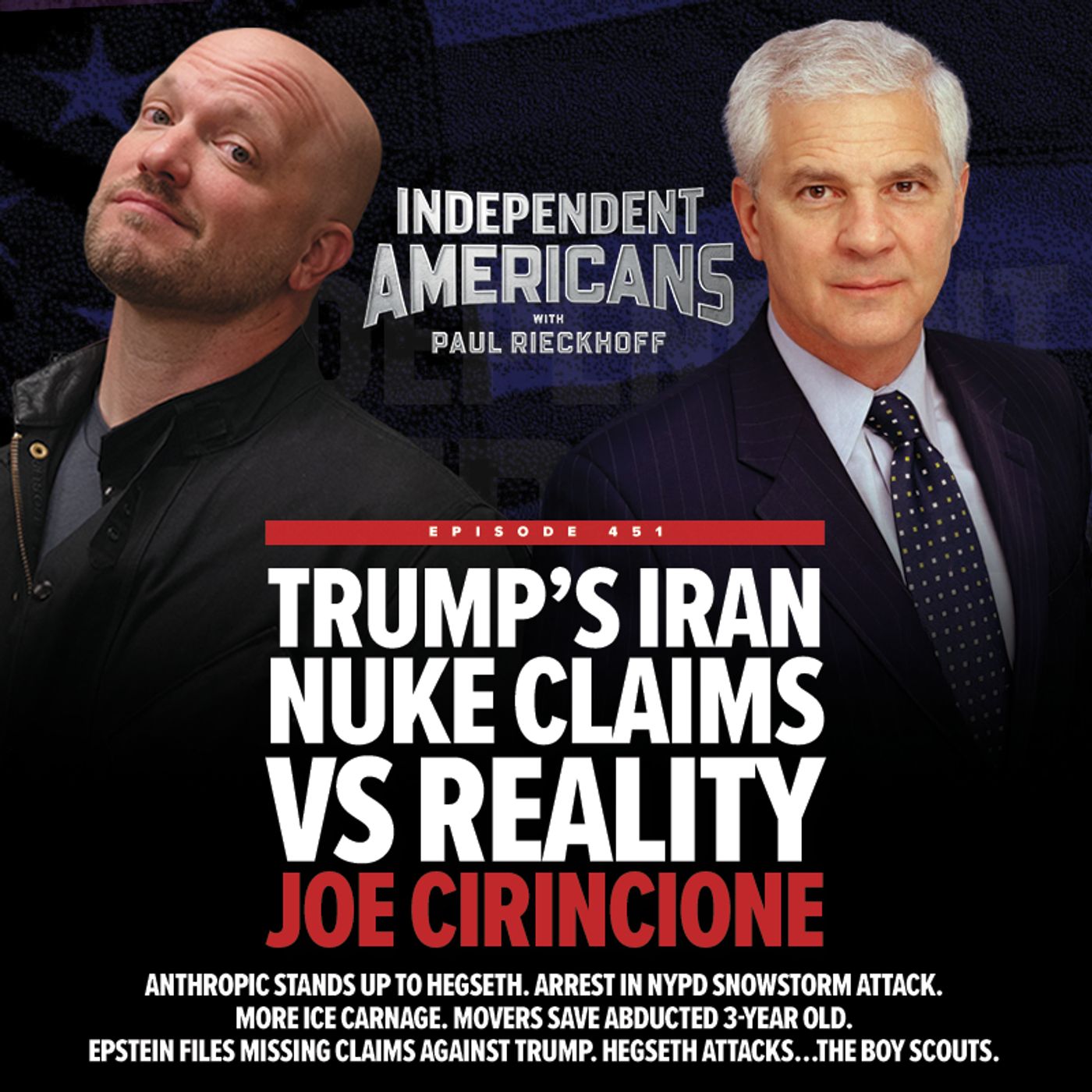
Independent Americans with Paul Rieckhoff
Trump’s Iran Nuke Claims vs Reality w/ Joe Cirincione.
01:05:47
Paul Rieckhoff delivers unfiltered analysis from Florida in this special episode — breaking down Trump's State of the Union, the looming threat of military action against Iran, America's shameful abstention on Ukraine at the UN, and what NYC's new mayor got dangerously wrong with the NYPD. No spin. Just the straight talk independent Americans deserve.
Loading summary
Transcript66 lines
- [00:00]
Ad Read Announcer
Did you know you can save up to 70% on the best brands just by shopping at from rebel.com we're talking about strollers, car seats, high chairs, espresso machines, cookware, everything you need for way less. Here's how it works. Every single day, Rebel drops thousands of new products on the site for up to 70% off. It is a constant stream of endless deals from top brands like Uppababy, Nuna, Baby bjorn, Breville, Nespresso, KitchenAid, Le Creuset and more. But you have to act fast because every deal is one of a kind. So if you see something you love, make sure you add to cart fast. So stop paying full price when you don't have to. Whether it's baby gear, kitchen upgrades or a treasure for your home you didn't know you needed, Rebel has it for way less. Up to 70% less. Shop from rebel.com and save big. If you're an H Vac technician and a call comes in, Grainger knows that you need a partner that helps you find the right product fast and hassle free. And you know that when the first problem of the day is a clanking blower motor, there's no need to break a sweat. With Grainger's easy to use website and product details, you're confident you'll soon have everything humming right along. Call 1-800-GRAINGER clickgrainger.com or just stop by Granger for the ones who get it done.
- [01:26]
Paul Rykoff
What is on the landscape that most Americans may not even be thinking about that they should be?
- [01:32]
Joe Saracione
96% of the nuclear weapons in the world are now controlled by authoritarians.
- [01:53]
Paul Rykoff
Welcome to independent Americans. Welcome to episode 451. 451. Fahrenheit. 451. The temperature that paper burns. But we're not burning any paper today. We're not burning any books. But we are going to burn through the news and policy and drama that you need to know about. I am your host Paul Rykoff and I am coming to you from New York City, usa. I am finally back home. It only took me four days, longer than I expected, but I am finally out of Florida. I am back in New York and the weather is not too bad. It's actually in the 50s and sunny and it is Friday, February 27th. It is an important Friday to get through a lot of stuff. And today's artist to help us get through this Friday is the great Ace Freely, founding member of kiss.
- [02:43]
Joe Saracione
Why?
- [02:43]
Paul Rykoff
Because I'm back. I'm back in a New York mood and if you're digging Ace Freely, you should check out, of course, all his classics, including Rip it out, which is another classic. Doesn't get nearly the attention that it should. We're going to rip out this show on a Friday and bring you the Five Eyes. I bring you in every episode. Independence, integrity, information, inspiration and impact. And our guest today is a classic like A's Freely. And he is going to bring it and more. He is the great Professor Nuke, Joe Saracione. If you've been listening or watching this show for a long time, you know Joe is, I think, the best guy in America on nukes. And with war potentially happening with Iran any minute now and nukes being discussed, we gotta talk to Joe. We're gonna talk about everything Iran. We're gonna talk about the intersection of AI and nukes and all kinds of other scary shit to bring you into your weekend, but stuff that you need to know about. But before we get to that, a lot of other things that you gotta know about and I gotta hit on because they're really about like half a dozen really important stories. It seems like they flood out on a Friday, and we got to get after them to help us all, even on a Friday. Stay vigilant. All right. The top topic, in my view, our national security is a fucking mess. And there is a lot happening, related and intersecting with our national security, a lot of which we're going to get into with the great Joe Saracione. But first off, there is an important fight happening at the Pentagon. If you're not aware, the Pentagon is into a fight with a. With a vendor called, called Anthropic. Anthropic does AI. And there is a debate and a fight around whether or not the Pentagon will take over Anthropic and whether or not Anthropic will say no. Anthropic might be the first technology company, major technology company, to not bend the knee to Trump and Hegseth and the Pentagon, they are a very influential, very innovative technology company at the forefront of AI. And basically yesterday, the Anthropic team said there have been. There's been virtually no progress on negotiations. And CEO Dario Amodi said he will not accept what defense officials have labeled as their final offer, set to expire on Friday today at 5:01. So we have no idea where this will develop over the weekend. But it looks like they are at an impasse. And somebody, one company is standing up against the Pentagon. They're standing up because they don't want to allow the Pentagon to use Their technology for mass surveillance of Americans. They also don't want to allow them to use their technology to remove humans from the decision making process around killing people. Basically, some want to create killer robots. We're going to talk more about this with Joe Seracione. You do not want to miss this. And AI is saying, I'm sorry, Anthropic is saying, no, you cannot use our AI. You must keep humans in the decision making process. Now there's this attack, very political attack happening between the Department of Defense and Anthropic. The news media is covering it. The DoD claim, as Jake Tapper said, this narrative is fake and being peddled by leftists in the media. The fact is, it's literally what Anthropic says are the issues, that they present novel risks to our fundamental liberties and that there is serious concerns with the use of AI. So do you want AI deciding who our Pentagon kills? Do you want AI surveilling Americans? If not, you should stand with Anthropics. So I'm gonna say on this Friday, especially good on you, Anthropic. It's refreshing to see someone standing up for what's right and the best interest of the American people because it's clearly not happening from the Pentagon. Political leadership and propagandists and more tech companies should follow your lead. America's freedom and national security may depend on it. Now, there's a lot of tangents to this, related tangents. And Jennifer Griffin, the great reporter at Fox News who often gets attacked by Hegseth, said on X that it's strange that the Pentagon Hegseth picked this fight with Anthropic, the AI company which its systems and war fighters currently rely on on the eve of a possible war in the Middle East. So we rely on this technology. At least some parts of our national security do. And Hegseth wants to dump them. Now, we saw what can happen if a technology company shuts the lights off. We've seen that with regard to the Russians fighting the Ukrainians as Elon Musk has shut off Starlink. So what is the national security risk if Anthropic just shuts it off? Hopefully we won't find out. But this is kind of a stupid fight in my view, for Hegseth to be dying on this mountain. But stupid is as stupid does. And stopping troops from going to Harvard as they've recently moved to do is definitely not going to help. All right, let's talk about other related stupid, crazy shit around our national security. The FAA banned flights on Thursday in an area around Fort Hancock, Texas, after lawmakers said a military laser based anti drone system was believed to have been used by the Pentagon to actually accidentally shoot down a Customs and Border Patrol drone. Yes, this is really also happening yesterday. So as angry staffer our friend posted on Blue sky, it sounds like the military accidentally shot down a Customs and Border Patrol drone in El Paso accidentally with a laser. How in the actual fuck. Yes, this is happening, folks. And they want to let AI run more robots. And to top it all off, on this Friday, where national security is at the forefront of everything, the Department of War has officially named a new enemy, the Boy Scouts. Yes, Acting Secretary of Culture War Pete Hegseth posted a video today saying that the Scouting America, that's what they're now called, is on notice. He is arguing that they should adopt their stance on gender and all kinds of other culture war. So the acting Secretary of Culture War continues to remain focused on culture war issues as real potential war with Iran looms. He's attacking the Boy Scouts now. He knows what he's there to do. I've said this before and he never loses focus on it. It is fighting the culture war on behalf of Trump to the detriment of our national security and our democracy. And none of it is acceptable and none of it is normal, but it is continuing to happen. And all these issues around our national security, especially on a Friday when they tend to dump a lot of it out, are another reason that you should stay vigilant. All right. Now, speaking of all of this, don't forget we could be at war with Iran any minute now. The drumbeats continue. Trump continues to have his surrogates out there pushing for war. And Reuters has reported that President Trump's claims that Iran will soon have a missile is not backed. Sorry. That Iran could soon have a missile that could hit the United States is not backed by U.S. intelligence reports and appears to be exaggerated according to three sources familiar with the intelligence reports. You don't say. What a surprise. We're going to get into that with Joe Saracione coming up. He's going to talk about all the arguments that that Trump is making about the threat of Iran and what you should know about them now. Also, the Senate is moving in their glacial pace as always. Tim Kaine, the Democrat says, said on the Senate floor that his and Rand Paul, the Republican from Kentucky's resolution to reject attacks on Iran will likely be before the body next week. Yes, next week. Congress will take this up. Now. That might be too late. It's something that should be accelerated and addressed now, don't you think? But remember, Congress leaves on Fridays and we wouldn't want to interrupt their weekend by asking them to do their damn job, especially when it comes to authorizing war. Trump continues to do whatever he wants with the military and throw the middle finger up to Congress in the rear view, just like he has on the eight other countries he's hit in the last year. This is not working, America. We need more from our Congress, we need more from the Senate, and we need more for any of you who have not yet voiced your opinions. So contact your senator, contact both of them and tell them, hey, you know what, you could work on a Friday and at least have a conversation about whether or not we blow up a whole new country. All right? Meanwhile, somewhat related to the region yesterday, you may have missed this because this has been below the radar. There's a lot that's been below the radar. But Pakistan's defense minister says his country has run out of patience and now considers that there is an open war with Afghanistan after both countries launched strikes following an Afghan cross border attack. So we'll get into this with Joe Sarancione as well. But it looks like Pakistan could be the latest country interested in getting into a quagmire in Afghanistan, following the US And Russia and thousands of others over the decades and millennias who've tried to take over Afghanistan and fail. But there is more war with another nuke powered country that we will talk about with Joe Saraciona and also below the radar because there is so much flying at us today. This is one of the most important stories that you need to know about. Pro Trump attorneys have circulated a draft executive order that claims without evidence, of course, that China interfered in the 2020 election to justify declaring a national emergency that would give the president expanded authority over voting. This is being reported by multiple news agencies today and it's very, very, very critical. Trump is looking for a reason to interfere with elections. He has been all along, and even more so now that his numbers have cratered. We talked about that in the show earlier this week. His numbers are falling off a cliff with all Americans and especially with independent Americans. He said outright that he doesn't want free and fair elections this fall. He's been telegraphing this punch for months and we should believe him. And if you think he's going to leave the elections alone this fall, you're delusional. Or you're one of the far too many Democrats who are already spiking the ball thinking they won this thing. But this is an area that we must continue to focus on. Whether or not he finds a reason to declare martial law, whether or not he finds a reason to invoke the Insurrection act, whether he finds a reason to try to intervene in the federal elections, they are all interconnected. They are all woven into our national security. And they are all reasons that you need to stay not just on top of what's happening now, but what could happen next. And you need to stay vigilant. All right, some good news. I want to pop good news when I can. US mortgage rates fell below 6% for the first time in years. I think this could be welcome news, especially for many working Americans, folks who are trying to afford a house, as well as homeowners that are trying to sell. Maybe this will spark some good news for people across the country and in places that have been hard hit. Some unsurprising news, Epstein files are missing records about a woman who made a claim against Trump. This should be absolutely unsurprising to everyone in America. The Epstein files continue to be front and center. Ro Khanna, who's been a guest on the show along with Tom Matzi, is leading the push on Epstein. I hope both of them will come back on the show. They are also, interestingly, leading a push in the house on Iran. So these guys are ones to watch. All right. Also unsurprising, ICE continues to run rampant across America. Every day, more bad shit. And you can't make up the nastiness and the dastardliness of what they continue to do. Almost every day there's shocking new information. And now there is video of a Border Patrol of Border Patrol abandoning Nurul Shah Alam, a Buffalo refugee who is blind. Okay, the man was blind. And Border Patrol claimed that they dropped him off at a Tim Horton shop. And they said it was open, but the doors were locked. They never notified any family or lawyers. And they just left him out there in the cold in the snow. And he was found dead days later. They left him out there, a blind man. They left him out there in the cold to die because this is what they do. Their culture is broken. There is no accountability. They are unlawful. They are unconstitutional. And apparently more news. They are coercing unaccompanied minors into voluntarily removal, lawyers have said. Attorneys represent some Guatemalan minors who were nearly deported last fall. According to abc, Customs and Border Patrol agents are attempting to return unaccompanied migrant children, including some protected by federal court order, to their home countries before they can meet with an attorney or appear before an immigration judge. Attorneys representing a group of Guatemala minors who were nearly deported over Labor Day weekend as a part of Trump's crackdown. Allegedly that the Trump administration is engaging in a practice that openly flouts the plain text of the court's injunction which blocks the government from removing minors. Last fall, a judge blocked the administration from deporting 76 unaccompanied Guatemalan kids as they sat on planes. Defendants allegedly are using misinformation, coercion, fear and threats to persuade the children to relinquish their rights and sign paperwork. This is some uniquely dastardly shit. They are absolutely not respecting the law and they continue to have a total disregard for the safety of kids. And there was another shameful, disgusting and perfectly on brand example from Newark, NJ.
- [16:12]
Joe Saracione
A pursuit by ICE agents in Newark ended in a multi car crash involving three children.
- [16:18]
Paul Rykoff
According to the mayor, ICE agents were attempting to pull over a van which
- [16:21]
Joe Saracione
which led to a car chase through the city.
- [16:23]
Paul Rykoff
The Mayor says.
- [16:24]
Joe Saracione
An eyewitness says the van appeared to
- [16:26]
Paul Rykoff
try and avoid a bus, crossed into
- [16:28]
Joe Saracione
oncoming traffic and hit two vehicles including an SUV carrying children.
- [16:32]
Paul Rykoff
The eyewitness says the ICE vehicle didn't hit any cars, but ICE agents were in an illegal high speed chase that caused a chain reaction crash involving three civilian cars sending multiple multiple people including three young siblings in a lift headed to school to the hospital as masked agents then jumped out and detained a driver and residents confronted the officers on the scene. They created a high speed chase and a crash that involved three kids because they are totally unlawful, they are totally unprofessional, they are totally unrestrained. And let's give props to Mayor Ras Baraka who issued a statement involving the car incident in New York, I mean sorry in Newark. The Mayor said the chase led to an incident in Clinton Avenue in 10th street involving several vehicles, one of which had three children as passengers, two 15 year olds and one 12 year old. The suspect sustained injuries and was taken to the hospital. Newark police were not notified in the investigation and only responded to the accident. This is the point you need to know about from the Mayor of Newark. He said. This is our city, these are our people and this behavior is in keeping with a rabid lawless pattern seen nationally. Somebody could have been killed in Newark today, but these agents have to adhere to local laws. Well done by the Mayor of Newark. Ras Baraka standing up for what we all can see is right. It's a good response from the Mayor to another shameful, ridiculous, unacceptable display from ice. ICE is unlawful, unconstitutional, unaccountable, should be defunded, and should be disbanded. We will continue to track this and we will continue, of course, to stay vigilant. All right, let's talk about a bad response from another mayor. I talked about it earlier in the week, what's now being called snowball gate in New York City. Well, if you haven't heard the Latest, this week, NYPD arrested Guzman Kubali, he is 27 years old, for assaulting officers in Washington Square park this week. Mr. Kubali was previously arrested less than three weeks ago for an attempted robbery in the transit system. And I think it's really, really important to note that Mayor Mamdani said it was just a snowball fight. This is not just a kid throwing snowballs. This was a kid who assaulted cops. Anybody who raises kids tells them not to throw ice and snowballs at cops. This is pretty basic, and it's good to see this guy under arrest. He has to be held accountable. And a message has to be sent to others about assaulting cops. This is different from ice, and you shouldn't assault ICE agents either. But we have to send a message and explain to our children that assaulting uniformed officers, and especially police officers who are local, is absolutely unacceptable. And we need the mayor to get the message that it wasn't a snowball fight, it was a mob. I blasted Mamdani on my show earlier this week and in other media for again failing the nypd. And anyone defending Mamdani's comment, I think specifically is blinded by political loyalty. This is not acceptable. And our mayor has to make that clear, especially to young people in this city who listen to him, young people who might confuse ICE and the NYPD and National Guard. And most importantly, emphasize peace if you're frustrated, even if you're screwing around in a snowstorm, do not throw ice or anything else at cops or any other civil servants. This is pretty basic. Related this week, yesterday, Mamdani again met with Trump and he posted that he had a productive meeting with President Trump and he's looking forward to building more housing in New York City. And they held up a fake newspaper headline. Trump is sitting down, smiling. Mamdani has his hands crossed, not smiling. And the headline is a fake headline that says, trump to City. Let's build. So Mamdani's in there with Trump, and they have this weird political agreement, it seems. And here's what's true. They're both benefiting from this relationship. Both of them who are very, very divisive, who are very Very polarizing, I would argue are politically extreme. The two of them are drafting off each other and they're both benefiting from it. And it steeps in kind of a very weird and I think potentially damaging kind of politics. Don't be dismayed that this is some kind of peace accord between warring factions. This is something different. This could be a very, very twisted way of two very extreme groups, the extreme left and the extreme right to be coming together. But most importantly, both of them want some shine and they seem to be getting shine off each other. So when it comes to Trump and I would argue, Mamdani, you should be suspicious.
- [21:11]
Ad Read Announcer
This year, perfect your morning routine with Nespresso Vertuo up with a three second start, easy open lever and dedicated coffee creations mode button. It's easier than ever to brew coffee with smooth flavor and rich crema over ice or milk. It's your coffee your way. At the click of a button. Sip for yourself and shop vertuo up@nespresso.com
- [21:33]
Paul Rykoff
come and you should definitely stay vigilant. All right, more politics. A couple quick things. Hillary Clinton had a deposition yesterday on the Epstein trials. This was important. It got a lot of coverage, especially from the right. The most important headline is she denied ever meeting Epstein or knowing anything about his crimes. And it was briefly disrupted after a Republican leaked a photo of the proceedings. But the Republicans have long tried to ensnare the that Clinton's up in this Epstein stuff. If there's information that comes out that does that, they should definitely be held accountable. But it looks like they didn't land any blows on Hillary Clinton. She walked right into it. And we can continue to move on to find out why the parts of the Epstein files that reference Trump are mysteriously missing. All right. All of it is pretty disgusting when it comes to Epstein. There's been very little accountability in this country, despite accountability in England and other places. And there are plenty of people carrying water for Trump and plenty of people just looking kind of gross. Nobody more so than our vice president who had a very interesting thing to say this week and I am definitely going to play this clip. Took special note of one thing that she said though. Kelly said that I'm the coolest vice president in American history. And I said, Kelly, that is a low standard. That is a very low bar. But I do think that I clearly that bar. But I, I think that was a, that was a low standard she set me to. But so Vance asks, am I in the. Am I the coolest VP in American history? I think I Clear that bar. He thinks he's the coolest VP in history. First of all, he's not cool. There's a lot of things he is, and cool is not one of them. He's very cringy. Like, uniquely cringy. And is he cooler than who, Dan Quayle? He's cooler than Al Gore. It is a pretty low bar. But even with that low bar, I do not think that J.D. vance will ever be named the coolest VP in American history. All right, let's talk about something that is the opposite of that. Something that I think is cool and is important. It looks like September 11th could become a public holiday. New York State could see another holiday soon, as a newly proposed state bill aims to officially designate September 11th as Remembrance Day, adding to New York's list of legal public holidays. That would mean schools, businesses, government offices would close on 911 to give new Yorkers more of a chance to pause, reflect, and honor victims and heroes of the 911 attack. I am a 911 first responder. I think this is actually very important. I've also talked about the need for a national and statewide curriculum to teach young people about 9 11. There is not a formal curriculum to teach them about the basic history of 9 11. I think that's important. And although, you know, I'd like to see them in school learning about 9 11, I think it is important. The same way Veterans Day and Memorial Day becomes a national day of reflection. And that will be true if it's a national holiday. So it's got my support. And if any of the sponsors want to come on this show and talk about it, we'd love to have them. We also remembered the 1993 anniversary of the attack on the World Trade center that happened this week. And I want to remind everybody to learn more about that and remember that folks were also wounded and killed during that attack. And it's something also that we should never forget. Never forget.
- [24:43]
Joe Saracione
Yeah, never, never, never, never forget.
- [24:53]
Paul Rykoff
All right. Finally, never forget that in politics, independents are not just moving the needle, we are the needle. And there's some good news from a guest on this show and someone I've asked you to keep an eye on. Todd Achilles, who's running as an independent in Idaho, has some really, really good news. Yesterday, he was joined by his wife and his dedic. They went to the Capitol steps and they turned in nearly double the required signatures to officially qualify for the ballot, along with his filing paperwork. So it's official. This November 2026, you can vote for Todd Achilles, independent veteran for U.S. senate. He says he's reclaiming Idaho's Senate seat from corporate interests and partisan games and returning it where it belongs. The government of the people, by the people, for the people. And he says, let's get to work. So congratulations to our friend Todd Achilles. I encourage you to check him out. Check out my conversation with him and many of the other independent veterans and independent candidates that have been a part of my Meet the Candidate series. If you want to follow Todd's lead and run for office as an independent veteran, check out independentveteransofamerica.org you are bringing hope, inspiration, and an alternative to the partisan crap that we see every day. More and more folks are declaring their independence. 45% of this country is independent, and more and more candidates are stepping up to represent them and represent all Americans, just like Todd. All right, finally, let's talk about sports. Even though the Olympics are over, Olympic controversy continues, but so do the teaching moments. And I want to play you a clip here from one of our best leaders, hockey captain Hillary Knight, who said the joke was distasteful and unfortunate. Now I have to sit in front of you and explain someone else's behavior. It's not my responsibility. It's a great teaching point to really shine light on how women should be championed for their amazing feats.
- [26:41]
Hillary Knight
The joke was distasteful and unfortunate, and I think, you know, just the way women are represented. It's a great teaching point to really shine light on how women should be championed for their amazing feats. And now I have to sort of sit and anybody has to sit, sit in front of you and explain someone else's behavior. It's not my responsibility. So. But what is is shifting the focus and shifting the narrative of this amazing accomplishment that we all did together. And granted, the men's and the women's team did it together. And that is super special. It's never been done in our program's history. It's something we're extremely proud about. But these women are amazing. And whatever is going on shouldn't never outshine or minimize their work and our success on the world stage. This was the best American women's hockey team, the best American team we've ever put together on a world stage when the lightest, when the lights have been the brightest ever. And so I think everybody felt that, you know, going through the tournament. And I want to celebrate. I want people to be remembered for that. I want the legacy of this, this team to be remembered. And so that's what I'm trying to, you know, shift the narrative on and really focus and championing what we've done and what we've accomplished the last two and a half weeks together.
- [28:03]
Paul Rykoff
This is really important because every stupid thing that happens from J.D. vance or from Donald Trump especially is a teaching moment. I often tell my kids, don't be like him. Don't be mean, don't be sexist, don't be misogynistic, don't be Trump. It is a powerful teaching tool that is a bit of a opportunity in the crisis that is his leadership that continues to plague our politics, our news and even our sports. And of course, this week and what a week it's been. I already missed the Olympics, the good parts anyway. But I want to remind you that next week on March 6, the Paralympics begin with the opening ceremonies in Milano Cortino. The Paralympics, if you've never watched them, are especially inspirational. The American team always kicks ass, is often full of a number of veterans, including folks that I know and I just want to, in advance of the Paralympics, send them our best and say, go USA but here, back in the usa, there will be no breaks, not even on a Friday. The news will continue, the crisis of our national security will continue, and the issues you have to stay vigilant about will continue. And we could have war with Iran for our weekend. So let's get after it with one of my favorite guests and a man you definitely need to hear from. And because even on a Friday, especially on a Friday, with all this chaos of national security and with a potential war with Iran looming overhead, now is the time for us all to stay vigilant. All right, folks, this is an unusually crazy Friday. I feel like there are six, seven top stories. But this is a very, very important time to stay vigilant on what I think is the most important story. And it is a returning champion who is going to help us do that on this Friday, a man who I think is a scholar and a gentleman, one of my favorite guests we've had on the show for many years. He is a national security analyst and author with over 40 years of experience. He's been a congressional staffer, a program director, a philanthropist, an advisor at the State Department and three presidential campaigns. Now he writes on a sub stack called Strategy and History that you should definitely check out. And he is, I think, the smartest and most down to earth and understandable guy on nukes, which are always front and center for people who understand nukes, but in times like this, should be front and center for all of us. Joining us again, rejoining us, a returning champion on independent Americans, the great and powerful Joe Saracione is back. Welcome back, my friend.
- [30:36]
Joe Saracione
Thank you, Paul. It's a pleasure to be with you, my man.
- [30:40]
Paul Rykoff
So how's retirement?
- [30:42]
Joe Saracione
I love retirement. I hope you work long enough to be able to retire because it is wonderful. I'm retired for five years now. Meaning I still talk, I still lecture, I give interviews, I travel. But I do it on my own time. Nobody pays me. I'm not beholden to anybody. I don't have a board, I don't have staff meetings. I don't have to raise money Monday mornings. Monday mornings are like Sunday mornings. It's nice. It's nice.
- [31:07]
Paul Rykoff
So you can basically do whatever the hell you want, which is what Trump does, right?
- [31:14]
Joe Saracione
I could do whatever I want. That's true.
- [31:16]
Paul Rykoff
There's no guardrails. You can throw your middle finger up to everybody. There's no friction.
- [31:21]
Joe Saracione
I just went sailing for two weeks in December in French Polynesia. I mean, come on.
- [31:30]
Paul Rykoff
Well, has is Trump have plans to strike French Polynesia? Is that on his vision board?
- [31:36]
Joe Saracione
Not yet, but his visions of empire are still developing.
- [31:40]
Paul Rykoff
Well, you look good, you look younger. You look like retirement is treating you well, but we have to pull you out of retirement because the issues that you are expert on are always front and center, but especially now. But before we get to that, let me ask you, where in the world are you, Joe? And how are you?
- [31:54]
Joe Saracione
I'm in Washington, D.C. right outside Washington, a small town called Takoma Park, Maryland. It's a nuclear free zone. So in case of nuclear war, not allowed. Not allowed here. And I've been in Washington now for just over about 44 years. So I have no plans to leave.
- [32:12]
Paul Rykoff
You know, you've been on this show before a number of times. We've had, you know, conversations about the world of nukes, and it always seems to come back to Iran. And you are the perfect person to talk to today on this Friday, where he could launch strikes any minute now. And I think this, above all else is our top topic. And I always say if you're not angry, you're not paying attention. But I feel like this is, this is really, really important. And you wrote a piece called Our Stupidest War Yet. You said not even the man who was starting the war with Iran can explain why. Maybe we can talk about that in a number of pieces and pull it apart, but, you know, the president made a case at the State of the Union, and he's asserted that Iran has Restarted its nuclear program, that it has enough material to build a bomb within days, and that it's developing long range missiles that could be capable of hitting the US it seems like all three of these claims are bullshit. But I want to throw the ball to you. You're the expert. Tell us what we need to know.
- [33:25]
Joe Saracione
Sure. So does Iran have a nuclear threat? Well, yes, it does, but it's a very distant one. It's a very. Fragment. Fragmented. Fragmented one. There's no imminent threat that requires us to go to war. And maybe this is why the President isn't really talking about it beyond a sentence or two in the State of the Union. There's nothing like the debate we had before the 2003 invasion of Iraq. The United States isn't even attempting to win public support for this war or the support of our allies, none of whom, by the way, support this war, with the exception of Israel. But we'll get to that. Does Iran have a nuclear program? Well, yes, it's mainly a civilian program. But the longtime fear, and this has been going on for as long as I've been tracking the program since the late 1990s, is that under the COVID of a civilian program to make fuel, they will use their centrifuges to enrich uranium to bomb grade material. Same centrifuges that can enrich it to low grade for fuel rides could enrich it to high grade for the core of a bomb. Could they do that now? Yes. Yes, they could. Even after the strikes of June, the IAEA estimates that they have about 440 kilograms of uranium enriched up to 60%, meaning almost bomb grade. And it would take about one tenth of that, put it back into the centrifuges, whip it up for about a week, and you'd have enough of the core of one bomb. So right now they have the material, should they choose to process it, to make the cores of about 10 bombs. But that's just the beginning. It's the hardest part. But once you have that, then you gotta fashion it into a bomb that's complicated. You gotta turn that uranium into a metal, fashion it into the core. That would take weeks, perhaps months. Then you, you want to make sure the bomb works, you have to test it. The North Koreans, for example, their first nuclear test in 2006 was a fizzle. Their bomb design didn't work. They had to go perfect it. And then you'd have to shape this into a device that could fit on the nose cone of a missile and test the missile so that it had a re Entry vehicle that could survive the stresses and heat of reaching the actual target. All that would take a year or more and we would see them doing it. So is it a long term concern? Yes. An imminent threat? No. Do they have missiles that can reach the United States? No way. I mean, people have been talking about this since don Rumsfeld in 1998 warned about this threat. They have a missile program, pretty good missiles, regional missiles. Iran doesn't have an air force. The missiles are their air force. They're their deterrent to Saudi Arabia or Israel or someone else attacking the country. So they can hit the Saudis, they could hit the Israelis. They have a range of about 1200 miles at the outset. That's maybe Turkey, maybe southern Greece, but not northern Europe and certainly not, not North America. So these concerns are there, but nothing imminent, Certainly nothing that justifies a war at this time.
- [36:40]
Paul Rykoff
Joe, they, they said they obliterated it last time in June, where he went all gas, no breaks, no counsel with Congress. Basically told everybody about it after he did it, which feels like what he's gonna do now. Congress says they may meet next week, which could be too late. It feels like every day he's just flying at 100 miles an hour and throwing the middle finger up in the rear view at the Democrats or anybody else who wants to ask questions. Why do you feel or why do you think he wants to do this now? Is it that there is still a threat to Israel and other allies in the region? Is it part of his conquest for power? Is it some reaction to the slaughter of the protesters? Why now do we have 40% of our military in the Gulf and more forces than since the invasion of Iraq? Why do you think they want to hit it now?
- [37:35]
Joe Saracione
Sherlock Holmes said that when you eliminate the possible, whatever is left, however improbable, there's gotta be the truth. So you tick down the possible reasons. Is Iran really proposing an imminent threat? That's why you would do a preemptive strike. That's why you would strike first. No. No way. It's weaker now than has ever been. Could a military strike achieve regime change? Well, we could assassinate a lot of people, we could cause a lot of damage, but Iran is a big country, 90 million people spread out. I think it's three times the size of Iraq, for example. No war in history, as far as I know, has succeeded in overthrowing a regime by air power alone. You got to have boots on the ground. And that is not something that anybody in the military wants to do. Or we could do. Put Boots on the ground, seize Tehran? Not going to happen. Third, if you did destabilize the regime which Marco Rubio talks about, would it be replaced by something more favorable to the us? Highly unlikely. You know, in a power vacuum, the power goes to people with the guns. Who has the guns? Revolutionary Guard. Which in many ways could be worse than the clerical regime. So you're not going to airlift in Reza Pavlovi, the son of the deposed Shah, and establish some kind of pro Western pseudo democratic state? That is not going to happen. You're talking about chaos in the region. Could this be a quick war? Highly unlikely. And achieve any of these objectives. So that means you're looking at the Straits of Hormuz being shut down. Instability. And the reason Trump will no longer be able to brag about the low price of gas, because oil prices are going to shoot through the roof. This could cause a global economic recession. Which is why there aren't any US Allies who think this is a good idea. Nobody except for Israel. So what's, what's left? Vainglory that he can. New York Times has a story today that he wants to just declare a win. Yeah, that's kind of a short lived goal, but I mean, that's possible. So what you come down to and what I conclude is that he wants to change the subject. He is in deep domestic difficulties here, particularly because of the growing Epstein scandal, which is getting closer and closer to him, not just his friends. And this is a tried and true method. Wag the Dog. You saw Bob De Niro in Wag the Dog, that famous movie. This is. You know, people, leaders often try to stage some kind of foreign adventure to distract attention from domestic difficulties and rally the public around the flag. I actually think that's what's going on. But here's the really, really disturbing part. We don't know because he hasn't bothered to explain to us what his objectives are. This is how dictators go to war. There's no consultations with Congress, there's no consultations with allies. Whether or not we go to war with Iran is going to be determined by Donald Trump, by his whim on any particular day. Will it happen Saturday? Will it happen next week? Will it happen at all? We don't know. You might call this Schrodinger's War.
- [40:57]
Ad Read Announcer
Most people don't realize how much of their personal information is being bought and sold every day. Data brokers are making billions pulling details about you from public records and the Internet, then packaging and selling it, usually without your consent. That's how your information lands in the hands of scammers, spammers, even stalkers. It's why you get endless robocalls and why ads seem to follow you and everywhere. That's where Aura comes in. Aura actively removes your data from broker sites and keeps it off. They also instantly alert you if your information shows up in a breach or on the dark web. But Aura goes beyond data protection. With one app you get a vpn, antivirus, password manager, spam call protection, dark web monitoring, and even up to 5 million in identity theft insurance. All backed by 24, 7 US based fraud support. Other companies might just sell credit monitoring or just a vpn. Aura gives you all of it together at the same price. Competitors charge for just one service. Start your free trial today at aura.com Secure Protect yourself now at aura.com Secure
- [41:57]
Joe Saracione
Like Schrodinger's cat in that famous quantum theory, there's a cat is both alive and dead. And you don't know until you open the box. This war, we're both in a state of war and not war. And we won't know until Donald Trump opens his mouth.
- [42:11]
Paul Rykoff
Well, and we're in a state of forever war where he's hit eight countries in the last year without any congressional approval. And we're in a forever war situation where I think there is something to the fact that he wants wins, wins, beget wins. And I think he's feeling himself after Venezuela. And there is the rise of a new generation of chicken hawks who think that war can be easy, war can be surgical, there will be no casualties. And so far it's been true of what he's been able to do. It's been miraculous, has been a testament to armed forces. But it's folly to assume that that is sustainable if we continue to engage multiple countries. Can you talk about. He's not talking about the cost. Right. And the cost could be significant, especially to the region if they start firing off at Israel, any other number of places. This is not Venezuela. They have proxy forces all around the region, potentially around the world. There's always the question of Iranian sleeper cells and whether they could be activated. Right. Is this a scenario where things could go sideways? Even if it's an extended air campaign, you're talking about weeks, potentially even months, which could be minimal American casualties. It could be incredibly surgical. It could be perhaps what they should have done in Iraq. Right. With more of a counterterrorism effect instead of a counter insurgency. Right. Without putting all the boots on the ground. But is it also an Opportunity where we could see increased attacks on U.S. forces in the region and in other places like Europe and even potentially here in the homeland, which gives him what I think he's always wanted, which is a reason to bring the hammer down harder back home and potentially do something like put more US forces in the streets or invoke the Insurrection act, or have a reason not just to distract from Epstein, but to potentially disrupt the fall election, which he is also talking about openly discussing and telegraphing this week as well.
- [44:02]
Joe Saracione
Right. Just on that last point, yes, an extended war, however grim, would provide a sense of emergency that could justify, be one of the justifications for the President's declaring a state of emergency in order to not prosecute a war, but to seize control of the election apparatus, which he wants to do anyway. So, I mean, again, as you check off the nominal reasons, the usual reasons, we go to war and you see they're not there, you're left with these other nefarious aims, which are quite possible and we have to be. And we shouldn't shirk from discussing that. We have to be honest about our analysis and not rule things out just because no other president has ever done that. Well, this is Admiral Kaine. The head chairman of the Joint Chiefs is concerned enough about this that you're starting to hear him about his briefings to the President. And that's the interesting part. We're starting to hear about his briefings to the President. You've been in this business long enough to know that the Pentagon intentionally leaks information that they want to use to influence the debate. So you're hearing these rumors of military concerns about the strike. It's not quite at the panic level yet, and I think it's just being honest. Anyway, Venezuela was the exception. It was a remarkable mission on just a military level. Whether it was illegal, it was unauthorized, there's all kinds of problems with it. But from a military point of view, that was a sweet operation. In some ways. We got the Venezuelan curse now because, as you say, the President and his advisors think, oh, that was easy. Let's go do that to a country 10 times farther away, 10 times larger, much more entrenched, with a much bigger, more capable military and, oh, by the way, an international terrorist network. I mean, you can't have it both ways. You can't say that the chief sponsor of state terrorism in the world with the tentacles everywhere, and then ignore that as one of the possible responses that could come from you attacking them. They're going to try to maintain their comparative advantage. And one of the comparative advantages is they could hit us soft targets, Kentucky Fried Chickens in BERLIN, you know, McDonald's in Rome. I mean they could go anywhere and do this. And that kind of uncertainty, man, that's going to sink the stock market. Say goodbye to 50,000. You know, mine, the Straits of Hormuz, that is probably the number one thing they would do. It would hurt them, but it would hurt us more. And in a sustained war they're arguing or believing, I think, that they can outlast us. And that's true in part. It's because of the size of the operation. We have now assembled in the Middle East a greater military force than we had in 2003. We've flown 50% of our combat aircraft into the Middle East. 50% of all the aircraft we have in the world are now in the Middle East. That costs hundreds of millions of dollars to sustain. And that's just to put it in place. You want to start using this stuff. I mean we're talking about, you know, billion dollars, billions of dollars for this operation. And some of the generals, and you've seen some of this are concerned that after seven or 10 days they're not sure we could maintain the pace of the kind of bombing campaign that would be necessary to destabilize the regiment. And we have a shortage of missile interceptors. And they have lots of cheap missiles, hundreds, thousands of drones that can soak up your interceptor inventory. And that opens up the possibility of strikes, not necessarily on a US aircraft carrier. That's why they're keeping them out of range. You can see they're in the Arabian Sea, they're not in the Persian Gulf, they're in the eastern Med, not the Persian Gulf. Out of range of anti ships ballistic missiles. But it opens up Tel Aviv. I mean, you know, regional missile interceptors are good, thaad Patriot, Aegis, but you can overwhelm them. And they're not everywhere. They have a relatively small perimeter they can defend. So you could see skyscrapers in Tel Aviv be hit by missiles, the kind of thing we've never seen before. Which is why, you know, again, front page of the New York Times, Israel is preparing for war and they're nervous. They're nervous. I have relatives in Israel, they're, you know, cleaning out their safe rooms, they're making sure they have supplies. They're going to be on the front lines of this whether they like it or not.
- [48:48]
Paul Rykoff
I think this conversation is so important because when I talk to you, you have no failure of imagination. And I think there's A dangerous failure of imagination in this country, especially when it comes to how bad things can get involving national security. While on a parallel track here, Ukraine continues to be pummeled every single day in a way that we can't even begin to comprehend. But I think the cautions about how this leaves us less safe are really important to keep front and center. The amassing of 50% of our forces in the Middle east in compromising the ability to project power in Asia if China decides to take Taiwan. The issue of our strategic reserves. Now we've got F22s in Israel, right? There's a question of cost, like can we sustain this? But the idea that Iran can become a sucking chest wound, right, that continues to pull things in is what I'm sure Dan Cain is trying to emphasize to the President right now, because he seems to be the lone circuit breaker. But it also seems like we're in the moment where they could just be waiting for the weather. They could be waiting for the weather to be right. And somebody at the Pentagon says, okay, it's go time. We have a window of three days and the President has to decide go or no go. Let me, let me ask you to build on a related conversation that I think is below the radar. It's in national security press today, and I think now it's become national news. But the fight over AI and national defense, you know, spearheaded by this battle between Anthropic and Pete Hegseth, and you know, I mentioned it in the intro, but I'm gonna briefly summarize, right, the debate is over whether or not this private company should be forced into putting AI into the chain of decision making around kills and whether or not the AI can be used to track American civilians, right? Those are the two benchmarks. And it feels like Anthropic is the first major tech company to push back. And the Pentagon is coming out guns blazing. You know, they're attacking the CEO, they're saying they're unpatriotic. But it feels like a really important crossing point. Not just on whether or not a private company can push back against the Pentagon in defense of their values and arguably American values, but also, like, this is crazy sci fi shit. We're talking about whether or not AI can decide to make kills, right? Or if it can even advise on kills, it can advise the human person who then decides to take out an aircraft or take out a strategic target. But this is like Terminator Dime, right? Where the AI clicks into a place where it starts to make its own decisions and it Seems like at least some of the Pentagon are okay with that. And most folks, especially the more responsible and more conservative AI folks, say no, there should be humans making decisions at this center point. Can you help us understand what you think is most important about this discussion? That's supposed to hit a crescendo at 5:01 today on Friday, where Hegseth has given Anthropic a deadline of either bend the knee or we'll crush you.
- [51:51]
Joe Saracione
Well, it's my understanding that Anthropic has made its decision and this actually would qualify for one of the good news stories that you always do at the end, but I'll use it here. We see a major vital high tech company standing up to this ridiculous demand, standing up to this administration and not afraid to lose the contracts. There's hundreds of millions of dollars at stake here and Anthropic is saying, well, we got billions. We did just raised $30 billion in investment. We don't need your contracts. And then in this town in Washington D.C. which is awash in defense contractor money and defense contractor lobbyists, that is a big deal to stand up to this ridiculous demand. Why are they doing it? Well, it turns out they have moral values, they have principles. They don't think it's a good idea to have mass surveillance of the American public. And apparently this administration does. And it wants Google, it wants OpenAI, it wants all the other ones to bend the knee and participate in what you have to call an authoritarian surveillance state. That's what they want to do. And then there's the more frightening part, and you've talked about this on your show a lot, about the evolving nature of drone warfare. Ukraine is making right now about 3 million drones a year. We make about, I don't know, 100 to 200,000. They make 3 million. And they're getting smarter and they're getting better. But the next leap is to give them AI that could make them self guiding. And there's been a big pushback around this idea for years, even when it was just an idea to stop killer robots, as they call them. And that's what this, this is. I don't know if you are a fan of the show Black Mirror, but I watch it in one of those episodes. This was like seven years ago, had a story where a woman's being chased by these AI killer robots. They're the little dog robots that they make up in, up in Boston. And it was terrifying. That's what they're talking about. They want AI drones that you can launch no Guidance, no signal to jam, that can go and seek the target and perform the kill on its own. Well, you know, is that what you want? You want to hand these decisions over to robots? You want to unleash this world? And this gets into my territory because a lot of people are talking about incorporating AI into nuclear command and control because the threats are so complex. The technology is advancing the speed of the delivery systems, the ability to detect the delivery systems. This is really, really starting to overwhelm. And they want to put AI at least in the loop and some would say make the decision. Don't these guys go to the movies? Have they never seen Terminator? Well, Anthropic is standing up to that. They're saying, no, we don't want to do that. We don't want to do it domestically, we don't want to do it internationally. We should applaud Anthropic. Good for them.
- [54:55]
Paul Rykoff
Yeah. I mean, I'm old enough to remember War Games, right? I mean, do you want to play a game?
- [55:00]
Joe Saracione
Right.
- [55:00]
Paul Rykoff
This is the world where we're going into now. And I think the drone component is really important. And I just want to focus on that for a second because I think we covered this week. Zelensky said something like 80, 85% of the kills are happening via drone. Right. And we are so not ready for this. For a box truck opening up a couple blocks from where I am near ground zero and a swarm of drones coming out, which is a tactic that's been utilized on the battlefield that the Iranians could do. Right. We could very good to Russia.
- [55:30]
Joe Saracione
They did this already. They've done this successfully.
- [55:33]
Paul Rykoff
Right. We are very much into like a worse version of post 9, 11. That is Ukraine's reality. And for some reason there's this cognitive disconnect where we don't see that that reality could be Israel in a week and could be New York three weeks later. Right. I mean, if there is any kind of real technical capacity for Iran, let me just. I want to get to something good. We are going to end with something good because the shit we talk about with you is crazy. But what do you think is the threat that most Americans aren't thinking about? You have no failure of imagination. It's your job to think about the most dangerous courses of action. What is on the landscape that most Americans may not even be thinking about, that they should be.
- [56:15]
Joe Saracione
96% of the nuclear weapons in the world are now controlled by authoritarians. This is not the world that we thought we were in. Our policies weren't designed for this world. We, the democracies, the good guys, the people with more values, who care about civilian lives, only have nuclear weapons to stop the bad guys, these aggressive, territorial, seeking authoritarians. Well, turns out that now after we've gotten used to authoritarian regimes getting nuclear weapons, nuclear weapon armed states are getting nuclear, are getting authoritarian regimes. So when you look at who's got the nuclear weapons, China, Russia, North Korea, clearly authoritarian, but now India, Pakistan, Israel, the United States. Authoritarian leaders, different kinds, some totalitarian, some just as politician. Political scientists now call the United States an illiberal democracy. But the only true democracies left with nuclear weapons are Britain and France. And who knows how long they're gonna stay democracies. We have not confronted this problem. We still think that the nuclear threat is coming from out there. But what happens when the threat is in the house? What happens when you are entrusting all your nuclear weapons to totalitarian leaders who can make the decision on their own, on their own whim? How scary. You know, we just talked about how scary the Iran war is. Well, think about the fact that the president of the United States has the unfettered sole authority to launch nuclear weapons whenever he wants, for whatever reason he wants. We've got to grapple with this. This is not your grandfather's nuclear world.
- [57:55]
Paul Rykoff
I'm terrified, but aware and vigilant and glad you brought that up and reminded everybody about the severity of that because, you know, this is one reason why you're a national resource, you're a treasure and your voice is so, and your writing is so critical to remind everyone of that. And I can't leave that without asking you. Yesterday Pakistan said they are now officially at war with Afghanistan. Right. So now you've got, you know, Pakistan and India in perpetual conflict, but now Pakistan saying they are at war with Afghanistan. How does that play into the calculation of what's happening on the global landscape with Pakistan as a nuclear capable nation opening a whole new front.
- [58:39]
Joe Saracione
Right. We've talked always about the danger of India and Pakistan going to war, especially now that both are nuclear armed. You know, one miscalculation, zero warning time. So you don't have time to even consult. Get on a hotline that. Well, now you see Pakistan starting to use his military power backed up by its nuclear weapons. They have about 120 nuclear weapons and a variety of delivery vehicles to assert itself in the region. You know, and they've accompanying this, by the way. The Pakistanis are in discussions with Saudi Arabia to provide Saudi Arabia with extended deterrence what, what they call standard, that if you attack, we will defend you with our nuclear weapons.
- [59:21]
Paul Rykoff
They're calling you to tell you to shut up. That's why.
- [59:23]
Joe Saracione
Yeah, sorry about that.
- [59:24]
Paul Rykoff
No, no, it's okay. So, so, so, you know, what, what
- [59:33]
Joe Saracione
does that mean about Pakistan exerting its influence? How is India going to look at that? And you could see that regional rivalries, regional world wars, when they involve states that are nuclear armed, can quickly escalate into global catastrophes. So, you know, what happens in the mountains of Afghanistan has to concern us.
- [59:53]
Paul Rykoff
Yeah. And also, maybe here goes another country into Afghanistan. Right. I mean, Russia went in and lost, you know, so much in decades, and then we went in and lost so much in decades. And now Pakistan looks like they want to follow our lead and potentially do the same thing and enter into their own potential quagmire over there. But I think the underlying theme here is concern, instability, but most important, vigilance. I mean, this is the stuff that folks get swept up in, Epstein. You get swept up in so many other things that are important. But I continue to say the most important story in the world is that Trump can do anything he wants with the most powerful military the world has ever seen, and that includes nukes. I said this before he was elected. I said, remember, this is a guy who can control our nukes and he doesn't care about permission. So he's all gas, no brakes, and that could extend all the way to nukes if he feels so inclined. Right. And I think we all have to be rooting for Anthropic. We all have to be rooting for Dan Cain, we have to be rooting for Joe Serizione. And let me root for something good to end this Friday, okay? Because after all this doom and gloom, we got to go with something good. I'm going to start, then I'm going to throw it to you. Okay? Some folks may have seen what I think is a really, really great story out of Arizona. There was a quick thinking crew of movers that were in a parking lot and a security guard that helped save a three year old named Kalani Rogers after spotting her being led by a woman matching an Amber Alert election. The movers were in their truck and there's video of this. They're kind of discussing, hey, that looks like her, it might be her. And he said, you know what, let's block the car. And they took initiative. They saw something and said something. They blocked the suspected kidnapper with the vehicle and head the ground until the police arrived. The Little girl was reunited safely with her family. The suspect is in custody. Little girl unharmed. And I just want to commend them for. For doing something right. You know, they could have been wrong. It could have been somebody else. But they said, you know what? That might be the little girl who was kidnapped. We're going to take some initiative. We're not just going to sit here eating a donut because they were eating donuts in the truck. Right. They pulled up and they potentially saved a little girl's life. I just want to celebrate that. Especially at a time when so many people feel helpless, there is always something you can do. And when that moment comes, you can respond. So to those movers in Arizona, props to you guys. You are definitely something good. All right, Joe, over to you. What do you got? On this Friday? It's something good.
- [62:22]
Joe Saracione
That's wonderful. That's great. I guess I'm still a creature of Washington. So it's something political. And there are signs of life in Congress. People are starting to stand up to the President of the United States in a bipartisan way. This week, Democrat Ro Khanna and his partner, Republican Tom Maci, have introduced a resolution to prohibit the President Trump from going to war with Iran. So they're finally saying, hey, we're the ones get to authorize the war, not you. That resolution has now got the support of at least the Democratic leadership in the House and Senate. It's going to be proposed for a vote next week. Right now, that resolution would lose, but there's a long time between now and next week, and it's time for people to call to their representatives and let them know how they feel, whether Republican or Democrat. Let's pull in the reins on this unnecessary and possibly extremely dangerous new war in the Middle East.
- [63:22]
Paul Rykoff
Here, here. Ro Khanna and Tom Matzi are maybe in position for their own Nobel Peace Prize if they can pull this off. And the Epstein files, you know, the two of them together have been a formidable one, two punch. Ro Khanna has been on the show. I hope he'll come back again. I hope Matzy will come on the show as well. And, Joe, I hope you never really retire because we really need you covering this stuff. Everybody should definitely check out. Joe substack anything he writes. Anytime he's on television, anytime he's speaking in your area or anywhere else. If he's not in French Polynesia drinking wine, he's covering the most important shit in the world. So, my friend, I'm so grateful for your wisdom and your continued service and for joining us again on the show.
- [64:04]
Joe Saracione
I appreciate you, man. Thanks for having me.
- [64:07]
Paul Rykoff
And maybe we can do a show from French Polynesia when there's peace and all the nukes are gone.
- [64:11]
Joe Saracione
I got some great beaches to take you to. Nobody's there, just us.
- [64:15]
Paul Rykoff
I am down. I might have to go there. If I keep doing this show and calling their. So it'll be better than being in Guantanamo or a black site in Greenland, that's for sure. All right, the great and powerful Joe Saracione. Thank you, Joe. Have a great weekend. We appreciate you, man.
- [64:30]
Joe Saracione
My pleasure.
- [64:33]
Paul Rykoff
All right, there you have it, guys. One of my favorite guests, Joe Sarancione. If you're listening to us and you never watched us on YouTube, go on over there and you can watch my conversation with Joe and see my previous conversations with Joe. He's one of my favorite guests. He's a wonderful guy, a true public servant, and I've been honored to have him as a regular guest on this show. I hope he'll come back soon. All right. Speaking of guests, next week got some confirmations. The great Sebastian Younger will be back. He has a new piece out about why Democrats are losing young men. We're going to talk to him about that. We'll talk to him about national security. We'll talk to him about many more things. Sebastian Younger will be back next week and next Friday, Adam Kinziger, the representative who is some for some reason still a Republican, but I hope will be an Independent, will be back on the show. We'll talk about the latest on Iran, Ukraine and whatever else happens. Also, our friend Barret Tunde Thurston will be joining us soon, maybe next week, maybe the week after, to talk about AI in particular, he's an expert on technology and AI. I want to dig into that. Remember, we are daily now and we hit number 36 on the chart. So if you want to help us, follow wherever you're listening, be sure to hit subscribe, give us a rating and share. Check out the IA merchandise. We have independent Americans merchandise and we'll give a shout out to Jonathan Root in Kensington, Maryland. He picked up one of our Indigo Blue XL independent hoodies, which are pretty cool if you've never seen them. There will be a link in the show notes and you can go to our website and get yours. Perfect for what is finally the thawing of America and spring is coming soon. We got some great hoodies and you can represent for independence. Really cool stuff. Shout out to Chris for designing them, but that's all at our website. Now, look, America is more divided than ever, especially on a Friday. But here in independent Americans, we are working to change that, adding light to contrast the heat of all the other political shows and all the other podcasts. We're going to continue to bring it with a special focus on national security, on domestic security, on military affairs, on issues that you need to know about. Because at the end of the day, is there anything that's more urgent than nukes? We're talking about it. And if you're among the now 45% of Americans who are independent, especially this is your show. Our independent movement is hope for the Future. Country over party, people over politics, light over heat, challenging the status quo and fueling that new movement that spans across our society and it is growing. You see that with our friend Todd Achilles in Idaho. And to many of you who are speaking out and speaking up and bringing hope, that is the oxygen of democracy. If you enjoyed this episode with Joe Cirrancione, please share it far and wide. Invite others to declare their independence and stay vigilant, my friend, because eternal vigilance is the price of freedom. And know you're not alone in your vigilance. We're all vigilant and we're all in this together. I'm your host, Paul Rykoff. Still nursing a voice that just keeps grinding out, but I got home late, around 12 o'. Clock. Finally got back to New York and hopefully going to rest it a little bit this weekend, but also have to coach some basketball. By Monday, I I will be back with a brand new episode. Thank you for tuning into Independent Americans. I will see you or you will hear me on Monday. Until then, a special happy birthday to my amazing little boy, river, who turns seven tomorrow. We're going to blow it out. So I might not have my voice back on Monday, but we're going to celebrate his birthday shout out to his amazing mother and everybody in our community that's helping us raise this special, fiery, creative, wonderful little boy that is a light of our lives. And I hope you can share that light with those around you. Happy Friday and good weekend to all of you. Have a great weekend. Happy Rivers birthday weekend and stay vigilant, America. Stay vigil.
- [68:02]
Joe Saracione
He tells me the left and right are dreams for those without a clue and when you wait it's time to
- [68:09]
Paul Rykoff
grow and it's not cool to believe in school but if I can say one thing I've seen the children of the revolution and the good trouble they can be he says the red and
- [68:18]
Joe Saracione
blue are dead and independent is an attitude an island in the sea of rhetoric.
- [68:30]
Paul Rykoff
And when you wait, it's time to grow Powered by righteous media.