← Independent Americans with Paul Rieckhoff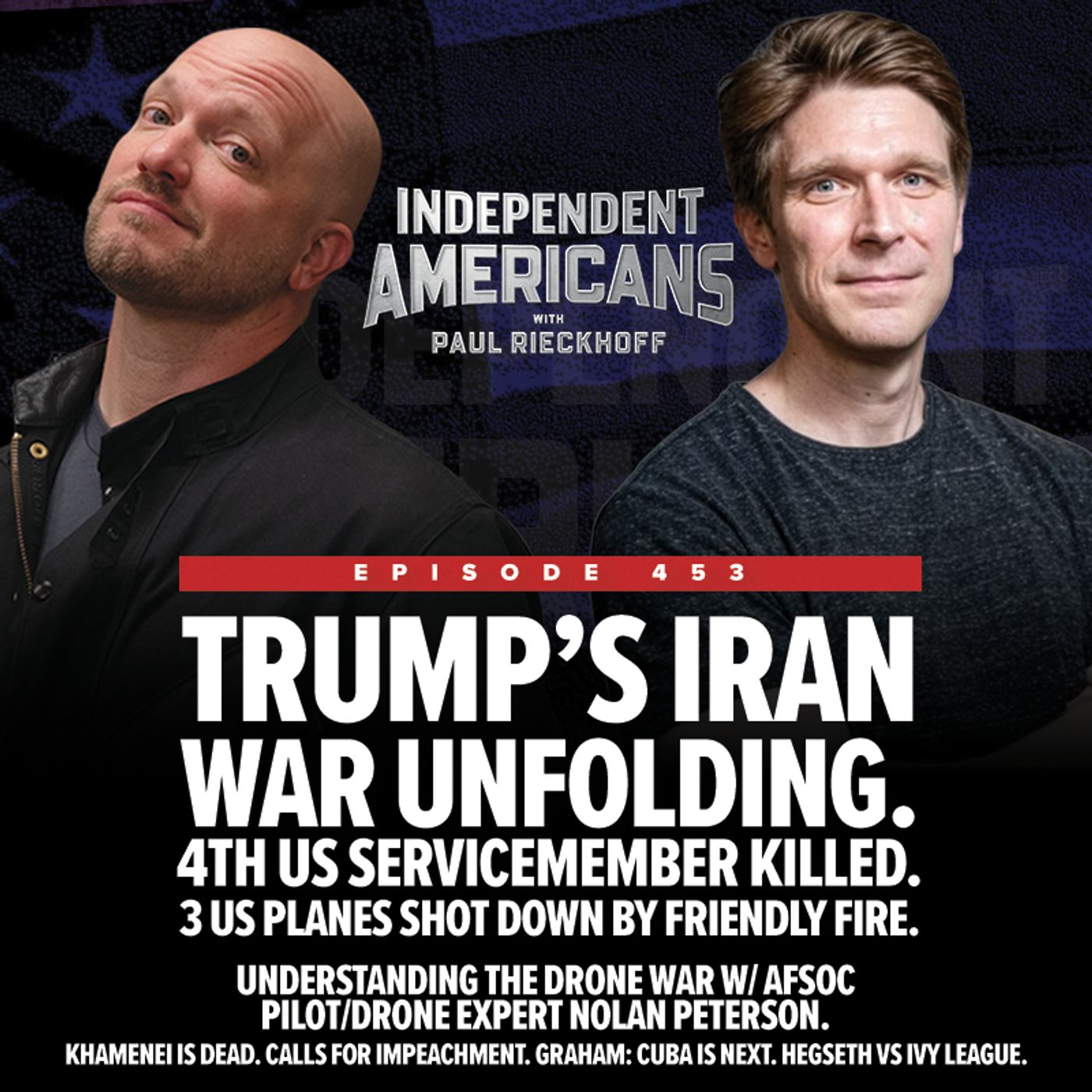
Independent Americans with Paul Rieckhoff
Trump’s Iran War Unfolding. 4th US Servicemember Killed. 3 US Planes Shot Down by Friendly Fire.
01:25:35
War has come to Iran, and America is not ready for what comes next. Paul Rieckhoff sits down with former special operations pilot and drone warfare expert Nolan Peterson to break down the air war, the drone threat to the U.S. homeland, and the terrifying question of AI in the military kill chain. This is the conversation Congress isn't having — and the one every American needs to hear right now.
Loading summary
Transcript70 lines
- [00:00]
Nolan Peterson
Support for this podcast comes from progressive America's 1 motorcycle insurer. Did you know? Riders who switch and save with Progressive save nearly $180 per year. That's a whole new pair of riding gloves and more. Progressive Casualty Insurance Company and affiliates national average 12 month savings of $178 by new customers surveyed who saved with Progressive between October 2022 and September 2023. Potential savings will vary.
- [00:27]
Ollie Advertisement Voice
Matching outfits, extravagant birthdays, many nicknames, a few classic moves of a dog obsessed parent At Ollie, they're obsessed with how obsessed you are with your pup, which is why they obsess over giving your dog the best. Ollie's fresh human grade recipes are developed by real chefs and backed by vet nutritionists. The meals are perfectly portioned and come with a puptainer and scoop for easy storing and mess free serving, delivering the best experience for you and your pup. And through the Ollie app, you can actually check in on your dog's health with real vets. By uploading a picture, their team can check your dog's weight, digestion, teeth and coat. They'll then provide next steps on how to keep them thriving. And because they're just as obsessed as you are, there's zero judgment. If you check in every day. You could say Ollie feeds the obsession. Go to ollie.com happypup and use code happypup to get 60% off your welcome kit.
- [01:25]
Paul Rykoff
Ollie feed the Obsession Iranian and Iranian proxy drones are going to continue to be the most immediate threat for U.S. and allied personnel in the region and worldwide, I believe. And the threats that are most likely to be successful are going to be those Iranian drones and they are a threat to the US at home here too. I going to talk to Nolan Peterson much more about that in a second. But as Ukraine has shown and warned us, we are not ready. Most of the western world isn't ready. And this is what the next war looks like. It looks like drones. Welcome to Independent Americans. Welcome to episode 453. I am your host Paul Rykoff and I am coming to you from New York City USA where the weather is sunny and cold again. It is Monday, March 2nd. March is here and it is coming in like a lion. That is for damn sure. We have a lot more war and a lot to talk about. But first take today's artist is Edwin Starr. Edwin Starr because he's best remembered for his Motown singles of the 1970s with Norman Whitfield, including most notably the number one hit War. War, huh? What is it good for? Well, we're going to find out this week. And I'm going to bring you the five eyes that I bring you in every show and are going to be especially important in a time like this. Independence, integrity, information, inspiration and impact. And our guest today is going to bring you that. It is a guest that is perfect for this moment. He is a returning champion. He is my friend Nolan Peterson, who is an expert on policy. He's consulted for the Pentagon and defense tech firms. He is an expert on drones. He spends a lot of his time inside Ukraine. He helped me co found American Veterans for Ukraine. And he is a former special operations pilot, war reporter and fantastic person to help us understand everything from the planes that are being shot down to the drones that are being launched to what can happen next. Because on this show especially, that is what I want to help you understand not just what's happening now, but what's happening next. But first, there is a ton happening today in a whole new war. But on this day, on this Monday, as we kick off a very fierce march, it is definitely a time to stay vigilant. All right. There is a lot of reasons to stay vigilant today. And our top story should be obvious. It's on. It happened. I left you on Friday saying that war could happen over the weekend and it has. And the Department of War is calling it Operation Epic Fury. Well, it is epic. All right. On Saturday, as you now know, the US And Iran and Israel launched major attacks across Israel and chaos has ensued. The Khomeini is dead. Ayatollah is. The Ayatollah Al Khomeini is dead. Iran's supreme leader is dead. As I record this now, Israel and Hezbollah are trading blows. Threats continue across the Middle East. And Trump just told Jake Tapper that the big wave is yet to come in the war in Iran. And in separate remarks, Trump also ignored his warnings over nuclear program and said he did not rule out sending US Troops to Iran if necessary. This is big news. All right, let's start with the top line. The way that Trump did this is all wrong. He did not go through Congress. He did not brief the American people. There is not clarity around an end state, a timeline, potential casualties. But there is good news in that Khomeini is gone. That is a good thing for the world and especially for the brave Iranian people. Both things can be true. Trump can have done this the wrong way. And Khomeini being dead can be good. And it will probably be decades before we know the true cost of what it took to take out Khomeini and whatever comes next. But the same would have been true with decades more of tyranny. And tyranny should never be acceptable over fear of unpredictable potential alternatives. There is no certainty for what comes next now. And there's definitely no clarity from Trump or Netanyahu about a real long term plan. But whatever happens for a future of a potentially free Iran should be driven by one group of people, the Iranian people. But there is no freedom without basic security. And there's no telling how long that will take to establish. It could be weeks or it could be decades. But however long it takes, the future of Iran must belong to the Iranian people, no one else. Not to Trump, not to Netanyahu or any other leader or country. And it's the responsibility of the American and the Israeli people to all of us on this conversation right now and to all of you, especially to make sure that that is known and adhered to now and forever. Now footage continues to fly around the Internet of Iranian drone attacks, of American bombings. And there was footage of an Iranian attack drone slamming into the headquarters of U.S. navy's 5th Fleet at Naval support in Bahrain over the weekend. Now, this is really, really, I think, important because Iranian and Iranian proxy drones are going to continue to be the most immediate threat for U.S. and allied personnel in the region and worldwide, I believe. And the threats that are most likely to be successful are going to be those Iranian drones. And they are a threat to the US at home here, too. I'm going to talk to Nolan Peterson much more about that in a second. But as Ukraine has shown and warned us, we are not ready. Most of the Western world isn't ready. And this is what the next war looks like. It looks like drones. And this is this reality we're facing today. This is the next 9 11. Now, if you didn't hear my show on Friday with new expert Joe Serencione, we've been covering this for years and he had a great conversation with me about all of it. It was very prophetic. We knew the war might unfold. And if you haven't heard that conversation, go back and check it out, especially with regard to the nukes. But we also have to keep focused on the drones. And now so many people see why New York City Police Commissioner Jessica Tisch said a few weeks ago, if there's one threat that keeps me up at night, it's drones. And it should be the thing that keeps you up at night, too, because Ukraine's terrifying and terrible drone war reality for the last four years is the Middle east reality today. This is what Zelenskyy has repeatedly warned could happen in Europe. The future of war is happening now and it's no longer contained just to Ukraine. It was only a matter of time and it's only a matter of time before it expands further. Now the threat of drones today is like the threat of terrorism after 9 11, but much more real for much more of the world. And it's long past time for the world and especially America to confront this new reality and this new normal. It's one of the many reasons this week especially we have to stay vigilant. All right. There is never war without cost. Only chicken hawks believe that or propagandists. And as of today, there are now four Americans killed in action as a result of the ongoing operations in Iran. CENTCOM has been putting them out on X. They finally did a press conference this morning with Hegseth that was unsurprising, long overdue and a bit contentious to say the least. But now we have four American killed in action, at least five wounded. The latest as of March 2nd. This morning, 7:30, CENTCOM announced that the fourth US service member has been killed. This is all they've shared so far because I would argue shamefully and dangerously they're not doing regular press conferences as usually is the standard in a modern, modern America during war. Today there was a press conference. We'll see if they do them daily. But the chicken hawks told you it would be bloodless like Venezuela. And it's not. We've already got four Americans dead. And if you want to help the families of these fallen service members in this time of unimaginable pain and loss, support the heroic work of our friends from Tragedy Assistance Program for survivors, taps. I will link to it in the show notes and you should bookmark it because this will probably be the first of many more casualties to come. Now the human cost extends of course to the people of Iran and to civilians and we should never lose sight of that. There's at least one episode that's gotten some significant press coverage. There was a strike by Americans on what turned out to be a girls elementary school in Minab, Iran. It looks like there could be as many as 60 students dead, dozens injured, and it's a truly tragic situation. Civilians will die as well, and we can't. Especially as Americans lose sight of the civilians that are caught up in this right now. There's more breaking news as I record this midday on Monday, three US planes have been shot down in what the US is calling A friendly fire incident in Kuwait. Separately, a drone attack hit the US Embassy compound in the Persian Gulf state as Iran continues to to hit American assets across the Middle East. But three American planes have gone down. And a friend asked me this morning, how does this happen? That's what I was asked today. Well, it's war. And in war a wide spectrum of unpredictable and unexpected bad things happen. And this could be just the start. It's probably just the start. Only people who haven't seen war don't understand that. And that's why war should always be a last resort. But in America today, we have an unaccountable and unencumbered president who is on a never ending global war path that Congress can't even interrupt their plans over a weekend to vote on. This is not working, America. And it's getting worse fast. They did finally do a press conference, which I think underscored one thing that's important. Hegseth is not prepared or suitable to this moment. It's never been more true than now and the whole world can see it, especially our enemies. And don't forget, before the war started on Friday, around 5 o' clock officially, I think Trump tweeted a couple hours before that they finally did what they said they were going to do and they dropped and attacked AI company Anthropic. Trump gave the orders to stop using Anthropic. And this was important because it was on the eve of using Anthropic's technology to, to do a lot of what you're seeing right now. So it's gonna take months for them to decouple themselves from Anthropic. They said Anthropic was unpatriotic. Anthropic said, we don't wanna leave kill chain decisions up to AI. So Anthropic is out, but that seems like ancient history for most folks who have already moved on to whatever video you're seeing online coming out of Iran. But this is important and we're gonna get into it with my friend Nolan Peterson, because the discussion around how AI is involved in the decision to kill people is absolutely essential, not just to this war, but to the future of war and to the future of humanity, quite frankly. We talked about it with Joe Cirancione. We're going to talk about it again with Nolan Peterson and we're going to continue to talk about it because it is central to how the US Is waging war right now. All right. Also on Friday, on the eve of the war with Iran, the culture war continued because culture war is forever war and it never stops. It's, of course, being led by the Secretary of Culture War, Pete Hegseth, who on Friday announced that that he is ordering the complete and immediate cancellation of Department of Defense attendance at Princeton, Columbia, mit, Brown, Yale and many others. Now, he said, for too long the Ivy League and similar institutions have been subjecting our warders to woke indoctrination. Those days are over. So says the Secretary of Culture War, who himself went to Princeton. But the culture war led by Hegseth continues inside the Pentagon and with the Pentagon in the lead. Everything they want to do in America starts with and is led by the Pentagon. It's the tip of the spear for their culture war, and he is the Secretary of culture War. The question remains, how will this destructive, I think stupid policy change impacting Ivy League colleges, impact veterans at those schools using the GI Bill? That's something no one has answered. But important to understand that they launched a number of culture war attacks before they launched the real war this weekend. And the culture war won't stop because the real war is unfolding quite the opposite. They will probably be moving in parallel. And as all this unfolds, regardless of the politics and my feelings about Trump, I'm keeping our men and women of the U.S. military and their families front of mind always. And think you should, too. Remember the humanity. Remember alongside our troops, the, the brave civilians of Iran, and especially the courageous protesters who've lived under brutality for decades and right now are just trying to survive. It's always incredibly hard to separate the people from the politics, especially during war. But that, that is when it's most critical. We can't lose track of humanity in the midst of all the tallies and the military scorekeeping. And despite what too many think nowadays, especially those who haven't seen war up close, war is not a video game. There is painful human cost. And unfortunately, most likely that human cost is just starting. And it's one area we should be united, and it's one area where we have to be vigilant. All right. In contrast, a group that's not really vigilant is Congress. They can't be bothered. While this war unfolded, the UN Security Council had an emergency meeting on Iran, and the UN Security Council came together to talk about Iran and talk about what's unfolding. But our Congress, they were posting comments on social media from their nice houses and fancy dinners, while American sons and daughters were actively engaged in combat and dying. They couldn't even bother to come in for an emergency session. They couldn't bother to vote. I think this is very, very important. Our failed and feckless Congress won't even interrupt their weekends to address the global war that Trump has started. This is not working, America, and I think most Americans know it. But will most Americans speak out? Because only 1 in 4Americans approve the US strikes, while half, including 1 in 4 Republicans, believe Trump is too willing to use military force. That was according to a Reuters Ipsos poll that came out on Sunday. 27% of Americans said they approved of the strikes. Only 27%, 43 disapproved, and 29% were not sure. Nine in 10 respondents said they had heard little, at least a little, about the strikes, which began on Saturday. Now, 56% of Americans think Trump, who has also ordered strikes in Venezuela, Syria, Nigeria in recent months, is too willing to use military force to advance US interests. The vast majority of Democrats, the 87%, held this view, 23% of Republicans and 60% of independents. Independents will continue to be key here. But here's the most important point. I think when you hear these polls and you hear about public opinion, Trump doesn't care what the American people think. That should be clear by now. And he doesn't care what Congress thinks. He's all gas, no brakes. And all the while he's just looking and waiting for a reason to take over, disrupt, corrupt the November elections. One drone hitting an American city is all he'll need to break that glass. The most important story is still always, and especially now, that Donald Trump can do whatever he wants with the most powerful military the world has ever seen. And nothing is stopping him. They're not even slowing him down. Congress can't even bother to call an emergency session when he launches a whole new war. And now four Americans have been killed, with likely more to come. He should not be able to do whatever he wants without any guardrails or even speed bumps. This is not working, America. And we have to stay vigilant because Cuba could be next. Yes, Cuba is likely next. I think I've been pretty accurate in laying out how this was going to go down. You know, of course he went after Venezuela, he went after Iran again, he tried to go after Greenland and pulled back, don't forget. He may come back to that. But it's clear they have telegraphed, they have communicated that Cuba is next on their vision board. And check this out from Senator Lindsey Graham of South Carolina is President Trump
- [18:32]
Nolan Peterson
finished the job that President Reagan failed to do.
- [18:35]
Paul Rykoff
I am a big admirer of Ronald Reagan, but I'm here to tell you
- [18:39]
Nolan Peterson
that Donald Trump, in my opinion, is
- [18:41]
Paul Rykoff
the gold standard for Republicans and maybe
- [18:44]
Nolan Peterson
any president when it comes to foreign policy. Maduro, everybody talked about him.
- [18:49]
Paul Rykoff
Well, Donald Trump's got him in jail. Cuba's next.
- [18:53]
Nolan Peterson
They're going to fall this communist dictatorship in Cuba.
- [18:56]
Paul Rykoff
Their days are numbered.
- [18:57]
Nolan Peterson
The Iranian regime, the mothership of international
- [19:01]
Paul Rykoff
terrorism is about to collapse. Cuba is next. He said it. And if it's one thing that's true about Trump and his minions, they telegraph their punches. Believe them. Congress, maybe you can get moving now and have a vote, I don't know, two, three weeks after Cuba happens. But he should not be able to do whatever he wants without any guardrails or speed bumps. And this is not working. Congress is failing. It doesn't mean you shouldn't contact them. It doesn't mean you shouldn't raise hell, doesn't mean you shouldn't run for office yourself. But in this moment, if you haven't contacted your senator, both of your senators, your members of Congress, and ask them why they can't be bothered to have a vote on a war that has already happened, then you should ask them why they haven't resigned. Because now is the time for congressional members to step up and raise their voices. And I would argue many of them should have the courage to call for his impeachment. They haven't even called for a war powers act. I hope some of them will call for his impeachment because it seems like what he's doing is illegal. There should be a conversation about whether or not a president can continue to have never ending war without any consultation or approval from Congress. And if your member of Congress isn't asking that question, at least
- [20:13]
Shopify Advertisement Voice
nobody does selling better than Shopify. Shopify is the home of the number one checkout on the planet and the not so secret secret with Shoppay that boosts conversions up to 50%, meaning way less carts go abandoned and way more sales going through. So if you're into growing your business, your commerce platform better be ready to sell wherever your customers are scrolling or strolling on the web, in your store, in their feed and everywhere in between. Businesses that sell more sell on Shopify. Upgrade your business and get the same checkout that Skims uses. Sign up for your $1 per month trial period for 3 months at shopify.com Westwood1 all lowercase go to shopify.com Westwood1 to upgrade your selling today. Shopify.com Westwood1 LifeLock how can I help?
- [21:13]
Nolan Peterson
The IRS said I filed my return, but I haven't 1 in 4 tax paying Americans has paid the price of identity fraud.
- [21:19]
Ollie Advertisement Voice
What do I do?
- [21:20]
Paul Rykoff
My refund though.
- [21:21]
Nolan Peterson
I'm freaking out. Don't worry, I can fix this. Lifelock fixes identity theft guaranteed and gets your money back with up to $3 million in coverage.
- [21:28]
Ollie Advertisement Voice
I'm so relieved. No problem.
- [21:30]
Nolan Peterson
I'll be with you every step of the way. Way one in four was a fraud paying American. Not anymore. Save up to 40% your first year. Visit lifelock.com Special offer terms apply.
- [21:40]
Ollie Advertisement Voice
Matching outfits, extravagant birthdays, many nicknames. A few classic moves of a dog obsessed parent. At Ollie, they're obsessed with how obsessed you are with your pup. Which is why they obsess over giving your dog the best. Ollie's fresh human grade recipes are developed by real chefs and backed by vet nutritionists. The meals are perfectly port and come with a puptainer and scoop for easy storing and mess free serving. Delivering the best experience for you and your pup. And through the Ollie app, you can actually check in on your dog's health with real vets. By uploading a picture, their team can check your dog's weight, digestion, teeth and coat. They'll then provide next steps on how to keep them thriving. And because they're just as obsessed as you are, there's zero judgment. If you check in every day, you could say Ollie feeds the obsession. Go to ollie.com happypup and use code happypup to get 60% off your welcome kit. Ollie feed the obsession.
- [22:40]
Paul Rykoff
They should be gone and maybe you can run against them. But this is not working, America. And it's why we, especially the American people, and especially independent Americans, need to
- [22:50]
Nolan Peterson
stay vigil,
- [22:57]
Paul Rykoff
all right? And remember now, when combat happens is a time for perspective and a time for friends. And there might be none that are important right now to America and to Israel than Ukraine. And among the first people to post, one among the first world leaders to post was, unsurprisingly, President Zelensky. And he posted a statement saying the events in the Middle east and the Gulf region are unfolding rapidly. Unfortunately, Ukraine knows all too well what this is about. Although Ukrainians never threatened Iran, the Iranian regime chose to become Putin's accomplice and supplied him with shahed drones. And not only the drones themselves, but also the technology to produce them. Iran has also provided weapons to Russia. Now he goes on to expand on their experience in drones, which is really, really important. And he said people cannot know the day, the hour, yet every act of evil, terror and aggression against neighbors ultimately meets a just response. We expect that in the end, the Middle east region will become safer and more stable. Much has changed toward that goal. Ukraine is ready to help every nation so that security and justice increase and terrorist regimes decrease. Ukraine has our back, America, even though Trump doesn't have theirs. And as all this unfolds, don't forget about Ukraine. As you see these videos of shahed drones hitting civilian targets, this is what Kiev and other cities in Ukraine deal with every single day. And as Craig Bagwell posted on X, an important reminder, as we watch the full application of American might applied against Iran, take a moment to imagine what that might have achieved in the defense of Ukraine. Trump has done this all wrong with Iran and it was probably unnecessary. Imagine if he had done this in support of Ukraine against Putin. Imagine how our world would be different. Imagine how our world would be safer. Imagine how our world could be better. But our friends are out there and help is out there. If we have leadership that can recognize and if we have American people that stay vigilant now, our friends are out there. But often it's below the radar. And, you know, in a time of national stress like this, it would be good to hear from the Veterans Affairs Secretary about the resources that are available to veterans nationwide because this is a stressful time for everyone and especially for veterans and for military families. It would be nice for them to hear that the VA is out there or to hear that the VA will be there for the service members who are involved in the Iran attacks right now when they get home. But this is not a normal VA secretary. So the only post we had yesterday was from VA Secretary Doug Collins, who retweeted Trump's tweet saying Khomeini is dead. And he wrote, finally, justice for hundreds of American veterans who were killed or injured by the Iranian regime. Thank you, POTUS and our brave American service members. That's all you got from the VA secretary? Another culture war hack focused on kissing Trump's ass and carrying his water for him as much as possible. I've called him dishonest. Doug. There's not a lot of good reason to be on X, but one of them is our Army Reddit, which posts commentary on national security issues and, of course, veterans issues. And our Army Reddit wrote, you just tried to reduce disability payments to those that were injured by that regime, you piece of shit. So I think it's important to remember that this is a time where leaders will be tested and leaders will be defined and leaders will be revealed. And don't Forget. As all of this war and chaos unfolds, another prong of Trump's plan continues at home. As ICE continues to run rampant across America. That hasn't stopped. There will continue to be bad shit. And you must try to find a way to focus on all of it. And don't believe the government. Believe your eyes. You couldn't believe them around ice, and you shouldn't believe them now around war. Trump is all gas and no brakes and nothing is slowing him down. And that includes his continued focus on ways he could potentially invoke the Insurrection act and the ways he could potentially impede, corrupt, disrupt the fall elections. And all of us as Americans have to lead the way. Independent Americans especially, have to lead the way. And veterans especially must lead the way. And on this show especially, I'm going to bring you voices from veterans and national security community folks that, that can help us all understand the big picture, the complicated stuff and what's next, especially in times of war and this new time as we enter into march of what is truly forever war and potentially global world war. And from the air war to the US Pilots shot down by friendly fire, to the drone war, to the future that is now our present. I've got a perfect guess for this moment, and I'm going to continue to bring you guests throughout this week and in the days to come, even if my voice doesn't hold up, I will bring you other voices that do. And I've got a person that understands war, from Kiev to Afghanistan to Tehran to Iraq, to whatever comes next and to whatever could come here, because our shores may not be big enough to defend what could happen next. What's happening in Kyiv is now happening in Tel Aviv and could be happening here at home. Don't have a failure of imagination, folks. Continue to stay vigilant and listen to the voices who understand that. I'm going to bring you one now that you definitely need to hear. Because as March begins in a truly lion like form and new war begins to expand by the minute, now is most definitely more than any other time in our lifetime, a time to stay vigilant. All right, folks, the war is on and it is going sideways in ways that are unpredictable, as war often is. And in these moments, especially in this next couple of weeks, maybe it's a couple of months, I want to bring you leaders who understand the dynamism of, of all of it, who understand it from a personal perspective, from a technical perspective, from a strategic perspective, and from a policy perspective. So I'm very happy to be bringing back a returning champion, a man who's helped us stay vigilant around issues of national security, in particular in the past. He is now a non resident senior fellow at the center for European Policy Analysis. He's consulted at the Pentagon and on defense tech firms, specifically on the lessons of drone warfare from Ukraine. You remember him being on the show talking about Ukraine. He helped me launch American Veterans for Ukraine along with others. He is a former special operations pilot, a writer, a war reporter, and I think an international man of mystery, but a true voice of conscience and perspective. The great and powerful Nolan Peterson is back on Independent Americans for a Very Important day. Welcome back, sir.
- [30:03]
Nolan Peterson
Well, thank you for having me on. I appreciate it. Good to see you again.
- [30:06]
Paul Rykoff
You too, man. You too. I mean, you're a guy to talk to today. Like, we, you know, I was thinking, like, who can we talk to? I'm like, oh, Nolan. We need to talk to Nolan. There's a lot to get into. You've been there, you've done that, you've seen it, you've predicted a lot of it. But let me start with a very basic question I ask everybody. Where are you and how are you? As we all process this new phase of our world. Where are you and how are you, man?
- [30:34]
Nolan Peterson
So I'm doing great. I'm living in Las Vegas, Nevada right now. You know, my wife and I had been living in Kyiv, Ukraine for well over a decade and through the full scale war. And then over time, I started drifting a little bit away from journalism and doing more sort of proactive things to learn lessons from the war, to both help our military and to do things to help the Ukrainians. So out here in the American west for the first time, my wife and I are loving it. Not, not too used to driving everywhere. It's a little bit of a change from living in like a, you know, a city center like Kyiv. But we still divided my time going back to Ukraine and other places and staying engaged. But it's, yeah, it's a crazy world. And it seems like every couple weeks we're pivoting to some new conflict, some new, you know, challenge that we're facing. And it just reiterates that we live in a dangerous time. Right. And we have to stay vigilant and, yeah, it's never dull.
- [31:31]
Paul Rykoff
Can I, can I ask you to address what must be a mind fuck of going from Kiev to Las Vegas, two weird and dangerous places in very different ways. But to go from a major city that has the threat of a drone hitting anywhere Anytime to going to Las Vegas, which, like, I guess in my mind's eye, I could see a world where drones are hitting Vegas. Right. I could see a world where drones hit the Freedom Tower not far from where I'm standing. But I feel like we have the burden of that perspective, the burden of that anticipation. And that's a kind of a weird thing, I think, especially for anybody who's been in conflict, but American veterans who can see the dangers before they come. So for you, on a personal and a professional level, how are you processing that?
- [32:15]
Nolan Peterson
Yeah, well, first of all, like, yeah, you know, having lived in Kiev since 2014 through, you know, 2023, 2024, and my wife and I still spend almost half our year there. Right. And yeah, it's just, you can't help but having lived in a war zone like that for so long to when you, you know, when you return home, you see everything through the lens of what you've lived through. And so every time I walk down the street, I imagine an air raid siren going off. And how would Americans react to that? You know, I, I look at the city skyline and I can envision scenes I remember from Shaheds hitting, you know, high rise towers in Kyiv. So you, you do see everything to the frame of, of war and how war could affect life here. You also, I have to admit, you kind of want to kiss the ground you walk on when you come back home because you're so grateful that we can live in peace here, that we have these, that luxury of not having to worry about attacks. But I also, on that note, I fear that it is a bit jarring when you watch the news about how we are now engaged in a war against Iran. And you walk around streets in America and things are just going on about as normal life is just carrying on like it normally does. And I can't help but worry that at some point we're not going to be able to engage in combat overseas without the effects of that combat, the retaliations striking our homeland, our enemies certainly have the will to do that. And I think that with these new technologies like drones, which we'll get into today, they have the ability, you know, Iran doesn't need ICBMs or hypersonic missiles or stealth bombers or anything like that to hit our homeland. They can do that now through obviously, you know, terrorist cells have been something that's existed for decades, but with armed with drones, they could affect damage on our country. That is strategic. Right. They could hit our air bases and our infrastructure in ways they may not have been able to do otherwise. So I think the overwhelming impression I have is just this idea that we assume that we are sanctuary here. And I worry that that illusion will be shattered at some point in the future.
- [34:21]
Paul Rykoff
Future. I have that same worry, as I've emphasized on this show for a long time, and I think it's in many ways coming to a head and I want to go deeper on that on the air war on the drone piece. But let me ask you to come back to what I think. You are one of the guys I really am anxious to hear from this moment for America. Right. You and I served in the post 911 generation. Really, the first protracted conflict on the all volunteer military where most of Americans lived life uninterrupted while guys like us and our friends fought and died. Yeah, this is like a new forever war, right. Where Trump is hitting eight countries and counting. There's no end in sight. There seems to be more. And I was on TV yesterday and some of the hosts were saying, yeah, you know, there are some protests. And I'm like, no, there really aren't, because ICE protests were happening because people felt it. This could go on for years, theoretically. Right. It could go on for decades like it did last time, and America won't feel it. So I think this is like, you know, the crisis point for democracy has been compounded. And now we are in a place where it's almost like after 9 11, where it may not be possible to have patriotism light, where only other people's kids fight and die. Especially if we get one attack on US soil, that all changes. Right? But can you address this moment for our democracy where I have said repeatedly, and I'm gonna say a lot this week, this is not working. Congress is not working. There's no accountability, there's no oversight, and Trump's doing whatever the fuck he wants and putting middle fingers up to the entire world. But how do you see that part of this, Nolan?
- [35:50]
Nolan Peterson
Yeah, so I as you're talking, I just remember yesterday I got a haircut for the first time in a while. Get all ready for this show. And the gentleman sitting next to me, he was born in 1980, you know, a couple years older than me, but basically my same generation. And he was talking to the lady cutting his hair, and he was just saying, you know, the news is so crazy right now, everything going on. I said, I just want to live in my bubble and just zone out. And the lady cutting his hair said the same thing. Like, yeah, me too. I just don't Want to care. I just want to live my life. And so I think there's two things going on. One is that people are just so exhausted by all everything going on politically in the world. And so they are a bit, I think, just detaching from the news paired with the fact that our military is incredibly capable and lethal. And we've had some wins recently, which I think set the bar at a place where we think that we're untouchable, right? And then we can go out and do these one and done operations and there's going to be no payback or no consequences for our military. We're not going to have any casualties, no fatalities at least. And so it creates a little bit of a complacency. And so I think it's a combination of our military being so dominant that, you know, we're not really, we're not feeling the sort of the, the bad effects of combat in the sense that we're not getting bombarded with terrible news from some of these operations recently, but also people detaching from the news cycles. And so Iran, however, is a different story because this is not going to be a one night, you know, bombing raid. This is not going to be a quick special operations mission. This is going to be something that's going to go on for a while. And although casualties are relatively small, you know, three fatalities at this point and three friendly fire F15Es being brought down. But thankfully all the pilots seem to be okay. Every American death is obviously a huge tragedy. But if this thing goes on for weeks on end or months like, you know, the price we pay will be higher. And at that point I hope that Americans will become more engaged because we are paying.
- [38:12]
Shopify Advertisement Voice
Nobody does selling better than Shopify. Shopify is the home of the number one checkout on the planet and the not so secret secret with shop pay that boosts conversions up to 50%, meaning way less carts go abandoned and way more sales going through. So if you're into growing your business, your commerce platform better be ready to sell wherever your customers are scrolling or strolling on the web, in your store, in their feed and everywhere in between. Businesses that sell more sell on Shopify. Upgrade your business and get the same checkout that Skims uses. Sign up for your $1 per month trial period for three months at shopify.com all lowercase go to shopify.com Westwood One to upgrade your selling today. Shopify.com Westwood One
- [39:10]
Ollie Advertisement Voice
matching outfits, extravagant birthdays, many nicknames, a few classic moves of a dog obsessed parent at Ollie they're obsessed with how obsessed you are with your puppy, which is why they obsess over giving your dog the best. Ollie's fresh human grade recipes are developed by real chefs and backed by vet nutritionists. The meals are perfectly portioned and come with a puptainer and scoop for easy storing and mess free serving, delivering the best experience for you and your pup. And through the Ollie app, you can actually check in on your dog's health with real vets. By uploading a picture, their team can check your dog's weight, digestion, teeth and coat. They'll then provide next steps on how to keep them thriving. And because they're just as obsessed as you are, there's zero judgment. If you check in every day, you could say, Ollie feeds the obsession. Go to ollie.com happypup and use code happypup to get 60% off your welcome kit. Ollie, feed the obsession a more direct price.
- [40:12]
Nolan Peterson
And God forbid if Iran is able to actually retaliate within the homeland in any way too. I think that will certainly be a slap in the face for many Americans that these things happening abroad have consequences at home.
- [40:27]
Paul Rykoff
Yeah. I've talked a lot about how there's a failure of imagination in this country and part of my job is to kind of pierce that. I want to pop that dude's bubble sitting next to you getting a haircut. Because you know the old saying, you know, I'm not into politics. Well, politics is into you. And I think that, you know, there's this idea that we can be detached from it and a lot of folks are too young or don't want to remember 9, 11, when they felt scared of being attacked in the homeland or they knew people who served. And so I really think it's an important moment and the president's not going to do it. Right. I mean, I think the greatest foreign policy mistake was not even that Bush went to war in Iraq, but that he never asked anybody to do anything afterward. Right. He sent everybody to the mall. So it created this expectation of no social backstop, of no skin in the game. And now we've got decades that just expect that that's how it's going to be. And it's not. I don't think it's sustainable. Right. I think there is a point where we will see American casualties. We already see them. The Latest update is 4. You may not have seen it, but in the last hour they've announced now four have been killed. Yeah. And there'll be more. But I think we were lulled after 9, 11, too. When I deployed to Iraq, I did not expect New York not to get hit. Right? I expected New York to get hit. I expected New York to look like Tel Aviv, and now Tel Aviv looks like Kyiv, and it kind of is moving to the left. So let's get into that if we can. I think there's a lot that if you're not angry, you're not paying attention about. But this week especially, we've got to pick a top topic. And you. Now, today, I think. I think the top topic has got to be the air war. Right? I mean, this is. Right now, guys like me who are infantry are sitting on their hands, watching on tv. Right? I mean, they're doing some stuff. But. But this is not a ground game. This is very different from Iraq. Some could argue this is how we should have done Iraq, who knows? But the reality is this is an air war right now and a drone war and a cyber war, which are in coordination. But you, as a special operations veteran, as a pilot yourself, you've been in conflict zones, you've been a pilot. I think your perspective is going to be really, really important for folks to understand what. What's really happening. Maybe I can ask you to talk, Nolan, by starting about the air war. How do you see this? What does this look like for you? And talk about the F15s that were mistakenly shot down by Kuwait today. Yes, they're safe, but somebody said to me, you know, how can this happen? Oh, it's war. Crazy shit happens. Mistakes happen. Pilots know that as well as anybody. And we have been, I think, lulled into complacency after Venezuela. But start with the air war. How do you see this unfolding and what do you think people need to be thinking about and looking for?
- [43:09]
Nolan Peterson
Yeah, I mean, from my perspective, having studied the drone war on in Ukraine for so long, there's always these debates about, you know, are manned aircraft still relevant and all these legacy, you know, traditional weapon systems, do they still matter? And I think we've clearly seen that. Yes, absolutely. You know, air power in the traditional sense still matters. I think that this conflict has so far been a great, you know, it's been a lesson awake. Yeah. It helped demonstrate how truly incredible our air force is. I think that's something that has not. Because we've been engaged in these sort of long, simmering conflicts in Iraq and Afghanistan, we do lose sight a bit about the high end, high intensity edge of our military and how unbelievably capable it is. And it makes me frustrated, having been in Ukraine all these years. Like, gosh, like, that would have been super effective to close the skies in Ukraine. Like, I think we could have quite easily done that against the Russian air force, especially after they've demonstrated their, you know, their lack of capabilities over the last few years. So, yes, it's. It's a great demonstration of American power. You know, typically, air power is limited in its abilities to affect the kind of changes you really want on the ground. I think this campaign is obviously designed to take out key nodes of the Iranian regime to try and affect the late, you know, present the groundwork for some sort of regime change. That's apparently what we're seeing. The. That's what's been advertised as. I think the overall objective of this, whether or not that'll be successful or not. You know, I. I have spent time with Iranian Kurds in Northern and Iraqi Kurdistan, and that's only one segment, obviously, of the Iranian population. But from what I learned from them, like the Iraq, the Iranian population is very much against the regime. And so I think there is a sentiment within the population that, you know, they would like to overturn the regime. How, you know, practical that is, in reality, just through sort of the impetus of an airstrike campaign, we'll see. But this, you know, this could end up being a textbook example of how air power is able to achieve larger strategic effects like that, or it could end up not achieving. You know, it could end up being a case study in the limitations of air power, too. So I think at this point, we'll just have to see where it goes. But, yeah, I mean, incredibly impressed. And as a former Air Force pilot, just, you know, I feel grateful that we have such competent and capable airmen and men and women up there flying these aircraft, maintaining them, operating them, able to do these things. Uh, but I. I do worry, as time goes on, that, like you said, you know, war is chaotic and it's unpredictable, and there will inevitably be be casualties, more casualties, even the Iranian regime, which seems feckless and sort of, you know, incompetent or incapable of mounting a very concerted retaliatory effort at this point. As things go on, I think there will be surprises, and I just. I pray that we're able to achieve our objectives before the price becomes much higher.
- [46:21]
Paul Rykoff
Yeah, I'm with you on that, man. I mean, you know, it's. We know, we in the military especially know how powerful our air power is, right? And I think we haven't really seen it fully demonstrated in its full capacity maybe since the early days of the Iraq war or the Gulf War. Right. I mean, there have been the isolated examples, like the strike in Iran earlier and Venezuela, but this is like, you know, we've never had a president that broke the glass and pulled all the guns out and used them all. And it seems like now Trump is going to use them all. I mean, the B2s that flew from Missouri all the way to Iran and back, I mean, we are flexing things that we've never flexed before. The F22 in Israel, plenty of other things that we don't know about. Right. That are being engaged and being used. And I think at the same time, there's that respect and admiration and reverence for what we can do and the wish that our president would use him for something better. Right. We'd use them in Ukraine three years ago. Right. So that we could have stopped all that bloodshed. But let's, let's move if we can, Nolan, over to your true area of expertise, especially in the last couple years, which is I call the segment below the radar. This is literally below the radar. Right. And for years on this show, I have been trying to highlight the danger of drones and the evolution of drones. It might be one thing that Hegset's done recently that I agreed with. I felt like we were behind in the production capacity of cheap drones, which I think Zelensky recently said is 80 to 90% of all kills happening on the battlefield right now. I want to ask you to talk about the drone piece because they're getting through. Right. They're hitting Dubai, they're hitting Kuwait, they could be hitting Israel and other places. And there is always the threat of what we talked about with Joe Cirruncione last week, a box truck opening up and a bunch of cheap drones flying out in an American city like we've seen in other places. So can you talk, maybe start big picture? Drones are, in my view, the future.
- [48:18]
Nolan Peterson
Right.
- [48:19]
Paul Rykoff
Or even the present. The present is here. It's drones. How do you see it and what do you think Americans need to start by knowing most of all about this new normal that we're in.
- [48:29]
Nolan Peterson
Yeah. So drones, like, as we've seen in Ukraine, I think there's kind of three main ways in which drones are, you know, transforming warfare. The first is like really on the tactical level. So when I was a special operations pilot over Iraq and Afghanistan, I flew as part of what we'd call a stack of aircraft over a target. So we'd have my special operations aircraft, surveillance aircraft, some high end Drones, you know, providing ISR, so surveillance coverage of the target, as well as fighter jets and tankers and AWACs. All this horrible iron in the air flying over a target, most of which was manned, and if it was unmanned, it was extremely expensive. But yeah, that, that was, you know, that was the way we leveraged air power in those wars because we had complete air dominance. I mean, I never had to worry about a Taliban fighter jet coming and shooting me down or an Al Qaeda fighter jet. Right. Like we owned the skies. And so we were able to affect these operations, these so called stacks in combat. Well, on the ground in Ukraine, you now see Ukrainians basically creating analogs of that stack that we operated in the US Air Force with drones exclusively. So they have small drones that provide ISR that are feeding imagery to help FPV pilots get to their targets. You've got different sort of levels of ranges, like, you know, actual physical ranges. The drones operated at different altitudes. So it's effectively like a bubble of superiority in what we call the air littoral, which is this low altitude airspace within which drones fly. And although that does not sort of replicate the effects of manned air superiority like we're seeing being put in place over Iran right now by the Israeli and American air forces, it does create a pocket of superiority in that low altitude airspace. And the intent of air superiority when you have ground forces involved, is to allow your ground forces to basically operate with impunity on the ground. And you can no longer do that exclusively through manned aircraft alone now because of the drones. And it's not, you know, drones are not like one off weapons. It's not a drone is not a replacement for a Javelin or a mortar. It's this complex, it's this architecture of drones that is, that is so important. It's the ability to create, like I said, these little pockets of air superior so on the most like, kind of like the narrowest aperture there. Looking at drone warfare I think on the ground, in combat involving air, land, battle and aircraft and ground troops, like drones have transformed combat at that level because manned, superior air superiority, air dominance at this point is not enough to fully protect our ground forces from threats from above. Now that's obviously we don't have ground forces in Iran right now. It's not exactly relevant. But of course Americans will at some point be fighting in another war in which we have ground forces involved. And so we have to take into account this new reality and you know, the naysayers against drone warfare, the people who say, oh, this is Just a fad. It's going to pass. It's not that transformative. They tend to argue against the notion that drones have replaced anything. Drones. They'll say, no, Elon Musk is wrong. Right. Like, drones have not replaced or, you know, fighter jets are still relevant. Drones will not replace fighter jets. But what I would say is that, you know, drones haven't replaced anything, but they have basically. Excuse me.
- [51:56]
Paul Rykoff
They have Elon calling you right now.
- [51:59]
Nolan Peterson
Yeah, he's pissed.
- [52:02]
Paul Rykoff
He's undoubtedly listening to probably both of us for the last few years. So he wakes up every day. We're both listening you. To both of you. That's me speaking, not Nolan, but go ahead. Back to you, sir.
- [52:15]
Nolan Peterson
Yeah, yeah. Drones, yeah. So replacing anything. But it's like, this may be corny analogy, but it's like a painter having a new color on his palette. Right. It's just a new reality we have to deal with in combat now. So that's like the most sort of atomic low, low level there. Secondly, we've seen drones used in these very like, enterprising, unconventional ways. All right, so this is the second sort of aspect of drone war warfare if you get used to, which is that drones bridge unconventional and conventional operations. And then, like, the simplest way to put it is drones are a tactical tool that can have strategic effects. The most blatant example is obviously Operation Rising lion by Israel last year, where they snuck Israeli teams in there, launched small drones that took out Iranian missile sites to protect Israeli homeland from retaliation. And then obviously Operation Spiderweb by the Ukrainians, where they are able to go in there with semi trucks and destroy a sizable amount of the Russians nuclear bomber fleet using FPV drones. So the first person view drones that are flown by guys wearing virtual reality glasses.
- [53:27]
Paul Rykoff
So when for a second, Nolan, can we talk about that? Because I think this is below the radar. Some folks don't understand or know about this operation. Can you just summarize it and explain why it was so significant? Because I think it's an insight into what Iranian proxies could potentially do. Right. Or what other nefarious actors could do in the Middle east, in Europe, potentially in the U.S. it's not incomprehensible, especially given how unfocused our FBI and Homeland Security are. But can you talk about that operation for a second?
- [54:02]
Nolan Peterson
Yeah, I mean, I had this throwaway line a little earlier in the conversation. Our enemies don't need hypersonic missiles and ballistic missiles and that. Well, I think Operation Spider Web of the Ukrainians proves that because to attack Russia's strategic assets, like they're nuclear capable bombers, Ukrainians didn't rely on high end weapons systems, cruise missiles, Tomahawks or anything like that. What they did is they had a, you know, an operation carried out by, you know, special agents, I don't know, like special operations forces, effectively, that got into Russian over a very long period of time. They equipped these semi trucks with these special compartments in the back. They released basically swarms of FPV drones that are controlled by humans. They're not automated, but controlled by humans remotely. That went out there and destroyed a number of Russian nuclear bombers just parked on the tarmac at their air bases. That was certainly a wake up call for us. And it's something that a lot of people have been following drone warfare for decades. Like, you know, back in 2014, when I first arrived in Ukraine, I saw Ukrainians already experimenting with small commercial Chinese drones at the time, modifying for them for combat, even equipping them with munitions. This is, you know, well over a decade ago. So this is something that's been happening for a long time. But immediately you think, okay, like an B2 parked at the ramp at Whiteman Air Force Base In Missouri, or F22s, you know, at a Tyndall, you know, warplanes at any base in America or, or other assets, military assets parked anywhere could be extremely vulnerable to a drone operator who could infiltrate America somehow. And you can buy these drones anywhere. Best buy off online equipping them with an improvised explosive. Like the Ukrainians in the early days of the war, they were taking monster energy can drinks, putting explosives in it, and then putting a 3D printed fin on top and dropping it and killing Russian soldiers. So the ability to improvise these things, it's like a flying IED basically, right? But it's precision dropped and it's this, you know, I think we get a little bit locked in this idea that drones could just go out there and terrorize people or kill civilians in a terrorist attack. But drones could also have a strategic effect, right? Like at London Gatwick a few years ago, a bunch of unarmed drones shut the airport down for a couple days and stranded millions of passengers without even having explosives on them. So to think about the level of societal society wide paralysis that could happen from a coordinated drone series of drone attacks across our country that besides being able to maybe take out our electrical grid or portions of it, or bring air traffic to a halt or take out key military assets, these things could have a strategic effect on our homeland. To bring the cost of a war back to Americans. Like, you know, Clausewitz always, always said that in his writings. He said that wars have centers of gravity. And I think our enemies have always thought that the American popular will to sustain a war is one of our centers of gravity. And to attack, that could be a way to sort of derail whatever support we have for a conflict abroad. Right. On the other hand, Americans do have a tendency to get quite pissed when our homeland is attacked. So that could actually have a reverse effect on them. I would argue that if they, if any enemy tries to bring the attack or brings the cost of war to the American homeland, they'll probably get the opposite effect they're looking for, which is more united and more pissed off America in their faces. But, yeah, so drones, they, you know, the second key thing that I think is dawning on people and I think we're seeing this awareness grow, is that our homeland and our forces abroad, but particularly our homeland, were really vulnerable to this unconventional application of drones to achieve strategic effects. And we see the complications of defending against that. Like the recent incident in El Paso where you're trying to integrate drone defenses into the civilian airspace, the civilian commercial, you know, airspace architecture. And that produces friction and potential problems where you can't have complete vigilance against drone threats without running the risk of interfering with the safety of commercial airflow.
- [58:07]
Paul Rykoff
And to remind people in El Paso, the military shot down a DHS drone somewhere in El Paso, shut down the El Paso airport for some period of time. Right. But I think it underscores kind of the new era of chaos in the skies. Right. In the low level, high level, you've also got civilian drones. I mentioned this in my intro, but New York City Police Commissioner Tish says the thing that keeps her up at night is drones. Right. And I would imagine most major cities, the police chiefs are. There is nothing stopping a bunch of drones, civilian made from coming in off the Hudson river and hitting Radio City Music hall, hitting any other number of significant cultural targets. Right. So I think your, your point about flying IEDs for folks who don't know IEDs or improvised explosive devices, many of them took a next level step when the Iranians started doing the explosive war projectiles. Right. So we saw in Iraq and Afghanistan the evolution of IEDs that became the single biggest troop killer. Right. And cheap, easy to employ, fucked up a lot of people. That's what drones are right now, I think in this next phase of warfare. Right. Can you talk about having lived in all these regions, the threat to civilian targets. Kuwait Airport got hit, hotels got hit in Dubai. I mean maybe just underscore, they only got to get one through, right? It's like a suicide bomber, you only got to get one through. How easy in your view is it to hit soft civilian targets like those in the region and across the globe?
- [59:37]
Nolan Peterson
And that's a great segue into sort of the third aspect of drone warfare that we've seen really emerge from Ukraine. So the first is, you know, the battlefield transformation. Second is these unconventional applications. And the third is the reimagining of strategic air power now that we have new drones like the Shaheds, the Iranian design Shahed and the Russian Garon equivalent. And now we have an American analog to all these as well that was used against Iran. But you know, starting like after World War I into World War II, you obviously have the idea of strategic bombing, right? You can knock out keynotes in a adversaries homeland and disrupt their war effort, including among those, you know, civilian will to fight. And now with advent and use of Shah heads by Russians against within Ukraine, you're seeing the application now of unmanned assets trying to achieve basically sort of this foundational intents of strategic air power, strategic bombing in World War II, which is to destroy the enemy's or an adversary's ability to just like their military industrial complex will fight all these things. It's very, it's a, I, I think and I think this has been very underplayed, it, it is quite a transformational moment in, in the application of air power because strategic bombing was always limited by the fact that you can't sustain losses in air crews like we did in World War II. And modern air defenses make a like you know, a B17 raid over, you know, Germany unsustainable now because those aircraft would just be annihilated from the skies and we're going to be losing air crews. So basically for, for many years we transitioned to this more like precision strike with high end assets, you know, stealth bombers and fighter jets to affect an air campaign to achieve what strategic bombing was intendedly designed to do. But now with the advent of these cheap and expendable one way drones, you can sustain a bombing campaign with basically zero cost to yourself in lost air crew with minimal cost financially because each shot head is you know, 40, $50,000 versus a multi million dollar jet or a bomber. And so a country like Iran or Russia can sustain a strategic bombing campaign in a way they never could have with manned aircraft. And that is transformational. And so I think we're seeing now in Iran's, you know, their attempts to retaliate for, for our air campaign against our allies and partners across the Middle east using these one way attack drones as a way to, you know, sort of, I think right now we're trying to, we're seeing a psychological intent by them more than anything. But just like the Russians have done in Ukraine, you're able to use these drones to saturate, deplete traditional air defense systems to pave the way for more advanced systems like ballistic missiles, you know, other types of more destructive weapon systems. And so you see the, you know, a lot of these Middle Eastern countries right now burning through their stocks of very expensive surface to air defense systems to shoot down a shot head. It cost as much as a, you know, a car that we probably drive to work every day in, um, and that, that's a huge threat. And I think it's something that frustrates a lot of us who've been paying attention to the drone war for a long time, which is like we've always been advocating for the fact that you need a layered air defense system. You need cheaper, more expendable options, match attrition with attrition, right? Mass with mass. And so you, if Iran's gonna try and pump a bunch of shot heads to overwhelm air defense systems to potentially lower the guards or pave the way for more destructive attacks, we should have a line of defense against shot heads and not does not require burning Patriot missiles to shoot them down. That's something Ukrainians had to develop over the years and they'd become quite effective at it. And it would have been nice to enlist, I think, Ukrainians expertise in advance of this war with Iran to defend our allies and partners across the region. Because you know, the Ukrainians aren't burning through patriots to shoot down shot heads anymore. They've got these mobile teams in the back of pickups with guns. They've got acoustic networks across the country. They're using, you know, smaller, more, you know, sort of antique aircraft to go out there and shoot these things down. Occasionally they'll have an F16, go try and shoot one down. But they're not burning through their most advanced air defense systems to shoot down shot heads any longer. They're relying on a very layered, diverse network of assets to bring these things down so they can keep their true defenses raised for the big threats, right, The Russian ice, you know, the ballistic missiles, cruise missiles, other things like that. That I think is a huge sort of reality check for both the Us and our forces across the region is that we need to have a more diverse air defense architecture that can defend against these attacks. So drones. Yeah, I mean to get back to your sort of original question here. Yeah, I mean it's, drones can now be used, you know, apart from just the battlefield effects, these sort of snuff videos we see from Ukraine drones are, can now be used in a strategic effect from abroad. And we see groups like the Houthis and the Iranians, you know, sort of like, you know, lower tier military powers that can achieve effects that we could previously achieve with Tomahawk missiles through these cheap and expendable systems that they can sustain a high burn rate with because they can replenish them and keep putting pressure on us from a distance. So yeah, like, and the threat obviously from America for the United States homeland is not necessarily that we'll have huge shot head attacks, but like you sort of alluded to earlier, like a, you know, a cargo ship coming into any one of our major ports could open up one cargo container or launch some Shaw heads or other you know, one way attack drones that could have, you know, inflict some serious damage on us here at home or even, you know, not to add any fuel to the fire here, but I did see some Russian telegram channels where they had sort of the shahed rings emanating from, from Cuba. And so, you know, not to feed into hysteria here, but it does, you know, just make the point that if an adversary did have some sort of platform from which to launch these things against the homeland, you know, I, I would argue we would be challenged to defend ourselves in a meaningful way against those without burning through any high.
- [66:03]
Paul Rykoff
I think, you know, we always want to talk about what's happening on the show, but what's next, right? And, and I think those of us who've been watching the drone close drone more closely know that, you know, Israel is probably in the closest line of fire and, and the Emirates and others that can, you know, sustain this cover for a period of time with Patriots and everything else. But then they're going to run out, right? And, and they're going to run out of the big stuff. And there will still be Iranians throughout the region with the cheap stuff, right. This is like the Taliban with, with roadside bombs, right. That kind of threat never goes away. And all you gotta do is get one through, all you gotta get is one through into a hotel or into a school to have a major disruptive effect on the way people live. Which I think is the point you're making that is so important. Taking us back to Las Vegas. Right. This is, this could be the Trump justification for Cuba because they made it clear as recently as today that they want Cuba to be next. The Russians are going to continue to pump drones into their, their allies, whether it's Iran or Cuba. And this might be all the justification that Trump needs to try to strike Cuba to say, hey, it's only 90 miles from Miami. We're worried about the Russian drone threat or worried about the Cuban drone threat. And this gives them the justification for the expansion of a forever war, right. I mean this is terrorism. This is terrorism 2026. Right.
- [67:20]
Nolan Peterson
It would be incredibly dumb for Cuba to launch sheads against America. Right? We would, the punishment would be insane. But it does if they assume the
- [67:28]
Paul Rykoff
punishment is coming anyway. Right. Which they should assume. Right.
- [67:32]
Nolan Peterson
Because it raises sort of our awareness though that you know, we, we are locked. I think a lot of times in these sort of Cold war sort of framing of the threats facing our country, primarily the ICBM threat. Right. And I think we just need to reimagine all the different tools available to our adversaries now, which primarily sort of empowered by drone technology. And I think drone technology isn't. There hasn't been some technological leap. It's just sort of this re. It's a reimagining of what these very basic tools basically, you know, like a Shaw head is not very technically sophisticated, but reimagining the idea that air power, like there's another a concept there probably we've locked on to this like high end stealth fighter, very expensive platforms, you know, silver bullet things, precision strikes. The other idea is just mass, right. It's just overwhelming a bunch of cheap shit that we can't defend against. And that's what our adversaries I think are glomming onto because like you just mentioned, like okay, Post World War II, we can't do these massive bombing raids anymore. We think we tried to do it in North Vietnam again, you know, the North Vietnamese people did not bend over the psychological, under the psychological pressure of bombing just to put that out there. Like, you know, psychological or strategic bombing has never been very successful at getting an A population to surrender. We certainly see that in Ukraine and I think it's been pretty consistent throughout history. That said, so like to sustain an unmanned air war like you, you can't sustain over months a burn rate of your cruise missiles, right? Like you can't, you can't keep that up for very long. However you can keep up a bombing campaign using Shaw heads for much longer because the, the sort of, the financial material burden on the society is much less to sustain an air war or a bombing campaign with shot heads.
- [69:24]
Paul Rykoff
Yeah, I mean, look, it's, it's the, it's the democratization of a very lethal technology. I mean, any, anybody listening or watching knows you can get your kid a drone for his birthday on Amazon. I mean, you know, bad guys can get those drones too and do bad things with them. And not to mention, you know, the civilian threat that we, that cops are worried about every day when people are flying drones around places. It is a new normal that I don't think most Americans have wrapped their head around. And as it continues to move further to the east now in Tel Aviv, and hopefully it will stop there, I think it's becoming more, more, more, more, more real for everybody. Let me ask you if I can. Nolan, you've been really generous with your time to address one issue that's related to all this. That was front of news Friday and then kind of went away for most people. But shouldn't now. The DoD came after anthropic because Anthropic said, we're not going to put AI in the kill chain. We talked about this with Joe Serencioni on the show Friday. If you folks haven't heard that, go check it out. But, but this happened on Friday, right? Like, right before they launched the war on Saturday, they decided they were going to kick Anthropic out. That's going to take months for them to decouple themselves. Sam Altman comes in and says, I don't have those same moral problems. I'm okay with AI can you just address what is now the Terminator reality that some are okay with, which is AI making kill decisions or at least being involved in the kill chain, independent of a human decision maker with a conscience and a morality which. Which I think is now going to accelerate even further. I mean, this is going to be a bit of a parallel. But, you know, there was a time when the VA said, the va the suicide rate is so bad, we have to have no bid contracts. We have to go to the private sector. The emergency is so real, we can't go by the regular rules. That's what they're going to do now. They're going to say, you know, the threat is so real, we can't go by the regular rules. We don't have time. Especially if, God forbid, there is an attack. They're gonna accelerate what should be a very thoughtful national conversation around the morality of war and how we conduct war that I feel like is gonna get shoved through in the next week. And another, less morally, I don't come with less moral integrity or less concern. Is willing to step in. So can just from your expert perspective, anthropic this moment, what is most important for folks to think about?
- [71:45]
Nolan Peterson
Yeah, and this is something that I find incredibly interesting. I've actually started doing a lot of work on the infusion of AI and other algorithms into our military decision making or kill chains, but just across the spectrum how it's affecting our, our culture more broadly. But I think specifically within the military. And I hate, you know, you always run the risk of being off sort of off target when you make a historical analogy. But I think one that is broadly applicable here is if we've all seen the movie Oppenheimer, right? So we developed the atomic, atomic weapons and then we were on the verge of this precipice. Did we move forward with fusion bombs, with hydrogen bombs, right, which are exponentially more powerful than weapons we dropped on Hiroshima and Nagasaki. And they called it the super. Right, that was the codename before they actually started building these things. So I feel like now we're a bit at this moment which is sort of analogous maybe to that transition to developing hydrogen weapons. And I think the guiding principle that sort of led us to develop hydrogen weapons was the fact that, well, our enemies are going to do it. So we might, we need to have that deterrent, right? We need to have the ability to respond to what they're doing. So I think within our society, our democratic society, which values free thinking, we value initiative, we value human rights. Clearly that is not shared by our adversaries, China and Russia, those same cultural proclivities. And we, I think what you're seeing now is just this internal debate. Well, we know that our adversaries are not bound by the same limits, ethical limits that we are. And so are we going to be hamstrung and impose these limits on ourselves when our adversaries will not? I personally think it's, you know, it's very dangerous to try and take humans out of the kill chains because there's like, you can even, you know, refer to like the financial flash crashes over the last couple of decades, right, where you introduce algorithms into expressions of human behavior at scale and you get unpredictable things happening or even more, you know, probably more sort of realistically is things just to start accelerating so fast that no human has the competence to step in and stop things. So for me it's, we're obviously in un sort of charted territory with the infusion of AI into military decision making. But the rapidity at which these kill chains are going to be happening, we call it like a flash war, right? Things just happen so fast that no human could operate as a referee. Even if we try to maintain a human in or on the loop to referee these, these decision making processes are do we even have the ability to function and to stop these things? Do we, are we competent enough and couple that with. I think, which is something that should probably be addressed at some point too is like, are humans as generations now progress and become more dependent upon psych these technologies? Do we even have a selection of society who are like capable of free thinking, autonomy of thought of quick decision making, of the ethical foundations to step in and be that guardrail? If we're counting on this, like this principled human to be on the loop refereeing these things in 20 or 30 years, do we have people who are able to think independently of machines to even operate in that function? Right? Like as a pilot in pilot training, in my generation of pilot training and I'm 43, I'm not that old, but like when I went through pilot training, I started off flying with radio navigation vors doing like trigonometry in the aircraft like the old World War II guys would do. And then I graduated and one day they're like, okay, you can turn the GPS on, you can fly gps. And from then on it's just like, whatever. It was so much easier to navigate nowadays. I don't, you know, I haven't been out and witnessed UPT or pilot training, Air Force pilot training in a long time. But from what I hear, you know, they're getting used to GPS and all these tools a lot earlier than we did. And I worry that, you know, in a war where suddenly our adversary could turn off gps, not able to fly without, you know, these technological aids. Well, that I think applies, you know, you widen the aperture to even more generalizations like can we function across all aspects of our lives without the tools of technology? Like I used to drive using, you know, like street signs and like, you know, trying to remember which way is north and south. So anyway, a long winded way of saying like, yeah, I think we have to acknowledge what our adversaries are doing while also baking in safeguards to make sure that we don't act irresponsibly with AI. But I also think we need to understand that we can't just have this like sort of fantastical idea that we can have one person sitting there, like refereeing a tennis match, sitting there on their umpire stand, making sure that AI is not getting out of control. Because, number one, I think AI is going to be operating so fast. We just don't physically have the. Or mentally have the ability to do that. But also, I think that, you know, we don't even. We are not sort of habituated to challenge technology throughout our daily lives. And so how are we then going to operate and challenge technology in a military setting as well? And you think. And it's one more sidebar here, but, you know, you remember, like, these stories from the Cold War, the man who saved the world, Stanislav Petrovn, the Russian radar commander, who saw his systems were telling him that Americans had launched nuclear missiles at the Soviet Union. And long story short, he just didn't believe it. He thought the technology is wrong. This doesn't make sense from a human level. I don't believe the United States would launch a surprise nuclear attack against us. And so he did not kickstart the chain of events that could have precipitated a Soviet retaliatory response. Fast forward to today. Is a human being who has lived with, you know, one of these in their hands since birth, are they going to have the inclination to challenge technology in that way when it doesn't feel right at a human level? And I worry about that, that we don't have that. That that human capacity will be lost.
- [77:58]
Paul Rykoff
That is. That is the central point that people need to remember right now. I mean, it goes all the way back to where we started with. The guy in the barbershop with you is like, I just want to live in my bubble. This is not a time to say, you know, I'm just going to let go of the wheel. And I think there's a lot of folks. I even had a friend yesterday, so, you know, it's just too much. I can't keep up. They want you to say that and let go, right? And now the question is, who are you letting go to? Are you letting go to someone like Nolan, who's been trained by the military to make good decision, or are you letting go to a piece of technology that hasn't been vetted or doesn't have the same guardrails? It is a seminal moment, I think, for the future of humanity. I know that sounds big, but I think it really is. It's happening right now, and vigilance is required. So you can't check out, and you can't allow policymakers to say they Want us to check out because it's too fast, it's too dangerous. That's the moment where most of all, you need to stay vigilant. All right, Nolan, I'm gonna end on something good. Cause we're talking about a lot of crazy shit. And I hope you come back regularly. I'm so glad it's you today to have the big conversations. Because when it's all coming at you guys like, we gotta think about the big picture. Don't lose sight of the strategic because of the tactical, because there will be crazy things happening. It will go sideways. But you have to keep your eye on the goal and the strategic imperatives and values, which are very important. So let me come back to my something good, and then I'll come something good. Oh, something sweet.
- [79:23]
Nolan Peterson
Feel the fire, dude.
- [79:25]
Paul Rykoff
Today, especially today, my something good is American military families. There's a great person on Instagram that calls herself Melissa in Chaos. She says she's a grade A McDonald's mom, not a Pinterest mom. She's a mom of four, an army wife who has a deployed person right now. And she wrote something I'm just going to read. She said, there's a silence in my house even on the loudest of days. Today, like so many others in the last 10 months, I just kept moving. There were birthday parties and baseball practices, laundry to fold, dishes to put away. A completely normal Saturday passed by me. Except this morning, like you, I woke up to the news from the Middle east where my husband is deployed. I watched my phone like a hawk, waiting for it to ring. Held my breath, hoping to hear his voice. I wish this was a unique experience, but it's not. Thousands of other spouses are living this same Saturday, and my heart breaks for them. I see your texts and your messages and I'm so thankful, truly. But I want to offer something else today. A way you can help. Now is not the time to just show up. For those you know, in a deployment season, send a thinking of you. Sorry. Now is the time to show up. For those you know, in a deployment season, send a thinking of you text without expecting a reply, bring a meal by or send a gift card for one, have your husband mow their lawn, come help clean the house or fold the laundry, offer to take the kids for a few hours or maybe sit in the silence. With this, there is nothing you can do to remove our fear or anxiety. But you can be the extra set of hands we're missing. I'll admit it, we're stubborn. We're used to doing it alone. We often say we don't need anything, but it's not true. The decision fatigue is so heavy and coming up with ways you can help is just too much. We knew need you. So just show up. Don't ask if we've heard from them. Please don't ask if we know what's going on. Please don't share your thoughts on politics. We don't carry the weight of your emotions while we're carrying the weight of our own heartbreak and. And fear. We can't. But mostly I want you. I want to ask you this. Hug your people tighter. Be thankful for the chaos of an ordinary Saturday at home. Call someone you love. Find gratitude that we live in the home of the free because of the brave. And if nothing else, fill our silence with love. Fill it with joy. Be present with the people in your life. Remember my husband missed yet another ordinary Saturday with our kids. So you can kiss yours good night in peace. Please don't take that for granted. Praying for peace until they all come home. That's Melissa in chaos. Follow her on Instagram. I think it's an important reminder. And my something good. All right, Nolan, over to you, man. What do you got? That's something good.
- [81:55]
Ollie Advertisement Voice
Yeah.
- [81:55]
Nolan Peterson
So I got two things to tag on to that sort of very emotional note you just read. So first, when I was a pilot in the Air Force, my younger brother Drew was also in the Air Force. And, you know, I had been to Iraq and Afghanistan. And while I was there, I hardly batted an eye at the dangers I faced or whatever. It was just doing my job, you know, with my fellow airmen. And my biggest concern was just not messing up or doing anything stupid, Right? But when I came home and my brother was in Afghanistan, deployed or half a year, I suddenly felt the burden of the war in a way I never had before. I would walk around with this weight on my soul at all times, and I'd go through day to day life with this idea that I could not shake with. My brother is in a war zone. He's risking his life for all of us. And why don't you care? You know, like you at the grocery store or the G, you know, wherever, at the gym. I just wanted to look everybody and grab my lapel and be like, care, like, pay attention, you know, And I can imagine that's how many military families think is just. Just to care, just to know that people are remembering what's going on. You don't have to bend your life backwards to say thank you for your service. Or anything, but just to know, just to be aware in your life, to give a second of thought, at least to the fact that we have a lot of very incredibly courageous men and women abroad doing what they've been ordered to do under the. I think the assumption that leads us all to serve in the military is that we're serving in a force for good and that what we're doing is noble and justified. And so we. You know, I think that the overarching lesson I've learned from being somebody who has a loved one in a war zone is to just demonstrate that you're paying attention to what's going on. The second thing, I think, as us, you and me, veterans, you know, the war experience that I think loomed most largely over us before we went to war with Vietnam. And I'll never forget, after my first deployment to Afghanistan, I came back in a late the Rotator, so civilian commercial aircraft had been sort of repurposed for bringing us back from the war zones. And I came back on a flight full of across the spectrum. Pilots, army soldiers, Marines, whatever. We're all in one flight. And we came back to Baltimore, got in after midnight, airport was empty, people out, like, sweeping the. You know, sweeping the hallways, right? And it's kind of a surreal experience coming back in the den at night from a war zone and collected our stuff from baggage claim, and then we exited. And lining the way were hundreds of Vietnam veterans. They're out there. You know, they had cookies and treats and welcome home packages they were handing out to all of us. Clearly, they had the. They. They wanted to give us the welcome home that they never got for themselves and to demonstrate that, like, we respect you and thank you for doing what you've done to protect all of us. So from my generation, from our generation who served in Iraq and Afghanistan previously, I think, you know, I think it's upon us to. To demonstrate and to help welcome home this generation of warriors when they come back from this effort, no matter its outcome, to make sure that they know that, you know, they belong to, you know, a family who has served in these wars and that we respect what they've done. And, yeah, that'd be amazing.
- [85:43]
Paul Rykoff
Thank you for that, man. That is something very good. And thank you for sharing that. It's an important perspective, because the thing I just want to end on is you can't forget your humanity and other people's humanity. And it's a time to be closer, not farther apart. Nobody over there is fighting because they believe they love Donald Trump. They're fighting for so many other different reasons. And despite your fury at the policy or at hegseth or at someone else, just remember that there are family members that are waiting for their mom or dad, and there are kids that are waiting for their mom and dad and they don't care about all that. And I think the humanity, including the humanity of the Iranian people and everybody else in the region is so critical. And it's voices like yours, Nolan, that help us bridge the humanity, the policy, the technical components. You are a brilliant person and a true patriot, and I hope you will speak a lot more in the days to come on all these things and, and anything else. I wish you were in the Senate. So maybe you can run for Senate as an independent from Nevada. Maybe would be a great move. Yeah. All right. That wasn't a no.
- [86:47]
Nolan Peterson
I'll think about it. I'll talk to my wife about that. Yeah. From the bomb shelters of Kev to running for Senate.
- [86:52]
Paul Rykoff
Hey, you're the kind of more stressful. I know you wouldn't. You. You would be okay interrupting your weekend to come back for a war powers vote, unlike most of Congress this weekend. So. All right, folks, that's what we're going to end on draft. Nolan. In the meantime, follow him everywhere. Read everything he writes. He's a really brilliant and important voice of our generation and for our country. I'm grateful for your time, sir. Thank you for helping us all stay vigilant. I hope you come back soon.
- [87:19]
Nolan Peterson
All right, thank you so much for having me, Paul, and great to see you.
- [87:22]
Paul Rykoff
Thank you, brother. All right, my thanks to Nolan Peterson. He is an important voice. These are conversations that you can't jam in between Viagra commercials on cable television. So I'm going to have some shows that are going to be a bit longer at times, and I hope they're worth your time. I believe they are. I believe these voices are worth your time because you can't explain the drone threat in a two minute segment on cable news. There's just not enough time. So I'm going to try to use this format, this podcast format, to elevate voices, unpack conversations, and talk about the big picture and the human picture that too often gets lost in traditional media. And I'm going to bring you some guests that will meet that moment. So coming up this week, I've got two locked in already that are going to be especially important. Our friend Sebastian Younger, a man who understands war, conflict, culture, is going to be here to join us. He's going to talk about the latest. And he's going to talk about why the Democrats are losing young men, which is going to be especially important if there is an election this fall. And on Friday, another veteran pilot, another Air Force veteran, another post 911 veteran, another important voice, former Representative Adam Kinzinger, will be here on Friday to break down wherever we are at that point. And we are daily now. So I'm going to continue to bring you quick pops if I can. I brought you one this morning after my conversation on Ms. Now be sure to follow us everywhere, wherever you're listening. Hit subscribe right now. Give us a rating and share, especially on YouTube. If you haven't checked us out on YouTube, please do that. We've got great clips that you can also share. We're on TikTok, of course, we're on Instagram. And join our Patreon community if you want to chip in a couple bucks. You can do that by subscribing on YouTube or by joining our Patreon community. And be sure to subscribe wherever you're listening right now and spread the word because this show especially is at the intersection of national security and politics. And that is the number one issue until further notice. And I'm going to try to meet that moment and give you content that you need. America might be divided, but here at Independent Americans, I am working to change that because Americans seem to be a bit united on thinking this war with Iran is not a great idea. So I'm going to add light to contrast the heat of all the other political shows. And most of those shows, remember, are not hosted by veterans, are not hosted by people with military experience. And I think now especially is a time to look to those voices, not just mine, but the few others that are out there. And if you're among the now 45% of Americans who are independent, you know this is your show. Our independent movement is hope for the future and is meeting this moment, especially now. Country over party, people over politics, light over heat, and fueling a movement that continues to grow in this moment of chaos and war. Hope is the oxygen of democracy. So don't lose hope, especially when all this is happening and don't tune out. If you enjoyed this episode with Nolan Peterson, please share it far and wide and invite others to declare their independence, especially now. Because if you're like me, most of the news, especially on television, is not meeting the moment. They are behind what's happening. And we, especially as independent Americans, have to stay ahead of it. But know you're not alone in your vigilance we're all vigilant and we're all in this together. I'm your host, Paul Rykoff. Thank you for tuning in to independent Americans, especially now. Happy New Week, Happy New Month and Unhappy New War. Here we go, folks. It's on. And we're going to try to keep you ahead of it. I'll see you tomorrow. Please keep spreading the word. And most of all, stay vigilant, America. Stay vigilant Archipelago.
- [90:57]
Nolan Peterson
He tells me the left and right Our dreams for the those without a clue and when you wake it's time
- [91:04]
Paul Rykoff
to grow and it's not cool to believe in school but if I can say one thing I've seen the children of the revolution and the good trouble
- [91:11]
Nolan Peterson
they can bring he says the red and blue are dead and independent is
- [91:15]
Paul Rykoff
an attitude an island in the sea of rhetoric and tells me the left
- [91:22]
Nolan Peterson
and right Our dreams for those without
- [91:24]
Paul Rykoff
a clue and when you wait it's time to grow Power by Righteous Media.